

The DOI matches its Crossref record; 14 of the 14 references it cites were found in a registry or an index.
Oral Microbiome Profiles: 16S rRNA Pyrosequencing and Microarray Assay Comparison
Open accessAbstract
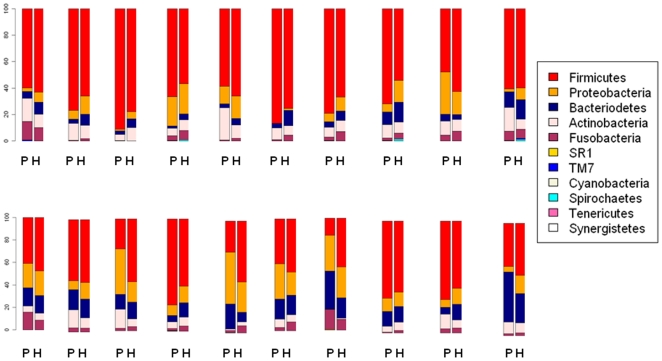
OBJECTIVES: The human oral microbiome is potentially related to diverse health conditions and high-throughput technology provides the possibility of surveying microbial community structure at high resolution. We compared two oral microbiome survey methods: broad-based microbiome identification by 16S rRNA gene sequencing and targeted characterization of microbes by custom DNA microarray. METHODS: Oral wash samples were collected from 20 individuals at Memorial Sloan-Kettering Cancer Center. 16S rRNA gene survey was performed by 454 pyrosequencing of the V3-V5 region (450 bp). Targeted identification by DNA microarray was carried out with the Human Oral Microbe Identification Microarray (HOMIM). Correlations and relative abundance were compared at phylum and genus level, between 16S rRNA sequence read ratio and HOMIM hybridization intensity. RESULTS: The major phyla, Firmicutes, Proteobacteria, Bacteroidetes, Actinobacteria, and Fusobacteria were identified with high correlation by the two methods (r = 0.70∼0.86). 16S rRNA gene pyrosequencing identified 77 genera and HOMIM identified 49, with 37 genera detected by both methods; more than 98% of classified bacteria were assigned in these 37 genera. Concordance by the two assays (presence/absence) and correlations were high for common genera (Streptococcus, Veillonella, Leptotrichia, Prevotella, and Haemophilus; Correlation = 0.70-0.84). CONCLUSION: Microbiome community profiles assessed by 16S rRNA pyrosequencing and HOMIM were highly correlated at the phylum level and, when comparing the more commonly detected taxa, also at the genus level. Both methods are currently suitable for high-throughput epidemiologic investigations relating identified and more common oral microbial taxa to disease risk; yet, pyrosequencing may provide a broader spectrum of taxa identification, a distinct sequence-read record, and greater detection sensitivity.
Overview
The claims and statistics of this paper haven’t been checked yet.
Run the check — free, no account needed. It reads the open-access text and checks the sources it cites.
Integrity signals
Registry
Cites
Statistics
Figures
Verification
Claims the paper makes
The claims and statistics of this paper haven’t been checked yet.
Run the check — free, no account needed. It reads the open-access text and checks the sources it cites.
Claims other papers make about this one
Each is checked against this paper’s own text: does it say what the citing paper says it does?
In the citing paper
“Up to 80% of oral bacteria are dominated by about 200 species in the Phyla Firmicutes (esp. Streptococcus, Veillonella, Granulicatella, Gemella spp.) and Proteobacteria (esp. Neisseria, Haemophilus spp.), with contributions from Bacteroidetes, Actinobacteria and Fusobacteria totaling upwards of 95% of all identified oral microbiota (Figure 2)[171–177].”
From Enterosalivary nitrate metabolism and the microbiome: Intersection of microbial metabolism, nitric oxide and diet in cardiac and pulmonary vascular health (2017) · cites this paper as [177]
Self-check
Percentages, sums and reported differences re-computed from the paper’s own numbers.
The self-check needs the paper’s full text.
Citations
Cites
Naive Bayesian Classifier for Rapid Assignment of rRNA Sequences into the New Bacterial Taxonomy
Wang, Q., Garrity, G. M., Tiedje, J. M., & Cole, J. R. (2007) · Applied and Environmental Microbiology · doi:10.1128/aem.00062-07 · Cited by 20,145
Development of the Human Infant Intestinal Microbiota
Palmer, C., Bik, E. M., DiGiulio, D. B., Relman, D. A., & Brown, P. O. (2007) · PLoS Biology · doi:10.1371/journal.pbio.0050177 · Cited by 2,877
The NIH Human Microbiome ProjectPreprint
The NIH HMP Working Group, Peterson, J. L., Garges, S., Giovanni, M. Y., McInnes, P., Wang, L., Schloss, J. A., Bonazzi, V. R., McEwen, J. E., Wetterstrand, K. A., et al. (2009) · Genome Research · doi:10.1101/gr.096651.109 · Cited by 2,168
The Ribosomal Database Project (RDP-II): sequences and tools for high-throughput rRNA analysis
Cole, J. R. (2004) · Nucleic Acids Research · doi:10.1093/nar/gki038 · Cited by 1,478
Chen, T., Yu, W.-H., Izard, J., Baranova, O. V., Lakshmanan, A., & Dewhirst, F. E. (2010) · Database · doi:10.1093/database/baq013 · Cited by 1,162
Claesson, M. J., O’Sullivan, Ó., Wang, Q., Nikkilä, J., Marchesi, J. R., Smidt, H., de Vos, W. M., Ross, R. P., & O’Toole, P. W. (2009) · PLoS ONE · doi:10.1371/journal.pone.0006669 · Cited by 900
Design of 16S rRNA gene primers for 454 pyrosequencing of the human foregut microbiome
Nossa, C. W. (2010) · World Journal of Gastroenterology · doi:10.3748/wjg.v16.i33.4135 · Cited by 580
Colombo, A. P. V., Boches, S. K., Cotton, S. L., Goodson, J. M., Kent, R., Haffajee, A. D., Socransky, S. S., Hastürk, H., Dyke, T. E. V., Dewhirst, F. E., et al. (2009) · Journal of Periodontology · doi:10.1902/jop.2009.090185 · Cited by 562
Bacterial biota in the human distal esophagus
Pei, Z., Bini, E. J., Yang, L., Zhou, M., Francois, F., & Blaser, M. J. (2004) · Proceedings of the National Academy of Sciences · doi:10.1073/pnas.0306398101 · Cited by 501
Meurman, J. H. (2010) · Journal of Oral Microbiology · doi:10.3402/jom.v2i0.5195 · Cited by 194
Paster, B. J., & Dewhirst, F. E. (2009) · Periodontology 2000 · doi:10.1111/j.1600-0757.2009.00316.x · Cited by 127
Abiko, Y., Sato, T., Mayanagi, G., & Takahashi, N. (2010) · Journal of Periodontal Research · doi:10.1111/j.1600-0765.2009.01250.x · Cited by 115
Microarray analysis of the microflora of root caries in elderly
Preza, D., Olsen, I., Willumsen, T., Boches, S. K., Cotton, S. L., Grinde, B., & Paster, B. J. (2008) · European Journal of Clinical Microbiology & Infectious Diseases · doi:10.1007/s10096-008-0662-8 · Cited by 107
Microbiology: The new germ theory
Buchen, L. (2010) · Nature · doi:10.1038/468492a · Cited by 12
Cited by
Sorted by citations
Human Gut Microbiome and Risk for Colorectal Cancer
Ahn, J., Sinha, R., Pei, Z., Dominianni, C., Wu, J., Shi, J., Goedert, J. J., Hayes, R. B., & Yang, L. (2013) · JNCI: Journal of the National Cancer Institute · doi:10.1093/jnci/djt300 · Cited by 947
Oral microbiomes: more and more importance in oral cavity and whole body
Gao, L., Xu, T., Huang, G., Jiang, S., Gu, Y., & Chen, F. (2018) · Protein & Cell · doi:10.1007/s13238-018-0548-1 · Cited by 770
PCR Biases Distort Bacterial and Archaeal Community Structure in Pyrosequencing Datasets
Pinto, A. J., & Raskin, L. M. (2012) · PLoS ONE · doi:10.1371/journal.pone.0043093 · Cited by 439
Deep Sequencing of the Oral Microbiome Reveals Signatures of Periodontal Disease
Liu, B., Faller, L. L., Klitgord, N., Mazumdar, V., Ghodsi, M., Sommer, D. D., Gibbons, T. R., Treangen, T. J., Chang, Y.-C., Li, S., et al. (2012) · PLoS ONE · doi:10.1371/journal.pone.0037919 · Cited by 411
Lessons learned and unlearned in periodontal microbiology
Teles, R. P., Teles, F., Frias‐Lopez, J., Paster, B. J., & Haffajee, A. D. (2013) · Periodontology 2000 · doi:10.1111/prd.12010 · Cited by 387
Metadata
- Authors
- Ahn, J., Yang, L., Paster, B. J., Ganly, I., Morris, L., Pei, Z., & Hayes, R. B.
- Affiliations
- New York University (US)
- Harvard University (US)
- Memorial Sloan Kettering Cancer Center (US)
- Corresponding author
- Ahn, Jiyoung
- Venue
- PLoS ONE
- Publisher
- Public Library of Science (PLoS)
- Published
- 2011-07-29
- Volume
- 6
- Issue
- 7
- Pages
- e22788
- ISSN
- 1932-6203 (ISSN-L)
- PMC
- PMC3146496
- OpenAlex
- W2032525833
- Cited by
- 183
- References
- 14
- Citations by year
- 2026: 1 · 2025: 4 · 2024: 5 · 2023: 6 · 2022: 13 · 2021: 9 · 2020: 11 · 2019: 12 · 2018: 11 · 2017: 15 · 2016: 21 · 2015: 19 · 2014: 21 · 2013: 16 · 2012: 17
- FWCI
- 22.12
- Type
- journal article
- Language
- en
- Open access
- gold
- doi.org
- Locations
- PLoS ONE (publishedVersion, cc-by)
- Europe PMC (PubMed Central) (publishedVersion, cc-by)
- PubMed Central (publishedVersion, cc-by)
- PubMed (publishedVersion)
- DOAJ (DOAJ: Directory of Open Access Journals) (submittedVersion, cc-by-sa)
- Figshare (submittedVersion, cc-by)
- Funders
- National Institutes of Health
- National Cancer Institute (R01CA159036, UH3CA140233)
- National Institute of Allergy and Infectious Diseases (R01AI063477)
- Topics
- Health Sciences › Dentistry › Periodontics › Oral microbiology and periodontitis research
- Life Sciences › Biochemistry, Genetics and Molecular Biology › Molecular Biology › Gut microbiota and health
- Physical Sciences › Environmental Science › Ecology › Microbial Community Ecology and Physiology
- Keywords
- oral microbiota, 16S rRNA pyrosequencing, DNA microarrays, method comparison, microbial community analysis, Streptococcus, Veillonella, Prevotella, Haemophilus, Leptotrichia, cancer patients
- MeSH terms
- Adult, Aged, Aged, 80 and over, Bacteria, Female, Humans, Male, Middle Aged, Mouth, RNA, Bacterial, RNA, Ribosomal, 16S, Biomarkers, Oligonucleotide Array Sequence Analysis, Gene Expression Profiling, Metagenome, Young Adult, DNA Barcoding, Taxonomic
About these checks
Registry, retraction, Cites and statistics results are computed, not judged, with one exception: a printed reference that no index lists is read once by a model before it counts as a citation error. Claims are extracted by a model and kept only when their quote appears verbatim in the text; each cited source is then checked, with a model’s help, for whether it says what the claim relies on. Those verdicts can be wrong — read the claim’s quote and the cited source before relying on one.
Statistics and arithmetic are recomputed, not judged.
Confidence bands are shown only for fields calibrated on our annotated test set. None is calibrated yet, so no band is shown.
What counts as a claim ›How we measure confidence ›How we check this ›
Are you an author, or do you see a problem with this page? Request a review
