

The RelA/SpoT homolog (RSH) superfamily: distribution and functional evolution of ppGpp synthetases and hydrolases across the tree of life.
Open accessThe DOI matches its Crossref record; 102 of the 102 references it cites were found in a registry or an index.
Abstract
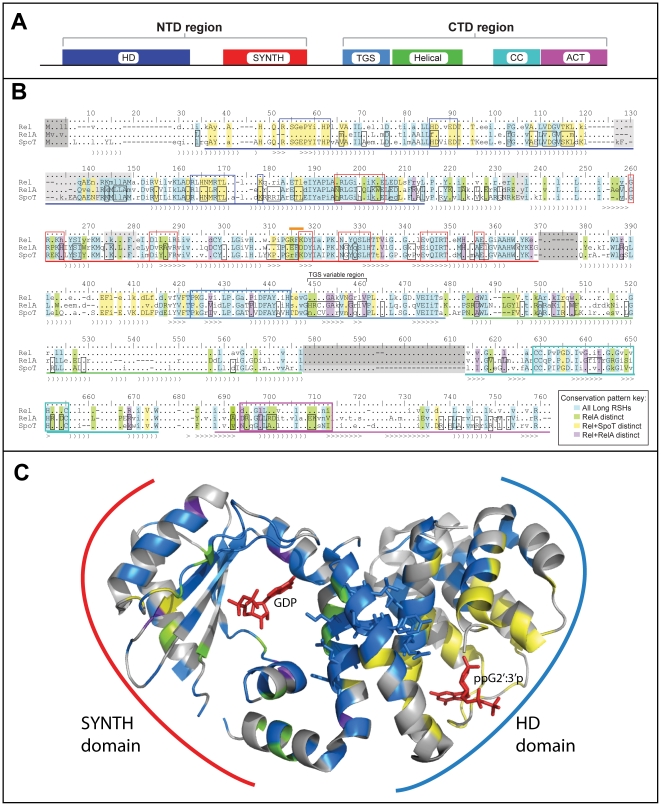
RelA/SpoT Homologue (RSH) proteins, named for their sequence similarity to the RelA and SpoT enzymes of Escherichia coli, comprise a superfamily of enzymes that synthesize and/or hydrolyze the alarmone ppGpp, activator of the "stringent" response and regulator of cellular metabolism. The classical "long" RSHs Rel, RelA and SpoT with the ppGpp hydrolase, synthetase, TGS and ACT domain architecture have been found across diverse bacteria and plant chloroplasts, while dedicated single domain ppGpp-synthesizing and -hydrolyzing RSHs have also been discovered in disparate bacteria and animals respectively. However, there is considerable confusion in terms of nomenclature and no comprehensive phylogenetic and sequence analyses have previously been carried out to classify RSHs on a genomic scale. We have performed high-throughput sensitive sequence searching of over 1000 genomes from across the tree of life, in combination with phylogenetic analyses to consolidate previous ad hoc identification of diverse RSHs in different organisms and provide a much-needed unifying terminology for the field. We classify RSHs into 30 subgroups comprising three groups: long RSHs, small alarmone synthetases (SASs), and small alarmone hydrolases (SAHs). Members of nineteen previously unidentified RSH subgroups can now be studied experimentally, including previously unknown RSHs in archaea, expanding the "stringent response" to this domain of life. We have analyzed possible combinations of RSH proteins and their domains in bacterial genomes and compared RSH content with available RSH knock-out data for various organisms to determine the rules of combining RSHs. Through comparative sequence analysis of long and small RSHs, we find exposed sites limited in conservation to the long RSHs that we propose are involved in transmitting regulatory signals. Such signals may be transmitted via NTD to CTD intra-molecular interactions, or inter-molecular interactions either among individual RSH molecules or among long RSHs and other binding partners such as the ribosome.
Overview
The claims and statistics of this paper haven’t been checked yet.
Free: it reads the open-access text and checks the first 5 claims that cite a source we can check. Create a free account to check every claim.
Integrity signals
Registry
Cites
Statistics
Figures
Verification
Claims the paper makes
The claims and statistics of this paper haven’t been checked yet.
Free: it reads the open-access text and checks the first 5 claims that cite a source we can check. Create a free account to check every claim.
Claims other papers make about this one
Each is checked against this paper’s own text: does it say what the citing paper says it does?
The cited source says what the claim attributes to it.
In the citing paper
“In E. coli, the levels of the two alarmones ppGpp and pppGpp are mainly controlled by the activity of two enzymes, RelA and SpoT (Atkinson et al., 2011; Potrykus and Cashel, 2018; Pausch et al., 2020).”
From The Dynamic SecYEG Translocon (2021) · cites this paper as Atkinson et al., 2011
Self-check
Percentages, sums and reported differences re-computed from the paper’s own numbers.
The self-check needs the paper’s full text.
Citations
Cites
MrBayes 3: Bayesian phylogenetic inference under mixed models
Ronquist, F., & Huelsenbeck, J. P. (2003) · Bioinformatics · doi:10.1093/bioinformatics/btg180 · Cited by 29,077 · cited 1×
“2 [50] on the Cipres server 2.”
The PyMOL Molecular Graphics System
DeLano, W. L. (2002) · Medical Entomology and Zoology · Cited by 18,147
RAxML-VI-HPC: maximum likelihood-based phylogenetic analyses with thousands of taxa and mixed models
Stamatakis, A. (2006) · Bioinformatics · doi:10.1093/bioinformatics/btl446 · Cited by 15,582 · cited 1×
“4 [47] maximum likelihood (ML) tree was generated.”
BackgroundOhno, S. (1970) · doi:10.1007/978-3-642-86659-3 · Cited by 7,833 · cited 1×
“Gene duplication results in a redundant copy of the original gene that is free from selective pressure and able to diverge in sequence [100].”
BackgroundEddy, S. R. (1998) · Bioinformatics · doi:10.1093/bioinformatics/14.9.755 · Cited by 5,515
MAFFT version 5: improvement in accuracy of multiple sequence alignment
Katoh, K. (2005) · Nucleic Acids Research · doi:10.1093/nar/gki198 · Cited by 4,837 · cited 1×
“626b [46].”
Predicting Subcellular Localization of Proteins Based on their N-terminal Amino Acid Sequence
Emanuelsson, O., Nielsen, H., Brunak, S., & von Heijne, G. (2000) · Journal of Molecular Biology · doi:10.1006/jmbi.2000.3903 · Cited by 4,263 · cited 1×
“Scans of eukaryotic Mesh1[H]s on the TargetP server [55] show no mitochondrial target peptides, suggesting they are cytoplasmic proteins.”
BackgroundNetwork motifs: theory and experimental approaches
Alon, U. (2007) · Nature Reviews Genetics · doi:10.1038/nrg2102 · Cited by 3,279 · cited 1×
“By analyzing possible combinations of RSH proteins and their domains in bacterial genomes, and comparing RSH content with available RSH knock-out data for various organisms [18,28,68], we attempt to interpret the functional consequences of RSH gain and loss and rationalize the design rules of RSH sensory systems [69].”
MethodBacterial Persistence as a Phenotypic Switch
Balaban, N. Q., Merrin, J., Chait, R., Kowalik, L., & Leibler, S. (2004) · Science · doi:10.1126/science.1099390 · Cited by 2,952
Pfam: clans, web tools and services
Finn, R. D. (2006) · Nucleic Acids Research · doi:10.1093/nar/gkj149 · Cited by 2,302 · cited 1×
“For the first-pass survey, the full alignment of the synthetase domain was downloaded from Pfam (RelA_SpoT, PF04607 [45]).”
Method
Cited by
Items 401–454 of 454
Genetics and Pathogenicity Factors of Group C and G Streptococci
Malke, H. (2019) · ASM Press eBooks · doi:10.1128/9781683670131.ch15 · Cited by 1
Corrigan, R. M. (2019) · Faculty Opinions – Post-Publication Peer Review of the Biomedical Literature · doi:10.3410/f.734655915.793554952
Corrigan, R. M. (2019) · Faculty Opinions – Post-Publication Peer Review of the Biomedical Literature · doi:10.3410/f.735735149.793562945
Quantitative PCR Analysis of the Bartonella henselae carD Gene during Bacterial Stress
Simmonds, J. (2016) · Open Access Victoria University of Wellington | Te Herenga Waka (Figshare) · doi:10.26686/wgtn.17060216
Poole, R. K. (2019) · Faculty Opinions – Post-Publication Peer Review of the Biomedical Literature · doi:10.3410/f.732770207.793568901
Sondermann, H., & Savelle, C. (2019) · Faculty Opinions – Post-Publication Peer Review of the Biomedical Literature · doi:10.3410/f.736859989.793567154
Signaling nucleotides in bacteria
Gupta, K. R., Arora, G., & Sajid, A. (2022) · Elsevier eBooks · doi:10.1016/b978-0-323-91806-0.00013-8
Fung, D. K. C., & Wang, J. D. (2022) · Nature Chemical Biology · doi:10.1038/s41589-022-01200-6
Efeito do glifosato sobre a susceptibilidade a antibióticos em Escherichia coli
Ospino, K. (2022) · Digital Library of Theses and Dissertations (Universidade de São Paulo) · doi:10.11606/d.42.2022.tde-07122022-152116
Alarmone Synthesis Inhibition as a New Strategy for Tuberculosis Treatment
Sidorov, R. Y., Markelova, E. I., & Ткаченко, А. Г. (2023) · Lecture notes in networks and systems · doi:10.1007/978-3-031-28086-3_42
Mahmoud, A. H., Abdellrazeq, G. S., Fry, L. M., Schneider, D. A., Attreed, S. E., Burton, L., Sangewar, N., Mwangi, W., deSouza, C., Hulubei, V., et al. (2024) · bioRxiv (Cold Spring Harbor Laboratory) · doi:10.1101/2024.01.10.575042
nature inspired and medicinally relevant short peptides
Ciulla, M. G., Civera, M., & Sattin, S. (2023) · Vide Leaf, Hyderabad eBooks · doi:10.37247/updph2ed.2.23.4
Résistance aux β-lactamines médiée par la L,D-transpeptidase YcbB chez Escherichia coli
Voedts, H. (2022) · theses.fr (ABES) · doi:10.70675/e2a755baze50bz4abczbe07z9d0906388113
Stress endogènes et acquisition de résistance aux antibiotiques par les intégrons en biofilm
Tlili, L. (2021) · theses.fr (ABES) · doi:10.70675/fc79d3edza3b5z4fa0zb76bz3b40105a6d5d · Cited by 2
Santos, D. D. S., Mendonça, A. A., Zuniga, M. R., de Morais, M. A., & Elsztein, C. (2024) · Research Square · doi:10.21203/rs.3.rs-4252796/v1
Bamb, K. R., Mell, J. C., & Hall, D. C. (2024) · iDEA - Drexel University Institutional Repository · doi:10.17918/00010500
The Mechanism of Mycobacterial (p)ppGpp Synthetase Inhibition by Synthetic Erogorgiaene Analog
Sidorov, R. Y., & Ткаченко, А. Г. (2024) · Biochemistry (Moscow) · doi:10.31857/s0320972524030019
Shang, R., Liang, S., Yan, Q., Wang, B., Qian, G., Yang, L., & Wu, X. (2024) · Journal of Integrative Agriculture · doi:10.1016/j.jia.2024.09.031
Guo, Z., Ding, W., Hou, L., Yu, H., & Chen, Y. (2025) · Natural Product Research · doi:10.1080/14786419.2025.2472282
“RelA protein utilises ATP and GTP/GDP to synthesise ppGpp, while spoT protein can decompose ppGpp into GTP/GDP and phosphoric acid (Potrykus and Cashel 2008; Atkinson et al. 2011).”
Thejaswini, L., Subramani, U. K., Parthiban, K. T., Sekar, I., & Vijayan, R. (2025) · Plant Science Today · doi:10.14719/pst.6927
Bacteria export alarmone synthetases that produce (p)ppApp and (p)ppGpp
Ahmad, S., Guedez, A. G., Manisa, B., Adewale, A. M., Tsang, K. K., Schiefer, V., Bullen, N. P., Thakar, H., Kim, Y., Wang, B., et al. (2025) · mBio · doi:10.1128/mbio.02227-25
“The active-site architecture of the two enzymes is also remarkably conserved, with nearly identical positioning of residues involved in ATP binding between Sa EAS and Apk1 ( Sa EAS/Apk1: R124/R330, E182/E382, Q184/Q382, N169/N370, K154/K353) (2, 6, 18).”
NADPH phosphatase activity of Mesh1 contributes to sleep regulation in Drosophila
Ishikawa, T., Nitta, Y., Osaka, J., Nemoto, T., Ito, D., Sasaki, R., Nonoyama, S., Oikawa, A., Sugie, A., Suzuki, T., et al. (2026) · iScience · doi:10.64898/2025.12.14.694245
Investigating the Role of Reactive Oxygen Species on Antibiotic Tolerance in Pseudomonas aeruginosa
Senthil, A. (2025) · Carolina Digital Repository (University of North Carolina at Chapel Hill) · doi:10.17615/3v6p-pp32
Mechanistic understanding of β-lactam resistance in Staphylococcus aureus.
Portman-Ross, C. (2024) · White Rose eTheses Online (University of Leeds, The University of Sheffield, University of York)
Elucidating the regulatory function of LysR-type transcription regulators in Escherichia coli
Roy, R. B. (2025) · Kölner Universitäts PublikationsServer (Universität zu Köln)
Septic arthritis drives alveolar bone loss in mice through microbiota-dependent functional shifts
Boff, D., Bambirra, F. H. S., Queiroz‐Junior, C. M., Anestino, T. A., de Oliveira, V. L. S., Ferreira, L. M. A., Lobo, I., Rios, D. L., Teixeira, M. M., Silva, T. A., et al. (2025) · Microbial Pathogenesis · doi:10.1016/j.micpath.2025.108270
The opposite effects of stringent response on phage infection of Pseudomonas putida
Lewańczyk, A. C., Hinnu, M., Mägi, E., Rikberg, R., Brauer, A., & Tamman, H. (2026) · microLife · doi:10.1093/femsml/uqaf048 · Cited by 1
“The small nucleotide alarmones are produced by the RSH enzymes—RelA and SpoT homologs, named for two long (p)ppGpp synthesis/hydrolysis enzymes in Escherichia coli and other γ -proteobacteria (Atkinson et al. 2011 ).”
InfluentialPrucker, I., Milanov, M., Moser, P., Popp, C., Haas, T., Qiu, D., Koch, H., & Jessen, H. J. (2026) · bioRxiv (Cold Spring Harbor Laboratory) · doi:10.64898/2026.01.08.698462
Karadöller, S. K. (2024) · OpenMETU (Middle East Technical University)
Bacterial persisters: from mechanism modules to target prioritization and inhibitor development
Chen, Z., Zhang, R., Dai, R., Zhou, Q., Pan, Y., & Huang, L. (2026) · Microbial Pathogenesis · doi:10.1016/j.micpath.2026.108472
Engineering aminoacyl-tRNA synthetase activity to enhance branched-chain amino acid biosynthesis
Derunets, A. S., & Yanenko, A. S. (2026) · Biochimie · doi:10.1016/j.biochi.2026.03.014
Rôle de la sous-unité sigma de l'ARN polymérase bactérienne dans la tolérance aux antibiotiques
Benabad, Z. (2016) · theses.fr (ABES) · doi:10.70675/047f66fbz4fd5z4d58za131z79a598724863 · Cited by 1
Regulation of membrane modifications in Escherichia coli biofilms
Szczesny, M. (2017) · theses.fr (ABES) · doi:10.70675/696a441fz0859z4cc7z9609z15687aee159a
Genetic bases of adaptation to intracellularity during experimental evolution of mimosa symbionts
Tang, M. (2019) · theses.fr (ABES) · doi:10.70675/2f36f720zb1c7z4a8bz90a7z4b53c4eb2105
Re-allocation of cellular resources for the production of heterologous proteins in Bacillus subtilis
Zaarour, M. (2019) · theses.fr (ABES) · doi:10.70675/1ae7eea5z7c68z4e95z8f62z7f8d45eb0c51
Études de motifs de signalisation amyloïde des bactéries aux champignons filamenteux
Bardin, T. (2020) · theses.fr (ABES) · doi:10.70675/8e783c71za151z4301z95d0zd7ed22d1a81f
Barthe, M. (2021) · theses.fr (ABES) · doi:10.70675/08feb31bzca5fz45a9z93e9z55496d297292 · Cited by 2
Romand, S. (2023) · theses.fr (ABES) · doi:10.70675/61e124afz82a7z460fzb62dz4c9f72cd29bf
Regulation of global metabolism by PTS-ntr in rhizobium leguminosarum
Tjahjono, O. (2025) · Oxford University Research Archive (ORA) (University of Oxford) · doi:10.5287/ora-zg9z28db1
Rathore, A., Kumari, J., Firdous, S., Sarkar, B., Manhas, R., & Mahapa, A. (2026) · ACS Infectious Diseases · doi:10.1021/acsinfecdis.6c00134
Llop, A., Bibak, S., Cantos, R., Salinas, P., Tremiño, L., & Contreras, A. (2026) · Frontiers in Microbiology · doi:10.3389/fmicb.2026.1860886 · Cited by 1
Korban, S. A., Spiridonova, Z. A., Kasatsky, P. S., Shvetsov, A. V., Gurzhiy, V. V., Paleskava, A., Kulminskaya, A. A., Konevega, A. L., & Vinogradova, D. S. (2026) · International Journal of Molecular Sciences · doi:10.3390/ijms27125509
Wanted and unwanted modifications of mRNA and their effect on gene expression and signaling
Urs, A. N. N., Dali, A., & Zaher, H. S. (2026) · Journal of Biological Chemistry · doi:10.1016/j.jbc.2026.113314
“Analogous to the ISR, the stringent response also reprograms gene expression, increasing amino acid biosynthesis and stress response and inhibits proliferation (287).”
A Construction of Archaean Rest-Like Biology from GenomicsPreprint
Vellanki, A. (2026) · Research Square · doi:10.21203/rs.3.rs-10315455/v1
Shi, J., Xu, X., Yu, C., Chu, W., Li, H., Hou, L., Elderini, A., Jiang, N., Li, J., & Luo, L. (2026) · Microbiological Research · doi:10.1016/j.micres.2026.128656
Metabolism as a driver of antibiotic resistance
Aksoy, C. S. (2026) · Microbiology · doi:10.1099/mic.0.001741
Nemoto, T., Omata, Y., Inazu, M., Nonoyama, S., & Masuda, S. (2026) · Biochemistry · doi:10.1021/acs.biochem.6c00467
Metadata
- Authors
- Atkinson, G. C., Tenson, T., & Hauryliuk, V.
- Affiliations
- University of Tartu (EE)
- Corresponding author
- Atkinson, Gemma C.
- Venue
- PLoS ONE
- Publisher
- Public Library of Science (PLoS)
- Published
- 2011-08-09
- Volume
- 6
- Issue
- 8
- Pages
- e23479
- ISSN
- 1932-6203 (ISSN-L)
- PMC
- PMC3153485
- OpenAlex
- W1964979713
- Cited by
- 447
- References
- 101
- Citations by year
- 2026: 18 · 2025: 22 · 2024: 31 · 2023: 40 · 2022: 38 · 2021: 44 · 2020: 56 · 2019: 50 · 2018: 34 · 2017: 22 · 2016: 24 · 2015: 28 · 2014: 13 · 2013: 17 · 2012: 8
- FWCI
- 7.78
- Type
- journal article
- Language
- en
- Open access
- gold
- doi.org
- Locations
- PLoS ONE (publishedVersion, cc-by)
- Europe PMC (PubMed Central) (publishedVersion, cc-by)
- PubMed Central (publishedVersion, cc-by)
- PubMed (publishedVersion)
- RePEc: Research Papers in Economics (submittedVersion)
- DOAJ (DOAJ: Directory of Open Access Journals) (submittedVersion, cc-by-sa)
- Figshare (submittedVersion, cc-by)
- Funders
- Eesti Teadusfondi (MJD99)
- European Regional Development Fund
- Topics
- Life Sciences › Biochemistry, Genetics and Molecular Biology › Genetics › Bacterial Genetics and Biotechnology
- Life Sciences › Biochemistry, Genetics and Molecular Biology › Molecular Biology › Genomics and Phylogenetic Studies
- Life Sciences › Biochemistry, Genetics and Molecular Biology › Molecular Biology › Biochemical and Molecular Research
- Keywords
- alarmone, stringent response, archaea, chloroplasts, domain architecture, signal transduction, ribosome
- MeSH terms
- Amino Acid Sequence, Animals, Bacteria, Ligases, Models, Molecular, Molecular Sequence Data, Phylogeny, Pyrophosphatases, Sequence Alignment, Sequence Homology, Amino Acid, Protein Structure, Tertiary, Evolution, Molecular, Databases, Genetic, Eukaryota
About these checks
Registry, retraction, Cites and statistics results are computed, not judged, with one exception: a printed reference that no index lists is read once by a model before it counts as a citation error. Claims are extracted by a model and kept only when their quote appears verbatim in the text; each cited source is then checked, with a model’s help, for whether it says what the claim relies on. Those verdicts can be wrong — read the claim’s quote and the cited source before relying on one.
Statistics and arithmetic are recomputed, not judged.
Confidence bands are shown only for fields calibrated on our annotated test set. None is calibrated yet, so no band is shown.
What counts as a claim ›How we measure confidence ›How we check this ›
Are you an author, or do you see a problem with this page? Request a review
Data sources
Bibliographic data: Semantic Scholar, OpenAlex, Crossref.
Contains information from the Semantic Scholar Academic Graph Datasets, made available under the ODC Attribution License (ODC-BY 1.0).
Semantic Scholar’s data is described in: Kinney, R., et al. (2023). The Semantic Scholar Open Data Platform. arXiv:2301.10140.
