

The DOI matches its Crossref record; 9 of the 10 references it cites were found in a registry or an index.
Assessing Google Flu Trends Performance in the United States during the 2009 Influenza Virus A (H1N1) Pandemic
Open accessAbstract
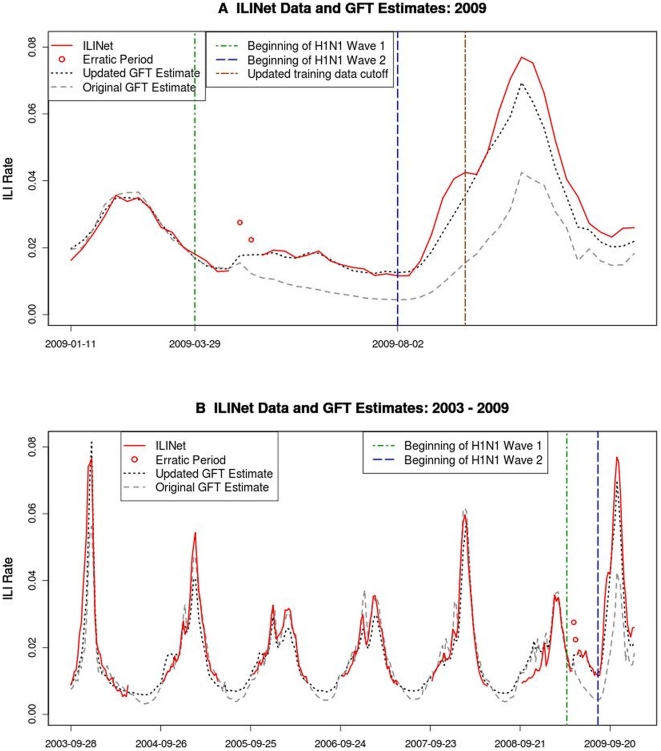
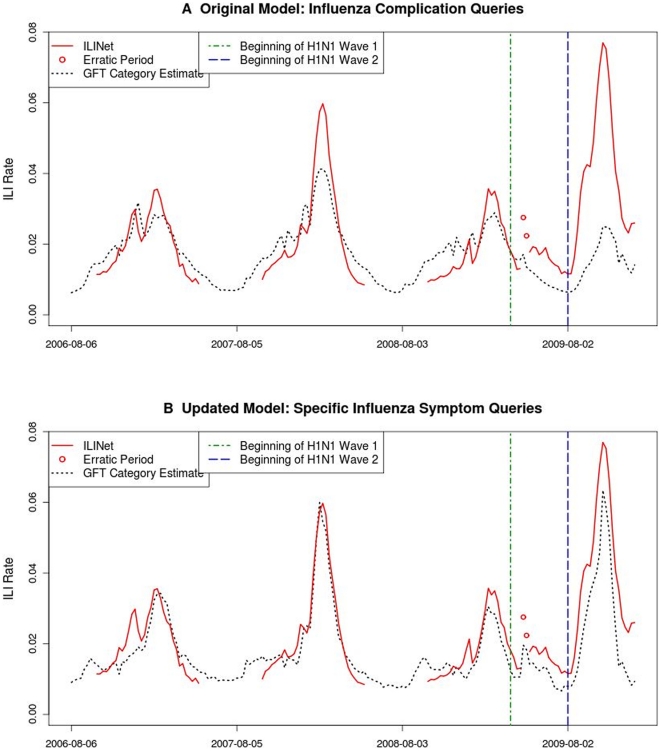
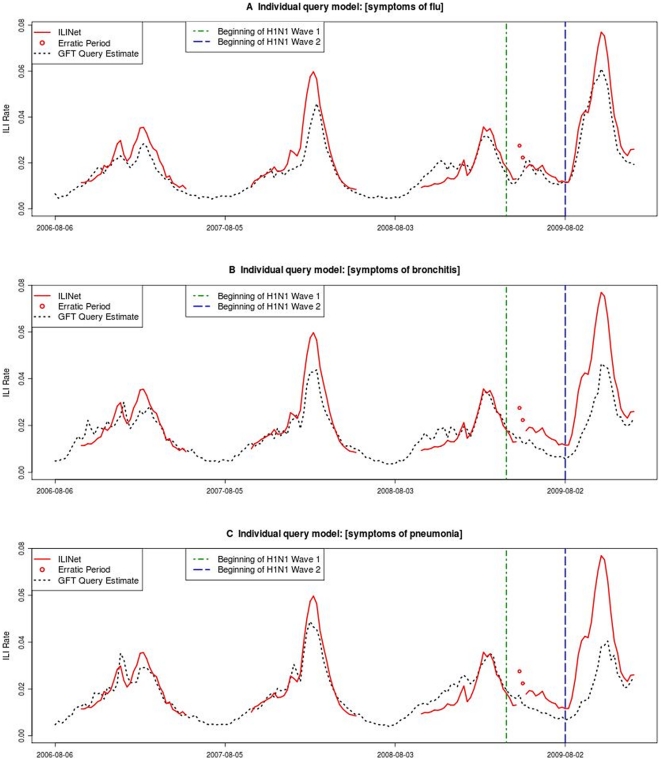
BACKGROUND: Google Flu Trends (GFT) uses anonymized, aggregated internet search activity to provide near-real time estimates of influenza activity. GFT estimates have shown a strong correlation with official influenza surveillance data. The 2009 influenza virus A (H1N1) pandemic [pH1N1] provided the first opportunity to evaluate GFT during a non-seasonal influenza outbreak. In September 2009, an updated United States GFT model was developed using data from the beginning of pH1N1. METHODOLOGY/PRINCIPAL FINDINGS: We evaluated the accuracy of each U.S. GFT model by comparing weekly estimates of ILI (influenza-like illness) activity with the U.S. Outpatient Influenza-like Illness Surveillance Network (ILINet). For each GFT model we calculated the correlation and RMSE (root mean square error) between model estimates and ILINet for four time periods: pre-H1N1, Summer H1N1, Winter H1N1, and H1N1 overall (Mar 2009-Dec 2009). We also compared the number of queries, query volume, and types of queries (e.g., influenza symptoms, influenza complications) in each model. Both models' estimates were highly correlated with ILINet pre-H1N1 and over the entire surveillance period, although the original model underestimated the magnitude of ILI activity during pH1N1. The updated model was more correlated with ILINet than the original model during Summer H1N1 (r = 0.95 and 0.29, respectively). The updated model included more search query terms than the original model, with more queries directly related to influenza infection, whereas the original model contained more queries related to influenza complications. CONCLUSIONS: Internet search behavior changed during pH1N1, particularly in the categories "influenza complications" and "term for influenza." The complications associated with pH1N1, the fact that pH1N1 began in the summer rather than winter, and changes in health-seeking behavior each may have played a part. Both GFT models performed well prior to and during pH1N1, although the updated model performed better during pH1N1, especially during the summer months.
Overview
The claims and statistics of this paper haven’t been checked yet.
Run the check — free, no account needed. It reads the open-access text and checks the sources it cites.
Integrity signals
Registry
Cites
Statistics
Figures
Verification
Claims the paper makes
The claims and statistics of this paper haven’t been checked yet.
Run the check — free, no account needed. It reads the open-access text and checks the sources it cites.
Claims other papers make about this one
Each is checked against this paper’s own text: does it say what the citing paper says it does?
The cited source doesn’t support the claim as written.
In the citing paper
“This ad hoc method of throwing out peculiar search terms failed when GFT completely missed the nonseasonal 2009 infl uenza A–H1N1 pandemic ( 2, 14).”
From The Parable of Google Flu: Traps in Big Data Analysis (2014) · cites this paper as [14]
Checked by a reasoning model — may be wrong.
Experimental — accuracy not yet measuredThe cited source doesn’t support the claim as written.
In the citing paper
“Oddly, the few search terms offered in the papers ( 14) do not seem to be strongly related with either GFT or the CDC data (SM)—we surmise that the authors felt an unarticulated need to cloak the actual search terms identifi ed.”
From The Parable of Google Flu: Traps in Big Data Analysis (2014) · cites this paper as [14]
Checked by a reasoning model — may be wrong.
Experimental — accuracy not yet measuredThe source backs part of the claim, not all of it — or backs it for a different population, condition or comparison.
In the citing paper
“GFT has never documented the 45 search terms used, and the examples that have been released appear misleading ( 14) (SM).”
From The Parable of Google Flu: Traps in Big Data Analysis (2014) · cites this paper as [14]
Experimental — accuracy not yet measured
Self-check
Percentages, sums and reported differences re-computed from the paper’s own numbers.
The self-check needs the paper’s full text.
Citations
Cites
MapReduce: simplified data processing on large clusters
Dean, J., & Ghemawat, S. (2008) · Communications of the ACM · doi:10.1145/1327452.1327492 · Cited by 18,476
Detecting influenza epidemics using search engine query data
Ginsberg, J., Mohebbi, M. H., Patel, R. S., Brammer, L., Smolinski, M. S., & Brilliant, L. (2009) · Nature · doi:10.1038/nature07634 · Cited by 4,295
Self-citationEmergence of a Novel Swine-Origin Influenza A (H1N1) Virus in Humans
Novel Swine-Origin Influenza A (H1N1) Virus Investigation Team (2009) · New England Journal of Medicine · doi:10.1056/nejmoa0903810 · Cited by 3,063
Infodemiology: tracking flu-related searches on the web for syndromic surveillance.
Eysenbach, G. (2006) · PubMed · Cited by 414
Kelly, H., & Grant, K. A. (2009) · Eurosurveillance · doi:10.2807/ese.14.31.19288-en · Cited by 193
Interpreting “Google Flu Trends” data for pandemic H1N1 influenza: The New Zealand experience
Wilson, N., Mason, K., Tobias, M., Peacey, M., Huang, Q. S., & Baker, M. G. (2009) · Eurosurveillance · doi:10.2807/ese.14.44.19386-en · Cited by 78
Brammer, L., Blanton, L., Epperson, S., Mustaquim, D., Bishop, A., Kniss, K. L., Dhara, R., Nowell, M., Kamimoto, L., & Finelli, L. (2010) · Clinical Infectious Diseases · doi:10.1093/cid/ciq009 · Cited by 67
Influenza activity--United States and worldwide, 2007-08 season.
(2008) · PubMed · Cited by 63
Reed, C., Angulo, F. J., Biggerstaff, M., Swerdlow, D. L., & Finelli, L. (2010) · Clinical Infectious Diseases · doi:10.1093/cid/ciq024 · Cited by 16
Cited by
Sorted by citations
Items 101–200 of 379
Klembczyk, J. J., Jalalpour, M., Levin, S., Washington, R., Pines, J. M., Rothman, R. E., & Dugas, A. F. (2016) · Journal of Medical Internet Research · doi:10.2196/jmir.5585 · Cited by 38
Your friends have more friends than you do
Han, B., & Srinivasan, A. (2012) · ACM International Symposium on Mobile Ad Hoc Networking and Computing (MobiHoc) · doi:10.1145/2248371.2248376 · Cited by 37
Quantitative Agent Based Model of Opinion Dynamics: Polish Elections of 2015
Sobkowicz, P. (2016) · PLoS ONE · doi:10.1371/journal.pone.0155098 · Cited by 36
Finding Healthcare Issues with Search Engine Queries and Social Network Data
Lali, M. I. U., Mustafa, R. U., Saleem, K., Nawaz, M. S., Zia, T., & Shahzad, B. (2016) · International Journal on Semantic Web and Information Systems · doi:10.4018/ijswis.2017010104 · Cited by 35
Exploiting Online Discussions to Discover Unrecognized Drug Side Effects
Fang, H., Stanhope, S. J., & Wu, H. (2013) · Methods of Information in Medicine · doi:10.3414/me12-02-0004 · Cited by 36
A Bidirectional Long Short-Term Memory Model Algorithm for Predicting COVID-19 in Gulf Countries
Aldhyani, T. H. H., & Alkahtani, H. S. (2021) · Life · doi:10.3390/life11111118 · Cited by 34
Bernard, R., Bowsher, G. M., Milner, C., Boyle, P., Patel, P., & Sullivan, R. J. (2018) · Journal of Public Health · doi:10.1007/s10389-018-0899-3 · Cited by 33
Doan, S., Lucila Ohno-machado, A., & Collier, N. (2012) · IEEE International Conference on Healthcare Informatics, Imaging and Systems Biology · doi:10.1109/hisb.2012.21 · Cited by 32
The use of ambient humidity conditions to improve influenza forecast
Shaman, J. L., Kandula, S., Yang, W., & Karspeck, A. R. (2017) · PLoS Computational Biology · doi:10.1371/journal.pcbi.1005844 · Cited by 32
Rohart, F., Milinovich, G. J., Avril, S. M. R., Cao, K. L., Tong, S., & Hu, W. (2016) · Scientific Reports · doi:10.1038/srep38522 · Cited by 31
Assessment of thunderstorm-induced asthma using Google Trends
Bousquet, J., O’Hehir, R. E., Antó, J. M., D’Amato, G., Mösges, R., Hellings, P. W., Eerd, M. V., & Sheikh, A. (2017) · Journal of Allergy and Clinical Immunology · doi:10.1016/j.jaci.2017.04.042 · Cited by 31
Research on Web Search Behavior: How Online Query Data Inform Social Psychology
Lai, K., Lee, Y. X., Chen, H., & Yu, R. (2017) · Cyberpsychology Behavior and Social Networking · doi:10.1089/cyber.2017.0261 · Cited by 31
Predicting tick-borne encephalitis using Google Trends
Sulyok, M., Richter, H., Sulyok, Z., Kapitány‐Fövény, M., & Walker, M. D. (2019) · Ticks and Tick-borne Diseases · doi:10.1016/j.ttbdis.2019.101306 · Cited by 31
Jie, Q., & Peng, T. (2016) · Internet Research · doi:10.1108/intr-04-2014-0104 · Cited by 30
Deep Learning and Holt-Trend Algorithms for Predicting Covid-19 Pandemic
Aldhyani, T. H. H., Alrasheed, M., Al-Adhaileh, M. H., Alqarni, A. A., Alzahrani, M. Y., & Alahmadi, A. H. (2021) · Computers, materials & continua/Computers, materials & continua (Print) · doi:10.32604/cmc.2021.014498 · Cited by 30
Systems thinking in combating infectious diseases
Xia, S., Zhou, X., & Liu, J. (2017) · Infectious Diseases of Poverty · doi:10.1186/s40249-017-0339-6 · Cited by 33
Assessing the impact of a health intervention via user-generated Internet content
Lampos, V., Yom‐Tov, E., Pebody, R. G., & Cox, I. J. (2015) · Data Mining and Knowledge Discovery · doi:10.1007/s10618-015-0427-9 · Cited by 29
Thompson, L. H., Malik, T. M., Gumel, A. B., Strome, T., & Mahmud, S. M. (2014) · Epidemiology and Infection · doi:10.1017/s0950268813003464 · Cited by 29
Can electoral popularity be predicted using socially generated big data?
Yasseri, T., & Bright, J. (2014) · it - Information Technology · doi:10.1515/itit-2014-1046 · Cited by 29
Actions Are Louder than Words in Social Media
Korolov, R., Peabody, J., Lavoie, A., Das, S., Magdon‐Ismail, M., & Wallace, W. A. (2015) · IEEE/ACM International Conference on Advances in Social Networks Analysis and Mining (ASONAM) · doi:10.1145/2808797.2809376 · Cited by 29
Influenza Activity Surveillance Based on Multiple Regression Model and Artificial Neural Network
Xue, H., Bai, Y., Hu, H., & Liang, H. (2017) · IEEE Access · doi:10.1109/access.2017.2771798 · Cited by 29
Valuating aesthetic benefits of cultural ecosystem services using conservation culturomics
Do, Y. (2019) · Ecosystem Services · doi:10.1016/j.ecoser.2019.100894 · Cited by 29
Satpathy, P., Kumar, S., & Prasad, P. (2021) · Disaster Medicine and Public Health Preparedness · doi:10.1017/dmp.2021.249 · Cited by 30
Syndromic surveillance for influenza in Tianjin, China: 2013–14
Dong, X., Boulton, M. L., Carlson, B. F., Montgomery, J. P., & Wells, E. V. (2016) · Journal of Public Health · doi:10.1093/pubmed/fdw022 · Cited by 29
Cato, K., Bockting, W. O., & Larson, E. (2016) · Journal of Empirical Research on Human Research Ethics · doi:10.1177/1556264616661611 · Cited by 28
Internet Interest in Colon Cancer Following the Death of Chadwick Boseman: Infoveillance Study
Naik, H., Johnson, M. D. D., & Johnson, M. R. (2021) · Journal of Medical Internet Research · doi:10.2196/27052 · Cited by 28
Keller, M. S., Mosadeghi, S., Cohen, E. R., Kwan, J., & Spiegel, B. M. R. (2018) · Journal of Medical Internet Research · doi:10.2196/jmir.9870 · Cited by 28
Álamo, T., Reina, D. G., & Millán, P. (2020) · arXiv (Cornell University) · doi:10.48550/arxiv.2006.01731 · Cited by 49
Social networks, web-based tools and diseases: implications for biomedical research
Costa, F. F. (2012) · Drug Discovery Today · doi:10.1016/j.drudis.2012.10.006 · Cited by 28
The Detection of Emerging Trends Using Wikipedia Traffic Data and Context Networks
Kämpf, M., Tessenow, E., Kenett, D. Y., & Kantelhardt, J. W. (2015) · PLoS ONE · doi:10.1371/journal.pone.0141892 · Cited by 27
Design and ethics in the era of big data
Goodman, E. (2014) · interactions · doi:10.1145/2598902 · Cited by 27
Predicting charitable donations using social media
Korolov, R., Peabody, J., Lavoie, A., Das, S., Magdon-Ismail, M., & Wallace, W. (2016) · Social Network Analysis and Mining · doi:10.1007/s13278-016-0341-1 · Cited by 26
Kelly, H. A., Grant, K. A., Tay, E. L., Franklin, L. J., & Hurt, A. C. (2012) · Influenza and Other Respiratory Viruses · doi:10.1111/irv.12057 · Cited by 26
Sequential detection of influenza epidemics by the Kolmogorov-Smirnov test
Closas, P., Coma, E., & Méndez-Boo, L. (2012) · BMC Medical Informatics and Decision Making · doi:10.1186/1472-6947-12-112 · Cited by 26
Schwab‐Reese, L. M., Hovdestad, W., Tonmyr, L., & Fluke, J. (2018) · Child Abuse & Neglect · doi:10.1016/j.chiabu.2018.01.014 · Cited by 26
Internet search query data improve forecasts of daily emergency department volume
Tideman, S., Santillana, M., Bickel, J. P., & Reis, B. Y. (2019) · Journal of the American Medical Informatics Association · doi:10.1093/jamia/ocz154 · Cited by 26
Stevens, K., & Pfeiffer, D. U. (2015) · Spatial and Spatio-temporal Epidemiology · doi:10.1016/j.sste.2015.04.003 · Cited by 25
Surveillance strategy for early detection of unusual infectious disease events
Koopmans, M. (2013) · Current Opinion in Virology · doi:10.1016/j.coviro.2013.02.003 · Cited by 25
Spatiotemporal evolution of online attention to vaccines since 2011: An empirical study in China
Hu, F., Qiu, L., Xia, W., Liu, C.-F., Xi, X., Zhao, S., Yu, J., Wei, S., Hu, X., Su, N., et al. (2022) · Frontiers in Public Health · doi:10.3389/fpubh.2022.949482 · Cited by 25
Identification of Keywords From Twitter and Web Blog Posts to Detect Influenza Epidemics in Korea
Woo, H., Cho, H. S., Shim, E., Lee, J., Lee, K., Song, G., & Cho, Y. (2017) · Disaster Medicine and Public Health Preparedness · doi:10.1017/dmp.2017.84 · Cited by 25
Lymelight: forecasting Lyme disease risk using web search data
Sadilek, A., Hswen, Y., Bavadekar, S., Shekel, T., Brownstein, J. S., & Gabrilovich, E. (2020) · npj Digital Medicine · doi:10.1038/s41746-020-0222-x · Cited by 25
Niu, B., Liang, R., Zhang, S., Zhang, H., Qu, X., Su, Q., Zheng, L., & Chen, Q. (2020) · Transboundary and Emerging Diseases · doi:10.1111/tbed.13902 · Cited by 25
Improving Google Flu Trends Estimates for the United States through Transformation
Martin, L. J., Xu, B., & Yasui, Y. (2014) · PLoS ONE · doi:10.1371/journal.pone.0109209 · Cited by 24
BIG DATA: NEW SCIENCE, NEW CHALLENGES, NEW DIALOGICAL OPPORTUNITIES
Fuller, M. (2015) · Zygon® · doi:10.1111/zygo.12187 · Cited by 24
de Lange, M. M. A., Meijer, A., Friesema, I. H. M., Donker, G., Koppeschaar, C. E., Hooiveld, M., Ruigrok, N., & van der Hoek, W. (2013) · BMC Public Health · doi:10.1186/1471-2458-13-881 · Cited by 23
Performance of eHealth Data Sources in Local Influenza Surveillance: A 5-Year Open Cohort Study
Timpka, T., Sprečo, A., Dahlström, Ö., Eriksson, O., Gursky, E. A., Ekberg, J., Blomqvist, E., Strömgren, M., Karlsson, D., Eriksson, H., et al. (2014) · Journal of Medical Internet Research · doi:10.2196/jmir.3099 · Cited by 24
Paid Sick Leave and Absenteeism: The First Evidence from the U.S.Preprint
Ahn, T., & Yelowitz, A. S. (2016) · SSRN Electronic Journal · doi:10.2139/ssrn.2740366 · Cited by 24
Predicting plant attractiveness to pollinators with passive crowdsourcing
Bahlai, C. A., & Landis, D. A. (2016) · Royal Society Open Science · doi:10.1098/rsos.150677 · Cited by 22
Big Data and Survey Research: Supplement or Substitute?
Johnson, T. P., & Smith, T. (2016) · Springer geography · doi:10.1007/978-3-319-40902-3_7 · Cited by 23
Respiratory syncytial virus tracking using internet search engine data
Oren, E., Frere, J. J., Yom-Tov, E., & Yom‐Tov, E. (2018) · BMC Public Health · doi:10.1186/s12889-018-5367-z · Cited by 23
Online and ubiquitous HCI research
Lazar, J. K., Feng, J. H., & Hochheiser, H. (2017) · Elsevier eBooks · doi:10.1016/b978-0-12-805390-4.00014-5 · Cited by 22
Evaluating the impact of health awareness events on Google search frequency
Hao, Z., Liu, M., & Ge, X. (2019) · Preventive Medicine Reports · doi:10.1016/j.pmedr.2019.100887 · Cited by 22
Google Trends Analysis of COVID-19 Pandemic
Pan, Z., Nguyen, H. L., Abu-gellban, H., & Zhang, Y. (2020) · IEEE International Conference on Big Data (BigData) · doi:10.1109/bigdata50022.2020.9377852 · Cited by 22
Inferring Atmospheric Particulate Matter Concentrations from Chinese Social Media Data
Tao, Z., Kokas, A., Zhang, R., Cohan, D. S., & Wallach, D. S. (2016) · PLoS ONE · doi:10.1371/journal.pone.0161389 · Cited by 21
Zhao, N., Cao, G., Vanos, J., & Vecellio, D. J. (2017) · International Journal of Biometeorology · doi:10.1007/s00484-017-1306-4 · Cited by 22
Adawi, M., Bragazzi, N. L., Watad, ., Sharif, Κ., Amital, H., & Mahroum, N. (2017) · JMIR Public Health and Surveillance · doi:10.2196/publichealth.9136 · Cited by 20
Ackley, S. F., Pilewski, S., Petrovic, V. S., Worden, L., Murray, E. L., & Porco, T. C. (2020) · Health Informatics Journal · doi:10.1177/1460458219897152 · Cited by 20
Social Media and Health Crisis Communication During Epidemics
Denecke, K., & Atique, S. (2016) · Elsevier eBooks · doi:10.1016/b978-0-12-809269-9.00004-9 · Cited by 20
Abbas, M. M., Morland, T., Hall, E. S., & EL‐Manzalawy, Y. (2021) · International Journal of Environmental Research and Public Health · doi:10.3390/ijerph18094560 · Cited by 19
Improving Google Flu Trends for COVID-19 estimates using Weibo posts
Guo, S., Fang, F., Zhou, T., Zhang, W., Guo, Q., Zeng, R., Chen, X., Liu, J.-G., & Lu, X. B. (2021) · Data Science and Management · doi:10.1016/j.dsm.2021.07.001 · Cited by 23
LGscore: A method to identify disease-related genes using biological literature and Google data
Kim, J., Kim, H., Yoon, Y., & Park, S. (2015) · Journal of Biomedical Informatics · doi:10.1016/j.jbi.2015.01.003 · Cited by 18
Flu and Finances: Influenza Outbreaks and Loan Defaults in US Cities, 2004–2012
Houle, J. N., Collins, J. M., & Schmeiser, M. D. (2015) · American Journal of Public Health · doi:10.2105/ajph.2015.302671 · Cited by 18
Prediction of influenza peaks in Russian cities: Comparing the accuracy of two SEIR models
Ivanov, S. V., & Leonenko, V. N. (2017) · Mathematical Biosciences & Engineering · doi:10.3934/mbe.2018009 · Cited by 18
Google Health Trends performance reflecting dengue incidence for the Brazilian states
Romero-Álvarez, D., Parikh, N., Osthus, D., Martinez, K. M., Generous, N., Valle, S. Y. D., & Manore, C. A. (2020) · BMC Infectious Diseases · doi:10.1186/s12879-020-04957-0 · Cited by 19
Kalichman, S. C., & Kegler, C. (2014) · Journal of Health Communication · doi:10.1080/10810730.2013.852274 · Cited by 18
Lwin, M. O., Vijaykumar, S., Foo, S. S.-B., Fernando, O. N. N., Lim, G., Panchapakesan, C., & Wimalaratne, P. (2015) · Health Education Research · doi:10.1093/her/cyv065 · Cited by 18
Theory‐Interpretable, Data‐Driven Agent‐Based Modeling
Rand, W. M. (2019) · Wiley eBooks · doi:10.1002/9781119485001.ch15 · Cited by 18
Twitter vs. Zika—The role of social media in epidemic outbreaks surveillance
Abouzahra, M., & Tan, J. (2020) · Health Policy and Technology · doi:10.1016/j.hlpt.2020.10.014 · Cited by 17
Adelhoefer, S. J., Berning, P., Solomon, S. B., Maybody, M., Whelton, S. P., Blaha, M. J., & Dzaye, O. D. A. (2021) · Cancer Causes & Control · doi:10.1007/s10552-021-01409-1 · Cited by 17
Daughton, A. R., Chunara, R., & Paul, M. J. (2020) · JMIR Public Health and Surveillance · doi:10.2196/14986 · Cited by 17
Interest in dentistry in early months of the COVID‐19 global pandemic: A Google Trends approach
Bağcı, N., & Peker, İ. (2022) · Health Information & Libraries Journal · doi:10.1111/hir.12421 · Cited by 16
Web search activity data accurately predict population chronic disease risk in the USA
Nguyen, T., Tran, T., Luo, W., Gupta, S., Rana, S., Phung, D., Nichols, M. S., Millar, L., Venkatesh, S., & Allender, S. E. (2015) · Journal of Epidemiology & Community Health · doi:10.1136/jech-2014-204523 · Cited by 16
Martin, L. J., Lee, B. E., & Yasui, Y. (2015) · Epidemiology and Infection · doi:10.1017/s0950268815001478 · Cited by 16
DOVE: An Infectious Disease Outbreak Statistics Visualization System
Lee, M., Kim, J. W., & Jang, B. (2018) · IEEE Access · doi:10.1109/access.2018.2867030 · Cited by 16
Internet searches offer insight into early-season pollen patterns in observation-free zones
Hall, J., Lo, F., Saha, S., Vaidyanathan, A., & Hess, J. J. (2020) · Scientific Reports · doi:10.1038/s41598-020-68095-y · Cited by 16
The Prediction of Hepatitis E through Ensemble Learning
Peng, T., Chen, X., Wan, M., Jin, L., Wang, X., Du, X., Ge, H., & Yang, X. (2020) · International Journal of Environmental Research and Public Health · doi:10.3390/ijerph18010159 · Cited by 16
Donar, G. B., & Aydan, S. (2021) · The International Journal of Health Planning and Management · doi:10.1002/hpm.3342 · Cited by 15
Forecasting virus outbreaks with social media data via neural ordinary differential equations
Núñez, M., Barreiro, N. L., Barrio, R. A., & Rackauckas, C. (2023) · Scientific Reports · doi:10.1038/s41598-023-37118-9 · Cited by 21
Wang, H.-W., & Chen, D. (2018) · JMIR Public Health and Surveillance · doi:10.2196/publichealth.7314 · Cited by 16
Nonannual seasonality of influenza‐like illness in a tropical urban setting
Lam, H. M., Wesolowski, A., Hùng, N. T., Nguyen, T. D., Nhat, N. T. D., Todd, S., Vinh, D. N., Vy, N. H. T., Thao, T. T. N., Thanh, N. T. L., et al. (2018) · Influenza and Other Respiratory Viruses · doi:10.1111/irv.12595 · Cited by 13
Orellano, P. W., Reynoso, J. I., Antman, J., & Argibay, O. (2015) · Cadernos de Saúde Pública · doi:10.1590/0102-311x00072814 · Cited by 15
Souza, R. C. S. N. P., de Brito, D. E. F., Cardoso, R. L., de Oliveira, D. M., Meira, W., & Pappa, G. L. (2014) · Lecture notes in computer science · doi:10.1007/978-3-319-12027-0_24 · Cited by 15
National Utilization and Forecasting of Ototopical Antibiotics
Crowson, M. G., Schulz, K. A., & Tucci, D. L. (2016) · Otology & Neurotology · doi:10.1097/mao.0000000000001115 · Cited by 14
Regional variation in discussion of opioids on social media
Flores, L., & Young, S. D. (2021) · Journal of Addictive Diseases · doi:10.1080/10550887.2021.1874804 · Cited by 14
Zhou, X., Yang, F., Feng, Y., Li, Q., Tang, F., Hu, S., Lin, Z. W., & Zhang, L. (2017) · IEEE Transactions on Computational Biology and Bioinformatics · doi:10.1109/tcbb.2017.2690631 · Cited by 14
Global Research on Syndromic Surveillance from 1993 to 2017: Bibliometric Analysis and Visualization
Musa, I., Park, H. W., Munkhdalai, L., & Ryu, K. H. (2018) · Sustainability · doi:10.3390/su10103414 · Cited by 14
Santillana, M. (2016) · Clinical Infectious Diseases · doi:10.1093/cid/ciw660 · Cited by 14
Zimmer, C., Leuba, S. I., Cohen, T., & Yaesoubi, R. (2018) · Statistical Methods in Medical Research · doi:10.1177/0962280218805780 · Cited by 13
Kaveh-Yazdy, F., & Zarifzadeh, S. (2020) · International Journal of Medical Informatics · doi:10.1016/j.ijmedinf.2020.104309 · Cited by 15
Cakici, B., & Sanches, P. (2014) · Societies · doi:10.3390/soc4030399 · Cited by 13
Multiplying numbers differently: an epidemiology of contagious convolution
Mackenzie, A. (2014) · Distinktion Journal of Social Theory · doi:10.1080/1600910x.2014.922110 · Cited by 13
Triggering Interventions for Influenza: The ALERT Algorithm
Reich, N. G., Cummings, D. A. T., Lauer, S. A., Zorn, M., Robinson, C. C., Nyquist, A., Price, C. S., Simberkoff, M. S., Radonovich, L. J., & Perl, T. M. (2014) · Clinical Infectious Diseases · doi:10.1093/cid/ciu749 · Cited by 13
Big Data and Infectious Disease Epidemiology: Bibliometric Analysis and Research Agenda
Amusa, L. B., Twinomurinzi, H., Phalane, E., & Phaswana-Mafuya, N. R. (2022) · Interactive Journal of Medical Research · doi:10.2196/42292 · Cited by 12
Artificial Intelligence and Telehealth may Provide Early Warning of Epidemics
Arslan, J., & Benke, K. K. (2021) · Frontiers in Artificial Intelligence · doi:10.3389/frai.2021.556848 · Cited by 12
PINI, A., Merk, H., Carnahan, A., Galanis, I., van Straten, E., Danis, K., Edelstein, M. L., & Wallensten, A. (2017) · Epidemiology and Infection · doi:10.1017/s0950268816003290 · Cited by 12
A spatio-temporal hierarchical Markov switching model for the early detection of influenza outbreaks
Amorós, R., Conesa, D., López‐Quílez, A., & Martínez‐Beneito, M. A. (2020) · Stochastic Environmental Research and Risk Assessment · doi:10.1007/s00477-020-01773-5 · Cited by 12
Using Partial Least Squares Regression to Fit Small Data of H7N9 Incidence Based on the Baidu Index
Gan, R., Tan, J., Mo, L., Li, Y., & Huang, D. (2020) · IEEE Access · doi:10.1109/access.2020.2983799 · Cited by 12
What Big Data May Mean for Surveys
Couper, M. P. (2014) · Cited by 11
Visual network analysis of the Baidu-index data on greenhouse gas
Zhu, X., & Xia, C. (2021) · International Journal of Modern Physics B · doi:10.1142/s0217979221501150 · Cited by 11
Uncovering the relationships between military community health and affects expressed in social media
Volkova, S., Charles, L., Harrison, J., & Corley, C. D. (2017) · EPJ Data Science · doi:10.1140/epjds/s13688-017-0102-z · Cited by 11
Metadata
- Authors
- Cook, S., Conrad, C., Fowlkes, A. L., & Mohebbi, M. H.
- Affiliations
- Google (United States) (US)
- Google (United Kingdom) (GB)
- Centers for Disease Control and Prevention (US)
- Corresponding author
- Conrad, Corrie
- ORCID
- Fowlkes, Ashley L.
- Venue
- PLoS ONE
- Publisher
- Public Library of Science (PLoS)
- Published
- 2011-08-19
- Volume
- 6
- Issue
- 8
- Pages
- e23610
- ISSN
- 1932-6203 (ISSN-L)
- PMC
- PMC3158788
- OpenAlex
- W1998956117
- Cited by
- 381
- References
- 10
- Citations by year
- 2026: 5 · 2025: 4 · 2024: 7 · 2023: 8 · 2022: 25 · 2021: 33 · 2020: 50 · 2019: 25 · 2018: 26 · 2017: 34 · 2016: 41 · 2015: 48 · 2014: 38 · 2013: 27 · 2012: 9
- FWCI
- 18.08
- Type
- journal article
- Language
- en
- Open access
- gold
- doi.org
- Licence
- Locations
- PLoS ONE (publishedVersion, public-domain)
- Europe PMC (PubMed Central) (publishedVersion, public-domain)
- PubMed Central (publishedVersion, public-domain)
- PubMed (publishedVersion)
- DOAJ (DOAJ: Directory of Open Access Journals) (submittedVersion, cc-by-sa)
- Funders
- Topics
- Health Sciences › Medicine › Epidemiology › Data-Driven Disease Surveillance
- Health Sciences › Medicine › Epidemiology › Influenza Virus Research Studies
- Health Sciences › Medicine › Epidemiology › Respiratory viral infections research
- Keywords
- Google Flu Trends, influenza surveillance, 2009 H1N1 pandemic, influenza-like illness, online search behavior, health-seeking behavior, model accuracy assessment
- MeSH terms
- Humans, Influenza, Human, Models, Biological, Population Surveillance, Time Factors, United States, Influenza A Virus, H1N1 Subtype, Search Engine, Pandemics
About these checks
Registry, retraction, Cites and statistics results are computed, not judged, with one exception: a printed reference that no index lists is read once by a model before it counts as a citation error. Claims are extracted by a model and kept only when their quote appears verbatim in the text; each cited source is then checked, with a model’s help, for whether it says what the claim relies on. Those verdicts can be wrong — read the claim’s quote and the cited source before relying on one.
Statistics and arithmetic are recomputed, not judged.
Confidence bands are shown only for fields calibrated on our annotated test set. None is calibrated yet, so no band is shown.
What counts as a claim ›How we measure confidence ›How we check this ›
Are you an author, or do you see a problem with this page? Request a review
