

The DOI matches its Crossref record; 54 of the 54 references it cites were found in a registry or an index; 3 of the 42 sources its claims cite were checked for support.
Insights into the Ecology and Evolutionary Success of Crocodilians Revealed through Bite-Force and Tooth-Pressure Experimentation
Open accessAbstract
BACKGROUND: Crocodilians have dominated predatory niches at the water-land interface for over 85 million years. Like their ancestors, living species show substantial variation in their jaw proportions, dental form and body size. These differences are often assumed to reflect anatomical specialization related to feeding and niche occupation, but quantified data are scant. How these factors relate to biomechanical performance during feeding and their relevance to crocodilian evolutionary success are not known. METHODOLOGY/PRINCIPAL FINDINGS: We measured adult bite forces and tooth pressures in all 23 extant crocodilian species and analyzed the results in ecological and phylogenetic contexts. We demonstrate that these reptiles generate the highest bite forces and tooth pressures known for any living animals. Bite forces strongly correlate with body size, and size changes are a major mechanism of feeding evolution in this group. Jaw shape demonstrates surprisingly little correlation to bite force and pressures. Bite forces can now be predicted in fossil crocodilians using the regression equations generated in this research. CONCLUSIONS/SIGNIFICANCE: Critical to crocodilian long-term success was the evolution of a high bite-force generating musculo-skeletal architecture. Once achieved, the relative force capacities of this system went essentially unmodified throughout subsequent diversification. Rampant changes in body size and concurrent changes in bite force served as a mechanism to allow access to differing prey types and sizes. Further access to the diversity of near-shore prey was gained primarily through changes in tooth pressure via the evolution of dental form and distributions of the teeth within the jaws. Rostral proportions changed substantially throughout crocodilian evolution, but not in correspondence with bite forces. The biomechanical and ecological ramifications of such changes need further examination.
Overview
AI snapshot
Written from the paper’s full text.
TL;DR
Erickson et al. measured bite forces and tooth pressures across all 23 extant crocodilian species (83 adults) and found that body mass, not rostral shape, explains nearly all bite-force variation. Crocodilians generate the highest bite forces and tooth pressures known among living animals, with tooth pressures exceeding the shear strength of bone and previously reported maxima.
Key findings
- Molariform bite forces ranged from 900 to 8,983 N (*Paleosuchus palpebrosus* and *Crocodylus porosus*, respectively); one *C. porosus* individual reached 16,414 N, the highest bite force measured in any animal, exceeding the 4,500 N recorded for spotted hyena.
- Body mass was the primary determinant of bite force (TIPs: R² = 0.92; PIC: R² = 0.87, p < 0.0001), with a scaling coefficient of 0.708 ± 0.111, not statistically different from isometry (0.667). Rostral proportions explained just 19% of remaining size-standardized phylogenetically corrected variance (2.5% of total variance; p = 0.03).
- Caniniform tooth pressures ranged from 195 to 1,344 MPa; molariform pressures ranged from 203 to 1,388 MPa. All exceeded the 147 MPa reported for *Dunkleosteus*, some by as much as 17-fold, and all exceeded the 65–71 MPa ultimate shear strength of bone.
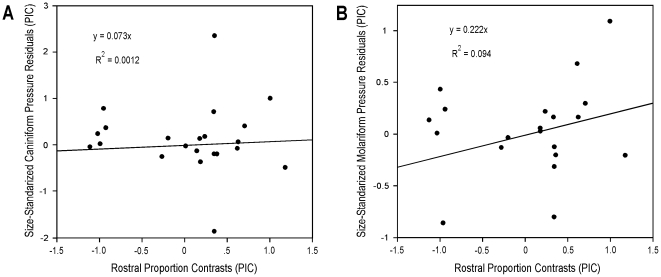
- Tooth pressures scaled positively allometric (caniniform: 0.490 ± 0.203; molariform: 0.553 ± 0.180 vs. isometry 0.000) and were uncorrelated with rostral proportions (PIC R² = 0.001 caniniform; 0.094 molariform). *Gavialis gangeticus* was the only statistical low-force outlier; fossil predictions included 27,531–34,424 N for 6.7 m *C. porosus* and a historical range of 628–102,803 N.
Methods
- 83 sexually mature adult specimens representing all 23 extant crocodilian species were tested from St. Augustine Alligator Farm Zoological Park and Crocodylus Park; size range was 1.24–4.59 m and 7–531 kg, with multiple individuals for 19 species.
- Bite forces were recorded using sandwich transducers and a portable charge amplification system; 3–5 bites were recorded per animal and the highest used. Forces were measured at the prominent maxillary molariform tooth, and caniniform forces were inferred by moment calculation. Tooth contact areas came from dental putty molds and epoxy casts indented 1 mm into clay, measured with ImageJ; pressures were force divided by contact area.
- Analyses used OLS and reduced major axis regressions on log-transformed taxon representative data, raw “TIPs” analyses, and phylogenetically independent contrasts (PIC) based on a re-estimated DNA sequence phylogeny from Gatesy et al. data; K statistics and ancestral-state reconstructions were also used, with statistical significance reported for PICs.
Limitations
- Stated: competing phylogenetic hypotheses exist and some sub-clade relationships are debated; the tree used is the best available estimate, and exploring other hypotheses was beyond scope. The upper-bound bite-force estimate for *Deinosuchus riograndensis* is more tenuous because the largest fossil specimens greatly exceed the neontological size range studied.
- Stated: caniniform pressure estimation was not possible for taxa with shed or broken caniniform teeth; initial tooth pressures alone are insufficient to single out durophagous species’ biomechanical import, and rostral shape needs further explanation.
- Evident from the text and tables: sample sizes are highly uneven, with many species represented by N = 1 (e.g., *Crocodylus intermedius*, *C. mindorensis*, *C. moreletii*, *C. palustris*), and all specimens were captive, conservation, or display animals from two facilities, so wild population variation is not directly sampled, although the paper cites prior captive–wild equivalence for *Alligator mississippiensis*.
Model-written summary. Check it against the paper before relying on it.
Integrity signals
Registry
Cites
Statistics
Figures
Verification
Claims the paper makes
40 Own result · 35 Own interpretation · 17 No full text of the sources · 10 Own method · 10 No basis given · 8 Not checked yet · 2 Supported · 2 Sources not found · 1 Couldn’t confirm · accuracy not yet measured
Every source the paper cites for this claim was checked and supports it.
In the paper
“Values for all taxa exceeded the highest reported previously (147 MPa [21,321 psi]) for the giant extinct placoderm fish Dunkleosteus [22]), and pressures for some individuals were as much as 17-fold higher (Table 2).”
§ Insights into the Ecology and Evolutionary Success of Crocodilians Revealed through Bite-Force and Tooth-Pressure Experimentation > Discussion
What the sources say
- Supportedcites [22] PS Anderson, 2006, Feeding mechanics and bite force modelling of the skull of Dunkleosteus terrelli, an ancient apex predator., Biol Lett source
The cited paper’s Results and discussion (section 3) reports a fang-tip bite stress of 147 million N m−2, equivalent to 147 MPa, for Dunkleosteus. The 17-fold comparison refers to the citing paper’s own crocodilian values in its Table 2, not to a result attributed to this source. (LLM, conf=0.93)
plain- Asserted: passes — The authors put it forward as true.
- Checkable: passes — It can be checked against evidence.
- Load-bearing: passes — The paper’s conclusions depend on it.
- Based: passes — The paper gives a reason why it holds.
- Supported
The cited sources that could be checked couldn’t confirm or dispute this claim.
In the paper
“It was also certainly vital to the occupation of near-shore habitats by crocodilians over millennia – although prey types changed, the materials of which they were composed did not (e.g. [30]).”
§ Insights into the Ecology and Evolutionary Success of Crocodilians Revealed through Bite-Force and Tooth-Pressure Experimentation > Discussion
What the sources say
- Could not verifycites [30] GM Erickson, 2002, Evolution of the biomechanical material properties of the femur., Anat Rec sourceExperimental — accuracy not yet measured
The Discussion (page unavailable) examines the evolutionary stability of femoral material properties and briefly reports measurements for crocodilians. It does not address whether biomechanical capacity enabled crocodilians to occupy near-shore habitats, or whether changing prey types retained the same material composition. Searches for near-shore habitats, crocodilian occupation, and prey materials found no passage supporting those points. (LLM, conf=0.72)
boosteddirect- Asserted: passes — The authors put it forward as true.
- Checkable: passes — It can be checked against evidence.
- Load-bearing: unclear — It is unclear whether the paper’s conclusions depend on it.
- Based: passes — The paper gives a reason why it holds.
- Could not verify
Every source the paper cites for this claim was checked and supports it.
In the paper
“Values for all taxa exceeded the highest reported previously (147 MPa [21,321 psi]) for the giant extinct placoderm fish Dunkleosteus [22]), and pressures for some individuals were as much as 17-fold higher (Table 2).”
§ Insights into the Ecology and Evolutionary Success of Crocodilians Revealed through Bite-Force and Tooth-Pressure Experimentation > Discussion
What the sources say
- Supportedcites [22] PS Anderson, 2006, Feeding mechanics and bite force modelling of the skull of Dunkleosteus terrelli, an ancient apex predator., Biol Lett source
The Results and discussion section reports a bite stress of 147 million N m−2 at Dunkleosteus’s fang tip, equivalent to 147 MPa, and a lower value at the blade edge. The comparison with values for all taxa is the citing study’s own finding, not a result attributed to this source. (LLM, conf=0.93)
plain- Asserted: passes — The authors put it forward as true.
- Checkable: passes — It can be checked against evidence.
- Load-bearing: passes — The paper’s conclusions depend on it.
- Based: passes — The paper gives a reason why it holds.
- Supported
A result the paper reports from its own data — it cites no other source for it, so there is none to check. The quote shows it is in the paper.
In the paper
“Only in the extremely slender-snouted Gavialis gangeticus, arguably the only truly piscivorous species, is there evidence of significant departure in performance, and this is reflected in their anatomy.”
§ Insights into the Ecology and Evolutionary Success of Crocodilians Revealed through Bite-Force and Tooth-Pressure Experimentation > Discussion
plainSingle case- Asserted: passes — The authors put it forward as true.
- Checkable: passes — It can be checked against evidence.
- Load-bearing: passes — The paper’s conclusions depend on it.
- Based: passes — The paper gives a reason why it holds.
A result the paper reports from its own data — it cites no other source for it, so there is none to check. The quote shows it is in the paper.
In the paper
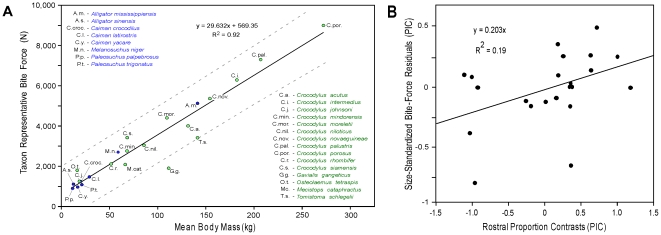
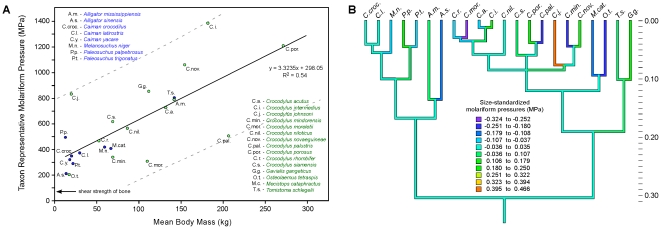
“Only the forces for Gavialis gangeticus in the TIPS analysis are significantly atypical (lower) than those of extant Crocodylia as a whole (Figure 3A).”
§ Insights into the Ecology and Evolutionary Success of Crocodilians Revealed through Bite-Force and Tooth-Pressure Experimentation > Results
plain- Asserted: passes — The authors put it forward as true.
- Checkable: passes — It can be checked against evidence.
- Load-bearing: unclear — It is unclear whether the paper’s conclusions depend on it.
- Based: passes — The paper gives a reason why it holds.
The paper states this without a source or data behind it here, so there is nothing to check it against. The quote shows it is in the paper.
In the paper
“As mentioned above, crocodilian molariform pressures are comparable to those in the caniniform teeth.”
§ Insights into the Ecology and Evolutionary Success of Crocodilians Revealed through Bite-Force and Tooth-Pressure Experimentation > Discussion
plain- Asserted: passes — The authors put it forward as true.
- Checkable: passes — It can be checked against evidence.
- Load-bearing: passes — The paper’s conclusions depend on it.
- Based: passes — The paper gives a reason why it holds.
The paper states this without a source or data behind it here, so there is nothing to check it against. The quote shows it is in the paper.
In the paper
“Body size, and not rostral proportions, explains nearly all interspecific differences in bite-force generation.”
§ Insights into the Ecology and Evolutionary Success of Crocodilians Revealed through Bite-Force and Tooth-Pressure Experimentation > Discussion
plaindirect- Asserted: passes — The authors put it forward as true.
- Checkable: passes — It can be checked against evidence.
- Load-bearing: passes — The paper’s conclusions depend on it.
- Based: passes — The paper gives a reason why it holds.
A result the paper reports from its own data — it cites no other source for it, so there is none to check. The quote shows it is in the paper.
In the paper
“Exceptionally high values stand out in the slender-snouted, semi-piscivorous Crocodylus intermedius, and highly piscivorous Gavialis gangeticus”
§ Insights into the Ecology and Evolutionary Success of Crocodilians Revealed through Bite-Force and Tooth-Pressure Experimentation > Results
plain- Asserted: passes — The authors put it forward as true.
- Checkable: passes — It can be checked against evidence.
- Load-bearing: unclear — It is unclear whether the paper’s conclusions depend on it.
- Based: passes — The paper gives a reason why it holds.
A result the paper reports from its own data — it cites no other source for it, so there is none to check. The quote shows it is in the paper.
In the paper
“Furthermore, Gavialis gangeticus generates the lowest relative bite forces among living crocodilians; Figure 3.”
§ Insights into the Ecology and Evolutionary Success of Crocodilians Revealed through Bite-Force and Tooth-Pressure Experimentation > Discussion
plain- Asserted: passes — The authors put it forward as true.
- Checkable: passes — It can be checked against evidence.
- Load-bearing: unclear — It is unclear whether the paper’s conclusions depend on it.
- Based: passes — The paper gives a reason why it holds.
A result the paper reports from its own data — it cites no other source for it, so there is none to check. The quote shows it is in the paper.
In the paper
“All other ecomorph representatives show similar relative values.”
§ Insights into the Ecology and Evolutionary Success of Crocodilians Revealed through Bite-Force and Tooth-Pressure Experimentation > Results
plain- Asserted: passes — The authors put it forward as true.
- Checkable: passes — It can be checked against evidence.
- Load-bearing: unclear — It is unclear whether the paper’s conclusions depend on it.
- Based: passes — The paper gives a reason why it holds.
- It may state two separate claims as one. 29
- Probably not a substantial claim. 16
The paper states this without a source or data behind it here, so there is nothing to check it against. The quote shows it is in the paper.
In the paper
“The crocodilian musculo-cranial design allows for the generation of prodigious bite forces across a broad range of sizes (Gavialis gangeticus is the exception; see above).”
§ Insights into the Ecology and Evolutionary Success of Crocodilians Revealed through Bite-Force and Tooth-Pressure Experimentation > Discussion
plaindirect- Asserted: passes — The authors put it forward as true.
- Checkable: passes — It can be checked against evidence.
- Load-bearing: passes — The paper’s conclusions depend on it.
- Based: passes — The paper gives a reason why it holds.
It may state two separate claims as one.
A result the paper reports from its own data — it cites no other source for it, so there is none to check. The quote shows it is in the paper.
In the paper
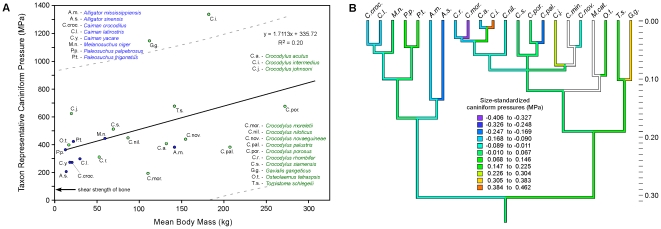
“The RMA scaling coefficient for log-transformed taxon representative caniniform tooth pressure regressed against log-transformed body mass was 0.490±0.203 (95% CI), which is greater (i.e. positively allometric) than isometry (scaling coefficient = 0.000), and so did not support our hypothesis.”
§ Insights into the Ecology and Evolutionary Success of Crocodilians Revealed through Bite-Force and Tooth-Pressure Experimentation > Results
plaincorrelational- Asserted: passes — The authors put it forward as true.
- Checkable: passes — It can be checked against evidence.
- Load-bearing: passes — The paper’s conclusions depend on it.
- Based: passes — The paper gives a reason why it holds.
It may state two separate claims as one.
A result the paper reports from its own data — it cites no other source for it, so there is none to check. The quote shows it is in the paper.
In the paper
“These values also trend positively with increasing body mass, but are highly variable (TIPs: R2 = 0.20; PIC: R2 = 0.19, p = 0.09).”
§ Insights into the Ecology and Evolutionary Success of Crocodilians Revealed through Bite-Force and Tooth-Pressure Experimentation > Results
plaincorrelational- Asserted: passes — The authors put it forward as true.
- Checkable: passes — It can be checked against evidence.
- Load-bearing: unclear — It is unclear whether the paper’s conclusions depend on it.
- Based: passes — The paper gives a reason why it holds.
It may state two separate claims as one.
A result the paper reports from its own data — it cites no other source for it, so there is none to check. The quote shows it is in the paper.
In the paper
“Body size actually accounts for nearly all interspecific variance in adult crocodilian bite-force capacity, and these forces scale isometrically to body mass.”
§ Insights into the Ecology and Evolutionary Success of Crocodilians Revealed through Bite-Force and Tooth-Pressure Experimentation > Discussion
plaincorrelational- Asserted: passes — The authors put it forward as true.
- Checkable: passes — It can be checked against evidence.
- Load-bearing: passes — The paper’s conclusions depend on it.
- Based: passes — The paper gives a reason why it holds.
It may state two separate claims as one.
A result the paper reports from its own data — it cites no other source for it, so there is none to check. The quote shows it is in the paper.
In the paper
“Size-standardized caniniform tooth pressures changed independently on multiple lineages (Figure 4B) and were uncorrelated with rostral proportions (PIC R2 = 0.001; Figure 5A).”
§ Insights into the Ecology and Evolutionary Success of Crocodilians Revealed through Bite-Force and Tooth-Pressure Experimentation > Results
plain- Asserted: passes — The authors put it forward as true.
- Checkable: passes — It can be checked against evidence.
- Load-bearing: passes — The paper’s conclusions depend on it.
- Based: passes — The paper gives a reason why it holds.
It may state two separate claims as one.
None of the sources cited for this claim have been checked yet.
In the paper
“All other crocodilian ecomorphs (molluscivores, terrestrial foragers, broad-snouted generalists, and the slender-snouted generalists – such as Tomistoma schlegelii and the American crocodile – Crocodylus acutus [1], [7]) show similar values to each other that are relatively lower.”
§ Insights into the Ecology and Evolutionary Success of Crocodilians Revealed through Bite-Force and Tooth-Pressure Experimentation > Discussion
What the sources say
- Not checked yetcites [1] G Webb, 1989, Crocodiles of Australia
- Not checked yetcites [7] AC Pooley, 1989, Food and feeding habits.
plain- Asserted: passes — The authors put it forward as true.
- Checkable: passes — It can be checked against evidence.
- Load-bearing: passes — The paper’s conclusions depend on it.
- Based: passes — The paper gives a reason why it holds.
It may state two separate claims as one.
A result the paper reports from its own data — it cites no other source for it, so there is none to check. The quote shows it is in the paper.
In the paper
“Size-standardized molariform tooth pressures changed repeatedly in the phylogeny (Figure 6B) and were not significantly correlated with rostral proportions (PIC R2 = 0.094; Figure 5B).”
§ Insights into the Ecology and Evolutionary Success of Crocodilians Revealed through Bite-Force and Tooth-Pressure Experimentation > Results
plain- Asserted: passes — The authors put it forward as true.
- Checkable: passes — It can be checked against evidence.
- Load-bearing: passes — The paper’s conclusions depend on it.
- Based: passes — The paper gives a reason why it holds.
It may state two separate claims as one.
A result the paper reports from its own data — it cites no other source for it, so there is none to check. The quote shows it is in the paper.
In the paper
“No values are statistical outliers, and no definitive ecomorphological groupings exist.”
§ Insights into the Ecology and Evolutionary Success of Crocodilians Revealed through Bite-Force and Tooth-Pressure Experimentation > Discussion
plain- Asserted: passes — The authors put it forward as true.
- Checkable: passes — It can be checked against evidence.
- Load-bearing: passes — The paper’s conclusions depend on it.
- Based: passes — The paper gives a reason why it holds.
It may state two separate claims as one.
A result the paper reports from its own data — it cites no other source for it, so there is none to check. The quote shows it is in the paper.
In the paper
“The reduced major axis (RMA) scaling coefficient for log-transformed taxon representative bite force regressed against log-transformed body mass was 0.708±0.111 (95% CI), which is not statistically different from isometry (scaling coefficient = 0.667).”
§ Insights into the Ecology and Evolutionary Success of Crocodilians Revealed through Bite-Force and Tooth-Pressure Experimentation > Results
plain- Asserted: passes — The authors put it forward as true.
- Checkable: passes — It can be checked against evidence.
- Load-bearing: passes — The paper’s conclusions depend on it.
- Based: passes — The paper gives a reason why it holds.
It may state two separate claims as one.
A result the paper reports from its own data — it cites no other source for it, so there is none to check. The quote shows it is in the paper.
In the paper
“The RMA scaling coefficient for log-transformed taxon representative molariform tooth pressures regressed against log-transformed body mass was 0.553±0.180 (95% CI), which is greater (i.e. positively allometric) than isometry (scaling coefficient = 0.000), and therefore did not support our hypothesis.”
§ Insights into the Ecology and Evolutionary Success of Crocodilians Revealed through Bite-Force and Tooth-Pressure Experimentation > Results
plaincorrelational- Asserted: passes — The authors put it forward as true.
- Checkable: passes — It can be checked against evidence.
- Load-bearing: passes — The paper’s conclusions depend on it.
- Based: passes — The paper gives a reason why it holds.
It may state two separate claims as one.
The paper states this without a source or data behind it here, so there is nothing to check it against. The quote shows it is in the paper.
In the paper
“The values for Crocodylus johnsoni are moderately high.”
§ Insights into the Ecology and Evolutionary Success of Crocodilians Revealed through Bite-Force and Tooth-Pressure Experimentation > Results
plainSingle case- Asserted: passes — The authors put it forward as true.
- Checkable: passes — It can be checked against evidence.
- Load-bearing: fails — The paper’s conclusions may not depend on it.
- Based: passes — The paper gives a reason why it holds.
Probably not a substantial claim. The paper’s conclusions may not depend on it.
A result the paper reports from its own data — it cites no other source for it, so there is none to check. The quote shows it is in the paper.
In the paper
“(Our datum for one Crocodylus porosus individual, 16,414 N [3,689 lbs] represents the highest bite force measured in any animal.”
§ Insights into the Ecology and Evolutionary Success of Crocodilians Revealed through Bite-Force and Tooth-Pressure Experimentation > Discussion
plainSingle case- Asserted: passes — The authors put it forward as true.
- Checkable: passes — It can be checked against evidence.
- Load-bearing: passes — The paper’s conclusions depend on it.
- Based: passes — The paper gives a reason why it holds.
It may state two separate claims as one.
A result the paper reports from its own data — it cites no other source for it, so there is none to check. The quote shows it is in the paper.
In the paper
“Nevertheless, those for the slender-snouted Crocodylus johnsoni and Crocodylus intermedius are relatively high, and those for the broader-snouted generalists, the mugger (Crocodylus palustris), and Morelet's crocodile (Crocodylus moreletii) are relatively low.”
§ Insights into the Ecology and Evolutionary Success of Crocodilians Revealed through Bite-Force and Tooth-Pressure Experimentation > Results
plain- Asserted: passes — The authors put it forward as true.
- Checkable: passes — It can be checked against evidence.
- Load-bearing: unclear — It is unclear whether the paper’s conclusions depend on it.
- Based: passes — The paper gives a reason why it holds.
It may state two separate claims as one.
The paper states this without a source or data behind it here, so there is nothing to check it against. The quote shows it is in the paper.
In the paper
“None of the molariform pressure values are statistical outliers.”
§ Insights into the Ecology and Evolutionary Success of Crocodilians Revealed through Bite-Force and Tooth-Pressure Experimentation > Results
plain- Asserted: passes — The authors put it forward as true.
- Checkable: passes — It can be checked against evidence.
- Load-bearing: fails — The paper’s conclusions may not depend on it.
- Based: passes — The paper gives a reason why it holds.
Probably not a substantial claim. The paper’s conclusions may not depend on it.
A result the paper reports from its own data — it cites no other source for it, so there is none to check. The quote shows it is in the paper.
In the paper
“Body mass is the primary determinant of crocodilian force generation in both the raw data analysis (TIPs: R2 = 0.92) and phylogenetically corrected analysis (PIC: R2 = 0.87, p<0.0001).”
§ Insights into the Ecology and Evolutionary Success of Crocodilians Revealed through Bite-Force and Tooth-Pressure Experimentation > Results
plaindirect- Asserted: passes — The authors put it forward as true.
- Checkable: passes — It can be checked against evidence.
- Load-bearing: passes — The paper’s conclusions depend on it.
- Based: passes — The paper gives a reason why it holds.
It may state two separate claims as one.
A result the paper reports from its own data — it cites no other source for it, so there is none to check. The quote shows it is in the paper.
In the paper
“Fortuitously the prominent molariform tooth position is at a comparable relative distance from the fulcrum across taxa, as an RMA plot of log-transformed fulcrum to molariform distance regressed against log-transformed body mass showed a scaling coefficient of 0.342±0.029 (95% CI), which is not different than isometry at 0.333.”
§ Insights into the Ecology and Evolutionary Success of Crocodilians Revealed through Bite-Force and Tooth-Pressure Experimentation > Materials and Methods > Data Collection
plain- Asserted: passes — The authors put it forward as true.
- Checkable: passes — It can be checked against evidence.
- Load-bearing: passes — The paper’s conclusions depend on it.
- Based: passes — The paper gives a reason why it holds.
It may state two separate claims as one.
A claim is checked only against the cited paper’s full text, never its abstract, and none is available for its sources.
In the paper
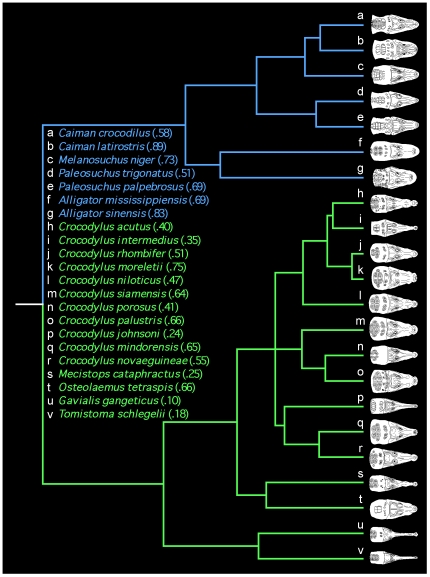
“All searches found the same single tree (Figure 1), congruent with the slightly less resolved tree in Gatesy et al. [2], and identical to that in the more recent Gatesy and Amato [45] analysis with the exception of our tree resolving one trichotomy near the tip in Crocodylus.”
§ Insights into the Ecology and Evolutionary Success of Crocodilians Revealed through Bite-Force and Tooth-Pressure Experimentation > Materials and Methods > Phylogeny Reconstruction
What the sources say
- Not checked — no full text of the sourcecites [2] J Gatesy, 2004, Inconsistencies in arguments for the supertree approach: supermatrices versus supertrees of Crocodylia., Sys Bio source
- Not checked — no full text of the sourcecites [45] J Gatesy, 2008, The rapid accumulation of consistent molecular support for intergeneric crocodilian relationships., Molec Phylog Evol source
plain- Asserted: passes — The authors put it forward as true.
- Checkable: passes — It can be checked against evidence.
- Load-bearing: fails — The paper’s conclusions may not depend on it.
- Based: passes — The paper gives a reason why it holds.
Probably not a substantial claim. The paper’s conclusions may not depend on it. It may state two separate claims as one.
A result the paper reports from its own data — it cites no other source for it, so there is none to check. The quote shows it is in the paper.
In the paper
“A smoothing parameter value of 3.2 was found to minimize deviations and was the value used in the final analysis.”
§ Insights into the Ecology and Evolutionary Success of Crocodilians Revealed through Bite-Force and Tooth-Pressure Experimentation > Materials and Methods > Phylogeny Reconstruction
plaindirect- Asserted: passes — The authors put it forward as true.
- Checkable: passes — It can be checked against evidence.
- Load-bearing: fails — The paper’s conclusions may not depend on it.
- Based: passes — The paper gives a reason why it holds.
Probably not a substantial claim. The paper’s conclusions may not depend on it. It may state two separate claims as one.
A result the paper reports from its own data — it cites no other source for it, so there is none to check. The quote shows it is in the paper.
In the paper
“Since bite force was strongly correlated with body mass for both raw data (R2 = 0.92) and phylogenetically corrected log-transformed data (R2 = 0.87), we first created size-standardized variables.”
§ Insights into the Ecology and Evolutionary Success of Crocodilians Revealed through Bite-Force and Tooth-Pressure Experimentation > Materials and Methods > Phylogenetic Independent Contrasts
boostedcorrelational- Asserted: passes — The authors put it forward as true.
- Checkable: passes — It can be checked against evidence.
- Load-bearing: passes — The paper’s conclusions depend on it.
- Based: passes — The paper gives a reason why it holds.
It may state two separate claims as one.
A claim is checked only against the cited paper’s full text, never its abstract, and none is available for its sources.
In the paper
“Conversely adult body sizes and cranio-dental anatomy are conspicuously variable [3], [6] (Figure 1).”
§ Insights into the Ecology and Evolutionary Success of Crocodilians Revealed through Bite-Force and Tooth-Pressure Experimentation > Introduction
What the sources say
- Not checked — no full text of the sourcecites [3] CA Brochu, 2001, Crocodylian snouts in space and time: phylogenetic approaches toward adaptive radiation., Amer Zool source
- Not checked — no full text of the sourcecites [6] CA Brochu, 2003, Phylogenetic approaches toward crocodylian history., Ann Rev Ear Plan Sci source
plain- Asserted: passes — The authors put it forward as true.
- Checkable: passes — It can be checked against evidence.
- Load-bearing: fails — The paper’s conclusions may not depend on it.
- Based: passes — The paper gives a reason why it holds.
Probably not a substantial claim. The paper’s conclusions may not depend on it. It may state two separate claims as one.
What the paper did — it cites no source for this, so there is none to check. The quote shows it is in the paper.
In the paper
“Multiple individuals were studied for 19 species (Table 1).”
§ Insights into the Ecology and Evolutionary Success of Crocodilians Revealed through Bite-Force and Tooth-Pressure Experimentation > Materials and Methods > Data Collection
plain- Asserted: passes — The authors put it forward as true.
- Checkable: passes — It can be checked against evidence.
- Load-bearing: fails — The paper’s conclusions may not depend on it.
- Based: passes — The paper gives a reason why it holds.
Probably not a substantial claim. The paper’s conclusions may not depend on it.
A conclusion the paper draws from its own results — it cites no other source for it, so there is none to check. The quote shows it is in the paper.
In the paper
“Collectively, the data and methods from this study provide the quantitative biomechanical foundation for further exploration (particularly in fossil taxa) of the remarkable evolutionary success of these long-term predatory denizens of the water-land interface.”
§ Insights into the Ecology and Evolutionary Success of Crocodilians Revealed through Bite-Force and Tooth-Pressure Experimentation > Discussion
plain- Asserted: passes — The authors put it forward as true.
- Checkable: fails — It may be too vague to check against evidence.
- Load-bearing: passes — The paper’s conclusions depend on it.
- Based: passes — The paper gives a reason why it holds.
Probably not a substantial claim. It may be too vague to check against evidence.
In the paper
“Catastrophic failure of the prey's tissues is subsequently induced either by driving cracks [21] at the point of tooth engagement (the damage being more expansive in the stoutest-toothed forms), or by causing structural failure away from the point(s) of tooth engagement due to bite force alone.”
§ Insights into the Ecology and Evolutionary Success of Crocodilians Revealed through Bite-Force and Tooth-Pressure Experimentation > Discussion
What the sources say
- Not checked — no full text of the sourcecites [21] PW Lucas, 2004, Dental Functional Morphology: How Teeth Work source
plaindirect- Asserted: passes — The authors put it forward as true.
- Checkable: passes — It can be checked against evidence.
- Load-bearing: passes — The paper’s conclusions depend on it.
- Based: passes — The paper gives a reason why it holds.
It may state two separate claims as one.
A conclusion the paper draws from its own results — it cites no other source for it, so there is none to check. The quote shows it is in the paper.
In the paper
“Rostral proportions changed substantially throughout crocodilian evolution, but not in correspondence with bite forces.”
§ Insights into the Ecology and Evolutionary Success of Crocodilians Revealed through Bite-Force and Tooth-Pressure Experimentation > Abstract > Conclusions/Significance
plain- Asserted: passes — The authors put it forward as true.
- Checkable: passes — It can be checked against evidence.
- Load-bearing: passes — The paper’s conclusions depend on it.
- Based: passes — The paper gives a reason why it holds.
It may state two separate claims as one.
A conclusion the paper draws from its own results — it cites no other source for it, so there is none to check. The quote shows it is in the paper.
In the paper
“We suspect the reason for the similarity is that both tooth types are composed of the same dental constituents (enamel and von Ebner's dentine) and must be able to damage, and yet sustain impacts with the same tissue types when feeding.”
§ Insights into the Ecology and Evolutionary Success of Crocodilians Revealed through Bite-Force and Tooth-Pressure Experimentation > Discussion
hedgeddirect- Asserted: passes — The authors put it forward as true.
- Checkable: passes — It can be checked against evidence.
- Load-bearing: passes — The paper’s conclusions depend on it.
- Based: passes — The paper gives a reason why it holds.
Probably not a substantial claim.
In the paper
“In total 83 adult (sexually mature) specimens representing all 23 extant crocodilian species currently recognized by the IUCN-SSC (Species Survival Commission of the International Union for Conservation) Crocodile Specialist Group ([23]; size range 1.24–4.59 m, 7–531 kg) were accessed.”
§ Insights into the Ecology and Evolutionary Success of Crocodilians Revealed through Bite-Force and Tooth-Pressure Experimentation > Materials and Methods > Data Collection
What the sources say
- Not checked yetcites [23] FW King, 1989, Crocodilian, Tuatara and Turtle Species of the World: A Taxonomic Reference
plainn = 83- Asserted: passes — The authors put it forward as true.
- Checkable: passes — It can be checked against evidence.
- Load-bearing: passes — The paper’s conclusions depend on it.
- Based: passes — The paper gives a reason why it holds.
It may state two separate claims as one.
What the paper did — it cites no source for this, so there is none to check. The quote shows it is in the paper.
In the paper
“No animals were injured during the execution of this research.”
§ Insights into the Ecology and Evolutionary Success of Crocodilians Revealed through Bite-Force and Tooth-Pressure Experimentation > Materials and Methods > Data Collection
plain- Asserted: passes — The authors put it forward as true.
- Checkable: passes — It can be checked against evidence.
- Load-bearing: fails — The paper’s conclusions may not depend on it.
- Based: passes — The paper gives a reason why it holds.
Probably not a substantial claim. The paper’s conclusions may not depend on it.
What the paper did — it cites no source for this, so there is none to check. The quote shows it is in the paper.
In the paper
“Spurious correlations were avoided by examining the effects of phylogenic relationships using independent contrasts.”
§ Insights into the Ecology and Evolutionary Success of Crocodilians Revealed through Bite-Force and Tooth-Pressure Experimentation > Introduction
plain- Asserted: passes — The authors put it forward as true.
- Checkable: passes — It can be checked against evidence.
- Load-bearing: passes — The paper’s conclusions depend on it.
- Based: passes — The paper gives a reason why it holds.
Probably not a substantial claim.
A conclusion the paper draws from its own results — it cites no other source for it, so there is none to check. The quote shows it is in the paper.
In the paper
“This enhanced jaw-closing performance was likely afforded at the cost of diminished bite-force capacity, which is consistent with our empirical findings for both molariform and estimated caniniform bite forces in Gavialis gangeticus.”
§ Insights into the Ecology and Evolutionary Success of Crocodilians Revealed through Bite-Force and Tooth-Pressure Experimentation > Discussion
hedgedconditionalSingle case- Asserted: passes — The authors put it forward as true.
- Checkable: passes — It can be checked against evidence.
- Load-bearing: passes — The paper’s conclusions depend on it.
- Based: passes — The paper gives a reason why it holds.
It may state two separate claims as one.
A claim is checked only against the cited paper’s full text, never its abstract, and none is available for its sources.
In the paper
“These low-force biters independently evolved extremely hypertrophied, low-mechanical advantage adductor mandibulae muscles, and small, fusiform-fibered posterior pterygoid muscles that presumably accentuate rapid jaw closure [17], [19].”
§ Insights into the Ecology and Evolutionary Success of Crocodilians Revealed through Bite-Force and Tooth-Pressure Experimentation > Discussion
What the sources say
- Not checked — no full text of the sourcecites [17] NN Iordansky, 1964, The jaw muscles of the crocodiles and some relating structures of the crocodilian skull., Anat Anz
- Not checked — no full text of the sourcecites [19] H Endo, 2002, Comparative functional morphology of the masticatory apparatus in the long-snouted crocodiles., Anat Histol Embr source
hedgedconditional- Asserted: passes — The authors put it forward as true.
- Checkable: passes — It can be checked against evidence.
- Load-bearing: passes — The paper’s conclusions depend on it.
- Based: passes — The paper gives a reason why it holds.
It may state two separate claims as one.
A conclusion the paper draws from its own results — it cites no other source for it, so there is none to check. The quote shows it is in the paper.
In the paper
“Because the molariform teeth are stouter, they are well suited for enduring higher resistance forces while at the same time generating pressures that, like the caniniform teeth, are initially sufficient to damage the hard constituents in their prey.”
§ Insights into the Ecology and Evolutionary Success of Crocodilians Revealed through Bite-Force and Tooth-Pressure Experimentation > Discussion
boosteddirect- Asserted: passes — The authors put it forward as true.
- Checkable: passes — It can be checked against evidence.
- Load-bearing: passes — The paper’s conclusions depend on it.
- Based: passes — The paper gives a reason why it holds.
It may state two separate claims as one.
What the paper did — it cites no source for this, so there is none to check. The quote shows it is in the paper.
In the paper
“This study was carried out in strict accordance with the recommendations in the Guide for the Care and Use of Laboratory Animals of the National Institutes of Health. The research protocol was approved by the Animal Care and Use Committee of The Florida State University (Permit Number: 0011).”
§ Insights into the Ecology and Evolutionary Success of Crocodilians Revealed through Bite-Force and Tooth-Pressure Experimentation > Materials and Methods > Data Collection
plain- Asserted: passes — The authors put it forward as true.
- Checkable: passes — It can be checked against evidence.
- Load-bearing: fails — The paper’s conclusions may not depend on it.
- Based: passes — The paper gives a reason why it holds.
Probably not a substantial claim. The paper’s conclusions may not depend on it. It may state two separate claims as one.
In the paper
“Our conceptual model leaves rostral shape, which is obviously very important with regard to the crocodilian diversification, to be explained more fully by its relevance to the positioning and numbers of teeth, jaw hydrodynamics, and resistance to torsion or bending during prey capture and processing [11].”
§ Insights into the Ecology and Evolutionary Success of Crocodilians Revealed through Bite-Force and Tooth-Pressure Experimentation > Discussion
What the sources say
- Not checked — no full text of the sourcecites [11] SE Pierce, 2008, Patterns of morphospace occupation and mechanical performance in extant crocodilian skulls: a combined geometric morphometric and finite element modeling approach., J Morph source
plaincorrelational- Asserted: passes — The authors put it forward as true.
- Checkable: fails — It may be too vague to check against evidence.
- Load-bearing: fails — The paper’s conclusions may not depend on it.
- Based: passes — The paper gives a reason why it holds.
Probably not a substantial claim. It may be too vague to check against evidence. The paper’s conclusions may not depend on it.
A conclusion the paper draws from its own results — it cites no other source for it, so there is none to check. The quote shows it is in the paper.
In the paper
“A consequence of this is that more slender-snouted forms will at the same time experience higher stresses to their jaws since they have lower area moments of inertia with which to resist bending.”
§ Insights into the Ecology and Evolutionary Success of Crocodilians Revealed through Bite-Force and Tooth-Pressure Experimentation > Discussion
plaindirect- Asserted: passes — The authors put it forward as true.
- Checkable: passes — It can be checked against evidence.
- Load-bearing: passes — The paper’s conclusions depend on it.
- Based: passes — The paper gives a reason why it holds.
It may state two separate claims as one.
A conclusion the paper draws from its own results — it cites no other source for it, so there is none to check. The quote shows it is in the paper.
In the paper
“Thus, the hypothesis that crocodilian rostal proportions positively correlate with bite-force capacity, while statistically significant (p = 0.03), is not supported as a major predictor of force even after correcting for size.”
§ Insights into the Ecology and Evolutionary Success of Crocodilians Revealed through Bite-Force and Tooth-Pressure Experimentation > Results
plain- Asserted: passes — The authors put it forward as true.
- Checkable: passes — It can be checked against evidence.
- Load-bearing: passes — The paper’s conclusions depend on it.
- Based: passes — The paper gives a reason why it holds.
It may state two separate claims as one.
A conclusion the paper draws from its own results — it cites no other source for it, so there is none to check. The quote shows it is in the paper.
In the paper
“We suspect the answer lies primarily in their prey selection. They target small prey relative to their size (e.g. fish and crustaceans, and/or birds and small mammals by the larger species) whose low inertia contributes little to resistance forces.”
§ Insights into the Ecology and Evolutionary Success of Crocodilians Revealed through Bite-Force and Tooth-Pressure Experimentation > Discussion
hedgeddirect- Asserted: passes — The authors put it forward as true.
- Checkable: passes — It can be checked against evidence.
- Load-bearing: passes — The paper’s conclusions depend on it.
- Based: passes — The paper gives a reason why it holds.
It may state two separate claims as one.
What the paper did — it cites no source for this, so there is none to check. The quote shows it is in the paper.
In the paper
“No sequence data were available for Caiman yacare, and so it was not included in the phylogeny, nor in subsequent phylogenetic independent contrasts (PIC). (Note: it was, however, included in analyses of the raw [TIPs] data.)”
§ Insights into the Ecology and Evolutionary Success of Crocodilians Revealed through Bite-Force and Tooth-Pressure Experimentation > Materials and Methods > Phylogeny Reconstruction
plaindirect- Asserted: passes — The authors put it forward as true.
- Checkable: passes — It can be checked against evidence.
- Load-bearing: fails — The paper’s conclusions may not depend on it.
- Based: passes — The paper gives a reason why it holds.
Probably not a substantial claim. The paper’s conclusions may not depend on it. It may state two separate claims as one.
What the paper did — it cites no source for this, so there is none to check. The quote shows it is in the paper.
In the paper
“For the same four taxa in which the range of intraspecific body size was greater than 70% of the largest individual's size (see above), we accounted for scaling effects on contact area using power-law modeling.”
§ Insights into the Ecology and Evolutionary Success of Crocodilians Revealed through Bite-Force and Tooth-Pressure Experimentation > Materials and Methods > Raw Data (“TIPS”) Analyses
plain- Asserted: passes — The authors put it forward as true.
- Checkable: passes — It can be checked against evidence.
- Load-bearing: fails — The paper’s conclusions may not depend on it.
- Based: passes — The paper gives a reason why it holds.
Probably not a substantial claim. The paper’s conclusions may not depend on it.
In the paper
“shearing is the primary means of failure for hard materials in biological systems [29].”
§ Insights into the Ecology and Evolutionary Success of Crocodilians Revealed through Bite-Force and Tooth-Pressure Experimentation > Materials and Methods > Data Collection
What the sources say
- Not checked — no full text of the sourcecites [29] DR Carter, 2001, Skeletal Function and Form: Mechanobiology of Skeletal Development, Aging, and Regeneration
plaindirect- Asserted: passes — The authors put it forward as true.
- Checkable: passes — It can be checked against evidence.
- Load-bearing: passes — The paper’s conclusions depend on it.
- Based: passes — The paper gives a reason why it holds.
Probably not a substantial claim.
A conclusion the paper draws from its own results — it cites no other source for it, so there is none to check. The quote shows it is in the paper.
In the paper
“The effective bite force applied during sub-aquatic or terrestrial clenching bites [i.e. where the bite-force transducer or prey has already been seized and a new bite initiated] would be unaffected by drag.”
§ Insights into the Ecology and Evolutionary Success of Crocodilians Revealed through Bite-Force and Tooth-Pressure Experimentation > Materials and Methods > Data Collection
hedged- Asserted: passes — The authors put it forward as true.
- Checkable: passes — It can be checked against evidence.
- Load-bearing: passes — The paper’s conclusions depend on it.
- Based: fails — The paper may give no reason why it holds.
Probably not a substantial claim. The paper may give no reason why it holds.
The paper relies on this without support.
Extinct crocodilians followed the same body-mass-to-bite-force scaling relationship as extant species, so regression equations from extant taxa can predict fossil bite forces.
“Bite forces can now be predicted in fossil crocodilians using the regression equations generated in this research.”
“Crocodilian bite-force retention can be used to predict forces in other specimens and species, including taxa known only from fossils (see Materials and Methods).”
The paper relies on this without support.
Crocodilians typically bite unilaterally, so the crowns of the prominent caniniform teeth initiate contact with prey during biting.
“Because of their greater length relative to the adjacent teeth, and the propensity of crocodilians to bite unilaterally, the crowns of these teeth typically initiate contact with prey during biting.”
The paper relies on this without support.
The caniniform and molariform teeth of crocodilians are composed of the same dental constituents, enamel and von Ebner's dentine.
“We suspect the reason for the similarity is that both tooth types are composed of the same dental constituents (enamel and von Ebner's dentine) and must be able to damage, and yet sustain impacts with the same tissue types when feeding.”
The paper relies on this without support.
The prominent molariform tooth position is where crocodilians primarily crush prey.
“This is an ecologically relevant location since it is where these animals primarily crush prey.”
The paper relies on this without support.
Crocodilians stereotypically seize prey contacted by the teeth and jaws as the head is swiped to the side.
“Crocodilians stereotypically seize prey contacted by the teeth and jaws as the head is swiped to the side.”
The paper relies on this without support.
Crocodilians process food on one side of the jaw.
“They also process food on one side of the jaw.”
The paper relies on this without support.
Unilateral crushing of prey at the molariform teeth commonly occurs with the head out of water in all species.
“Additionally, unilateral crushing of prey at the molariform teeth commonly occurs with the head out of water in all species.”
The paper relies on this without support.
Seizing of prey using the caniniform teeth often occurs with the head out of water.
“Similarly, the seizing of prey using the caniniform teeth often occurs with the head out of water.”
Self-check
Percentages, sums and reported differences re-computed from the paper’s own numbers.
Each contradiction between two passages listed here was confirmed by an independent check.
Rated major: it would touch a result — a value a result rests on, reported and recomputed p-values on opposite sides of the significance level, two passages that conflict with no sign which is right, or a cited work retracted before this paper was published.
In the paper
§ Insights into the Ecology and Evolutionary Success of Crocodilians Revealed through Bite-Force and Tooth-Pressure Experimentation > Discussion
“For instance, scientifically documented 6.7-meter long Crocodylus porosus individuals [1] were likely capable of molariform bite forces of approximately 27,531 N to 34,424 N (6,187 to 7,736 lbs).”
§ Insights into the Ecology and Evolutionary Success of Crocodilians Revealed through Bite-Force and Tooth-Pressure Experimentation > Materials and Methods > Estimations of Bite Forces in Fossil Crocodilians and Large Extant Individuals
“Our range of bite-force estimates for 6.7 m specimens of Crocodylus porosus was based upon the interspecific regression of mean body mass versus mean bite force (Y(force, N) = 29.632x(body mass, kg)+569.35; R2 = 0.92; see Figure 3A) with an estimated mass of 1,308 kg”
Rated minor: it would not touch a result — a value no result rests on, a p-value that stays on the same side of the significance level, or a conflict that is clerical, resolved elsewhere in the paper, or outside its own findings.
In the paper
§ Insights into the Ecology and Evolutionary Success of Crocodilians Revealed through Bite-Force and Tooth-Pressure Experimentation > Results
“| Tomistoma schlegelii | 3 | 2.99 | 1.72–1.84 | 678 | 613–737 | 4.28 | 3.14–5.05 | 790 | 337–1384 |”
§ Insights into the Ecology and Evolutionary Success of Crocodilians Revealed through Bite-Force and Tooth-Pressure Experimentation > Results
“CCA = Taxon Representative Caniniform Contact Area @1 mm depth (mm2). RCCA = Range of Caniniform Contact Areas @ 1 mm depth (mm2).”
Rated minor: it would not touch a result — a value no result rests on, a p-value that stays on the same side of the significance level, or a conflict that is clerical, resolved elsewhere in the paper, or outside its own findings.
In the paper
§ Insights into the Ecology and Evolutionary Success of Crocodilians Revealed through Bite-Force and Tooth-Pressure Experimentation > Introduction
“| Melanosuchus niger | 3 | 0.73 | 59 | 31–103 | 246 | 304 | 2696 | 1779–4310 | 1.42 | 1911 | 1180–3112 |”
§ Insights into the Ecology and Evolutionary Success of Crocodilians Revealed through Bite-Force and Tooth-Pressure Experimentation > Introduction
“MTL = Mean Total Length (cm). RTL = Range of Total lengths (cm).”
Citations
Cites
R: A Language and Environment for Statistical Computing
R Core Team (2000) · doi:10.32614/r.manuals · Cited by 355,893
MODELTEST: testing the model of DNA substitution.
Posada, D., & Crandall, K. A. (1998) · Bioinformatics · doi:10.1093/bioinformatics/14.9.817 · Cited by 19,820 · cited 1×
“Modeltest [44] and the Akaike Information Criterion.”
(2009) · Cited by 6,571
Picante: R tools for integrating phylogenies and ecology
Kembel, S. W., Cowan, P. D., Helmus, M. R., Cornwell, W. K., Morlon, H., Ackerly, D. D., Blomberg, S. P., & Webb, C. O. (2010) · Bioinformatics · doi:10.1093/bioinformatics/btq166 · Cited by 6,192
MacClade 4.0: analysis of phylogeny and character evolution
(2001) · Choice Reviews Online · doi:10.5860/choice.39-2183 · Cited by 5,533
TESTING FOR PHYLOGENETIC SIGNAL IN COMPARATIVE DATA: BEHAVIORAL TRAITS ARE MORE LABILE
Blomberg, S. P., Garland, T., & Ives, A. R. (2003) · Evolution · doi:10.1111/j.0014-3820.2003.tb00285.x · Cited by 4,678 · cited 1×
“0 indicates these data are fit by a Brownian motion model, whereas values close to 0 indicate closely related taxa are less similar than expected under Brownian motion, as might be caused by adaptation or measurement error [50].”
BackgroundSanderson, M. J. (2002) · Molecular Biology and Evolution · doi:10.1093/oxfordjournals.molbev.a003974 · Cited by 1,977 · cited 1×
“[46], [47] and the ML branch lengths.”
Functional morphology in vertebrate paleontology
(1995) · Choice Reviews Online · doi:10.5860/choice.32-6223 · Cited by 1,162
Dental Functional Morphology: How Teeth Work
Lucas, P. W. (2004) · doi:10.1017/cbo9780511735011 · Cited by 550
Phylogenetic approaches toward crocodylian history.
Brochu, C. A. (2003) · Annual Review of Earth and Planetary Sciences · doi:10.1146/annurev.earth.31.100901.141308 · Cited by 410 · cited 3×
“Conversely adult body sizes and cranio-dental anatomy are conspicuously variable [3], [6] (Figure 1).”
Background
Cited by
Sorted by citations
Antimicrobial Peptides in Reptiles
van Hoek, M. L. (2014) · Pharmaceuticals · doi:10.3390/ph7060723 · Cited by 153
“Within their semi-aquatic ecosystems, these large animals are the apex predators, using their powerful jaws to capture large and small prey [50].”
BackgroundStructure, innervation and response properties of integumentary sensory organs in crocodilians
Leitch, D. B., & Catania, K. C. (2012) · Journal of Experimental Biology · doi:10.1242/jeb.076836 · Cited by 152
“In alligators, the highest densities of ISOs are found around the teeth, inside the mouth,and at the rostral margins of the mandibles and maxilla, suggesting a role in discriminating food items or determining appropriate bite force (Erickson et al., 2012).”
BackgroundWhy the Long Face? The Mechanics of Mandibular Symphysis Proportions in Crocodiles
Walmsley, C. W., Smits, P. D., Quayle, M. R., et al. (2013) · PLoS ONE · doi:10.1371/journal.pone.0053873 · Cited by 146
“Note that the suggestion that safety factors in crocodilian skulls are high is inconsistent with in vivo strain data from rostra in Alligator mississippiensis [52], and stresses in crocodilian teeth [47].”
BackgroundResultInfluentialNature’s design solutions in dental enamel: Uniting high strength and extreme damage resistance
Wilmers, J., & Bargmann, S. (2020) · Acta Biomaterialia · doi:10.1016/j.actbio.2020.02.019 · Cited by 121
The Biomechanics Behind Extreme Osteophagy in Tyrannosaurus rex
Gignac, P. M., & Erickson, G. M. (2017) · Scientific Reports · doi:10.1038/s41598-017-02161-w · Cited by 100
Self-citation
Metadata
- Authors
- Erickson, G. M., Gignac, P. M., Steppan, S. J., Lappin, A. K., Vliet, K. A., Brueggen, J. D., Inouye, B. D., Kledzik, D., & Webb, G. J. W.
- Affiliations
- Florida State University (US)
- California State Polytechnic University (US)
- University of Florida (US)
- Charles Darwin University (AU)
- Corresponding author
- Erickson, Gregory M.
- ORCID
- Venue
- PLoS ONE
- Publisher
- Public Library of Science (PLoS)
- Published
- 2012-03-14
- Volume
- 7
- Issue
- 3
- Pages
- e31781
- ISSN
- 1932-6203 (ISSN-L)
- PMC
- PMC3303775
- OpenAlex
- W2048410549
- Semantic Scholar
- 6c10b5a18592760e865f3efdb6382f3e8f89d3a4
- Cited by
- 218
- References
- 52
- Citations by year
- 2026: 13 · 2025: 10 · 2024: 16 · 2023: 8 · 2022: 16 · 2021: 27 · 2020: 16 · 2019: 28 · 2018: 10 · 2017: 17 · 2016: 14 · 2015: 15 · 2014: 13 · 2013: 11 · 2012: 4
- FWCI
- 10.25
- Type
- journal article
- Language
- en
- Open access
- gold
- doi.org
- Locations
- PLoS ONE (publishedVersion, cc-by)
- PubMed Central (publishedVersion, cc-by)
- PubMed (publishedVersion)
- CDU eSpace Institutional Repository (Charles Darwin University) (submittedVersion)
- DOAJ (DOAJ: Directory of Open Access Journals) (submittedVersion, cc-by-sa)
- Funders
- National Science Foundation (0841447, 0959029, 0623791)
- National Geographic Society
- Topics
- Physical Sciences › Earth and Planetary Sciences › Paleontology › Paleontology and Evolutionary Biology
- Physical Sciences › Earth and Planetary Sciences › Paleontology › Evolution and Paleontology Studies
- Health Sciences › Medicine › Anatomy › Comparative Animal Anatomy Studies
- Keywords
- crocodilians, bite force, feeding mechanics, jaw morphology, body size, feeding evolution, fossil crocodilians, phylogenetic analysis, evolutionary success
- MeSH terms
- Alligators and Crocodiles, Animals, Biomechanical Phenomena, Bite Force, Body Weight, Biological Evolution, Jaw, Molar, Phylogeny, Predatory Behavior, Pressure, Skull, Tooth, Linear Models, Extinction, Biological, Ecological and Environmental Phenomena
About these checks
Registry, retraction, Cites and statistics results are computed, not judged, with one exception: a printed reference that no index lists is read once by a model before it counts as a citation error. Claims are extracted by a model and kept only when their quote appears verbatim in the text; each cited source is then checked, with a model’s help, for whether it says what the claim relies on. Those verdicts can be wrong — read the claim’s quote and the cited source before relying on one.
A language model drew the claims from the paper on 2026-10-28, under version 3 of the claim definition (model deepseek-v4.1-flash, prompt extract-v3).
A second model labelled each claim on 2026-10-28 (model jev-1.13-20260917, definition revision gold-guideline-v0.2).
Cited sources are checked with a language model’s help (gpt-6-sol).
Statistics and arithmetic are recomputed, not judged.
Confidence bands are shown only for fields calibrated on our annotated test set. None is calibrated yet, so no band is shown.
What counts as a claim ›How we measure confidence ›How we check this ›
Are you an author, or do you see a problem with this page? Request a review
