

Genome-Wide Gene Expression Analysis in Cancer Cells Reveals 3D Growth to Affect ECM and Processes Associated with Cell Adhesion but Not DNA Repair
Open accessThe DOI matches its Crossref record; 46 of the 46 references it cites were found in a registry or an index.
Abstract
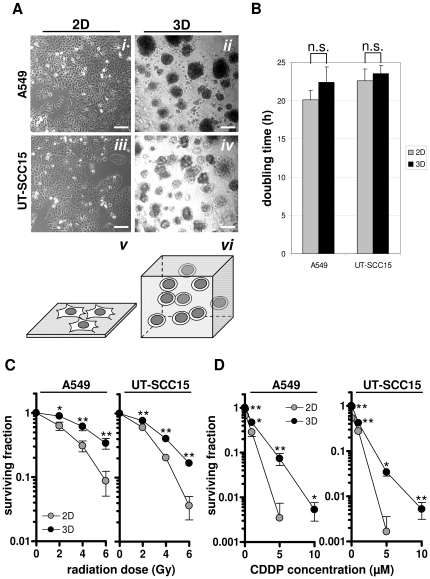
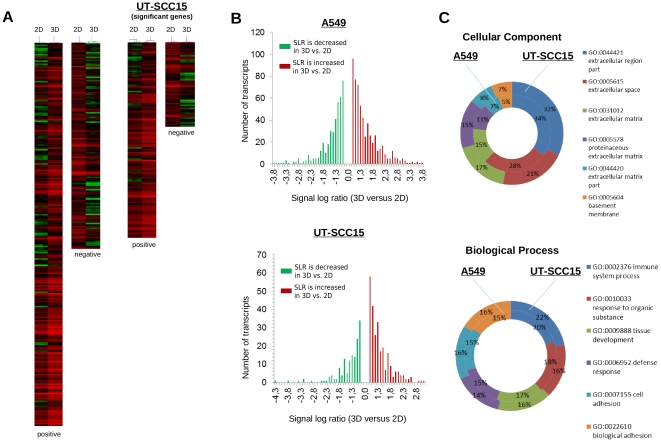
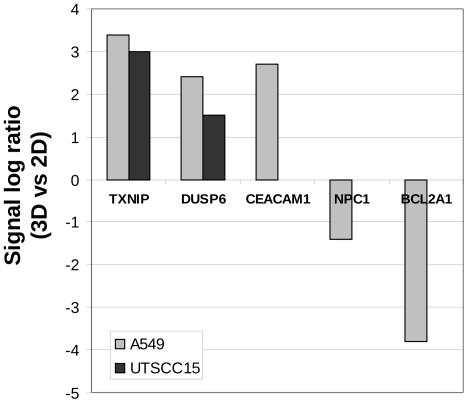
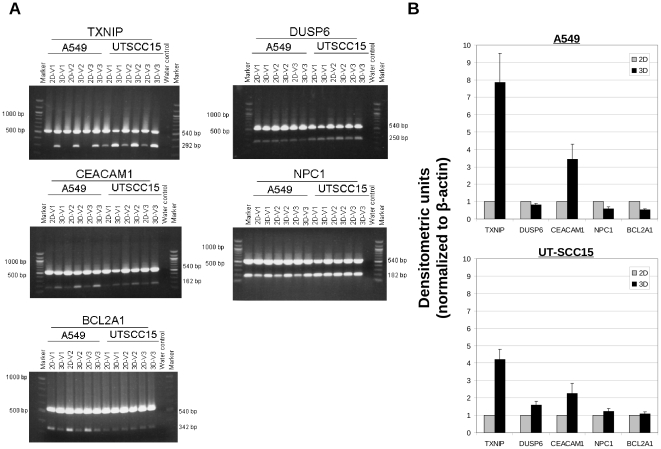
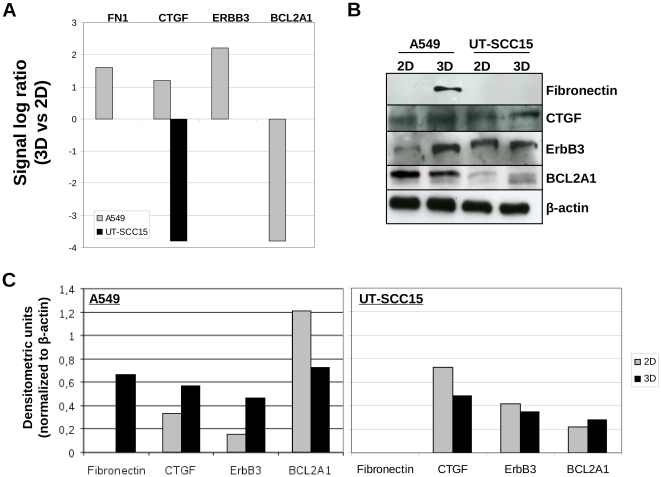
Cell morphology determines cell behavior, signal transduction, protein-protein interaction, and responsiveness to external stimuli. In cancer, these functions profoundly contribute to resistance mechanisms to radio- and chemotherapy. With regard to this aspect, this study compared the genome wide gene expression in exponentially growing cell lines from different tumor entities, lung carcinoma and squamous cell carcinoma, under more physiological three-dimensional (3D) versus monolayer cell culture conditions. Whole genome cDNA microarray analysis was accomplished using the Affymetrix HG U133 Plus 2.0 gene chip. Significance analysis of microarray (SAM) and t-test analysis revealed significant changes in gene expression profiles of 3D relative to 2D cell culture conditions. These changes affected the extracellular matrix and were mainly associated with biological processes like tissue development, cell adhesion, immune system and defense response in contrast to terms related to DNA repair, which lacked significant alterations. Selected genes were verified by semi-quantitative RT-PCR and Western blotting. Additionally, we show that 3D growth mediates a significant increase in tumor cell radio- and chemoresistance relative to 2D. Our findings show significant gene expression differences between 3D and 2D cell culture systems and indicate that cellular responsiveness to external stress such as ionizing radiation and chemotherapeutics is essentially influenced by differential expression of genes involved in the regulation of integrin signaling, cell shape and cell-cell contact.
Overview
The claims and statistics of this paper haven’t been checked yet.
Free: it reads the open-access text and checks the first 5 claims that cite a source we can check. Create a free account to check every claim.
Integrity signals
Registry
Cites
Statistics
Figures
Verification
Claims the paper makes
The claims and statistics of this paper haven’t been checked yet.
Free: it reads the open-access text and checks the first 5 claims that cite a source we can check. Create a free account to check every claim.
Claims other papers make about this one
Each is checked against this paper’s own text: does it say what the citing paper says it does?
The source backs part of the claim, not all of it — or backs it for a different population, condition or comparison.
In the citing paper
“One study showed a signi fi cant difference in the levels of gene expression affecting ECM remodeling, namely processes associated with cell adhesion and tumor growth, and this resulted in increased radio- and chemoresistance in the 3D Matrigel model compared with the 2D culture, which highlights the poor reproduction of in vivo fi ndings in 2D models [36].”
From 3D In Vitro Model (R)evolution: Unveiling Tumor–Stroma Interactions (2021) · cites this paper as [36]
Experimental — accuracy not yet measuredThe cited source says what the claim attributes to it.
In the citing paper
“One study showed a signi fi cant difference in the levels of gene expression affecting ECM remodeling, namely processes associated with cell adhesion and tumor growth, and this resulted in increased radio- and chemoresistance in the 3D Matrigel model compared with the 2D culture, which highlights the poor reproduction of in vivo fi ndings in 2D models [36].”
From 3D In Vitro Model (R)evolution: Unveiling Tumor–Stroma Interactions (2021) · cites this paper as [36]
Self-check
Percentages, sums and reported differences re-computed from the paper’s own numbers.
The self-check needs the paper’s full text.
Citations
Cites
In silico prediction of protein-protein interactions in human macrophages
Souiai, O., Guerfali, F., Ben Miled, S., Brun, C., & Benkahla, A. (2014) · BMC Research Notes · doi:10.1186/1756-0500-7-157 · Cited by 10,803
Significance analysis of microarrays applied to the ionizing radiation response
Tusher, V. G., Tibshirani, R., & Chu, G. (2001) · Proceedings of the National Academy of Sciences · doi:10.1073/pnas.091062498 · Cited by 10,568
Jemal, A., Siegel, R., Ward, E., Hao, Y., Xu, J., & Thun, M. J. (2009) · CA: A Cancer Journal for Clinicians · doi:10.3322/caac.20006 · Cited by 9,709
Taking Cell-Matrix Adhesions to the Third Dimension
Cukierman, E., Pankov, R., Stevens, D. R., & Yamada, K. M. (2001) · Science · doi:10.1126/science.1064829 · Cited by 3,027 · cited 1×
“Apart from a significant impact of integrinmediated cell-ECM interactions [28], a complex interplay of biochemical signaling pathways and biophysical/mechanotransduction-related factors is thought to confer this enhanced tumor cell resistance whose underlying mechanisms remain to be determined both on the gene and on…”
BackgroundToppGene Suite for gene list enrichment analysis and candidate gene prioritization
Chen, J., Bardes, E. E., Aronow, B. J., & Jegga, A. G. (2009) · Nucleic Acids Research · doi:10.1093/nar/gkp427 · Cited by 2,952 · cited 1×
“For gene list, functional enrichment we used the ToppGeneSuite [36].”
MethodThe third dimension bridges the gap between cell culture and live tissue
Pampaloni, F., Reynaud, E. G., & Stelzer, E. H. K. (2007) · Nature Reviews Molecular Cell Biology · doi:10.1038/nrm2236 · Cited by 2,817
Systematic variation in gene expression patterns in human cancer cell lines
Ross, D. T., Scherf, U., Eisen, M. B., Perou, C. M., Rees, C., Spellman, P., Iyer, V., Jeffrey, S. S., Van de Rijn, M., Waltham, M., et al. (2000) · Nature Genetics · doi:10.1038/73432 · Cited by 2,088 · cited 2×
“For example, both A549 and UT-SCC15 showed distinctive basal patterns of genes encoding for proteins with functions in the modulation of the ECM like Laminin, Fibronectin, Collagen, a finding similarly observed in a basal gene expression analysis of 60 cancer cell lines and their corresponding cancer tissues and in a…”
BackgroundWeaver, V. M., Petersen, O. W., Wang, F., Larabell, C. A., Briand, P., Damsky, C., & Bissell, M. J. (1997) · The Journal of Cell Biology · doi:10.1083/jcb.137.1.231 · Cited by 1,483 · cited 1×
“For cells growing in a 3D Matrigel environment, cells were isolated as previously described [23,33] using a Neubauer counting chamber.”
MethodPetersen, O. W., Rønnov-Jessen, L., Howlett, A. R., & Bissell, M. J. (1992) · Proceedings of the National Academy of Sciences · doi:10.1073/pnas.89.19.9064 · Cited by 1,094 · cited 2×
“A large body of work has shown how interactions of cells with the extracellular matrix (ECM), as one of the key components of the microenvironment, contribute to the regulation of critical cell functions such as cell shape/architecture, survival, proliferation, and differentiation [2,4,5,6,7,8,9].”
BackgroundThree-Dimensional Cell Culture Matrices: State of the Art
Lee, J., Cuddihy, M. J., & Kotov, N. A. (2008) · Tissue Engineering Part B: Reviews · doi:10.1089/teb.2007.0150 · Cited by 1,047 · cited 2×
“Loss of functional and phenotypic characteristics occur when cells are cultured ex vivo in a 2D microenvironment [1,4,18,20].”
Background
Cited by
Items 101–128 of 128
Ravera, F., Efeoğlu, E., & Byrne, H. J. (2024) · The Analyst · doi:10.1039/d4an00315b · Cited by 4
Tissue-Cultured Chondrocytes Survive After Irradiation in 1300 Gy Dose
Baranovskii, D., Smirnova, A. V., Yakimova, A. O., Kisel, A. A., Koryakin, S. N., Atiakshin, D., Ignatyuk, M. A., Potievskiy, M. B., Saburov, V. O., Budnik, S. V., et al. (2025) · Biomedicines · doi:10.3390/biomedicines13092153 · Cited by 3
Characterization of in vitro 3D cultures
Mousavi, N. (2021) · Apmis · doi:10.1111/apm.13168 · Cited by 3
Zeqiri, E., da Silva, M. A., Aspinall, S. R., Hoffman, E., Hutter, V., & Cook, M. T. (2024) · RSC Applied Polymers · doi:10.1039/d3lp00056g · Cited by 3
“RSC Applied Polymers from defined polymeric composition with natural or synthetic composition are attractive biomaterials for cell culture in vitro.”
Lee, J., Ko, J., Kim, H., Im, H., Kim, E. J., & Yi, J. Y. (2018) · Biochemical and Biophysical Research Communications · doi:10.1016/j.bbrc.2018.10.095 · Cited by 3
Evaluation of surrogate tissues as indicators of drug activity in a melanoma skin model
Parekh, P. R., Choudhuri, R., Weyemi, U., Martin, O. A., Bonner, W. M., & Redon, C. E. (2016) · Cancer Medicine · doi:10.1002/cam4.726 · Cited by 2
Lee, J., Kim, H.-J., & Yi, J. Y. (2016) · Biochemical and Biophysical Research Communications · doi:10.1016/j.bbrc.2016.11.053 · Cited by 2
“, who compared gene expression profiles in 3D and 2D cell culture conditions, reported that 3D growth conditions noticeably impacted gene expression [9], showing that 3D culture affected genes involved in extracellular matrix, tissue development, cell adhesion, the immune system, and defense responses.”
BackgroundPerduns, R., Volk, J., Plum, M., Jochums, A., Gutzki, F. M., Kaever, V., & Geurtsen, W. (2020) · Dental Materials · doi:10.1016/j.dental.2020.11.005 · Cited by 2
Analysis of Cell Proliferation by Three-Dimensional Culture
Tang, X., & Brindley, D. N. (2022) · Methods in molecular biology · doi:10.1007/978-1-0716-2736-5_15 · Cited by 2
Niche Induces Dedifferentiation
Kapoor, P. S. A. (2013) · Journal of Bioanalysis & Biomedicine · doi:10.4172/1948-593x.1000089 · Cited by 2
“3D cell culture matrices, also known as 3D scaffolds, were recently introduced as a way to overcome the limitations of traditional 2D cell culture [17,18].”
Background3 Dimensional Cell Culture Techniques in Cancer Research
Dhanya, K., & Menon, A. (2020) · Springer eBooks · doi:10.1007/978-981-15-5999-0_11 · Cited by 2
王, 晗. (2025) · Hans Journal of Medicinal Chemistry · doi:10.12677/hjmce.2025.131002 · Cited by 1
Movia, D., & Prina‐Mello, A. (2018) · InTech eBooks · doi:10.5772/intechopen.69447 · Cited by 2
“This culture time (spheroid growth phase) is comparable to those reported in the scientific literature [93].”
ResultThe role of the inhibitor of apoptosis protein Survivin in cellular radiation response
Petraki, C. (2014) · Technischen Universität Darmstadt · doi:10.26083/tuprints-00004034
The Role of CDK2 and CDK9 in the Radiation Response of human HNSCC Cancer Cells
Soffar, A. A. (2013) · Qucosa (Saxon State and University Library Dresden)
Enhancement of death receptor-mediated apoptosis in multiple myeloma cells
Arhoma, A. A. (2017) · Sheffield Hallam University · doi:10.7190/shu-thesis-00026 · Cited by 1
“It has been established that the response behaviors of cells in 2D traditional cell cultures and 3D cultures models differ (Zschenker et al., 2012; Hehlgans et al., 2009; Hehlgans et al., 2009).”
BackgroundEngineering Macrophages for Cell-Based Therapies
Lee, S. (2017) · eScholarship (California Digital Library)
Kang, J., Park, M., Kim, J., Hur, H., Min, B., Baik, S. H., Lee, K., & Kim, N. K. (2019) · Oncology Letters · doi:10.3892/ol.2019.10702
A Brief Review of Current 3D Genomics Research
Zhang, L., & Zhao, J. (2020) · Elsevier eBooks · doi:10.1016/b978-0-12-801238-3.11594-6
Key Characteristics of Circulating Tumor Cell Clusters and Implications for Cancer Metastases
Perlov, Y., & Lee, D. A. (2021) · Journal of Student Research · doi:10.47611/jsrhs.v10i2.1470
“Furthermore, Zschenker et al. (2012) demonstrated that tumorospheres showed distinct expression patterns of genes responsible for extracellular matrix organization and cell adhesion.”
BackgroundFrom conical flax to industrial bioreactor
Behera, B. K. (2023) · Elsevier eBooks · doi:10.1016/b978-0-443-18748-3.00014-7
Gomez-Roman, N., Chong, M. Y., Chahal, S. K., Caragher, S. P., Jackson, M. R., Stevenson, K. H., Dongre, S. A., & Chalmers, A. J. (2023) · doi:10.1158/1535-7163.c.6539649.v1
Ferronato, G. A. (2022) · Digital Library of Theses and Dissertations (Universidade de São Paulo) · doi:10.11606/d.74.2022.tde-03072023-110254
Epigenetic modulation of cancer stem cells in vitro 3D models
Das, J., Stella, J. H., Saunders, M., Joassaint, N., Dawes, M., Ellis, B., Yearde, O., Stiffin, R. M., Sherman, M., Das, M., et al. (2023) · Elsevier eBooks · doi:10.1016/b978-0-443-13212-4.00035-0 · Cited by 1
Kartini, D. A., Karoon, P., Malad, Y., Tippayamontri, T., Sanghangthum, T., Talabnin, C., & KOBDAJ, C. (2024) · Research Square · doi:10.21203/rs.3.rs-4393269/v1
Kartini, D. A., Karoon, P., Malad, Y., Tippayamontri, T., Sanghangthum, T., Talabnin, C., & KOBDAJ, C. (2025) · Radiological Physics and Technology · doi:10.1007/s12194-025-00921-2
Hongju, X., Li, C., Wu, L., Yang, J., Ji, J., Liu, S., Wang, Y., Zheng, H., Zhu, Y., Zheng, Y., et al. (2026) · Biomaterials Advances · doi:10.1016/j.bioadv.2026.215138
Borodins, O., Vehlow, A., Sameith, K., Dahl, A., Spangle, J. M., Aust, D. E., Brunner, C., Monni, O. M., Lange, I., Mircetic, J., et al. (2026) · Signal Transduction and Targeted Therapy · doi:10.1038/s41392-026-02995-9
“41 However, a direct epigenetic regulatory function of cell adhesion molecules remains largely to be clari fi ed.”
Self-citation
Metadata
- Authors
- Zschenker, O., Streichert, T., Hehlgans, S., & Cordes, N.
- Affiliations
- OncoRay (DE)
- University Medical Center Hamburg-Eppendorf (DE)
- Corresponding author
- Cordes, Nils
- Venue
- PLoS ONE
- Publisher
- Public Library of Science (PLoS)
- Published
- 2012-04-11
- Volume
- 7
- Issue
- 4
- Pages
- e34279
- ISSN
- 1932-6203 (ISSN-L)
- PMC
- PMC3324525
- OpenAlex
- W1991102099
- Cited by
- 129
- References
- 45
- Citations by year
- 2026: 2 · 2025: 4 · 2024: 7 · 2023: 7 · 2022: 7 · 2021: 9 · 2020: 10 · 2019: 11 · 2018: 8 · 2017: 13 · 2016: 16 · 2015: 8 · 2014: 10 · 2013: 12 · 2012: 5
- FWCI
- 5.54
- Type
- journal article
- Language
- en
- Open access
- gold
- doi.org
- Locations
- PLoS ONE (publishedVersion, cc-by)
- PubMed Central (publishedVersion, cc-by)
- PubMed (publishedVersion)
- DOAJ (DOAJ: Directory of Open Access Journals) (submittedVersion, cc-by-sa)
- Figshare (submittedVersion, cc-by)
- Funders
- Bundesministerium für Bildung und Forschung (03ZIK041)
- European Regional Development Fund (100066308)
- Topics
- Health Sciences › Medicine › Oncology › Cancer Cells and Metastasis
- Life Sciences › Biochemistry, Genetics and Molecular Biology › Cell Biology › Cellular Mechanics and Interactions
- Life Sciences › Biochemistry, Genetics and Molecular Biology › Molecular Biology › Gene expression and cancer classification
- Keywords
- 3D cell culture, 2D cell culture, gene expression profiling, extracellular matrix, cell adhesion, DNA repair, radioresistance (biology), chemoresistance, lung cancer, squamous cell carcinoma, integrin signaling, cell morphology, cancer cell lines
- MeSH terms
- Cell Adhesion, Cell Survival, DNA Repair, Extracellular Matrix, Humans, Reproducibility of Results, Cell Culture Techniques, Oligonucleotide Array Sequence Analysis, Gene Expression Profiling, Genomics, Cell Line, Tumor, Cell Proliferation
About these checks
Registry, retraction, Cites and statistics results are computed, not judged, with one exception: a printed reference that no index lists is read once by a model before it counts as a citation error. Claims are extracted by a model and kept only when their quote appears verbatim in the text; each cited source is then checked, with a model’s help, for whether it says what the claim relies on. Those verdicts can be wrong — read the claim’s quote and the cited source before relying on one.
Statistics and arithmetic are recomputed, not judged.
Confidence bands are shown only for fields calibrated on our annotated test set. None is calibrated yet, so no band is shown.
What counts as a claim ›How we measure confidence ›How we check this ›
Are you an author, or do you see a problem with this page? Request a review
Data sources
Bibliographic data: Semantic Scholar, OpenAlex, Crossref.
Contains information from the Semantic Scholar Academic Graph Datasets, made available under the ODC Attribution License (ODC-BY 1.0).
Semantic Scholar’s data is described in: Kinney, R., et al. (2023). The Semantic Scholar Open Data Platform. arXiv:2301.10140.
