

The DOI matches its Crossref record; 34 of the 35 references it cites were found in a registry or an index.
Speech Graphs Provide a Quantitative Measure of Thought Disorder in Psychosis
Open accessAbstract
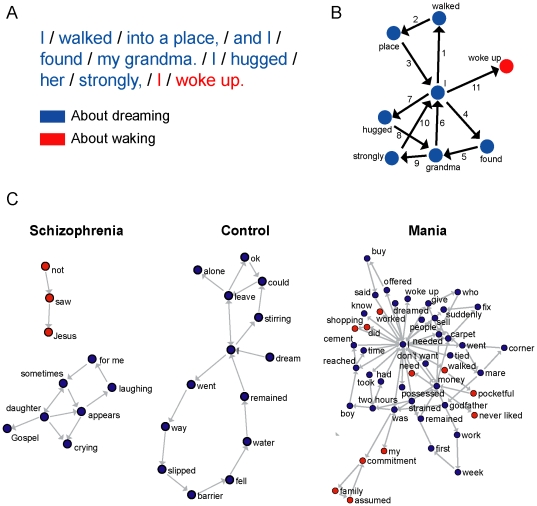
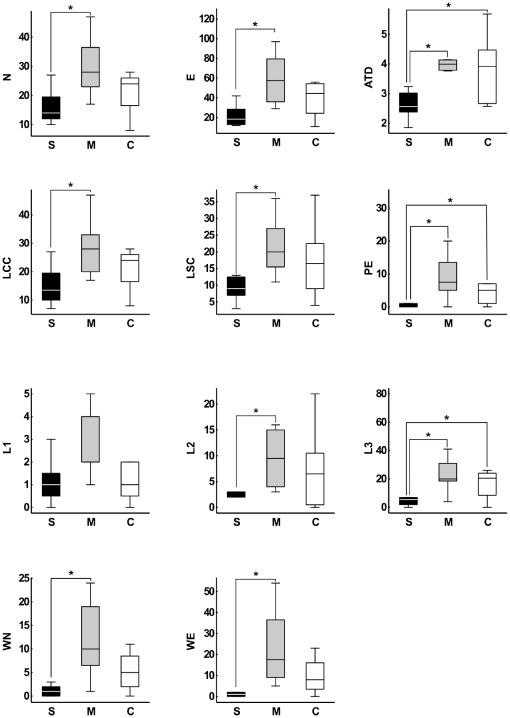
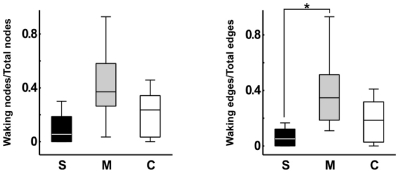
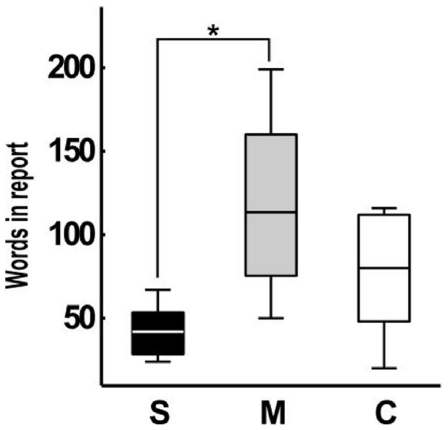
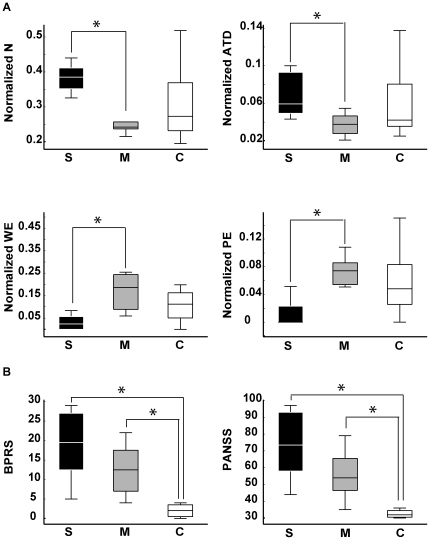
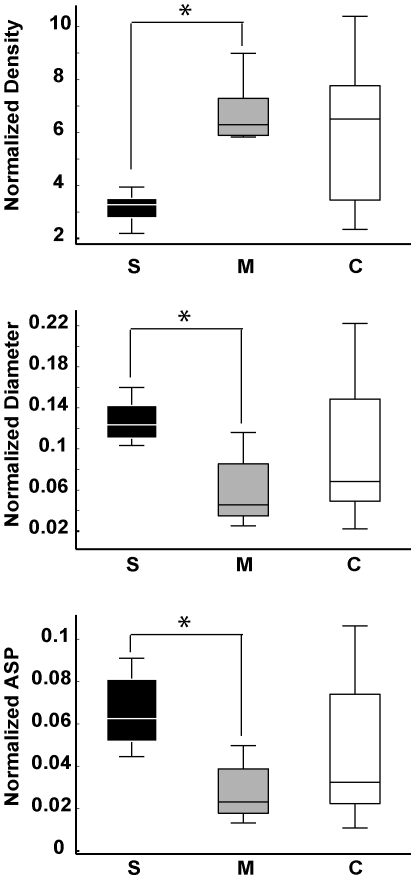
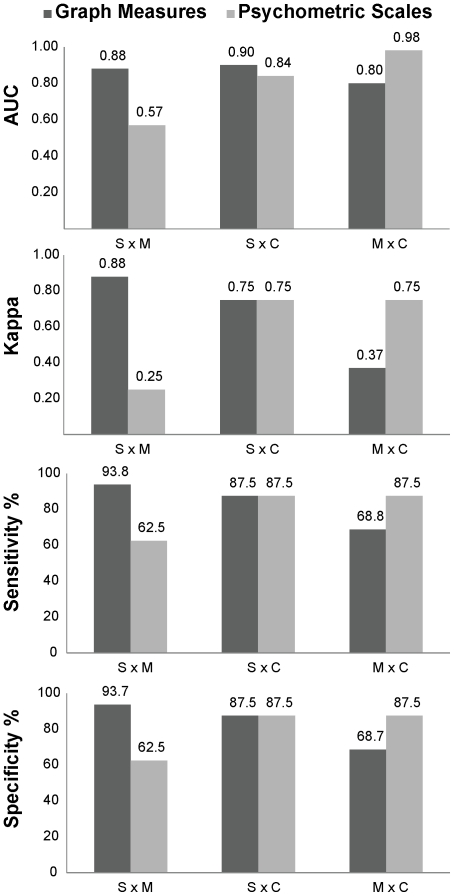
BACKGROUND: Psychosis has various causes, including mania and schizophrenia. Since the differential diagnosis of psychosis is exclusively based on subjective assessments of oral interviews with patients, an objective quantification of the speech disturbances that characterize mania and schizophrenia is in order. In principle, such quantification could be achieved by the analysis of speech graphs. A graph represents a network with nodes connected by edges; in speech graphs, nodes correspond to words and edges correspond to semantic and grammatical relationships. METHODOLOGY/PRINCIPAL FINDINGS: To quantify speech differences related to psychosis, interviews with schizophrenics, manics and normal subjects were recorded and represented as graphs. Manics scored significantly higher than schizophrenics in ten graph measures. Psychopathological symptoms such as logorrhea, poor speech, and flight of thoughts were grasped by the analysis even when verbosity differences were discounted. Binary classifiers based on speech graph measures sorted schizophrenics from manics with up to 93.8% of sensitivity and 93.7% of specificity. In contrast, sorting based on the scores of two standard psychiatric scales (BPRS and PANSS) reached only 62.5% of sensitivity and specificity. CONCLUSIONS/SIGNIFICANCE: The results demonstrate that alterations of the thought process manifested in the speech of psychotic patients can be objectively measured using graph-theoretical tools, developed to capture specific features of the normal and dysfunctional flow of thought, such as divergence and recurrence. The quantitative analysis of speech graphs is not redundant with standard psychometric scales but rather complementary, as it yields a very accurate sorting of schizophrenics and manics. Overall, the results point to automated psychiatric diagnosis based not on what is said, but on how it is said.
Overview
The claims and statistics of this paper haven’t been checked yet.
Run the check — free, no account needed. It reads the open-access text and checks the sources it cites.
Integrity signals
Registry
Cites
Statistics
Figures
Verification
Claims the paper makes
The claims and statistics of this paper haven’t been checked yet.
Run the check — free, no account needed. It reads the open-access text and checks the sources it cites.
Claims other papers make about this one
Each is checked against this paper’s own text: does it say what the citing paper says it does?
In the citing paper
“They noted that when using the tangentiality model of semantic coherence (i.e. regression of the coherence over time with the sliding window) of Elvevåg et al. [25] and the incoherence model of semantic coherence of Bedi et al. [16], they were unable to convincingly separate their clinical and control participants based on language analysis.”
From A Review of Automated Speech and Language Features for Assessment of Cognitive and Thought Disorders (2020) · cites this paper as [16]
In the citing paper
“The language features with the best predictive power in the classifier were the minimum coherence between consecutive phrases for each participant (maximum discontinuity) and the frequency of use of determiners (normalized by sentence length).”
From A Review of Automated Speech and Language Features for Assessment of Cognitive and Thought Disorders (2020) · cites this paper as [16]
In the citing paper
“This initial study only had 34 participants total (only 5 CHR+ participants) and was intended as a proof-of-principle exploration.”
From A Review of Automated Speech and Language Features for Assessment of Cognitive and Thought Disorders (2020) · cites this paper as [16]
Self-check
Percentages, sums and reported differences re-computed from the paper’s own numbers.
The self-check needs the paper’s full text.
Citations
Cites
A Coefficient of Agreement for Nominal Scales
Cohen, J. (1960) · Educational and Psychological Measurement · doi:10.1177/001316446002000104 · Cited by 42,398
(2003) · Journal of Machine Learning Research · doi:10.5555/944919.944937 · Cited by 32,337
Book Review: Pattern Recognition and Machine Learning
Nasrabadi, N. M. (2007) · Journal of Electronic Imaging · doi:10.1117/1.2819119 · Cited by 22,066
An introduction to ROC analysis
Fawcett, T. (2006) · Pattern Recognition Letters · doi:10.1016/j.patrec.2005.10.010 · Cited by 21,879
The Positive and Negative Syndrome Scale (PANSS) for schizophrenia.
Kay, S. R., Fiszbein, A., & Opler, L. A. (1987) · Schizophrenia Bulletin · doi:10.1093/schbul/13.2.261 · Cited by 21,378
Seel, N. M. (2012) · Springer eBooks · doi:10.1007/978-1-4419-1428-6_5195 · Cited by 19,482
The WEKA data mining software: an update
Hall, M., Frank, E., Holmes, G., Pfahringer, B., Reutemann, P., & Witten, I. H. (2009) · ACM SIGKDD Explorations Newsletter · doi:10.1145/1656274.1656278 · Cited by 17,750
Blei, D. M., Ng, A. Y., & Jordan, M. I. (2002) · The MIT Press eBooks · doi:10.7551/mitpress/1120.003.0082 · Cited by 12,683
Complex brain networks: graph theoretical analysis of structural and functional systems
Bullmore, E., & Sporns, O. (2009) · Nature Reviews Neuroscience · doi:10.1038/nrn2575 · Cited by 11,820
I.—COMPUTING MACHINERY AND INTELLIGENCE
TURING, A. M. (1950) · Mind · doi:10.1093/mind/lix.236.433 · Cited by 10,290
Research works printed but not linked: 1
- MH First, 1990, Structured Clinical Interview for DSM-IV Axis I Disorders – Research Version, Patient Edition (SCID-I/P)
Cited by
Sorted by citations
Items 201–265 of 265
Cross-linguistic benchmarking of NLP metrics for psychosis research
Stein, D., Bobrovskiy, D., Stede, M., Montag, C., & Just, S. A. (2026) · npj Digital Medicine · doi:10.1038/s41746-026-03053-y · Cited by 1
Computational Characterization of Mental States: A Natural Language Processing Approach
Carrillo, F. (2017) · Annual Meeting of the Association for Computational Linguistics: Student Research Workshop (ACL SRW) · doi:10.18653/v1/p17-3001 · Cited by 1
Neurocognitive Implications of Tangential Speech in Patients with Focal Brain Damage
Vigliecca, N. S. (2018) · InTech eBooks · doi:10.5772/intechopen.71904 · Cited by 1
Introduction: Cognitive Issues in Natural Language Processing
Poibeau, T., & Villavicencio, A. (2017) · Cambridge University Press eBooks · doi:10.1017/9781316676974.001 · Cited by 1
Barros, F., Valente, A. R., Teixeira, A. J. S., & Silva, S. (2023) · Lecture notes of the Institute for Computer Sciences, Social Informatics and Telecommunications Engineering · doi:10.1007/978-3-031-32029-3_24 · Cited by 1
Uncovering emotional and network dynamics in the speech of patients with chronic low back pain
dos Reis, F. J. J., Bonfim, I. D. S., Corrêa, L. A., Nogueira, L. A. C., Meziat‐Filho, N., & de Almeida, R. S. (2024) · Musculoskeletal Science and Practice · doi:10.1016/j.msksp.2024.102925 · Cited by 1
Marques, P. C. F., Soares, L. R. F., Araujo, A. V. D. A., Monteiro, A. R., Batista, A. D. A. L., Pimentel, T., Calheiros, L. D. L., Padilla, M., Pacheco, A. L. D. G., Queda, F., et al. (2024) · Brazilian Journal of Health Review · doi:10.34119/bjhrv7n2-337 · Cited by 1
Age-Related Differences in Speech and Gray Matter Volume: The Modulating Role of Multilingualism
Yu, H., Kang, K., Pliatsikas, C., Zhou, Y., & Zhang, H. (2025) · NeuroImage · doi:10.1016/j.neuroimage.2025.121149 · Cited by 1
A graph-based approach for characterizing resident and nurse handoff conversations
Kannampallil, T., Awadalla, S., Jones, S., & Abraham, J. (2019) · Journal of Biomedical Informatics · doi:10.1016/j.jbi.2019.103178 · Cited by 1
Computer-Aided Intervention for Reading Comprehension Disabilities
Tsai, C.-L., Lin, Y.-G., Lin, W.-Y., & Zakierski, M. M. (2019) · Lecture notes in computer science · doi:10.1007/978-3-030-22244-4_8 · Cited by 1
Computer-Aided Grouping of Students with Reading Disabilities for Effective Response-to-Intervention
Tsai, C.-L., Lin, Y.-G., Liu, M.-C., & Lin, W.-Y. (2020) · Lecture notes in computer science · doi:10.1007/978-3-030-49663-0_9 · Cited by 1
Mota, N. B., Copelli, M., & Ribeiro, S. T. G. (2016) · arXiv (Cornell University) · doi:10.48550/arxiv.1610.08566 · Cited by 1
Self-citationSpeech analysis as a tool for detection and monitoring of medical conditions: a review (Preprint)Preprint
Ziółko, M. (2020) · doi:10.2196/preprints.19839 · Cited by 1
Alves, C. L., Toutain, T. G. L. D. O., Porto, J. A. M., Aguiar, P. D. C., Pineda, A. M., Rodrigues, F. A., de Sena, E. P., & Thielemann, C. (2022) · medRxiv · doi:10.1101/2022.11.06.22282001 · Cited by 1
Quillivic, R., Gayraud, F., Auxéméry, Y., Vanni, L., Peschanski, D., Eustache, F., Dayan, J., & Mesmoudi, S. (2023) · Research Square · doi:10.21203/rs.3.rs-3747882/v1 · Cited by 1
Martens, L. (2013) · Utrecht University Repository (Utrecht University)
Khantavchai, A., & Jiarasuksakun, T. (2017) · Thai Journal of Mathematics
Martin, J. M. (2017) · LA Referencia (Red Federada de Repositorios Institucionales de Publicaciones Científicas)
da Silva, A. C. G. (2018) · Digital Library of Theses and Dissertations (Universidade de São Paulo) · doi:10.11606/d.8.2018.tde-13082018-165755
Prediction of Psychosis using Linguistic Marker
P, S. M. S. H. (2020) · International Journal for Research in Applied Science and Engineering Technology · doi:10.22214/ijraset.2020.2033
A Word Graph-based Method for Disease Topic Identification in Biomedical Literature.
Wang, K., Xia, E., Yu, Y., Huang, Z., Huang, S., Mei, J., & Li, S. (2020) · PubMed Central
Addressing Variability in Speech when Recognizing Emotion and Mood In-the-Wild
Gideon, J. (2019) · Deep Blue (University of Michigan)
Abnormal Low-Gamma Small-World Response After Visual Stimulation in SchizophreniaPreprint
Galdino, L., Fernandes, T. P., Schmidt, K. E., & dos Santos, N. A. (2021) · Research Square · doi:10.21203/rs.3.rs-690074/v1
Corlett, P. R., & Fineberg, S. K. (2014) · The British Journal of Psychiatry · doi:10.1192/bjp.205.5.409a
A commentary on the interpretability of computational linguistic findings in schizophrenia research
Kapitány‐Fövény, M. (2022) · Schizophrenia Research · doi:10.1016/j.schres.2022.10.012
NLP and Graph embeddings: TextGraphs.jlPreprint
Argôlo, F. C., Gondim, J. M., Lopes-Rocha, A. C., Ara, A., Loch, A. A., & Mota, N. B. (2023) · doi:10.31234/osf.io/nfze4
Self-citationGallo, F. T., Spiousas, I., Herrero, N. L., Godoy, D. L., Tommasel, A., Rolín, M. G., Ramele, R., Gleiser, P. M., & Forcato, C. (2023) · doi:10.31234/osf.io/c9ewn
Systematic Review on Bisonets for Linking Two Domains
Sibanda, E. M., & Zuva, T. (2023) · Lecture notes in networks and systems · doi:10.1007/978-3-031-35311-6_55
Jia, B., Jun, F., Li, G.-J., Wang, B., & Chen, Y.-F. (2023) · Archives of Acoustics · doi:10.24425/aoa.2023.146811
On the application of Machine Learning and Complex Networks to Neuroscience
Alves, C. L. (2023) · Digital Library of Theses and Dissertations (Universidade de São Paulo) · doi:10.11606/t.55.2023.tde-31082023-145944
Kowalski, P., & Alikowski, A. (2023) · Archives of Acoustics · doi:10.24425/aoa.2023.146642
Zagad, A., Blachier, A., Tahmazov, E., Haralambous, Y., Walter, M., Navarro, L., Lenca, P., & Lemey, C. (2024) · doi:10.2196/preprints.56779
Mehta, U. M., Bagali, K. B., & Kommanapalli, S. (2024) · Springer eBooks · doi:10.1007/978-981-97-0503-0_10
Ramos, Y. E., Miranda, J. G. V., & Bacelar, F. S. (2024) · SSRN Electronic Journal · doi:10.2139/ssrn.4806235
Two Languages in One Mind in the Classroom
Finger, I., & Weissheimer, J. (2024) · The American Journal of Psychology · doi:10.5406/19398298.137.2.11
Saga, T., & Tanaka, H. (2025) · Springer eBooks · doi:10.1007/978-981-96-1313-7_7
Raheel, K., Biabani, N., Ivanenko, O., See, Q. R., Bertani, R., Gnoni, V., O’Regan, D., Cvetković, Z., Drakatos, P., Bernardi, G., et al. (2025) · Research Square · doi:10.21203/rs.3.rs-6761771/v1
Language of Individuals With Schizophrenia
Alonso-Sánchez, M. F., Sović, M. S., & Savić, A. (2025) · Elsevier eBooks · doi:10.1016/b978-0-323-95504-1.00748-1
Song-making in a group (SING): a longitudinal study for people experiencing psychosis
Greco, D. L., Castiello, S., Camilo, S., Freeland, C. M., Pavlo, A. J., Bien, C., Nachemson, J., Lubinski, C., Christoferson, A., Kenney, J. G., et al. (2026) · Psychosis · doi:10.1080/17522439.2026.2634654
Ayesa‐Arriola, R., Martínez-Asensi, C., Díaz‐Pons, A., de la Foz, V. O., Parás, C., Mouslih, C. E., Sattari, R., Incera, S., & Palaniyappan, L. K. (2025) · Schizophrenia Research Cognition · doi:10.1016/j.scog.2025.100398
Bordon, B. P., & Vargas, K. F. M. (2025) · Revista Latinoamericana de Psicopatologia Fundamental · doi:10.1590/1415-4714.e240865
Terrisse, R., Lemey, C., Kim-Dufor, D.-H., Miglianico, L., & Stéphan, F. (2026) · Frontiers in Psychiatry · doi:10.3389/fpsyt.2025.1702187
Lang, Y., Weissheimer, J., Finger, I., & Kroll, J. F. (2026) · Frontiers in Language Sciences · doi:10.3389/flang.2025.1717090
Francese, R., Santis, L. D., Iannotta, F., & Iasevoli, F. (2026) · Multimedia Tools and Applications · doi:10.1007/s11042-026-21401-8
Gadalla, M., Nikoletseas, S., & Amazonas, J. R. D. A. (2026) · Frontiers in Psychology · doi:10.3389/fpsyg.2026.1526215 · Cited by 3
Trognon, A. (2022) · theses.fr (ABES) · doi:10.70675/a61baf2dz0493z4668z80b0za8538881eb16 · Cited by 1
The autism-schizophrenia continuum : prosodic and conversational patterns as new endophenotypes
Lucarini, V. (2024) · theses.fr (ABES) · doi:10.70675/b674de0bz354ez4361zb6fez867240052631
Lee, H.-S., Rbeiz, K. S., Gui, Y., Babbitt, K., Baxter, T., Sangimino, M., Bruni, P., Felsenheimer, A. K., Jelsma, O., LI, M., et al. (2026) · Schizophrenia Bulletin Open · doi:10.1093/schizbullopen/sgag017
Abnormal speech production in veterans with bipolar disorder: Relationship to the arcuate fasciculus
Szeszko, P. R., Chan, C. C., Agurto, C., Chu, K.-W., Goodman, M. S., Hazlett, E. A., Finer, E. B., Haznedar, M. M., Corcoran, C. M., & Cecchi, G. (2026) · Journal of Affective Disorders · doi:10.1016/j.jad.2026.121974
Self-citationComputational Linguistic Alignment in Psychosis from Semi-Structured Clinical InterviewsPreprint
Olarewaju, E., Voppel, A., Meister, F., Mouslih, C. E., Dzialoszynski, P., & Palaniyappan, L. K. (2026) · medRxiv · doi:10.64898/2026.05.24.26353973
Castaño-Castaño, S., Díaz‐Pons, A., & Ayesa‐Arriola, R. (2026) · Medical Hypotheses · doi:10.1016/j.mehy.2026.112039
Nakamura, H., Kano, Y., Sugihara, G., Takemura, R., Yamaguchi, Y., Shimizu, M., Takagi, S., Iizuka, M., Tashiro, S., Kitazawa, M., et al. (2026) · Psychological Medicine · doi:10.1017/s0033291726104668
Voice, Speech, and Large Language Models in Neurology: From Acoustic Biomarkers to Conversational AI
Shelly, S. (2026) · Computation · doi:10.3390/computation14070160
Tang, X., Chen, J., Huang, Y., & Yao, Q. (2026) · International Journal of Medical Informatics · doi:10.1016/j.ijmedinf.2026.106690
Mimault, T., Quillivic, R., Gayraud, F., Mesmoudi, S., Léveillée, S., Dayan, J., & Auxéméry, Y. (2026) · Journal of Family Violence · doi:10.1007/s10896-026-01173-3
Academic achievement map: a clear cognitive route and a promising motor path
Fernandes, V. D. R., Nunes, N. G. D. S., Mota, N. B., Ribeiro, S., & Deslandes, A. C. (2026) · Jornal de Pediatria · doi:10.1016/j.jped.2026.101611
Self-citationMoon, K. C., Behbehani, L. M., Malhotra, A., Spilka, M. J., & Tang, S. X. (2026) · medRxiv · doi:10.64898/2026.10.05.26364692
A graph theory approach to chart the architecture of dream and mind-wandering reports
Coppola, P., Sikka, P., Valli, K., Tuominen, J., Revonsuo, A., Loukola, V., Bernstein, R., Strid, N., Kirberg, M., Ezquerro‐Nassar, A., et al. (2026) · Communications Psychology · doi:10.1038/s44271-026-00509-5 · Cited by 1
Self-citation
Metadata
- Authors
- Mota, N. B., Vasconcelos, N. A. P., Lemos, N., Pieretti, A. C., Kinouchi, O., Cecchi, G. A., Copelli, M., & Ribeiro, S.
- Affiliations
- Universidade Federal do Rio Grande do Norte (BR)
- Universidade de São Paulo (BR)
- IBM Research - Thomas J. Watson Research Center (US)
- Universidade Federal de Pernambuco (BR)
- Corresponding author
- Ribeiro, Sidarta
- Venue
- PLoS ONE
- Publisher
- Public Library of Science (PLoS)
- Published
- 2012-04-09
- Volume
- 7
- Issue
- 4
- Pages
- e34928
- ISSN
- 1932-6203 (ISSN-L)
- PMC
- PMC3322168
- OpenAlex
- W2091298722
- Cited by
- 265
- References
- 35
- Citations by year
- 2026: 22 · 2025: 18 · 2024: 24 · 2023: 43 · 2022: 34 · 2021: 21 · 2020: 30 · 2019: 15 · 2018: 13 · 2017: 10 · 2016: 12 · 2015: 4 · 2014: 11 · 2013: 6 · 2012: 2
- FWCI
- 5.17
- Type
- journal article
- Language
- en
- Open access
- gold
- doi.org
- Locations
- PLoS ONE (publishedVersion, cc-by)
- Europe PMC (PubMed Central) (publishedVersion, cc-by)
- PubMed Central (publishedVersion, cc-by)
- PubMed (publishedVersion)
- Americanae (AECID Library) (publishedVersion, other-oa)
- LA Referencia (Red Federada de Repositorios Institucionales de Publicaciones Científicas) (publishedVersion, other-oa)
- Portuguese National Funding Agency for Science, Research and Technology (RCAAP Project by FCT) (publishedVersion)
- DOAJ (DOAJ: Directory of Open Access Journals) (submittedVersion, cc-by-sa)
- Figshare (submittedVersion, cc-by)
- Funders
- Governo Brasil
- Conselho Nacional de Desenvolvimento Científico e Tecnológico (481506/2007-1)
- Financiadora de Estudos e Projetos (01.06.1092.00)
- Universidade Federal do Rio Grande do Norte
- Topics
- Health Sciences › Medicine › Psychiatry and Mental health › Schizophrenia research and treatment
- Social Sciences › Psychology › Experimental and Cognitive Psychology › Mental Health Research Topics
- Social Sciences › Psychology › Social Psychology › Mental Health via Writing
- Keywords
- thought disorder, psychosis, schizophrenia, mania, differential diagnosis, graph theory, speech analysis, flight of ideas, automated psychiatric diagnosis, psychiatric symptoms
- MeSH terms
- Adult, Female, Humans, Male, Middle Aged, Psychiatric Status Rating Scales, Psychotic Disorders, Schizophrenia, Speech, Thinking, Young Adult
About these checks
Registry, retraction, Cites and statistics results are computed, not judged, with one exception: a printed reference that no index lists is read once by a model before it counts as a citation error. Claims are extracted by a model and kept only when their quote appears verbatim in the text; each cited source is then checked, with a model’s help, for whether it says what the claim relies on. Those verdicts can be wrong — read the claim’s quote and the cited source before relying on one.
Statistics and arithmetic are recomputed, not judged.
Confidence bands are shown only for fields calibrated on our annotated test set. None is calibrated yet, so no band is shown.
What counts as a claim ›How we measure confidence ›How we check this ›
Are you an author, or do you see a problem with this page? Request a review
