

Therapist Experience and Knowledge Acquisition in Internet-Delivered CBT for Social Anxiety Disorder: A Randomized Controlled Trial
Open accessThe DOI matches its Crossref record; 79 of the 80 references it cites were found in a registry or an index.
Abstract
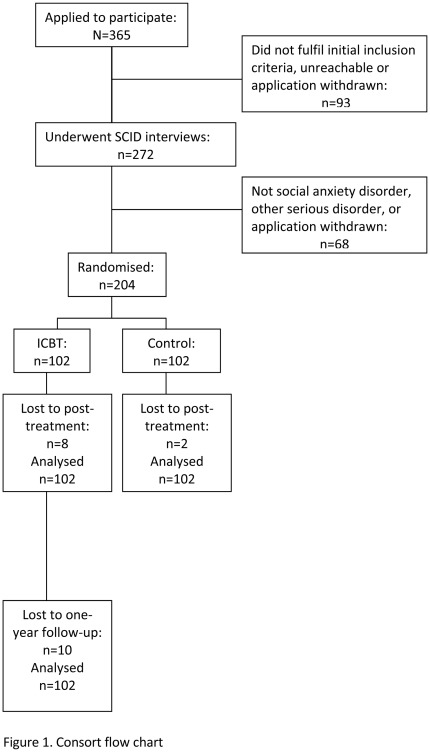
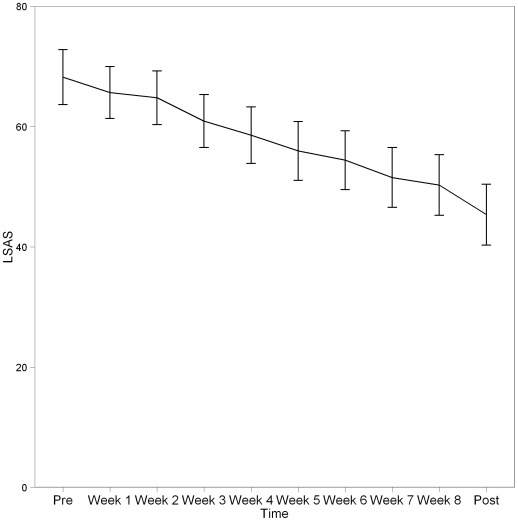
BACKGROUND: Guided internet-delivered cognitive behavior therapy (ICBT) has been tested in several trials on social anxiety disorder (SAD) with moderate to large effects. The aims of this study were threefold. First, to compare the effects of ICBT including online discussion forum with a moderated online discussion forum only. Second, to investigate if knowledge about SAD increased following treatment and third to compare the effects of inexperienced versus experienced therapists on patient outcomes. METHODS: A total of 204 participants with a primary diagnosis of SAD were included and randomized to either guided ICBT or the control condition. ICBT consisted of a 9-week treatment program which was guided by either psychology students at MSc level (n = 6) or by licensed psychologists with previous experience of ICBT (n = 7). A knowledge test dealing with social anxiety was administered before and after treatment. Measures of social anxiety and secondary outcomes dealing with general anxiety, depression, and quality of life were administered before and after treatment. In addition, a 1-year follow-up was conducted on the treated individuals. RESULTS: Immediately following treatment, the ICBT group showed superior outcome on the Liebowitz Social Anxiety Scale self-report version with a between group posttreatment Hedges g effect size of g = 0.75. In addition, significant differences on all the secondary outcomes were observed. Gains were well maintained one year later. Knowledge, as assessed by the knowledge test, increased following treatment with little gain in the control group. Therapist experience did not result in different outcomes, but experienced therapists logged in less frequently compared to the inexperienced therapists, suggesting that they needed less time to support patients. DISCUSSION: We conclude that guided ICBT reduce symptoms of SAD, increase knowledge about SAD and that therapist experience does not make a difference apart from the finding that experienced therapist may require less time to guide patients. TRIAL REGISTRATION: UMIN.ac.jp UMIN000001383.
Overview
The claims and statistics of this paper haven’t been checked yet.
Free: it reads the open-access text and checks the first 5 claims that cite a source we can check. Create a free account to check every claim.
Integrity signals
Registry
Cites
Statistics
Figures
Verification
Claims the paper makes
The claims and statistics of this paper haven’t been checked yet.
Free: it reads the open-access text and checks the first 5 claims that cite a source we can check. Create a free account to check every claim.
Claims other papers make about this one
Each is checked against this paper’s own text: does it say what the citing paper says it does?
The source backs part of the claim, not all of it — or backs it for a different population, condition or comparison.
In the citing paper
“while the amount and nature of the therapists’ experience has not been found to greatly influence the clinical outcome of internet therapy [40].”
From Study protocol for a randomised controlled trial of internet-based cognitive-behavioural therapy for obsessive-compulsive disorder (2014) · cites this paper as [40]
Experimental — accuracy not yet measuredThe cited source says what the claim attributes to it.
In the citing paper
“novice clinicians can be as effective as clinicians who have more experience with ICBT 30”
From Internet-delivered psychological treatments: from innovation to implementation (2019) · cites this paper as [30]
The cited source says what the claim attributes to it.
In the citing paper
“Studies have investigated whether ICBT influences knowledge acquisition in social anxiety disorder 30 , eating dis orders 92 and, most recently, adolescents with depression 93 .The studies show that improvements in knowledge occur following ICBT.”
From Internet-delivered psychological treatments: from innovation to implementation (2019) · cites this paper as [30]
Self-check
Percentages, sums and reported differences re-computed from the paper’s own numbers.
The self-check needs the paper’s full text.
Citations
Cites
Diagnostic and Statistical Manual of Mental Disorders
Williams, J. B. W., & First, M. (2013) · Encyclopedia of Social Work · doi:10.1093/acrefore/9780199975839.013.104 · Cited by 109,519
Diagnostic and Statistical Manual of Mental Disorders.
Widiger, T. A. (2000) · Encyclopedia of Psychology, Vol. 3. · doi:10.1037/10518-009 · Cited by 19,744
An inventory for measuring clinical anxiety: Psychometric properties.
Beck, A. T., Epstein, N., Brown, G., & Steer, R. A. (1988) · Journal of Consulting and Clinical Psychology · doi:10.1037/0022-006x.56.6.893 · Cited by 14,407 · cited 2×
“Three secondary measures were used to measure general anxiety, depression and quality of life: the Beck Anxiety Inventory (BAI) [51], the MADRS-S [52], and the Quality of Life Inventory (QOLI) [53].”
MethodDiagnostic and Statistical Manual of Mental Disorders
Siegel, L. J., & Fletcher‐Janzem, E. (2008) · Encyclopedia of Special Education · doi:10.1002/9780470373699.speced0655 · Cited by 8,477
Jacobson, N. S., & Truax, P. (1991) · Journal of Consulting and Clinical Psychology · doi:10.1037/0022-006x.59.1.12 · Cited by 7,770 · cited 1×
“Clinically significant improvement was determined for the LSAS-SR in accordance with Jacobson and Truax criteria [59] by using the Reliable Change Index for each individual and a posttest score within two standard deviations (SDs) of the mean of the normal population [47].”
MethodMoher, D., Schulz, K. F., & Altman, D. G. (2001) · The Lancet · doi:10.1016/s0140-6736(00)04337-3 · Cited by 5,373
Structured Clinical Interview for DSM-IV Axis I Disorders
Spitzer, R. L., First, M. B., & Gibbon, M. (1997) · Medical Entomology and Zoology · Cited by 4,096
Mattick, R. P., & Clarke, J. C. (1998) · Behaviour Research and Therapy · doi:10.1016/s0005-7967(97)10031-6 · Cited by 3,367 · cited 7×
“Four social anxiety questionnaires were used as outcome measures: the Liebowitz Social Anxiety Scale self- PLoS ONE | www.plosone.org 2 May 2012 | Volume 7 | Issue 5 | e37411 report version (LSAS-SR) [46,47], the Social Phobia Scale (SPS) [48], the Social Interaction Anxiety Scale (SIAS) [48], and the SPSQ [49].”
MethodInfluential(1997) · American Psychiatric Press eBooks · Cited by 3,056
Moher, D., Schulz, K. F., & Altman, D. G. (2001) · BMC Medical Research Methodology · doi:10.1186/1471-2288-1-2 · Cited by 2,755 · cited 1×
“We regarded the LSAS-SR as the primary outcome measure [50].”
Method
Cited by
Items 101–165 of 165
Berg, I., Hovne, V., Carlbring, P., Bernhard‐Oettel, C., Oscarsson, M., Mechler, J., Lindqvist, K., Topooco, N., Andersson, G., & Philips, B. (2022) · Internet Interventions · doi:10.1016/j.invent.2022.100592 · Cited by 14
“…a strong correlation between the degree of support and outcome in the treatment of depression, where a higher degree of support included contact before and/or after treatment (Johansson and Andersson, 2012), few studies have examined the actual dose-response relationship (Baumeister et al., 2014).”
BackgroundSelf-citationInternet‐Delivered Treatments for Social Anxiety Disorder
Andersson, G., Carlbring, P., & Furmark, T. (2014) · Wiley eBooks · doi:10.1002/9781118653920.ch26 · Cited by 12
Self-citationMutter, A., Bücheler, M., Idrees, A. R., Domhardt, M., & Baumeister, H. (2024) · BMJ Open · doi:10.1136/bmjopen-2024-086728 · Cited by 12
Westas, M., Mourad, G., Andersson, G., Neher, M., Lundgren, J., & Johansson, P. (2022) · BMC Psychiatry · doi:10.1186/s12888-022-03939-7 · Cited by 14
Self-citationInternet-based treatments - Experiences from Sweden
(2013) · Verhaltenstherapie · doi:10.1159/000188079 · Cited by 8
Self-citationPan, J., Carlbring, P., & Lu, L. (2024) · Research on Social Work Practice · doi:10.1177/10497315241252054 · Cited by 8
“Some of the positive effects had been maintained at 2-month (Lintvedt et al., 2013), 3-month (Dear et al., 2019; Harrer et al., 2021), and 1-year (Andersson et al., 2012) follow-up assessments.”
Self-citationRozen, N., & Aderka, I. M. (2020) · Clinical Psychology Review · doi:10.1016/j.cpr.2020.101874 · Cited by 5
Bert, F., Moro, G. L., Giacomini, G., Minutiello, E., & Siliquini, R. (2023) · Health Promotion International · doi:10.1093/heapro/daad006 · Cited by 5
Käll, A., & Andersson, G. (2023) · Journal of Behavior Therapy and Experimental Psychiatry · doi:10.1016/j.jbtep.2023.101872 · Cited by 7
Self-citationSafety and Efficacy of Modular Digital Psychotherapy for Social Anxiety: Randomized Controlled Trial
Garvert, M. M., McFadyen, J., Linke, S., McCloud, T. L., Meyer, S. S., Sobanska, S., Sharp, P. B., Long, A., Huys, Q. J. M., & Ahmadi, M. (2025) · Journal of Medical Internet Research · doi:10.2196/64138 · Cited by 6
Zieve, G. G., Armstrong, C. C., Richardson, I. M., Garcia, S. B., & Harvey, A. G. (2022) · Cognitive Therapy and Research · doi:10.1007/s10608-022-10293-1 · Cited by 6
Jackson, H. M., Batterham, P. J., Ohan, J. L., Calear, A. L., & Farrer, L. M. (2024) · BMC Psychiatry · doi:10.1186/s12888-024-05953-3 · Cited by 9
“This is in line with previous trials of DMHIs, which have indicated improvements in knowledge confidence following intervention [43, 44].”
ResultJohnsen, D. B., Arendt, K. B., & Thastum, M. (2019) · Scandinavian Journal of Child and Adolescent Psychiatry and Psychology · doi:10.21307/sjcapp-2019-010 · Cited by 4
Bjurner, P., Isacsson, N. H., Abdesslem, F. B., Boman, M., Forsell, E., & Kaldo, V. (2025) · Internet Interventions · doi:10.1016/j.invent.2025.100816 · Cited by 5
“A study by Andersson et al. (2012) reports empirical evidence supporting that therapist's level of experience do not affect outcome in ICBT.”
Käll, A., Lynch, C. O., Sundling, K., Furmark, T., Carlbring, P., & Andersson, G. (2023) · Clinical Psychology in Europe · doi:10.32872/cpe.11379 · Cited by 5
“More information about the initial phase of the study can be found in Andersson et al. (2012).”
BackgroundMethodInfluentialSelf-citationLy, K. H. (2015) · Linköping University Electronic Press eBooks · doi:10.3384/diss.diva-113996 · Cited by 17
Guided Internet Treatment of Anxiety Disorders in Adults
Andersson, G. (2014) · Wiley eBooks · doi:10.1002/9781118775349.ch61 · Cited by 3
Self-citationVernmark, K. (2017) · doi:10.3384/diss.diva-142389 · Cited by 7
Esfandiari, N., Mazaheri, M. A., Sadeghi‐Firoozabadi, V., & Cheraghi, M. (2020) · doi:10.2196/preprints.18275 · Cited by 4
Lopes, R. D. C. T., Šipka, D., Strayhorn, J. C., Fernández‐Álvarez, J., Krieger, T., Klein, J. P., & Berger, T. (2025) · Behaviour Research and Therapy · doi:10.1016/j.brat.2025.104816 · Cited by 2
Technological Interventions for Anxiety Disorders
Baños, R., Vara, M. D., Mira, A., García‐Palacios, A., & Botella, C. (2020) · Elsevier eBooks · doi:10.1016/b978-0-12-818697-8.00008-x · Cited by 2
Clinician- vs non-clinician-supported eTherapy for anxiety and depression
Lidbetter, N., Grigoroglou, C., Seccombe, N., Taxiarchi, V. P., Court, K., & Karachaliou, D. (2024) · Mental Health and Digital Technologies · doi:10.1108/mhdt-04-2024-0011 · Cited by 2
The Use of Technology to Augment Clinical Care in Depression and Anxiety Disorders: An Evidence Map
Maher, A. R., Apaydin, E. A., Raaen, L. B., Motala, A., Shanman, R., & Hempel, S. (2019) · RAND Corporation eBooks · doi:10.7249/rr2177 · Cited by 2
“…2014; Allen et al., 2016; Andersson et al., 2005; Andersson, Carlbring, and Furmark, 2012; Andersson et al., 2006; Andersson, Hesser, et al., 2013; Andersson et al., 2012; Andersson et al., 2009; Andersson, Waara, et al., 2013; Andrews, Davies, and Titov, 2011; Arean et al., 2016; Au, 2015; Bae…”
How Online Counselling Is Utilised, Evaluated, and Received
Agathokleous, G., & Taiwo, A. O. (2021) · Advances in psychology, mental health, and behavioral studies (APMHBS) book series · doi:10.4018/978-1-7998-7991-6.ch011 · Cited by 4
“Wampold, 2015), in this case does not account for the same effect (e.g. Lewis et al., 2011; Andersson et al., 2012).”
BackgroundThe competence of physiotherapists to deliver a cognitive behavioural approach for low back pain
Hansen, Z. (2026) · Warwick Research Archive Portal (University of Warwick) · doi:10.82444/warw.33646315 · Cited by 2
Sasseville, M., LeBlanc, A., Tchuente, J., Boucher, M., Dugas, M., Mbemba, G. I. C., Barony, R., Chouinard, M., Beaulieu, M., Beaudet, N., et al. (2021) · medRxiv · doi:10.1101/2021.04.12.21255333 · Cited by 2
“Andersson(32) 2012 Sweden Generalized anxiety disorder 81 Internet or website/ mobile application Anxiety/Depression”
BackgroundDuddeck, L., Stolz, T., Zottl, C., Berger, T., & Boettcher, J. (2025) · JMIR Formative Research · doi:10.2196/62781 · Cited by 1
“Different forms of guidance have been studied, including nonprofessional guidance, technical support, or diagnostic interviews [16-20], with promising results.”
Gjerdalen, O. S., Zucknick, M., Westlie, I. T., Bull, H. C., Evensen, S., Falkum, E., Grande, M., Hagen, R., Romm, K. L., Jensen, L. H., et al. (2025) · Frontiers in Psychiatry · doi:10.3389/fpsyt.2025.1527549 · Cited by 1
Arnfred, B. T., Zeka, F., Hjorthøj, C. R., Winding, C., Moeller, K. S., Pedersen, M. Ø., Rosenberg, N., Clemmensen, L., Glenthøj, L. B., & Nordentoft, M. (2025) · JMIR Mental Health · doi:10.2196/73815 · Cited by 4
“These thresholds reflect the smallest clinically meaningful change, corresponding to a Cohen d of 0.33 based on prior studies' standard deviations [59,60].”
InfluentialEfectos del terapeuta en el tratamiento de adolescentes con fobia social generalizada.
Olivares-Olivares, P. J., Montesinos, L., Alcázar, A. I. R., & Macià, D. (2015) · Anales de Psicología · doi:10.6018/analesps.31.1.164031 · Cited by 3
Hjärnan formas av psykologisk behandling
Månsson, K. N. T. (2016) · Linköping studies in behavioural science · doi:10.3384/diss.diva-132637 · Cited by 1
“An evidence-based cognitive behavioural treatment program for SAD was used (Andersson et al., 2012; Andersson et al., 2006; Carlbring et al., 2007; Furmark et al., 2009), delivered over a period of nine weeks via the internet.”
MethodMental Health and Well-Being Products/Apps and Their Challenges
Sooradas, S., Vatsa, A., Negi, A., Singh, H., Mantri, A., Khedkar, S., & Varshney, R. (2023) · Advances in psychology, mental health, and behavioral studies (APMHBS) book series · doi:10.4018/978-1-6684-7221-7.ch009 · Cited by 2
Effectiveness of the Internet-Based Self-Help Program for Social Anxiety Disorder
안정광, 윤혜영, & Kwon, J. (2014) · The Korean Journal of Clinical Psychology · doi:10.15842/kjcp.2014.33.4.003 · Cited by 1
Anxiety Disorders: Social Anxiety Disorder and Specific Phobia
McCabe, R. E., Hood, H. K., & Antony, M. M. (2015) · Wiley eBooks · doi:10.1002/9781118753378.ch54 · Cited by 1
Andersson, G. (2023) · Clinical Psychology in Europe · doi:10.32872/cpe.12063 · Cited by 1
“We began studying knowledge acquisition more than 10 years back (Andersson et al., 2012), but returned to the topic and were also inspired by Harvey and co-workers (2014).”
BackgroundSelf-citationGuided Internet-Based Cognitive Behaviour Therapy for Chronic Pain
Buhrman, M. (2012) · Uppsala University Publications (Uppsala University)
Social Media, Patients and Health Care: What's the Story?
Abògúnr̀in, Ṣ., & Lombard, L. (2014)
Johnson, N. (2015) · Brock University Digital Repository (Brock University)
Fobia społeczna – sposoby terapii z zastosowaniem internetu
Kozłowska, M. K. (2016) · Ogrody Nauk i Sztuk · doi:10.15503/onis2016.175.185
Berg, M. (2021) · Linköping studies in behavioural science · doi:10.3384/diss.diva-173553 · Cited by 13
“To our knowledge, only two published randomised controlled trials have evaluated explicit knowledge gain during treatment in ICBT (G.Andersson et al. 2012; Strandskov et al., 2018).”
BackgroundMethodResultInfluentialBeligeanu, M. (2021) · Studia Doctoralia · doi:10.47040/sdpsych.v12i2.131
“Possible treatments include: in vivo or virtual reality exposure therapy (Anderson, Rothbaum & Hodges, 2003; Andersson et al., 2012; Leichsenring et al., 2013), progressive muscle relaxation (Cougle et al., 2020), social skills training (Beidel et al., 2014; Herbert et al., 2005; Olivares…”
BackgroundRomijn, G., Batelaan, N. M., Kok, R., Koning, J., van Balkom, A. J. L. M., Titov, N., & Riper, H. M. (2018) · doi:10.2196/preprints.11706
Ren, Z., Ma, G. X., Franken, I. H. A., van der Heiden, C., Hoyt, W. T., & Zhao, L. (2017) · doi:10.2196/preprints.9624
Poetar, C.-R., Dobrean, A., Andersson, G., & Zaharie, G. C. (2021) · doi:10.2196/preprints.31676
Self-citationWestas, M. (2022) · Linköping University medical dissertations · doi:10.3384/9789179293796
Cognitive-Behavioral Therapy for Social Anxiety Disorder
Huguenel, B. M., Ander, I., & Cohen, J. N. (2023) · Current clinical psychiatry · doi:10.1007/978-3-031-29368-9_5 · Cited by 1
Andersson, G., & Berger, T. (2015) · Wiley eBooks · doi:10.1002/9781394259229.ch20
Self-citationSelf-guided interventions for Social Anxiety Disorder: a systematic review
Dittz, C. P., Lourenço, L. M., Swerts, L. S., Coelho, L. D. C., Gomes, D. A. G., & Lopes, R. D. C. T. (2024) · Estudos de Psicologia (Campinas) · doi:10.1590/1982-0275202441e220028 · Cited by 1
Berg, M., Malmquist, A., Rozental, A., Topooco, N., & Andersson, G. (2020) · Figshare · doi:10.6084/m9.figshare.12941001
Self-citationSasseville, M., LeBlanc, A., Tchuente, J., Boucher, M., Dugas, M., Mbemba, G. I. C., Barony, R., Chouinard, M., Beaulieu, M., Beaudet, N., et al. (2023) · Figshare · doi:10.6084/m9.figshare.22767515
Sasseville, M., LeBlanc, A., Tchuente, J., Boucher, M., Dugas, M., Mbemba, G. I. C., Barony, R., Chouinard, M., Beaulieu, M., Beaudet, N., et al. (2023) · Figshare · doi:10.6084/m9.figshare.22767530
Sasseville, M., LeBlanc, A., Tchuente, J., Boucher, M., Dugas, M., Mbemba, G. I. C., Barony, R., Chouinard, M., Beaulieu, M., Beaudet, N., et al. (2023) · Figshare · doi:10.6084/m9.figshare.22767518
Westas, M., Mourad, G., Andersson, G., Neher, M., Lundgren, J., & Johansson, P. (2022) · Figshare · doi:10.6084/m9.figshare.19654717
Self-citationJackson, H. M., Batterham, P. J., Ohan, J. L., Calear, A. L., & Farrer, L. M. (2024) · Figshare · doi:10.6084/m9.figshare.26756740
Sasseville, M., LeBlanc, A., Tchuente, J., Boucher, M., Dugas, M., Mbemba, G. I. C., Barony, R., Chouinard, M., Beaulieu, M., Beaudet, N., et al. (2023) · Figshare · doi:10.6084/m9.figshare.22767521
Sasseville, M., LeBlanc, A., Tchuente, J., Boucher, M., Dugas, M., Mbemba, G. I. C., Barony, R., Chouinard, M., Beaulieu, M., Beaudet, N., et al. (2023) · Figshare · doi:10.6084/m9.figshare.22767527
Sasseville, M., LeBlanc, A., Tchuente, J., Boucher, M., Dugas, M., Mbemba, G. I. C., Barony, R., Chouinard, M., Beaulieu, M., Beaudet, N., et al. (2023) · Figshare · doi:10.6084/m9.figshare.22767524
Sasseville, M., LeBlanc, A., Tchuente, J., Boucher, M., Dugas, M., Mbemba, G. I. C., Barony, R., Chouinard, M., Beaulieu, M., Beaudet, N., et al. (2023) · Figshare · doi:10.6084/m9.figshare.22767512
Xiong, Y., Xiao, N., Ding, X., Zhang, J., & Luo, H.-S. (2026) · Frontiers in Psychology · doi:10.3389/fpsyg.2026.1787151 · Cited by 1
Feng, L., Deng, J., Qin, Y., Cui, L., Zhuang, X., & Tang, X. (2026) · Research on Social Work Practice · doi:10.1177/10497315261455809
Li, Y., Zhang, Z., He, L.-P., Zhou, X.-Q., Yu, B., Huang, X.-M., Yang, D., Xia, D., & Wang, D. (2026) · Frontiers in Psychiatry · doi:10.3389/fpsyt.2026.1883150
Afraid of the Therapist: The Value of Internet-Based Treatments for Social Anxiety
Lucyk, B. (2013) · Western Undergraduate Psychology Journal
Hesslow, T., & Nilsson, M. (2015) · DiVA (Stockholm University)
Metadata
- Authors
- Andersson, G., Carlbring, P., Furmark, T., & on behalf of the S. O. F. I. E. Research Group
- Affiliations
- Linköping University (SE)
- Umeå University (SE)
- Uppsala University (SE)
- Corresponding author
- Andersson, Gerhard
- Venue
- PLoS ONE
- Publisher
- Public Library of Science (PLoS)
- Published
- 2012-05-23
- Volume
- 7
- Issue
- 5
- Pages
- e37411
- ISSN
- 1932-6203 (ISSN-L)
- PMC
- PMC3359350
- OpenAlex
- W1981160108
- Cited by
- 166
- References
- 80
- Citations by year
- 2026: 4 · 2025: 6 · 2024: 8 · 2023: 17 · 2022: 9 · 2021: 14 · 2020: 15 · 2019: 8 · 2018: 7 · 2017: 11 · 2016: 10 · 2015: 14 · 2014: 22 · 2013: 19 · 2012: 2
- FWCI
- 25.43
- Type
- journal article
- Language
- en
- Open access
- gold
- doi.org
- Locations
- PLoS ONE (publishedVersion, cc-by)
- PubMed Central (publishedVersion, cc-by)
- PubMed (publishedVersion)
- DiVA (Linkoping University) (submittedVersion, other-oa)
- DiVA at Umeå University (Umeå University) (submittedVersion, other-oa)
- Uppsala University Publications (Uppsala University) (submittedVersion, other-oa)
- RePEc: Research Papers in Economics (submittedVersion)
- DOAJ (DOAJ: Directory of Open Access Journals) (submittedVersion, cc-by-sa)
- Figshare (submittedVersion, cc-by)
- Funders
- Vetenskapsrådet
- Topics
- Social Sciences › Psychology › Applied Psychology › Digital Mental Health Interventions
- Social Sciences › Psychology › Experimental and Cognitive Psychology › Anxiety, Depression, Psychometrics, Treatment, Cognitive Processes
- Social Sciences › Psychology › Clinical Psychology › Psychological Treatments and Assessments
- Keywords
- internet-based cognitive behavioral therapy, social anxiety disorder, therapist experience, online forums, knowledge acquisition, maintenance of treatment effects, general anxiety, depression, quality of life, licensed psychologists, psychology students
- MeSH terms
- Anxiety Disorders, Humans, Health Knowledge, Attitudes, Practice, Patients, Phobic Disorders, Cognitive Behavioral Therapy, Treatment Outcome, Internet
About these checks
Registry, retraction, Cites and statistics results are computed, not judged, with one exception: a printed reference that no index lists is read once by a model before it counts as a citation error. Claims are extracted by a model and kept only when their quote appears verbatim in the text; each cited source is then checked, with a model’s help, for whether it says what the claim relies on. Those verdicts can be wrong — read the claim’s quote and the cited source before relying on one.
Statistics and arithmetic are recomputed, not judged.
Confidence bands are shown only for fields calibrated on our annotated test set. None is calibrated yet, so no band is shown.
What counts as a claim ›How we measure confidence ›How we check this ›
Are you an author, or do you see a problem with this page? Request a review
Data sources
Bibliographic data: Semantic Scholar, OpenAlex, Crossref.
Contains information from the Semantic Scholar Academic Graph Datasets, made available under the ODC Attribution License (ODC-BY 1.0).
Semantic Scholar’s data is described in: Kinney, R., et al. (2023). The Semantic Scholar Open Data Platform. arXiv:2301.10140.
