

Theories of Willpower Affect Sustained Learning
Open accessThe DOI matches its Crossref record; 13 of the 13 references it cites were found in a registry or an index; none of the 14 sources its claims cite is checked for support yet.
Abstract
Building cognitive abilities often requires sustained engagement with effortful tasks. We demonstrate that beliefs about willpower-whether willpower is viewed as a limited or non-limited resource-impact sustained learning on a strenuous mental task. As predicted, beliefs about willpower did not affect accuracy or improvement during the initial phases of learning; however, participants who were led to view willpower as non-limited showed greater sustained learning over the full duration of the task. These findings highlight the interactive nature of motivational and cognitive processes: motivational factors can substantially affect people's ability to recruit their cognitive resources to sustain learning over time.
Overview
CoChat Summary
TL;DR
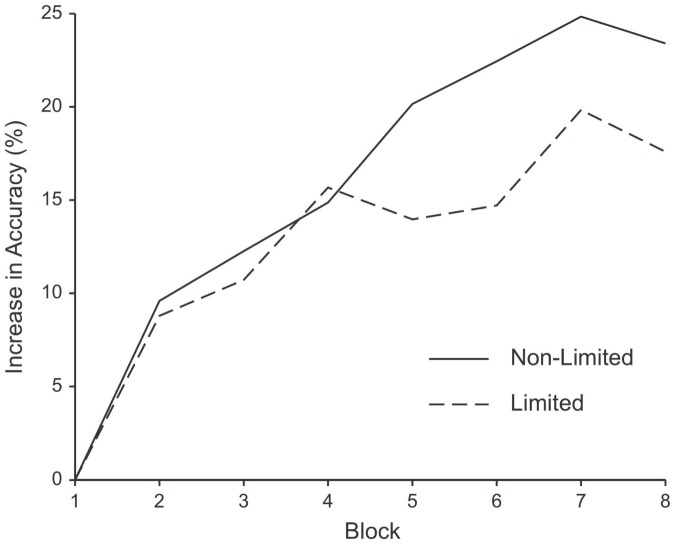
Beliefs about whether willpower is limited or non-limited affected sustained learning on a demanding working-memory task. Participants primed with a non-limited theory kept improving over the full task, whereas those primed with a limited theory stopped improving in the second half.
Key findings
- Initial accuracy did not differ by condition: intercept effect \(b = .066\), \(SE = .052\), \(p = .206\).
- Both groups improved similarly in the first half of trials: limited \(b = .045\), \(SE = .007\), \(p < .001\); non-limited \(b = .042\), \(SE = .009\), \(p < .001\); condition difference \(b = -.004\), \(SE = .012\), \(p = .777\).
- In the second half, condition significantly affected growth: \(b = .010\), \(SE = .005\), \(p = .040\). The limited group did not improve (\(b = .003\), \(SE = .003\), \(p = .412\)), while the non-limited group continued to improve (\(b = .013\), \(SE = .003\), \(p < .001\)).
- Only participants led to view willpower as non-limited sustained learning for the entire 20-minute task.
Methods
- Fifty-six college students were randomly assigned to a “limited” or “non-limited” willpower condition.
- Implicit theories were manipulated with 8-item biased questionnaires; participants in each group showed strong agreement with their assigned items (\(M_{\text{limited}} = 3.27\), \(M_{\text{non-limited}} = 3.03\), scale midpoint = 2.50; one-sample \(ts > 6.80\), \(ps < 10^{-7}\)).
- The main task was a 20-minute, 540-trial spatial 3-back task. Learning was measured as improvement in accuracy over time, analyzed with a two-piece linear growth model across eight equal-size trial blocks using Mplus 6.1.
Limitations
- The paper states that it did not determine whether or how long acquired information or skills are retained.
- The paper states that directionality is unresolved: it shows only a relative benefit of priming a non-limited theory versus a limited theory, not whether non-limited improves, limited undermines, or both.
- The paper states that it primed one theory rather than examining preexisting individual differences in willpower beliefs; evident from the text, the study also used a small college-student sample and a single short-term laboratory task.
Model-written summary. Check it against the paper before relying on it.
Integrity signals
Registry
Cites
Statistics
Figures
Verification
Claims the paper makes
0 Valid · 0 Not valid · 11 Not checked · 16 Own results and interpretations
A result the paper reports from its own data — it cites no other source for it, so there is none to check. The quote shows it is in the paper.
In the paper
“As predicted, beliefs about willpower did not affect accuracy or improvement during the initial phases of learning”
- Also stated in: § Results and Discussion · hedged
“We found no effect of condition on the intercept (b = .066, SE = .052, p = .206), indicating that participants in both conditions were equally accurate initially.”
§ Theories of Willpower Affect Sustained Learning > Abstract
plain- Asserted: passes — The authors put it forward as true.
- Checkable: passes — It can be checked against evidence.
- Load-bearing: passes — The paper’s conclusions depend on it.
- Based: passes — The paper gives a reason why it holds.
- Also stated in: § Results and Discussion · hedged
A result the paper reports from its own data — it cites no other source for it, so there is none to check. The quote shows it is in the paper.
In the paper
“However, we did find a significant effect of condition on growth across the second half of the trials (b = .010, SE = .005, p = .040).”
§ Theories of Willpower Affect Sustained Learning > Results and Discussion
plainstates an association- Asserted: passes — The authors put it forward as true.
- Checkable: passes — It can be checked against evidence.
- Load-bearing: passes — The paper’s conclusions depend on it.
- Based: passes — The paper gives a reason why it holds.
A result the paper reports from its own data — it cites no other source for it, so there is none to check. The quote shows it is in the paper.
In the paper
“Participants led to view willpower as limited did not improve during second half of trials (b = .003, SE = .003 p = .412)”
§ Theories of Willpower Affect Sustained Learning > Results and Discussion
plain- Asserted: passes — The authors put it forward as true.
- Checkable: passes — It can be checked against evidence.
- Load-bearing: passes — The paper’s conclusions depend on it.
- Based: passes — The paper gives a reason why it holds.
A result the paper reports from its own data — it cites no other source for it, so there is none to check. The quote shows it is in the paper.
In the paper
“In the first half of trials, participants in both the limited and non-limited groups demonstrated significant improvements in performance (limited: b = .045, SE = .007, p<.001; non-limited: b = .042, SE = .009, p<.001).”
§ Theories of Willpower Affect Sustained Learning > Results and Discussion
boosted- Asserted: passes — The authors put it forward as true.
- Checkable: passes — It can be checked against evidence.
- Load-bearing: passes — The paper’s conclusions depend on it.
- Based: passes — The paper gives a reason why it holds.
A result the paper reports from its own data — it cites no other source for it, so there is none to check. The quote shows it is in the paper.
In the paper
“In each group, participants expressed strong agreement with the items (Figure S1; M limited = 3.27, and M non-limited = 3.03; scale midpoint = 2.50), one-sample ts>6.80, ps<10−7).”
§ Theories of Willpower Affect Sustained Learning > Methods
boosted- Asserted: passes — The authors put it forward as true.
- Checkable: passes — It can be checked against evidence.
- Load-bearing: passes — The paper’s conclusions depend on it.
- Based: passes — The paper gives a reason why it holds.
12 more claims
Create a free account to see all 27 claims and to verify the 13 references still open.
- Probably not a substantial claim. 7
- It may state two separate claims as one. 3
Citations
Cites
Motivational beliefs, values, and goals
Eccles, J. S., & Wigfield, A. (2002) · Annual Review of Psychology · doi:10.1146/annurev.psych.53.100901.135153 · Cited by 7,587
Ego depletion: Is the active self a limited resource?
Baumeister, R. F., Bratslavsky, E., Muraven, M., & Tice, D. M. (1998) · Journal of Personality and Social Psychology · doi:10.1037//0022-3514.74.5.1252 · Cited by 5,312 · cited 1×
“The simple nature of the manipulation employed in this study suggests that beliefs about willpower can be easily modified by subtle input, at least in the short-term. This point is especially important given that much recent academic and popular literature claims that human willpower is inherently limited (e.g.,”
BackgroundBlackwell, L. S., Trzesniewski, K. H., & Dweck, C. S. (2007) · Child Development · doi:10.1111/j.1467-8624.2007.00995.x · Cited by 3,784
Self-citationImproving fluid intelligence with training on working memory
Jaeggi, S. M., Buschkuehl, M., Jonides, J., & Perrig, W. J. (2008) · Proceedings of the National Academy of Sciences · doi:10.1073/pnas.0801268105 · Cited by 2,187 · cited 1×
“, a modified n-back task) to increased fluid intelligence [12].”
BackgroundColquitt, J. A., LePine, J. A., & Noe, R. A. (2000) · Journal of Applied Psychology · doi:10.1037/0021-9010.85.5.678 · Cited by 2,126 · cited 1×
“, [7,8]) and highlight the interactive nature of motivational and cognitive processes by demonstrating that implicit theories about willpower can affect people’s ability to recruit cognitive resources to sustain learning over time.”
BackgroundEgo Depletion—Is It All in Your Head?: Implicit Theories About Willpower Affect Self-Regulation
Job, V., Dweck, C. S., & Walton, G. M. (2010) · Psychological Science · doi:10.1177/0956797610384745 · Cited by 910
Self-citationMolden, D. C., & Dweck, C. S. (2006) · American Psychologist · doi:10.1037/0003-066x.61.3.192 · Cited by 861 · cited 1×
“Recent findings have highlighted the pronounced role that implicit theories about the nature of intelligence and personality traits play in shaping behavior [2,3].”
BackgroundSelf-citationWillpower: rediscovering the greatest human strength
(2012) · Choice Reviews Online · doi:10.5860/choice.49-3547 · Cited by 617
Motivation, personal beliefs, and limited resources all contribute to self-control
Vohs, K. D., Baumeister, R. F., & Schmeichel, B. J. (2012) · Journal of Experimental Social Psychology · doi:10.1016/j.jesp.2012.03.002 · Cited by 239
Li, F., Duncan, T. E., & Hops, H. (2001) · Journal of Studies on Alcohol · doi:10.15288/jsa.2001.62.199 · Cited by 141
Cited by
Müller, T., & Apps, M. A. J. (2019) · Neuropsychologia · doi:10.1016/j.neuropsychologia.2018.04.030 · Cited by 229
A dual‐systems perspective on addiction: contributions from neuroimaging and cognitive training
McClure, S. M., & Bickel, W. K. (2014) · Annals of the New York Academy of Sciences · doi:10.1111/nyas.12561 · Cited by 196
Self-citationHow Poverty Affects Classroom Engagement.
Jensen, E. (2013) · Educational leadership · Cited by 194
Implicit theories about willpower predict self-regulation and grades in everyday life.
Job, V., Walton, G. M., Bernecker, K., & Dweck, C. S. (2015) · Journal of Personality and Social Psychology · doi:10.1037/pspp0000014 · Cited by 191
Self-citationHongsuchon, T., Emary, I. M. M. E., Hariguna, T., & Qhal, E. M. A. (2022) · Sustainability · doi:10.3390/su14052570 · Cited by 118
Metadata
- Authors
- Miller, E. M., Walton, G. M., Dweck, C. S., Job, V., Trzesniewski, K. H., & McClure, S. M.
- Affiliations
- Stanford University (US)
- University of Zurich (CH)
- University of California, Davis (US)
- Corresponding author
- Miller, Eric M.
- Venue
- PLoS ONE
- Publisher
- Public Library of Science (PLoS)
- Published
- 2012-06-22
- Volume
- 7
- Issue
- 6
- Pages
- e38680
- ISSN
- 1932-6203 (ISSN-L)
- PMC
- PMC3382137
- OpenAlex
- W2092284648
- Cited by
- 88
- References
- 13
- Citations by year
- 2026: 3 · 2025: 3 · 2024: 4 · 2023: 6 · 2022: 4 · 2021: 4 · 2020: 6 · 2019: 8 · 2018: 13 · 2017: 11 · 2016: 11 · 2015: 9 · 2014: 3 · 2013: 3
- FWCI
- 5.19
- Type
- journal article
- Language
- en
- Open access
- gold
- doi.org
- Locations
- PLoS ONE (publishedVersion, cc-by)
- Europe PMC (PubMed Central) (publishedVersion, cc-by)
- PubMed Central (publishedVersion, cc-by)
- PubMed (publishedVersion)
- RePEc: Research Papers in Economics (submittedVersion)
- DOAJ (DOAJ: Directory of Open Access Journals) (submittedVersion)
- Figshare (submittedVersion, cc-by)
- Topics
- Social Sciences › Psychology › Applied Psychology › Behavioral Health and Interventions
- Social Sciences › Psychology › Social Psychology › Grit, Self-Efficacy, and Motivation
- Social Sciences › Psychology › Developmental and Educational Psychology › Education, Achievement, and Giftedness
- Keywords
- willpower, sustained learning, motivation, cognitive resources, task persistence, metacognition
- MeSH terms
- Cognition, Humans, Learning, Motivation
About these checks
Registry, retraction, Cites and statistics results are computed, not judged, with one exception: a printed reference that no index lists is read once by a model before it counts as a citation error. Claims are extracted by a model and kept only when their quote appears verbatim in the text; each cited source is then checked, with a model’s help, for whether it says what the claim relies on. Those verdicts can be wrong — read the claim’s quote and the cited source before relying on one.
A language model drew the claims from the paper on 2026-11-24, under version 3 of the claim definition (model deepseek-v4.1-flash, prompt extract-v3).
A second model labelled each claim on 2026-11-24 (model jev-1.13-20260917, definition revision gold-guideline-v0.2).
Statistics and arithmetic are recomputed, not judged.
Confidence bands are shown only for fields calibrated on our annotated test set. None is calibrated yet, so no band is shown.
What counts as a claim ›How we measure confidence ›How we check this ›
Are you an author, or do you see a problem with this page? Request a review
How to cite
Cite CoChat for the checks on this page, and the paper for its own findings.
- This page
- CoChat. (2026). Citation check: Theories of Willpower Affect Sustained Learning. https://app.cochat.ai/papers/10.1371/journal.pone.0038680
- The paper
- Miller, E. M., Walton, G. M., Dweck, C. S., Job, V., Trzesniewski, K. H., & McClure, S. M. (2012). Theories of Willpower Affect Sustained Learning. PLoS ONE. https://doi.org/10.1371/journal.pone.0038680
Data sources
Bibliographic data: Semantic Scholar, OpenAlex, Crossref.
Contains information from the Semantic Scholar Academic Graph Datasets, made available under the ODC Attribution License (ODC-BY 1.0).
Semantic Scholar’s data is described in: Kinney, R., et al. (2023). The Semantic Scholar Open Data Platform. arXiv:2301.10140.
