

Theories of Willpower Affect Sustained Learning
Open accessThe DOI matches its Crossref record; 13 of the 13 references it cites were found in a registry or an index; none of the 14 sources its claims cite is checked for support yet.
Abstract
Building cognitive abilities often requires sustained engagement with effortful tasks. We demonstrate that beliefs about willpower-whether willpower is viewed as a limited or non-limited resource-impact sustained learning on a strenuous mental task. As predicted, beliefs about willpower did not affect accuracy or improvement during the initial phases of learning; however, participants who were led to view willpower as non-limited showed greater sustained learning over the full duration of the task. These findings highlight the interactive nature of motivational and cognitive processes: motivational factors can substantially affect people's ability to recruit their cognitive resources to sustain learning over time.
Overview
CoChat Summary
TL;DR
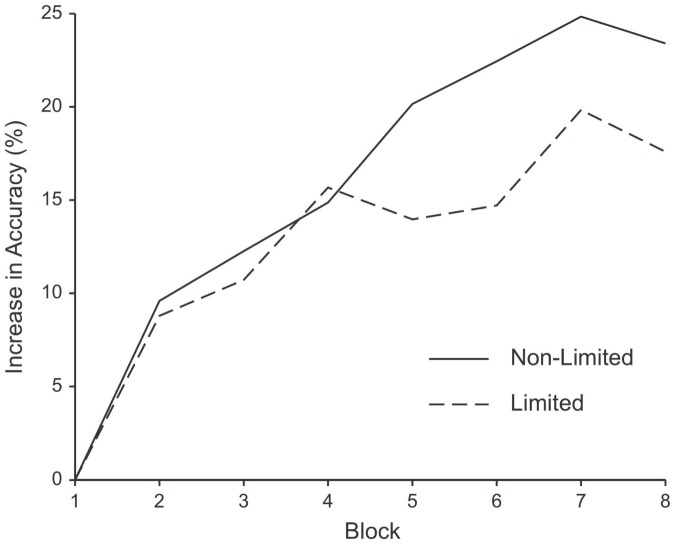
Beliefs about whether willpower is limited or non-limited affected sustained learning on a demanding working-memory task. Participants primed with a non-limited theory kept improving over the full task, whereas those primed with a limited theory stopped improving in the second half.
Key findings
- Initial accuracy did not differ by condition: intercept effect \(b = .066\), \(SE = .052\), \(p = .206\).
- Both groups improved similarly in the first half of trials: limited \(b = .045\), \(SE = .007\), \(p < .001\); non-limited \(b = .042\), \(SE = .009\), \(p < .001\); condition difference \(b = -.004\), \(SE = .012\), \(p = .777\).
- In the second half, condition significantly affected growth: \(b = .010\), \(SE = .005\), \(p = .040\). The limited group did not improve (\(b = .003\), \(SE = .003\), \(p = .412\)), while the non-limited group continued to improve (\(b = .013\), \(SE = .003\), \(p < .001\)).
- Only participants led to view willpower as non-limited sustained learning for the entire 20-minute task.
Methods
- Fifty-six college students were randomly assigned to a “limited” or “non-limited” willpower condition.
- Implicit theories were manipulated with 8-item biased questionnaires; participants in each group showed strong agreement with their assigned items (\(M_{\text{limited}} = 3.27\), \(M_{\text{non-limited}} = 3.03\), scale midpoint = 2.50; one-sample \(ts > 6.80\), \(ps < 10^{-7}\)).
- The main task was a 20-minute, 540-trial spatial 3-back task. Learning was measured as improvement in accuracy over time, analyzed with a two-piece linear growth model across eight equal-size trial blocks using Mplus 6.1.
Limitations
- The paper states that it did not determine whether or how long acquired information or skills are retained.
- The paper states that directionality is unresolved: it shows only a relative benefit of priming a non-limited theory versus a limited theory, not whether non-limited improves, limited undermines, or both.
- The paper states that it primed one theory rather than examining preexisting individual differences in willpower beliefs; evident from the text, the study also used a small college-student sample and a single short-term laboratory task.
Model-written summary. Check it against the paper before relying on it.
Integrity signals
Registry
Cites
Statistics
Figures
Verification
Claims the paper makes
0 Valid · 0 Not valid · 11 Not checked · 16 Own results and interpretations
A result the paper reports from its own data — it cites no other source for it, so there is none to check. The quote shows it is in the paper.
In the paper
“As predicted, beliefs about willpower did not affect accuracy or improvement during the initial phases of learning”
- Also stated in: § Results and Discussion · hedged
“We found no effect of condition on the intercept (b = .066, SE = .052, p = .206), indicating that participants in both conditions were equally accurate initially.”
§ Theories of Willpower Affect Sustained Learning > Abstract
plain- Asserted: passes — The authors put it forward as true.
- Checkable: passes — It can be checked against evidence.
- Load-bearing: passes — The paper’s conclusions depend on it.
- Based: passes — The paper gives a reason why it holds.
- Also stated in: § Results and Discussion · hedged
A result the paper reports from its own data — it cites no other source for it, so there is none to check. The quote shows it is in the paper.
In the paper
“However, we did find a significant effect of condition on growth across the second half of the trials (b = .010, SE = .005, p = .040).”
§ Theories of Willpower Affect Sustained Learning > Results and Discussion
plainstates an association- Asserted: passes — The authors put it forward as true.
- Checkable: passes — It can be checked against evidence.
- Load-bearing: passes — The paper’s conclusions depend on it.
- Based: passes — The paper gives a reason why it holds.
A result the paper reports from its own data — it cites no other source for it, so there is none to check. The quote shows it is in the paper.
In the paper
“Participants led to view willpower as limited did not improve during second half of trials (b = .003, SE = .003 p = .412)”
§ Theories of Willpower Affect Sustained Learning > Results and Discussion
plain- Asserted: passes — The authors put it forward as true.
- Checkable: passes — It can be checked against evidence.
- Load-bearing: passes — The paper’s conclusions depend on it.
- Based: passes — The paper gives a reason why it holds.
A result the paper reports from its own data — it cites no other source for it, so there is none to check. The quote shows it is in the paper.
In the paper
“In the first half of trials, participants in both the limited and non-limited groups demonstrated significant improvements in performance (limited: b = .045, SE = .007, p<.001; non-limited: b = .042, SE = .009, p<.001).”
§ Theories of Willpower Affect Sustained Learning > Results and Discussion
boosted- Asserted: passes — The authors put it forward as true.
- Checkable: passes — It can be checked against evidence.
- Load-bearing: passes — The paper’s conclusions depend on it.
- Based: passes — The paper gives a reason why it holds.
A result the paper reports from its own data — it cites no other source for it, so there is none to check. The quote shows it is in the paper.
In the paper
“In each group, participants expressed strong agreement with the items (Figure S1; M limited = 3.27, and M non-limited = 3.03; scale midpoint = 2.50), one-sample ts>6.80, ps<10−7).”
§ Theories of Willpower Affect Sustained Learning > Methods
boosted- Asserted: passes — The authors put it forward as true.
- Checkable: passes — It can be checked against evidence.
- Load-bearing: passes — The paper’s conclusions depend on it.
- Based: passes — The paper gives a reason why it holds.
12 more claims
Create a free account to see all 27 claims and to verify the 13 references still open.
- Probably not a substantial claim. 7
- It may state two separate claims as one. 3
Citations
Cites
Motivational beliefs, values, and goals
Eccles, J. S., & Wigfield, A. (2002) · Annual Review of Psychology · doi:10.1146/annurev.psych.53.100901.135153 · Cited by 7,587
Ego depletion: Is the active self a limited resource?
Baumeister, R. F., Bratslavsky, E., Muraven, M., & Tice, D. M. (1998) · Journal of Personality and Social Psychology · doi:10.1037//0022-3514.74.5.1252 · Cited by 5,312 · cited 1×
“The simple nature of the manipulation employed in this study suggests that beliefs about willpower can be easily modified by subtle input, at least in the short-term. This point is especially important given that much recent academic and popular literature claims that human willpower is inherently limited (e.g.,”
BackgroundBlackwell, L. S., Trzesniewski, K. H., & Dweck, C. S. (2007) · Child Development · doi:10.1111/j.1467-8624.2007.00995.x · Cited by 3,784
Self-citationImproving fluid intelligence with training on working memory
Jaeggi, S. M., Buschkuehl, M., Jonides, J., & Perrig, W. J. (2008) · Proceedings of the National Academy of Sciences · doi:10.1073/pnas.0801268105 · Cited by 2,187 · cited 1×
“, a modified n-back task) to increased fluid intelligence [12].”
BackgroundColquitt, J. A., LePine, J. A., & Noe, R. A. (2000) · Journal of Applied Psychology · doi:10.1037/0021-9010.85.5.678 · Cited by 2,126 · cited 1×
“, [7,8]) and highlight the interactive nature of motivational and cognitive processes by demonstrating that implicit theories about willpower can affect people’s ability to recruit cognitive resources to sustain learning over time.”
BackgroundEgo Depletion—Is It All in Your Head?: Implicit Theories About Willpower Affect Self-Regulation
Job, V., Dweck, C. S., & Walton, G. M. (2010) · Psychological Science · doi:10.1177/0956797610384745 · Cited by 910
Self-citationMolden, D. C., & Dweck, C. S. (2006) · American Psychologist · doi:10.1037/0003-066x.61.3.192 · Cited by 861 · cited 1×
“Recent findings have highlighted the pronounced role that implicit theories about the nature of intelligence and personality traits play in shaping behavior [2,3].”
BackgroundSelf-citationWillpower: rediscovering the greatest human strength
(2012) · Choice Reviews Online · doi:10.5860/choice.49-3547 · Cited by 617
Motivation, personal beliefs, and limited resources all contribute to self-control
Vohs, K. D., Baumeister, R. F., & Schmeichel, B. J. (2012) · Journal of Experimental Social Psychology · doi:10.1016/j.jesp.2012.03.002 · Cited by 239
Li, F., Duncan, T. E., & Hops, H. (2001) · Journal of Studies on Alcohol · doi:10.15288/jsa.2001.62.199 · Cited by 141
Cited by
Müller, T., & Apps, M. A. J. (2019) · Neuropsychologia · doi:10.1016/j.neuropsychologia.2018.04.030 · Cited by 229
A dual‐systems perspective on addiction: contributions from neuroimaging and cognitive training
McClure, S. M., & Bickel, W. K. (2014) · Annals of the New York Academy of Sciences · doi:10.1111/nyas.12561 · Cited by 196
Self-citationHow Poverty Affects Classroom Engagement.
Jensen, E. (2013) · Educational leadership · Cited by 194
Implicit theories about willpower predict self-regulation and grades in everyday life.
Job, V., Walton, G. M., Bernecker, K., & Dweck, C. S. (2015) · Journal of Personality and Social Psychology · doi:10.1037/pspp0000014 · Cited by 191
Self-citationHongsuchon, T., Emary, I. M. M. E., Hariguna, T., & Qhal, E. M. A. (2022) · Sustainability · doi:10.3390/su14052570 · Cited by 118
Changing theories of change: Strategic shifting in implicit theory endorsement.
Leith, S. A., Ward, C. L. P., Giacomin, M., Landau, E. S., Ehrlinger, J. M., & Wilson, A. E. (2014) · Journal of Personality and Social Psychology · doi:10.1037/a0037699 · Cited by 110
Job, V., Bernecker, K., Miketta, S., & Friese, M. (2015) · Journal of Personality and Social Psychology · doi:10.1037/pspp0000042 · Cited by 109
Self-citationHuber, S. E., Kiili, K., Nebel, S., Ryan, R. M., Sailer, M., & Ninaus, M. (2024) · Educational Psychology Review · doi:10.1007/s10648-024-09868-z · Cited by 85
McCarthy, M. H., Wood, J. V., & Holmes, J. G. (2017) · Journal of Personality and Social Psychology · doi:10.1037/pspi0000093 · Cited by 85
Bernecker, K., & Job, V. (2019) · British Journal of Psychology · doi:10.1111/bjop.12382 · Cited by 70
Self-citationJohnson, R. E., Lin, S., & Lee, H. W. (2018) · Advances in motivation science · doi:10.1016/bs.adms.2018.01.004 · Cited by 64
Implicit Theories About Willpower Predict Subjective Well‐Being
Bernecker, K., Herrmann, M., Brandstätter, V., & Job, V. (2015) · Journal of Personality · doi:10.1111/jopy.12225 · Cited by 62
Self-citationGame elements enhance engagement and mitigate attrition in online learning tasks
Huber, S. E., Cortez, R. L. A., Kiili, K. J. M., Lindstedt, A., & Ninaus, M. (2023) · Computers in Human Behavior · doi:10.1016/j.chb.2023.107948 · Cited by 58
Wang, C., Zhang, Y.-Y., & Chen, S. (2021) · Frontiers in Psychology · doi:10.3389/fpsyg.2021.573590 · Cited by 55
Francis, Z., & Job, V. (2018) · Social and Personality Psychology Compass · doi:10.1111/spc3.12381 · Cited by 40
Self-citationSELF-REGULATION AND SELF-REGULATORY CAPACITIES: COMPONENTS, LEVELS, MODELS
Ozhiganova, G. V. (2018) · Вестник Российского университета дружбы народов. Серия: Психология и педагогика · doi:10.22363/2313-1683-2018-15-3-255-270 · Cited by 48
No Pain, no Gain? Investigating motivational mechanisms of game elements in cognitive tasks
Bernecker, K., & Ninaus, M. (2021) · Computers in Human Behavior · doi:10.1016/j.chb.2020.106542 · Cited by 44
Preschoolers find ways to resist temptation after learning that willpower can be energizing
Haimovitz, K., Dweck, C. S., & Walton, G. M. (2019) · Developmental Science · doi:10.1111/desc.12905 · Cited by 42
Self-citationBernecker, K., & Job, V. (2015) · Frontiers in Psychology · doi:10.3389/fpsyg.2015.01496 · Cited by 42
Self-citationWilliams, J. M., Greenleaf, A. T., Barnes, E. F., & Scott, T. R. (2018) · Improving Schools · doi:10.1177/1365480218821501 · Cited by 38
Bernecker, K., & Job, V. (2015) · Basic and Applied Social Psychology · doi:10.1080/01973533.2015.1049348 · Cited by 37
Self-citationAutonomous Goal Striving Promotes a Nonlimited Theory About Willpower
Sieber, V., Flueckiger, L., Mata, J., Bernecker, K., & Job, V. (2019) · Personality and Social Psychology Bulletin · doi:10.1177/0146167218820921 · Cited by 37
Self-citationBucciol, A., Houser, D. E., & Piovesan, M. (2013) · PLoS ONE · doi:10.1371/journal.pone.0053713 · Cited by 36
Perceived Mental Fatigue and Self-Control
Clarkson, J. J., Otto, A. S., Hassey, R., & Hirt, E. R. (2016) · Elsevier eBooks · doi:10.1016/b978-0-12-801850-7.00010-x · Cited by 35
Proximate and Ultimate Causes of Ego Depletion
Francis, Z. L., & Inzlicht, M. (2016) · Elsevier eBooks · doi:10.1016/b978-0-12-801850-7.00018-4 · Cited by 31
Konze, A.-K., Rivkin, W., & Schmidt, K. (2018) · European Journal of Work and Organizational Psychology · doi:10.1080/1359432x.2018.1560269 · Cited by 31
Effortful experiences of self-control foster lay theories that self-control is limited
Klinger, J. A., Scholer, A. A., Hui, C. M., & Molden, D. C. (2018) · Journal of Experimental Social Psychology · doi:10.1016/j.jesp.2018.04.006 · Cited by 24
Shapcott, S., & Carr, S. (2020) · Motivation Science · doi:10.1037/mot0000154 · Cited by 22
Maio, S. D., Keller, J., Job, V., Felsenberg, D., Ertel, W., Schwarzer, R., & Knoll, N. (2020) · International Journal of Behavioral Medicine · doi:10.1007/s12529-020-09865-w · Cited by 17
Self-citationCompagnoni, M., Sieber, V., & Job, V. (2020) · Frontiers in Psychology · doi:10.3389/fpsyg.2020.601724 · Cited by 15
Self-citationWillpower as Cultural Construct: Do Chinese Students Believe Less in Its Depletion?
Sun, X., Cortina, K. S., Miller, K. F., & He, N. (2019) · Frontiers in Psychology · doi:10.3389/fpsyg.2019.00988 · Cited by 13
The Influence of Implicit Theories of Depression on Treatment-Relevant Attitudes
Zimmermann, M., Hmaidan, R., Preiser, B., & Papa, A. (2020) · Cognitive Therapy and Research · doi:10.1007/s10608-020-10120-5 · Cited by 13
The impact of social media overload on learning engagement: a moderated mediation model
Duan, N., Li, L., Kanchanapoom, K., Zhou, Q., & Xu, T. (2025) · BMC Psychology · doi:10.1186/s40359-025-03557-4 · Cited by 13
Ego depletion improves insight
DeCaro, M. S., & Stockum, C. A. V. (2017) · Thinking & Reasoning · doi:10.1080/13546783.2017.1396253 · Cited by 12
Petrocelli, J. V., Williams, S. A., & Clarkson, J. J. (2015) · Journal of Experimental Social Psychology · doi:10.1016/j.jesp.2015.01.004 · Cited by 12
Believe in your self-control: Lay theories of self-control and their downstream effects
Bermúdez, J. P., & Murray, S. (2024) · Current Opinion in Psychology · doi:10.1016/j.copsyc.2024.101879 · Cited by 11
Wisse, R. P. L., Coster, T., van der Schaaf, M. F., & ten Cate, O. (2017) · BMJ Simulation & Technology Enhanced Learning · doi:10.1136/bmjstel-2016-000137 · Cited by 11
Academic Success for the 21st Century Learner: Intrapersonal Intelligence and Resilience
Parker, J. L. (2016) · ScholarWorks (Walden University) · Cited by 9
Job, V., & Walton, G. M. (2017) · Springer eBooks · doi:10.1007/978-3-319-57306-9_3 · Cited by 8
Self-citationDetours increase local knowledge—Exploring the hidden benefits of self-control failure
Wiesner, C. D., Meyer, J., & Lindner, C. (2021) · PLoS ONE · doi:10.1371/journal.pone.0257717 · Cited by 8
Li, J., Gillebaart, M., & van Timmeren, T. (2024) · Current Opinion in Psychology · doi:10.1016/j.copsyc.2024.101898 · Cited by 7
Worick, C. E., Usher, E. L., Osterhage, J. L., Love, A. M. A., & Keller, P. S. (2023) · The Journal of Experimental Education · doi:10.1080/00220973.2023.2209861 · Cited by 7
Holding a silver lining theory: When negative attributes heighten performance
Wesnousky, A. E., Oettingen, G., & Gollwitzer, P. M. (2014) · Journal of Experimental Social Psychology · doi:10.1016/j.jesp.2014.11.001 · Cited by 7
Clocking in or Not? Optimal Design of a Novel Gamified Business Model in Online Learning
Gao, Y., Liu, D., & Kumar, S. (2023) · Information Systems Research · doi:10.1287/isre.2021.0138 · Cited by 6
Griffiths, K. (2017) · FedUni ResearchOnline (Federation University Australia) · Cited by 6
Konze, A.-K., Rivkin, W., & Schmidt, K. (2017) · Zeitschrift für Arbeitswissenschaft · doi:10.1007/s41449-017-0062-y · Cited by 6
Chislenko, E. (2023) · Synthese · doi:10.1007/s11229-023-04369-y · Cited by 6
Ryan, A. D. (2015) · DUNE - DigitalUNE (University of New England) · Cited by 5
İrade ve ahlaki bütünlüğün olumlu psikolojik çıktıları üzerine bir karma model araştırması
Okan, N. (2019) · Marmara University Open Access System · Cited by 5
Lau, Y. C. Y., Bryant, S., & Gullo, M. J. (2022) · Addictive Behaviors · doi:10.1016/j.addbeh.2022.107378 · Cited by 4
Perceptions of Employees and Supervisors of a Skills Training Program
Calcavecchi, L. T. (2018) · ScholarWorks (Walden University) · Cited by 4
Cuschieri, R. A. (2019) · Emerald Group Publishing Limited eBooks · doi:10.1108/978-1-78756-010-920191014 · Cited by 3
An Examination of Psychological Variables and Reading Achievement in Upper Elementary Students
Anderson, J. K. (2017) · Carolina Digital Repository (University of North Carolina at Chapel Hill) · doi:10.17615/71pq-mv45 · Cited by 3
The role of self-control in pro-environmental behaviour
Oniga, A. (2019) · St Andrews Research Repository (St Andrews Research Repository) · doi:10.17630/10023-19249 · Cited by 2
Remédiation cognitive dans le TDA/H
Fourneret, P. (2017) · doi:10.1016/b978-2-294-75006-9.00014-8 · Cited by 2
Implicit theories about willpower and their consequences for achievement, health, and well-being
Bernecker, K. (2016) · Zurich Open Repository and Archive (University of Zurich) · doi:10.5167/uzh-123239 · Cited by 2
Willpower and ego depletion: Useful constructs?
Dubner, D. (2016) · Cited by 2
Measuring Self-Control Beliefs: A Multidimensional and Domain-Specific Perspective
Bwalya, A., Koi, P., Rabagliati, H., & Chevalier, N. (2026) · Psychological Reports · doi:10.1177/00332941251415321 · Cited by 2
Tuyen, N. C. B. (2018) · HO CHI MINH CITY OPEN UNIVERSITY JOURNAL OF SCIENCE - SOCIAL SCIENCES · doi:10.46223/hcmcoujs.soci.en.8.2.285.2018 · Cited by 2
A Study of Semantic Processing Performance
Dever, D. A. (2017) · STARS (University of Central Florida) · Cited by 2
The effects of physical and mental foci on self-regulatory persistence
Egan, P. M. (2015) · IUScholarWorks (Indiana University) · Cited by 1
Workplace-based assessment in clinical radiology in the UK - a validity study
Page, M. (2016) · Stirling Online Research Repository (University of Stirling) · Cited by 1
E-learning efficiency of university students: evidence from Vietnam
Nguyen, P. D., Ca, D. M. T., & Anh, N. N. P. (2025) · International Journal of Information and Learning Technology · doi:10.1108/ijilt-05-2024-0093 · Cited by 1
Chai, M., Wan, W., Yan, S., & Lu, S. (2022) · African and Asian Studies · doi:10.1163/15692108-12341551 · Cited by 1
Beliefs About Self-Control and Regulation: Do They Matter for College Performance?
Worick, C. E. (2018) · UKnowledge (University of Kentucky) · doi:10.13023/etd.2018.285 · Cited by 1
Interpersonal Perceptions of Mental Fatigue Vary with Willpower Theories
Francis, Z. L. (2020) · TSpace (University of Toronto) · Cited by 1
Rigaud, K. (2024) · theses.fr (ABES) · doi:10.70675/b265bb94z671az4b88za44az8a0724d2a1f5 · Cited by 1
Intention and Normative Belief
Chislenko, E. (2016) · eScholarship (California Digital Library) · Cited by 1
Saving the environment? That is beyond my (will)power!
Jankowski, J. M., Mlynski, C., Prinz, T., & Job, V. (2026) · Motivation Science · doi:10.1037/mot0000379 · Cited by 1
Self-citationProcessos de gestió i regulació en matemàtiques a l'aula d'acollida de Secundària
Pérez, R., & del Carmen, A. (2016) · Dipòsit Digital de la Universitat de Barcelona (Universitat de Barcelona) · Cited by 1
Remédiation cognitive dans le TDAH de l’enfant et de l’adolescent
Gauld, C., Jurek, L., & Fourneret, P. (2023) · Elsevier eBooks · doi:10.1016/b978-2-294-78309-8.00025-2
Adaptive schools : investigating impact, continuity, and change in one school district.
Wheeler, W. C. (2016) · ThinkIR: The University of Louisville's Institutional Repository (University of Louisville) · doi:10.18297/etd/2463
Heine, A. (2022) · Psychologie in Bildung und Erziehung: vom Wissen zum Handeln · doi:10.1007/978-3-658-36260-7_5
The Effects of Depletion and Brain Stimulation on MotivationPreprint
Bell, S. B. (2018) · Thesis Commons (OSF Preprints) · doi:10.31237/osf.io/v2b7q
The Effects of Depletion and Brain Stimulation on Motivation
Bell, S. B. (2017) · UKnowledge (University of Kentucky) · doi:10.13023/etd.2017.154
Rietig, K. (2021) · SSRN Electronic Journal · doi:10.2139/ssrn.3912173
Learning Theory: The Power of Yet and Dreaming Big
Rietig, K. (2023) · Springer eBooks · doi:10.1007/978-3-031-41452-7_2
Predicting first year student success : an evaluation of assessment testing and self-efficacy
Herrin, B. (2013) · CSUN ScholarWorks (California State University, Northridge)
(2017) · Advances in higher education and professional development book series · doi:10.4018/978-1-5225-2271-3.ch001
Sun, H.-Y., Haiwuer, M., Pan, L., & Sun, H.-M. (2025) · The Journal of Social Psychology · doi:10.1080/00224545.2025.2567329
Towards a motivational alternative to the strength model of self-control
Lees, D. A. (2016)
Kelly, C. (2018) · Lancaster EPrints (Lancaster University) · doi:10.17635/lancaster/thesis/258
Understanding self-control: the role of metacognitive beliefs and strategy use
Bwalya, A. (2026) · ERA · doi:10.7488/era/7259
Zur dynamischen Entstehung psychischer Erschöpfung durch Selbstkontrolle bei der Arbeit
Konze, A.-K. (2019) · Technische Universität Dortmund Eldorado (Technische Universität Dortmund) · doi:10.17877/de290r-20030
Haidinger, E. (2018) · University Library Linz repository (Johannes Kepler Universitat Linz)
Testing the strength model of self-control: Does willpower resemble a muscle?
Fullerton, C. L. (2016) · Wolverhampton Intellectual Repository and E-Theses (University of Wolverhampton)
Vilensky, M. R. (2015) · OhioLink ETD Center (Ohio Library and Information Network)
Teko, L. (2021) · Nelson Mandela University Research Repository
Metadata
- Authors
- Miller, E. M., Walton, G. M., Dweck, C. S., Job, V., Trzesniewski, K. H., & McClure, S. M.
- Affiliations
- Stanford University (US)
- University of Zurich (CH)
- University of California, Davis (US)
- Corresponding author
- Miller, Eric M.
- Venue
- PLoS ONE
- Publisher
- Public Library of Science (PLoS)
- Published
- 2012-06-22
- Volume
- 7
- Issue
- 6
- Pages
- e38680
- ISSN
- 1932-6203 (ISSN-L)
- PMC
- PMC3382137
- OpenAlex
- W2092284648
- Cited by
- 88
- References
- 13
- Citations by year
- 2026: 3 · 2025: 3 · 2024: 4 · 2023: 6 · 2022: 4 · 2021: 4 · 2020: 6 · 2019: 8 · 2018: 13 · 2017: 11 · 2016: 11 · 2015: 9 · 2014: 3 · 2013: 3
- FWCI
- 5.19
- Type
- journal article
- Language
- en
- Open access
- gold
- doi.org
- Locations
- PLoS ONE (publishedVersion, cc-by)
- Europe PMC (PubMed Central) (publishedVersion, cc-by)
- PubMed Central (publishedVersion, cc-by)
- PubMed (publishedVersion)
- RePEc: Research Papers in Economics (submittedVersion)
- DOAJ (DOAJ: Directory of Open Access Journals) (submittedVersion)
- Figshare (submittedVersion, cc-by)
- Topics
- Social Sciences › Psychology › Applied Psychology › Behavioral Health and Interventions
- Social Sciences › Psychology › Social Psychology › Grit, Self-Efficacy, and Motivation
- Social Sciences › Psychology › Developmental and Educational Psychology › Education, Achievement, and Giftedness
- Keywords
- willpower, sustained learning, motivation, cognitive resources, task persistence, metacognition
- MeSH terms
- Cognition, Humans, Learning, Motivation
About these checks
Registry, retraction, Cites and statistics results are computed, not judged, with one exception: a printed reference that no index lists is read once by a model before it counts as a citation error. Claims are extracted by a model and kept only when their quote appears verbatim in the text; each cited source is then checked, with a model’s help, for whether it says what the claim relies on. Those verdicts can be wrong — read the claim’s quote and the cited source before relying on one.
A language model drew the claims from the paper on 2026-11-24, under version 3 of the claim definition (model deepseek-v4.1-flash, prompt extract-v3).
A second model labelled each claim on 2026-11-24 (model jev-1.13-20260917, definition revision gold-guideline-v0.2).
Statistics and arithmetic are recomputed, not judged.
Confidence bands are shown only for fields calibrated on our annotated test set. None is calibrated yet, so no band is shown.
What counts as a claim ›How we measure confidence ›How we check this ›
Are you an author, or do you see a problem with this page? Request a review
Data sources
Bibliographic data: Semantic Scholar, OpenAlex, Crossref.
Contains information from the Semantic Scholar Academic Graph Datasets, made available under the ODC Attribution License (ODC-BY 1.0).
Semantic Scholar’s data is described in: Kinney, R., et al. (2023). The Semantic Scholar Open Data Platform. arXiv:2301.10140.
