

The DOI matches its Crossref record; 36 of the 36 references it cites were found in a registry or an index.
Giving Leads to Happiness in Young Children
Open accessAbstract
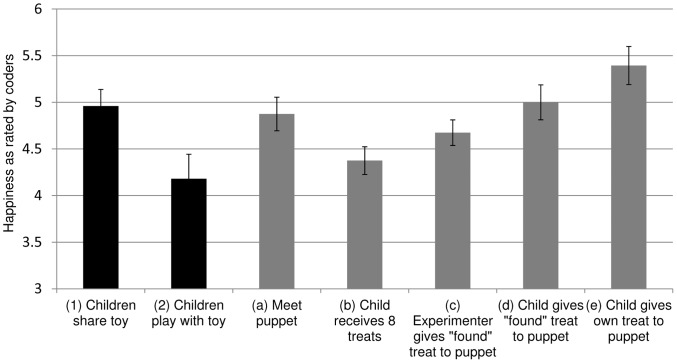
Evolutionary models of cooperation require proximate mechanisms that sustain prosociality despite inherent costs to individuals. The "warm glow" that often follows prosocial acts could provide one such mechanism; if so, these emotional benefits may be observable very early in development. Consistent with this hypothesis, the present study finds that before the age of two, toddlers exhibit greater happiness when giving treats to others than receiving treats themselves. Further, children are happier after engaging in costly giving--forfeiting their own resources--than when giving the same treat at no cost. By documenting the emotionally rewarding properties of costly prosocial behavior among toddlers, this research provides initial support for the claim that experiencing positive emotions when giving to others is a proximate mechanism for human cooperation.
Overview
The claims and statistics of this paper haven’t been checked yet.
Run the check — free, no account needed. It reads the open-access text and checks the sources it cites.
Integrity signals
Registry
Cites
Statistics
Figures

Verification
Claims the paper makes
The claims and statistics of this paper haven’t been checked yet.
Run the check — free, no account needed. It reads the open-access text and checks the sources it cites.
Claims other papers make about this one
Each is checked against this paper’s own text: does it say what the citing paper says it does?
The source backs part of the claim, not all of it — or backs it for a different population, condition or comparison.
In the citing paper
“Likewise, toddlers and preschoolers display positive emotions when acting prosocially (Aknin, Hamlin, & Dunn, 2012; Ross, 2017).”
From Emotion understanding and the moral self-concept as motivators of prosocial behavior in middle childhood (2020) · cites this paper as Aknin et al., 2012
Experimental — accuracy not yet measured
Self-check
Percentages, sums and reported differences re-computed from the paper’s own numbers.
The self-check needs the paper’s full text.
Citations
Cites
Axelrod, R., & Hamilton, W. D. (1981) · Science · doi:10.1126/science.7466396 · Cited by 20,065
Fredrickson, B. L. (2001) · American Psychologist · doi:10.1037//0003-066x.56.3.218 · Cited by 18,025
The benefits of frequent positive affect: Does happiness lead to success?
Lyubomirsky, S., King, L., & Diener, E. (2005) · Psychological Bulletin · doi:10.1037/0033-2909.131.6.803 · Cited by 7,143
Five Rules for the Evolution of Cooperation
Nowak, M. A. (2006) · Science · doi:10.1126/science.1133755 · Cited by 5,894
Altruistic punishment in humans
Fehr, E., & Gächter, S. (2002) · Nature · doi:10.1038/415137a · Cited by 5,616
Skinner, B. F. (1938) · Cited by 3,571
Fehr, E., & Fischbacher, U. (2003) · Nature · doi:10.1038/nature02043 · Cited by 3,475 · cited 1×
“Indeed, human survival and flourishing have depended on our species’ ability to work together to achieve feats that could not be achieved alone, such as hunting large prey and building shelter in inhospitable regions [1].”
BackgroundPositive affect facilitates creative problem solving.
Isen, A. M., Daubman, K. A., & Nowicki, G. P. (1987) · Journal of Personality and Social Psychology · doi:10.1037/0022-3514.52.6.1122 · Cited by 2,986
Evolution of indirect reciprocity
Nowak, M. A., & Sigmund, K. (2005) · Nature · doi:10.1038/nature04131 · Cited by 2,762
Altruistic Helping in Human Infants and Young Chimpanzees
Warneken, F., & Tomasello, M. (2006) · Science · doi:10.1126/science.1121448 · Cited by 1,743
Cited by
Sorted by citations
Freeman, D. H., Loe, B. S., Chadwick, A., Vaccari, C., Waite, F., Rosebrock, L. E., Jenner, L., Petit, A., Lewandowsky, S., Vanderslott, S., et al. (2020) · Psychological Medicine · doi:10.1017/s0033291720005188 · Cited by 802
Curry, O. S., Rowland, L. A., Van Lissa, C. J., Zlotowitz, S., McAlaney, J., & Whitehouse, H. (2018) · Journal of Experimental Social Psychology · doi:10.1016/j.jesp.2018.02.014 · Cited by 528
Moral Judgment and Action in Preverbal Infants and Toddlers
Hamlin, J. K. (2013) · Current Directions in Psychological Science · doi:10.1177/0963721412470687 · Cited by 444
Self-citationLayous, K., Nelson, S. K., Oberle, E., Schonert-Reichl, K., & Lyubomirsky, S. (2012) · PLoS ONE · doi:10.1371/journal.pone.0051380 · Cited by 388
Nelson, S. K., Layous, K., Cole, S. W., & Lyubomirsky, S. (2016) · Emotion · doi:10.1037/emo0000178 · Cited by 356
Metadata
- Authors
- Aknin, L. B., Hamlin, J. K., & Dunn, E. W.
- Affiliations
- University of British Columbia (CA)
- Corresponding author
- Aknin, Lara B.
- Venue
- PLoS ONE
- Publisher
- Public Library of Science (PLoS)
- Published
- 2012-06-14
- Volume
- 7
- Issue
- 6
- Pages
- e39211
- ISSN
- 1932-6203 (ISSN-L)
- PMC
- PMC3375233
- OpenAlex
- W2081113617
- Cited by
- 304
- References
- 36
- Citations by year
- 2026: 14 · 2025: 14 · 2024: 16 · 2023: 22 · 2022: 43 · 2021: 28 · 2020: 30 · 2019: 23 · 2018: 14 · 2017: 32 · 2016: 19 · 2015: 23 · 2014: 18 · 2013: 5 · 2012: 3
- FWCI
- 31.56
- Type
- journal article
- Language
- en
- Open access
- gold
- doi.org
- Locations
- PLoS ONE (publishedVersion, cc-by)
- PubMed Central (publishedVersion, cc-by)
- PubMed (publishedVersion)
- DOAJ (DOAJ: Directory of Open Access Journals) (submittedVersion, cc-by-sa)
- Funders
- Social Sciences and Humanities Research Council of Canada
- Topics
- Social Sciences › Psychology › Developmental and Educational Psychology › Child and Animal Learning Development
- Social Sciences › Sociology and Political Science › Evolutionary Game Theory and Cooperation
- Social Sciences › Economics, Econometrics and Finance › Economics and Econometrics › Experimental Behavioral Economics Studies
- Keywords
- warm glow giving, prosocial behavior, happiness, toddlers, cooperation, early childhood development
- MeSH terms
- Altruism, Analysis of Variance, Child, Preschool, Female, Happiness, Humans, Male
About these checks
Registry, retraction, Cites and statistics results are computed, not judged, with one exception: a printed reference that no index lists is read once by a model before it counts as a citation error. Claims are extracted by a model and kept only when their quote appears verbatim in the text; each cited source is then checked, with a model’s help, for whether it says what the claim relies on. Those verdicts can be wrong — read the claim’s quote and the cited source before relying on one.
Statistics and arithmetic are recomputed, not judged.
Confidence bands are shown only for fields calibrated on our annotated test set. None is calibrated yet, so no band is shown.
What counts as a claim ›How we measure confidence ›How we check this ›
Are you an author, or do you see a problem with this page? Request a review
