

The DOI matches its Crossref record; 36 of the 36 references it cites were found in a registry or an index.
Giving Leads to Happiness in Young Children
Open accessAbstract
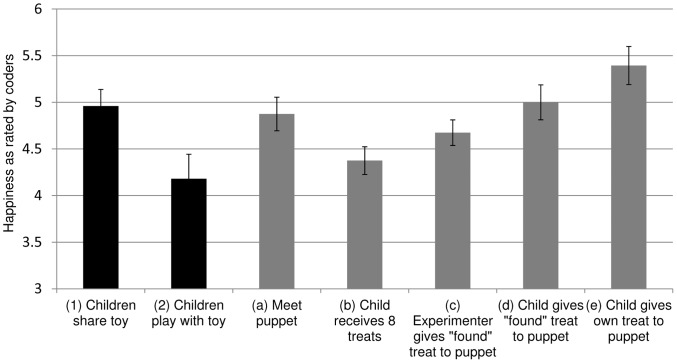
Evolutionary models of cooperation require proximate mechanisms that sustain prosociality despite inherent costs to individuals. The "warm glow" that often follows prosocial acts could provide one such mechanism; if so, these emotional benefits may be observable very early in development. Consistent with this hypothesis, the present study finds that before the age of two, toddlers exhibit greater happiness when giving treats to others than receiving treats themselves. Further, children are happier after engaging in costly giving--forfeiting their own resources--than when giving the same treat at no cost. By documenting the emotionally rewarding properties of costly prosocial behavior among toddlers, this research provides initial support for the claim that experiencing positive emotions when giving to others is a proximate mechanism for human cooperation.
Overview
The claims and statistics of this paper haven’t been checked yet.
Run the check — free, no account needed. It reads the open-access text and checks the sources it cites.
Integrity signals
Registry
Cites
Statistics
Figures

Verification
Claims the paper makes
The claims and statistics of this paper haven’t been checked yet.
Run the check — free, no account needed. It reads the open-access text and checks the sources it cites.
Claims other papers make about this one
Each is checked against this paper’s own text: does it say what the citing paper says it does?
The source backs part of the claim, not all of it — or backs it for a different population, condition or comparison.
In the citing paper
“Likewise, toddlers and preschoolers display positive emotions when acting prosocially (Aknin, Hamlin, & Dunn, 2012; Ross, 2017).”
From Emotion understanding and the moral self-concept as motivators of prosocial behavior in middle childhood (2020) · cites this paper as Aknin et al., 2012
Experimental — accuracy not yet measured
Self-check
Percentages, sums and reported differences re-computed from the paper’s own numbers.
The self-check needs the paper’s full text.
Citations
Cites
Axelrod, R., & Hamilton, W. D. (1981) · Science · doi:10.1126/science.7466396 · Cited by 20,065
Fredrickson, B. L. (2001) · American Psychologist · doi:10.1037//0003-066x.56.3.218 · Cited by 18,025
The benefits of frequent positive affect: Does happiness lead to success?
Lyubomirsky, S., King, L., & Diener, E. (2005) · Psychological Bulletin · doi:10.1037/0033-2909.131.6.803 · Cited by 7,143
Five Rules for the Evolution of Cooperation
Nowak, M. A. (2006) · Science · doi:10.1126/science.1133755 · Cited by 5,894
Altruistic punishment in humans
Fehr, E., & Gächter, S. (2002) · Nature · doi:10.1038/415137a · Cited by 5,616
Skinner, B. F. (1938) · Cited by 3,571
Fehr, E., & Fischbacher, U. (2003) · Nature · doi:10.1038/nature02043 · Cited by 3,475 · cited 1×
“Indeed, human survival and flourishing have depended on our species’ ability to work together to achieve feats that could not be achieved alone, such as hunting large prey and building shelter in inhospitable regions [1].”
BackgroundPositive affect facilitates creative problem solving.
Isen, A. M., Daubman, K. A., & Nowicki, G. P. (1987) · Journal of Personality and Social Psychology · doi:10.1037/0022-3514.52.6.1122 · Cited by 2,986
Evolution of indirect reciprocity
Nowak, M. A., & Sigmund, K. (2005) · Nature · doi:10.1038/nature04131 · Cited by 2,762
Altruistic Helping in Human Infants and Young Chimpanzees
Warneken, F., & Tomasello, M. (2006) · Science · doi:10.1126/science.1121448 · Cited by 1,743
Cited by
Sorted by citations
Freeman, D. H., Loe, B. S., Chadwick, A., Vaccari, C., Waite, F., Rosebrock, L. E., Jenner, L., Petit, A., Lewandowsky, S., Vanderslott, S., et al. (2020) · Psychological Medicine · doi:10.1017/s0033291720005188 · Cited by 802
Curry, O. S., Rowland, L. A., Van Lissa, C. J., Zlotowitz, S., McAlaney, J., & Whitehouse, H. (2018) · Journal of Experimental Social Psychology · doi:10.1016/j.jesp.2018.02.014 · Cited by 528
Moral Judgment and Action in Preverbal Infants and Toddlers
Hamlin, J. K. (2013) · Current Directions in Psychological Science · doi:10.1177/0963721412470687 · Cited by 444
Self-citationLayous, K., Nelson, S. K., Oberle, E., Schonert-Reichl, K., & Lyubomirsky, S. (2012) · PLoS ONE · doi:10.1371/journal.pone.0051380 · Cited by 388
Nelson, S. K., Layous, K., Cole, S. W., & Lyubomirsky, S. (2016) · Emotion · doi:10.1037/emo0000178 · Cited by 356
The Emerging Study of Positive Empathy
Morelli, S. A., Lieberman, M. D., & Zaki, J. (2015) · Social and Personality Psychology Compass · doi:10.1111/spc3.12157 · Cited by 387
Prosocial Spending and Happiness: Using Money to Benefit Others Pays Off
Dunn, E. W., Aknin, L. B., & Norton, M. I. (2014) · Current Directions in Psychological Science · doi:10.1177/0963721413512503 · Cited by 334
Self-citationPositive feelings reward and promote prosocial behavior
Aknin, L. B., Van de Vondervoort, J. W., & Hamlin, J. K. (2018) · Current Opinion in Psychology · doi:10.1016/j.copsyc.2017.08.017 · Cited by 325
Self-citationSchmitt, M. T., Aknin, L. B., Axsen, J., & Shwom, R. (2017) · Ecological Economics · doi:10.1016/j.ecolecon.2017.07.007 · Cited by 275
Self-citationProsocial behavior leads to happiness in a small-scale rural society.
Aknin, L. B., Broesch, T., Hamlin, J. K., & de Vondervoort, J. W. V. (2015) · Journal of Experimental Psychology General · doi:10.1037/xge0000082 · Cited by 246
Self-citationMaking a difference matters: Impact unlocks the emotional benefits of prosocial spending
Aknin, L. B., Dunn, E. W., Whillans, A. V., Grant, A. M., & Norton, M. I. (2013) · Journal of Economic Behavior & Organization · doi:10.1016/j.jebo.2013.01.008 · Cited by 222
Self-citationSocial Motivation: Costs and Benefits of Selfishness and Otherishness
Crocker, J., Canevello, A., & Brown, A. A. (2016) · Annual Review of Psychology · doi:10.1146/annurev-psych-010416-044145 · Cited by 233
Positive Empathy and Prosocial Behavior: A Neglected Link
Telle, N.-T., & Pfister, H. (2015) · Emotion Review · doi:10.1177/1754073915586817 · Cited by 216
On the Benefits of Giving Social Support
Inagaki, T. K., & Orehek, E. (2017) · Current Directions in Psychological Science · doi:10.1177/0963721416686212 · Cited by 203
The development of generosity and moral cognition across five cultures
Cowell, J. M., Lee, K., Malcolm‐Smith, S., Selçuk, B., Zhou, X., & Decety, J. (2016) · Developmental Science · doi:10.1111/desc.12403 · Cited by 166
How does happiness relate to economic behaviour? A review of the literature
Lane, T. (2017) · Journal of Behavioral and Experimental Economics · doi:10.1016/j.socec.2017.04.001 · Cited by 148
Martin, A., & Olson, K. R. (2015) · Perspectives on Psychological Science · doi:10.1177/1745691615568998 · Cited by 141
Luthar, S. S., & Eisenberg, N. (2017) · Child Development · doi:10.1111/cdev.12737 · Cited by 147
The Moral brain: a multidisciplinary perspective
Decety, J., & Wheatley, T. (2015) · Choice Reviews Online · doi:10.5860/choice.192126 · Cited by 110
Helping and Happiness: A Review and Guide for Public Policy
Aknin, L. B., & Whillans, A. V. (2020) · Social Issues and Policy Review · doi:10.1111/sipr.12069 · Cited by 128
Self-citationMogilner, C., & Norton, M. I. (2015) · Current Opinion in Psychology · doi:10.1016/j.copsyc.2015.10.018 · Cited by 105
Experimental manipulation of extraverted and introverted behavior and its effects on well-being.
Margolis, S., & Lyubomirsky, S. (2019) · Journal of Experimental Psychology General · doi:10.1037/xge0000668 · Cited by 105
Expanding the social science of happiness
Helliwell, J. F., & Aknin, L. B. (2018) · Nature Human Behaviour · doi:10.1038/s41562-018-0308-5 · Cited by 116
Self-citationPutra, I. G. N. E., Astell-Burt, T., Cliff, D. P., Vella, S. A., John, E. E., & Feng, X. (2020) · Frontiers in Psychology · doi:10.3389/fpsyg.2020.00859 · Cited by 102
Oliveira, R., Arriaga, P., Santos, F. P., Mascarenhas, S. F., & Paiva, A. (2020) · Computers in Human Behavior · doi:10.1016/j.chb.2020.106547 · Cited by 108
Prosocial behavior promotes positive emotion during the COVID-19 pandemic.
Varma, M. M., Chen, D., Lin, X., Aknin, L. B., & Hu, X. (2022) · Emotion · doi:10.1037/emo0001077 · Cited by 106
Self-citationMartela, F., & Ryan, R. M. (2020) · Motivation and Emotion · doi:10.1007/s11031-019-09800-x · Cited by 85
Sandstrom, G. M., & Boothby, E. J. (2020) · Self and Identity · doi:10.1080/15298868.2020.1816568 · Cited by 81
Social Capital and Prosocial Behaviour as Sources of Well-Being
Helliwell, J. F., Aknin, L. B., Shiplett, H., Huang, H., & Wang, S. (2017) · National Bureau of Economic Research · doi:10.3386/w23761 · Cited by 76
Self-citationPreschoolers’ generosity increases with understanding of the affective benefits of sharing
Paulus, M., & Moore, C. (2017) · Developmental Science · doi:10.1111/desc.12417 · Cited by 77
Early prosocial development across cultures
Callaghan, T. C., & Corbit, J. D. (2017) · Current Opinion in Psychology · doi:10.1016/j.copsyc.2017.07.039 · Cited by 76
The Development of Inequity Aversion
Shaw, A., Choshen‐Hillel, S., & Caruso, E. M. (2016) · Psychological Science · doi:10.1177/0956797616660548 · Cited by 75
Selectivity in toddlers’ behavioral and emotional reactions to prosocial and antisocial others.
de Vondervoort, J. W. V., Aknin, L. B., Kushnir, T., Slevinsky, J., & Hamlin, J. K. (2017) · Developmental Psychology · doi:10.1037/dev0000404 · Cited by 73
Self-citationChristner, N., Pletti, C., & Paulus, M. (2020) · Cognitive Development · doi:10.1016/j.cogdev.2020.100893 · Cited by 71
Vaish, A., Hepach, R., & Tomasello, M. (2017) · Journal of Experimental Child Psychology · doi:10.1016/j.jecp.2017.11.005 · Cited by 72
The fulfillment of others’ needs elevates children’s body posture.
Hepach, R., Vaish, A., & Tomasello, M. (2016) · Developmental Psychology · doi:10.1037/dev0000173 · Cited by 73
Węziak‐Białowolska, D., Białowolski, P., VanderWeele, T. J., & McNeely, E. (2020) · American Journal of Health Promotion · doi:10.1177/0890117120964083 · Cited by 68
Oarga, C., Stavrova, O., & Fetchenhauer, D. (2015) · European Journal of Social Psychology · doi:10.1002/ejsp.2092 · Cited by 75
An Ecosocial Approach to Well-Being: A Solution to the Wicked Problems in the Era of Anthropocene
Salonen, A. O., & Konkka, J. (2015) · Foro de Educación · doi:10.14516/fde.2015.013.019.002 · Cited by 68
Erreygers, S., Vandebosch, H., Vranješ, I., Baillien, E., & Witte, H. D. (2018) · Journal of Happiness Studies · doi:10.1007/s10902-018-0003-2 · Cited by 76
Stifter, C., Augustine, M. E., & Dollar, J. (2020) · The Journal of Positive Psychology · doi:10.1080/17439760.2019.1695877 · Cited by 66
Putra, I. G. N. E., Astell‐Burt, T., Cliff, D. P., Vella, S. A., & Feng, X. (2020) · Environmental Research · doi:10.1016/j.envres.2020.110334 · Cited by 65
Fairness in Animals: Where to from Here?
Brosnan, S. F., & de Waal, F. Β. Μ. (2012) · Social Justice Research · doi:10.1007/s11211-012-0165-8 · Cited by 65
Happiness and Prosocial Behavior: An Evaluation of the Evidence
Aknin, L. B., Whillans, A. V., Norton, M. I., & Dunn, E. W. (2019) · Cited by 62
Self-citationHow Durable are Social Norms? Immigrant Trust and Generosity in 132 Countries
Helliwell, J. F., Wang, S., & Xu, J. (2015) · Social Indicators Research · doi:10.1007/s11205-015-1026-2 · Cited by 58
Goal-directed, habitual and Pavlovian prosocial behavior
GÄTMsiarz, F., & Crockett, M. J. (2015) · Frontiers in Behavioral Neuroscience · doi:10.3389/fnbeh.2015.00135 · Cited by 70
Conceptualizing sustainable consumption: toward an integrative framework
Giulio, A. D., Fischer, D., Schäfer, M., & Blättel‐Mink, B. (2014) · Sustainability Science Practice and Policy · doi:10.1080/15487733.2014.11908124 · Cited by 65
The Development of Prosocial Emotions
Vaish, A., & Hepach, R. (2019) · Emotion Review · doi:10.1177/1754073919885014 · Cited by 60
Why do infants help? A simple action reveals a complex phenomenon
Köster, M., & Kärtner, J. (2019) · Developmental Review · doi:10.1016/j.dr.2018.11.004 · Cited by 57
Altruistic behaviors relieve physical pain
Wang, Y., Ge, J., Zhang, H., Wang, H., & Xie, X. (2019) · Proceedings of the National Academy of Sciences · doi:10.1073/pnas.1911861117 · Cited by 58
Padilla‐Walker, L. M., & Fraser, A. M. (2014) · Journal of Adolescence · doi:10.1016/j.adolescence.2014.07.008 · Cited by 54
Rudimentary empathy in macaques’ social decision-making
Ballesta, S., & Duhamel, J. (2015) · Proceedings of the National Academy of Sciences · doi:10.1073/pnas.1504454112 · Cited by 57
Ekososiaalinen sivistys herättää luottamusta tulevaisuuteen
Salonen, A. O., & Brady, M. (2015) · Aikuiskasvatus · doi:10.33336/aik.94118 · Cited by 54
Simplicity and validity in infant research
Kominsky, J. F., Lucca, K., Thomas, A. J., Frank, M. C., & Hamlin, J. K. (2022) · Cognitive Development · doi:10.1016/j.cogdev.2022.101213 · Cited by 56
Self-citationTaxing behavioral control diminishes sharing and costly punishment in childhood
Steinbeis, N. (2016) · Developmental Science · doi:10.1111/desc.12492 · Cited by 54
Children’s Cognitive and Behavioral Reactions to an Autonomous Versus Controlled Social Robot Dog
Chernyak, N., & Gary, H. E. (2016) · Early Education and Development · doi:10.1080/10409289.2016.1158611 · Cited by 50
Putra, I. G. N. E., Astell‐Burt, T., Cliff, D. P., Vella, S. A., & Feng, X. (2021) · Urban forestry & urban greening · doi:10.1016/j.ufug.2021.127264 · Cited by 57
Happy Little Benefactor: Prosocial Behaviors Promote Happiness in Young Children From Two Cultures
Song, Y., Broekhuizen, M. L., & Dubas, J. S. (2020) · Frontiers in Psychology · doi:10.3389/fpsyg.2020.01398 · Cited by 49
Preschool Children's Anticipation of Recipients' Emotions Affects Their Resource Allocation
Paulus, M., & Moore, C. L. (2015) · Social Development · doi:10.1111/sode.12126 · Cited by 46
Villarroel, J. D., & Infante, G. (2013) · Journal of Biological Education · doi:10.1080/00219266.2013.837406 · Cited by 46
Developmental Differences in Prosocial Behavior Between Preschool and Late Elementary School
Flook, L., Zahn‐Waxler, C., & Davidson, R. J. (2019) · Frontiers in Psychology · doi:10.3389/fpsyg.2019.00876 · Cited by 51
The Emotional Rewards of Prosocial Spending Are Robust and Replicable in Large Samples
Aknin, L. B., Dunn, E. W., & Whillans, A. V. (2022) · Current Directions in Psychological Science · doi:10.1177/09637214221121100 · Cited by 47
Self-citationHappiness is from the soul: The nature and origins of our happiness concept.
Yang, F., Knobe, J., & Dunham, Y. C. (2020) · Journal of Experimental Psychology General · doi:10.1037/xge0000790 · Cited by 45
Happiness—Concept, Measurement and Promotion
Ng, Y. (2021) · Springer eBooks · doi:10.1007/978-981-33-4972-8 · Cited by 53
Social norms, happiness, and the environment: closing the circle
Helliwell, J. F. (2014) · Sustainability Science Practice and Policy · doi:10.1080/15487733.2014.11908126 · Cited by 42
Buying well‐being: Spending behavior and happiness
Aknin, L. B., Wiwad, D., & Hanniball, K. B. (2018) · Social and Personality Psychology Compass · doi:10.1111/spc3.12386 · Cited by 51
Self-citationCompassion-focused therapy with children and adolescents
Carona, C., Rijo, D., Salvador, C., Castilho, P., & Gilbert, P. (2017) · BJPsych Advances · doi:10.1192/apt.bp.115.015420 · Cited by 48
Life satisfaction and tax morale: The role of trust in government and cultural orientation
Ciziceno, M., & Pizzuto, P. (2022) · Journal of Behavioral and Experimental Economics · doi:10.1016/j.socec.2021.101824 · Cited by 61
Delayed negative effects of prosocial spending on happiness
Falk, A., & Graeber, T. W. (2020) · Proceedings of the National Academy of Sciences · doi:10.1073/pnas.1914324117 · Cited by 40
Prosocial deficits in behavioral variant frontotemporal dementia relate to reward network atrophy
Sturm, V. E., Perry, D. C., Wood, K., Hua, A. Y., Alcantar, O., Datta, S., Rankin, K. P., Rosen, H. J., Miller, B. L., & Kramer, J. H. (2017) · Brain and Behavior · doi:10.1002/brb3.807 · Cited by 41
Miles, A., Andiappan, M., Upenieks, L., & Orfanidis, C. (2021) · PLoS ONE · doi:10.1371/journal.pone.0245865 · Cited by 48
The Paradox of Wealthy Nations’ Low Adolescent Life Satisfaction
Rudolf, R., & Bethmann, D. (2022) · Journal of Happiness Studies · doi:10.1007/s10902-022-00595-2 · Cited by 40
The thermodynamic brain and the evolution of intellect: the role of mental energy
Déli, É., & Kisvárday, Z. F. (2020) · Cognitive Neurodynamics · doi:10.1007/s11571-020-09637-y · Cited by 36
An Interdisciplinary Perspective on the Origins of Concern for Others
Zahn‐Waxler, C., Schoen, A. J., & Decety, J. (2017) · Cambridge University Press eBooks · doi:10.1017/9781316271698.008 · Cited by 40
Prosocial spending and buying time: Money as a tool for increasing subjective well-being
Dunn, E. W., Whillans, A. V., Norton, M. I., & Aknin, L. B. (2019) · Advances in experimental social psychology · doi:10.1016/bs.aesp.2019.09.001 · Cited by 36
Self-citationMotives matter: The emotional consequences of recalled self- and other- focused prosocial acts
Wiwad, D., & Aknin, L. B. (2017) · Motivation and Emotion · doi:10.1007/s11031-017-9638-2 · Cited by 37
Self-citationShoshani, A. (2022) · Computers in Human Behavior · doi:10.1016/j.chb.2022.107546 · Cited by 41
Zhao, X., & Nicholas Epley, A. (2022) · Psychological Science · doi:10.1177/09567976221097615 · Cited by 35
de Leeuw, R. N. H., Kleemans, M., Rozendaal, E., Anschütz, D. J., & Buijzen, M. (2015) · Journal of Children and Media · doi:10.1080/17482798.2015.1089297 · Cited by 34
Anthropomorphism in comparative affective science: Advocating a mindful approach
Williams, L. A., Brosnan, S. F., & Clay, Z. (2020) · Neuroscience & Biobehavioral Reviews · doi:10.1016/j.neubiorev.2020.05.014 · Cited by 35
You, robot? The role of anthropomorphic emotion attributions in children’s sharing with a robot
Nijssen, S. R. R., Müller, B. C. N., Bosse, T., & Paulus, M. (2021) · International Journal of Child-Computer Interaction · doi:10.1016/j.ijcci.2021.100319 · Cited by 36
Putra, I. G. N. E., Astell‐Burt, T., Cliff, D. P., Vella, S. A., & Feng, X. (2021) · Journal of Environmental Psychology · doi:10.1016/j.jenvp.2021.101579 · Cited by 32
Zheng, X., Xie, F., & Ding, L. (2018) · Journal of Pacific Rim Psychology · doi:10.1017/prp.2017.14 · Cited by 31
Perkins, N., Sehmbi, T., & Smith, P. A. (2022) · Mindfulness · doi:10.1007/s12671-022-01925-4 · Cited by 39
Waugh, W. E., & Brownell, C. A. (2017) · Infancy · doi:10.1111/infa.12189 · Cited by 29
Transforming Pain With Prosocial Meaning: A Functional Magnetic Resonance Imaging Study
López‐Solà, M., Koban, L., & Wager, T. D. (2018) · Psychosomatic Medicine · doi:10.1097/psy.0000000000000609 · Cited by 29
Ng, S. H., & Diener, E. (2021) · The Journal of Positive Psychology · doi:10.1080/17439760.2021.1940250 · Cited by 29
Motivation Counts: Autonomous But Not Obligated Sharing Promotes Happiness in Preschoolers
Wu, Z., Zhang, Z., Guo, R., & Gros-Louis, J. J. (2017) · Frontiers in Psychology · doi:10.3389/fpsyg.2017.00867 · Cited by 31
Evidence for a developmental shift in the motivation underlying helping in early childhood
Hepach, R., Engelmann, J. M., Herrmann, E., Gerdemann, S. C., & Tomasello, M. (2022) · Developmental Science · doi:10.1111/desc.13253 · Cited by 28
Miles, A., Andiappan, M., Upenieks, L., & Orfanidis, C. (2022) · PLoS ONE · doi:10.1371/journal.pone.0272152 · Cited by 41
Downward Social Comparison Increases Life-Satisfaction in the Giving and Volunteering Context
Huang, Y. (2014) · Social Indicators Research · doi:10.1007/s11205-014-0849-6 · Cited by 29
Eisenberg, N., Zuffianò, A., & Spinrad, T. L. (2024) · Development and Psychopathology · doi:10.1017/s0954579424000063 · Cited by 27
To give or to take money? The effects of choice on prosocial spending and happiness
Moche, H., & Västfjäll, D. (2021) · The Journal of Positive Psychology · doi:10.1080/17439760.2021.1940248 · Cited by 33
Datu, J. A. D., Mateo, N. J., & Natale, S. (2022) · Child Psychiatry & Human Development · doi:10.1007/s10578-021-01299-z · Cited by 33
You and me: Investigating the role of self-evaluative emotion in preschool prosociality
Ross, J. (2017) · Journal of Experimental Child Psychology · doi:10.1016/j.jecp.2016.11.001 · Cited by 26
Empathy as a buffer: How empathy moderates the emotional effects on Preschoolers’ sharing
Guo, R., & Wu, Z. (2020) · British Journal of Psychology · doi:10.1111/bjop.12466 · Cited by 32
Prosocial Behavior and Empathy-Related Responding: Relations to Children’s Well-Being
Spinrad, T. L., & Eisenberg, N. (2017) · Springer eBooks · doi:10.1007/978-3-319-58763-9_18 · Cited by 34
Hepach, R., & Warneken, F. (2018) · Current Opinion in Psychology · doi:10.1016/j.copsyc.2018.02.001 · Cited by 26
How designers and marketers can work together to support consumers' happiness
Sääksjärvi, M., & Hellén, K. (2013) · Research Repository (Delft University of Technology) · Cited by 25
Ahı, B. (2017) · Journal of Baltic Science Education · doi:10.33225/jbse/17.16.32 · Cited by 25
Metadata
- Authors
- Aknin, L. B., Hamlin, J. K., & Dunn, E. W.
- Affiliations
- University of British Columbia (CA)
- Corresponding author
- Aknin, Lara B.
- Venue
- PLoS ONE
- Publisher
- Public Library of Science (PLoS)
- Published
- 2012-06-14
- Volume
- 7
- Issue
- 6
- Pages
- e39211
- ISSN
- 1932-6203 (ISSN-L)
- PMC
- PMC3375233
- OpenAlex
- W2081113617
- Cited by
- 304
- References
- 36
- Citations by year
- 2026: 14 · 2025: 14 · 2024: 16 · 2023: 22 · 2022: 43 · 2021: 28 · 2020: 30 · 2019: 23 · 2018: 14 · 2017: 32 · 2016: 19 · 2015: 23 · 2014: 18 · 2013: 5 · 2012: 3
- FWCI
- 31.56
- Type
- journal article
- Language
- en
- Open access
- gold
- doi.org
- Locations
- PLoS ONE (publishedVersion, cc-by)
- PubMed Central (publishedVersion, cc-by)
- PubMed (publishedVersion)
- DOAJ (DOAJ: Directory of Open Access Journals) (submittedVersion, cc-by-sa)
- Funders
- Social Sciences and Humanities Research Council of Canada
- Topics
- Social Sciences › Psychology › Developmental and Educational Psychology › Child and Animal Learning Development
- Social Sciences › Sociology and Political Science › Evolutionary Game Theory and Cooperation
- Social Sciences › Economics, Econometrics and Finance › Economics and Econometrics › Experimental Behavioral Economics Studies
- Keywords
- warm glow giving, prosocial behavior, happiness, toddlers, cooperation, early childhood development
- MeSH terms
- Altruism, Analysis of Variance, Child, Preschool, Female, Happiness, Humans, Male
About these checks
Registry, retraction, Cites and statistics results are computed, not judged, with one exception: a printed reference that no index lists is read once by a model before it counts as a citation error. Claims are extracted by a model and kept only when their quote appears verbatim in the text; each cited source is then checked, with a model’s help, for whether it says what the claim relies on. Those verdicts can be wrong — read the claim’s quote and the cited source before relying on one.
Statistics and arithmetic are recomputed, not judged.
Confidence bands are shown only for fields calibrated on our annotated test set. None is calibrated yet, so no band is shown.
What counts as a claim ›How we measure confidence ›How we check this ›
Are you an author, or do you see a problem with this page? Request a review
