

The DOI matches its Crossref record; 179 of the 179 references it cites were found in a registry or an index.
Alexithymia and the Processing of Emotional Facial Expressions (EFEs): Systematic Review, Unanswered Questions and Further Perspectives
Open accessAbstract
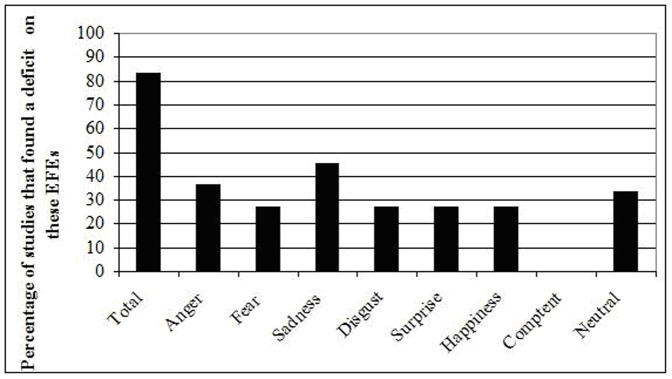
Alexithymia is characterized by difficulties in identifying, differentiating and describing feelings. A high prevalence of alexithymia has often been observed in clinical disorders characterized by low social functioning. This review aims to assess the association between alexithymia and the ability to decode emotional facial expressions (EFEs) within clinical and healthy populations. More precisely, this review has four main objectives: (1) to assess if alexithymia is a better predictor of the ability to decode EFEs than the diagnosis of clinical disorder; (2) to assess the influence of comorbid factors (depression and anxiety disorder) on the ability to decode EFE; (3) to investigate if deficits in decoding EFEs are specific to some levels of processing or task types; (4) to investigate if the deficits are specific to particular EFEs. Twenty four studies (behavioural and neuroimaging) were identified through a computerized literature search of Psycinfo, PubMed, and Web of Science databases from 1990 to 2010. Data on methodology, clinical characteristics, and possible confounds were analyzed. The review revealed that: (1) alexithymia is associated with deficits in labelling EFEs among clinical disorders, (2) the level of depression and anxiety partially account for the decoding deficits, (3) alexithymia is associated with reduced perceptual abilities, and is likely to be associated with impaired semantic representations of emotional concepts, and (4) alexithymia is associated with neither specific EFEs nor a specific valence. These studies are discussed with respect to processes involved in the recognition of EFEs. Future directions for research on emotion perception are also discussed.
Overview
The claims and statistics of this paper haven’t been checked yet.
Run the check — free, no account needed. It reads the open-access text and checks the sources it cites.
Integrity signals
Registry
Cites
Statistics
Figures
Verification
Claims the paper makes
The claims and statistics of this paper haven’t been checked yet.
Run the check — free, no account needed. It reads the open-access text and checks the sources it cites.
Claims other papers make about this one
Each is checked against this paper’s own text: does it say what the citing paper says it does?
The cited source says what the claim attributes to it.
In the citing paper
“alexithymia is associated with impaired abilities known to rely upon interoception, such as emotion regulation (Stasiewicz et al., 2012), emotion recognition (Grynberg et al., 2012), empathy (e.g. Enzi et al., 2016; Gleichgerrcht et al., 2015; Moriguchi et al., 2007a; Silani et al., 2008), reward processing (Bibby and Ferguson, 2011; Goerlich et al., 2016; Morie et al., 2016) and decision-making,”
From Atypical interoception as a common risk factor for psychopathology: A review (2021) · cites this paper as Grynberg et al., 2012
The cited source says what the claim attributes to it.
In the citing paper
“Alexithymia has been shown to predict performance on other tasks that require participants to match emotion words to faces (Grynberg et al., 2012), meaning that increased rates of alexithymia in ASD may explain the ASD impairment on the RMET if emotion recognition ability, rather than ToM, drives performance.”
From ‘Theory of Mind’ is not Theory of Emotion: a cautionary note on the reading the Mind in the Eyes test (2016) · cites this paper as Grynberg et al., 2012
Self-check
Percentages, sums and reported differences re-computed from the paper’s own numbers.
The self-check needs the paper’s full text.
Citations
Cites
Preferred Reporting Items for Systematic Reviews and Meta-Analyses: the PRISMA statement
Moher, D., Liberati, A., Tetzlaff, J., Altman, D. G., & for the PRISMA Group (2009) · BMJ · doi:10.1136/bmj.b2535 · Cited by 83,823
Preferred reporting items for systematic reviews and meta-analyses: the PRISMA Statement.
(2009) · PubMed Central · Cited by 44,859
Applied Multiple Regression/Correlation Analysis for the Behavioral Sciences
Cohen, P., Cohen, P., West, S. G., & Aiken, L. S. (2014) · Psychology Press eBooks · doi:10.4324/9781410606266 · Cited by 20,870
Preferred Reporting Items for Systematic Reviews and Meta-Analyses: The PRISMA Statement
Moher, D., Liberati, A., Tetzlaff, J., & Altman, D. G. (2009) · Journal of Clinical Epidemiology · doi:10.1016/j.jclinepi.2009.06.005 · Cited by 19,575
Journal of experimental psychology: Human Perception and performance
Jong, R. D., Coles, M. G. H., Logan, G. D., & Gratton, G. (1987) · Journal of Sound and Vibration · doi:10.1016/0022-460x(87)90423-8 · Cited by 5,411
Bagby, R. M., Parker, J. D. A., & Taylor, G. J. (1994) · Journal of Psychosomatic Research · doi:10.1016/0022-3999(94)90005-1 · Cited by 5,293
The distributed human neural system for face perception
Haxby, J. V., Hoffman, E. A., & Gobbini, M. I. (2000) · Trends in Cognitive Sciences · doi:10.1016/s1364-6613(00)01482-0 · Cited by 4,891
Applied Multiple Regression/Correlation Analysis for the Behavioral Sciences.
Fong, G. T., Cohen, J., & Cohen, P. R. (1985) · Journal of the American Statistical Association · doi:10.2307/2287930 · Cited by 4,610
Baron‐Cohen, S., Wheelwright, S., Hill, J., Raste, Y., & Plumb, I. (2001) · Journal of Child Psychology and Psychiatry · doi:10.1111/1469-7610.00715 · Cited by 4,555
Ekman, P. (1976) · Medical Entomology and Zoology · Cited by 4,345
Cited by
Sorted by citations
Oakley, B. F. M., Brewer, R., Bird, G., & Catmur, C. (2016) · Journal of Abnormal Psychology · doi:10.1037/abn0000182 · Cited by 431
Interoception and psychopathology: A developmental neuroscience perspective
Murphy, J., Brewer, R., Catmur, C., & Bird, G. (2017) · Developmental Cognitive Neuroscience · doi:10.1016/j.dcn.2016.12.006 · Cited by 404
Alexithymia: A general deficit of interoception
Brewer, R., Cook, R., & Bird, G. (2016) · Royal Society Open Science · doi:10.1098/rsos.150664 · Cited by 400
Neural correlates of alexithymia: A meta-analysis of emotion processing studies
van der Velde, J., Servaas, M. N., Goerlich, K. S., Bruggeman, R., Horton, P., Costafreda, S. G., & Aleman, A. (2013) · Neuroscience & Biobehavioral Reviews · doi:10.1016/j.neubiorev.2013.07.008 · Cited by 294
Brewer, R., Biotti, F., Catmur, C., Press, C., Happé, F., Cook, R., & Bird, G. (2016) · Autism Research · doi:10.1002/aur.1508 · Cited by 233
Metadata
- Authors
- Grynberg, D., Chang, B., Corneille, O., Maurage, P., Vermeulen, N., Berthoz, S., & Luminet, O.
- Affiliations
- UCLouvain (BE)
- Inserm (FR)
- Corresponding author
- Grynberg, Delphine
- ORCID
- Venue
- PLoS ONE
- Publisher
- Public Library of Science (PLoS)
- Published
- 2012-08-23
- Volume
- 7
- Issue
- 8
- Pages
- e42429
- ISSN
- 1932-6203 (ISSN-L)
- PMC
- PMC3426527
- OpenAlex
- W2017164168
- Cited by
- 305
- References
- 178
- Citations by year
- 2026: 12 · 2025: 23 · 2024: 22 · 2023: 18 · 2022: 22 · 2021: 24 · 2020: 32 · 2019: 33 · 2018: 25 · 2017: 24 · 2016: 18 · 2015: 23 · 2014: 16 · 2013: 13
- FWCI
- 2.24
- Type
- journal article
- Language
- en
- Open access
- gold
- doi.org
- Locations
- PLoS ONE (publishedVersion, cc-by)
- PubMed Central (publishedVersion, cc-by)
- PubMed (publishedVersion)
- HAL (submittedVersion)
- DIAL (Catholic University of Leuven) (submittedVersion, other-oa)
- DOAJ (DOAJ: Directory of Open Access Journals) (submittedVersion, cc-by-sa)
- Figshare (submittedVersion, cc-by)
- Funders
- Fonds De La Recherche Scientifique - FNRS
- Topics
- Health Sciences › Medicine › Psychiatry and Mental health › Psychosomatic Disorders and Their Treatments
- Life Sciences › Neuroscience › Cognitive Neuroscience › Face Recognition and Perception
- Social Sciences › Psychology › Experimental and Cognitive Psychology › Anxiety, Depression, Psychometrics, Treatment, Cognitive Processes
- Keywords
- alexithymia, emotional facial expressions, emotion perception, facial expression recognition, depression, anxiety disorders, comorbidities, emotion labeling, social functioning
- MeSH terms
- Affective Symptoms, Emotions, Facial Expression, Humans, Neuroimaging
About these checks
Registry, retraction, Cites and statistics results are computed, not judged, with one exception: a printed reference that no index lists is read once by a model before it counts as a citation error. Claims are extracted by a model and kept only when their quote appears verbatim in the text; each cited source is then checked, with a model’s help, for whether it says what the claim relies on. Those verdicts can be wrong — read the claim’s quote and the cited source before relying on one.
Statistics and arithmetic are recomputed, not judged.
Confidence bands are shown only for fields calibrated on our annotated test set. None is calibrated yet, so no band is shown.
What counts as a claim ›How we measure confidence ›How we check this ›
Are you an author, or do you see a problem with this page? Request a review
