

The DOI matches its Crossref record; 68 of the 68 references it cites were found in a registry or an index.
Dynamic Sounds Capture the Boundaries of Peripersonal Space Representation in Humans
Open accessAbstract
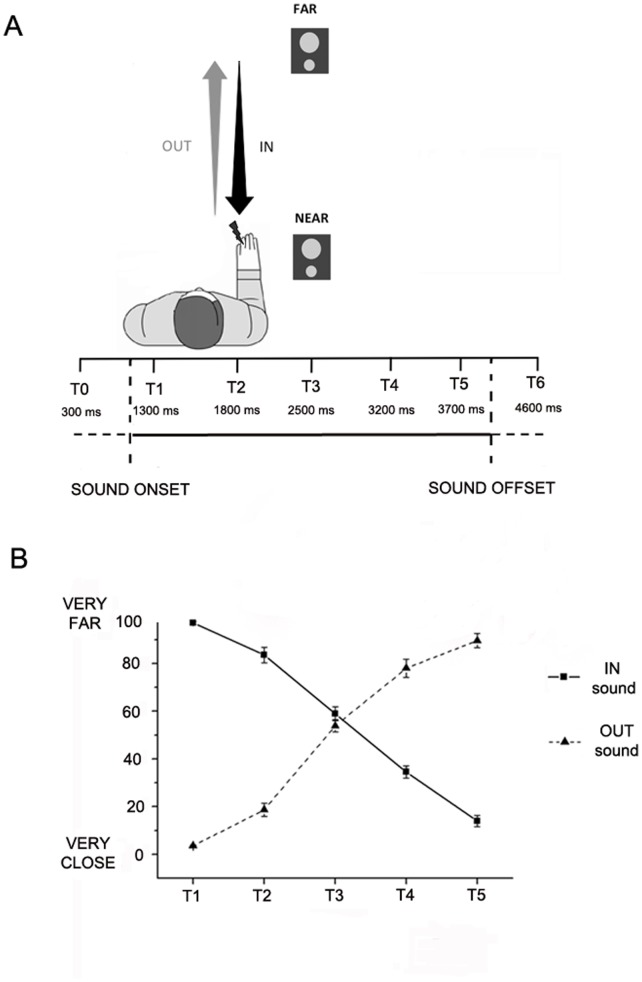
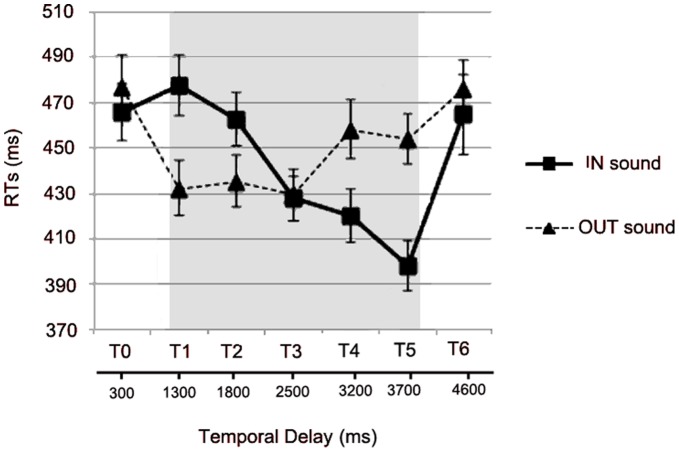
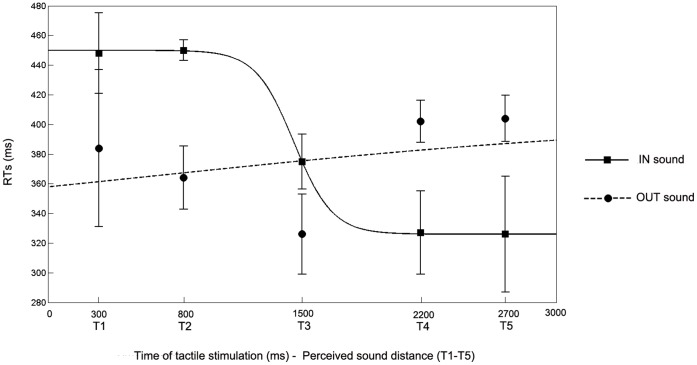
BACKGROUND: We physically interact with external stimuli when they occur within a limited space immediately surrounding the body, i.e., Peripersonal Space (PPS). In the primate brain, specific fronto-parietal areas are responsible for the multisensory representation of PPS, by integrating tactile, visual and auditory information occurring on and near the body. Dynamic stimuli are particularly relevant for PPS representation, as they might refer to potential harms approaching the body. However, behavioural tasks for studying PPS representation with moving stimuli are lacking. Here we propose a new dynamic audio-tactile interaction task in order to assess the extension of PPS in a more functionally and ecologically valid condition. METHODOLOGY/PRINCIPAL FINDINGS: Participants vocally responded to a tactile stimulus administered at the hand at different delays from the onset of task-irrelevant dynamic sounds which gave the impression of a sound source either approaching or receding from the subject's hand. Results showed that a moving auditory stimulus speeded up the processing of a tactile stimulus at the hand as long as it was perceived at a limited distance from the hand, that is within the boundaries of PPS representation. The audio-tactile interaction effect was stronger when sounds were approaching compared to when sounds were receding. CONCLUSION/SIGNIFICANCE: This study provides a new method to dynamically assess pps representation: The function describing the relationship between tactile processing and the position of sounds in space can be used to estimate the location of PPS boundaries, along a spatial continuum between far and near space, in a valuable and ecologically significant way.
Overview
The claims and statistics of this paper haven’t been checked yet.
Run the check — free, no account needed. It reads the open-access text and checks the sources it cites.
Integrity signals
Registry
Cites
Statistics
Figures
Verification
Claims the paper makes
The claims and statistics of this paper haven’t been checked yet.
Run the check — free, no account needed. It reads the open-access text and checks the sources it cites.
Claims other papers make about this one
Each is checked against this paper’s own text: does it say what the citing paper says it does?
In the citing paper
“We used an audio-tactile interaction task to identify the point in space where a looming sound speeded up tactile processing as a proxy of the boundaries of multisensory PPS (see Canzoneri et al., 2012; Canzoneri et al., 2013a; Canzoneri et al., 2013b; Teneggi et al., 2013, Noel et al., 2014).”
From Peripersonal space as the space of the bodily self (2015) · cites this paper as Canzoneri et al., 2012
Self-check
Percentages, sums and reported differences re-computed from the paper’s own numbers.
The self-check needs the paper’s full text.
Citations
Cites
Sound Localization by Human Listeners
Middlebrooks, J. C., & Green, D. M. (1991) · Annual Review of Psychology · doi:10.1146/annurev.ps.42.020191.001031 · Cited by 1,211
Complex Movements Evoked by Microstimulation of Precentral Cortex
Graziano, M. S. A., Taylor, C. S. R., & Moore, T. (2002) · Neuron · doi:10.1016/s0896-6273(02)00698-0 · Cited by 921
Coding of visual space by premotor neurons.
Graziano, M. S. A., Yap, G. S., & Gross, C. G. (1994) · Science · doi:10.1126/science.7973661 · Cited by 841
Afferent properties of periarcuate neurons in macaque monkeys. II. Visual responses.
Rizzolatti, G., Scandolara, C., Matelli, M., & Gentilucci, M. (1981) · Behavioural Brain Research · doi:10.1016/0166-4328(81)90053-x · Cited by 831
Polymodal Motion Processing in Posterior Parietal and Premotor Cortex
Bremmer, F., Schlack, A., Shah, N. J., Zafiris, O., Kubischik, M., Hoffmann, K.-P., Zilles, K., & Fink, G. R. (2001) · Neuron · doi:10.1016/s0896-6273(01)00198-2 · Cited by 803
Rizzolatti, G., Fadiga, L., Fogassi, L., & Gallese, V. (1997) · Science · doi:10.1126/science.277.5323.190 · Cited by 712
Ventral intraparietal area of the macaque: Anatomic location and visual response properties
Colby, C. L., Duhamel, J. R., & Goldberg, M. E. (1993) · Journal of Neurophysiology · doi:10.1152/jn.1993.69.3.902 · Cited by 701
Coding of peripersonal space in inferior premotor cortex (area F4).
Fogassi, L., Gallese, V., Fadiga, L., Luppino, G., Matelli, M., & Rizzolatti, G. (1996) · Journal of Neurophysiology · doi:10.1152/jn.1996.76.1.141 · Cited by 688 · cited 2×
“Second, this paradigm directly resembles the stimulations used in monkey neurophysiology to study PPS bimodal or trimodal neurons, where a visual or an auditory stimulus was presented, as approaching to or receding from the animal’s body part where the neuron’s tactile receptive field was located [6,8,9,11].”
BackgroundMethodParieto-frontal interactions, personal space, and defensive behavior
Graziano, M. S. A., & Cooke, D. F. (2006) · Neuropsychologia · doi:10.1016/j.neuropsychologia.2005.09.011 · Cited by 653
Spatial invariance of visual receptive fields in parietal cortex neurons
Duhamel, J., Bremmer, F., Hamed, S. B., & Graf, W. M. (1997) · Nature · doi:10.1038/39865 · Cited by 635
Cited by
Sorted by citations
Items 201–246 of 246
The Defensive Role of the Peripersonal Space in Social ContextsPreprint
Mustile, M., Borghi, A. M., Tommaso, D. D., & Wykowska, A. (2024) · doi:10.31234/osf.io/rbdgc · Cited by 1
Taffou, M. (2014) · theses.fr (ABES) · doi:10.70675/fa00368fz6279z418ez8f0az76c3b4493c9d · Cited by 4
Audiotactile interactions: psychophysical and neuroimaging approaches
Leonardelli, E. (2015) · Unitn-eprints PhD (University of Trento) · doi:10.15168/11572_368218
Individual differences in rapid spatial orientation across spatial frames of reference
Garcia, A. J., & Baldwin, C. L. (2016) · International Journal of Human Factors and Ergonomics · doi:10.1504/ijhfe.2016.076574
Newborns Are Sensitive to Impending Collision Within Their Peripersonal Space
Orioli, G., Filippetti, M. L., Gerbino, W., Dragovic, D., & Farroni, T. (2014) · OpenstarTs (Univeristy of Trieste https://www.units.it/) · doi:10.13140/2.1.3914.4006
Body part-centered and full body- centered peripersonal space
Noel, J., Galli, G., Canzoneri, E., & Marmaroli, P. (2015)
Self-citationMaternal brain gain: enlarged representation of the peripersonal space in pregnancyPreprint
Cardini, F., Fatemi-Ghomi, N., Gajewska‐Knapik, K., Gooch, V., & Aspell, J. E. (2018) · bioRxiv (Cold Spring Harbor Laboratory) · doi:10.1101/492017
Action planning and affective states within the auditory peripersonal spacePreprint
Bahadori, M., Barumerli, R., Geronazzo, M., & Cesari, P. (2020) · bioRxiv (Cold Spring Harbor Laboratory) · doi:10.1101/2020.08.04.236380
VR Setup to Assess Peripersonal Space Audio-Tactile 3D Boundaries
Lerner, F., Tahar, G., Bar, A., Koren, O., & Flash, T. (2021) · Frontiers in Virtual Reality · doi:10.3389/frvir.2021.644214 · Cited by 1
Avivi-Reich, M., Sran, R., & Schneider, B. A. (2022) · Frontiers in Psychology · doi:10.3389/fpsyg.2022.838576
Spiousas, I., Vergara, R. O., Lombera, E. N., & Etchemendy, P. E. (2023) · doi:10.31234/osf.io/9nfqz
Serino, A. (2023) · OSF Preprints (OSF Preprints) · doi:10.31219/osf.io/t5xfa
Self-citationOrioli, G., Dragovic, D., & Farroni, T. (2023) · doi:10.31234/osf.io/7u6hw
Back and front peripersonal space: behavioural and EMG evidence of top–down and bottom–up mechanisms
Cocchini, G., Müllensiefen, D., Platania, R., Niglio, C., Tricomi, E., Veronelli, L., & Judica, E. (2023) · Experimental Brain Research · doi:10.1007/s00221-023-06740-4 · Cited by 1
Charge cognitive et surdité attentionnelle : des pistes opérationnelles
Suied, C. (2025) · Revue Défense Nationale · doi:10.3917/rdna.hs16.0185
Themelis, L. Z., Konstantoulaki, A., Klein, C., Vatakis, A., & Smyrnis, N. (2025) · Experimental Brain Research · doi:10.1007/s00221-025-07088-7
Spiousas, I., Vergara, R. O., Lombera, E. N., & Etchemendy, P. E. (2025) · Attention Perception & Psychophysics · doi:10.3758/s13414-025-03071-0
Barumerli, R., Geronazzo, M., & Cesari, P. (2025) · bioRxiv (Cold Spring Harbor Laboratory) · doi:10.1101/2025.06.30.662313
Behavior-Relevant Periodized Neural Representation of Acoustic But Not Tactile Rhythm in Humans
Lenoir, C., Lenc, T., Polak, R., & Nozaradan, S. (2025) · Journal of Neuroscience · doi:10.1523/jneurosci.0664-25.2025 · Cited by 2
Revisiting tool use and distance perception: twenty years later
Boussard, L., Heurley, L., & Morgado, N. (2025) · Psychological Research · doi:10.1007/s00426-025-02194-1
Flockton, J. R., McCall, C., & Preston, C. (2025) · Frontiers in Behavioral Neuroscience · doi:10.3389/fnbeh.2025.1688172
Intact Audiovisual Spatial Integration in Autistic Children
Vassall, S. G., & Wallace, M. T. (2025) · Journal of Autism and Developmental Disorders · doi:10.1007/s10803-025-07124-z
Rastelli, F., Ferroni, F., Bianchi, F. P., Ferri, D., Gallese, V., & Ardizzi, M. (2026) · Journal of Environmental Psychology · doi:10.1016/j.jenvp.2026.103169
A Closed-loop Platform for the Embodiment of Supernumerary Robotic Limbs During Augmented Tasks
Iandoli, M., Deiana, D., Pinardi, M., Noccaro, A., Formica, D., & Pino, G. D. (2025) · Annual International Conference of the IEEE Engineering in Medicine and Biology Society (EMBC) · doi:10.1109/embc58623.2025.11254391
Peripersonal Space Perception Is Similar When We Interact With Other Humans or With Humanoid Robots
Mustile, M., Borghi, A. M., Tommaso, D. D., & Wykowska, A. (2026) · Quarterly Journal of Experimental Psychology · doi:10.1177/17470218251412245
LAMIA, P., Nafiseh, S., & Candidi, M. (2026) · Scientific Reports · doi:10.1038/s41598-026-36796-5
Mine, D., & Narumi, T. (2026) · Attention Perception & Psychophysics · doi:10.3758/s13414-026-03230-x
The farther, the earlier: perceived depth biases temporal order judgments
Li, B., & Qian, J. (2026) · Psychological Research · doi:10.1007/s00426-026-02282-w
The peripersonal space : a space to inter-act
Patané, I. (2018) · theses.fr (ABES) · doi:10.70675/65489b37z5297z4a85z96cczc535ef9ca767
Dimension sociale de l’espace péri-personnel des primates
Dureux, A. (2021) · theses.fr (ABES) · doi:10.70675/624f12eaz695fz4433zbd0aza56128110325
Peripersonal Space : hand-centred coding in perceptual and learning processes
Zanini, A. (2021) · theses.fr (ABES) · doi:10.70675/93b32e72z3792z4231z96ddz5621d33e348a
Gigliotti, M. F. (2022) · theses.fr (ABES) · doi:10.70675/a2b8f7c9z4edaz450fzbf14z3b83f785a770 · Cited by 1
Touch Through Sound: Ring-Mounted Auditory Pseudo-Haptics for Material Perception
Cai, Z., Wang, C., Wang, Y., Yu, J., Li, C., Jin, Z., & Gao, Y. (2026) · CHI Conference Extended Abstracts on Human Factors in Computing Systems (CHI EA) · doi:10.1145/3772363.3798554
Barumerli, R., Geronazzo, M., & Cesari, P. (2026) · Scientific Reports · doi:10.1038/s41598-026-48067-4
Duclermortier, R., Lavandier, M., & Perrin, F. (2026) · Hearing Research · doi:10.1016/j.heares.2026.109652
Salemme, R., Farnè, A., Koun, É., Patané, I., Brozzoli, C., Zanini, A., & Blini, E. (2021) · OSF Preprints (OSF Preprints)
Self-Prioritization is Grounded in Personal Space, Governed by Cultural Norms in Social SpacePreprint
Lu, Z., & Sui, J. (2026) · SSRN Electronic Journal · doi:10.2139/ssrn.6854029
Peripersonal space reflects self-orientation induced by visuo-vestibular stimulationPreprint
Wu, H.-P., Herbelin, B., Nakul, E., Lance, F., Vuarnesson, L., Bertoni, T., Serino, A., & Blanke, O. (2026) · SSRN Electronic Journal · doi:10.2139/ssrn.6948781
Self-citationInterpersonal motor coordination Modulates Visuo-Tactile integration
Cuomo, G., Afragola, A. P., Pesci, U. G., Era, V., & Candidi, M. (2026) · iScience · doi:10.1016/j.isci.2026.116950
Visuonociceptive facilitation in peripersonal space and its relationship to body ownership
Coppi, S., D’Angelo, M., & Ehrsson, H. H. (2026) · Neuropsychologia · doi:10.1016/j.neuropsychologia.2026.109580
Born, M., Akselrod, M., Trabanelli, S., Girondini, M., Παπαδοπούλου, Γ., Vanoni, G., Cornu, A., Bertoni, T., Jandus, C., & Serino, A. (2026) · Brain Behavior and Immunity · doi:10.1016/j.bbi.2026.107059
Self-citationThe active self in autism: multisensory and sensorimotor foundations of bodily self-representation
Najafabadi, A. J., & Rastegari, A. (2026) · BMC Psychiatry · doi:10.1186/s12888-026-08756-w · Cited by 1
Geers, L., & Coello, Y. (2026) · Psychonomic Bulletin & Review · doi:10.3758/s13423-026-03023-1
Peripersonal space: a neural system mapping self–environment interaction ‘here and now’
Serino, A. (2026) · Trends in Cognitive Sciences · doi:10.1016/j.tics.2026.10.002
Self-citation
Metadata
- Authors
- Canzoneri, E., Magosso, E., & Serino, A.
- Affiliations
- University of Bologna (IT)
- Corresponding author
- Serino, Andrea
- Venue
- PLoS ONE
- Publisher
- Public Library of Science (PLoS)
- Published
- 2012-09-28
- Volume
- 7
- Issue
- 9
- Pages
- e44306
- ISSN
- 1932-6203 (ISSN-L)
- PMC
- PMC3460958
- OpenAlex
- W1996403482
- Cited by
- 248
- References
- 68
- Citations by year
- 2026: 18 · 2025: 25 · 2024: 17 · 2023: 13 · 2022: 16 · 2021: 34 · 2020: 25 · 2019: 20 · 2018: 24 · 2017: 15 · 2016: 10 · 2015: 16 · 2014: 10 · 2013: 5
- FWCI
- 13.31
- Type
- journal article
- Language
- en
- Open access
- gold
- doi.org
- Locations
- PLoS ONE (publishedVersion, cc-by)
- PubMed Central (publishedVersion, cc-by)
- PubMed (publishedVersion)
- Archivio istituzionale della ricerca (Alma Mater Studiorum Università di Bologna) (submittedVersion)
- DOAJ (DOAJ: Directory of Open Access Journals) (submittedVersion, cc-by-sa)
- Topics
- Social Sciences › Psychology › Experimental and Cognitive Psychology › Multisensory perception and integration
- Life Sciences › Neuroscience › Cognitive Neuroscience › Tactile and Sensory Interactions
- Physical Sciences › Computer Science › Human-Computer Interaction › Virtual Reality Applications and Impacts
- Keywords
- peripersonal space, tactile processing, multisensory integration, frontoparietal cortex, spatial perception, ecological validity
- MeSH terms
- Acoustic Stimulation, Adult, Brain, Female, Humans, Male, Personal Space, Physical Stimulation, Sound Localization, Space Perception, Touch, Young Adult
About these checks
Registry, retraction, Cites and statistics results are computed, not judged, with one exception: a printed reference that no index lists is read once by a model before it counts as a citation error. Claims are extracted by a model and kept only when their quote appears verbatim in the text; each cited source is then checked, with a model’s help, for whether it says what the claim relies on. Those verdicts can be wrong — read the claim’s quote and the cited source before relying on one.
Statistics and arithmetic are recomputed, not judged.
Confidence bands are shown only for fields calibrated on our annotated test set. None is calibrated yet, so no band is shown.
What counts as a claim ›How we measure confidence ›How we check this ›
Are you an author, or do you see a problem with this page? Request a review
