

Cognition in Males and Females with Autism: Similarities and Differences
Open accessThe DOI matches its Crossref record; 141 of the 146 references it cites were found in a registry or an index.
Abstract
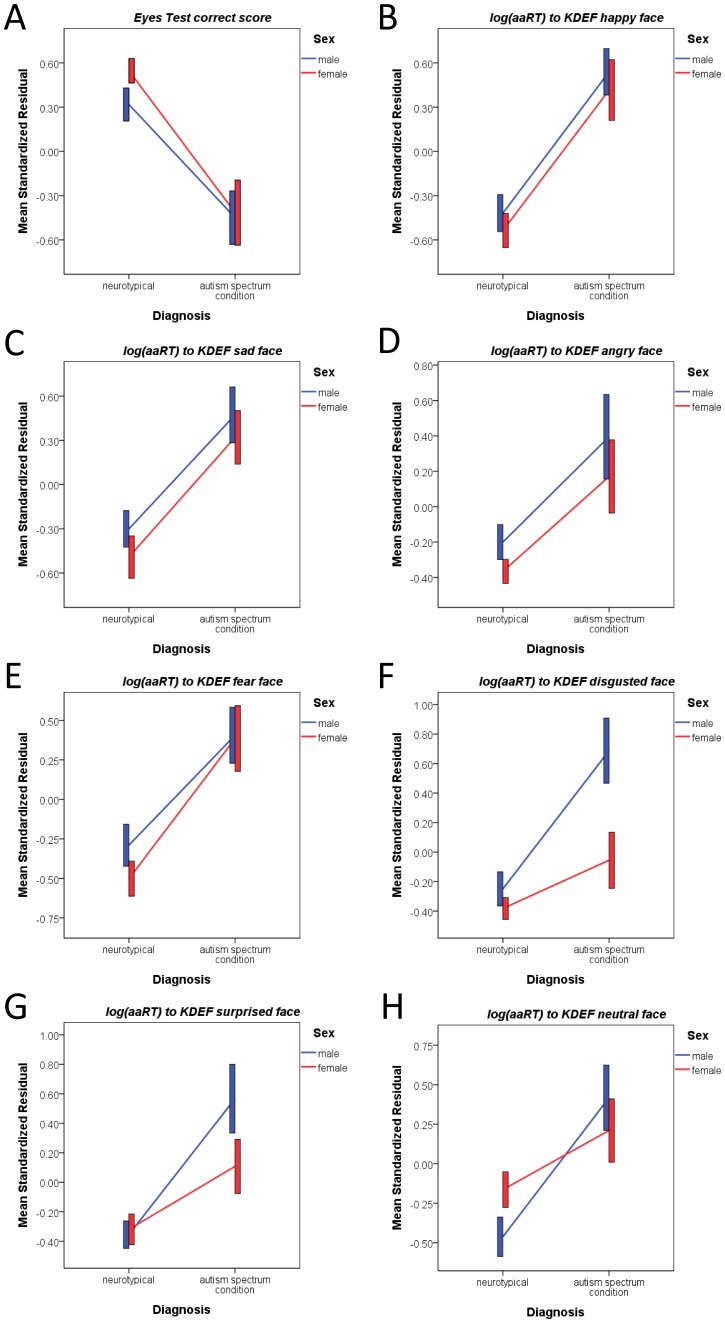
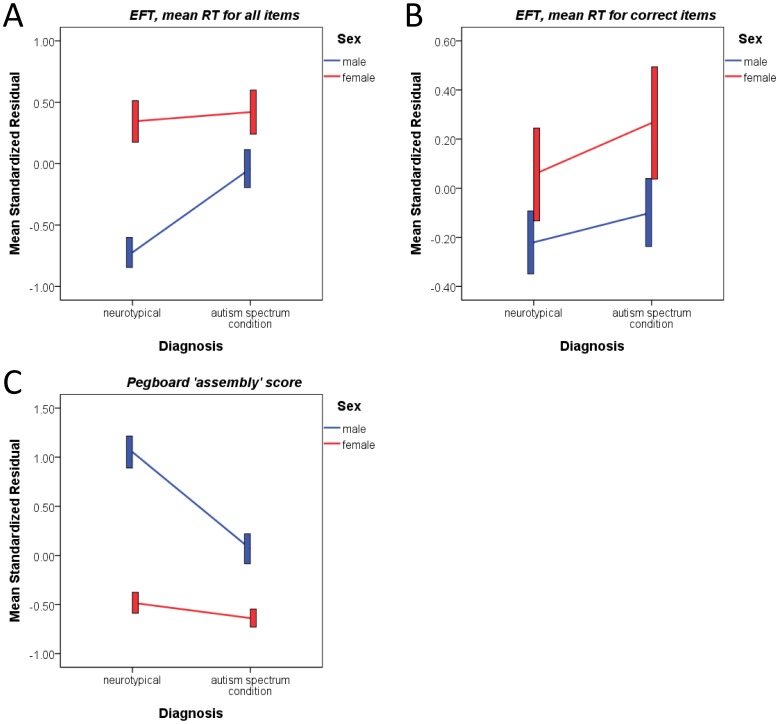
The male bias in autism spectrum conditions (ASC) has led to females with ASC being under-researched. This lack of attention to females could hide variability due to sex that may explain some of the heterogeneity within ASC. In this study we investigate four key cognitive domains (mentalizing and emotion perception, executive function, perceptual attention to detail, and motor function) in ASC, to test for similarities and differences between males and females with and without ASC (n = 128 adults; n = 32 per group). In the mentalizing and facial emotion perception domain, males and females with ASC showed similar deficits compared to neurotypical controls. However, in attention to detail and dexterity involving executive function, although males with ASC showed poorer performance relative to neurotypical males, females with ASC performed comparably to neurotypical females. We conclude that performance in the social-cognitive domain is equally impaired in male and female adults with ASC. However, in specific non-social cognitive domains, performance within ASC depends on sex. This suggests that in specific domains, cognitive profiles in ASC are modulated by sex.
Overview
The claims and statistics of this paper haven’t been checked yet.
Free: it reads the open-access text and checks the first 5 claims that cite a source we can check. Create a free account to check every claim.
Integrity signals
Registry
Cites
Statistics
Figures
Verification
Claims the paper makes
The claims and statistics of this paper haven’t been checked yet.
Free: it reads the open-access text and checks the first 5 claims that cite a source we can check. Create a free account to check every claim.
Self-check
Percentages, sums and reported differences re-computed from the paper’s own numbers.
The self-check needs the paper’s full text.
Citations
Cites
(1966) · Medical Entomology and Zoology · Cited by 10,293
Lord, C., Rutter, M., & Le Couteur, A. (1994) · Journal of Autism and Developmental Disorders · doi:10.1007/bf02172145 · Cited by 9,065 · cited 1×
“The ASC participants were further selected based on their ADIR scores [42].”
Does the autistic child have a “theory of mind” ?
Baron-Cohen, S., Leslie, A. M., & Frith, U. (1985) · Cognition · doi:10.1016/0010-0277(85)90022-8 · Cited by 8,599 · cited 1×
“For cognition related to secondary intersubjectivity, theory of mind (ToM) or mentalizing deficits have been found across the life span, from the classical first-order ToM deficit in children [52], to complex ToM deficits revealed in moral judgments [53] and spontaneous ToM [54] in adults with ASC.”
Self-citationSignal detection theory and psychophysics
Ingleby, J. D. (1967) · Journal of Sound and Vibration · doi:10.1016/0022-460x(67)90197-6 · Cited by 8,509
Lord, C., Risi, S., Lambrecht, L., Cook, E. H., Leventhal, B. L., DiLavore, P. C., Pickles, A., & Rutter, M. (2000) · Journal of Autism and Developmental Disorders · doi:10.1023/a:1005592401947 · Cited by 7,520 · cited 4×
“MA scored significantly higher than FA in ADOS scores even after correction for multiple comparisons.”
InfluentialBaron‐Cohen, S., Wheelwright, S., Hill, J., Raste, Y., & Plumb, I. (2001) · Journal of Child Psychology and Psychiatry · doi:10.1111/1469-7610.00715 · Cited by 4,555 · cited 17×
“Bo¨lte and colleagues found that adolescent females with high-functioning ASC outperformed males with high-functioning ASC on the Trail Making Test (measuring set-shifting), but the opposite was observed in their unaffected siblings [35].”
InfluentialSelf-citationBaron‐Cohen, S., Wheelwright, S. J., Hill, J., Raste, Y., & Plumb, I. (2001) · PubMed · Cited by 4,313
Self-citationFrith, C., & Frith, U. (2005) · Current Biology · doi:10.1016/j.cub.2005.08.041 · Cited by 3,481
Voyer, D., Voyer, S., & Bryden, M. P. (1995) · Psychological Bulletin · doi:10.1037/0033-2909.117.2.250 · Cited by 2,868 · cited 2×
“Thirdly, to fully address the relationship between sex and ASC it is best to have tasks showing the largest effect sizes for typical sex differences, such as those measuring visuospatial abilities of targeting, mental rotation, and aggression [129,137].”
(1989) · UCL Discovery (University College London) · Cited by 2,724
Research works printed but not linked: 1
- [40]40. American Psychiatric Association (2000) Diagnostic and Statistical Manual of Mental Disorders, 4th edition text revision (DSM-IV-TR). Washington, DC: American Psychiatric Publishing, Inc.
Cited by
Items 201–238 of 238
An empirical evaluation of executive function in Autism Spectrum Disorder
Demetriou, E. (2018) · The Sydney eScholarship Repository (The University of Sydney) · Cited by 1
Owens, M. (2020) · Digital Commons - East Tennessee State University (East Tennessee State University)
Manett, J. (2020) · TSpace (University of Toronto)
Unmet Medical Home Needs and Educational Services Access in Children with Autism Spectrum Disorder
Rizk, S. (2020) · UWM Digital Commons (University of Wisconsin–Milwaukee)
Brain Networks Involved in Higher Cognitive Functions in Adults with Autism Spectrum Disorder
Yuk, V. (2020) · TSpace (University of Toronto)
Carroll, W. G. (2021) · Digital Commons (Liberty University) · Cited by 1
Autism spectrum conditions in women: diagnosis, mental health, and the role of camouflaging
Belcher, H. (2020) · Anglia Ruskin Research Online (Anglia Ruskin University) · Cited by 1
Kognitív funkciók autizmusban.
Szabó-Balogh, V. (2017) · SZTE Repository of Dissertations (University of Szeged) · doi:10.14232/phd.3905 · Cited by 1
Autism Assessment Including Reading, Learning, and Executive Function in Females
Gabrielsen, T. P., Begay, K. K., Campbell, K. M., Hahn, K., & Harrington, L. T. (2023) · Springer eBooks · doi:10.1007/978-3-031-33969-1_7
Ertaş, E. B., Demirci, E., & Özmen, S. (2024) · Turkiye Klinikleri Journal of Health Sciences · doi:10.5336/healthsci.2023-98331
“4,5 The most important difficulty that individuals with autism experience are known as understanding the social world and adapting to it.”
BackgroundAutismus-Spektrum-Störung im Erwachsenenalter
Brouzou, K. O., Chaliani, I., & Schilbach, L. (2024) · InFo Neurologie + Psychiatrie · doi:10.1007/s15005-024-3829-7
Is Autism Different for Girls and Boys?
Fasano, R. M., Romero, C., Durocher, J. S., & Perry, L. K. (2024) · Frontiers for Young Minds · doi:10.3389/frym.2024.1111693
“Two groups of scientists studied executive function abilities and found the same thing: autistic girls have better executive function abilities than autistic boys [5, 6].”
BackgroundO'Brien, M., & Lee, N. (2024) · iDEA - Drexel University Institutional Repository · doi:10.17918/00001953
Karaminis, T. N., Gabrielatos, C., Maden-Weinberger, U., & Beattie, G. W. (2024) · OSF Preprints (OSF Preprints) · doi:10.31219/osf.io/7udnr
Aeberhard, R., Sy, M., & Kramer-Roy, D. (2024) · Cadernos Brasileiros de Terapia Ocupacional · doi:10.1590/2526-8910.ctoao278136222
Cognition and Neuropsychological Profiles
Siracusano, M., Arturi, L., Riccioni, A., & Mazzone, L. (2024) · Springer eBooks · doi:10.1007/978-3-031-62072-0_3
Łapczuk, A. (2023) · Edukacja Biologiczna i Środowiskowa · doi:10.24131/3247.230214
Gender Differences of Internalizing and Externalizing Behaviors in Autistic Children and Adolescents
Mohite, D. (2023) · Carolina Digital Repository (University of North Carolina at Chapel Hill) · doi:10.17615/fvwt-2011
Kamuflering hos personer med autismespekterforstyrrelse – En systematisk litteraturgjennomgang
Lehre, E. E. (2021) · Duo Research Archive (University of Oslo)
Waizbard‐Bartov, E. (2023) · eScholarship (California Digital Library)
Bylemans, T. (2023) · VUBIR (Vrije Universiteit Brussel)
Corpus callosum in preschoolers with Autism Spectrum Disorder: an imaging study
Saviozzi, I. (2014) · Electronic Theses and Dissertations Repository (University of Pisa)
Colat-Parros, L. (2023) · UCL Discovery (University College London) · Cited by 3
Ward, M. (2017) · Mspace (University of Manitoba)
Mann, R. S., Pineda, H. C., & Schmid, S. (2026) · Neuroscience · doi:10.1016/j.neuroscience.2026.02.029
Harada, Y., Kamei, N., Tsukiyama, C., Shiozaki, K., Ohyama, J., & Wada, M. (2026) · Attention Perception & Psychophysics · doi:10.3758/s13414-026-03222-x
“Previous studies have reported varied attentional characteristics between male and female individuals with ASD (Bölte et al., 2011).”
InfluentialPaolizzi, E., Anderle, F., Bentenuto, A., Semenzin, L., & Venuti, P. (2026) · Review Journal of Autism and Developmental Disorders · doi:10.1007/s40489-026-00545-1 · Cited by 1
Adejayan, J. (2026) · Open Access at Essex (University of Essex) · doi:10.5526/err-00043110
Gender differences in autism prevalence: origins of bias and its current scientific relevance
Peña-Casquero, P., Wojcik, D. Z., & Canal‐Bedia, R. (2026) · Frontiers in Psychiatry · doi:10.3389/fpsyt.2026.1739570
Measurement Invariance of the Autism Spectrum Rating Scales Across Gender
Golson, M. E., McClain, M. B., Schwartz, S., Harris, B., & Gabrielsen, T. P. (2026) · Contemporary School Psychology · doi:10.1007/s40688-026-00612-8
Pedregal, C. R. (2026) · Goldsmiths (University of London) · doi:10.25602/gold.00040786
Wong, O. W., Zhu, S., Chow, J. W., Barzilay, R., Moore, T. M., Ruparel, K., Lam, A. M. W., Adamska-Stolarczyk, I., Lau, P., Chan, S. S., et al. (2026) · Research Square · doi:10.21203/rs.3.rs-10617508/v1
“Furthermore, only a minority of studies included a non-ASD control group [23, 24], even though intrinsic sex differences in cognitive abilities are well-documented in the general population [25, 26].”
Gutiérrez-Ruiz, K., & Espinosa, P. (2026) · Advances in Autism · doi:10.1108/aia-03-2026-0036
Metadata
- Authors
- Lai, M.-C., Lombardo, M. V., Ruigrok, A. N. V., Chakrabarti, B., Wheelwright, S. J., Auyeung, B., Allison, C., MRC AIMS Consortium, & Baron-Cohen, S.
- Affiliations
- University of Cambridge (GB)
- Corresponding author
- Lai, Meng-Chuan
- ORCID
- Venue
- PLoS ONE
- Publisher
- Public Library of Science (PLoS)
- Published
- 2012-10-17
- Volume
- 7
- Issue
- 10
- Pages
- e47198
- ISSN
- 1932-6203 (ISSN-L)
- PMC
- PMC3474800
- OpenAlex
- W1983626034
- Semantic Scholar
- e1e0984b77a3170ee0702efd242e5aaecab6280a
- Cited by
- 217
- References
- 146
- Citations by year
- 2026: 9 · 2025: 7 · 2024: 10 · 2023: 12 · 2022: 12 · 2021: 10 · 2020: 7 · 2019: 18 · 2018: 28 · 2017: 24 · 2016: 25 · 2015: 25 · 2014: 15 · 2013: 13 · 2012: 2
- FWCI
- 9.00
- Type
- journal article
- Language
- en
- Open access
- gold
- doi.org
- Locations
- PLoS ONE (publishedVersion, cc-by)
- Europe PMC (PubMed Central) (publishedVersion, cc-by)
- PubMed Central (publishedVersion, cc-by)
- PubMed (publishedVersion)
- CentAUR (University of Reading) (acceptedVersion)
- Research Bank (Australian Catholic University) (submittedVersion, cc-by)
- DOAJ (DOAJ: Directory of Open Access Journals) (submittedVersion, cc-by-sa)
- Research Portal (King's College London) (submittedVersion)
- Research Explorer (The University of Manchester) (submittedVersion, other-oa)
- Edinburgh Research Explorer (University of Edinburgh) (submittedVersion, cc-by)
- Funders
- Wellcome Trust
- Waterloo Foundation
- National Institute for Health and Care Research (RP-PG-0606-1045, NF-SI-0510-10268)
- British Academy
- King's College London
- University of Oxford
- Medical Research Council (400061, GO 400061)
- Menzies Centre for Australian Studies, King's College London, University of London
- Topics
- Life Sciences › Neuroscience › Cognitive Neuroscience › Autism Spectrum Disorder Research
- Life Sciences › Biochemistry, Genetics and Molecular Biology › Genetics › Genetics and Neurodevelopmental Disorders
- Life Sciences › Neuroscience › Developmental Neuroscience › Williams Syndrome Research
- Keywords
- autism spectrum disorder, sex differences, cognitive profile, mentalization, emotional face processing, executive function, attention to detail, motor function, dexterity, social cognition, autistic adults
- MeSH terms
- Adolescent, Adult, Attention, Autistic Disorder, Cognition, Emotions, Female, Humans, Male, Middle Aged, Motor Activity, Sex Factors, Social Behavior, Case-Control Studies, Genetic Heterogeneity, Executive Function, Theory of Mind, Emotional Intelligence
About these checks
Registry, retraction, Cites and statistics results are computed, not judged, with one exception: a printed reference that no index lists is read once by a model before it counts as a citation error. Claims are extracted by a model and kept only when their quote appears verbatim in the text; each cited source is then checked, with a model’s help, for whether it says what the claim relies on. Those verdicts can be wrong — read the claim’s quote and the cited source before relying on one.
Statistics and arithmetic are recomputed, not judged.
Confidence bands are shown only for fields calibrated on our annotated test set. None is calibrated yet, so no band is shown.
What counts as a claim ›How we measure confidence ›How we check this ›
Are you an author, or do you see a problem with this page? Request a review
Data sources
Bibliographic data: Semantic Scholar, OpenAlex, Crossref.
Contains information from the Semantic Scholar Academic Graph Datasets, made available under the ODC Attribution License (ODC-BY 1.0).
Semantic Scholar’s data is described in: Kinney, R., et al. (2023). The Semantic Scholar Open Data Platform. arXiv:2301.10140.
