

Relationships between Mitochondrial Function and Metabolic Flexibility in Type 2 Diabetes Mellitus
Open accessThe DOI matches its Crossref record; 41 of the 41 references it cites were found in a registry or an index.
Abstract
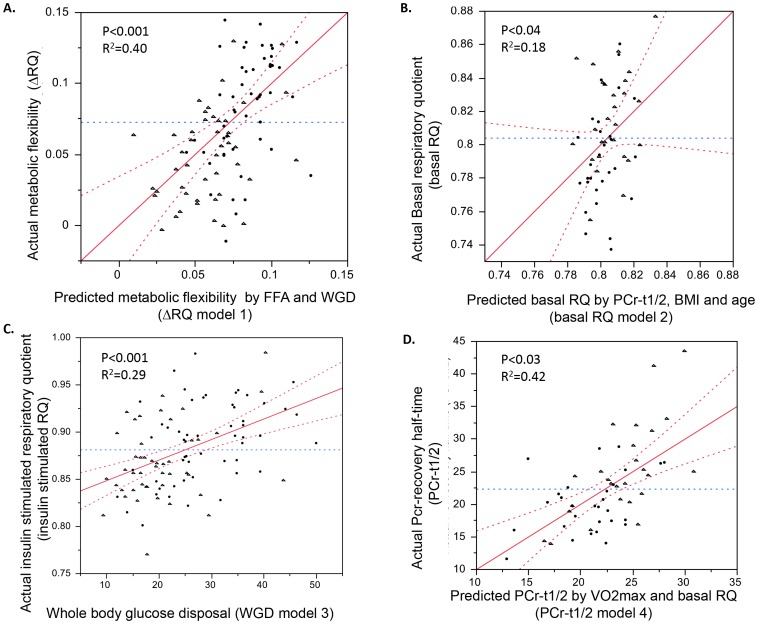
INTRODUCTION: Mitochondrial dysfunction, lipid accumulation, insulin resistance and metabolic inflexibility have been implicated in the etiology of type 2 diabetes (T2D), yet their interrelationship remains speculative. We investigated these interrelationships in a group of T2D and obese normoglycemic control subjects. METHODS: 49 non-insulin dependent male T2D patients and 54 male control subjects were enrolled, and a hyperinsulinemic-euglycemic clamp and indirect calorimetry were performed. A muscle biopsy was taken and intramyocellular lipid (IMCL) was measured. In vivo mitochondrial function was measured by PCr recovery in 30 T2D patients and 31 control subjects. RESULTS: Fasting NEFA levels were significantly elevated in T2D patients compared with controls, but IMCL was not different. Mitochondrial function in T2D patients was compromised by 12.5% (p<0.01). Whole body glucose disposal (WGD) was higher at baseline and lower after insulin stimulation. Metabolic flexibility (ΔRER) was lower in the type 2 diabetic patients (0.050±0.033 vs. 0.093±0.050, p<0.01). Mitochondrial function was the sole predictor of basal respiratory exchange ratio (RER) (R(2) = 0.18, p<0.05); whereas WGD predicted both insulin-stimulated RER (R(2) = 0.29, p<0.001) and metabolic flexibility (R(2) = 0.40, p<0.001). CONCLUSIONS: These results indicate that defects in skeletal muscle in vivo mitochondrial function in type 2 diabetic patients are only reflected in basal substrate oxidation and highlight the importance of glucose disposal rate as a determinant of substrate utilization in response to insulin.
Overview
The claims and statistics of this paper haven’t been checked yet.
Free: it reads the open-access text and checks the first 5 claims that cite a source we can check. Create a free account to check every claim.
Integrity signals
Registry
Cites
Statistics
Figures
Verification
Claims the paper makes
The claims and statistics of this paper haven’t been checked yet.
Free: it reads the open-access text and checks the first 5 claims that cite a source we can check. Create a free account to check every claim.
Claims other papers make about this one
Each is checked against this paper’s own text: does it say what the citing paper says it does?
The cited source doesn’t support the claim as written.
In the citing paper
“Many studies support the idea that deregulation of mitochondrial function underlies the onset of metabolic inflexibility [reviewed in Muoio (4)], although a causal link between the two still remains to be fully established (100, 101).”
From Metabolic Flexibility as an Adaptation to Energy Resources and Requirements in Health and Disease (2018) · cites this paper as [101]
Checked by a reasoning model — may be wrong.
Experimental — accuracy not yet measuredThe source backs part of the claim, not all of it — or backs it for a different population, condition or comparison.
In the citing paper
“However, studies have found that metabolic inflexibility of glucose is largely due to defective glucose transport,201,202 which suggests that skeletal muscle is unable to promote sufficient insulin secretion from type 2 diabetic islet-beta cells via any signalling mechanisms, in which it likely attempts to achieve given its need for increased glucose uptake.3,197”
From A review of current trends with type 2 diabetes epidemiology, aetiology, pathogenesis, treatments and future perspectives (2021) · cites this paper as [201]
Experimental — accuracy not yet measuredThe cited source says what the claim attributes to it.
In the citing paper
“Obese normoglycemic individuals were shown to have better metabolic flexibility than weight-matched T2D patients.201”
From A review of current trends with type 2 diabetes epidemiology, aetiology, pathogenesis, treatments and future perspectives (2021) · cites this paper as [201]
Self-check
Percentages, sums and reported differences re-computed from the paper’s own numbers.
The self-check needs the paper’s full text.
Citations
Cites
Glucose clamp technique: a method for quantifying insulin secretion and resistance.
DeFronzo, R. A., Tobin, J. D., & Andres, R. (1979) · American Journal of Physiology-Endocrinology and Metabolism · doi:10.1152/ajpendo.1979.237.3.e214 · Cited by 7,425 · cited 2×
“Hyperinsulinemic-euglycemic clamp In all subjects a 3-h hyperinsulinemic-euglycemic (40 mU /m(2)/ min) clamp was performed according to DeFronzo [20].”
MethodEckel, R. H., Alberti, K., Grundy, S. M., & Zimmet, P. Z. (2010) · The Lancet · doi:10.1016/s0140-6736(09)61794-3 · Cited by 6,295
Eckel, R. H., Grundy, S. M., & Zimmet, P. Z. (2005) · The Lancet · doi:10.1016/s0140-6736(05)66378-7 · Cited by 5,550
Randle, P. J., Garland, P. B., Hales, C. N., & Newsholme, E. A. (1963) · The Lancet · doi:10.1016/s0140-6736(63)91500-9 · Cited by 5,093 · cited 2×
“signaling pathways and a subsequent decline in glucose uptake by lipotoxic intermediates [26,27,28,29,30,31].”
BackgroundMechanisms of fatty acid-induced inhibition of glucose uptake.
Boden, G., Chen, X., Ruiz, J., White, J. V., & Rossetti, L. (1994) · Journal of Clinical Investigation · doi:10.1172/jci117252 · Cited by 3,705 · cited 1×
“signaling pathways and a subsequent decline in glucose uptake by lipotoxic intermediates [26,27,28,29,30,31].”
BackgroundCalculation of substrate oxidation rates in vivo from gaseous exchange.
Frayn, K. N. (1983) · Journal of Applied Physiology · doi:10.1152/jappl.1983.55.2.628 · Cited by 2,365 · cited 1×
“From oxygen consumption and carbondioxide production levels, whole body glucose oxidation and fat oxidation rates could be calculated using stoichiometric equations according to Frayn [24] with the assumption that protein oxidation was negligible.”
MethodThe Gross Composition of the Body
SIRI, W. E. (1956) · Advances in Biological and Medical Physics · doi:10.1016/b978-1-4832-3110-5.50011-x · Cited by 1,765
Diet, muscle glycogen and physical performance.
Bergström, J., Hermansen, L., Hultman, E., & Saltin, B. (1967) · Acta Physiologica Scandinavica · doi:10.1111/j.1748-1716.1967.tb03720.x · Cited by 1,740 · cited 1×
“Muscle biopsies were performed prior to the clamp under local anesthesia (2% lidocaine) according to the Bergstrom technique [22].”
MethodINFLUENCES OF GLUCOSE LOADING AND OF INJECTED INSULIN ON HEPATIC GLUCOSE OUTPUT*
Steele, R. (1959) · Annals of the New York Academy of Sciences · doi:10.1111/j.1749-6632.1959.tb44923.x · Cited by 1,670 · cited 11×
“Calculations Steele’s single-pool non–steady-state equations were used to calculate glucose endogenous glucose production (EGP) and whole body glucose disposal (WGD) [25].”
MethodInfluentialDresner, A., Laurent, D., Marcucci, M., Griffin, M. E., Dufour, S., Cline, G. W., Slezak, L. A., Andersen, D. K., Hundal, R. S., Rothman, D. L., et al. (1999) · Journal of Clinical Investigation · doi:10.1172/jci5001 · Cited by 1,311 · cited 1×
“These factors have been suggested to interfere with muscle insulin sensitivity but may also affect mitochondrial function or vice versa [7,8,9,10,11,12].”
Background
Cited by
Metabolic Flexibility as an Adaptation to Energy Resources and Requirements in Health and Disease
Smith, R. L., Soeters, M. R., Wüst, R. C. I., & Houtkooper, R. H. (2018) · Endocrine Reviews · doi:10.1210/er.2017-00211 · Cited by 787
Reed, J., Bain, S., & Kanamarlapudi, V. (2021) · Diabetes, Metabolic Syndrome and Obesity: Targets and Therapy · doi:10.2147/dmso.s319895 · Cited by 441
Virmani, M. A., & Cirulli, M. (2022) · International Journal of Molecular Sciences · doi:10.3390/ijms23052717 · Cited by 276
Insulin Resistance and Mitochondrial Dysfunction
González-Franquesa, A., & Patti, M. (2017) · Advances in experimental medicine and biology · doi:10.1007/978-3-319-55330-6_25 · Cited by 173
Trimethylamine N-oxide impairs pyruvate and fatty acid oxidation in cardiac mitochondria
Makrecka‐Kuka, M., Volska, K., Antone, U., Vilšķe̅rsts, R., Grīnberga, S., Bandere, D., Liepinsh, E., & Dambrova, M. (2017) · Toxicology Letters · doi:10.1016/j.toxlet.2016.12.017 · Cited by 150
Metadata
- Authors
- van de Weijer, T., Sparks, L. M., Phielix, E., Meex, R. C., van Herpen, N. A., Hesselink, M. K. C., Schrauwen, P., & Schrauwen-Hinderling, V. B.
- Affiliations
- Maastricht University Medical Centre (NL)
- Venue
- PLoS ONE
- Publisher
- Public Library of Science (PLoS)
- Published
- 2013-02-13
- Volume
- 8
- Issue
- 2
- Pages
- e51648
- ISSN
- 1932-6203 (ISSN-L)
- PMC
- PMC3572106
- OpenAlex
- W2079395532
- Cited by
- 87
- References
- 41
- Citations by year
- 2026: 4 · 2025: 4 · 2024: 3 · 2023: 6 · 2022: 9 · 2021: 8 · 2020: 5 · 2019: 4 · 2018: 8 · 2017: 8 · 2016: 12 · 2015: 4 · 2014: 5 · 2013: 7
- FWCI
- 6.48
- Type
- journal article
- Language
- en
- Open access
- gold
- doi.org
- Locations
- PLoS ONE (publishedVersion, cc-by)
- Europe PMC (PubMed Central) (publishedVersion, cc-by)
- PubMed Central (publishedVersion, cc-by)
- PubMed (publishedVersion)
- Research Publications (Maastricht University) (publishedVersion, cc-by)
- DOAJ (DOAJ: Directory of Open Access Journals) (submittedVersion, cc-by-sa)
- Research Publications (Maastricht University) (submittedVersion, other-oa)
- Funders
- Nierstichting
- Diabetes Fonds
- Nederlandse Organisatie voor Wetenschappelijk Onderzoek (918.96.618)
- Center for Translational Molecular Medicine
- Topics
- Health Sciences › Medicine › Physiology (medical) › Adipose Tissue and Metabolism
- Life Sciences › Biochemistry, Genetics and Molecular Biology › Molecular Biology › Metabolism, Diabetes, and Cancer
- Life Sciences › Biochemistry, Genetics and Molecular Biology › Molecular Biology › Mitochondrial Function and Pathology
- Keywords
- type 2 diabetes, mitochondrial function, metabolic flexibility, skeletal muscle, intramyocellular lipid, respiratory exchange ratio, glucose disposal, insulin resistance, fatty acid oxidation, phosphocreatine recovery, free fatty acids, substrate oxidation
- MeSH terms
- Aged, Blood Glucose, Diabetes Mellitus, Type 2, Fatty Acids, Nonesterified, Humans, Insulin, Insulin Resistance, Male, Middle Aged, Mitochondria, Obesity, Glucose Clamp Technique, Muscle, Skeletal, Lipid Metabolism
About these checks
Registry, retraction, Cites and statistics results are computed, not judged, with one exception: a printed reference that no index lists is read once by a model before it counts as a citation error. Claims are extracted by a model and kept only when their quote appears verbatim in the text; each cited source is then checked, with a model’s help, for whether it says what the claim relies on. Those verdicts can be wrong — read the claim’s quote and the cited source before relying on one.
Statistics and arithmetic are recomputed, not judged.
Confidence bands are shown only for fields calibrated on our annotated test set. None is calibrated yet, so no band is shown.
What counts as a claim ›How we measure confidence ›How we check this ›
Are you an author, or do you see a problem with this page? Request a review
How to cite
Cite CoChat for the checks on this page, and the paper for its own findings.
- This page
- CoChat. (2026). Citation check: Relationships between Mitochondrial Function and Metabolic Flexibility in Type 2 Diabetes Mellitus. https://app.cochat.ai/papers/10.1371/journal.pone.0051648
- The paper
- van de Weijer, T., Sparks, L. M., Phielix, E., Meex, R. C., van Herpen, N. A., Hesselink, M. K. C., Schrauwen, P., & Schrauwen-Hinderling, V. B. (2013). Relationships between Mitochondrial Function and Metabolic Flexibility in Type 2 Diabetes Mellitus. PLoS ONE. https://doi.org/10.1371/journal.pone.0051648
Data sources
Bibliographic data: Semantic Scholar, OpenAlex, Crossref.
Contains information from the Semantic Scholar Academic Graph Datasets, made available under the ODC Attribution License (ODC-BY 1.0).
Semantic Scholar’s data is described in: Kinney, R., et al. (2023). The Semantic Scholar Open Data Platform. arXiv:2301.10140.
