

The DOI matches its Crossref record; 50 of the 50 references it cites were found in a registry or an index.
Autologous Bone Marrow Mononuclear Cell Transplantation in Patients with Decompensated Alcoholic Liver Disease: A Randomized Controlled Trial
Open accessAbstract
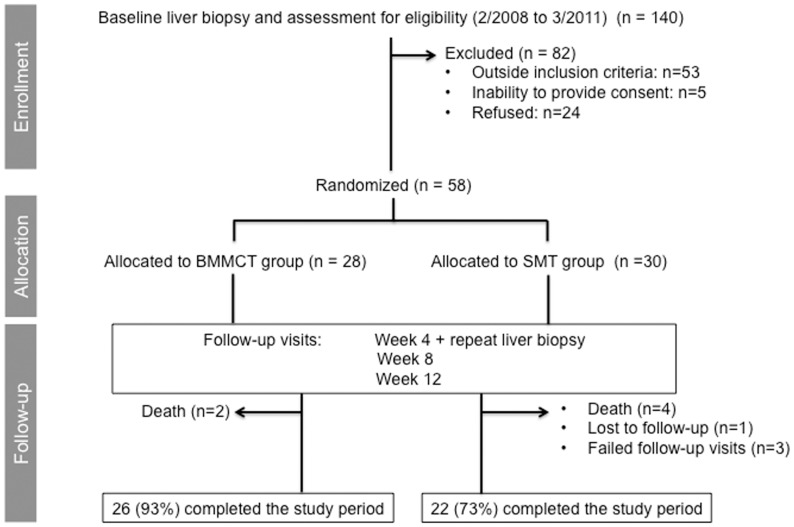
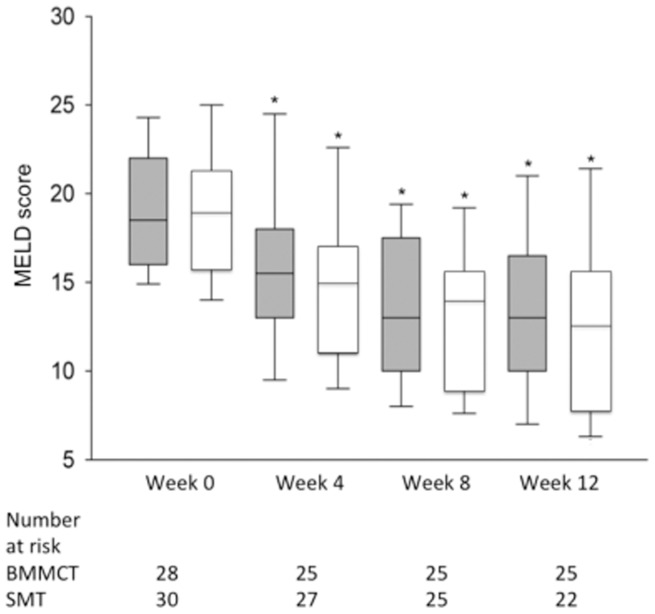
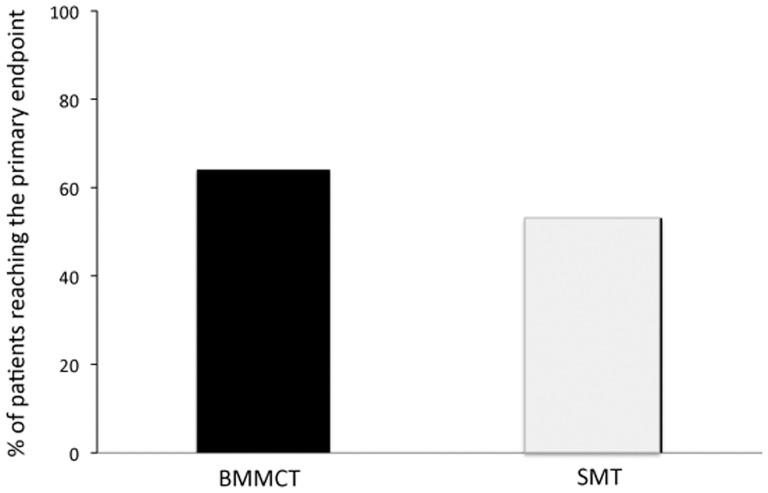
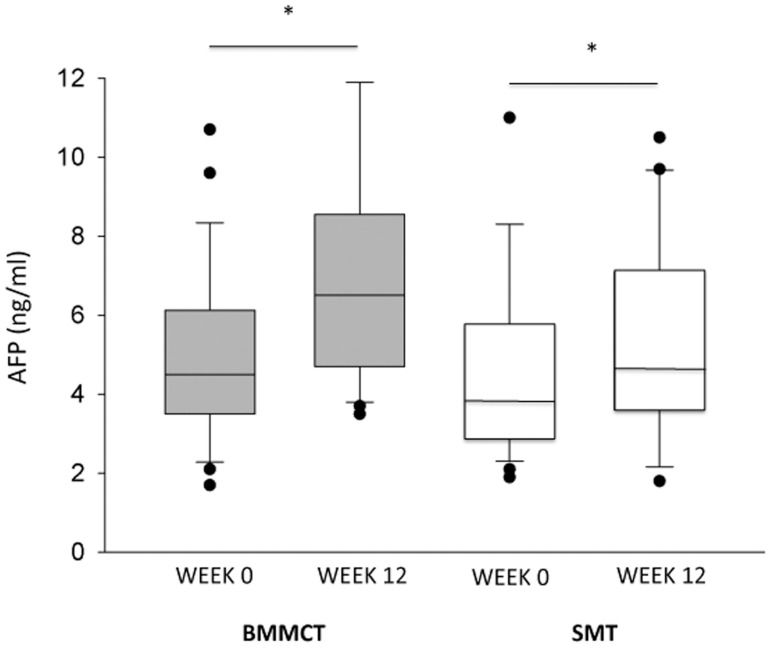
OBJECTIVE: Impaired liver regeneration is associated with a poor outcome in patients with decompensated alcoholic liver disease (ALD). We assessed whether autologous bone marrow mononuclear cell transplantation (BMMCT) improved liver function in decompensated ALD. DESIGN: 58 patients (mean age 54 yrs; mean MELD score 19, all with cirrhosis, 81% with alcoholic steatohepatitis at baseline liver biopsy) were randomized early after hospital admission to standard medical therapy (SMT) alone (n = 30), including steroids in patients with a Maddrey's score ≥32, or combined with G-CSF injections and autologous BMMCT into the hepatic artery (n = 28). Bone marrow cells were harvested, isolated and reinfused the same day. The primary endpoint was a ≥3 points decrease in the MELD score at 3 months, corresponding to a clinically relevant improvement in liver function. Liver biopsy was repeated at week 4 to assess changes in Ki67+/CK7+ hepatic progenitor cells (HPC) compartment. RESULTS: Both study groups were comparable at baseline. After 3 months, 2 and 4 patients died in the BMMCT and SMT groups, respectively. Adverse events were equally distributed between groups. Moderate alcohol relapse occurred in 31% of patients. The MELD score improved in parallel in both groups during follow-up with 18 patients (64%) from the BMMCT group and 18 patients (53%) from the SMT group reaching the primary endpoint (p = 0.43 (OR 1.6, CI 0.49-5.4) in an intention to treat analysis. Comparing liver biopsy at 4 weeks to baseline, steatosis improved (p<0.001), and proliferating HPC tended to decrease in both groups (-35 and -33%, respectively). CONCLUSION: Autologous BMMCT, compared to SMT is a safe procedure but did not result in an expanded HPC compartment or improved liver function. These data suggest either insufficient regenerative stimulation after BMMCT or resistance to liver regenerative drive in patients with decompensated alcoholic cirrhosis. TRIAL REGISTRATION: Controlled-Trials.com ISRCTN83972743.
Overview
The claims and statistics of this paper haven’t been checked yet.
Run the check — free, no account needed. It reads the open-access text and checks the sources it cites.
Integrity signals
Registry
Cites
Statistics
Figures
Verification
Claims the paper makes
The claims and statistics of this paper haven’t been checked yet.
Run the check — free, no account needed. It reads the open-access text and checks the sources it cites.
Claims other papers make about this one
Each is checked against this paper’s own text: does it say what the citing paper says it does?
The cited source says what the claim attributes to it.
In the citing paper
“Another clinical trial in decompensated alcoholic cirrhosis (DAC) also indicated that the combination of BM-MNCs with standard medical therapy (SMT) did not show superiority over SMT alone [53].”
From Mechanisms, efficacy, and future perspectives of cellular-based therapies for liver fibrosis/cirrhosis: focusing on mesenchymal stromal cells (2025) · cites this paper as [53]
The cited source says what the claim attributes to it.
In the citing paper
“Furthermore, this approach, which included G-CSF mobilization, failed to stimulate LPC expansion or promote liver regeneration [53].”
From Mechanisms, efficacy, and future perspectives of cellular-based therapies for liver fibrosis/cirrhosis: focusing on mesenchymal stromal cells (2025) · cites this paper as [53]
Self-check
Percentages, sums and reported differences re-computed from the paper’s own numbers.
The self-check needs the paper’s full text.
Citations
Cites
Design and validation of a histological scoring system for nonalcoholic fatty liver disease†
Kleiner, D. E., Brunt, E. M., Van Natta, M., Behling, C., Contos, M. J., Cummings, O. W., Ferrell, L. D., Liu, Y., Torbenson, M. S., Unalp‐Arida, A., et al. (2005) · Hepatology · doi:10.1002/hep.20701 · Cited by 10,791
Purified hematopoietic stem cells can differentiate into hepatocytes in vivo
Lagasse, E., Connors, H., Al-Dhalimy, M., Reitsma, M., Dohse, M., Osborne, L., Wang, X., Finegold, M., Weissman, I. L., & Grompe, M. (2000) · Nature Medicine · doi:10.1038/81326 · Cited by 2,314
Alcoholic Liver Disease: Pathogenesis and New Therapeutic Targets
Gao, B., & Bataller, R. (2011) · Gastroenterology · doi:10.1053/j.gastro.2011.09.002 · Cited by 1,963
The model for end-stage liver disease (MELD)
Kamath, P. S., & Kim, R. W. (2007) · Hepatology · doi:10.1002/hep.21563 · Cited by 1,674
Roskams, T., Theise, N. D., Balabaud, C. P., Bhagat, G., Bhathal, P. S., Bioulac‐Sage, P., Brunt, E. M., Crawford, J. M., Crosby, H. A., Desmet, V. J., et al. (2004) · Hepatology · doi:10.1002/hep.20130 · Cited by 729
Liver regeneration and repair: Hepatocytes, progenitor cells, and stem cells
Fausto, N. (2004) · Hepatology · doi:10.1002/hep.20214 · Cited by 720
EASL Clinical Practical Guidelines: Management of Alcoholic Liver Disease
European Association for the Study of the Liver (2012) · Journal of Hepatology · doi:10.1016/j.jhep.2012.04.004 · Cited by 720
Acute-on chronic liver failure
Jalan, R., Ginès, P., Olson, J. C., Mookerjee, R. P., Moreau, R., García–Tsao, G., Arroyo, V., & Kamath, P. S. (2012) · Journal of Hepatology · doi:10.1016/j.jhep.2012.06.026 · Cited by 674
Stem Cells and Liver Regeneration
Duncan, A. W., Dorrell, C., & Grompe, M. (2009) · Gastroenterology · doi:10.1053/j.gastro.2009.05.044 · Cited by 560
Terai, S., Ishikawa, T., Ômori, K., Aoyama, K., Marumoto, Y., Urata, Y., Yokoyama, Y., Uchida, K., Yamasaki, T., Fujii, Y., et al. (2006) · Stem Cells · doi:10.1634/stemcells.2005-0542 · Cited by 491
Cited by
Sorted by citations
Seitz, H. K., Bataller, R., Cortez-Pinto, H., Gao, B., Gual, A., Lackner, C., Mathurin, P., Mueller, S., Szabo, G., & Tsukamoto, H. (2018) · Nature Reviews Disease Primers · doi:10.1038/s41572-018-0014-7 · Cited by 1,271
Stem cell-based therapy for human diseases
Hoang, D. M., Pham, P. T., Bach, T. Q., Ngo, A. T. L., Nguyen, Q. T., Phan, T. T. K., Nguyen, G. H., Le, P. T. T., Hoang, V. T., Forsyth, N. R., et al. (2022) · Signal Transduction and Targeted Therapy · doi:10.1038/s41392-022-01134-4 · Cited by 1,074
EASL Clinical Practice Guidelines: Management of alcohol-related liver disease
Thursz, M. R., Gual, A., Lackner, C., Mathurin, P., Moreno, C., Spahr, L., Sterneck, M. R., & Cortez‐Pinto, H. (2018) · Journal of Hepatology · doi:10.1016/j.jhep.2018.03.018 · Cited by 953
Self-citationGranulocyte Colony-Stimulating Factor in Severe Alcoholic Hepatitis: A Randomized Pilot Study
Singh, V., Sharma, A. K., Narasimhan, L. R., Bhalla, A., Sharma, N., & Sharma, R. (2014) · The American Journal of Gastroenterology · doi:10.1038/ajg.2014.154 · Cited by 228
Hematopoietic Stem Cells and Their Roles in Tissue Regeneration
Lee, J. Y., & Hong, S.-H. (2020) · International Journal of Stem Cells · doi:10.15283/ijsc19127 · Cited by 165
Metadata
- Authors
- Spahr, L., Chalandon, Y., Terraz, S., Kindler, V., Rubbia-Brandt, L., Frossard, J.-L., Breguet, R., Lanthier, N., Farina, A., Passweg, J., Becker, C. D., & Hadengue, A.
- Affiliations
- University Hospital of Geneva (CH)
- Corresponding author
- Spahr, Laurent
- ORCID
- Venue
- PLoS ONE
- Publisher
- Public Library of Science (PLoS)
- Published
- 2013-01-14
- Volume
- 8
- Issue
- 1
- Pages
- e53719
- ISSN
- 1932-6203 (ISSN-L)
- PMC
- PMC3544843
- OpenAlex
- W1985534351
- Cited by
- 118
- References
- 50
- Citations by year
- 2026: 3 · 2025: 8 · 2024: 2 · 2023: 7 · 2022: 12 · 2021: 6 · 2020: 7 · 2019: 11 · 2018: 10 · 2017: 9 · 2016: 13 · 2015: 11 · 2014: 12 · 2013: 7
- FWCI
- 8.92
- Type
- journal article
- Language
- en
- Open access
- gold
- doi.org
- Locations
- PLoS ONE (publishedVersion, cc-by)
- PubMed Central (publishedVersion, cc-by)
- PubMed (publishedVersion)
- Archive ouverte UNIGE (University of Geneva) (publishedVersion, other-oa)
- Digital Access to Libraries (submittedVersion, other-oa)
- DOAJ (DOAJ: Directory of Open Access Journals) (submittedVersion, cc-by-sa)
- Figshare (submittedVersion, cc-by)
- Archive ouverte UNIGE (University of Geneva) (submittedVersion, cc-by)
- Funders
- American Association for the Study of Liver Diseases
- Louis-Jeantet Foundation
- Faculté de Médecine, Université de Genève
- Topics
- Health Sciences › Medicine › Hepatology › Liver Disease and Transplantation
- Life Sciences › Biochemistry, Genetics and Molecular Biology › Cell Biology › Mesenchymal stem cell research
- Health Sciences › Medicine › Hepatology › Liver physiology and pathology
- Keywords
- autologous bone marrow mononuclear cell transplantation, alcoholic cirrhosis, alcoholic steatohepatitis, liver regeneration, hepatic progenitor cells, MELD score, granulocyte colony-stimulating factor, liver function, alcohol relapse
- MeSH terms
- Adolescent, Adult, Aged, Female, Hepatic Artery, Humans, Liver, Liver Diseases, Alcoholic, Male, Middle Aged, Regeneration, Time Factors, Transplantation, Autologous, Biomarkers, Bone Marrow Transplantation, Cytokines, Recovery of Function, Hepatocytes, Stem Cell Transplantation, Cell Proliferation, Young Adult
About these checks
Registry, retraction, Cites and statistics results are computed, not judged, with one exception: a printed reference that no index lists is read once by a model before it counts as a citation error. Claims are extracted by a model and kept only when their quote appears verbatim in the text; each cited source is then checked, with a model’s help, for whether it says what the claim relies on. Those verdicts can be wrong — read the claim’s quote and the cited source before relying on one.
Statistics and arithmetic are recomputed, not judged.
Confidence bands are shown only for fields calibrated on our annotated test set. None is calibrated yet, so no band is shown.
What counts as a claim ›How we measure confidence ›How we check this ›
Are you an author, or do you see a problem with this page? Request a review
