

The DOI matches its Crossref record; 62 of the 63 references it cites were found in a registry or an index.
Factors Predicting Reversion from Mild Cognitive Impairment to Normal Cognitive Functioning: A Population-Based Study
Open accessAbstract
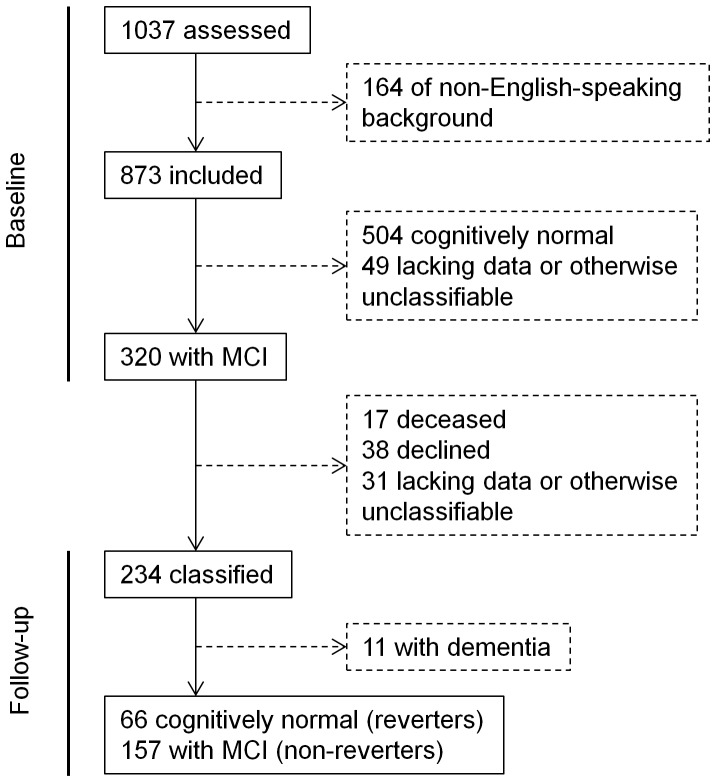
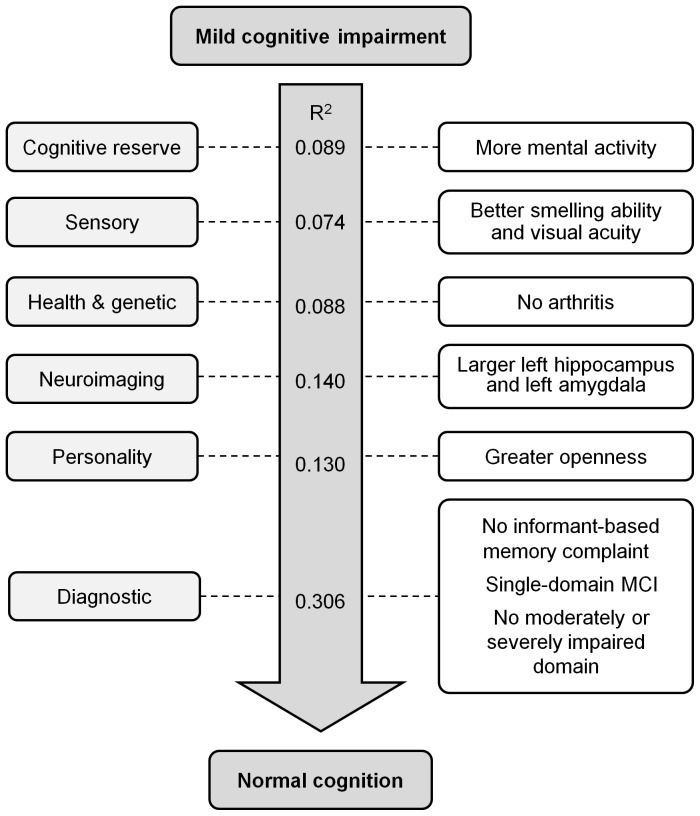
INTRODUCTION: Mild cognitive impairment (MCI) is associated with an increased risk of developing dementia. However, many individuals diagnosed with MCI are found to have reverted to normal cognition on follow-up. This study investigated factors predicting or associated with reversion from MCI to normal cognition. METHODS: Our analyses considered 223 participants (48.9% male) aged 71-89 years, drawn from the prospective, population-based Sydney Memory and Ageing Study. All were diagnosed with MCI at baseline and subsequently classified with either normal cognition or repeat diagnosis of MCI after two years (a further 11 participants who progressed from MCI to dementia were excluded). Associations with reversion were investigated for (1) baseline factors that included diagnostic features, personality, neuroimaging, sociodemographics, lifestyle, and physical and mental health; (2) longitudinal change in potentially modifiable factors. RESULTS: There were 66 reverters to normal cognition and 157 non-reverters (stable MCI). Regression analyses identified diagnostic features as most predictive of prognosis, with reversion less likely in participants with multiple-domain MCI (p = 0.011), a moderately or severely impaired cognitive domain (p = 0.002 and p = 0.006), or an informant-based memory complaint (p = 0.031). Reversion was also less likely for participants with arthritis (p = 0.037), but more likely for participants with higher complex mental activity (p = 0.003), greater openness to experience (p = 0.041), better vision (p = 0.014), better smelling ability (p = 0.040), or larger combined volume of the left hippocampus and left amygdala (p<0.040). Reversion was also associated with a larger drop in diastolic blood pressure between baseline and follow-up (p = 0.026). DISCUSSION: Numerous factors are associated with reversion from MCI to normal cognition. Assessing these factors could facilitate more accurate prognosis of individuals with MCI. Participation in cognitively enriching activities and efforts to lower blood pressure might promote reversion.
Overview
The claims and statistics of this paper haven’t been checked yet.
Run the check — free, no account needed. It reads the open-access text and checks the sources it cites.
Integrity signals
Registry
Cites
Statistics
Figures
Verification
Claims the paper makes
The claims and statistics of this paper haven’t been checked yet.
Run the check — free, no account needed. It reads the open-access text and checks the sources it cites.
Self-check
Percentages, sums and reported differences re-computed from the paper’s own numbers.
The self-check needs the paper’s full text.
Citations
Cites
Folstein, M. F., Folstein, S. E., & McHugh, P. R. (1975) · Journal of Psychiatric Research · doi:10.1016/0022-3956(75)90026-6 · Cited by 88,282
Chobanian, A. V. (2003) · JAMA · doi:10.1001/jama.289.19.2560 · Cited by 25,386
Hirono, N., Mori, E., Ikejiri, Y., Imamura, T., Shimomura, T., Hashimoto, M., Yamashita, H., & Ikeda, M. (1997) · PubMed · Cited by 21,012
Kok, J. S., Berg, I. J., & Scherder, E. J. A. (2013) · Dementia and Geriatric Cognitive Disorders Extra · doi:10.1159/000353441 · Cited by 20,589
Older Adults' Reasons for Using Technology while Aging in Place
Peek, S. T. M., Luijkx, K. G., Rijnaard, M. D., Nieboer, M. E., van der Voort, C. S., Aarts, S., van Hoof, J., Vrijhoef, H. J., & Wouters, E. (2015) · Gerontology · doi:10.1159/000430949 · Cited by 19,852
Sensitivity and False Alarm Rate of a Fall Sensor in Long-Term Fall Detection in the Elderly
Kangas, M., Korpelainen, R., Vikman, I., Nyberg, L., & Jämsä, T. J. (2014) · Gerontology · doi:10.1159/000362720 · Cited by 19,007
Tzourio-Mazoyer, N., Landeau, B., Papathanassiou, D., Crivello, F., Etard, O., Delcroix, N., Mazoyer, B., & Joliot, M. (2002) · NeuroImage · doi:10.1006/nimg.2001.0978 · Cited by 16,319
Development and validation of a geriatric depression screening scale: a preliminary report
Yesavage, J. A., Brink, T. L., Rose, T. L., Lum, O., Huang, V., Adey, M., & Leirer, V. O. (1982) · Journal of Psychiatric Research · doi:10.1016/0022-3956(82)90033-4 · Cited by 15,025
A simulation study of the number of events per variable in logistic regression analysis
Peduzzi, P., Concato, J., Kemper, E., Holford, T. R., & Feinstein, A. R. (1996) · Journal of Clinical Epidemiology · doi:10.1016/s0895-4356(96)00236-3 · Cited by 9,655
Mild Cognitive Impairment: Clinical Characterization and Outcome
Petersen, R. C., Smith, G. E., Waring, S. C., Ivnik, R. J., Tangalos, E. G., & Kokmen, E. (1999) · Archives of Neurology · doi:10.1001/archneur.56.3.303 · Cited by 8,980
Cited by
Sorted by citations
Kirova, A.-M., Bays, R. B., & Lagalwar, S. (2015) · BioMed Research International · doi:10.1155/2015/748212 · Cited by 649
Mild Cognitive Impairment in Clinical Practice: A Review Article
Jongsiriyanyong, S., & Limpawattana, P. (2018) · American Journal of Alzheimer s Disease & Other Dementias® · doi:10.1177/1533317518791401 · Cited by 516
Sanford, A. M. (2017) · Clinics in Geriatric Medicine · doi:10.1016/j.cger.2017.02.005 · Cited by 475
Sachdev, P. S., Lipnicki, D. M., Kochan, N. A., Crawford, J. D., Thalamuthu, A., Andrews, G., Brayne, C., Matthews, F. E., Stephan, B. C. M., Lipton, R. B., et al. (2015) · PLOS ONE · doi:10.1371/journal.pone.0142388 · Cited by 380
Self-citationCanevelli, M., Grande, G., Lacorte, E., Quarchioni, E., Cesari, M., Mariani, C., Bruno, G., & Vanacore, N. (2016) · Journal of the American Medical Directors Association · doi:10.1016/j.jamda.2016.06.020 · Cited by 226
Metadata
- Authors
- Sachdev, P. S., Lipnicki, D. M., Crawford, J., Reppermund, S., Kochan, N. A., Trollor, J. N., Wen, W., Draper, B., Slavin, M. J., Kang, K., Lux, O., Mather, K. A., Brodaty, H., Memory, T. S., & Team, A. S.
- Affiliations
- UNSW Sydney (AU)
- Corresponding author
- Sachdev, Perminder S.
- ORCID
- Venue
- PLoS ONE
- Publisher
- Public Library of Science (PLoS)
- Published
- 2013-03-27
- Volume
- 8
- Issue
- 3
- Pages
- e59649
- ISSN
- 1932-6203 (ISSN-L)
- PMC
- PMC3609866
- OpenAlex
- W1984399440
- Cited by
- 193
- References
- 63
- Citations by year
- 2026: 4 · 2025: 13 · 2024: 16 · 2023: 12 · 2022: 26 · 2021: 22 · 2020: 28 · 2019: 13 · 2018: 9 · 2017: 7 · 2016: 14 · 2015: 15 · 2014: 10 · 2013: 4
- FWCI
- 10.19
- Type
- journal article
- Language
- en
- Open access
- gold
- doi.org
- Locations
- PLoS ONE (publishedVersion, cc-by)
- Europe PMC (PubMed Central) (publishedVersion, other-oa)
- PubMed Central (publishedVersion, cc-by)
- PubMed (publishedVersion)
- UNSWorks (University of New South Wales, Sydney, Australia) (submittedVersion, cc-by-nc-nd)
- UNSWorks (UNSW Sydney) (submittedVersion, cc-by-nc-nd)
- DOAJ (DOAJ: Directory of Open Access Journals) (submittedVersion, cc-by-sa)
- Figshare (submittedVersion, cc-by)
- Funders
- Eli Lilly and Company
- Pfizer
- Sanofi
- Neuroscience Research Australia
- Medical Research Council (350833)
- Topics
- Health Sciences › Medicine › Psychiatry and Mental health › Dementia and Cognitive Impairment Research
- Health Sciences › Medicine › Oncology › Cancer-related cognitive impairment studies
- Social Sciences › Psychology › Experimental and Cognitive Psychology › Cognitive Abilities and Testing
- Keywords
- mild cognitive impairment, normal cognition, dementia risk, prognosis, arthritis, personality, openness to experience, vision, olfaction, hippocampus, amygdala, diastolic blood pressure, cognitive enrichment, Sydney Memory and Ageing Study
- MeSH terms
- Aged, Aged, 80 and over, Antihypertensive Agents, Cognition, Demography, Female, Follow-Up Studies, Health, Humans, Life Style, Male, Cognitive Dysfunction
About these checks
Registry, retraction, Cites and statistics results are computed, not judged, with one exception: a printed reference that no index lists is read once by a model before it counts as a citation error. Claims are extracted by a model and kept only when their quote appears verbatim in the text; each cited source is then checked, with a model’s help, for whether it says what the claim relies on. Those verdicts can be wrong — read the claim’s quote and the cited source before relying on one.
Statistics and arithmetic are recomputed, not judged.
Confidence bands are shown only for fields calibrated on our annotated test set. None is calibrated yet, so no band is shown.
What counts as a claim ›How we measure confidence ›How we check this ›
Are you an author, or do you see a problem with this page? Request a review
