

Evaluating the Impact of Sequencing Depth on Transcriptome Profiling in Human Adipose
Open accessThe DOI matches its Crossref record; 30 of the 30 references it cites were found in a registry or an index.
Abstract
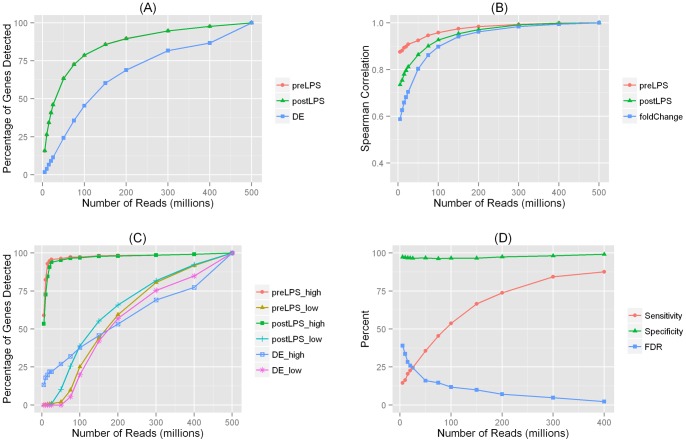
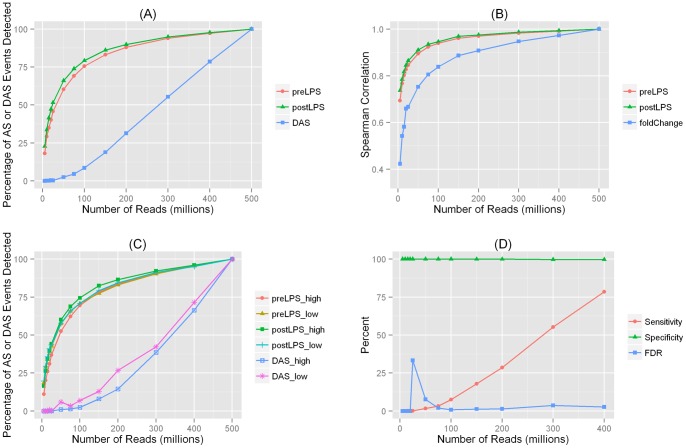
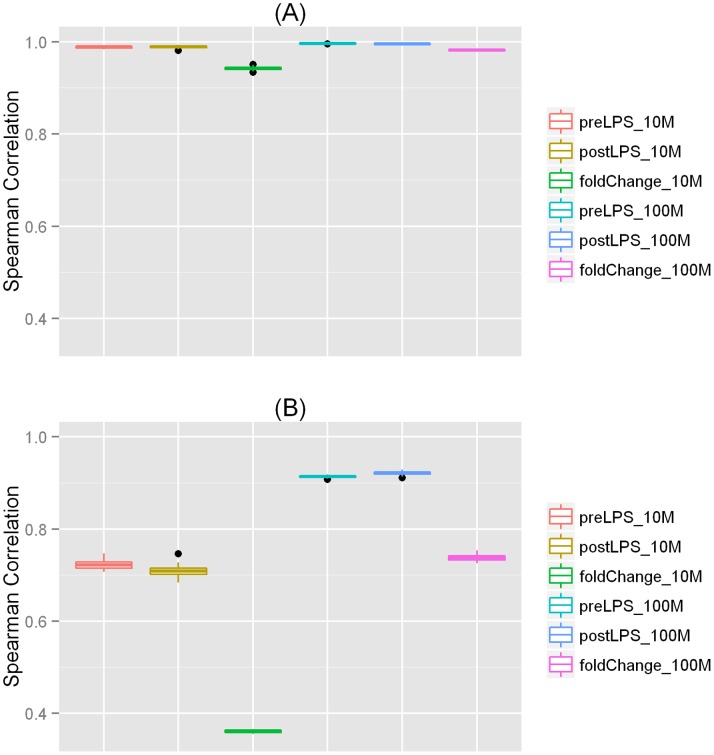
Recent advances in RNA sequencing (RNA-Seq) have enabled the discovery of novel transcriptomic variations that are not possible with traditional microarray-based methods. Tissue and cell specific transcriptome changes during pathophysiological stress in disease cases versus controls and in response to therapies are of particular interest to investigators studying cardiometabolic diseases. Thus, knowledge on the relationships between sequencing depth and detection of transcriptomic variation is needed for designing RNA-Seq experiments and for interpreting results of analyses. Using deeply sequenced Illumina HiSeq 2000 101 bp paired-end RNA-Seq data derived from adipose of a healthy individual before and after systemic administration of endotoxin (LPS), we investigated the sequencing depths needed for studies of gene expression and alternative splicing (AS). In order to detect expressed genes and AS events, we found that ∼100 to 150 million (M) filtered reads were needed. However, the requirement on sequencing depth for the detection of LPS modulated differential expression (DE) and differential alternative splicing (DAS) was much higher. To detect 80% of events, ∼300 M filtered reads were needed for DE analysis whereas at least 400 M filtered reads were necessary for detecting DAS. Although the majority of expressed genes and AS events can be detected with modest sequencing depths (∼100 M filtered reads), the estimated gene expression levels and exon/intron inclusion levels were less accurate. We report the first study that evaluates the relationship between RNA-Seq depth and the ability to detect DE and DAS in human adipose. Our results suggest that a much higher sequencing depth is needed to reliably identify DAS events than for DE genes.
Overview
The claims and statistics of this paper haven’t been checked yet.
Free: it reads the open-access text and checks the first 5 claims that cite a source we can check. Create a free account to check every claim.
Integrity signals
Registry
Cites
Statistics
Figures
Verification
Claims the paper makes
The claims and statistics of this paper haven’t been checked yet.
Free: it reads the open-access text and checks the first 5 claims that cite a source we can check. Create a free account to check every claim.
Self-check
Percentages, sums and reported differences re-computed from the paper’s own numbers.
The self-check needs the paper’s full text.
Citations
Cites
Trapnell, C., Williams, B. A., Pertea, G., Mortazavi, A., Kwan, G., van Baren, M. J., Salzberg, S. L., Wold, B. J., & Pachter, L. (2010) · Nature Biotechnology · doi:10.1038/nbt.1621 · Cited by 15,556
Mapping and quantifying mammalian transcriptomes by RNA-Seq
Mortazavi, A., Williams, B. A., McCue, K., Schaeffer, L., & Wold, B. (2008) · Nature Methods · doi:10.1038/nmeth.1226 · Cited by 13,696 · cited 1×
“[23] observed reduced precision for lower expressed transcripts.”
BackgroundTopHat: discovering splice junctions with RNA-Seq
Trapnell, C., Pachter, L., & Salzberg, S. L. (2009) · Bioinformatics · doi:10.1093/bioinformatics/btp120 · Cited by 11,617
Quantitative Monitoring of Gene Expression Patterns with a Complementary DNA Microarray
Schena, M., Shalon, D., Davis, R. W., & Brown, P. O. (1995) · Science · doi:10.1126/science.270.5235.467 · Cited by 9,609 · cited 1×
“for transcriptomics studies due to their ability to measure thousands of transcripts simultaneously [1].”
BackgroundAlternative isoform regulation in human tissue transcriptomes
Wang, E. T., Sandberg, R., Luo, S., Khrebtukova, I., Zhang, L., Mayr, C., Kingsmore, S. F., Schroth, G. P., & Burge, C. B. (2008) · Nature · doi:10.1038/nature07509 · Cited by 5,181 · cited 3×
“In humans, it is estimated that more than 90% of the multiexonic genes are alternatively spliced [5].”
BackgroundCabili, M. N., Trapnell, C., Goff, L., Koziol, M., Tazon-Vega, B., Regev, A., & Rinn, J. L. (2011) · Genes & Development · doi:10.1101/gad.17446611 · Cited by 3,502 · cited 3×
“An exciting feature of RNA-Seq lies in its ability to study AS, a regulated process during gene expression in which particular exons of a gene may be included or excluded from the final processed mRNAs.”
BackgroundRNA-seq: An assessment of technical reproducibility and comparison with gene expression arrays
Marioni, J. C., Mason, C. E., Mane, S. M., Stephens, M., & Gilad, Y. (2008) · Genome Research · doi:10.1101/gr.079558.108 · Cited by 2,771 · cited 1×
“are subject to biases in hybridization strength, and potential for cross-hybridization to probes with similar sequences [2].”
BackgroundThe impact of translocations and gene fusions on cancer causation
Mitelman, F., Johansson, B., & Mertens, F. (2007) · Nature Reviews Cancer · doi:10.1038/nrc2091 · Cited by 1,400 · cited 1×
“With deep coverage and single nucleotide resolution, RNA-Seq provides a platform to determine differential expression of genes or isoforms [4], alternative splicing (AS) [5], non-coding RNAs [6], posttranscriptional modifications [7,8], and gene fusions [9].”
BackgroundAnalysis and design of RNA sequencing experiments for identifying isoform regulation
Katz, Y., Wang, E. T., Airoldi, E. M., & Burge, C. B. (2010) · Nature Methods · doi:10.1038/nmeth.1528 · Cited by 1,353 · cited 2×
“, MISO [21] and DiffSplice [22]) because of our experimental design and the ease of use and robustness of the program.”
BackgroundGenetics of gene expression and its effect on disease
Emilsson, V., Thorleifsson, G., Zhang, B., Leonardson, A. S., Zink, F., Zhu, J., Carlson, S., Helgason, A., Walters, G. B., Gunnarsdottir, S., et al. (2008) · Nature · doi:10.1038/nature06758 · Cited by 1,296 · cited 1×
“While we acknowledge that our focus was restricted to adipose tissue and that findings could vary across distinct cells and tissues, we note that analysis of adipose tissue transcripts has established its utility in informing our understanding of complex cardiometabolic disorders [28,29,30].”
Background
Cited by
SEQC/MAQC-III Consortium (2014) · Nature Biotechnology · doi:10.1038/nbt.2957 · Cited by 983
RNA-Seq identifies novel myocardial gene expression signatures of heart failure
Liu, Y., Morley, M., Brandimarto, J., Hannenhalli, S., Hu, Y., Ashley, E. A., Tang, W. H. W., Moravec, C. S., Margulies, K. B., Cappola, T. P., et al. (2015) · Genomics · doi:10.1016/j.ygeno.2014.12.002 · Cited by 314
“In contrast to gene expression quantification, these analyses require a much higher sequencing depth to yield reliable results [28].”
BackgroundSelf-citationMulti-omics data integration considerations and study design for biological systems and disease
Graw, S., Chappell, K., Washam, C. L., Gies, A., Bird, J., Robeson, M. S., & Byrum, S. D. (2020) · Molecular Omics · doi:10.1039/d0mo00041h · Cited by 220
Loss-of-function variants in ADCY3 increase risk of obesity and type 2 diabetes
Grarup, N., Moltke, I., Andersen, M. K., Dalby, M., Vitting-Seerup, K., Kern, T., Mahendran, Y., Jørsboe, E., Larsen, C. V. L., Dahl-Petersen, I. K., et al. (2018) · Nature Genetics · doi:10.1038/s41588-017-0022-7 · Cited by 216
Nazarov, P. V., Muller, A., Kaoma, T., Nicot, N., Máximo, C., Birembaut, P. L., Tran, N. L., Dittmar, G., & Vallar, L. (2017) · BMC Genomics · doi:10.1186/s12864-017-3819-y · Cited by 100
“This fact was also illustrated by different studies aimed at the detection of alternative splicing: some studies were performed with only ~30 M–read libraries [14], while others point out that over 400 M of mapped reads should be used [7].”
Method
Metadata
- Authors
- Liu, Y., Ferguson, J. F., Xue, C., Silverman, I. M., Gregory, B., Reilly, M. P., & Li, M.
- Affiliations
- University of Pennsylvania (US)
- Corresponding author
- Reilly, Muredach P.
- Li, Mingyao
- ORCID
- Venue
- PLoS ONE
- Publisher
- Public Library of Science (PLoS)
- Published
- 2013-06-24
- Volume
- 8
- Issue
- 6
- Pages
- e66883
- ISSN
- 1932-6203 (ISSN-L)
- PMC
- PMC3691247
- OpenAlex
- W2013990566
- Cited by
- 74
- References
- 30
- Citations by year
- 2026: 3 · 2025: 8 · 2024: 2 · 2023: 4 · 2022: 6 · 2021: 7 · 2020: 4 · 2019: 7 · 2018: 7 · 2017: 7 · 2016: 4 · 2015: 4 · 2014: 9 · 2013: 2
- FWCI
- 2.84
- Type
- journal article
- Language
- en
- Open access
- gold
- doi.org
- Locations
- PLoS ONE (publishedVersion, cc-by)
- Europe PMC (PubMed Central) (publishedVersion, cc-by)
- PubMed Central (publishedVersion, cc-by)
- PubMed (publishedVersion)
- DOAJ (DOAJ: Directory of Open Access Journals) (submittedVersion, cc-by-sa)
- Figshare (submittedVersion, cc-by)
- Funders
- University of Pennsylvania (UL1-TR-000003)
- National Institutes of Health (and K24, R01DK, UL1TR000003)
- National Heart, Lung, and Blood Institute (K24HL107643, R01HL111694, U01HL108636, HL-083799, R01HL113147, HL113147, HL-108636, P50HL083799)
- National Human Genome Research Institute (R01HG005854, R01HG004517)
- National Institute of General Medical Sciences (T32GM008216)
- National Institute of Diabetes and Digestive and Kidney Diseases (R01DK090505)
- National Center for Research Resources
- National Center for Advancing Translational Sciences
- Topics
- Life Sciences › Biochemistry, Genetics and Molecular Biology › Molecular Biology › Genomics and Phylogenetic Studies
- Life Sciences › Biochemistry, Genetics and Molecular Biology › Molecular Biology › Single-cell and spatial transcriptomics
- Life Sciences › Biochemistry, Genetics and Molecular Biology › Molecular Biology › RNA Research and Splicing
- Keywords
- sequencing depth, gene expression profiling, human adipose tissue, differential splicing, differential gene expression, endotoxin, lipopolysaccharide, exon inclusion, cardiometabolic disease
- MeSH terms
- Adipose Tissue, Female, Gene Expression Regulation, Humans, Alternative Splicing, Statistics, Nonparametric, Gene Expression Profiling, Databases, Genetic, High-Throughput Nucleotide Sequencing
About these checks
Registry, retraction, Cites and statistics results are computed, not judged, with one exception: a printed reference that no index lists is read once by a model before it counts as a citation error. Claims are extracted by a model and kept only when their quote appears verbatim in the text; each cited source is then checked, with a model’s help, for whether it says what the claim relies on. Those verdicts can be wrong — read the claim’s quote and the cited source before relying on one.
Statistics and arithmetic are recomputed, not judged.
Confidence bands are shown only for fields calibrated on our annotated test set. None is calibrated yet, so no band is shown.
What counts as a claim ›How we measure confidence ›How we check this ›
Are you an author, or do you see a problem with this page? Request a review
Data sources
Bibliographic data: Semantic Scholar, OpenAlex, Crossref.
Contains information from the Semantic Scholar Academic Graph Datasets, made available under the ODC Attribution License (ODC-BY 1.0).
Semantic Scholar’s data is described in: Kinney, R., et al. (2023). The Semantic Scholar Open Data Platform. arXiv:2301.10140.
