

The DOI matches its Crossref record; 30 of the 31 references it cites were found in a registry or an index.
Yeast “Make-Accumulate-Consume” Life Strategy Evolved as a Multi-Step Process That Predates the Whole Genome Duplication
Open accessAbstract
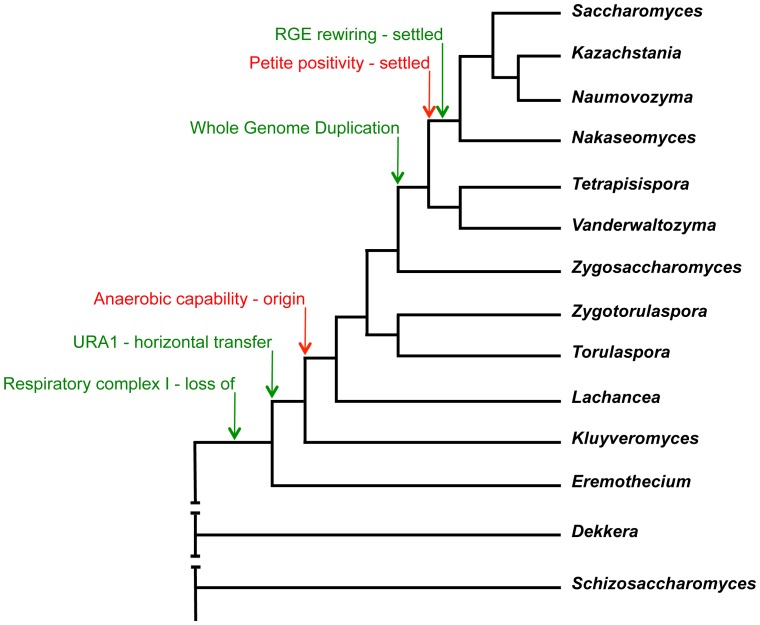
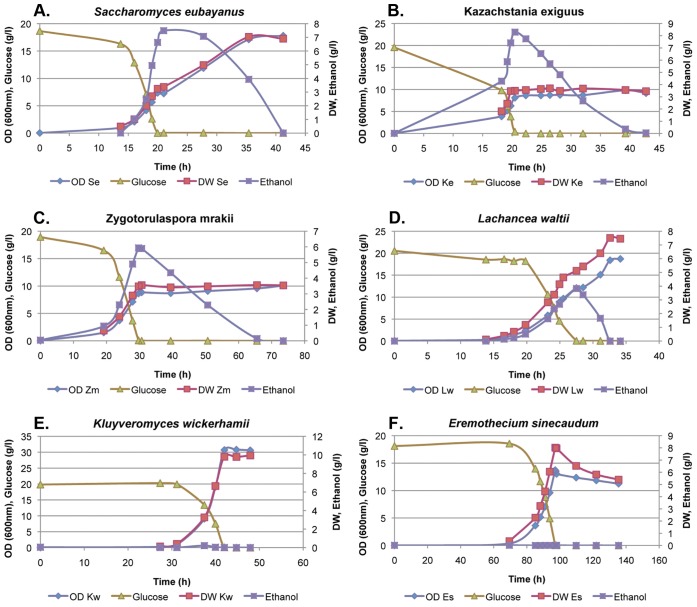
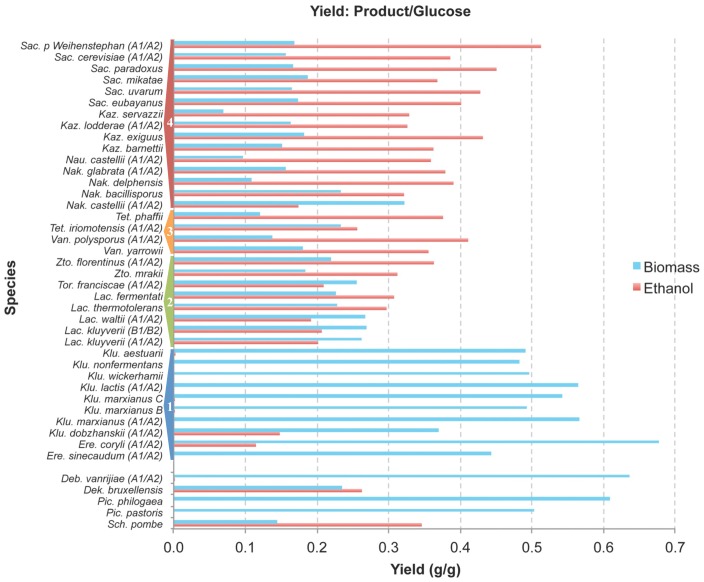
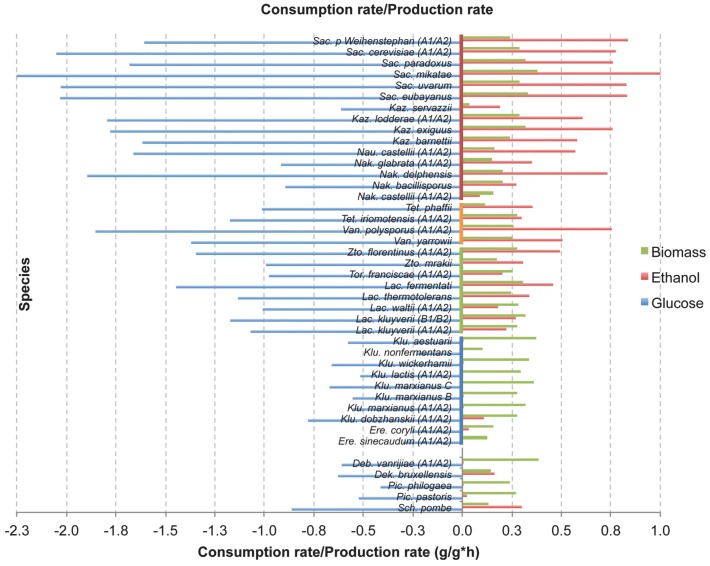
When fruits ripen, microbial communities start a fierce competition for the freely available fruit sugars. Three yeast lineages, including baker's yeast Saccharomyces cerevisiae, have independently developed the metabolic activity to convert simple sugars into ethanol even under fully aerobic conditions. This fermentation capacity, named Crabtree effect, reduces the cell-biomass production but provides in nature a tool to out-compete other microorganisms. Here, we analyzed over forty Saccharomycetaceae yeasts, covering over 200 million years of the evolutionary history, for their carbon metabolism. The experiments were done under strictly controlled and uniform conditions, which has not been done before. We show that the origin of Crabtree effect in Saccharomycetaceae predates the whole genome duplication and became a settled metabolic trait after the split of the S. cerevisiae and Kluyveromyces lineages, and coincided with the origin of modern fruit bearing plants. Our results suggest that ethanol fermentation evolved progressively, involving several successive molecular events that have gradually remodeled the yeast carbon metabolism. While some of the final evolutionary events, like gene duplications of glucose transporters and glycolytic enzymes, have been deduced, the earliest molecular events initiating Crabtree effect are still to be determined.
Overview
The claims and statistics of this paper haven’t been checked yet.
Run the check — free, no account needed. It reads the open-access text and checks the sources it cites.
Integrity signals
Registry
Cites
Statistics
Figures
Verification
Claims the paper makes
The claims and statistics of this paper haven’t been checked yet.
Run the check — free, no account needed. It reads the open-access text and checks the sources it cites.
Claims other papers make about this one
Each is checked against this paper’s own text: does it say what the citing paper says it does?
The cited source says what the claim attributes to it.
In the citing paper
“many aspects of its energy metabolism are relatively recent evolutionary adaptations to the predominantly fermentative lifestyle and are not typical of other yeast lineages”
From Mitochondrial retrograde control of transcription evolves with respiratory stress, metabolic adaptation, and virulence in budding yeasts (2026) · cites this paper as Hagman et al. 2013
The cited source says what the claim attributes to it.
In the citing paper
“S. cerevisiae belongs to yeasts exhibiting the Crabtree effect—preference for fermentative energy production in high glucose concentration even in the presence of oxygen (Hagman et al. 2013; Pfeiffer and Morley 2014; Williams et al. 2015; Nespolo et al. 2020).”
From Mitochondrial retrograde control of transcription evolves with respiratory stress, metabolic adaptation, and virulence in budding yeasts (2026) · cites this paper as Hagman et al. 2013
Self-check
Percentages, sums and reported differences re-computed from the paper’s own numbers.
The self-check needs the paper’s full text.
Citations
Cites
Goffeau, A., Barrell, B. G., Bussey, H., Davis, R. W., Dujon, B., Feldmann, H., Galibert, F., Hoheisel, J. D., Jacq, C., Johnston, M., et al. (1996) · Science · doi:10.1126/science.274.5287.546 · Cited by 4,423
Molecular evidence for an ancient duplication of the entire yeast genome
Wolfe, K. H., & Shields, D. C. (1997) · Nature · doi:10.1038/42711 · Cited by 1,785
Dujon, B., Sherman, D., Fischer, G., Durrens, P., Casaregola, S., Lafontaine, I., de Montigny, J., Marck, C., Neuvéglise, C., Talla, E., et al. (2004) · Nature · doi:10.1038/nature02579 · Cited by 1,623
Verduyn, C., Postma, E., Scheffers, W. A., & van Dijken, J. P. (1992) · Yeast · doi:10.1002/yea.320080703 · Cited by 1,510
Phylogenomics: The beginning of incongruence?
JEFFROY, O., BRINKMANN, H., DELSUC, F., & PHILIPPE, H. (2006) · Trends in Genetics · doi:10.1016/j.tig.2006.02.003 · Cited by 698
Kurtzman, C. P., & Robnett, C. J. (2003) · FEMS Yeast Research · doi:10.1016/s1567-1356(03)00012-6 · Cited by 652
How did Saccharomyces evolve to become a good brewer?
Piškur, J., Rozpędowska, E., Poláková, S., Merico, A., & Compagno, C. (2006) · Trends in Genetics · doi:10.1016/j.tig.2006.02.002 · Cited by 514
Self-citationComparative functional genomics of the fission yeasts
Rhind, N., Chen, Z., Yassour, M., Thompson, D. A., Haas, B. J., Habib, N., Wapinski, I., Roy, S., Lin, M. F., Heiman, D. I., et al. (2011) · Science · doi:10.1126/science.1203357 · Cited by 484
Resurrecting ancestral alcohol dehydrogenases from yeast
Thomson, J. M., Gaucher, E. A., Burgan, M. F., De Kee, D. W., Li, T., Aris, J. P., & Benner, S. A. (2005) · Nature Genetics · doi:10.1038/ng1553 · Cited by 341
Dujon, B. (2010) · Nature Reviews Genetics · doi:10.1038/nrg2811 · Cited by 330
Research works printed but not linked: 1
- Kurtzman CP, Fell JW, Boekhout T (2011) The Yeasts, a Taxanomic Study. London: Elsevier. 2080 p.
Cited by
Sorted by citations
Saccharomyces cerevisiae and its industrial applications
Parapouli, M., 1 Molecular Biology laboratory, D. O. B. A. A. T., Vasileiadi, A., Afendra, A.-S., Hatziloukas, E., 2 Genetics laboratory, D. O. B. A. A. T., & equally, #. T. T. A. C. (2020) · AIMS Microbiology · doi:10.3934/microbiol.2020001 · Cited by 685
An evolutionary perspective on the Crabtree effect
Pfeiffer, T., & Morley, A. (2014) · Frontiers in Molecular Biosciences · doi:10.3389/fmolb.2014.00017 · Cited by 318
Why, when, and how did yeast evolve alcoholic fermentation?
Dashko, S., Zhou, N., Compagno, C., & Piškur, J. (2014) · FEMS Yeast Research · doi:10.1111/1567-1364.12161 · Cited by 335
Self-citationTaming Wild Yeast: Potential of Conventional and Nonconventional Yeasts in Industrial Fermentations
Steensels, J., & Verstrepen, K. J. (2014) · Annual Review of Microbiology · doi:10.1146/annurev-micro-091213-113025 · Cited by 282
Kour, D., Rana, K. L., Yadav, N., Yadav, A. N., Singh, J., Rastegari, A. A., & Saxena, A. K. (2019) · Fungal biology · doi:10.1007/978-3-030-14846-1_1 · Cited by 196
Metadata
- Authors
- Hagman, A., Säll, T., Compagno, C., & Piskur, J.
- Affiliations
- Lund University (SE)
- University of Milan (IT)
- Corresponding author
- Hagman, Arne
- Säll, Torbjörn
- Compagno, Concetta
- Venue
- PLoS ONE
- Publisher
- Public Library of Science (PLoS)
- Published
- 2013-07-15
- Volume
- 8
- Issue
- 7
- Pages
- e68734
- ISSN
- 1932-6203 (ISSN-L)
- PMC
- PMC3711898
- OpenAlex
- W2158180844
- Cited by
- 219
- References
- 31
- Citations by year
- 2026: 10 · 2025: 15 · 2024: 12 · 2023: 20 · 2022: 17 · 2021: 29 · 2020: 12 · 2019: 21 · 2018: 17 · 2017: 16 · 2016: 17 · 2015: 15 · 2014: 18
- FWCI
- 7.47
- Type
- journal article
- Language
- en
- Open access
- gold
- doi.org
- Locations
- PLoS ONE (publishedVersion, cc-by)
- Europe PMC (PubMed Central) (publishedVersion, cc-by)
- PubMed Central (publishedVersion, cc-by)
- PubMed (publishedVersion)
- Archivio Istituzionale della Ricerca (Universita Degli Studi Di Milano) (submittedVersion, other-oa)
- DOAJ (DOAJ: Directory of Open Access Journals) (submittedVersion, cc-by-sa)
- Figshare (submittedVersion, cc-by)
- Lund University Publications (Lund University) (submittedVersion, other-oa)
- Funders
- Vetenskapsrådet
- Topics
- Life Sciences › Biochemistry, Genetics and Molecular Biology › Molecular Biology › Fungal and yeast genetics research
- Life Sciences › Immunology and Microbiology › Microbiology › Yeasts and Rust Fungi Studies
- Life Sciences › Biochemistry, Genetics and Molecular Biology › Molecular Biology › Microbial Metabolic Engineering and Bioproduction
- Keywords
- Crabtree effect, alcoholic fermentation, Saccharomyces cerevisiae, Saccharomycetaceae, yeast evolution, whole-genome duplication, carbon metabolism, glucose transporters, glycolytic enzymes, gene duplication, fruit ripening, microbial competition, fruit-bearing plants, aerobic fermentation
- MeSH terms
- Carbon, Saccharomycetales, Fermentation, Glucose, Genome, Fungal, Evolution, Molecular
About these checks
Registry, retraction, Cites and statistics results are computed, not judged, with one exception: a printed reference that no index lists is read once by a model before it counts as a citation error. Claims are extracted by a model and kept only when their quote appears verbatim in the text; each cited source is then checked, with a model’s help, for whether it says what the claim relies on. Those verdicts can be wrong — read the claim’s quote and the cited source before relying on one.
Statistics and arithmetic are recomputed, not judged.
Confidence bands are shown only for fields calibrated on our annotated test set. None is calibrated yet, so no band is shown.
What counts as a claim ›How we measure confidence ›How we check this ›
Are you an author, or do you see a problem with this page? Request a review
