

The DOI matches its Crossref record; 42 of the 42 references it cites were found in a registry or an index.
The Personalized Advantage Index: Translating Research on Prediction into Individualized Treatment Recommendations. A Demonstration
Open accessAbstract
BACKGROUND: Advances in personalized medicine require the identification of variables that predict differential response to treatments as well as the development and refinement of methods to transform predictive information into actionable recommendations. OBJECTIVE: To illustrate and test a new method for integrating predictive information to aid in treatment selection, using data from a randomized treatment comparison. METHOD: Data from a trial of antidepressant medications (N = 104) versus cognitive behavioral therapy (N = 50) for Major Depressive Disorder were used to produce predictions of post-treatment scores on the Hamilton Rating Scale for Depression (HRSD) in each of the two treatments for each of the 154 patients. The patient's own data were not used in the models that yielded these predictions. Five pre-randomization variables that predicted differential response (marital status, employment status, life events, comorbid personality disorder, and prior medication trials) were included in regression models, permitting the calculation of each patient's Personalized Advantage Index (PAI), in HRSD units. RESULTS: For 60% of the sample a clinically meaningful advantage (PAI≥3) was predicted for one of the treatments, relative to the other. When these patients were divided into those randomly assigned to their "Optimal" treatment versus those assigned to their "Non-optimal" treatment, outcomes in the former group were superior (d = 0.58, 95% CI .17-1.01). CONCLUSIONS: This approach to treatment selection, implemented in the context of two equally effective treatments, yielded effects that, if obtained prospectively, would rival those routinely observed in comparisons of active versus control treatments.
Overview
The claims and statistics of this paper haven’t been checked yet.
Run the check — free, no account needed. It reads the open-access text and checks the sources it cites.
Integrity signals
Registry
Cites
Statistics
Figures
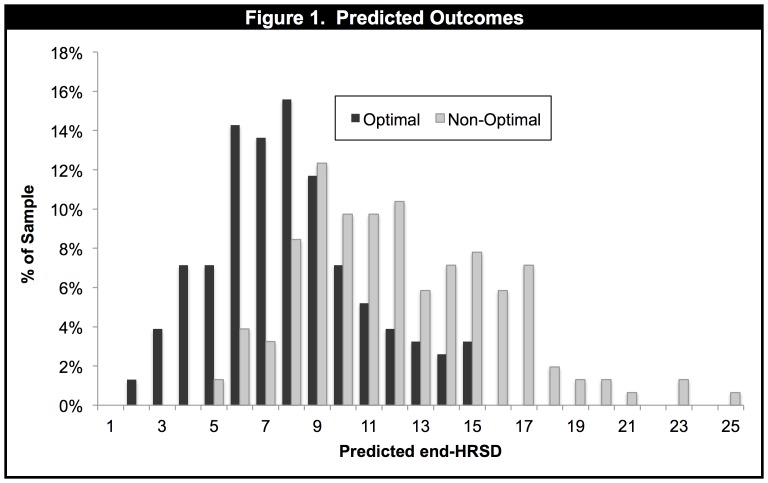
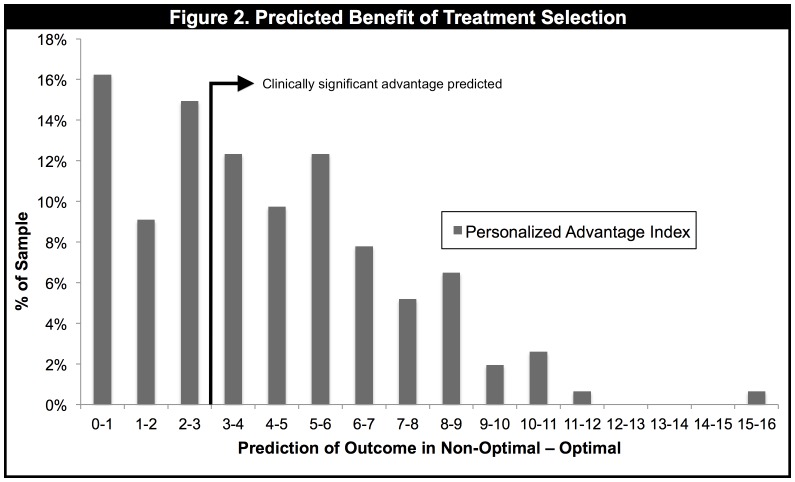
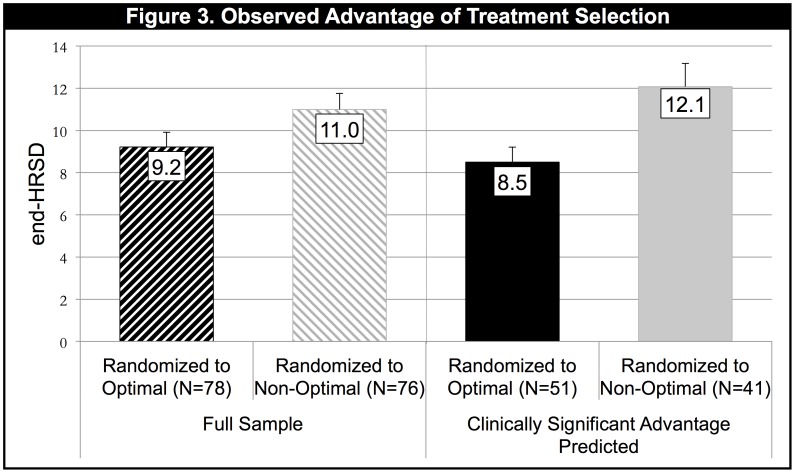
Verification
Claims the paper makes
The claims and statistics of this paper haven’t been checked yet.
Run the check — free, no account needed. It reads the open-access text and checks the sources it cites.
Claims other papers make about this one
Each is checked against this paper’s own text: does it say what the citing paper says it does?
In the citing paper
“The use of waiting list control groups as often the case in psychotherapy research may lead to an overestimation of the effects of treatment. 592,593”
From Time for united action on depression: a Lancet–World Psychiatric Association Commission (2022) · cites this paper as [592]
In the citing paper
“Literature on patient factors predicting treatment response to MBCT is emerging but still in its infancy, particularly compared to predictors of outcome of cognitive therapy (DeRubeis et al., 2014).”
From Adding mindfulness-based cognitive therapy to maintenance antidepressant medication for prevention of relapse/recurrence in major depressive disorder: Randomised controlled trial (2015) · cites this paper as DeRubeis et al., 2014
In the citing paper
“There is now a consensus in the literature that future improvements in outcomes obtained from cognitive behavioral therapy (CBT) for chronic pain will require research to identify patient and treatment variables that help explain outcomes.”
From Predictors and mediators of outcome in cognitive behavioral therapy for chronic pain: The contributions of psychological flexibility (2021) · cites this paper as DeRubeis et al., 2014
Self-check
Percentages, sums and reported differences re-computed from the paper’s own numbers.
The self-check needs the paper’s full text.
Citations
Cites
Hamilton, M. (1960) · Journal of Neurology, Neurosurgery & Psychiatry · doi:10.1136/jnnp.23.1.56 · Cited by 32,817
Draper, N. R., & Smith, H. (2005) · Technometrics · doi:10.1198/tech.2005.s303 · Cited by 17,993
A leisurely look at the bootstrap, the jackknife, and cross-validation
Efron, B., & Gong, G. (1983) · The American Statistician · doi:10.1080/00031305.1983.10483087 · Cited by 3,229
Mediators and Moderators of Treatment Effects in Randomized Clinical Trials
Kraemer, H. C., Wilson, G. T., Fairburn, C. G., & Agras, W. S. (2002) · Archives of General Psychiatry · doi:10.1001/archpsyc.59.10.877 · Cited by 2,562 · cited 1×
“Biostatisticians have described analytic frameworks to identify prescriptive (moderator) variables [38,39], but less attention has”
BackgroundKirsch, I., Deacon, B. J., Huedo-Medina, T. B., Scoboria, A., Moore, T. J., & Johnson, B. T. (2008) · PLoS Medicine · doi:10.1371/journal.pmed.0050045 · Cited by 2,442
Selective publication of antidepressant trials and its influence on apparent efficacy
Turner, E. H., Matthews, A. M., Linardatos, E., Tell, R. A., & Rosenthal, R. (2008) · New England Journal of Medicine · doi:10.1056/nejmsa065779 · Cited by 2,435
“Clinical versus Actuarial Judgment.”
Dawes, R. M., Faust, D., & Meehl, P. E. (1989) · Science · doi:10.1126/science.2648573 · Cited by 2,298
The Path to Personalized Medicine
Hamburg, M. A., & Collins, F. S. (2010) · New England Journal of Medicine · doi:10.1056/nejmp1006304 · Cited by 1,970
Encyclopedia of research design
(2011) · Choice Reviews Online · doi:10.5860/choice.48-2447 · Cited by 1,925
Cognitive Therapy vs Medications in the Treatment of Moderate to Severe Depression
DeRubeis, R. J., Hollon, S. D., Amsterdam, J. D., Shelton, R. C., Young, P. R., Salomon, R. M., O’Reardon, J. P., Lovett, M. L., Gladis, M. M., Brown, L. L., et al. (2005) · Archives of General Psychiatry · doi:10.1001/archpsyc.62.4.409 · Cited by 989
Self-citation
Cited by
Sorted by citations
Goldstein, A., Kapelner, A., Bleich, J., & Pitkin, E. (2015) · Journal of Computational and Graphical Statistics · doi:10.1080/10618600.2014.907095 · Cited by 1,861
“The goal of the analysis in DeRubeis et al. (2014) is to understand how different subjects respond to different treatments, conditional on their personal covariates.”
BackgroundMethodInfluentialComputational psychiatry as a bridge from neuroscience to clinical applications
Huys, Q. J. M., Maia, T. V., & Frank, M. J. (2016) · Nature Neuroscience · doi:10.1038/nn.4238 · Cited by 1,002
Time for united action on depression: a Lancet–World Psychiatric Association Commission
Herrman, H., Patel, V., Kieling, C., Berk, M., Buchweitz, C., Cuijpers, P., Furukawa, T. A., Kessler, R. C., Kohrt, B. A., Maj, M., et al. (2022) · The Lancet · doi:10.1016/s0140-6736(21)02141-3 · Cited by 1,104
Cross-trial prediction of treatment outcome in depression: a machine learning approach
Chekroud, A. M., Zotti, R. J., Shehzad, Z., Gueorguieva, R., Johnson, M. K., Trivedi, M. H., Cannon, T. D., Krystal, J. H., & Corlett, P. R. (2016) · The Lancet Psychiatry · doi:10.1016/s2215-0366(15)00471-x · Cited by 676
The Lancet Psychiatry Commission on psychological treatments research in tomorrow's science
Holmes, E. A., Ghaderi, A., Harmer, C. J., Ramchandani, P. G., Cuijpers, P., Morrison, A. P., Roiser, J. P., Bockting, C. L. H., O'Connor, R. C., Shafran, R., et al. (2018) · The Lancet Psychiatry · doi:10.1016/s2215-0366(17)30513-8 · Cited by 624
Metadata
- Authors
- DeRubeis, R. J., Cohen, Z. D., Forand, N. R., Fournier, J. C., Gelfand, L. A., & Lorenzo-Luaces, L.
- Affiliations
- University of Pennsylvania (US)
- The Ohio State University (US)
- University of Pittsburgh (US)
- Corresponding author
- DeRubeis, Robert J.
- Venue
- PLoS ONE
- Publisher
- Public Library of Science (PLoS)
- Published
- 2014-01-08
- Volume
- 9
- Issue
- 1
- Pages
- e83875
- ISSN
- 1932-6203 (ISSN-L)
- PMC
- PMC3885521
- OpenAlex
- W2079702662
- Cited by
- 509
- References
- 42
- Citations by year
- 2026: 36 · 2025: 25 · 2024: 33 · 2023: 41 · 2022: 52 · 2021: 99 · 2020: 46 · 2019: 51 · 2018: 34 · 2017: 35 · 2016: 26 · 2015: 23 · 2014: 8
- FWCI
- 22.60
- Type
- journal article
- Language
- en
- Open access
- gold
- doi.org
- Licence
- Locations
- PLoS ONE (publishedVersion, cc-by)
- Europe PMC (PubMed Central) (publishedVersion, cc-by)
- PubMed Central (publishedVersion, cc-by)
- PubMed (publishedVersion)
- D-Scholarship@Pitt (University of Pittsburgh) (acceptedVersion)
- RePEc: Research Papers in Economics (submittedVersion)
- DOAJ (DOAJ: Directory of Open Access Journals) (submittedVersion, cc-by-sa)
- Funders
- National Institute of Mental Health (2-R01-MH-060998-06, R01MH060998)
- Topics
- Health Sciences › Medicine › Pharmacology (medical) › Treatment of Major Depression
- Social Sciences › Psychology › Clinical Psychology › Psychotherapy Techniques and Applications
- Physical Sciences › Mathematics › Statistics and Probability › Statistical Methods in Clinical Trials
- Keywords
- personalized medicine, treatment selection, differential treatment response, prediction of treatment outcome, major depressive disorder, antidepressants, cognitive behavioral therapy, Hamilton Depression Rating Scale, treatment response prediction
- MeSH terms
- Antidepressive Agents, Depressive Disorder, Major, Major Depressive Disorder, Health Planning Guidelines, Humans, Prognosis, Psychiatric Status Rating Scales, Cognitive Behavioral Therapy, Translational Research, Biomedical, Precision Medicine
About these checks
Registry, retraction, Cites and statistics results are computed, not judged, with one exception: a printed reference that no index lists is read once by a model before it counts as a citation error. Claims are extracted by a model and kept only when their quote appears verbatim in the text; each cited source is then checked, with a model’s help, for whether it says what the claim relies on. Those verdicts can be wrong — read the claim’s quote and the cited source before relying on one.
Statistics and arithmetic are recomputed, not judged.
Confidence bands are shown only for fields calibrated on our annotated test set. None is calibrated yet, so no band is shown.
What counts as a claim ›How we measure confidence ›How we check this ›
Are you an author, or do you see a problem with this page? Request a review
