

The DOI matches its Crossref record; 58 of the 58 references it cites were found in a registry or an index.
Probiotic Microbes Sustain Youthful Serum Testosterone Levels and Testicular Size in Aging Mice
Open accessAbstract
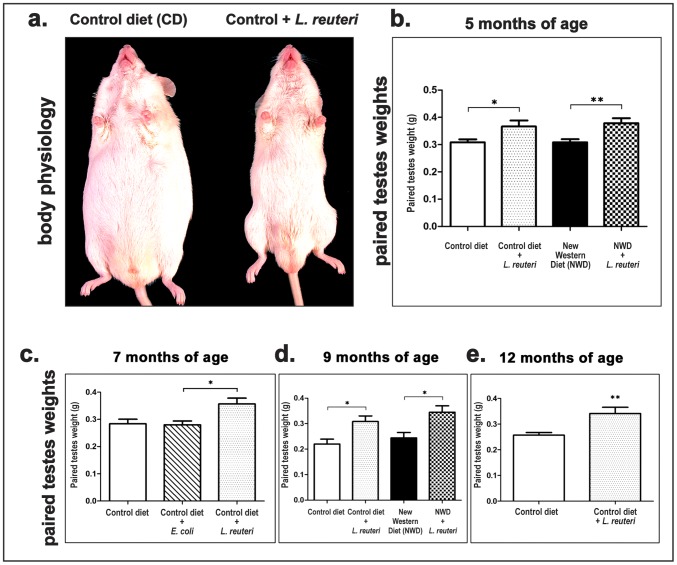
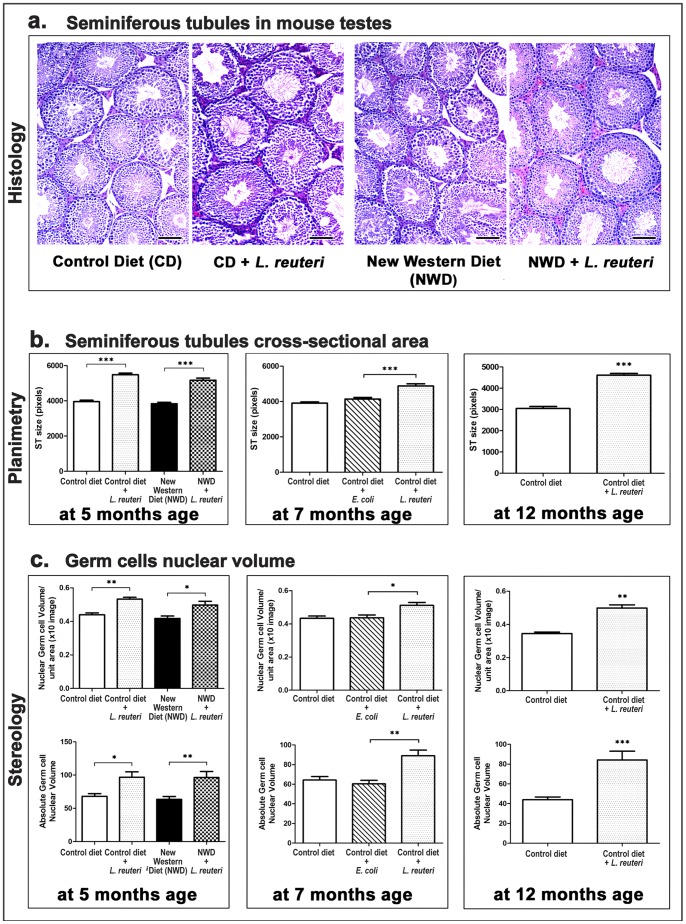
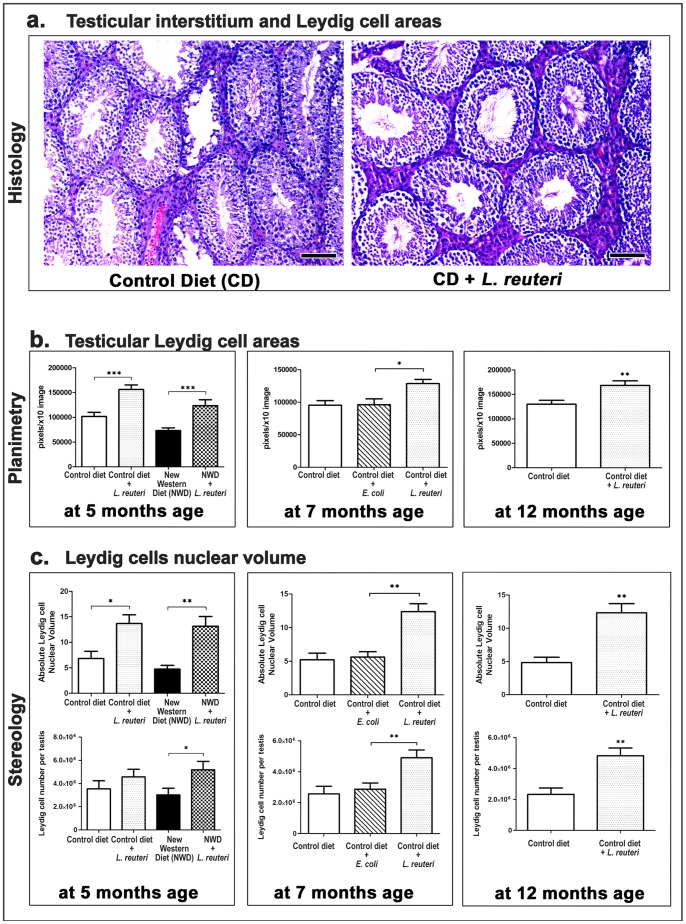
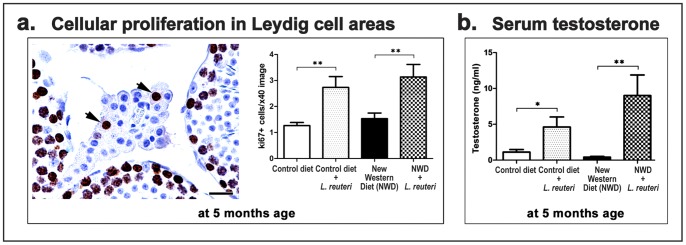
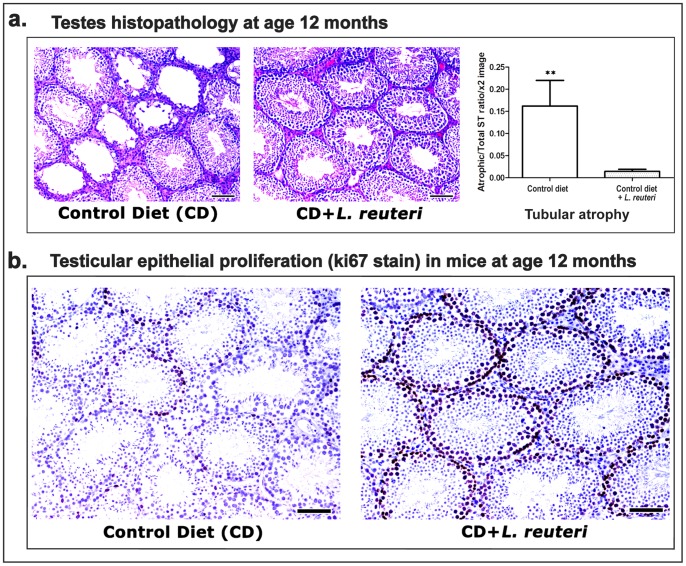
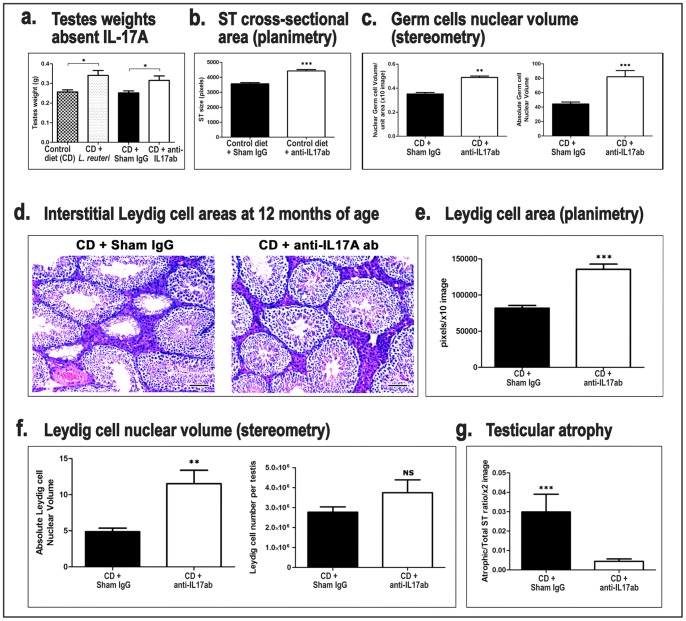
The decline of circulating testosterone levels in aging men is associated with adverse health effects. During studies of probiotic bacteria and obesity, we discovered that male mice routinely consuming purified lactic acid bacteria originally isolated from human milk had larger testicles and increased serum testosterone levels compared to their age-matched controls. Further investigation using microscopy-assisted histomorphometry of testicular tissue showed that mice consuming Lactobacillus reuteri in their drinking water had significantly increased seminiferous tubule cross-sectional profiles and increased spermatogenesis and Leydig cell numbers per testis when compared with matched diet counterparts This showed that criteria of gonadal aging were reduced after routinely consuming a purified microbe such as L. reuteri. We tested whether these features typical of sustained reproductive fitness may be due to anti-inflammatory properties of L. reuteri, and found that testicular mass and other indicators typical of old age were similarly restored to youthful levels using systemic administration of antibodies blocking pro-inflammatory cytokine interleukin-17A. This indicated that uncontrolled host inflammatory responses contributed to the testicular atrophy phenotype in aged mice. Reduced circulating testosterone levels have been implicated in many adverse effects; dietary L. reuteri or other probiotic supplementation may provide a viable natural approach to prevention of male hypogonadism, absent the controversy and side-effects of traditional therapies, and yield practical options for management of disorders typically associated with normal aging. These novel findings suggest a potential high impact for microbe therapy in public health by imparting hormonal and gonad features of reproductive fitness typical of much younger healthy individuals.
Overview
The claims and statistics of this paper haven’t been checked yet.
Run the check — free, no account needed. It reads the open-access text and checks the sources it cites.
Integrity signals
Registry
Cites
Statistics
Figures
Verification
Claims the paper makes
The claims and statistics of this paper haven’t been checked yet.
Run the check — free, no account needed. It reads the open-access text and checks the sources it cites.
Claims other papers make about this one
Each is checked against this paper’s own text: does it say what the citing paper says it does?
In the citing paper
“Further, aging mice supplemented with the probiotic bacterium L. reuteri had larger testicles and increased serum testosterone levels compared to their age-matched controls [237, 254].”
From International Society of Sports Nutrition Position Stand: Probiotics (2019) · cites this paper as [237]
In the citing paper
“In animals, probiotics have been associated with benefits including normalizing age-related drops in testosterone levels [237], increasing neurotransmitter synthesis [238], reducing stress-induced cortisol levels [239], reducing inflammation [100] and improving mood [240].”
From International Society of Sports Nutrition Position Stand: Probiotics (2019) · cites this paper as [237]
Self-check
Percentages, sums and reported differences re-computed from the paper’s own numbers.
The self-check needs the paper’s full text.
Citations
Cites
Bettelli, E., Carrier, Y., Gao, W., Korn, T., Strom, T. B., Oukka, M., Weiner, H. L., & Kuchroo, V. K. (2006) · Nature · doi:10.1038/nature04753 · Cited by 6,992
Bravo, J. A., Forsythe, P., Chew, M. V., Escaravage, E., Savignac, H. M., Dinan, T. G., Bienenstock, J., & Cryan, J. F. (2011) · Proceedings of the National Academy of Sciences · doi:10.1073/pnas.1102999108 · Cited by 3,888
Longitudinal Effects of Aging on Serum Total and Free Testosterone Levels in Healthy Men
Harman, S. M., Metter, E. J., Tobin, J. D., Pearson, J., & Blackman, M. R. (2001) · The Journal of Clinical Endocrinology & Metabolism · doi:10.1210/jcem.86.2.7219 · Cited by 2,760
Changes in diet and lifestyle and long-term weight gain in women and men
Mozaffarian, D., Hao, T., Rimm, E. B., Willett, W. C., & Hu, F. B. (2011) · New England Journal of Medicine · doi:10.1056/nejmoa1014296 · Cited by 2,527
Feldman, H. A., Longcope, C., Derby, C. A., Johannes, C. B., Araujo, A. B., Coviello, A. D., Bremner, W. J., & McKinlay, J. B. (2002) · The Journal of Clinical Endocrinology & Metabolism · doi:10.1210/jcem.87.2.8201 · Cited by 1,861
Park, E. J., Lee, J. H., Yu, G.-Y., He, G., Ali, S. R., Holzer, R. G., Österreicher, C. H., Takahashi, H., & Karin, M. (2010) · Cell · doi:10.1016/j.cell.2009.12.052 · Cited by 1,764
Diet, gut microbiota and immune responses
Maslowski, K. M., & Mackay, C. R. (2011) · Nature Immunology · doi:10.1038/ni0111-5 · Cited by 1,261
Has the Microbiota Played a Critical Role in the Evolution of the Adaptive Immune System?
Lee, Y. K., & Mazmanian, S. K. (2010) · Science · doi:10.1126/science.1195568 · Cited by 1,147
Salama, P. R., Phillips, M. R., Grieu, F., Morris, M. J., Zeps, N., Joseph, D. J., Platell, C. F. E., & Iacopetta, B. J. (2008) · Journal of Clinical Oncology · doi:10.1200/jco.2008.18.7229 · Cited by 1,025
Testosterone: a metabolic hormone in health and disease
Kelly, D. M., & Jones, T. H. (2013) · Journal of Endocrinology · doi:10.1530/joe-12-0455 · Cited by 612
Cited by
Sorted by citations
Flandroy, L., Poutahidis, T., Berg, G., Clarke, G. A., Dao, M. C., Decaestecker, E., Furman, E., Haahtela, T., Massart, S., Plovier, H., et al. (2018) · The Science of The Total Environment · doi:10.1016/j.scitotenv.2018.01.288 · Cited by 417
Self-citationSerum level of sex steroid hormone is associated with diversity and profiles of human gut microbiome
Shin, J.-H., Park, Y.-H., Sim, M., Kim, S.-A., Joung, H., & Shin, D.-M. (2019) · Research in Microbiology · doi:10.1016/j.resmic.2019.03.003 · Cited by 334
The neuroendocrinology of the microbiota-gut-brain axis: a behavioural perspective
Cussotto, S., Sandhu, K. V., Dinan, T. G., & Cryan, J. F. (2018) · Frontiers in Neuroendocrinology · doi:10.1016/j.yfrne.2018.04.002 · Cited by 326
“Interestingly, administration of the probiotic L. reuteri has been shown to increase testosterone levels in aging mice (Poutahidis et al., 2014).”
BackgroundThe relationship between circulating testosterone and inflammatory cytokines in men
Mohamad, N.-V., Wong, S. K., Hasan, W. N. W., Jolly, J. J., Farhana, M. F. N., Ima-Nirwana, S., & Chin, K. (2018) · The Aging Male · doi:10.1080/13685538.2018.1482487 · Cited by 319
Roles of Sex Hormones and Gender in the Gut Microbiota
Yoon, K., & Kim, N. (2021) · Journal of Neurogastroenterology and Motility · doi:10.5056/jnm20208 · Cited by 318
Metadata
- Authors
- Poutahidis, T., Springer, A., Levkovich, T., Qi, P., Varian, B. J., Lakritz, J. R., Ibrahim, Y. M., Chatzigiagkos, A., Alm, E. J., & Erdman, S. E.
- Affiliations
- Aristotle University of Thessaloniki (GR)
- Massachusetts Institute of Technology (US)
- Broad Institute (US)
- Corresponding author
- Alm, Eric J.
- Erdman, Susan E.
- ORCID
- Venue
- PLoS ONE
- Publisher
- Public Library of Science (PLoS)
- Published
- 2014-01-02
- Volume
- 9
- Issue
- 1
- Pages
- e84877
- ISSN
- 1932-6203 (ISSN-L)
- PMC
- PMC3879365
- OpenAlex
- W2045577016
- Cited by
- 177
- References
- 58
- Citations by year
- 2026: 16 · 2025: 17 · 2024: 24 · 2023: 13 · 2022: 22 · 2021: 20 · 2020: 14 · 2019: 10 · 2018: 8 · 2017: 10 · 2016: 11 · 2015: 7 · 2014: 5
- FWCI
- 15.74
- Type
- journal article
- Language
- en
- Open access
- gold
- doi.org
- Licence
- Locations
- PLoS ONE (publishedVersion, cc-by)
- PubMed Central (publishedVersion, cc-by)
- PubMed (publishedVersion)
- DOAJ (DOAJ: Directory of Open Access Journals) (submittedVersion, cc-by-sa)
- DSpace@MIT (Massachusetts Institute of Technology) (submittedVersion, cc-by-nc)
- Figshare (submittedVersion, cc-by)
- Funders
- National Institutes of Health (ES002109)
- National Cancer Institute (U01CA164337, R01CA108854)
- National Institute of Environmental Health Sciences (P30ES002109)
- Topics
- Life Sciences › Agricultural and Biological Sciences › Food Science › Probiotics and Fermented Foods
- Health Sciences › Medicine › Reproductive Medicine › Sperm and Testicular Function
- Health Sciences › Medicine › Endocrinology, Diabetes and Metabolism › Hormonal and reproductive studies
- Keywords
- probiotics, Lactobacillus reuteri, testosterone, male hypogonadism, testicular aging, seminiferous tubules, spermatogenesis, Leydig cells, IL-17A, inflammation, lactic acid bacteria, reproductive fitness, older men
- MeSH terms
- Age Factors, Animals, Atrophy, Diet, Leydig Cells, Male, Organ Size, Seminiferous Tubules, Spermatogenesis, Testis, Testosterone, Probiotics, Interleukin-17, Mice, Limosilactobacillus reuteri
About these checks
Registry, retraction, Cites and statistics results are computed, not judged, with one exception: a printed reference that no index lists is read once by a model before it counts as a citation error. Claims are extracted by a model and kept only when their quote appears verbatim in the text; each cited source is then checked, with a model’s help, for whether it says what the claim relies on. Those verdicts can be wrong — read the claim’s quote and the cited source before relying on one.
Statistics and arithmetic are recomputed, not judged.
Confidence bands are shown only for fields calibrated on our annotated test set. None is calibrated yet, so no band is shown.
What counts as a claim ›How we measure confidence ›How we check this ›
Are you an author, or do you see a problem with this page? Request a review
