

The DOI matches its Crossref record; 29 of the 29 references it cites were found in a registry or an index.
Potential Role of the Bovine Rumen Microbiome in Modulating Milk Composition and Feed Efficiency
Open accessAbstract
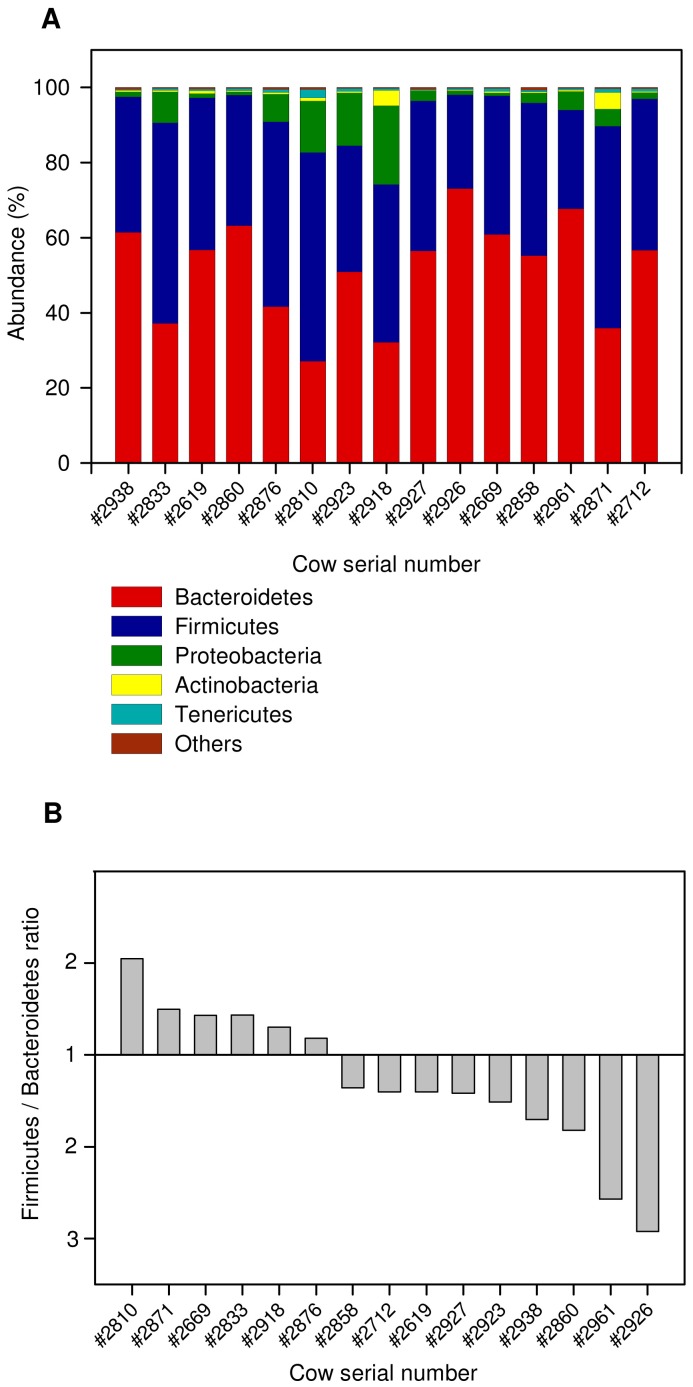
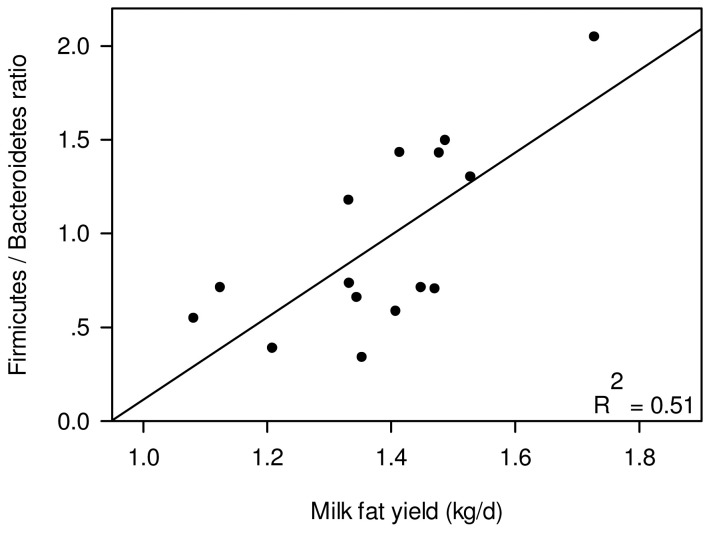
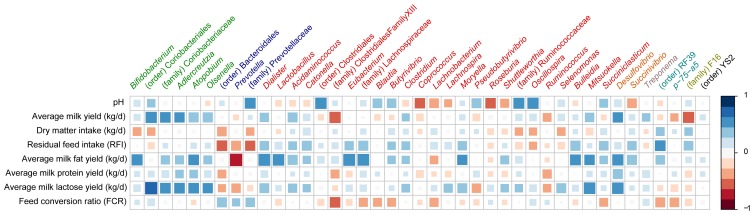
Ruminants are completely dependent on their microbiota for feed digestion and consequently, their viability. It is therefore tempting to hypothesize a connection between the composition and abundance of resident rumen bacterial taxa and the physiological parameters of the host. Using a pyrosequencing approach, we characterized the rumen bacterial community composition in 15 dairy cows and their physiological parameters. We analyzed the degree of divergence between the different animals and found that some physiological parameters, such as milk yield and composition, are highly correlated with the abundance of various bacterial members of the rumen microbiome. One apparent finding was a strong correlation between the ratio of the phyla Firmicutes to Bacteroidetes and milk-fat yield. These findings paralleled human studies showing similar trends of increased adiposity with an increase in Bacteroidetes. This correlation remained evident at the genus level, where several genera showed correlations with the animals' physiological parameters. This suggests that the bacterial community has a role in shaping host physiological parameters. A deeper understanding of this process may allow us to modulate the rumen microbiome for better agricultural yield through bacterial community design.
Overview
The claims and statistics of this paper haven’t been checked yet.
Run the check — free, no account needed. It reads the open-access text and checks the sources it cites.
Integrity signals
Registry
Cites
Statistics
Figures
Verification
Claims the paper makes
The claims and statistics of this paper haven’t been checked yet.
Run the check — free, no account needed. It reads the open-access text and checks the sources it cites.
Claims other papers make about this one
Each is checked against this paper’s own text: does it say what the citing paper says it does?
In the citing paper
“Jami et al. (2014) also reported a positive correlation between RFI and the uncultured rumen bacterium RF39,”
From Addressing global ruminant agricultural challenges through understanding the rumen microbiome: past, present, and future (2018) · cites this paper as Jami et al., 2014
Self-check
Percentages, sums and reported differences re-computed from the paper’s own numbers.
The self-check needs the paper’s full text.
Citations
Cites
QIIME allows analysis of high-throughput community sequencing data
Caporaso, J. G., Kuczynski, J., Stombaugh, J., Bittinger, K., Bushman, F. D., Costello, E. K., Fierer, N., Peña, A. G., Goodrich, J. K., Gordon, J. I., et al. (2010) · Nature Methods · doi:10.1038/nmeth.f.303 · Cited by 34,887
Search and clustering orders of magnitude faster than BLAST
Edgar, R. C. (2010) · Bioinformatics · doi:10.1093/bioinformatics/btq461 · Cited by 21,098
PAST: PALEONTOLOGICAL STATISTICAL SOFTWARE PACKAGE FOR EDUCATION AND DATA ANALYSIS
Hammer, Ø., Harper, D. A. T., & Ryan, P. D. (2001) · Palaeontologia Electronica · Cited by 17,871
An obesity-associated gut microbiome with increased capacity for energy harvest
Turnbaugh, P. J., Ley, R. E., Mahowald, M. A., Magrini, V., Mardis, E. R., & Gordon, J. I. (2006) · Nature · doi:10.1038/nature05414 · Cited by 12,444
Human gut microbes associated with obesity
Ley, R. E., Turnbaugh, P. J., Klein, S., & Gordon, J. I. (2006) · Nature · doi:10.1038/4441022a · Cited by 8,785
Enterotypes of the human gut microbiome
MetaHIT Consortium (additional members), Arumugam, M., Raes, J., Pelletier, E., Le Paslier, D., Yamada, T., Mende, D. R., Fernandes, G. R., Tap, J., Bruls, T., et al. (2011) · Nature · doi:10.1038/nature09944 · Cited by 7,548
Estimación lineal de los requerimientos nutricionales del NRC para ganado de leche.
Elizondo-Salazar, J. A. (2014) · Agronomía Mesoamericana · doi:10.15517/am.v13i1.13244 · Cited by 6,497
Gut Microbiota from Twins Discordant for Obesity Modulate Metabolism in Mice
Ridaura, V. K., Faith, J. J., Rey, F. E., Cheng, J., Duncan, A. E., Kau, A. L., Griffin, N. W., Lombard, V., Henrissat, B., Bain, J. R., et al. (2013) · Science · doi:10.1126/science.1241214 · Cited by 3,788
Chimeric 16S rRNA sequence formation and detection in Sanger and 454-pyrosequenced PCR ampliconsPreprint
Haas, B. J., Gevers, D., Earl, A. M., Feldgarden, M., Ward, D. V., Giannoukos, G., Ciulla, D., Tabbaa, D., Highlander, S. K., Sodergren, E. J., et al. (2011) · Genome Research · doi:10.1101/gr.112730.110 · Cited by 3,527
Polysaccharide utilization by gut bacteria: potential for new insights from genomic analysis
Flint, H. J., Bayer, E. A., Rincón, M. T., Lamed, R., & White, B. A. (2008) · Nature Reviews Microbiology · doi:10.1038/nrmicro1817 · Cited by 1,759
Cited by
Sorted by citations
Henderson, G., Cox, F., Ganesh, S., Jonker, A., Young, W., Collaborators, G. R. C., Abecia, L., Angarita, E., Aravena, P., Nora Arenas, G., et al. (2015) · Scientific Reports · doi:10.1038/srep14567 · Cited by 1,682
Self-citationSpecific microbiome-dependent mechanisms underlie the energy harvest efficiency of ruminants.
Shabat, S. K. B., Sasson, G., Doron-Faigenboim, A., Durman, T., Yaacoby, S., Berg Miller, M. E., White, B. A., Shterzer, N., & Mizrahi, I. (2016) · The ISME Journal · doi:10.1038/ismej.2016.62 · Cited by 823
“…between high and low RFI animals have been reported in terms of methane production, as well as of some differences in microbial composition (Nkrumah et al., 2006; Mizrahi, 2011; Hernandez-Sanabria et al., 2012; Jami et al., 2014; Kittelmann et al., 2014; Shi et al., 2014; Wallace et al., 2015).”
BackgroundLi, F., Li, C., Chen, Y., Liu, J., Zhang, C., Irving, B., Fitzsimmons, C., Plastow, G., & Guan, L. L. (2019) · Microbiome · doi:10.1186/s40168-019-0699-1 · Cited by 530
“ca (1)Department of Agricultural, Food and Nutritional Science, University of Alberta, Edmonton, Alberta T6G 2P5, Canada Full list of author information is available at the end of the article have suggested that differences in rumen microbiota are associated with cattle production and health traits, such as feed effic…”
BackgroundHuws, S. A., Creevey, C. J., Oyama, L. B., Mizrahi, I., Denman, S. E., Popova, M., Muñoz-Tamayo, R., Forano, E., Waters, S. M., Hess, M., et al. (2018) · Frontiers in Microbiology · doi:10.3389/fmicb.2018.02161 · Cited by 487
Self-citationMatthews, C., Crispie, F., Lewis, E., Reid, M., O’Toole, P. W., & Cotter, P. D. (2018) · Gut Microbes · doi:10.1080/19490976.2018.1505176 · Cited by 511
“With regards tomicroorganisms associatedwithmilkfat yield, Jami (2014) identified Firmicutes: Bacteroidetes to be strongly correlated to milk-fat yield.(30) Higher percentages of Firmicutes compensated for the lower abundances of Bacteroidetes.”
Background
Metadata
- Authors
- Jami, E., White, B. A., & Mizrahi, I.
- Affiliations
- Tel Aviv University (IL)
- University of Illinois Urbana-Champaign (US)
- Agricultural Research Organization (IL)
- Corresponding author
- Mizrahi, Itzhak
- Venue
- PLoS ONE
- Publisher
- Public Library of Science (PLoS)
- Published
- 2014-01-22
- Volume
- 9
- Issue
- 1
- Pages
- e85423
- ISSN
- 1932-6203 (ISSN-L)
- PMC
- PMC3899005
- OpenAlex
- W2042473229
- Cited by
- 588
- References
- 29
- Citations by year
- 2026: 26 · 2025: 46 · 2024: 78 · 2023: 54 · 2022: 67 · 2021: 82 · 2020: 55 · 2019: 46 · 2018: 38 · 2017: 47 · 2016: 22 · 2015: 20 · 2014: 7
- FWCI
- 63.79
- Type
- journal article
- Language
- en
- Open access
- gold
- doi.org
- Licence
- Locations
- PLoS ONE (publishedVersion, cc-by)
- Europe PMC (PubMed Central) (publishedVersion, cc-by)
- PubMed Central (publishedVersion, cc-by)
- PubMed (publishedVersion)
- DOAJ (DOAJ: Directory of Open Access Journals) (submittedVersion)
- Figshare (submittedVersion, cc-by)
- Topics
- Life Sciences › Agricultural and Biological Sciences › Animal Science and Zoology › Ruminant Nutrition and Digestive Physiology
- Life Sciences › Biochemistry, Genetics and Molecular Biology › Molecular Biology › Gut microbiota and health
- Life Sciences › Agricultural and Biological Sciences › Animal Science and Zoology › Animal Nutrition and Physiology
- Keywords
- rumen microbiome, dairy cattle, milk composition, milk yield, feed efficiency, rumen bacterial community, Firmicutes/Bacteroidetes ratio, milk fat yield, host-microbe interactions, rumen bacteria
- MeSH terms
- Animals, Animal Feed, Animal Nutritional Physiological Phenomena, Bacteria, Cattle, DNA, Bacterial, Fats, Female, Milk, Phylogeny, RNA, Ribosomal, 16S, Rumen, Sequence Analysis, DNA, Bacteroidetes, Host-Pathogen Interactions, Microbiota
About these checks
Registry, retraction, Cites and statistics results are computed, not judged, with one exception: a printed reference that no index lists is read once by a model before it counts as a citation error. Claims are extracted by a model and kept only when their quote appears verbatim in the text; each cited source is then checked, with a model’s help, for whether it says what the claim relies on. Those verdicts can be wrong — read the claim’s quote and the cited source before relying on one.
Statistics and arithmetic are recomputed, not judged.
Confidence bands are shown only for fields calibrated on our annotated test set. None is calibrated yet, so no band is shown.
What counts as a claim ›How we measure confidence ›How we check this ›
Are you an author, or do you see a problem with this page? Request a review
