

The DOI matches its Crossref record; 589 of the 591 references it cites were found in a registry or an index.
What Is the Evidence for Physical Therapy Poststroke? A Systematic Review and Meta-Analysis
Open accessAbstract
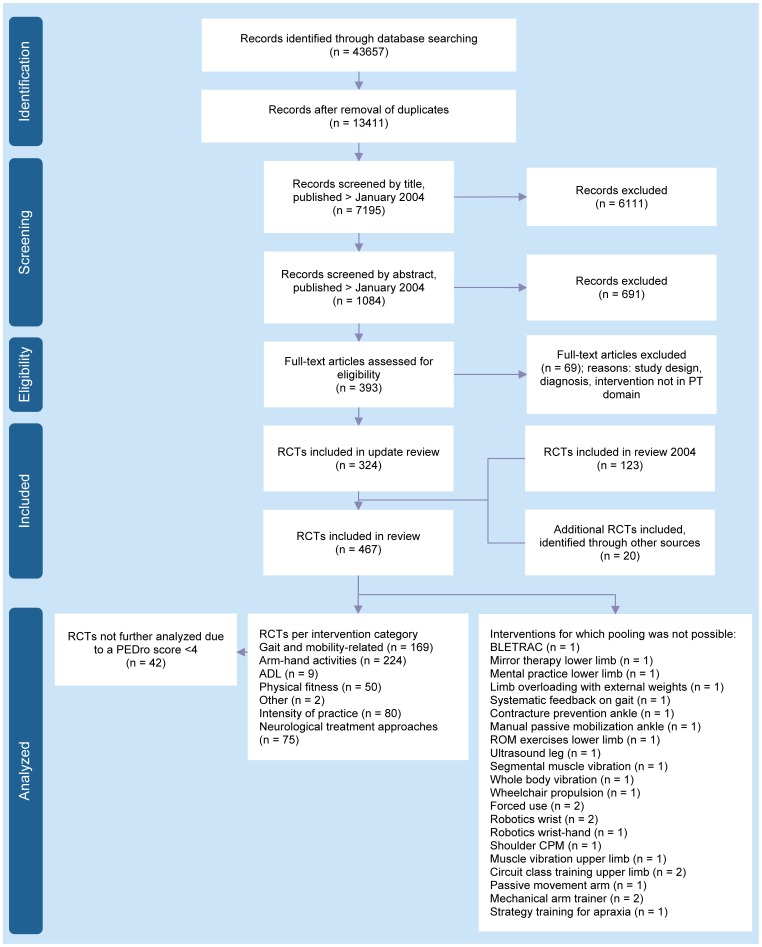
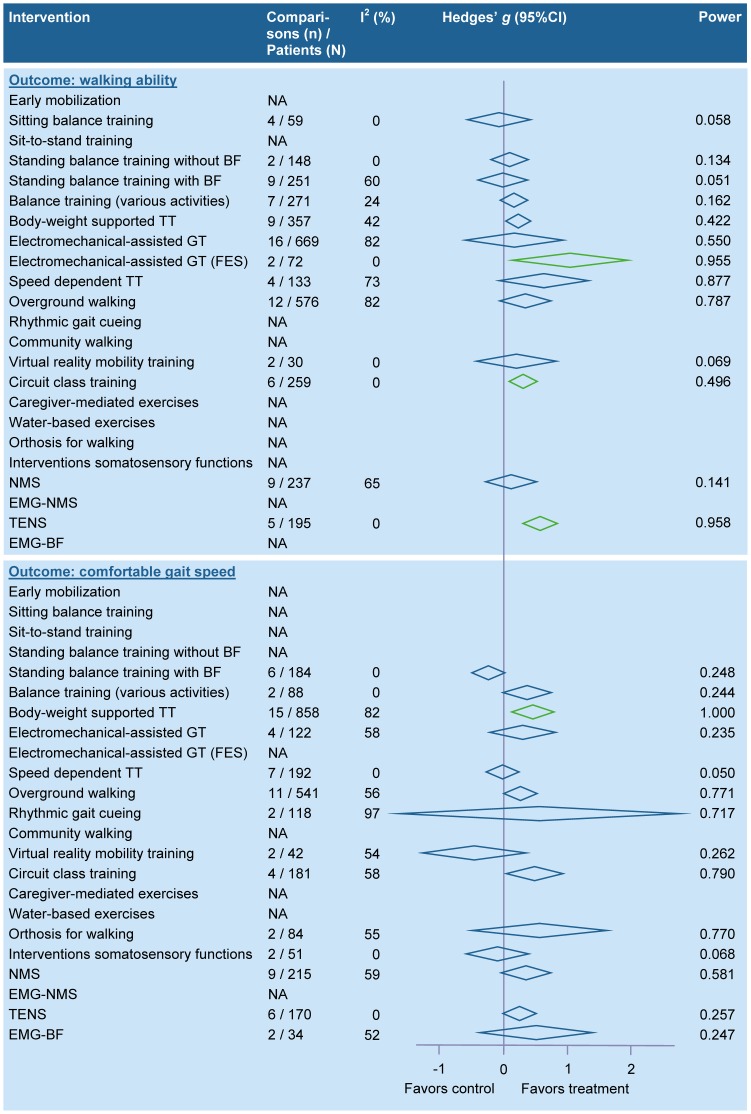
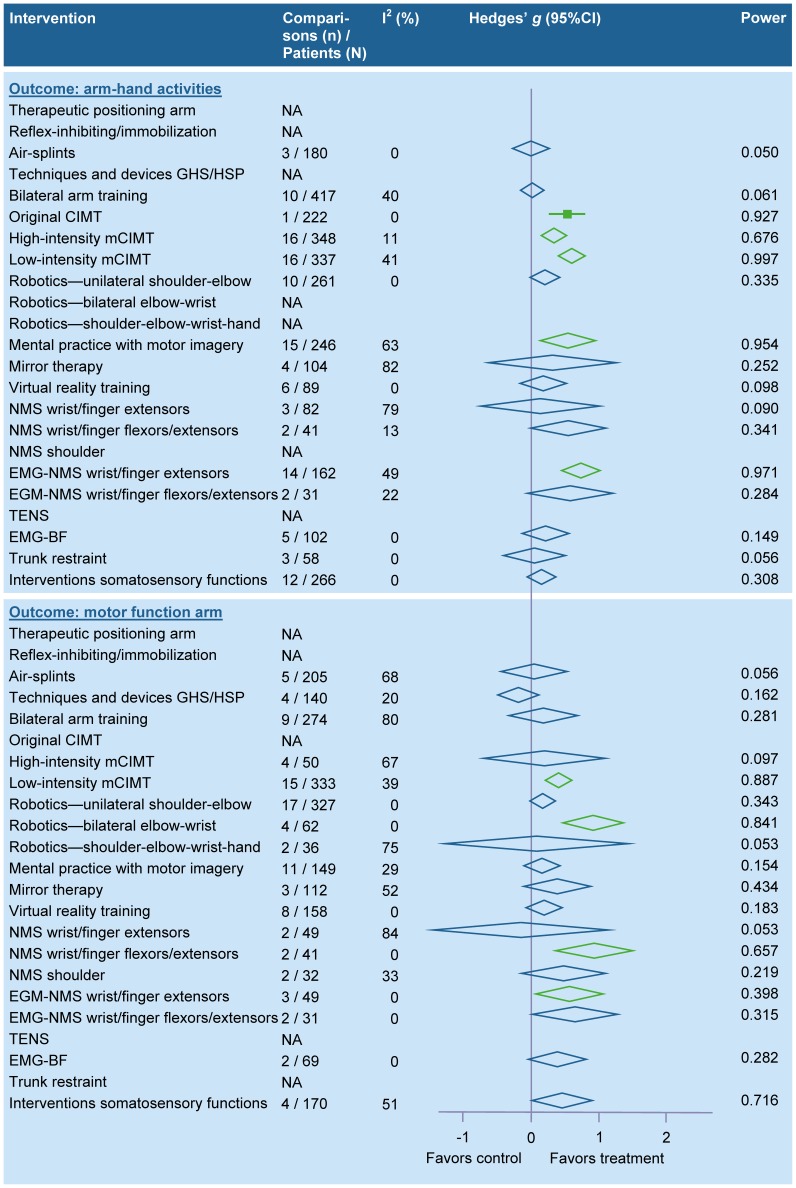
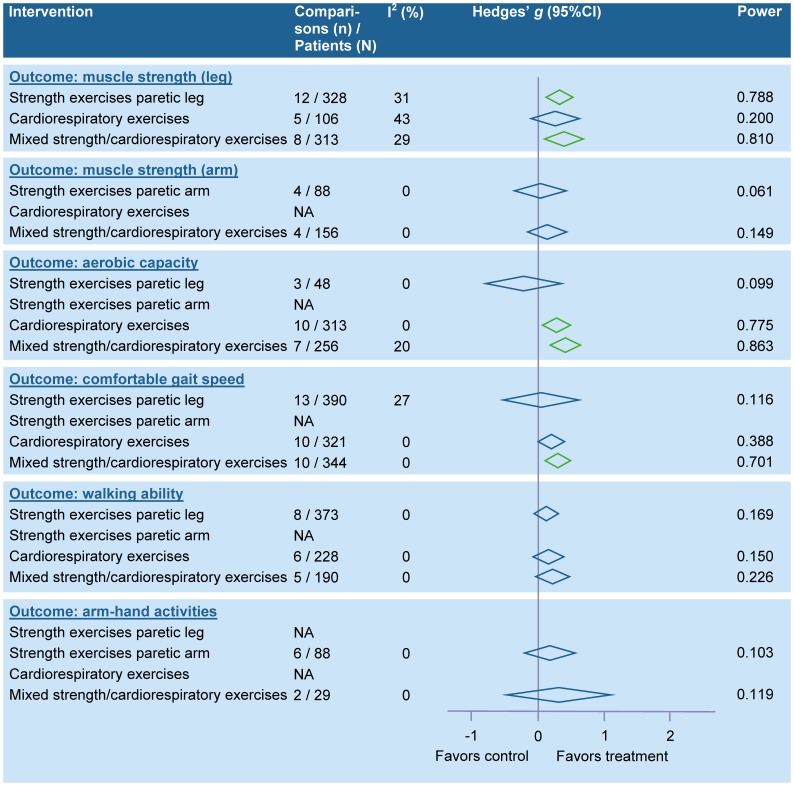
BACKGROUND: Physical therapy (PT) is one of the key disciplines in interdisciplinary stroke rehabilitation. The aim of this systematic review was to provide an update of the evidence for stroke rehabilitation interventions in the domain of PT. METHODS AND FINDINGS: Randomized controlled trials (RCTs) regarding PT in stroke rehabilitation were retrieved through a systematic search. Outcomes were classified according to the ICF. RCTs with a low risk of bias were quantitatively analyzed. Differences between phases poststroke were explored in subgroup analyses. A best evidence synthesis was performed for neurological treatment approaches. The search yielded 467 RCTs (N = 25373; median PEDro score 6 [IQR 5-7]), identifying 53 interventions. No adverse events were reported. Strong evidence was found for significant positive effects of 13 interventions related to gait, 11 interventions related to arm-hand activities, 1 intervention for ADL, and 3 interventions for physical fitness. Summary Effect Sizes (SESs) ranged from 0.17 (95%CI 0.03-0.70; I(2) = 0%) for therapeutic positioning of the paretic arm to 2.47 (95%CI 0.84-4.11; I(2) = 77%) for training of sitting balance. There is strong evidence that a higher dose of practice is better, with SESs ranging from 0.21 (95%CI 0.02-0.39; I(2) = 6%) for motor function of the paretic arm to 0.61 (95%CI 0.41-0.82; I(2) = 41%) for muscle strength of the paretic leg. Subgroup analyses yielded significant differences with respect to timing poststroke for 10 interventions. Neurological treatment approaches to training of body functions and activities showed equal or unfavorable effects when compared to other training interventions. Main limitations of the present review are not using individual patient data for meta-analyses and absence of correction for multiple testing. CONCLUSIONS: There is strong evidence for PT interventions favoring intensive high repetitive task-oriented and task-specific training in all phases poststroke. Effects are mostly restricted to the actually trained functions and activities. Suggestions for prioritizing PT stroke research are given.
Overview
The claims and statistics of this paper haven’t been checked yet.
Run the check — free, no account needed. It reads the open-access text and checks the sources it cites.
Integrity signals
Registry
Cites
Statistics
Figures
Verification
Claims the paper makes
The claims and statistics of this paper haven’t been checked yet.
Run the check — free, no account needed. It reads the open-access text and checks the sources it cites.
Claims other papers make about this one
Each is checked against this paper’s own text: does it say what the citing paper says it does?
In the citing paper
“Greater amounts of physical training poststroke is associated with improved outcomes (without harm) in a number of meta-analyses,5,6 and many guidelines recommend increasing training dose.”
From Prespecified dose-response analysis for A Very Early Rehabilitation Trial (AVERT) (2016) · cites this paper as [5]
In the citing paper
“In humans, a number of systematic reviews and meta-analyses suggest a dose-response relationship, with more intensive therapy resulting in improved functional outcome after stroke.5,6,15”
From Prespecified dose-response analysis for A Very Early Rehabilitation Trial (AVERT) (2016) · cites this paper as [5]
Self-check
Percentages, sums and reported differences re-computed from the paper’s own numbers.
The self-check needs the paper’s full text.
Citations
Cites
Cochrane Handbook for Systematic Reviews of Interventions: Cochrane Book Series
(2008) · doi:10.1002/9780470712184 · Cited by 25,048
CONSORT 2010 Statement: updated guidelines for reporting parallel group randomised trials
the CONSORT Group, Schulz, K. F., Altman, D. G., & Moher, D. (2010) · BMC Medicine · doi:10.1186/1741-7015-8-18 · Cited by 13,371
Borenstein, M., Hedges, L. V., Higgins, J. P. T., & Rothstein, H. R. (2021) · doi:10.1002/9781119558378 · Cited by 9,799
Heart Disease and Stroke Statistics—2023 Update: A Report From the American Heart Association
Tsao, C. W., Aday, A. W., Almarzooq, Z. I., Anderson, C. A. M., Arora, P., Avery, C. L., Baker-Smith, C. M., Beaton, A. Z., Boehme, A. K., Buxton, A. E., et al. (2023) · Circulation · doi:10.1161/cir.0000000000001123 · Cited by 8,300
Heart Disease and Stroke Statistics—2011 Update: A Report From the American Heart Association
Roger, V. L., Go, A. S., Lloyd-Jones, D. M., Adams, R. J., Berry, J. D., Brown, T. M., Carnethon, M. R., Dai, S., de Simone, G., Ford, E. S., et al. (2011) · Circulation · doi:10.1161/cir.0b013e3182009701 · Cited by 6,149
The Organization of Behavior; A Neuropsychological Theory.
Attneave, F., B., M., & Hebb, D. O. (1950) · The American Journal of Psychology · doi:10.2307/1418888 · Cited by 5,146
From best evidence to best practice: effective implementation of change in patients' care
Grol, R., & Grimshaw, J. (2003) · The Lancet · doi:10.1016/s0140-6736(03)14546-1 · Cited by 4,531
Classificação Internacional de Funcionalidade (CIF)
Battistella, L. R., & de Brito, C. M. M. (2002) · Acta Fisiátrica · doi:10.5935/0104-7795.20020003 · Cited by 4,470
International Classification of Functioning, Disability and Health
Chard, G. (2004) · British Journal of Occupational Therapy · doi:10.1177/030802260406700101 · Cited by 3,697
Langhorne, P., Bernhardt, J., & Kwakkel, G. (2011) · The Lancet · doi:10.1016/s0140-6736(11)60325-5 · Cited by 2,726
Self-citation
Research works printed but not linked: 26
- Cohen J (1977) Statistical power analysis for the behavioural sciences. New York: Academic Press.
- T Grant, 1997, Balance retraining following acute stroke: a comparison of two methods, Can J Rehabil, 11, 69
- V Kerdoncuff, 2004, [Interest of visual biofeedback training in rehabilitation of balance after stroke], Ann Readapt Med Phys, 47, 169
- F Heller, 2005, [Postural biofeedback and locomotion reeducation in stroke patients], Ann Readapt Med Phys, 48, 187
- H Barbeau, 2003, Optimal outcomes obtained with body-weight support combined with treadmill training in stroke subjects, Arch Phys Med Rehabil, 84, 1458
- L Ada, 2003, A treadmill and overground walking program improves walking in persons residing in the community after stroke: a placebo-controlled, randomized trial, Arch Phys Med Rehabil, 84, 1486
- H Argstatter, 2007, Music therapy in motor rehabilitation. Evaluation of a musicomedical gait training programfor hemiparetic stroke patients [Musiktherapie in der neurologischen Rehabilitation. Evaluation eines musikmedizinischen Behandlungskonzepts für die Gangrehabilitation von hemiparetischen Patienten nach Schlaganfall], Neurol Rehabil, 13, 159
- K Chu, 2004, Water-based exercise for cardiovascular fitness in people with chronic stroke: a randomized controlled trial, Arch Phys Med Rehabil, 85, 870
- Intercollegiate Stroke Working Party (2012) National clinical guideline for stroke, 4th edition. London: Royal College of Physicians.
- C Torriani, 2008, Effect of foot motor and sensorial stimulation hemiparetic in stroke patients, Rev Neurocienc, 16, 25
- J Heckmann, 1997, EMG-triggered electrical muscle stimulation in the treatment of central hemiparesis after a stroke, Eur J Phys Med Rehabil, 7, 138
- M Ploughman, 2004, Can forced-use therapy be clinically applied after stroke? An exploratory randomized controlled trial, Arch Phys Med Rehabil, 85, 1417
- M Heidari, 2011, Comparison of mobilizing and immobilizing splints on hand motor function in stroke patients: a randomized clinical trial, QOM University Med Sci J, 4, 48
- S Page, 2004, Efficacy of modified constraint-induced movement therapy in chronic stroke: a single-blinded randomized controlled trial, Arch Phys Med Rehabil, 85, 14
- A Mayr, 2008, [ARMOR: an electromechanical robot for upper limb training following stroke. A prospective randomised controlled pilot study], Handchir Mikrochir Plast Chir, 40, 66
- K Liu, 2004, Mental imagery for promoting relearning for people after stroke: a randomized controlled trial, Arch Phys Med Rehabil, 85, 1403
- J Crosbie, 2007, Virtual reality in the rehabilitation of the upper limb following hemiplegic stroke: a pilot randomised controlled trial (RCT), UK Stroke Forum Conference, 2007, 9
- T Sentandreu Mano, 2011, [Electrical stimulation in the treatment of the spastic hemiplegic hand after stroke: a ramdomized study], Med Clin (Barc), 137, 297
- K Smith, 1979, Biofeedback in strokes, Aust J Physiother, 25, 155
- J Williams, 1982, Use of electromyographic biofeedback for pain reduction in the spastic hemiplegic shoulder: a pilot study, Physiother Can, 34, 327
- J Moreland, 2003, Progressive resistance strengthening exercises after stroke: a single-blind randomized controlled trial, Arch Phys Med Rehabil, 84, 1433
- S Singh, 2008, Closed versus open kinematic chain exercises on gait performance in subacute stroke patients, Physiother Occup Ther J, 1, 73
- M Lippert-Grüner, 1999, Muskelkrafttraining in der Rehabilitation des zentral paretischen Armes, Neurol Rehabil, 5, 275
- G Thielman, 2004, Rehabilitation of reaching after stroke: task-related training versus progressive resistive exercise, Arch Phys Med Rehabil, 85, 1613
- A Kamps, 2005, Cyclic movement training of the lower limb in stroke rehabilitation, Neurol Rehabil, 11, S1
- B Dobke, 2010, Apparativ-assistive Bewegungstherapie in der Schlaganfallrehabilitation, Neurol Rehabil, 16, 173
Cited by
Sorted by citations
Items 301–400 of 1,000
Khurana, D., Padma, M. V., Bhatia, R., Kaul, S., Pandian, J. D., Sylaja, P. N., Arjundas, D., Uppal, A., Pradeep, V. G., Suri, V., et al. (2018) · Journal of Stroke Medicine · doi:10.1177/2516608518777935 · Cited by 27
Levy, T., J. Christie, L., Killington, M., Laver, K., Crotty, M., & Lannin, N. A. (2022) · Physiotherapy Theory and Practice · doi:10.1080/09593985.2021.1875525 · Cited by 26
Yang, J., Zhu, Y., Li, H., Wang, K., Li, D., & Qi, Q. (2024) · Frontiers in Neurology · doi:10.3389/fneur.2024.1453781 · Cited by 26
Repetitive Transcranial Magnetic Stimulation for Upper Extremity Motor Recovery: Does It Help?
Schambra, H. M. (2018) · Current Neurology and Neuroscience Reports · doi:10.1007/s11910-018-0913-8 · Cited by 27
Cho, K. H., & Song, W.-K. (2018) · Archives of Physical Medicine and Rehabilitation · doi:10.1016/j.apmr.2018.10.002 · Cited by 26
Reduced striatal activation in response to rewarding motor performance feedback after stroke
Widmer, M., Lutz, K., & Luft, A. R. (2019) · NeuroImage Clinical · doi:10.1016/j.nicl.2019.102036 · Cited by 24
Effects of arm weight support on neuromuscular activation during reaching in chronic stroke patients
Runnalls, K. D., Ortega-Auriol, P., McMorland, A. J. C., Anson, J. G., & Byblow, W. D. (2019) · Experimental Brain Research · doi:10.1007/s00221-019-05687-9 · Cited by 26
An extended stroke rehabilitation service for people who have had a stroke: the EXTRAS RCT
Shaw, L. C., Bhattarai, N., Cant, R., Drummond, A. E., Ford, G. A., Förster, A., Francis, R. P., Hills, K., Howel, D., Laverty, A. M., et al. (2020) · Health Technology Assessment · doi:10.3310/hta24240 · Cited by 29
Vandermeeren, Y., Doost, M. Y., Herman, B., Denis, A., Sapin, J., Galinski, D., Riga, A., Laloux, P., & Bihin, B. (2021) · Neural Regeneration Research · doi:10.4103/1673-5374.301030 · Cited by 26
Muller, C., Muthalib, M., Mottet, D., Perrey, S., Dray, G., Delorme, M., Duflos, C., Froger, J., Xu, B., Faity, G. V., et al. (2021) · Trials · doi:10.1186/s13063-021-05689-5 · Cited by 26
Chen, Z., He, C., Guo, F., Xiong, C., & Huang, X. (2021) · Archives of Physical Medicine and Rehabilitation · doi:10.1016/j.apmr.2021.06.001 · Cited by 28
Kuo, C.-Y., Liu, C.-W., Lai, C., Kang, J., Tseng, S., & Su, E. C. (2021) · Journal of NeuroEngineering and Rehabilitation · doi:10.1186/s12984-021-00965-6 · Cited by 26
Hughes, A., Bouças, S. B., Burridge, J. H., Murphy, M. A., Buurke, J. H., Feys, P., Klamroth-Marganska, V., Lamers, I., Prange-Lasonder, G. B., Timmermans, A. A. A., et al. (2016) · Journal of NeuroEngineering and Rehabilitation · doi:10.1186/s12984-016-0192-z · Cited by 26
Oliveira, T. R., COSTA, L. R., Catunda, J. M. Y., Pino, A. V., Barbosa, W. S., & de Souza, M. N. (2017) · Medical Engineering & Physics · doi:10.1016/j.medengphy.2017.03.001 · Cited by 26
Bertolin, M., Patten, R. V., Greif, T. R., & Fucetola, R. P. (2017) · Archives of Clinical Neuropsychology · doi:10.1093/arclin/acx096 · Cited by 26
Ballantyne, J. C., & Sullivan, M. D. (2022) · Journal of Pain · doi:10.1016/j.jpain.2022.05.001 · Cited by 25
Motor recovery of stroke patients after rehabilitation: one-year follow-up study
Kuptniratsaikul, V., Kovindha, A., Suethanapornkul, S., Massakulpan, P., Permsirivanich, W., & Kuptniratsaikul, P. S.-A. (2016) · International Journal of Neuroscience · doi:10.3109/00207454.2016.1138474 · Cited by 25
Developing a System for Post-Stroke Rehabilitation: An Exergames Approach
Reis, A., Laíns, J., Paredes, H., Filipe, V. M. D. J., Abrantes, C. G., Ferreira, F., Mendes, R., Amorim, P., & Barroso, J. (2016) · Lecture notes in computer science · doi:10.1007/978-3-319-40238-3_39 · Cited by 26
Lee, G. (2019) · Medical Science Monitor · doi:10.12659/msm.912589 · Cited by 25
van Bloemendaal, M., Bus, S. A., Nollet, F., Geurts, A. C. H., & Beelen, A. (2021) · Neurorehabilitation and neural repair · doi:10.1177/1545968320981942 · Cited by 25
Motaharinia, M., Gerrow, K., Boghozian, R., White, E. R., Choi, S.-E., Delaney, K. R., & Brown, C. E. (2021) · Nature Communications · doi:10.1038/s41467-021-26405-6 · Cited by 24
Stroke survivor perceptions of using an exoskeleton during acute gait rehabilitation
McDonald, C., Fingleton, C., Murphy, S. P., & Lennon, O. C. (2022) · Scientific Reports · doi:10.1038/s41598-022-18188-7 · Cited by 25
Zhang, Y., Liu, X., Qiao, X., & Fan, Y. (2023) · Journal of Medical Internet Research · doi:10.2196/42901 · Cited by 28
Clinical features of patients who might benefit more from walking robotic training
Morone, G., Masiero, S., Coiro, P., Angelis, D. D., Venturiero, V., Paolucci, S., & Iosa, M. (2018) · Restorative Neurology and Neuroscience · doi:10.3233/rnn-170799 · Cited by 25
Layfield, L. J., Glasgow, B. J., DuPuis, M. H., & Bhuta, S. M. (1987) · PubMed · Cited by 25
Yarossi, M. P., Manuweera, T., Adamovich, S., & Tunik, E. (2017) · Frontiers in Human Neuroscience · doi:10.3389/fnhum.2017.00242 · Cited by 23
A hierarchical privacy-preserving IoT architecture for vision-based hand rehabilitation assessment
Nadian-Ghomsheh, A., Farahani, B., & Kavian, M. (2021) · Multimedia Tools and Applications · doi:10.1007/s11042-021-10563-2 · Cited by 25
Marin‐Pardo, O., Phanord, C. S., Donnelly, M. R., Laine, C. M., & Liew, S. (2021) · Sensors · doi:10.3390/s21051806 · Cited by 24
Ranzani, R., Eicher, L., Viggiano, F., Engelbrecht, B., Held, J. P. O., Lambercy, O., & Gassert, R. (2021) · Frontiers in Bioengineering and Biotechnology · doi:10.3389/fbioe.2021.652380 · Cited by 23
Deep brain stimulation for movement disorders after stroke: a systematic review of the literature
Paro, M. R., Dyrda, M., Ramanan, S., Wadman, G., Burke, S.-A., Cipollone, I., Bosworth, C., Zurek, S., & Senatus, P. B. (2022) · Journal of neurosurgery · doi:10.3171/2022.8.jns221334 · Cited by 24
Ho, J. S.-W., Ko, K. S. Y., Law, S. W., & Man, G. C. W. (2023) · Frontiers in Neurology · doi:10.3389/fneur.2023.1126755 · Cited by 24
Visual and Human-Interpretable Feedback for Assisting Physical Activity
Antunes, M., Baptista, R., Demisse, G., Aouada, D., & Ottersten, B. (2016) · Lecture notes in computer science · doi:10.1007/978-3-319-48881-3_9 · Cited by 24
Straudi, S., & Basaglia, N. (2017) · Advances in experimental medicine and biology · doi:10.1007/978-3-319-47861-6_11 · Cited by 26
Stockley, R., O’Connor, D. A., Smith, P., Moss, S., Allsop, L., & Edge, W. (2017) · Rehabilitation Research and Practice · doi:10.1155/2017/9569178 · Cited by 24
Widmer, M., Held, J. P. O., Wittmann, F., Lambercy, O., Lutz, K., & Luft, A. R. (2017) · Trials · doi:10.1186/s13063-017-2328-2 · Cited by 25
Shimizu, N., Hashidate, H., Ota, T., & Saito, A. (2018) · Topics in Stroke Rehabilitation · doi:10.1080/10749357.2018.1446486 · Cited by 24
Langan, J., Bhattacharjya, S., Subryan, H., Xu, W., Chen, B., Li, Z., & Cavuoto, L. A. (2020) · JMIR mhealth and uhealth · doi:10.2196/19582 · Cited by 24
Camardella, C., Chiaradia, D., Bortone, I., Frisoli, A., & Leonardis, D. (2023) · Frontiers in Virtual Reality · doi:10.3389/frvir.2022.1019302 · Cited by 23
Freburger, J. K., Mormer, E. R., Ressel, K., Zhang, S., Johnson, A. M., Pastva, A. M., Turner, R. L., Coyle, P. C., Bushnell, C., Duncan, P. W., et al. (2024) · Archives of Physical Medicine and Rehabilitation · doi:10.1016/j.apmr.2024.10.010 · Cited by 23
Latif, A., Janabi, H. F. A., Joshi, M., Fusari, G., Shepherd, L. M., Darzi, A. W., & Leff, D. R. (2024) · BMJ Open · doi:10.1136/bmjopen-2024-084086 · Cited by 23
Time spent in rehabilitation and effect on measures of activity after stroke
Clark, B., Whitall, J., Kwakkel, G., Mehrholz, J., Ewings, S. M., & Burridge, J. H. (2017) · Cochrane Database of Systematic Reviews · doi:10.1002/14651858.cd012612 · Cited by 24
Self-citationPark, J., Shin, Y., You, J. H., & Park, M. S. (2018) · Neurorehabilitation · doi:10.3233/nre-172234 · Cited by 23
Design of a Single-Degree-of-Freedom Immersive Rehabilitation Device for Clustered Upper-Limb Motion
Zhao, P., Zhang, Y., Guan, H., Deng, X., & Chen, H. (2021) · Journal of Mechanisms and Robotics · doi:10.1115/1.4050150 · Cited by 23
Chen, P., Liu, T. W., Tse, M. Y. M., Lai, C. K. Y., Tsoh, J., & Ng, S. S. M. (2022) · Frontiers in Neurology · doi:10.3389/fneur.2022.926130 · Cited by 23
Virtual reality-based gait rehabilitation intervention for stroke individuals: a scoping review
Kim, M., & Kaneko, F. (2023) · Journal of Exercise Rehabilitation · doi:10.12965/jer.2346114.057 · Cited by 23
Physical Activity Levels and Their Associations With Postural Control in the First Year After Stroke
Persson, C. U., Hansson, P., Lappas, G., & Danielsson, A. (2016) · Physical Therapy · doi:10.2522/ptj.20150367 · Cited by 23
Sheehy, L., Taillon‐Hobson, A., Sveistrup, H., Bilodeau, M., Fergusson, D. A., Levac, D. E., & Finestone, H. M. (2016) · BMC Neurology · doi:10.1186/s12883-016-0563-x · Cited by 23
Complex Skill Training Transfers to Improved Performance and Control of Simpler Tasks After Stroke
Kantak, S. S., Zahedi, N., & McGrath, R. L. (2017) · Physical Therapy · doi:10.1093/ptj/pzx042 · Cited by 23
Prospectively Classifying Community Walkers After Stroke: Who Are They?
Mulder, M., Nijland, R. H. M., van de Port, I. G. L., van Wegen, E. E. H., & Kwakkel, G. (2019) · Archives of Physical Medicine and Rehabilitation · doi:10.1016/j.apmr.2019.04.017 · Cited by 23
Self-citationBauer, C. M., Nast, I., Scheermesser, M., Kuster, R. P., Textor, D., Wenger, M., Kool, J., & Baumgartner, D. (2021) · Applied Ergonomics · doi:10.1016/j.apergo.2021.103390 · Cited by 23
Batool, S., Soomro, N. N., Amjad, F., & Fauz, R. (2015) · Pakistan Journal of Medical Sciences · doi:10.12669/pjms.315.7910 · Cited by 23
Mitsutake, T., Imura, T., & Tanaka, R. (2020) · Journal of Stroke and Cerebrovascular Diseases · doi:10.1016/j.jstrokecerebrovasdis.2020.105214 · Cited by 25
Bicknell, E., Said, C. M., Haines, K. J., & Kuys, S. S. (2022) · Frontiers in Neurology · doi:10.3389/fneur.2022.900198 · Cited by 22
Hao, J., Yao, Z., Harp, K. A., Gwon, Y., Chen, Z., & Siu, K. (2022) · Physiotherapy Theory and Practice · doi:10.1080/09593985.2022.2094302 · Cited by 22
Yamamoto, R., Sasaki, S., Kuwahara, W., Kawakami, M., & Kaneko, F. (2022) · Journal of NeuroEngineering and Rehabilitation · doi:10.1186/s12984-022-01111-6 · Cited by 25
Andersson, P., & Franzén, E. (2015) · Topics in Stroke Rehabilitation · doi:10.1179/1074935715z.00000000052 · Cited by 24
Tolé, G., Holland, A. E., Mentiplay, B. F., Clark, R. A., & Williams, G. P. (2017) · Archives of Physical Medicine and Rehabilitation · doi:10.1016/j.apmr.2017.06.021 · Cited by 22
Held, J. P. O., Luft, A. R., & Veerbeek, J. M. (2018) · Frontiers in Neurology · doi:10.3389/fneur.2018.00013 · Cited by 22
Self-citationKuys, S. S., Ada, L., Paratz, J. D., & Brauer, S. (2018) · Brazilian Journal of Physical Therapy · doi:10.1016/j.bjpt.2018.06.001 · Cited by 23
Graham, S. A., Roth, E. J., & Brown, D. A. (2018) · Journal of NeuroEngineering and Rehabilitation · doi:10.1186/s12984-018-0442-3 · Cited by 22
Lamers, I., Raats, J., Spaas, J., Meuleman, M., Kerkhofs, L., Schouteden, S., & Feys, P. (2019) · Multiple Sclerosis and Related Disorders · doi:10.1016/j.msard.2019.06.014 · Cited by 22
Holleran, C. L., Bland, M. D., Reisman, D. S., Ellis, T. D., Earhart, G. M., & Lang, C. E. (2020) · Neurology Report · doi:10.1097/npt.0000000000000327 · Cited by 20
Ali, A., Senthil Kumaran, D., Unni, A., Sardesai, S., Prabhu, V., Nirmal, P., Pai, A. R., Guddattu, V., & Arumugam, A. (2024) · Neurorehabilitation and neural repair · doi:10.1177/15459683231222921 · Cited by 23
Shankar, R., Tang, N., Kamsani, N. S., Phan, P., Mukhopadhyay, A., & Chew, E. (2025) · BMJ Open · doi:10.1136/bmjopen-2024-095269 · Cited by 21
Toutain, M., Gauthier, A., & Leconte, P. (2022) · Frontiers in Psychiatry · doi:10.3389/fpsyt.2022.939856 · Cited by 22
Plasma Matrix Metalloproteinases in Patients With Stroke During Intensive Rehabilitation Therapy
Ma, F., Rodríguez, S., Buxó, X., Morancho, A., Llena, I. R., Carrera, A., Bustamante, A., Giralt, D., Montaner, J., Martinez, C., et al. (2016) · Archives of Physical Medicine and Rehabilitation · doi:10.1016/j.apmr.2016.06.007 · Cited by 24
Cao, Y. H., Sun, N. L., Yang, J., Yang, Z., Zhu, W. X., Zhang, Z., Wang, X., Shi, G., & Liu, C. (2016) · Neurochemistry International · doi:10.1016/j.neuint.2016.10.014 · Cited by 21
Vinstrup, J., Calatayud, J., Jakobsen, M. D., Sundstrup, E., Jay, K., Brandt, M., Zeeman, P., Jørgensen, J. R., & Andersen, L. L. (2017) · Topics in Stroke Rehabilitation · doi:10.1080/10749357.2016.1274466 · Cited by 21
Lehmann, I., Baer, G. D., & Schuster‐Amft, C. (2017) · Physiotherapy · doi:10.1016/j.physio.2017.03.001 · Cited by 21
Hwang, J., Shin, Y., Park, J., Cha, Y. J., & You, J. H. (2018) · Neurorehabilitation · doi:10.3233/nre-172226 · Cited by 21
Tsaih, P.-L., Chiu, M., Luh, J.-J., Yang, Y., Lin, J., & Hu, M. (2018) · Behavioural Neurology · doi:10.1155/2018/7080218 · Cited by 21
Rosbergen, I. C. M., Grimley, R., Hayward, K. S., Walker, K. C., Rowley, D., Campbell, A. M., McGufficke, S., Robertson, S. T., Trinder, J., Janssen, H., et al. (2016) · Pilot and Feasibility Studies · doi:10.1186/s40814-016-0081-z · Cited by 20
Carlsson, H., Rosén, B., Pessah-Rasmussen, H., Björkman, A., & Brogårdh, C. B. (2018) · Trials · doi:10.1186/s13063-018-2628-1 · Cited by 21
COVID-19 Outbreak During Inpatient Rehabilitation
Spielmanns, M., Pekacka-Egli, A. M., Cecon, M., Witassek, F., Schoendorf, S., Lutz, D., & Hermann, M. (2021) · American Journal of Physical Medicine & Rehabilitation · doi:10.1097/phm.0000000000001686 · Cited by 20
Gerardin, E., Bontemps, D., Babuin, N.-T., Herman, B., Denis, A., Bihin, B., Régnier, M., Leeuwerck, M., Deltombe, T., Riga, A., et al. (2022) · Journal of NeuroEngineering and Rehabilitation · doi:10.1186/s12984-022-01009-3 · Cited by 20
Exercise for Stroke Rehabilitation: A Bibliometric Analysis of Global Research From 2001 to 2021
Dong, Y., Weng, L., Hu, Y.-H., Mao, Y.-X., Zhang, Y., Lu, Z.-F., Shi, T., Du, R., Wang, W., Wang, J.-Y., et al. (2022) · Frontiers in Aging Neuroscience · doi:10.3389/fnagi.2022.876954 · Cited by 19
After 55 Years of Neurorehabilitation, What Is the Plan?
Viruega, H., & Gaviria, M. (2022) · Brain Sciences · doi:10.3390/brainsci12080982 · Cited by 22
Manual therapy and exercise for adhesive capsulitis: a systematic review with meta-analysis
Kirker, K., O’Connell, M., Bradley, L., Torres-Panchamé, R. E., & Masaracchio, M. F. (2023) · Journal of Manual & Manipulative Therapy · doi:10.1080/10669817.2023.2180702 · Cited by 20
Chihara, H., Takagi, Y., NISHINO, K., Yoshida, K., Arakawa, Y., Kikuchi, T., Takenobu, Y., & Miyamoto, S. (2015) · Neurologia medico-chirurgica · doi:10.2176/nmc.oa.2015-0178 · Cited by 20
Stewart, C. E., McCluskey, A., Ada, L., & Kuys, S. S. (2017) · Australian Occupational Therapy Journal · doi:10.1111/1440-1630.12351 · Cited by 21
Franck, J. A., Smeets, R., & Seelen, H. A. M. (2018) · Disability and Rehabilitation · doi:10.1080/09638288.2017.1423400 · Cited by 20
Karniel, N., Raveh, E., Schwartz, I., & Portnoy, S. (2019) · Assistive Technology · doi:10.1080/10400435.2019.1579269 · Cited by 20
Sohn, W. J., Sipahi, R., Sanger, T. D., & Sternad, D. (2019) · IEEE Journal of Translational Engineering in Health and Medicine · doi:10.1109/jtehm.2019.2953257 · Cited by 20
Impaired implicit learning and feedback processing after stroke
Lam, J. M., Globas, C., Hosp, J. A., Karnath, H., Wächter, T., & Luft, A. R. (2015) · Neuroscience · doi:10.1016/j.neuroscience.2015.11.051 · Cited by 19
Moumeni, I. N. (2025) · Frontiers in Neurology · doi:10.3389/fneur.2025.1670420 · Cited by 18
Joseph, C., Rhoda, A. J., & Conradsson, D. M. (2020) · Topics in Stroke Rehabilitation · doi:10.1080/10749357.2020.1741242 · Cited by 19
Borujeni, M. S., Hosseini, S. A., Akbarfahimi, N., & Ebrahimi, E. (2019) · Medical Journal of the Islamic Republic of Iran · doi:10.47176/mjiri.33.99 · Cited by 19
Management of Central Poststroke Pain: Systematic Review and Meta-analysis
Tamasauskas, A., Silva-Passadouro, B., Fallon, N. B., Frank, B., Laurinaviciute, S., Keller, S. S., & Marshall, A. G. (2024) · Journal of Pain · doi:10.1016/j.jpain.2024.104666 · Cited by 19
Bland, M. D., Whitson, M., Harris, H., Edmiaston, J., Connor, L. T., Fucetola, R. P., Carter, A. R., Corbetta, M., & Lang, C. E. (2014) · Physical Therapy · doi:10.2522/ptj.20140347 · Cited by 19
Bennett, L., Luker, J. A., English, C., & Hillier, S. (2015) · Disability and Rehabilitation · doi:10.3109/09638288.2015.1103788 · Cited by 19
McGlinchey, M. P., Paley, L., Hoffman, A., Douiri, A., & Rudd, A. G. (2018) · European Stroke Journal · doi:10.1177/2396987318800543 · Cited by 19
Cooperative Cooking: A Novel Virtual Environment for Upper Limb Rehabilitation
Goršič, M., Tran, M. H., & Novak, D. (2018) · Annual International Conference of the IEEE Engineering in Medicine and Biology Society (EMBC) · doi:10.1109/embc.2018.8513005 · Cited by 19
Family-Centered Care During Constraint-Induced Therapy After Chronic Stroke: A Feasibility Study
Blanton, S., Scheibe, D. C., Rutledge, A. H., Regan, B., O’Sullivan, C. S., & Clark, P. C. (2018) · Rehabilitation Nursing · doi:10.1097/rnj.0000000000000197 · Cited by 19
Dorsch, S., Weeks, K., King, L., & Polman, E. (2018) · Journal of physiotherapy · doi:10.1016/j.jphys.2018.11.004 · Cited by 19
Factors related to met needs for rehabilitation 6 years after stroke
Ytterberg, C., Kristensen, H. K., Tistad, M., & von Koch, L. (2020) · PLoS ONE · doi:10.1371/journal.pone.0227867 · Cited by 22
Pereira, F., Badia, S. B. I., Jorge, C., & Cameirão, M. S. (2019) · International Conference on Virtual Rehabilitation · doi:10.1109/icvr46560.2019.8994505 · Cited by 19
O’Brien, K. K., Brown, D. A., Corbett, C., Flanagan, N., Solomon, P. E., Vera, J. H., Aubry, R. L., & Harding, R. (2020) · AIDS Care · doi:10.1080/09540121.2020.1739203 · Cited by 18
van Meijeren-Pont, W., Tamminga, S. J., Goossens, P. H., Groeneveld, I. F., Arwert, H. J., Meesters, J. J. L., Mishre, R. R., Vlieland, T. P. M. V., & van den Hout, W. (2021) · Journal of Rehabilitation Medicine · doi:10.2340/16501977-2829 · Cited by 19
Latella, C., Peddle‐McIntyre, C. J., Marcotte, L., Steele, J., Kendall, K. L., & Fairman, C. M. (2021) · Sports Medicine · doi:10.1007/s40279-021-01455-4 · Cited by 19
Crepaldi, M., Thorsen, R., Jonsdottir, J., Scarpetta, S., Michieli, L. D., Salvo, M. D., Zini, G., Laffranchi, M., & Ferrarin, M. (2021) · IEEE Transactions on Neural Systems and Rehabilitation Engineering · doi:10.1109/tnsre.2021.3120293 · Cited by 19
Metadata
- Authors
- Veerbeek, J. M., van Wegen, E., van Peppen, R., van der Wees, P. J., Hendriks, E., Rietberg, M., & Kwakkel, G.
- Affiliations
- Amsterdam Movement Sciences (NL)
- Maastricht University (NL)
- Reade (NL)
- Corresponding author
- Kwakkel, Gert
- Venue
- PLoS ONE
- Publisher
- Public Library of Science (PLoS)
- Published
- 2014-02-04
- Volume
- 9
- Issue
- 2
- Pages
- e87987
- ISSN
- 1932-6203 (ISSN-L)
- PMC
- PMC3913786
- OpenAlex
- W2075019019
- Cited by
- 1,203
- References
- 591
- Citations by year
- 2026: 67 · 2025: 101 · 2024: 76 · 2023: 111 · 2022: 130 · 2021: 138 · 2020: 97 · 2019: 102 · 2018: 108 · 2017: 87 · 2016: 95 · 2015: 68 · 2014: 20
- FWCI
- 11.17
- Type
- journal article
- Language
- en
- Open access
- gold
- doi.org
- Locations
- PLoS ONE (publishedVersion, cc-by)
- Europe PMC (PubMed Central) (publishedVersion, cc-by)
- PubMed Central (publishedVersion, cc-by)
- PubMed (publishedVersion)
- Research Publications (Maastricht University) (publishedVersion, cc-by)
- Pure Amsterdam UMC (publishedVersion)
- Amsterdam UMC (VU Amsterdam) - Institutional Repository (publishedVersion)
- VU Research Portal (publishedVersion, other-oa)
- RePEc: Research Papers in Economics (submittedVersion)
- DOAJ (DOAJ: Directory of Open Access Journals) (submittedVersion, cc-by-sa)
- Figshare (submittedVersion, cc-by)
- Radboud Repository (Radboud University) (submittedVersion)
- Radboud Repository (Radboud University) (submittedVersion, other-oa)
- Research Publications (Maastricht University) (submittedVersion, other-oa)
- Data Archiving and Networked Services (DANS) (submittedVersion, other-oa)
- Data Archiving and Networked Services (DANS) (submittedVersion)
- Funders
- Royal Society
- Vrije Universiteit Amsterdam
- Koninklijk Nederlands Genootschap voor Fysiotherapie
- Topics
- Health Sciences › Medicine › Rehabilitation › Stroke Rehabilitation and Recovery
- Health Sciences › Health Professions › Physical Therapy, Sports Therapy and Rehabilitation › Medical Practices and Rehabilitation
- Health Sciences › Medicine › Clinical Neurology › Acute Ischemic Stroke Management
- Keywords
- physiotherapy, stroke rehabilitation, gait training, activities of daily living, physical fitness, sitting balance, motor function, muscle strength, task-oriented training, repeated practice, rehabilitation timing, International Classification of Functioning, Disability and Health
- MeSH terms
- Stroke Rehabilitation, Humans, Randomized Controlled Trials as Topic, Stroke, Physical Therapy Modalities, Muscle Strength
About these checks
Registry, retraction, Cites and statistics results are computed, not judged, with one exception: a printed reference that no index lists is read once by a model before it counts as a citation error. Claims are extracted by a model and kept only when their quote appears verbatim in the text; each cited source is then checked, with a model’s help, for whether it says what the claim relies on. Those verdicts can be wrong — read the claim’s quote and the cited source before relying on one.
Statistics and arithmetic are recomputed, not judged.
Confidence bands are shown only for fields calibrated on our annotated test set. None is calibrated yet, so no band is shown.
What counts as a claim ›How we measure confidence ›How we check this ›
Are you an author, or do you see a problem with this page? Request a review
