

Overlapping Neural Systems Represent Cognitive Effort and Reward Anticipation
Open accessThe DOI matches its Crossref record; 87 of the 87 references it cites were found in a registry or an index.
Abstract
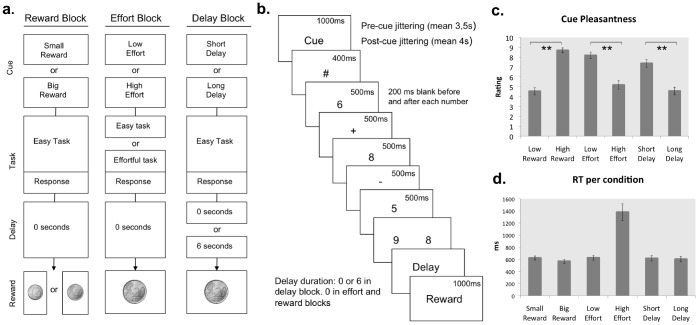
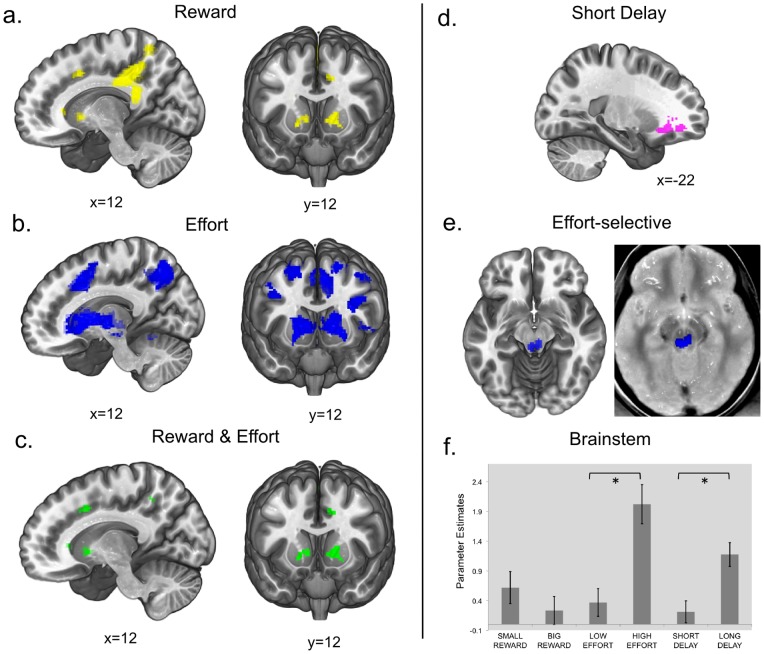
Anticipating a potential benefit and how difficult it will be to obtain it are valuable skills in a constantly changing environment. In the human brain, the anticipation of reward is encoded by the Anterior Cingulate Cortex (ACC) and Striatum. Naturally, potential rewards have an incentive quality, resulting in a motivational effect improving performance. Recently it has been proposed that an upcoming task requiring effort induces a similar anticipation mechanism as reward, relying on the same cortico-limbic network. However, this overlapping anticipatory activity for reward and effort has only been investigated in a perceptual task. Whether this generalizes to high-level cognitive tasks remains to be investigated. To this end, an fMRI experiment was designed to investigate anticipation of reward and effort in cognitive tasks. A mental arithmetic task was implemented, manipulating effort (difficulty), reward, and delay in reward delivery to control for temporal confounds. The goal was to test for the motivational effect induced by the expectation of bigger reward and higher effort. The results showed that the activation elicited by an upcoming difficult task overlapped with higher reward prospect in the ACC and in the striatum, thus highlighting a pivotal role of this circuit in sustaining motivated behavior.
Overview
The claims and statistics of this paper haven’t been checked yet.
Free: it reads the open-access text and checks the first 5 claims that cite a source we can check. Create a free account to check every claim.
Integrity signals
Registry
Cites
Statistics
Figures
Verification
Claims the paper makes
The claims and statistics of this paper haven’t been checked yet.
Free: it reads the open-access text and checks the first 5 claims that cite a source we can check. Create a free account to check every claim.
Claims other papers make about this one
Each is checked against this paper’s own text: does it say what the citing paper says it does?
The source backs part of the claim, not all of it — or backs it for a different population, condition or comparison.
In the citing paper
“Such an approach is common in the literature and assumes that rewards have a similar effect across individuals to exert the associated effort [11, 13, 43, 44].”
From Neurocomputational mechanisms underlying subjective valuation of effort costs (2017) · cites this paper as [43]
Experimental — accuracy not yet measured
Self-check
Percentages, sums and reported differences re-computed from the paper’s own numbers.
The self-check needs the paper’s full text.
Citations
Cites
Prospect Theory: An Analysis of Decision under Risk
Kahneman, D., & Tversky, A. (1979) · Econometrica · doi:10.2307/1914185 · Cited by 48,524
Prospect theory: An analysis of decision under risk
Kahneman, D., & Tversky, A. (1988) · Decision, Probability and Utility · doi:10.1017/cbo9780511609220.014 · Cited by 32,474
Conflict monitoring and cognitive control
Botvinick, M. M., Braver, T. S., Barch, D. M., Carter, C. S., & Cohen, J. D. (2001) · Psychological Review · doi:10.1037/0033-295x.108.3.624 · Cited by 7,351 · cited 1×
“Preparing to perform difficult calculations seems to rely on the same system that subserves other demanding cognitive functions, such as conflict monitoring [34,54] working memory encoding [55], and top-down attentional facilitation [23,24].”
BackgroundCarver, C. S., & White, T. L. (1994) · Journal of Personality and Social Psychology · doi:10.1037/0022-3514.67.2.319 · Cited by 7,306 · cited 3×
“Furthermore, the pleasantness ratings for the big reward cue correlated with the reward responsiveness scale of the Bis/Bas (r = .49, p,.01), indicating that more reward-responsive participants also liked the big reward cue more.”
MethodInfluentialThe reward circuit: linking primate anatomy and human imaging
Haber, S. N., & Knutson, B. (2010) · Neuropsychopharmacology · doi:10.1038/npp.2009.129 · Cited by 3,718 · cited 2×
“Reward-related activation (Figure 2a) was identified in the ACC and striatum, principal targets of dopaminergic midbrain projections [32] and key components of reward circuitry [4,10,51,52].”
BackgroundSeparate neural systems value immediate and delayed monetary rewards
McClure, S. M., Laibson, D. I., Loewenstein, G., & Cohen, J. D. (2004) · Science · doi:10.1126/science.1100907 · Cited by 3,089 · cited 2×
“On the other hand, anticipating higher effort might induce an arousal response and therefore elicit noradrenaline release [47,80], thus suggesting that the present functional result would reflect putative LC-noradrenergic activity.”
BackgroundResultThe expected value of control: an integrative theory of anterior cingulate cortex function
Shenhav, A., Botvinick, M. M., & Cohen, J. D. (2013) · Neuron · doi:10.1016/j.neuron.2013.07.007 · Cited by 2,321 · cited 1×
“Moreover, these findings are compatible with a recently proposed view of ACC function [67].”
BackgroundA framework for studying the neurobiology of value-based decision making
Rangel, A., Camerer, C., & Montague, P. R. (2008) · Nature Reviews Neuroscience · doi:10.1038/nrn2357 · Cited by 2,184 · cited 1×
“Reward processing has been investigated by several disciplines, ranging from economics to psychology and machine learning [1].”
BackgroundDissecting components of reward: ‘liking’, ‘wanting’, and learning
Berridge, K. C., Robinson, T. E., & Aldridge, J. W. (2009) · Current Opinion in Pharmacology · doi:10.1016/j.coph.2008.12.014 · Cited by 1,942 · cited 1×
“This can improve behavioral performance [21] and influence learning and memory, according to a concept known as incentive-salience [20,22].”
BackgroundValid conjunction inference with the minimum statistic
Nichols, T., Brett, M., Andersson, J., Wager, T., & Poline, J.-B. (2005) · NeuroImage · doi:10.1016/j.neuroimage.2004.12.005 · Cited by 1,880 · cited 1×
“Second, we performed a conjunction between single contrasts (strict conjunction approach [43] ((big reward.”
Method
Cited by
Motivation and cognitive control: from behavior to neural mechanism
Botvinick, M., & Braver, T. (2015) · Annual Review of Psychology · doi:10.1146/annurev-psych-010814-015044 · Cited by 909
“Consistent with theories introduced previously, evidence suggests that the ACC may serve as a key interface between reward and control networks (Kouneiher et al. 2009, Vassena et al. 2014).”
Cognitive effort: A neuroeconomic approach
Westbrook, A., & Braver, T. S. (2015) · Cognitive, Affective, & Behavioral Neuroscience · doi:10.3758/s13415-015-0334-y · Cited by 606
“One study on cognitive effort has revealed ventral striatal value representations appearing to reflect cognitive effort discounting, at the time when reward cues were delivered—after the period of effort expenditure (Botvinick, Huffstetler, & McGuire, 2009; cf. Schmidt et al., 2012; Vassena et al., 2014).”
BackgroundInfluentialOldham, S., Murawski, C., Fornito, A., Youssef, G., Yücel, M., & Lorenzetti, V. (2018) · Human Brain Mapping · doi:10.1002/hbm.24184 · Cited by 425
“These expected value signals subsequently modulate motivational processes, potentially via the dorsal striatum (den Ouden, Kok, & de Lange, 2012; Jensen et al., 2007; Kim, 2013; Kurniawan et al., 2013; Miller, Shankar, Knutson, & McClure, 2014; Niv, Daw, Joel, & Dayan, 2007; Schmidt, Lebreton, Cl� ery-Melin, Daunizeau…”
BackgroundNeurocomputational mechanisms underlying subjective valuation of effort costs
Chong, T. T.-J., Apps, M., Giehl, K., Sillence, A., Grima, L. L., & Husain, M. (2017) · PLOS Biology · doi:10.1371/journal.pbio.1002598 · Cited by 415
“Such an approach is common in the literature and assumes that rewards have a similar effect across individuals to exert the associated effort [11, 13, 43, 44].”
BackgroundThe anatomy of apathy: a neurocognitive framework for amotivated behaviour
Le Heron, C., Apps., M. A. J., & Husain, M. (2018) · Neuropsychologia · doi:10.1016/j.neuropsychologia.2017.07.003 · Cited by 380
Metadata
- Authors
- Vassena, E., Silvetti, M., Boehler, C. N., Achten, E., Fias, W., & Verguts, T.
- Affiliations
- Ghent University Hospital (BE)
- Corresponding author
- Vassena, Eliana
- Venue
- PLoS ONE
- Publisher
- Public Library of Science (PLoS)
- Published
- 2014-03-07
- Volume
- 9
- Issue
- 3
- Pages
- e91008
- ISSN
- 1932-6203 (ISSN-L)
- PMC
- PMC3946624
- OpenAlex
- W2149726746
- Cited by
- 200
- References
- 87
- Citations by year
- 2026: 11 · 2025: 21 · 2024: 13 · 2023: 21 · 2022: 23 · 2021: 27 · 2020: 18 · 2019: 20 · 2018: 13 · 2017: 13 · 2016: 8 · 2015: 9 · 2014: 2
- FWCI
- 5.95
- Type
- journal article
- Language
- en
- Open access
- gold
- doi.org
- Locations
- PLoS ONE (publishedVersion, cc-by)
- Europe PMC (PubMed Central) (publishedVersion, other-oa)
- PubMed Central (publishedVersion, cc-by)
- PubMed (publishedVersion)
- Ghent University Academic Bibliography (Ghent University) (submittedVersion, other-oa)
- DOAJ (DOAJ: Directory of Open Access Journals) (submittedVersion, cc-by-sa)
- Radboud Repository (Radboud University) (submittedVersion)
- Radboud Repository (Radboud University) (submittedVersion, other-oa)
- Funders
- Universiteit Gent (BOF08/GOA/011)
- Topics
- Life Sciences › Neuroscience › Cognitive Neuroscience › Neural and Behavioral Psychology Studies
- Life Sciences › Neuroscience › Cellular and Molecular Neuroscience › Neurotransmitter Receptor Influence on Behavior
- Life Sciences › Neuroscience › Cognitive Neuroscience › Neural dynamics and brain function
- Keywords
- cognitive effort, reward anticipation, anterior cingulate cortex, striatum, cortico-limbic network, motivational effects, task difficulty, reward delay, mental arithmetic, motivated behavior
- MeSH terms
- Adolescent, Brain Mapping, Cognition, Corpus Striatum, Female, Gyrus Cinguli, Humans, Magnetic Resonance Imaging, Male, Motivation, Reaction Time, Reward, Task Performance and Analysis, Young Adult, Anticipation, Psychological
About these checks
Registry, retraction, Cites and statistics results are computed, not judged, with one exception: a printed reference that no index lists is read once by a model before it counts as a citation error. Claims are extracted by a model and kept only when their quote appears verbatim in the text; each cited source is then checked, with a model’s help, for whether it says what the claim relies on. Those verdicts can be wrong — read the claim’s quote and the cited source before relying on one.
Statistics and arithmetic are recomputed, not judged.
Confidence bands are shown only for fields calibrated on our annotated test set. None is calibrated yet, so no band is shown.
What counts as a claim ›How we measure confidence ›How we check this ›
Are you an author, or do you see a problem with this page? Request a review
Data sources
Bibliographic data: Semantic Scholar, OpenAlex, Crossref.
Contains information from the Semantic Scholar Academic Graph Datasets, made available under the ODC Attribution License (ODC-BY 1.0).
Semantic Scholar’s data is described in: Kinney, R., et al. (2023). The Semantic Scholar Open Data Platform. arXiv:2301.10140.
