

The DOI matches its Crossref record; 129 of the 130 references it cites were found in a registry or an index.
Role of Omega-3 Fatty Acids in the Treatment of Depressive Disorders: A Comprehensive Meta-Analysis of Randomized Clinical Trials
Open accessAbstract
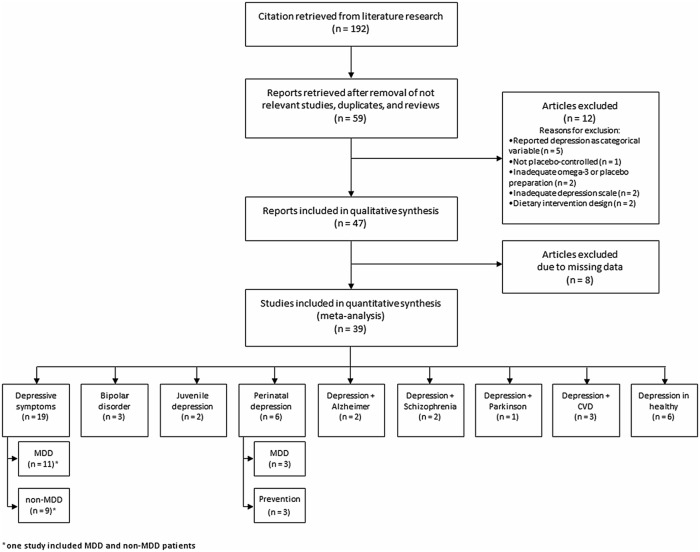
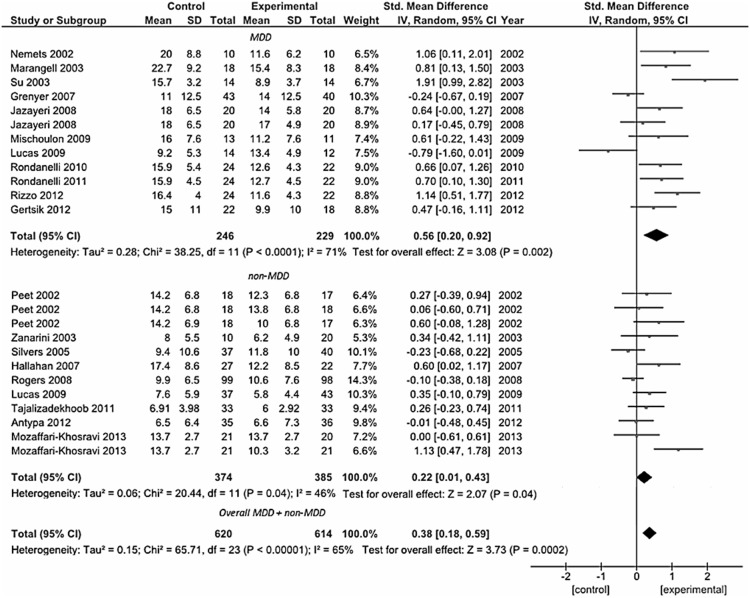
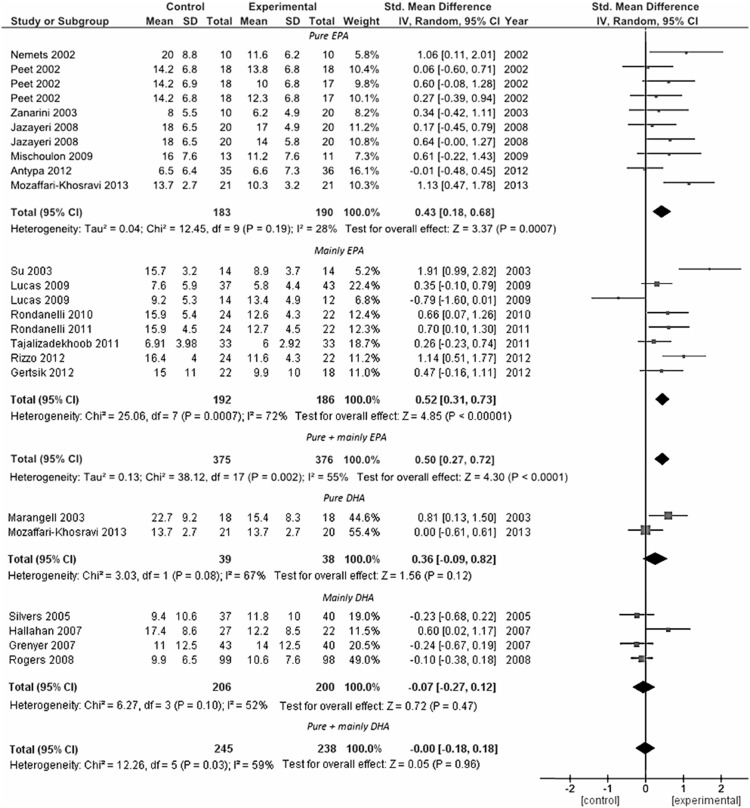
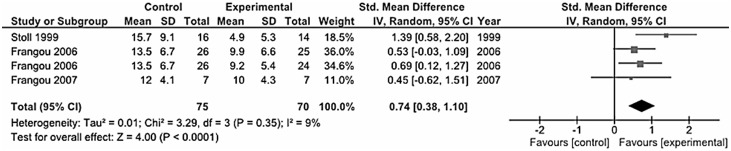
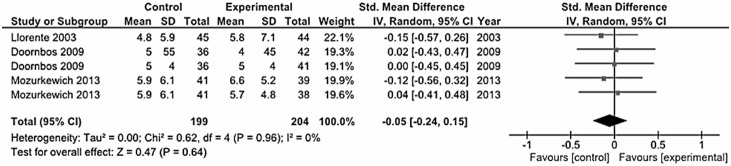
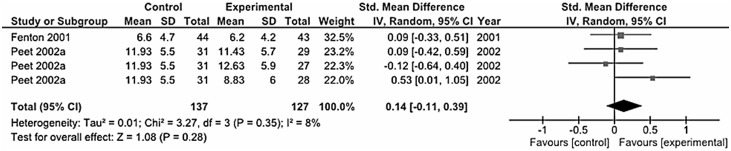
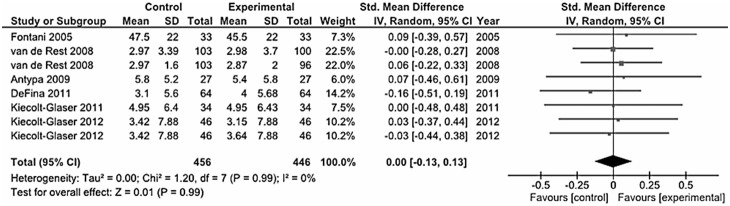
BACKGROUND: Despite omega-3 polyunsaturated fatty acids (PUFA) supplementation in depressed patients have been suggested to improve depressive symptomatology, previous findings are not univocal. OBJECTIVES: To conduct an updated meta-analysis of randomized controlled trials (RCTs) of omega-3 PUFA treatment of depressive disorders, taking into account the clinical differences among patients included in the studies. METHODS: A search on MEDLINE, EMBASE, PsycInfo, and the Cochrane Database of RCTs using omega-3 PUFA on patients with depressive symptoms published up to August 2013 was performed. Standardized mean difference in clinical measure of depression severity was primary outcome. Type of omega-3 used (particularly eicosapentaenoic acid [EPA] and docosahexaenoic acid [DHA]) and omega-3 as mono- or adjuvant therapy was also examined. Meta-regression analyses assessed the effects of study size, baseline depression severity, trial duration, dose of omega-3, and age of patients. RESULTS: Meta-analysis of 11 and 8 trials conducted respectively on patients with a DSM-defined diagnosis of major depressive disorder (MDD) and patients with depressive symptomatology but no diagnosis of MDD demonstrated significant clinical benefit of omega-3 PUFA treatment compared to placebo (standardized difference in random-effects model 0.56 SD [95% CI: 0.20, 0.92] and 0.22 SD [95% CI: 0.01, 0.43], respectively; pooled analysis was 0.38 SD [95% CI: 0.18, 0.59]). Use of mainly EPA within the preparation, rather than DHA, influenced final clinical efficacy. Significant clinical efficacy had the use of omega-3 PUFA as adjuvant rather than mono-therapy. No relation between efficacy and study size, baseline depression severity, trial duration, age of patients, and study quality was found. Omega-3 PUFA resulted effective in RCTs on patients with bipolar disorder, whereas no evidence was found for those exploring their efficacy on depressive symptoms in young populations, perinatal depression, primary disease other than depression and healthy subjects. CONCLUSIONS: The use of omega-3 PUFA is effective in patients with diagnosis of MDD and on depressive patients without diagnosis of MDD.
Overview
The claims and statistics of this paper haven’t been checked yet.
Run the check — free, no account needed. It reads the open-access text and checks the sources it cites.
Integrity signals
Registry
Cites
Statistics
Figures



Verification
Claims the paper makes
The claims and statistics of this paper haven’t been checked yet.
Run the check — free, no account needed. It reads the open-access text and checks the sources it cites.
Claims other papers make about this one
Each is checked against this paper’s own text: does it say what the citing paper says it does?
In the citing paper
“Independent clinical trials and meta-analyses of RCTs have also provided evidence of the superiority of n-3 PUFAs, namely eicosapentaenoic and docosahexaenoic acids, over a placebo as augmentation agents in the treatment of MDD [138].”
From Cognitive remission: a novel objective for the treatment of major depression? (2016) · cites this paper as [138]
Self-check
Percentages, sums and reported differences re-computed from the paper’s own numbers.
The self-check needs the paper’s full text.
Citations
Cites
2 retracted
Sohrabi, N., Kashanian, M., Ghafoori, S. S., & Malakouti, S. K. (2013) · Complementary Therapies in Medicine · doi:10.1016/j.ctim.2012.12.008 · Cited by 41
RetractedGao, F., Kiesewetter, D. O., Chang, L., Ma, K., Rapoport, S. I., & Igarashi, M. (2009) · Journal of Lipid Research · doi:10.1194/jlr.m900223-jlr200 · Cited by 26
RetractedMeasuring inconsistency in meta-analyses
Higgins, J. P. T., Thompson, S. G., Deeks, J. J., & Altman, D. G. (2003) · BMJ · doi:10.1136/bmj.327.7414.557 · Cited by 63,139
An inventory for measuring depression
BECK, A. T. (1961) · Archives of General Psychiatry · doi:10.1001/archpsyc.1961.01710120031004 · Cited by 38,032
Quantifying heterogeneity in a meta‐analysis
Higgins, J. P. T., & Thompson, S. G. (2002) · Statistics in Medicine · doi:10.1002/sim.1186 · Cited by 36,763
Hamilton, M. (1960) · Journal of Neurology, Neurosurgery & Psychiatry · doi:10.1136/jnnp.23.1.56 · Cited by 32,817
Assessing the quality of reports of randomized clinical trials: Is blinding necessary?
Jadad, A. R., Moore, R. A., Carroll, D., Jenkinson, C., Reynolds, D. J. M., Gavaghan, D. J., & McQuay, H. J. (1996) · Controlled Clinical Trials · doi:10.1016/0197-2456(95)00134-4 · Cited by 17,582
A new depression scale designed to be sensitive to change
Montgomery, S. A., & Åsberg, M. (1979) · British Journal of Psychiatry · doi:10.1192/bjp.134.4.382 · Cited by 13,962
Development of a Rating Scale for Primary Depressive Illness
Hamilton, M. (1967) · British Journal of Social and Clinical Psychology · doi:10.1111/j.2044-8260.1967.tb00530.x · Cited by 8,410
n−3 Polyunsaturated fatty acids, inflammation, and inflammatory diseases
Calder, P. C. (2006) · The American Journal of Clinical Nutrition · doi:10.1093/ajcn/83.6.1505s · Cited by 2,525
Cited by
Sorted by citations
Yatham, L. N., Kennedy, S. H., Parikh, S. V., Schaffer, A., Bond, D. J., Frey, B. N., Sharma, V., Goldstein, B. I., Rej, S., Beaulieu, S., et al. (2018) · Bipolar Disorders · doi:10.1111/bdi.12609 · Cited by 1,852
Inflammation: Depression Fans the Flames and Feasts on the Heat
Kiecolt-Glaser, J. K., Derry, H. M., & Fagundes, C. P. (2015) · American Journal of Psychiatry · doi:10.1176/appi.ajp.2015.15020152 · Cited by 844
Cleare, A., Pariante, C., Young, A., Anderson, I., Christmas, D., Cowen, P., Dickens, C., Ferrier, I., Geddes, J., Gilbody, S., et al. (2015) · Journal of Psychopharmacology · doi:10.1177/0269881115581093 · Cited by 759
Nutritional psychiatry: The present state of the evidence
Marx, W., Moseley, G., Berk, M., & Jacka, F. (2017) · Proceedings of the Nutrition Society · doi:10.1017/s0029665117002026 · Cited by 469
Influence of gut microbiota on neuropsychiatric disorders
Cénit, M. C., Sanz, Y., & Codoñer‐Franch, P. (2017) · World Journal of Gastroenterology · doi:10.3748/wjg.v23.i30.5486 · Cited by 433
Metadata
- Authors
- Grosso, G., Pajak, A., Marventano, S., Castellano, S., Galvano, F., Bucolo, C., Drago, F., & Caraci, F.
- Affiliations
- University of Catania (IT)
- Corresponding author
- Grosso, Giuseppe
- ORCID
- Venue
- PLoS ONE
- Publisher
- Public Library of Science (PLoS)
- Published
- 2014-05-07
- Volume
- 9
- Issue
- 5
- Pages
- e96905
- ISSN
- 1932-6203 (ISSN-L)
- PMC
- PMC4013121
- OpenAlex
- W2047790936
- Cited by
- 449
- References
- 130
- Citations by year
- 2026: 15 · 2025: 24 · 2024: 21 · 2023: 36 · 2022: 28 · 2021: 28 · 2020: 33 · 2019: 51 · 2018: 46 · 2017: 53 · 2016: 54 · 2015: 51 · 2014: 8
- FWCI
- 6.30
- Type
- journal article
- Language
- en
- Open access
- gold
- doi.org
- Locations
- PLoS ONE (publishedVersion, cc-by)
- Europe PMC (PubMed Central) (publishedVersion, other-oa)
- PubMed Central (publishedVersion, cc-by)
- PubMed (publishedVersion)
- Homo Politicus (Academy of Humanities and Economics in Lodz) (submittedVersion, cc-by-nc-nd)
- Homo Politicus (Academy of Humanities and Economics in Lodz) (submittedVersion)
- Jagiellonian University Repository (Jagiellonian University) (submittedVersion, other-oa)
- RePEc: Research Papers in Economics (submittedVersion)
- DOAJ (DOAJ: Directory of Open Access Journals) (submittedVersion, cc-by-sa)
- Figshare (submittedVersion, cc-by)
- Topics
- Health Sciences › Nursing › Nutrition and Dietetics › Fatty Acid Research and Health
- Health Sciences › Medicine › Pharmacology (medical) › Treatment of Major Depression
- Life Sciences › Neuroscience › Biological Psychiatry › Tryptophan and brain disorders
- Keywords
- omega-3 fatty acids, polyunsaturated fatty acids, depression, major depressive disorder, eicosapentaenoic acid, docosahexaenoic acid, omega-3 supplementation, adjuvant therapy, bipolar disorder, perinatal depression, young adults, depression severity
- MeSH terms
- Depressive Disorder, Docosahexaenoic Acids, Female, Humans, Pregnancy, Eicosapentaenoic Acid, Fatty Acids, Omega-3, Randomized Controlled Trials as Topic, MEDLINE, Dietary Supplements
About these checks
Registry, retraction, Cites and statistics results are computed, not judged, with one exception: a printed reference that no index lists is read once by a model before it counts as a citation error. Claims are extracted by a model and kept only when their quote appears verbatim in the text; each cited source is then checked, with a model’s help, for whether it says what the claim relies on. Those verdicts can be wrong — read the claim’s quote and the cited source before relying on one.
Statistics and arithmetic are recomputed, not judged.
Confidence bands are shown only for fields calibrated on our annotated test set. None is calibrated yet, so no band is shown.
What counts as a claim ›How we measure confidence ›How we check this ›
Are you an author, or do you see a problem with this page? Request a review
