

The DOI matches its Crossref record; 35 of the 36 references it cites were found in a registry or an index.
Development of Korean Smartphone Addiction Proneness Scale for Youth
Open accessAbstract
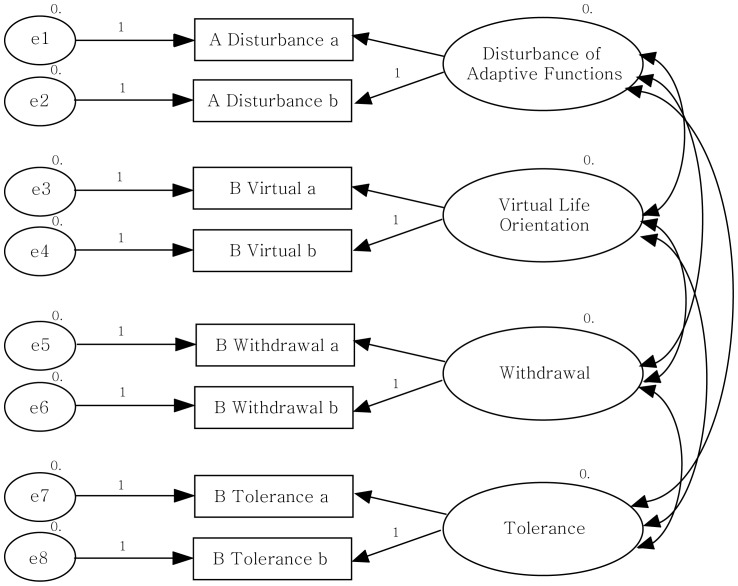
This study developed a Smartphone Addiction Proneness Scale (SAPS) based on the existing internet and cellular phone addiction scales. For the development of this scale, 29 items (1.5 times the final number of items) were initially selected as preliminary items, based on the previous studies on internet/phone addiction as well as the clinical experience of involved experts. The preliminary scale was administered to a nationally representative sample of 795 students in elementary, middle, and high schools across South Korea. Then, final 15 items were selected according to the reliability test results. The final scale consisted of four subdomains: (1) disturbance of adaptive functions, (2) virtual life orientation, (3) withdrawal, and (4) tolerance. The final scale indicated a high reliability with Cronbach's α of .880. Support for the scale's criterion validity has been demonstrated by its relationship to the internet addiction scale, KS-II (r = .49). For the analysis of construct validity, we tested the Structural Equation Model. The results showed the four-factor structure to be valid (NFI = .943, TLI = .902, CFI = .902, RMSEA = .034). Smartphone addiction is gaining a greater spotlight as possibly a new form of addiction along with internet addiction. The SAPS appears to be a reliable and valid diagnostic scale for screening adolescents who may be at risk of smartphone addiction. Further implications and limitations are discussed.
Overview
The claims and statistics of this paper haven’t been checked yet.
Run the check — free, no account needed. It reads the open-access text and checks the sources it cites.
Integrity signals
Registry
Cites
Statistics
Figures
Verification
Claims the paper makes
The claims and statistics of this paper haven’t been checked yet.
Run the check — free, no account needed. It reads the open-access text and checks the sources it cites.
Claims other papers make about this one
Each is checked against this paper’s own text: does it say what the citing paper says it does?
The source backs part of the claim, not all of it — or backs it for a different population, condition or comparison.
In the citing paper
“PSU shares many traits with substance abuse disorders and behavioural addictions [13–18], and it appears to be common.”
From Prevalence of problematic smartphone usage and associated mental health outcomes amongst children and young people: a systematic review, meta-analysis and GRADE of the evidence (2019) · cites this paper as [15]
Experimental — accuracy not yet measured
Self-check
Percentages, sums and reported differences re-computed from the paper’s own numbers.
The self-check needs the paper’s full text.
Citations
Cites
Digital Natives, Digital Immigrants Part 1
Prensky, M. (2001) · On the Horizon · doi:10.1108/10748120110424816 · Cited by 11,104
The online disinhibition effect
Suler, J. (2004) · CyberPsychology & Behavior · doi:10.1089/1094931041291295 · Cited by 4,375
Digital Natives, Digital Immigrants Part 2: Do They Really Think Differently?
Prensky, M. (2001) · On the Horizon · doi:10.1108/10748120110424843 · Cited by 4,035
The Smartphone addiction scale: development and validation of a short version for adolescents
Kwon, M., Kim, D.-J., Cho, H., & Yang, S. (2013) · PLoS ONE · doi:10.1371/journal.pone.0083558 · Cited by 2,177
Self-citationFacebook Use Predicts Declines in Subjective Well-Being in Young Adults
Kross, E., Verduyn, P., Demiralp, E., Park, J., Lee, D. S., Lin, N., Shablack, H., Jonides, J., & Ybarra, O. (2013) · PLoS ONE · doi:10.1371/journal.pone.0069841 · Cited by 1,596
Psychological Predictors of Problem Mobile Phone Use
Bianchi, A., & Phillips, J. G. (2005) · CyberPsychology & Behavior · doi:10.1089/cpb.2005.8.39 · Cited by 1,514
Psychology of Computer Use: XL. Addictive Use of the Internet: A Case That Breaks the Stereotype
Young, K. S. (1996) · Psychological Reports · doi:10.2466/pr0.1996.79.3.899 · Cited by 1,108
The psychometric properties of the Internet addiction test
Widyanto, L., & McMurran, M. (2004) · CyberPsychology & Behavior · doi:10.1089/cpb.2004.7.443 · Cited by 1,073
Modification in the Proposed Diagnostic Criteria for Internet Addiction
Beard, K. W., & Wolf, E. (2001) · CyberPsychology & Behavior · doi:10.1089/109493101300210286 · Cited by 1,019
Distinguishing addiction and high engagement in the context of online game playing
Charlton, J. P., & Danforth, I. D. W. (2007) · Computers in Human Behavior · doi:10.1016/j.chb.2005.07.002 · Cited by 946
Research works printed but not linked: 11
- J Chen, 2009, The acceptance and diffusion of the innovative smartphone use, Information and Management, 46, 241
- H Lee, 2008, Exploration of the Predicting Variables Affecting the Addictive Mobile Phone Use, The Korean Journal of Social and Personality Psychology, 22(1), 133
- D Zsolt, 2008, The three-factor model of internet addiction: The development of the problematic Internet Use Questionnaire, Behavior Research Methods, 40(2), 563
- D Kim, 2010, Technology Trends of Smartphone User Interface, Korea Information Science Society Review, 28(5), 15
- Kim M (2011) Study on Online and Offline Relationship of Smart Phone SNS Users: Centering on Twitter. The Graduate School of Ewha Women's University. Master's Thesis.
- M Noh, 2010, Analysis of Smartphone and Convergence of Functions through Association Analysis, Journal of the Korea Society of Management Information Systems, 1, 254
- J Kim, 2010, The Evolution of Mobile Internet Service, OSIA Standards & Technology Review, 38(1), 4
- WS Choi, 2010, Study on the importance of functional characteristic of smartphones, Journal of Information Technology Application & Management, 1, 289
- KS Young, 1996, Addictive use of the internet: a case that breaks the stereotype, Psychological Reports, 79, 899, 10.2466/pr0.1996.79.3.899 · DOI · Paper page
- H Kang, 2009, Development and Validation of the Mobile Phone Addiction Scale for Adolescents, Korean journal of health psychology, 14(3), 497
- Keum C (2013) Research into smartphone addiction proneness and mental health problem for middle and high school student at Korea. Seoul National University Master's Thesis.
Cited by
Sorted by citations
Items 101–200 of 430
The Conceptualization and Assessment of Problematic Mobile Phone Use
López-Fernández, O., Kuss, D. J., Griffiths, M. D., & Billieux, J. (2015) · IGI Global eBooks · doi:10.4018/978-1-4666-8239-9.ch050 · Cited by 47
Transitions in smartphone addiction proneness among children: The effect of gender and use patterns
Chiang, J., Chang, F., Lee, K., & Hsu, S.-Y. (2019) · PLoS ONE · doi:10.1371/journal.pone.0217235 · Cited by 48
Lai, X., Huang, S., Nie, C., Yan, J. J., Li, Y., Wang, Y., & Luo, Y. (2022) · Journal of Behavioral Addictions · doi:10.1556/2006.2022.00047 · Cited by 45
From assistance to reliance: Development and validation of the large language model dependence scale
Li, Z., Zhang, Z., Wang, M., & Wu, Q. (2025) · International Journal of Information Management · doi:10.1016/j.ijinfomgt.2025.102888 · Cited by 47
Arthy, C. C., Effendy, E., Amin, M. M., Loebis, B., Camellia, V., & Husada, M. S. (2019) · Open Access Macedonian Journal of Medical Sciences · doi:10.3889/oamjms.2019.691 · Cited by 64
Radwan, N. L., Ibrahim, M. M., & Mahmoud, W. S. (2020) · Journal of Physical Therapy Science · doi:10.1589/jpts.32.65 · Cited by 44
Gugushvili, N., Täht, K., Rozgonjuk, D., Raudlam, M., Ruiter, R. A. C., & Verduyn, P. (2020) · Cyberpsychology Journal of Psychosocial Research on Cyberspace · doi:10.5817/cp2020-2-3 · Cited by 56
Should it stay or should it go now? Smartphones and relational health.
Lapierre, M. A., & Lewis, M. N. (2016) · Psychology of Popular Media Culture · doi:10.1037/ppm0000119 · Cited by 42
Factors Associated with Smartphone Addiction Tendency in Korean Adolescents
Kim, J.-H. (2021) · International Journal of Environmental Research and Public Health · doi:10.3390/ijerph182111668 · Cited by 47
Lee, D., Lee, J., Namkoong, K., & Jung, Y.-C. (2021) · Addictive Behaviors · doi:10.1016/j.addbeh.2021.106823 · Cited by 37
Self-citationThe Psychology of Smartphone: The Development of the Smartphone Impact Scale (SIS)
Pancani, L., Preti, E., & Riva, P. (2019) · Assessment · doi:10.1177/1073191119831788 · Cited by 44
Kesici, A., & Tunç, N. F. (2018) · Universal Journal of Educational Research · doi:10.13189/ujer.2018.060204 · Cited by 36
Pyeon, A., Choi, J., Cho, H., Kim, J.-Y., Choi, I. Y., Ahn, K. J., Choi, J., Chun, J., & Kim, D. (2021) · Journal of Behavioral Addictions · doi:10.1556/2006.2021.00085 · Cited by 36
Self-citationKim, S., Kim, S.-Y., & Kang, H.-B. (2016) · Computational Intelligence and Neuroscience · doi:10.1155/2016/5718580 · Cited by 35
Impact of Smartphone Addiction on Business Students’ Academic Performance: A Case Study
Arefin, M. S., Islam, M. R., Mustafi, M. A. A., Afrin, S., & Islam, N. (2017) · Independent Journal of Management & Production · doi:10.14807/ijmp.v8i3.629 · Cited by 35
Kang, K. I., Kang, K., & Kim, C. (2021) · International Journal of Environmental Research and Public Health · doi:10.3390/ijerph18052224 · Cited by 35
Karabey, S. Ç., Palancı, A., & Turan, Z. (2023) · Psychology Health & Medicine · doi:10.1080/13548506.2023.2229241 · Cited by 54
Cross-cultural validation of the Social Media Disorder scale
Fung, S.-F. (2019) · Psychology Research and Behavior Management · doi:10.2147/prbm.s216788 · Cited by 35
Son, H.-G., Cho, H. J., & Jeong, K.-H. (2021) · International Journal of Environmental Research and Public Health · doi:10.3390/ijerph18136685 · Cited by 35
Altered Functional Connectivity of the Salience Network in Problematic Smartphone Users
Ahn, J., Lee, D., Namkoong, K., & Jung, Y. (2021) · Frontiers in Psychiatry · doi:10.3389/fpsyt.2021.636730 · Cited by 34
Determining the structure of smartphone addiction scale: A bifactor model analysis
Vintilă, M., Tudorel, O. I., Goian, C., & Bărbat, C. (2018) · Current Psychology · doi:10.1007/s12144-018-0035-0 · Cited by 43
Wadsley, M. G., & Ihssen, N. (2023) · Brain Sciences · doi:10.3390/brainsci13050787 · Cited by 40
Zhou, D., Liu, J., Wang, T., Liu, J., & Li, G. (2021) · Computers in Human Behavior · doi:10.1016/j.chb.2021.107171 · Cited by 38
Lee, W.-J., & Shin, S. (2016) · Journal of Applied Business Research (JABR) · doi:10.19030/jabr.v32i2.9592 · Cited by 26
Craig, S. L., Brooks, A. S., Doll, K., Eaton, A. D., McInroy, L. B., & Hui, J. (2023) · Journal of Adolescent Research · doi:10.1177/07435584221144958 · Cited by 36
Kim, J.-H. (2022) · International Journal of Environmental Research and Public Health · doi:10.3390/ijerph19137657 · Cited by 40
Zhao, X., Lai, X., Huang, S., Li, Y., Dai, X., Wang, H., He, Y., & Wang, Y. (2024) · Mental health and physical activity · doi:10.1016/j.mhpa.2024.100585 · Cited by 39
Ding, X., Xu, J., Chen, G., & Xu, C. (2016) · CHI Conference Extended Abstracts on Human Factors in Computing Systems (CHI EA) · doi:10.1145/2851581.2892415 · Cited by 35
Akıllı Telefon Bağımlılığı Ölçeği’nin (ATBÖ) Türk Lise Öğrencileri İçin Uyarlama Çalışması
Şata, M., ÇELİK, İ., Ertürk, Z., & TAŞ, U. E. (2016) · Eğitimde ve Psikolojide Ölçme ve Değerlendirme Dergisi · doi:10.21031/epod.95432 · Cited by 30
Psychopathology of Everyday Life in the 21st Century: Smartphone Addiction
Lin, Y., Lin, S., Yang, C. C. H., & Kuo, T. B. J. (2017) · Studies in neuroscience, psychology and behavioral economics · doi:10.1007/978-3-319-46276-9_20 · Cited by 30
Zhang, K., Lu, X., Zhang, X., Zhang, J., Ren, J., Guo, H., Zhu, Z., Yang, H., Yuan, G., Jin, G., et al. (2023) · Current Addiction Reports · doi:10.1007/s40429-023-00471-w · Cited by 34
Cemei, L., Sriram, S., Holý, O., & Rehman, S. (2024) · Psychology Research and Behavior Management · doi:10.2147/prbm.s472299 · Cited by 37
AlBarashdi, H., Bouazza, A., Jabur, N., & Al-Zubaidi, A. (2016) · International Journal of Psychology & Behavior Analysis · doi:10.15344/2455-3867/2016/113 · Cited by 29
Paik, S.-H., Park, C.-H., Kim, J.-Y., Chun, J., Choi, J., & Kim, D. (2019) · Frontiers in Psychiatry · doi:10.3389/fpsyt.2019.00516 · Cited by 28
Self-citationZeng, G., Zhang, L., Fung, S.-F., Li, J., Liu, Y.-M., Xiong, Z.-K., Jiang, Z.-Q., Zhu, F.-F., Chen, Z.-T., Luo, S.-D., et al. (2021) · International Journal of Environmental Research and Public Health · doi:10.3390/ijerph18136949 · Cited by 35
Pearson, B. A. D., Young, C. M., Shank, F., & Neighbors, C. (2021) · Journal of American College Health · doi:10.1080/07448481.2021.1910274 · Cited by 32
Reflective smartphone disengagement: Conceptualization, measurement, and validation
Matthes, J., Karsay, K., Hirsch, M., Stević, A., & Schmuck, D. (2021) · Computers in Human Behavior · doi:10.1016/j.chb.2021.107078 · Cited by 30
Effect of Growth Mindset on Mental Health Two Years Later: The Role of Smartphone Use
Lai, X., Nie, C., Huang, S., Li, Y., Xin, T., Zhang, C., & Wang, Y. (2022) · International Journal of Environmental Research and Public Health · doi:10.3390/ijerph19063355 · Cited by 38
Park, E. J., Hwang, S. S., Lee, M., & Bhang, S. (2022) · International Journal of Environmental Research and Public Health · doi:10.3390/ijerph19094939 · Cited by 38
When Does Internet and Smartphone Use Become a Problem?
Cheever, N. A., Moreno, M. A., & Rosen, L. D. (2018) · Springer eBooks · doi:10.1007/978-3-319-69638-6_10 · Cited by 34
Buabbas, A. J., Al-Mass, M. A., Al-Tawari, B. A., & Buabbas, M. A. (2020) · BMC Pediatrics · doi:10.1186/s12887-020-02417-x · Cited by 39
Khan, N. F., & Khan, M. N. (2021) · Asia-Pacific Journal of Business Administration · doi:10.1108/apjba-09-2021-0430 · Cited by 32
The Smartphone "Addiction" Narrative is Compelling, but Largely Unfounded
Lanette, S., & Mazmanian, M. (2018) · CHI Conference Extended Abstracts on Human Factors in Computing Systems (CHI EA) · doi:10.1145/3170427.3188584 · Cited by 27
Addiction-Like Mobile Phone Behavior – Validation and Association With Problem Gambling
Fransson, A., Montañés, M. C., & Håkansson, A. (2018) · Frontiers in Psychology · doi:10.3389/fpsyg.2018.00655 · Cited by 30
Jahng, K. E. (2018) · Children and Youth Services Review · doi:10.1016/j.childyouth.2018.12.028 · Cited by 28
Huang, S., Lai, X., Li, Y., Wang, W., Zhao, X., Dai, X., Wang, H., & Wang, Y. (2023) · Heliyon · doi:10.1016/j.heliyon.2023.e14897 · Cited by 37
Shim, J. (2019) · Journal of religion and health · doi:10.1007/s10943-018-00751-0 · Cited by 24
The relations between smartphone use, mood, and flow experience
Marty-Dugas, J., & Smilek, D. (2020) · Personality and Individual Differences · doi:10.1016/j.paid.2020.109966 · Cited by 28
Gökçearslan, Ş., Durak, H. Y., & Eşiyok, E. (2023) · Journal of Computer Assisted Learning · doi:10.1111/jcal.12785 · Cited by 38
Lapierre, M. A., & Zhao, P. (2021) · Social Science Computer Review · doi:10.1177/0894439320988762 · Cited by 24
Effect of Maternal Factors on Problematic Smartphone Use among Elementary School Children
Lee, E. J., & Kim, H. S. (2021) · International Journal of Environmental Research and Public Health · doi:10.3390/ijerph18179182 · Cited by 24
Psychometric properties of the Turkish version of the smartphone addiction inventory (SPAI)
Arpacı, İ., & Eşgi, N. (2018) · Current Psychology · doi:10.1007/s12144-018-9913-8 · Cited by 24
Kim, S. K., & Kang, H.-B. (2017) · Neurocomputing · doi:10.1016/j.neucom.2017.09.081 · Cited by 25
Tang, S., Chen, R., Ma, Z., Li, X., Chen, J., & Zhao, J. (2024) · Addictive Behaviors · doi:10.1016/j.addbeh.2024.107969 · Cited by 29
Zhao, P., & Lapierre, M. A. (2020) · Cyberpsychology Journal of Psychosocial Research on Cyberspace · doi:10.5817/cp2020-4-3 · Cited by 23
Gao, L., Wan, Z., Chu, X., Chen, H., & Li, W. (2022) · Frontiers in Psychiatry · doi:10.3389/fpsyt.2022.832933 · Cited by 23
Liu, Q., & Wu, J. (2023) · Education and Information Technologies · doi:10.1007/s10639-023-12071-2 · Cited by 25
Lapierre, M. A. (2019) · Psychology of Popular Media · doi:10.1037/ppm0000230 · Cited by 21
Yoo, J. H., Chun, J., Choi, M., Cho, H., Kim, J.-Y., Choi, J., & Kim, D. (2021) · Journal of Behavioral Addictions · doi:10.1556/2006.2021.00024 · Cited by 23
Self-citationPoulain, T., Vogel, M., Kliesener, T., & Kieß, W. (2021) · European Child & Adolescent Psychiatry · doi:10.1007/s00787-021-01874-8 · Cited by 21
Ko, M., Chi, S., Lee, J., Suh, S., & Lee, M. (2023) · Clinical Psychopharmacology and Neuroscience · doi:10.9758/cpn.2023.21.2.304 · Cited by 22
Self-citationLee, S.-J., Rho, M. J., Yook, I. H., Park, S.-H., Jang, K.-S., Park, B.-J., Lee, O., Lee, D. H., Kim, D., & Choi, I. Y. (2016) · Applied Sciences · doi:10.3390/app6120440 · Cited by 23
Self-citationSelvaganapathy, K., Rajappan, R., & Dee, T. H. (2017) · International Journal of Integrative Medical Sciences · doi:10.16965/ijims.2017.118 · Cited by 24
Gençlerin Akıllı Telefon Kullanım Motivasyonları
Bulduklu, Y., & Özer, N. P. (2016) · İnsan ve Toplum Bilimleri Araştırmaları Dergisi · doi:10.15869/itobiad.265374 · Cited by 21
Nomkin, L. G., & Gordon, I. (2021) · PLoS ONE · doi:10.1371/journal.pone.0257956 · Cited by 24
Jahrami, H., Fekih‐Romdhane, F., Saif, Z., Bragazzi, N. L., Pandi-Perumal, S. R., BaHammam, A. S., & Vitiello, M. V. (2022) · Clocks & Sleep · doi:10.3390/clockssleep4040040 · Cited by 24
Kwon, M., Jung, Y., Lee, D., & Lee, J. (2022) · Frontiers in Psychiatry · doi:10.3389/fpsyt.2022.1008557 · Cited by 21
Self-citationZhou, D., Liu, J., Ye, G., Wang, T., Xia, X., & Liu, J. (2022) · Behavioral Sciences · doi:10.3390/bs12110454 · Cited by 20
Transitions in Problematic Internet Use: A One-Year Longitudinal Study of Boys
Choi, B. Y., Huh, S. Y., Kim, D., Suh, S. W., Lee, S. G., & Potenza, M. N. (2019) · Psychiatry Investigation · doi:10.30773/pi.2019.04.02.1 · Cited by 25
Self-citationWang, Y., Long, J., Liu, Y.-H., Liu, T., & Billieux, J. (2020) · BMC Psychiatry · doi:10.1186/s12888-020-2449-0 · Cited by 21
Fallahtafti, S., Ghanbaripirkashani, N., Alizadeh, S. S., & Rovoshi, R. S. (2019) · International Journal of Developmental Science · doi:10.3233/dev-200002 · Cited by 21
Lapierre, M. A., & Custer, B. E. (2020) · Mobile Media & Communication · doi:10.1177/2050157920935163 · Cited by 28
Kim, H., Choi, I. Y., & Kim, D. (2020) · JMIR mhealth and uhealth · doi:10.2196/18505 · Cited by 22
Self-citationBuabbas, A. J., Hasan, H., & Buabbas, M. A. (2021) · PLoS ONE · doi:10.1371/journal.pone.0251479 · Cited by 27
Suicidal Ideation and Related Factors Among Korean High School Students
Sohn, M., Oh, H., Lee, S., & Potenza, M. N. (2017) · The Journal of School Nursing · doi:10.1177/1059840517734290 · Cited by 21
Cárthaigh, S. M. (2019) · Neurology Psychiatry and Brain Research · doi:10.1016/j.npbr.2019.11.002 · Cited by 20
Esmaeilpour, F., Letafatkar, A., Baker, J. S., Dutheil, F., Khazaei, O., Rabiei, P., & Anarinejad, A. (2021) · Journal of Public Health · doi:10.1007/s10389-021-01529-7 · Cited by 18
Smartphone Usage and Sleep Quality in Korean Middle School Students During the COVID-19 Pandemic
Chi, S., Ko, M., Lee, J., Yi, H.-S., & Lee, M. (2022) · Psychiatry Investigation · doi:10.30773/pi.2022.0032 · Cited by 20
Self-citationThe association of motives with problematic smartphone use: A systematic review
Sullivan, B. M., & George, A. M. (2023) · Cyberpsychology Journal of Psychosocial Research on Cyberspace · doi:10.5817/cp2023-1-2 · Cited by 29
Early Intervention in Gaming Disorder: What Can We Learn from Findings in the Substance Abuse Field?
Rumpf, H., Bischof, A., Bischof, G., Besser, B., Brand, D., & Rehbein, F. (2018) · Current Addiction Reports · doi:10.1007/s40429-018-0229-4 · Cited by 19
Wu, Y.-L., Lin, S., & Lin, Y. (2021) · Journal of Behavioral Addictions · doi:10.1556/2006.2020.00074 · Cited by 20
Bong, S. H., Kim, K. M., Seol, K. H., & Kim, J. W. (2021) · Asian Journal of Psychiatry · doi:10.1016/j.ajp.2021.102729 · Cited by 23
The mediating effect of attentional impulsivity between mindfulness and problematic smartphone use
Kim, M., Seong, G., Jeon, M.-J., Jung, Y., & Lee, D. (2024) · BMC Psychiatry · doi:10.1186/s12888-024-05708-0 · Cited by 28
Effects of depression and social interaction on smartphone addiction among female adolescents
Lee, E. J., & Kim, H. O. (2021) · Journal of Child and Adolescent Psychiatric Nursing · doi:10.1111/jcap.12349 · Cited by 18
Impact of Smartphone Addiction on Academic Performance of Business Students: A Case StudyPreprint
Arefin, M. S., Islam, M. R., Mustafi, M. A. A., Afrin, S., & Islam, N. (2018) · SSRN Electronic Journal · doi:10.2139/ssrn.3236301 · Cited by 18
Excessive and Problematic Smartphone Use and Poor Mental Health in Adolescents
Cho, Y. G. (2020) · Korean Journal of Family Medicine · doi:10.4082/kjfm.41.2e · Cited by 19
A Longitudinal Relationship Between Mother’s Smartphone Addiction to Child’s Smartphone Addiction
Jeong, K.-H., Kim, S., Ryu, J. H., & Lee, S. (2022) · International Journal of Mental Health and Addiction · doi:10.1007/s11469-022-00957-0 · Cited by 21
Is Nomophobia Problematic or Functional? A Perspective from Bifactor Structure
Ren, S., Liu, T., Zhao, X., Yang, H., & Elhai, J. D. (2023) · International Journal of Mental Health and Addiction · doi:10.1007/s11469-023-01030-0 · Cited by 20
Park, M., Jeong, S. H., Huh, K., Park, Y. S., Park, E., & Jang, S. (2022) · Sleep and Biological Rhythms · doi:10.1007/s41105-022-00377-6 · Cited by 21
A network analysis of problematic smartphone use in Japanese young adults
Tateno, M., Kato, T. A., Shirasaka, T., Kanazawa, J., Ukai, W., & Hirota, T. (2022) · PLoS ONE · doi:10.1371/journal.pone.0272803 · Cited by 16
An Empirical Study on Smartphone Addiction of the University Students
Alkhunzain, A. S. (2019) · International Journal of Interactive Mobile Technologies (iJIM) · doi:10.3991/ijim.v13i12.11120 · Cited by 15
Smartphones within Psychological Science
Ellis, D. A. (2020) · Cambridge University Press eBooks · doi:10.1017/9781108671408 · Cited by 14
Yoo, C. (2024) · Journal of Behavioral Addictions · doi:10.1556/2006.2024.00002 · Cited by 14
Huang, Y., Hu, S.-C., Shyu, L.-Y., & Yeh, C. (2020) · Journal of the Chinese Medical Association · doi:10.1097/jcma.0000000000000278 · Cited by 15
Kim, H. H., & Chun, J. (2018) · PLoS ONE · doi:10.1371/journal.pone.0196824 · Cited by 16
Wang, Y., Long, J., Liu, Y., Liu, T., & Billieux, J. (2020) · Frontiers in Psychiatry · doi:10.3389/fpsyt.2020.529949 · Cited by 15
Vujić, A., Volarov, M., Latas, M. B., Griffiths, M. D., & Szabó, A. (2023) · International Journal of Mental Health and Addiction · doi:10.1007/s11469-023-01013-1 · Cited by 14
Parental mediation in Turkey: The use of mobile devices in early childhood
Aslan, A., & TURGUT, Y. E. (2023) · E-Learning and Digital Media · doi:10.1177/20427530231167651 · Cited by 21
Çelik, O. T., Tunç, Y., Candemir, B., İçen, B. K., & Açar, D. (2023) · İnönü Üniversitesi Sağlık Hizmetleri Meslek Yüksek Okulu Dergisi · doi:10.33715/inonusaglik.1288302 · Cited by 15
Unveiling the grip of mobile phone addiction: an in-depth review
Li, J., & Yang, H. Y. (2024) · Frontiers in Psychiatry · doi:10.3389/fpsyt.2024.1429941 · Cited by 17
Metadata
- Authors
- Kim, D., Lee, Y., Lee, J., Nam, J. K., & Chung, Y.
- Affiliations
- Seoul National University (KR)
- Corresponding author
- Lee, Yunhee
- Venue
- PLoS ONE
- Publisher
- Public Library of Science (PLoS)
- Published
- 2014-05-21
- Volume
- 9
- Issue
- 5
- Pages
- e97920
- ISSN
- 1932-6203 (ISSN-L)
- PMC
- PMC4029762
- OpenAlex
- W2084863892
- Cited by
- 434
- References
- 36
- Citations by year
- 2026: 29 · 2025: 36 · 2024: 36 · 2023: 35 · 2022: 55 · 2021: 47 · 2020: 65 · 2019: 37 · 2018: 32 · 2017: 30 · 2016: 22 · 2015: 8 · 2014: 2
- FWCI
- 67.12
- Type
- journal article
- Language
- en
- Open access
- gold
- doi.org
- Locations
- PLoS ONE (publishedVersion, cc-by)
- Europe PMC (PubMed Central) (publishedVersion, cc-by)
- PubMed Central (publishedVersion, cc-by)
- PubMed (publishedVersion)
- RePEc: Research Papers in Economics (submittedVersion)
- DOAJ (DOAJ: Directory of Open Access Journals) (submittedVersion, cc-by-sa)
- Topics
- Social Sciences › Sociology and Political Science › Impact of Technology on Adolescents
- Social Sciences › Psychology › Clinical Psychology › Sexuality, Behavior, and Technology
- Social Sciences › Education › Child Development and Digital Technology
- Keywords
- smartphone addiction, scale development, adolescents, internet addiction, addiction screening, withdrawal, tolerance, construct validity, criterion validity
- MeSH terms
- Adolescent, Child, Female, Humans, Male, Surveys and Questionnaires, Reproducibility of Results, Behavior, Addictive, Internet, Cell Phone, Republic of Korea
About these checks
Registry, retraction, Cites and statistics results are computed, not judged, with one exception: a printed reference that no index lists is read once by a model before it counts as a citation error. Claims are extracted by a model and kept only when their quote appears verbatim in the text; each cited source is then checked, with a model’s help, for whether it says what the claim relies on. Those verdicts can be wrong — read the claim’s quote and the cited source before relying on one.
Statistics and arithmetic are recomputed, not judged.
Confidence bands are shown only for fields calibrated on our annotated test set. None is calibrated yet, so no band is shown.
What counts as a claim ›How we measure confidence ›How we check this ›
Are you an author, or do you see a problem with this page? Request a review
