

The DOI matches its Crossref record; 35 of the 36 references it cites were found in a registry or an index.
Development of Korean Smartphone Addiction Proneness Scale for Youth
Open accessAbstract
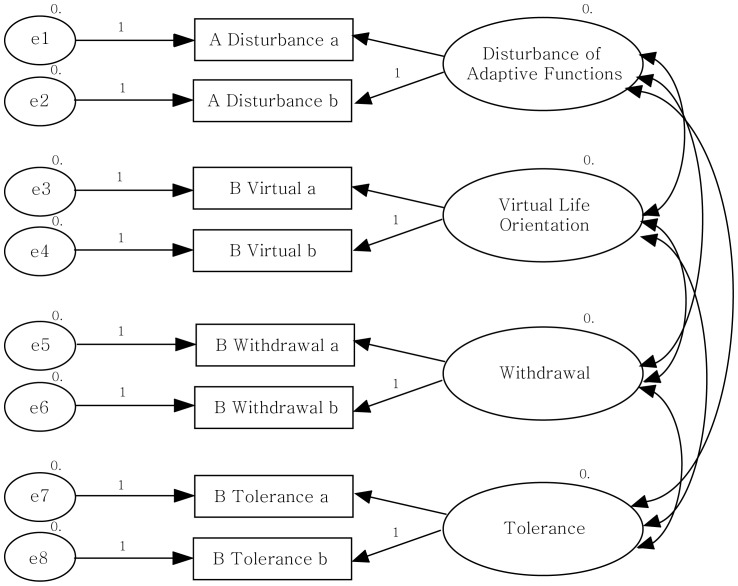
This study developed a Smartphone Addiction Proneness Scale (SAPS) based on the existing internet and cellular phone addiction scales. For the development of this scale, 29 items (1.5 times the final number of items) were initially selected as preliminary items, based on the previous studies on internet/phone addiction as well as the clinical experience of involved experts. The preliminary scale was administered to a nationally representative sample of 795 students in elementary, middle, and high schools across South Korea. Then, final 15 items were selected according to the reliability test results. The final scale consisted of four subdomains: (1) disturbance of adaptive functions, (2) virtual life orientation, (3) withdrawal, and (4) tolerance. The final scale indicated a high reliability with Cronbach's α of .880. Support for the scale's criterion validity has been demonstrated by its relationship to the internet addiction scale, KS-II (r = .49). For the analysis of construct validity, we tested the Structural Equation Model. The results showed the four-factor structure to be valid (NFI = .943, TLI = .902, CFI = .902, RMSEA = .034). Smartphone addiction is gaining a greater spotlight as possibly a new form of addiction along with internet addiction. The SAPS appears to be a reliable and valid diagnostic scale for screening adolescents who may be at risk of smartphone addiction. Further implications and limitations are discussed.
Overview
The claims and statistics of this paper haven’t been checked yet.
Run the check — free, no account needed. It reads the open-access text and checks the sources it cites.
Integrity signals
Registry
Cites
Statistics
Figures
Verification
Claims the paper makes
The claims and statistics of this paper haven’t been checked yet.
Run the check — free, no account needed. It reads the open-access text and checks the sources it cites.
Claims other papers make about this one
Each is checked against this paper’s own text: does it say what the citing paper says it does?
The source backs part of the claim, not all of it — or backs it for a different population, condition or comparison.
In the citing paper
“PSU shares many traits with substance abuse disorders and behavioural addictions [13–18], and it appears to be common.”
From Prevalence of problematic smartphone usage and associated mental health outcomes amongst children and young people: a systematic review, meta-analysis and GRADE of the evidence (2019) · cites this paper as [15]
Experimental — accuracy not yet measured
Self-check
Percentages, sums and reported differences re-computed from the paper’s own numbers.
The self-check needs the paper’s full text.
Citations
Cites
Digital Natives, Digital Immigrants Part 1
Prensky, M. (2001) · On the Horizon · doi:10.1108/10748120110424816 · Cited by 11,104
The online disinhibition effect
Suler, J. (2004) · CyberPsychology & Behavior · doi:10.1089/1094931041291295 · Cited by 4,375
Digital Natives, Digital Immigrants Part 2: Do They Really Think Differently?
Prensky, M. (2001) · On the Horizon · doi:10.1108/10748120110424843 · Cited by 4,035
The Smartphone addiction scale: development and validation of a short version for adolescents
Kwon, M., Kim, D.-J., Cho, H., & Yang, S. (2013) · PLoS ONE · doi:10.1371/journal.pone.0083558 · Cited by 2,177
Self-citationFacebook Use Predicts Declines in Subjective Well-Being in Young Adults
Kross, E., Verduyn, P., Demiralp, E., Park, J., Lee, D. S., Lin, N., Shablack, H., Jonides, J., & Ybarra, O. (2013) · PLoS ONE · doi:10.1371/journal.pone.0069841 · Cited by 1,596
Psychological Predictors of Problem Mobile Phone Use
Bianchi, A., & Phillips, J. G. (2005) · CyberPsychology & Behavior · doi:10.1089/cpb.2005.8.39 · Cited by 1,514
Psychology of Computer Use: XL. Addictive Use of the Internet: A Case That Breaks the Stereotype
Young, K. S. (1996) · Psychological Reports · doi:10.2466/pr0.1996.79.3.899 · Cited by 1,108
The psychometric properties of the Internet addiction test
Widyanto, L., & McMurran, M. (2004) · CyberPsychology & Behavior · doi:10.1089/cpb.2004.7.443 · Cited by 1,073
Modification in the Proposed Diagnostic Criteria for Internet Addiction
Beard, K. W., & Wolf, E. (2001) · CyberPsychology & Behavior · doi:10.1089/109493101300210286 · Cited by 1,019
Distinguishing addiction and high engagement in the context of online game playing
Charlton, J. P., & Danforth, I. D. W. (2007) · Computers in Human Behavior · doi:10.1016/j.chb.2005.07.002 · Cited by 946
Research works printed but not linked: 11
- J Chen, 2009, The acceptance and diffusion of the innovative smartphone use, Information and Management, 46, 241
- H Lee, 2008, Exploration of the Predicting Variables Affecting the Addictive Mobile Phone Use, The Korean Journal of Social and Personality Psychology, 22(1), 133
- D Zsolt, 2008, The three-factor model of internet addiction: The development of the problematic Internet Use Questionnaire, Behavior Research Methods, 40(2), 563
- D Kim, 2010, Technology Trends of Smartphone User Interface, Korea Information Science Society Review, 28(5), 15
- Kim M (2011) Study on Online and Offline Relationship of Smart Phone SNS Users: Centering on Twitter. The Graduate School of Ewha Women's University. Master's Thesis.
- M Noh, 2010, Analysis of Smartphone and Convergence of Functions through Association Analysis, Journal of the Korea Society of Management Information Systems, 1, 254
- J Kim, 2010, The Evolution of Mobile Internet Service, OSIA Standards & Technology Review, 38(1), 4
- WS Choi, 2010, Study on the importance of functional characteristic of smartphones, Journal of Information Technology Application & Management, 1, 289
- KS Young, 1996, Addictive use of the internet: a case that breaks the stereotype, Psychological Reports, 79, 899, 10.2466/pr0.1996.79.3.899 · DOI · Paper page
- H Kang, 2009, Development and Validation of the Mobile Phone Addiction Scale for Adolescents, Korean journal of health psychology, 14(3), 497
- Keum C (2013) Research into smartphone addiction proneness and mental health problem for middle and high school student at Korea. Seoul National University Master's Thesis.
Cited by
Sorted by citations
Elhai, J. D., Dvorak, R. D., Levine, J. C., & Hall, B. J. (2017) · Journal of Affective Disorders · doi:10.1016/j.jad.2016.08.030 · Cited by 1,689
Billieux, J., Maurage, P., Lopez-Fernandez, O., Kuss, D. J., & Griffiths, M. D. (2015) · Current Addiction Reports · doi:10.1007/s40429-015-0054-y · Cited by 1,205
Is smartphone addiction really an addiction?
Panova, T., & Carbonell, X. (2018) · Journal of behavioral addictions · doi:10.1556/2006.7.2018.49 · Cited by 976
“, 2014), “It would be painful if I am not allowed to use smartphone” (Kim et al., 2014), and “Bringing my smartphone to the toilet even when I am in a hurry to get there” (Kwon et al.”
BackgroundSohn, S. Y., Rees, P., Wildridge, B., Kalk, N. J., & Carter, B. (2019) · BMC Psychiatry · doi:10.1186/s12888-019-2350-x · Cited by 838
Scale development: ten main limitations and recommendations to improve future research practices
Morgado, F. F. D. R., Meireles, J. F. F., Neves, C. M., Amaral, A. C. S., & Ferreira, M. E. C. (2017) · Psicologia Reflexão e Crítica · doi:10.1186/s41155-016-0057-1 · Cited by 790
Depression, anxiety, and smartphone addiction in university students- A cross sectional study
Matar Boumosleh, J., & Jaalouk, D. (2017) · PLOS ONE · doi:10.1371/journal.pone.0182239 · Cited by 668
What type of content are smartphone users addicted to?: SNS vs. games
Jeong, S.-H., Kim, H., Yum, J.-Y., & Hwang, Y. (2016) · Computers in Human Behavior · doi:10.1016/j.chb.2015.07.035 · Cited by 500
Smartphone addiction and its relationship with social anxiety and loneliness
Enez Darcin, A., Kose, S., Noyan, C. O., Nurmedov, S., Yılmaz, O., & Dilbaz, N. (2016) · Behaviour & Information Technology · doi:10.1080/0144929x.2016.1158319 · Cited by 447
Epidemiology of Internet Behaviors and Addiction Among Adolescents in Six Asian Countries
Mak, K.-K., Lai, C.-M., Watanabe, H., Kim, D.-I., Bahar, N., Ramos, M. S., Young, K., Ho, R. C. M., Aum, N.-R., & Cheng, C. (2014) · Cyberpsychology, Behavior, and Social Networking · doi:10.1089/cyber.2014.0139 · Cited by 456
Self-citationLong, J., Liu, T.-Q., Liao, Y.-H., Qi, C., He, H.-Y., Chen, S.-B., & Billieux, J. (2016) · BMC Psychiatry · doi:10.1186/s12888-016-1083-3 · Cited by 384
López-Fernández, O. (2015) · Addictive Behaviors · doi:10.1016/j.addbeh.2015.11.013 · Cited by 397
Thomée, S. (2018) · International Journal of Environmental Research and Public Health · doi:10.3390/ijerph15122692 · Cited by 370
Kim, S.-E., Kim, J.-W., & Jee, Y.-S. (2015) · Journal of Behavioral Addictions · doi:10.1556/2006.4.2015.028 · Cited by 322
Problematic Mobile Phone and Smartphone Use Scales: A Systematic Review
Harris, B., Regan, T., Schueler, J., & Fields, S. A. (2020) · Frontiers in Psychology · doi:10.3389/fpsyg.2020.00672 · Cited by 275
Fischer-Grote, L., Kothgassner, O. D., & Felnhofer, A. (2019) · Neuropsychiatrie · doi:10.1007/s40211-019-00319-8 · Cited by 304
The Psychometric Properties of the Smartphone Application-Based Addiction Scale (SABAS)
Csibi, S., Griffiths, M. D., Cook, B. J., Demetrovics, Z., & Szabó, A. (2017) · International Journal of Mental Health and Addiction · doi:10.1007/s11469-017-9787-2 · Cited by 268
Kim, S.-G., Park, J., Kim, H.-T., Pan, Z., Lee, Y., & McIntyre, R. S. (2019) · Annals of General Psychiatry · doi:10.1186/s12991-019-0224-8 · Cited by 236
Self-citationKim, H.-J., Min, J.-Y., Min, K.-B., Lee, T.-J., & Yoo, S. (2018) · PLOS ONE · doi:10.1371/journal.pone.0190896 · Cited by 205
Risk Factors for Smartphone Addiction in Korean Adolescents: Smartphone Use Patterns
Lee, H., Kim, J. W., & Choi, T. Y. (2017) · Journal of Korean Medical Science · doi:10.3346/jkms.2017.32.10.1674 · Cited by 200
Barnes, S. J., Pressey, A. D., & Scornavacca, E. (2019) · Computers in Human Behavior · doi:10.1016/j.chb.2018.09.013 · Cited by 200
Kim, J.-H. (2017) · Computers in Human Behavior · doi:10.1016/j.chb.2016.11.004 · Cited by 196
Huang, S., Lai, X., Ke, L., Li, Y., Wang, H., Zhao, X., Dai, X., & Wang, Y. (2024) · Psychology Research and Behavior Management · doi:10.2147/prbm.s440889 · Cited by 196
Li, L., Gao, H., & Xu, Y. (2020) · Computers & Education · doi:10.1016/j.compedu.2020.104001 · Cited by 189
Ellis, D. A. (2019) · Computers in Human Behavior · doi:10.1016/j.chb.2019.03.006 · Cited by 186
Luk, T. T., Wang, M. P., Shen, C., Wan, A., Chau, P. H., Oliffe, J. L., Viswanath, K., Chan, S. S.-C., & Lam, T. H. (2018) · Journal of Behavioral Addictions · doi:10.1556/2006.7.2018.105 · Cited by 194
Randler, C., Wolfgang, L., Matt, K., Demirhan, E., Horzum, M. B., & Beşoluk, Ş. (2016) · Journal of Behavioral Addictions · doi:10.1556/2006.5.2016.056 · Cited by 193
Derevensky, J. L., Hayman, V., & Gilbeau, L. (2019) · Pediatric Clinics of North America · doi:10.1016/j.pcl.2019.08.008 · Cited by 205
Prevalence and predictors of smartphone addiction proneness among Korean adolescents
Lee, C., & Lee, S. (2017) · Children and Youth Services Review · doi:10.1016/j.childyouth.2017.04.002 · Cited by 182
Internet and Video Game Addictions
Sussman, C., Harper, J. M., Stahl, J. L., & Weigle, P. E. (2018) · Child and Adolescent Psychiatric Clinics of North America · doi:10.1016/j.chc.2017.11.015 · Cited by 190
Fullwood, C., Quinn, S., Kaye, L. K., & Redding, C. (2017) · Computers in Human Behavior · doi:10.1016/j.chb.2017.05.029 · Cited by 162
Problematic smartphone use: Investigating contemporary experiences using a convergent design
Kuss, D., Harkin, L., Kanjo, E., & Billieux, J. (2018) · International Journal of Environmental Research and Public Health · doi:10.3390/ijerph15010142 · Cited by 160
Accident risk associated with smartphone addiction: A study on university students in Korea
Kim, H.-J., Min, J., Kim, H., & Min, K. (2017) · Journal of Behavioral Addictions · doi:10.1556/2006.6.2017.070 · Cited by 165
Lapierre, M. A., Zhao, P., & Custer, B. E. (2019) · Journal of Adolescent Health · doi:10.1016/j.jadohealth.2019.06.001 · Cited by 154
Alotaibi, M., Fox, M., Coman, R., Ratan, Z., & Hosseinzadeh, H. (2022) · International Journal of Environmental Research and Public Health · doi:10.3390/ijerph19063710 · Cited by 144
Roffarello, A. M., & De Russis, L. (2023) · ACM Transactions on Computer-Human Interaction · doi:10.1145/3571810 · Cited by 137
Guan, Y., Li, Y., Liu, S., Liu, C., Jia, C., & Wang, S. (2021) · Journal of Behavioral Addictions · doi:10.1556/2006.2021.00059 · Cited by 151
Islam, M. S., Sujan, M. S. H., Tasnim, R., Mohona, R. A., Ferdous, M. Z., Kamruzzaman, S., Toma, T. Y., Sakib, M. N., Pinky, K. N., Islam, M. R., et al. (2021) · Frontiers in Psychiatry · doi:10.3389/fpsyt.2021.647386 · Cited by 131
Passive objective measures in the assessment of problematic smartphone use: A systematic review
Ryding, C., & Kuss, D. J. (2020) · Addictive Behaviors Reports · doi:10.1016/j.abrep.2020.100257 · Cited by 136
Wang, J., Wang, P., Yang, X., Zhang, G., Wang, X., Zhao, F., Zhao, M., & Lei, L. (2019) · International Journal of Mental Health and Addiction · doi:10.1007/s11469-019-00106-0 · Cited by 142
Hwang, Y., Choi, I., Yum, J.-Y., & Jeong, S. (2017) · Cyberpsychology Behavior and Social Networking · doi:10.1089/cyber.2016.0555 · Cited by 136
Rozgonjuk, D., Saal, K., & Täht, K. (2018) · International Journal of Environmental Research and Public Health · doi:10.3390/ijerph15010092 · Cited by 138
Ko, M., Choi, S., Yatani, K., & Lee, U. (2016) · CHI Conference on Human Factors in Computing Systems · doi:10.1145/2858036.2858568 · Cited by 121
Combatting digital addiction: Current approaches and future directions
Cemiloglu, D., Almourad, M. B., McAlaney, J., & Ali, R. (2021) · Technology in Society · doi:10.1016/j.techsoc.2021.101832 · Cited by 123
Pruthvi, S., Ramesh Masthi, N., & Phaneendra, M. (2018) · Indian Journal of Community Medicine · doi:10.4103/ijcm.ijcm_285_17 · Cited by 107
Ting, C. H., & Chen, Y. Y. (2020) · Elsevier eBooks · doi:10.1016/b978-0-12-818626-8.00008-6 · Cited by 123
Lee, E. J., & Kim, H. S. (2018) · Journal of Addictions Nursing · doi:10.1097/jan.0000000000000254 · Cited by 109
Smartphone use patterns and problematic smartphone use among preschool children
Park, J. H., & Park, M.-J. (2021) · PLoS ONE · doi:10.1371/journal.pone.0244276 · Cited by 125
Sánchez-Fernández, M., & Mas, M. D. L. M. B. (2022) · Education and Information Technologies · doi:10.1007/s10639-022-11437-2 · Cited by 131
Social isolation, social support and their relationship with smartphone addiction
Al-Kandari, Y. Y., & Al-Sejari, M. M. (2021) · Information, Communication & Society · doi:10.1080/1369118x.2020.1749698 · Cited by 99
Development of short-form and screening cutoff point of the Smartphone Addiction Inventory (SPAI-SF)
Lin, Y., Pan, Y., Lin, S., & Chen, S. (2016) · International Journal of Methods in Psychiatric Research · doi:10.1002/mpr.1525 · Cited by 97
Smartphone addiction risk and daytime sleepiness in Korean adolescents
Chung, J. E., Choi, S. A., Kim, K. T., Yee, J., Kim, J. H., Seong, J. W., Seong, J. M., Kim, J. Y., Lee, K. E., & Gwak, H. S. (2018) · Journal of Paediatrics and Child Health · doi:10.1111/jpc.13901 · Cited by 99
A network analysis of problematic smartphone use symptoms in a student sample
Huang, S., Lai, X., Xue, Y., Zhang, C., & Wang, Y. (2021) · Journal of Behavioral Addictions · doi:10.1556/2006.2020.00098 · Cited by 97
Tateno, M., Kim, D., Teo, A. R., Skokauskas, N., Guerrero, A. P. S., & Kato, T. A. (2019) · Psychiatry Investigation · doi:10.30773/pi.2018.12.25.2 · Cited by 99
Self-citationUnderstanding the construction of ‘behavior’ in smartphone addiction: A scoping review
James, R. J. E., Dixon, G., Dragomir, M.-G., Thirlwell, E., & Hitcham, L. (2022) · Addictive Behaviors · doi:10.1016/j.addbeh.2022.107503 · Cited by 109
Kempf, C., Llorca, P., Pizon, F., Brousse, G., & Flaudias, V. (2017) · Frontiers in Psychology · doi:10.3389/fpsyg.2017.01131 · Cited by 94
Does Parental Control Work With Smartphone Addiction?
Lee, E. J., & Ogbolu, Y. (2018) · Journal of Addictions Nursing · doi:10.1097/jan.0000000000000222 · Cited by 89
Zhen, R., Liu, R.-D., Hong, W., & Zhou, X. (2019) · International Journal of Environmental Research and Public Health · doi:10.3390/ijerph16132286 · Cited by 82
Ismail, W. S. W., Sim, S. T., Tan, K., Bahar, N., Ibrahim, N., Mahadevan, R., Jaafar, N. R. N., Baharudin, A., & Aziz, M. A. (2020) · Perspectives In Psychiatric Care · doi:10.1111/ppc.12517 · Cited by 92
Çelikkalp, Ü., Bilgiç, Ş., Temel, M., & Varol, G. (2020) · Journal of Nursing Research · doi:10.1097/jnr.0000000000000370 · Cited by 96
Kim, H.-J., Min, J.-Y., Kim, H.-J., & Min, K.-B. (2019) · Journal of Mental Health · doi:10.1080/09638237.2017.1370641 · Cited by 80
The Effects of Cell Phone Use and Emotion‐regulation Style on College Students' Learning
Lee, S., Kim, M. W., McDonough, I. M., Mendoza, J. S., & Kim, M. S. (2017) · Applied Cognitive Psychology · doi:10.1002/acp.3323 · Cited by 85
DISCONNECTED, THOUGH SATISFIED: PPHUBBING BEHAVIOR AND RELATIONSHIP SATISFACTION
Çizmeci, E. (2017) · The Turkish Online Journal of Design Art and Communication · doi:10.7456/10702100/018 · Cited by 102
The relationship between sleep and problematic smartphone use among adolescents: A systematic review
Mac Cárthaigh, S., Griffin, C., & Perry, J. (2020) · Developmental Review · doi:10.1016/j.dr.2020.100897 · Cited by 75
Smartphone use and study behavior: A Korean and Australian comparison
Winskel, H., Kim, T., Kardash, L., & Belic, I. (2019) · Heliyon · doi:10.1016/j.heliyon.2019.e02158 · Cited by 71
Neural correlates of cue reactivity in individuals with smartphone addiction
Schmitgen, M. M., Horvath, J., Mundinger, C., Wolf, N. D., Sambataro, F., Hirjak, D., Kubera, K. M., Koenig, J., & Wolf, R. C. (2020) · Addictive Behaviors · doi:10.1016/j.addbeh.2020.106422 · Cited by 74
Role of Frontostriatal Connectivity in Adolescents With Excessive Smartphone Use
Chun, J.-W., Choi, J.-Y., Cho, H., Choi, M.-R., Ahn, K., Choi, J.-S., & Kim, D. (2018) · Frontiers in Psychiatry · doi:10.3389/fpsyt.2018.00437 · Cited by 65
Self-citationRelationship between problematic Internet use and age at initial weekly Internet use
Nakayama, H., Ueno, F., Mihara, S., Kitayuguchi, T., & Higuchi, S. (2020) · Journal of Behavioral Addictions · doi:10.1556/2006.2020.00009 · Cited by 74
Kliesener, T., Meigen, C., Kieß, W., & Poulain, T. (2022) · BMC Psychiatry · doi:10.1186/s12888-022-03815-4 · Cited by 87
Werling, A. M., Kuzhippallil, S., Emery, S., Walitza, S., & Drechsler, R. (2022) · Journal of Behavioral Addictions · doi:10.1556/2006.2022.00007 · Cited by 68
Üniversite gençlerinin yalnızlık ve utangaçlık unsurları açısından akıllı telefon bağımlılığı
Aktaş, H., & Yılmaz, N. (2016) · International Journal of Social Sciences and Education Research · doi:10.24289/ijsser.283590 · Cited by 73
Smartphone Addiction among University Students and Its Relationship with Academic Performance
Boumosleh, J. M., & Jaalouk, D. (2017) · Global Journal of Health Science · doi:10.5539/gjhs.v10n1p48 · Cited by 69
Aranda, J. H., & Baig, S. (2018) · International Conference on Human-Computer Interaction with Mobile Devices and Services (MobileHCI) · doi:10.1145/3229434.3229468 · Cited by 65
Lateral orbitofrontal gray matter abnormalities in subjects with problematic smartphone use
Lee, D., Namkoong, K., Lee, J., Lee, B. O., & Jung, Y.-C. (2019) · Journal of Behavioral Addictions · doi:10.1556/2006.8.2019.50 · Cited by 64
“The SAPS test was developed by the Korean National Information Society Agency to evaluate problematic smartphone use (Kim et al., 2014).”
MethodSelf-citationChau, C.-L., Tsui, Y. Y.-Y., & Cheng, C. (2019) · Frontiers in Psychology · doi:10.3389/fpsyg.2019.02468 · Cited by 66
Bong, S. H., Won, G. H., & Choi, T. Y. (2021) · Psychiatry Investigation · doi:10.30773/pi.2020.0155 · Cited by 62
Jeong, B., Lee, J. Y., Kim, B. M., Park, E., Kwon, J.-G., Kim, D.-J., Lee, Y., Choi, J.-S., & Lee, D. (2020) · Addictive Behaviors · doi:10.1016/j.addbeh.2020.106485 · Cited by 62
Self-citationJo, H.-S., Na, E., & Kim, D. (2017) · Addiction Research & Theory · doi:10.1080/16066359.2017.1312356 · Cited by 63
Self-citationPrevalence of smartphone addiction and its correlates in a sample of Egyptian university students
Okasha, T. A., Saad, A. E., Ibrahim, I., ElHabiby, M. M., Khalil, S. A., & Morsy, M. H. A. (2021) · International Journal of Social Psychiatry · doi:10.1177/00207640211042917 · Cited by 68
Gui, M., Gerosa, T., Argentin, G., & Losi, L. (2022) · Computers & Education · doi:10.1016/j.compedu.2022.104705 · Cited by 83
The effects of technology use on working young loneliness and social relationships
Yayan, E. H., Dağ, Y. S., & Düken, M. E. (2018) · Perspectives In Psychiatric Care · doi:10.1111/ppc.12318 · Cited by 65
Fischer‐Grote, L., Kothgassner, O. D., & Felnhofer, A. (2021) · Acta Paediatrica · doi:10.1111/apa.15714 · Cited by 63
Montag, C., & Becker, B. (2023) · Psychoradiology · doi:10.1093/psyrad/kkad001 · Cited by 67
Preventive Interventions for Internet Addiction in Young Children: Systematic Review
Theopilus, Y., Mahmud, A. A., Davis, H., & Octavia, J. R. (2024) · JMIR Mental Health · doi:10.2196/56896 · Cited by 83
Smart Device Use and Perceived Physical and Psychosocial Outcomes among Hong Kong Adolescents
Kwok, S., Lee, P., & Lee, R. (2017) · International Journal of Environmental Research and Public Health · doi:10.3390/ijerph14020205 · Cited by 58
Does social media use confer suicide risk? A systematic review of the evidence
Macrynikola, N., Auad, E., Menjivar, J., & Miranda, R. (2021) · Computers in Human Behavior Reports · doi:10.1016/j.chbr.2021.100094 · Cited by 57
Huang, S., Lai, X., Li, Y., Luo, Y., & Wang, Y. (2021) · Journal of Behavioral Addictions · doi:10.1556/2006.2021.00048 · Cited by 63
Tsimtsiou, Z., Haidich, A., Drontsos, A., Dantsi, F., Sekeri, Z., Drosos, E., Trikilis, N., Dardavesis, T. I., Nanos, P., & Arvanitidou, M. (2017) · International Journal of Adolescent Medicine and Health · doi:10.1515/ijamh-2016-0115 · Cited by 57
To use or not to use? Compulsive behavior and its role in smartphone addiction
Lin, Y.-H., Lin, Y.-C., Lin, S., Lee, Y.-H., Lin, P.-H., Chiang, C.-L., Chang, L.-R., Yang, C. C. H., & Kuo, T. B. J. (2017) · Translational Psychiatry · doi:10.1038/tp.2017.1 · Cited by 56
Self-citationConceptualizing effective interventions for smartphone addiction among Korean female adolescents
Chun, J. (2017) · Children and Youth Services Review · doi:10.1016/j.childyouth.2017.11.013 · Cited by 60
Meeus, A., Eggermont, S., & Beullens, K. (2018) · Human Communication Research · doi:10.1093/hcr/hqy015 · Cited by 68
Developing a shorter version of the Estonian Smartphone Addiction Proneness Scale (E-SAPS18)
Rozgonjuk, D., Rosenvald, V., Janno, S., & Täht, K. (2016) · Cyberpsychology Journal of Psychosocial Research on Cyberspace · doi:10.5817/cp2016-4-4 · Cited by 72
Abu-Salim, T., Barachi, M. E., Onyia, O. P., & Mathew, S. S. (2020) · Information Technology and People · doi:10.1108/itp-06-2019-0300 · Cited by 53
Development and Validation of the Digital Addiction Scale for Teenagers (DAST)
Seema, R., Heidmets, M., Konstabel, K., & Varik-Maasik, E. (2021) · Journal of Psychoeducational Assessment · doi:10.1177/07342829211056394 · Cited by 67
Systematic review and meta-analysis of prevalence of depression among caregivers of cancer patients
Pan, Y.-C., & Lin, Y.-S. (2022) · Frontiers in Psychiatry · doi:10.3389/fpsyt.2022.817936 · Cited by 52
Zhao, H., Rafik-Galea, S., Fitriana, M., & Song, T. (2022) · PLoS ONE · doi:10.1371/journal.pone.0278092 · Cited by 58
A latent profile analysis of the interplay between PC and smartphone in problematic internet use
Kim, D., Nam, J. K., Oh, J., & Kang, M. C. (2015) · Computers in Human Behavior · doi:10.1016/j.chb.2015.11.009 · Cited by 52
Self-citationMobile phone use pattern and addiction in relation to depression and anxiety
Desouky, D. E.-S., & Abu-Zaid, H. (2020) · Eastern Mediterranean Health Journal · doi:10.26719/emhj.20.043 · Cited by 50
Nawaz, S. (2023) · Computers in Human Behavior Reports · doi:10.1016/j.chbr.2023.100327 · Cited by 57
Cheung, T. C. C., Lee, R., Tse, A. C. Y., Wai, C., So, B. C. L., Szeto, G. P. Y., & Lee, P. H. (2019) · Cyberpsychology Behavior and Social Networking · doi:10.1089/cyber.2019.0325 · Cited by 49
Using a smartphone while walking: The cost of smartphone-addiction proneness
Mourra, G. N., Sénécal, S., Frédette, M., Leporé, F., Faubert, J., Bellavance, F., Cameron, A., Labonté-LeMoyne, É., & Léger, P. (2020) · Addictive Behaviors · doi:10.1016/j.addbeh.2020.106346 · Cited by 49
Metadata
- Authors
- Kim, D., Lee, Y., Lee, J., Nam, J. K., & Chung, Y.
- Affiliations
- Seoul National University (KR)
- Corresponding author
- Lee, Yunhee
- Venue
- PLoS ONE
- Publisher
- Public Library of Science (PLoS)
- Published
- 2014-05-21
- Volume
- 9
- Issue
- 5
- Pages
- e97920
- ISSN
- 1932-6203 (ISSN-L)
- PMC
- PMC4029762
- OpenAlex
- W2084863892
- Cited by
- 434
- References
- 36
- Citations by year
- 2026: 29 · 2025: 36 · 2024: 36 · 2023: 35 · 2022: 55 · 2021: 47 · 2020: 65 · 2019: 37 · 2018: 32 · 2017: 30 · 2016: 22 · 2015: 8 · 2014: 2
- FWCI
- 67.12
- Type
- journal article
- Language
- en
- Open access
- gold
- doi.org
- Locations
- PLoS ONE (publishedVersion, cc-by)
- Europe PMC (PubMed Central) (publishedVersion, cc-by)
- PubMed Central (publishedVersion, cc-by)
- PubMed (publishedVersion)
- RePEc: Research Papers in Economics (submittedVersion)
- DOAJ (DOAJ: Directory of Open Access Journals) (submittedVersion, cc-by-sa)
- Topics
- Social Sciences › Sociology and Political Science › Impact of Technology on Adolescents
- Social Sciences › Psychology › Clinical Psychology › Sexuality, Behavior, and Technology
- Social Sciences › Education › Child Development and Digital Technology
- Keywords
- smartphone addiction, scale development, adolescents, internet addiction, addiction screening, withdrawal, tolerance, construct validity, criterion validity
- MeSH terms
- Adolescent, Child, Female, Humans, Male, Surveys and Questionnaires, Reproducibility of Results, Behavior, Addictive, Internet, Cell Phone, Republic of Korea
About these checks
Registry, retraction, Cites and statistics results are computed, not judged, with one exception: a printed reference that no index lists is read once by a model before it counts as a citation error. Claims are extracted by a model and kept only when their quote appears verbatim in the text; each cited source is then checked, with a model’s help, for whether it says what the claim relies on. Those verdicts can be wrong — read the claim’s quote and the cited source before relying on one.
Statistics and arithmetic are recomputed, not judged.
Confidence bands are shown only for fields calibrated on our annotated test set. None is calibrated yet, so no band is shown.
What counts as a claim ›How we measure confidence ›How we check this ›
Are you an author, or do you see a problem with this page? Request a review
