

Comparison of Soil Quality Index Using Three Methods
Open accessThe DOI matches its Crossref record; 44 of the 45 references it cites were found in a registry or an index; 1 of the 29 sources its claims cite were checked for support.
Abstract
Assessment of management-induced changes in soil quality is important to sustaining high crop yield. Three methods used to estimate SQI were: (i) simple additive SQI, (ii) weighted additive SQI, and (iii) statistically modeled SQI based on principal component analysis (PCA).
Overview
CoChat Summary
TL;DR
The paper compares three soil quality index (SQI) methods—simple additive, weighted additive, and PCA-based—using 72 soil samples from three Ohio on-farm sites. All three SQIs were significantly correlated with each other and with crop yield, but the PCA-based SQI-3 showed the strongest yield correlation and was judged best for long-term use.
Key findings
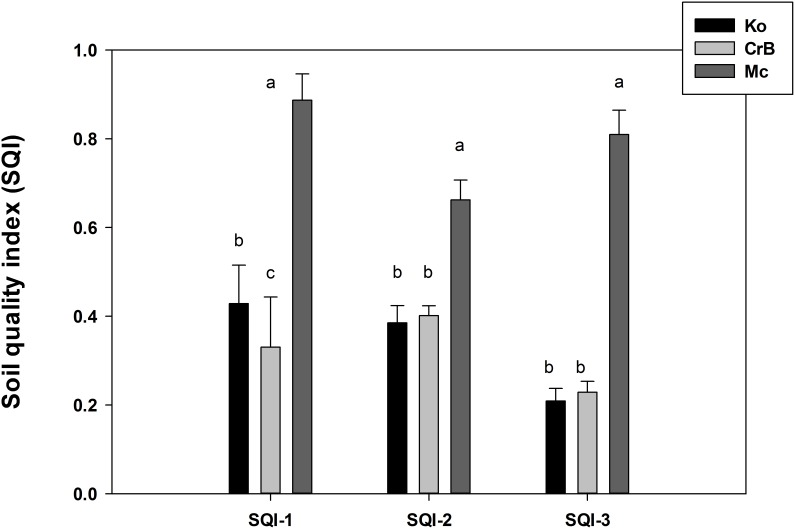
- SQI values varied by treatment and soil type and ranged from 0–0.9 (1 being maximum); the organic muck soil (Mc) had significantly higher soil quality than mineral soils, with SQI-1 ordered Mc > Ko > CrB.
- SQIs did not significantly differ by depth under any method; SQI-3 was most strongly correlated with crop yield (r = 0.74–0.78), and all three SQIs were significantly correlated with each other (r = 0.92–0.97) and with crop yield (r = 0.65–0.79).
- When the dataset was split by crop, correlations were low: r < 0.20 for soybean grain and r < 0.60 for corn grain (data not shown), indicating that crop-specific and key soil parameters are important for estimating SQI.
- SQI-1 and SQI-2 had higher values than SQI-3 in some scenarios (SQI-1 for Ko and Mc; SQI-2 for CrB), but SQI-3 predicted crop yield relatively higher and was regarded as the best and easiest model due to its objective approach and lower number of indicator selection.
Methods
- Soil samples were collected in May 2013 from three on-farm sites in Ohio: organic Mc (Martisco Variant silt loam), mineral CrB (Crosby silt loam), and Ko (Kokomo silty clay loam), at 0–10, 10–20, 20–40, and 40–60 cm depths under no-tillage/conventional tillage or cover crop/no-cover crop treatments.
- Thirteen soil parameters were measured (pH, EC, BD, WSA, GMD, MWD, PR, SOC, N, C-stock, N-stock, AWC, water content); SQI-1 and SQI-2 used nine after omitting redundant MWD, C and N concentrations, and water content, while SQI-3 used PCA to select a minimum data set of four non-redundant parameters (SOC, AWC, WSA, pH).
- SQI-1 used threshold scores from literature/expert opinion; SQI-2 used linear scoring and weighted additive functions (RDC 0.4, WSC 0.2, NSC 0.4); SQI-3 used PCA-based statistical modeling. SQIs were validated against soybean and corn yield via Pearson correlation, with Tukey’s test in SAS and PCA in SPSS.
Limitations
- The paper states there is no standard methodology for correlating crop yield with depthwise or combined-layer SQI, and that low crop-specific correlations (r < 0.20 for soybean grain, r < 0.60 for corn grain) suggest key soil fertility and microbial parameters (e.g., ion exchange capacities, macro/micronutrients, microbial biomass/C/N, respiration) were not monitored.
- The paper states SQI-1 is subjective and relies on researcher viewpoint; SQI-2 requires many soil parameters under different functional systems and may be expensive/time-consuming; SQI-3 needs long-term evaluation within a particular soil/crop system.
- Evident from the text: the study used 72 samples from three on-farm sites in one year (May 2013) and validated against same-year crop yield, with values based on three field or laboratory measurements, so findings may be site- and year-specific.
Model-written summary. Check it against the paper before relying on it.
Integrity signals
Registry
Cites
Statistics
Figures



Verification
Claims the paper makes
1 Valid · 0 Not valid · 15 Not checked · 57 Own results and interpretations
The sources with a verdict support this claim; the rest weren’t checked yet, have no full text we could read, or their verdicts aren’t rated yet.
In the paper
“Most studies indexed soil quality employing only one method, with a few exceptions [8], [15], [16].”
§ Comparison of Soil Quality Index Using Three Methods > Introduction
What the sources say
- Not checked — no full text of the sourcecites [8] Andrews S, Karlen D, Mitchell J (2002) A comparison of soil quality indexing methods for vegetable production systems in Northern California. Agriculture, Ecosystems & Environment 90: 25– 45. source
- Supportedcites [15] Zobeck TM, Halvorson AD, Wienhold B, Acosta-Martinez V, Karlen DL (2008) Comparison of two soil quality indexes to evaluate cropping systems in northern Colorado. Journal of Soil and Water Conservation 63: 329– 338. source
The Abstract describes this study as testing and comparing two soil-quality indexes, SQI and SCI. It therefore supports the citation’s role as an exception to studies using only one method; it does not need to establish how common single-method studies are. (LLM, conf=0.91)
- Not checked — no full text of the sourcecites [16] Zornoza R, Mataix-Solera J, Guerrero C, Arcenegui V, Mataix-Beneyto J, et al (2008) Validating the effectiveness and sensitivity of two soil quality indices based on natural forest soils under Mediterranean conditions. Soil Biology and Biochemistry 40: 2079– 2087. source
plain- Asserted: passes — The authors put it forward as true.
- Checkable: passes — It can be checked against evidence.
- Load-bearing: passes — The paper’s conclusions depend on it.
- Based: passes — The paper gives a reason why it holds.
A result the paper states — it cites no source for it, so there is none to check. The quote shows it is in the paper.
In the paper
“Nevertheless, relatively higher correlation coefficient was observed in the 0–10 cm soil layer than the deeper soil profile (Table 7)”
§ Comparison of Soil Quality Index Using Three Methods > Results and Discussions
plainstates an association- Asserted: passes — The authors put it forward as true.
- Checkable: passes — It can be checked against evidence.
- Load-bearing: unclear — It is unclear whether the paper’s conclusions depend on it.
- Based: passes — The paper gives a reason why it holds.
A result the paper states — it cites no source for it, so there is none to check. The quote shows it is in the paper.
In the paper
“Depth had little influence in any SQIs in the present study”
§ Comparison of Soil Quality Index Using Three Methods > Results and Discussions
plain- Asserted: passes — The authors put it forward as true.
- Checkable: passes — It can be checked against evidence.
- Load-bearing: unclear — It is unclear whether the paper’s conclusions depend on it.
- Based: passes — The paper gives a reason why it holds.
A result the paper reports from its own data — it cites no other source for it, so there is none to check. The quote shows it is in the paper.
In the paper
“The SQI calculated by three different methods indicated that studied muck soil has significantly higher soil quality than that of mineral soils under on-farm conditions.”
§ Comparison of Soil Quality Index Using Three Methods > Conclusions
hedged- Asserted: passes — The authors put it forward as true.
- Checkable: passes — It can be checked against evidence.
- Load-bearing: passes — The paper’s conclusions depend on it.
- Based: passes — The paper gives a reason why it holds.
A result the paper reports from its own data — it cites no other source for it, so there is none to check. The quote shows it is in the paper.
In the paper
“while both Ko and Mc had significantly higher influence of RDC in SQI-2 in the upper layers than the lower depths, the opposite trend was found for the NSC (Fig. S1).”
§ Comparison of Soil Quality Index Using Three Methods > Results and Discussions
plainstates an association- Asserted: passes — The authors put it forward as true.
- Checkable: passes — It can be checked against evidence.
- Load-bearing: unclear — It is unclear whether the paper’s conclusions depend on it.
- Based: passes — The paper gives a reason why it holds.
43 more claims
Create a free account to see all 73 claims and to verify the 1 reference still open.
- It may state two separate claims as one. 18
- Probably not a substantial claim. 7
Citations
Cites
Jolliffe, I. (2005) · Encyclopedia of Statistics in Behavioral Science · doi:10.1002/0470013192.bsa501 · Cited by 14,310
The application of electronic computers to factor analysis
Kaiser, H. F. (1960) · Educational and Psychological Measurement · doi:10.1177/001316446002000116 · Cited by 12,459 · cited 2×
“0 following Kaiser [36], the present study had the third and fourth components with eigenvalues of 0.”
InfluentialGoodall, C. (1988) · Technometrics · doi:10.1080/00401706.1988.10488412 · Cited by 8,675
Dunteman, G. (1989) · Sage eBooks · doi:10.4135/9781412985475 · Cited by 2,658
Defining Soil Quality for a Sustainable Environment
(1994) · SSSA Special Publications · doi:10.2136/sssaspecpub35 · Cited by 2,181
Defining and Assessing Soil Quality
Doran, J. W., & Parkin, T. B. (1994) · SSSA Special Publications · doi:10.2136/sssaspecpub35.c1 · Cited by 2,176 · cited 2×
“Soil quality is defined as the soil’s capacity to function within natural or managed ecosystem boundaries and to sustain plant productivity while reducing soil degradation [1–4].”
BackgroundSoil Quality: A Concept, Definition, and Framework for Evaluation (A Guest Editorial)
Karlen, D. L., Mausbach, M. J., Doran, J. W., Cline, R. G., Harris, R. F., & Schuman, G. E. (1997) · Soil Science Society of America Journal · doi:10.2136/sssaj1997.03615995006100010001x · Cited by 2,028 · cited 1×
“Thus, a mathematical or statistical framework was put forward in early 1990s to estimate soil quality index (SQI) [1,3,4].”
BackgroundA Direct Method of Aggregate Analysis of Soils and a Study of the Physical Nature of Erosion Losses1
Yoder, R. E. (1936) · Agronomy Journal · doi:10.2134/agronj1936.00021962002800050001x · Cited by 1,403 · cited 1×
“Bulk samples were obtained to measure the aggregate size distributions and fraction of water stable aggregates (WSA) using the wet sieving method [24].”
MethodThe Soil Management Assessment Framework: A Quantitative Soil Quality Evaluation Method
Andrews, S. S., Karlen, D. L., & Cambardella, C. A. (2004) · Soil Science Society of America Journal · doi:10.2136/sssaj2004.1945 · Cited by 1,341
Research works printed but not linked: 1
- Dane JH, Hopmans JH (2002) Water retention and storage. In: Dane JH, Topp GC, editors. Methods of soil analysis Part 4, SSSA Book Ser 5. Madison, WI.: SSSA. pp. 671–717.
Cited by
Items 101–200 of 379
Rodrigo‐Comino, J., Keshavarzi, A., & González, J. M. S. (2021) · River Research and Applications · doi:10.1002/rra.3865 · Cited by 25
Rodrigo‐Comino, J., Keshavarzi, A., Bagherzadeh, A., & Brevik, E. C. (2019) · Cuadernos de Investigación Geográfica · doi:10.18172/cig.3640 · Cited by 23
“The index in this study was based on an indicator sensitivity, where three different functions were assigned: 1) a “more is better” function; 2) a “less is better” function; and, 3) an “optimal range” function (Andrews et al., 2002; Mukherjee and Lal, 2014; Qi et al., 2009).”
MethodConstruction of a combined soil quality indicator to assess the effect of glyphosate application
Romano-Armada, N., Amoroso, M. J., & Rajal, V. B. (2019) · The Science of The Total Environment · doi:10.1016/j.scitotenv.2019.05.079 · Cited by 25
Alaboz, P., Dengız, O., & Demir, S. (2021) · Zemdirbyste-Agriculture · doi:10.13080/z-a.2021.108.028 · Cited by 22
Campolo, J., Güereña, D., Maharjan, S., & Lobell, D. B. (2020) · Field Crops Research · doi:10.1016/j.fcr.2020.107987 · Cited by 23
Soil carbon response to long‐term biosolids application
Villa, Y. B., & Ryals, R. A. (2021) · Journal of Environmental Quality · doi:10.1002/jeq2.20270 · Cited by 21
“Although there is not one direct measurement of soil quality, one must infer through many soil characteristics and parameters (Mukherjee and Lal, 2014).”
BackgroundMesfin, D., Assefa, E., & Simane, B. (2022) · Heliyon · doi:10.1016/j.heliyon.2022.e09850 · Cited by 20
“60), the variables with the largest factor loading (absolute value) are preserved as an indicator (Mukherjee and Lal, 2014; S anchez-Navarro et al., 2015; Tesfahunegn and Gebru, 2020).”
BackgroundBiswas, S., Singh, P., Rahaman, R., Patil, K. V., & De, N. (2023) · Frontiers in Soil Science · doi:10.3389/fsoil.2023.1155712 · Cited by 27
Development of a soil biological quality index for soils of semi-arid tropics
Aravindh, S., Chinnadurai, C., & Balachandar, D. (2020) · SOIL · doi:10.5194/soil-6-483-2020 · Cited by 21
The Potential of Biochar to Ameliorate the Major Constraints of Acidic and Salt-Affected Soils
Nguyen, B. T., Dinh, G. D., Tòng, N. X., Nguyen, D. T. P., Vu, T. N., Tran, H. T. T., Thai, N. V., Vu, H., & Do, D. D. (2022) · Journal of soil science and plant nutrition · doi:10.1007/s42729-021-00736-1 · Cited by 24
“The PCA/FA was applied to the entire dataset following the approach described by Mukherjee and Lal (2014).”
MethodNasir, M. J., Haider, M. F., Ali, Z., Akhtar, W., & Alam, S. (2023) · Journal of the Saudi Society of Agricultural Sciences · doi:10.1016/j.jssas.2023.09.001 · Cited by 24
“The three alternative SQI techniques utilized to generate the soil quality index are simple additive SQI (AbdelRehman et al., 2019), weighted additive SQI (Yu et al., 2018; Leul et al., 2023), and statistically modeled SQI (Mukherjee & Lal, 2014).”
Sustainable soil management: Insights from a 47-year maize-wheat cropping system study
Sankhyan, N. K., Sharma, N., Sharma, R. P., Anjali, Sharma, G. D., & Thakur, A. (2023) · Applied Soil Ecology · doi:10.1016/j.apsoil.2023.105230 · Cited by 21
Li, A., Li, A., Luo, C., & Liu, B. (2023) · Ecotoxicology and Environmental Safety · doi:10.1016/j.ecoenv.2023.115789 · Cited by 26
Ghorai, P. S., Biswas, S., Purakayastha, T. J., Ahmed, N., Das, T. K., Prasanna, R., Gawade, B. H., Bhattacharyya, K., Sinha, K., Singh, P., et al. (2022) · Soil Use and Management · doi:10.1111/sum.12847 · Cited by 23
“Despite this, the PCA approach is widely regarded as one of the best methods for the computation of soil quality index (Mukherjee & Lal, 2014; Nabiollahi et al., 2018).”
MethodDurán, G. A., Sacristán, D., Farrús, E., & Vadell, J. (2023) · International Soil and Water Conservation Research · doi:10.1016/j.iswcr.2023.06.001 · Cited by 22
Yeneneh, N., Elias, E., & Feyisa, G. L. (2024) · ENVIRONMENTAL SYSTEMS RESEARCH · doi:10.1186/s40068-024-00336-9 · Cited by 17
On‐Farm Assessments of Soil Quality in Ohio and Michigan
Nakajima, T., Shrestha, R. K., & Lal, R. (2016) · Soil Science Society of America Journal · doi:10.2136/sssaj2016.01.0003 · Cited by 22
Self-citationSoil Quality Assessment and Its Spatial Variability in an Intensively Cultivated Area in India
Rajath, E., Ananthakumar, M. A., Dharumarajan, S., Puttavenkategowda, T., Thimmegowda, M. N., Sannegowda, P. S., Mishra, A. P., Đurin, B., & Dogančić, D. (2024) · Land · doi:10.3390/land13070970 · Cited by 22
Bhatt, M. K., Singh, D. K., Raverkar, K. P., Chandra, R., Pareek, N., Dey, P., Pramanick, B., Joshi, H. C., Kumar, M., Gaber, A., et al. (2023) · Frontiers in Sustainable Food Systems · doi:10.3389/fsufs.2023.1206878 · Cited by 17
Reis, A., & Dindaroğlu, T. (2024) · Geoderma Regional · doi:10.1016/j.geodrs.2024.e00829 · Cited by 18
Techniques for Quantative Evaluation of Mine Site Reclamation Success
Mukhopadhyay, S., & Maiti, S. K. (2018) · Elsevier eBooks · doi:10.1016/b978-0-12-812986-9.00023-3 · Cited by 24
Soil quality indicator-based land productivity modelling for agricultural sustainability
Yousif, I. A. H., Hamid, A. A. E. L. A. E., Aldabaa, A. A. A., et al. (2025) · PLoS ONE · doi:10.1371/journal.pone.0316840 · Cited by 15
Kumar, U., Mishra, V. N., Kumar, N., Srivastava, L. K., Tedia, K., Bajpai, R., Singh, M., & Mohanty, M. (2022) · Soil Research · doi:10.1071/sr21122 · Cited by 15
Comparison of soil quality indexing methods for salt-affected soils of Indian coastal region
Mahajan, G. R., Das, B., Morajkar, S., Desai, A., Murgaokar, D., Patel, K. P., & Kulkarni, R. M. (2021) · Environmental Earth Sciences · doi:10.1007/s12665-021-09922-x · Cited by 19
“The drawback of the additives SQIs is that the results are subjective and rely on the investigator's view (Mukherjee and Lal 2014) and do not take into account the weight or loading of the factor or an indicator.”
BackgroundBaghche-Maryam, M. Z., Sheklabadi, M., & Ayoubi, S. (2025) · Soil and Tillage Research · doi:10.1016/j.still.2025.106571 · Cited by 22
Rezapour, S., Alamdari, P., & Kalavrouziotis, I. K. (2023) · Agricultural Water Management · doi:10.1016/j.agwat.2023.108592 · Cited by 14
Levels and Distribution of Heavy Metals in Weija Reservoir, Accra, Ghana
Ansah, E., Nukpezah, D., & Hogarh, J. N. (2018) · West African Journal of Applied Ecology · Cited by 14
A Versatile, Stand-Alone, In-Field Sensor Node for Implementation in Precision Agriculture
Sophocleous, M., Karkotis, A., & Georgiou, J. (2021) · IEEE Journal on Emerging and Selected Topics in Circuits and Systems · doi:10.1109/jetcas.2021.3099112 · Cited by 14
Mesfin, D., Assefa, E., & Simane, B. (2023) · Canadian Journal of Soil Science · doi:10.1139/cjss-2022-0053 · Cited by 14
“The variables with the highest factor loading (absolute value) were retained as an MDS if the variables were well correlated (r > 0.60) (Mukherjee and Lal 2014; SánchezNavarro et al. 2015; Filep et al. 2016; Tesfahunegn and Gebru 2020).”
MethodInfluentialLe, T. V., Nguyen, D. T. P., & Nguyen, B. T. (2023) · Environmental Monitoring and Assessment · doi:10.1007/s10661-023-11026-x · Cited by 19
“The whole dataset was subjected to PCA/FA and the results showed that the whole dataset of surface water quality for the period 2016–2020 in Tra Vinh province could Environ Monit Assess (2023) 195:408 1 3 408 Page 6 of 14 Vol:.”
MethodInfluentialTongsiri, P., Tseng, W.-Y., Shen, Y., & Lai, H. (2020) · Sustainability · doi:10.3390/su12114384 · Cited by 17
Evaluation of soil quality and land suitability in different management systems
Moghim, F. M., Karimi, A., Bodaghabadi, M. B., Emami, H., & Vasu, D. (2024) · Archives of Agronomy and Soil Science · doi:10.1080/03650340.2023.2298851 · Cited by 16
“Mukherjee and Lal (2014) used three methods for determining the SQI in Ohio.”
Bangre, J., Sinha, N. K., Mohanty, M., Jayaraman, S., Sahoo, R. N., Dwivedi, A. K., Singh, D., Mishra, A., Kumar, S., Wanjari, R. H., et al. (2024) · Land Degradation and Development · doi:10.1002/ldr.5220 · Cited by 18
“Similar observations were also made by Mohanty et al. (2007) in the rice-wheat system of Vertisols in central India, Mukherjee and Lal (2014) in maize and soybean, and Luo et al. (2017) in field pea and wheat.”
InfluentialFertility and quality of arable soils in Poland: spatial–temporal analysis of long-term monitoring
Tomczyk, P., Wdowczyk, A., Wiatkowska, B., Szymańska–Pulikowska, A., & Kuriqi, A. (2024) · Ecological Indicators · doi:10.1016/j.ecolind.2024.112375 · Cited by 17
Sarkar, S., Dhar, A., Dey, S., Chatterjee, S. K., Mukherjee, S., Chakraborty, A., Chatterjee, G., Ravisankar, N., & Mainuddin, M. (2024) · Land · doi:10.3390/land13111933 · Cited by 18
Tang, L., Hayashi, K., Ohigashi, K., Shimura, M., & Kohyama, K. (2019) · Journal of Cleaner Production · doi:10.1016/j.jclepro.2019.117890 · Cited by 14
Mihoub, A., Koull, N., Helimi, S., Kherraze, M. E., Mokhtari, S., & Fernández, M. P. (2021) · Soil Use and Management · doi:10.1111/sum.12770 · Cited by 14
“Because of different parameter units, in data set 1, all indicators were converted into unitless scores (range: 0– 1) using standard scoring functions (SSFs) (Mukherjee & Lal, 2014) that reflect soil quality (Qi et al., 2009).”
BackgroundMethodSingh, S. K., Jagadamma, S., Yoder, D. C., Yin, X., & Walker, F. R. (2021) · Soil Science Society of America Journal · doi:10.1002/saj2.20357 · Cited by 13
Soil Health Assessment Methods and Relationship with Wheat Yield
Biswas, J. C., Kalra, N., Maniruzzaman, M., Naher, U. A., & Haque, M. M. (2019) · Open Journal of Soil Science · doi:10.4236/ojss.2019.99011 · Cited by 14
“[12] reported a good relationship of SQI with soil function when subsurface properties were included with surface dynamic ones; but Mukherjee and Lal [13] found no variation with sub-surface properties.”
BackgroundShi, Z., Bai, Z., Guo, D., & Chen, M. (2021) · Land · doi:10.3390/land10080785 · Cited by 16
“SQI is outlined [37] because of the ability of the soil to supply the nutrients required to take care of crop yields throughout the expansion stage of plants within the system.”
BackgroundEffects of Performance Incentives for Community Health Worker Cooperatives in Rwanda
Shapira, G., Kalisa, I., Condo, J. U., Humuza, J., Mugeni, C., Nkunda, D., & Walldorf, J. (2017) · World Bank, Washington, DC eBooks · doi:10.1596/1813-9450-8059 · Cited by 13
Ecological Restoration of Abandoned Mine Land
Ahirwal, J., & Maiti, S. K. (2021) · Wiley eBooks · doi:10.1002/9781119678595.ch12 · Cited by 19
Soil properties sensitive to degradation caused by increasing intensity of conventional tillage
Estevam, R. F. H., Peixoto, D. S., Filho, J. F., Amorim, H. C. S., Moreira, F. M. D. S., & Silva, A. O. (2021) · Soil Research · doi:10.1071/sr20296 · Cited by 12
A weighted soil heath index approach for refined assessment of soil health in cropping systems
Singh, S. K., Jagadamma, S., Yoder, D. C., Yin, X., & Walker, F. R. (2023) · Frontiers in Soil Science · doi:10.3389/fsoil.2023.1118526 · Cited by 13
Soil fertility mapping of a cultivated area in Resunga Municipality, Gulmi, Nepal
Ghimire, P., Shrestha, S., Acharya, A., et al. (2024) · PLoS ONE · doi:10.1371/journal.pone.0292181 · Cited by 12
Impact of Conservation Agriculture on Soil Quality and Cotton–Maize System Yield in Semi-Arid India
Nthebere, K., TATA, R. P., Bhimireddy, P., Chandran, L. P., Gudapati, J., Admala, M., Sinha, N. K., Thumma, S. B., & Kavuru, P. (2025) · Sustainability · doi:10.3390/su17030978 · Cited by 15
Effects of Mulching on Soil Properties and Yam Production in Tropical Region
Kumar, S. S., Wani, O. A., Prasad, B., Banuve, A., Mua, P., Sharma, A. C., Prasad, S., Malik, A. R., El-Hendawy, S., & Mattar, M. A. (2024) · Sustainability · doi:10.3390/su16177787 · Cited by 22
Developing scoring functions to assess soil quality at a regional scale in rangelands of SW Spain
Fernández, M. P., Keshavarzi, A., Rodrigo‐Comino, J., Schnabel, S., Contador, J. F. L., Gómez‐Gutiérrez, Á., Lozano‐Parra, J., Barrena-González, J., Alfonso-Torreño, A., & Cerdà, A. (2020) · Revista Brasileira de Ciência do Solo · doi:10.36783/18069657rbcs20200090 · Cited by 11
“Therefore, a soil quality index should return a single value from a sum or multiplication (using weights or not) from different indicators scored (Mukherjee and Lal, 2014).”
BackgroundMethodPérez-Marin, A. M., Vendruscolo, J., Zárate-Salazar, J. R., Queiroz, H. A. D. A., Magalhães, D. L., Menezes, R. S. C., & Fernandes, I. M. (2022) · Sustainability · doi:10.3390/su14159735 · Cited by 23
Persico, F., Coulon, F., Ladyman, M. K., Fernández-López, C., & Temple, T. J. (2023) · The Science of The Total Environment · doi:10.1016/j.scitotenv.2023.161797 · Cited by 11
Carnier, R., de Abreu, C. A., de Andrade, C. A., Fernandes, A. O., da Silveira, A. P. D., & Coscione, A. R. (2023) · Environmental Geochemistry and Health · doi:10.1007/s10653-023-01602-y · Cited by 13
Arenas-Calle, L. N., Ramírez-Villegas, J., Whitfield, S., & Challinor, A. J. (2021) · Agricultural Systems · doi:10.1016/j.agsy.2021.103086 · Cited by 13
“Moreover, its correlation with soil quality indices (Mukherjee and Lal, 2014; Obade and Lal, 2016., Vasu et al., 2016) shows its suitability to indicate the extent to which soil health are related with productivity benefits.”
BackgroundDharumarajan, S., Kalaiselvi, B., Lalitha, M., Vasundhara, R., & Hegde, R. (2021) · Geocarto International · doi:10.1080/10106049.2021.1926553 · Cited by 14
“FMU are calculated based on the additive approach of soil fertility parameters (Mukherjee and Lal 2014).”
MethodSoil Quality Assessment in a Landslide Chronosequence of Indian Himalayan Region
Goyal, D., Joshi, V., Gupta, N., & Cabral-Pinto, M. M. S. (2022) · Land · doi:10.3390/land11101819 · Cited by 16
“For ‘less is better’ indicators, the lowest observed value was divided by each observed value [63,66].”
BackgroundGeremu, T., Abera, G., Lemma, B., & Rasche, F. (2025) · Environmental and Sustainability Indicators · doi:10.1016/j.indic.2025.100724 · Cited by 11
Biswas, S., Das, T. K., Bhattacharyya, R., Das, S., & Dwivedi, B. S. (2021) · Soil Research · doi:10.1071/sr21054 · Cited by 10
Parvizi, Y., & Fatehi, S. (2024) · Environmental Monitoring and Assessment · doi:10.1007/s10661-024-12349-z · Cited by 11
“…1 the productivity index (PI) method, 2 the soil quality index based on the weighting of the arithmetic redundancy of the measured soil variables (Biswas et al., 2017), and 3 the soil quality index based on weighting using principal components analysis (SQI-PCA normalized) (Mukhreji & Lal, 2014).”
InfluentialEffects of Land Use and Soil Management on Soil Quality in India’s Northeastern Himalayas
Hinge, G., Surampalli, R. Y., & Goyal, M. K. (2019) · Journal of Environmental Engineering · doi:10.1061/(asce)ee.1943-7870.0001507 · Cited by 11
Soil Quality Assessment Using Analytic Hierarchy Process (AHP)
Kumar, U., Kumar, N., Mishra, V. N., & Jena, R. K. (2019) · Advances in systems analysis, software engineering, and high performance computing book series · doi:10.4018/978-1-5225-7784-3.ch001 · Cited by 9
A fuzzy logic based soil chemical quality index for cacao
Mora-Herrera, D. Y., Guillaume, S., Snoeck, D., et al. (2020) · Computers and Electronics in Agriculture · doi:10.1016/j.compag.2020.105624 · Cited by 9
“Several attempts have been made to design soil quality indices, see (Mukherjee and Lal, 2014; Vogel et al., 2019) for recent surveys.”
BackgroundNguyen, B. T., Le, L. B., Le, A. H., & Thai, N. V. (2021) · Environmental Monitoring and Assessment · doi:10.1007/s10661-021-09015-z · Cited by 11
“The usefulness, rationale, and significance of this method were discussed by Mukherjee and Lal (2014).”
MethodSoil quality in volcanic soils in a forest biosphere reserve in Mexico
Chavarin-Pineda, Y., Reynoso, E. C., Torres, E., Cruz-Flores, G., Arvide, M. G. T., Linares-Fleites, G., & Valera-Pérez, M. Á. (2021) · Soil and Water Research · doi:10.17221/108/2020-swr · Cited by 9
Sadiq, F. K., Maniyunda, L. M., Adegoke, K. A., & Anumah, A. O. (2021) · Environmental Monitoring and Assessment · doi:10.1007/s10661-021-09157-0 · Cited by 14
Soil quality assessment in the Araban plain across various land use types
Çelik, Ö., & Sürücü, A. (2024) · Journal of King Saud University - Science · doi:10.1016/j.jksus.2024.103385 · Cited by 7
Kandel, D., Timilsina, S., Ayer, S., Chaudhary, S. K., Gautam, J., Adhikari, R., & Bhatta, K. P. (2024) · Scientifica · doi:10.1155/2024/1739115 · Cited by 13
Manglares y sus Servicios Ecosistémicos: hacia un Desarrollo Sostenible
Carvajal-Oses, M., Herrera-Ulloa, Á., Valdés-Rodríguez, B., & Campos–Rodríguez, R. (2020) · Gestión y Ambiente · doi:10.15446/ga.v22n2.80639 · Cited by 15
Assessing Soil Quality Index Under Different Sugarcane Monoculture Periods and Soil Orders
Kusumawati, A., Hanudin, E., Purwanto, B. H., & Nurudin, M. (2022) · Communications in Soil Science and Plant Analysis · doi:10.1080/00103624.2022.2112213 · Cited by 9
Poudel, A., Ayer, S., Joshi, R., Gautam, J., Timilsina, S., Khadka, K., Bhatta, K. P., & Maharjan, M. (2024) · Heliyon · doi:10.1016/j.heliyon.2024.e35441 · Cited by 10
“One of the most common quantitative approaches for soil quality assessment is to adopt soil quality indices (SQIs) [49 – 51].”
BackgroundGonzaga, M. I. S., Bispo, M. V. C., da Silva, T. L., dos Santos, W. M., & SANTANA, I. L. D. (2016) · Semina Ciências Agrárias · doi:10.5433/1679-0359.2016v37n6p3847 · Cited by 11
Multivariate and Spatial Analysis of Soil Quality in Kafr El-Sheikh Governorate, Egypt
Abuzaid, A. S., & Bassouny, M. A. (2018) · Journal of Soil Sciences and Agricultural Engineering /Journal of Soil Sciences and Agricultural Engineering · doi:10.21608/jssae.2018.35804 · Cited by 8
“Multivariate analysis such as principal component analysis (PCA) is a data reduction tool used for reducing indicator loads and avoiding data redundancy (Armenise et al., 2013).”
BackgroundMethodInfluentialExergy assessment of topsoil fertility
Valero, A., Palacino, B., Ascaso, S., & Valero, A. (2021) · Ecological Modelling · doi:10.1016/j.ecolmodel.2021.109802 · Cited by 9
Le, T. V., Do, D. D., & Nguyen, B. T. (2023) · Hydrological Sciences Journal · doi:10.1080/02626667.2023.2192352 · Cited by 11
“The usefulness, rationale, and significance of this method were discussed by Mukherjee and Lal (2014).”
MethodEffect of Green Manure on Water-Stable Soil Aggregates and Carbon Storage in Paddy Soil
Lee, C.-R., Kim, S. H., Oh, Y., et al. (2023) · 한국토양비료학회지 · doi:10.7745/kjssf.2023.56.2.191 · Cited by 8
Parhizkar, M. (2024) · International Journal of Sediment Research · doi:10.1016/j.ijsrc.2024.07.001 · Cited by 7
Nguyen, T. X. T., Nguyen, B. T., & Thai, B. V. (2024) · Soil Use and Management · doi:10.1111/sum.13104 · Cited by 7
“The estimated factor weights are shown in Table 2 and more details about the PCA/FA method can be found in Mukherjee and Lal (2014).”
Namr, K. I., Bel-Lahbib, S., Rerhou, B., Masmoudi, Y. A., Hajjaj, H., & Said, B. A. (2025) · Environmental Earth Sciences · doi:10.1007/s12665-025-12115-5 · Cited by 8
“EC is considered an important variable to include in the MDS to determine a global SQI (Smith and Doran 1997; Andrews et al. 2002, 2004; Mandal et al. 2008; Yao et al. 2013; Mukherjee and Lal 2014; Ibno Namr and Bel-Lahbib 2023).”
Ayer, S., Poudel, S., Adhikari, K., Shapkota, J., Bhatta, K. P., Gautam, J., Maraseni, T., & Maharjan, M. (2025) · Advances in Bamboo Science · doi:10.1016/j.bamboo.2025.100149 · Cited by 8
Ma, M., Zhang, Y., Ma, Q., Wang, Z., Du, Z., Chen, Y., Gao, Q., Fei, W., Gao, B., & Sun, K. (2026) · Biochar · doi:10.1007/s42773-025-00553-0 · Cited by 11
“Multivariate techniques such as PCA combine data into a robust index by assigning weights to indicators (Mukherjee and Lal 2014).”
Debnath, S., Purakayastha, T. J., Kishor, A., Kumar, A., V, & Bhowmik, A. (2022) · Land Degradation and Development · doi:10.1002/ldr.4402 · Cited by 10
“Nonetheless, SQI computed by the two discrete models were poorly correlated with each other (Figure 6c), which does not corroborate with previous reports (Mukherjee & Lal, 2014; Purakayastha et al., 2019).”
BackgroundResultSoil Health Management in Organic Production System – A Review
Shahane, A. A., & Shivay, Y. S. (2022) · International Journal of Bio-resource and Stress Management · doi:10.23910/1.2022.3141a · Cited by 9
Assessment of Soil Quality Index in the Southern Coastal Sandy Soils of Kerala, India
Athulya, B. M., Priya, G., Rani, B., Aparna, B., & Nishan, M. A. (2023) · International Journal of Environment and Climate Change · doi:10.9734/ijecc/2023/v13i81980 · Cited by 7
Chatterjee, S. (2023) · Environmental Development · doi:10.1016/j.envdev.2024.100992 · Cited by 8
Maji, P., & Mistri, B. (2024) · Environmental Monitoring and Assessment · doi:10.1007/s10661-024-12697-w · Cited by 9
Duddigan, S., Martínez, M. G., Fraser, T. D., Green, I. D., Díaz, A., Sizmur, T., Pawlett, M., Raulund‐Rasmussen, K., & Tibbett, M. (2020) · Agronomy · doi:10.3390/agronomy10081140 · Cited by 7
“, lots of variables may be correlated or confound with one another, rendering the use of all of them unnecessary), but also reduces the opportunity for bias, compared to methods of soil quality assessment that use expert opinion [21].”
BackgroundAsei, R., Abaidoo, R. C., Opoku, A., & Adjei-Nsiah, S. (2022) · Frontiers in Sustainable Food Systems · doi:10.3389/fsufs.2022.796878 · Cited by 8
Soil Quality Indicators with Potential Use at Plot or Experimental Unit Scale
Camacho, Ó. I. M., Díaz, J. S. G., Aldana, C. R. B., Toro, M. C. H., & Malagón, E. M. E. (2021) · Eurasian Soil Science · doi:10.1134/s1064229321140027 · Cited by 7
“ExPtSp and ExPtRo experiments obtained a low Sc for EC within NSC, WC, and AWC for WSC and AGG, GMD, and WMD for the functional property root development capacity (RDC), which generated a low Scw in the evaluated treatments (Table S4).”
BackgroundMethodInfluentialSimulating Maize Response to Split-Nitrogen Fertilization Using Easy-to-Collect Local Features
Parent, L., & Deslauriers, G. (2023) · Nitrogen · doi:10.3390/nitrogen4040024 · Cited by 7
Indexing Methods of Soil Quality in Agro-Ecosystems: An Overview of Indian Soils and Beyond
Bhaduri, D., Purakayastha, T. J., Pramanik, P., Saha, A., Verma, B. C., Shahid, M., & Saha, D. (2020) · Springer eBooks · doi:10.1007/978-981-15-2039-6_14 · Cited by 9
Financial Globalization: A Glass Half Empty?
Schmukler, S. L., & Abraham, F. (2017) · World Bank, Washington, DC eBooks · doi:10.1596/1813-9450-8194 · Cited by 7
The Assesment of Physical Variables of the Soil Quality Index in the Coal Mine Spoil Depends
Grzywna, A., & Ciosmak, M. (2021) · Journal of Ecological Engineering · doi:10.12911/22998993/132431 · Cited by 8
“Scoring function chart for soil physical quality index (Pieri 1992, Lal 1994, Reynolds 2009, Paluszek 2011, Mukherjee and Lal 2014, Nakajima et al. 2015) – modified Parameter unit 4 3 2 1 0 Texture -”
BackgroundDoes Eucalyptus determine agricultural soil quality?
Kangela, A. M., Luganda, E. K., & Mukotanyi, S. M. (2022) · Cogent Food & Agriculture · doi:10.1080/23311932.2022.2157115 · Cited by 6
“To describe the state of soil fertility under the three-land use, the statistical approach of principal component analysis (PCA) was used to determine the SQI since it uses certain mathematical tools (multiple correlations, factor, and cluster analysis) that avoid subjectivity encountered in other methods (Mukherjee e…”
MethodWilliams, R., Ogoke, A., Rodgers, K. J., Kelly, S., Mcintosh, R., Hursthouse, A. S., & Henriquez, F. L. (2023) · Soil & Environmental Health · doi:10.1016/j.seh.2023.100046 · Cited by 6
“These interpretations were based on established criteria previously published (O'Neill et al., 2005; Mukherjee and Lal, 2014).”
BackgroundMethodInfluentialSasanifar, S., Alijanpour, A., Shafiei, A. B., Rad, J. E., & Molaei, M. (2024) · The Science of The Total Environment · doi:10.1016/j.scitotenv.2024.172475 · Cited by 6
Soil quality variation associated with land cover in the Peruvian jungle of the Junín region
Carbajal, C., Moya-Ambrosio, F., Barja, A., Ottos-Diaz, E., Aguilar-Tito, C., Zeballos, O. A., Cruz, J., & Acosta, R. A. S. (2025) · Soil Security · doi:10.1016/j.soisec.2025.100188 · Cited by 6
The effects of two different biochars on the characteristics of saline acid sulfate soil
Nguyen, T. X. T., & Nguyen, B. T. (2023) · Land Degradation and Development · doi:10.1002/ldr.4717 · Cited by 10
“The PCA/FA was applied to the entire dataset following the approach described by Mukherjee and Lal (2014).”
MethodYoshimura, M., 前塚, 研., & Toma, Y. (2023) · Soil Science & Plant Nutrition · doi:10.1080/00380768.2023.2237992 · Cited by 5
“A minimum data set (MDS) was selected from a total data set (TDS) using methods such as principal component analysis (PCA) (Armenise et al. 2013; Mukherjee, Lal, and Sainju 2014) and factor analysis (Shukla, Lal, and Ebinger 2006) and the high consistency of the two datasets (MDS and TDS) was…”
MethodInfluentialGill, A., Sharma, V. K., Chandel, R. S., Dev, P., Gill, V., & Thakur, P. (2023) · Communications in Soil Science and Plant Analysis · doi:10.1080/00103624.2023.2268641 · Cited by 6
“Soil indicators for tea were selected based on a comprehensive review of literature (Alam et al. 2022; Baruah et al. 2017; Dolui et al. 2013; Ji et al. 2020) on soil quality in tea plantations and validated through expert opinion (Andrews, Karlen, and Mitchell 2002; Mukherjee, Lal, and Sainju 2014).”
MethodGeospatial Modelling for Soil Quality Assessment
Kumar, S., & Kalambukattu, J. G. (2020) · Springer eBooks · doi:10.1007/978-981-15-6864-0_11 · Cited by 7
The impact of traditional land use management on soil quality in Northeastern Himalayas (India)
Mishra, G., & Rodrigo‐Comino, J. (2021) · Geographia Polonica · doi:10.7163/gpol.0195 · Cited by 6
“The SQI was calculated using an additive index approach at both the depths (Abdel Rahman et al., 2019; Mukherjee & Lal, 2014).”
MethodOjo, A. O., Aliku, O., Aladele, S. E., Oshunsanya, S. O., Olubiyi, M. R., Olosunde, A. A., Ojo, V. I. A. –., & Alowonle, A. A. (2022) · Environmental Challenges · doi:10.1016/j.envc.2022.100510 · Cited by 8
Metadata
- Authors
- Mukherjee, A., & Lal, R.
- Affiliations
- The Ohio State University (US)
- Corresponding author
- Mukherjee, Atanu
- Venue
- PLoS ONE
- Publisher
- Public Library of Science (PLoS)
- Published
- 2014-08-22
- Volume
- 9
- Issue
- 8
- Pages
- e105981
- ISSN
- 1932-6203 (ISSN-L)
- PMC
- PMC4141864
- OpenAlex
- W2011488730
- Cited by
- 379
- References
- 45
- Citations by year
- 2026: 54 · 2025: 42 · 2024: 55 · 2023: 42 · 2022: 40 · 2021: 49 · 2020: 26 · 2019: 18 · 2018: 21 · 2017: 12 · 2016: 14 · 2015: 4 · 2014: 2
- FWCI
- 15.04
- Type
- journal article
- Language
- en
- Open access
- gold
- doi.org
- Locations
- PLoS ONE (publishedVersion, cc-by)
- PubMed Central (publishedVersion, cc-by)
- PubMed (publishedVersion)
- RePEc: Research Papers in Economics (submittedVersion)
- DOAJ (DOAJ: Directory of Open Access Journals) (submittedVersion, cc-by-sa)
- Funders
- U.S. Department of Agriculture (2011-68002-30190)
- National Institute of Food and Agriculture (20116800230190)
- Topics
- Life Sciences › Agricultural and Biological Sciences › Soil Science › Soil Management and Crop Yield
- Life Sciences › Agricultural and Biological Sciences › Soil Science › Soil Science and Environmental Management
- Life Sciences › Agricultural and Biological Sciences › Agronomy and Crop Science › Sustainable Agricultural Systems Analysis
- Keywords
- soil quality index, soil quality assessment, crop yield, principal component analysis, soil depth, organic soils, mineral soils, soil management, Ohio soils
- MeSH terms
- Zea mays, Models, Theoretical, Ohio, Soil, Glycine max, Models, Statistical, Crops, Agricultural, Principal Component Analysis
About these checks
Registry, retraction, Cites and statistics results are computed, not judged, with one exception: a printed reference that no index lists is read once by a model before it counts as a citation error. Claims are extracted by a model and kept only when their quote appears verbatim in the text; each cited source is then checked, with a model’s help, for whether it says what the claim relies on. Those verdicts can be wrong — read the claim’s quote and the cited source before relying on one.
A language model drew the claims from the paper on 2026-10-10, under version 3 of the claim definition (model deepseek-v4.1-flash, prompt extract-v3).
A second model labelled each claim on 2026-10-10 (model jev-1.13-20260917, definition revision gold-guideline-v0.2).
Cited sources are checked with a language model’s help (gpt-6-sol).
Statistics and arithmetic are recomputed, not judged.
Confidence bands are shown only for fields calibrated on our annotated test set. None is calibrated yet, so no band is shown.
What counts as a claim ›How we measure confidence ›How we check this ›
Are you an author, or do you see a problem with this page? Request a review
Data sources
Bibliographic data: Semantic Scholar, OpenAlex, Crossref.
Contains information from the Semantic Scholar Academic Graph Datasets, made available under the ODC Attribution License (ODC-BY 1.0).
Semantic Scholar’s data is described in: Kinney, R., et al. (2023). The Semantic Scholar Open Data Platform. arXiv:2301.10140.
