

Comparison of Soil Quality Index Using Three Methods
Open accessThe DOI matches its Crossref record; 44 of the 45 references it cites were found in a registry or an index; 1 of the 29 sources its claims cite were checked for support.
Abstract
Assessment of management-induced changes in soil quality is important to sustaining high crop yield. Three methods used to estimate SQI were: (i) simple additive SQI, (ii) weighted additive SQI, and (iii) statistically modeled SQI based on principal component analysis (PCA).
Overview
CoChat Summary
TL;DR
The paper compares three soil quality index (SQI) methods—simple additive, weighted additive, and PCA-based—using 72 soil samples from three Ohio on-farm sites. All three SQIs were significantly correlated with each other and with crop yield, but the PCA-based SQI-3 showed the strongest yield correlation and was judged best for long-term use.
Key findings
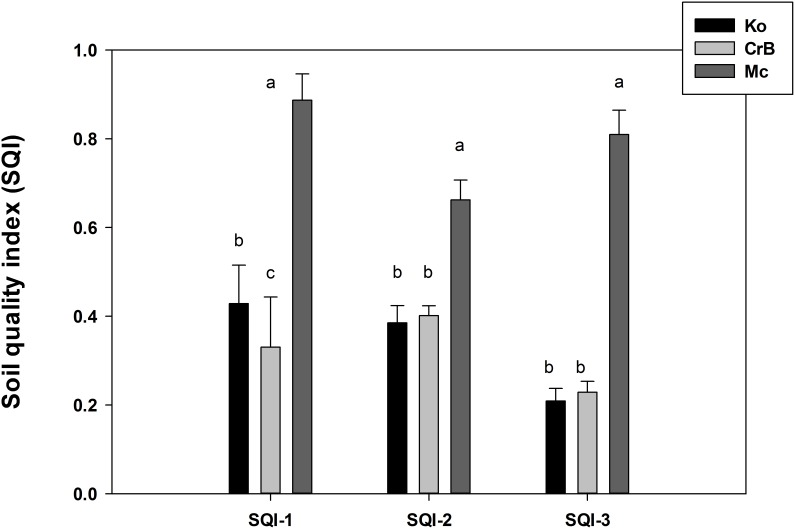
- SQI values varied by treatment and soil type and ranged from 0–0.9 (1 being maximum); the organic muck soil (Mc) had significantly higher soil quality than mineral soils, with SQI-1 ordered Mc > Ko > CrB.
- SQIs did not significantly differ by depth under any method; SQI-3 was most strongly correlated with crop yield (r = 0.74–0.78), and all three SQIs were significantly correlated with each other (r = 0.92–0.97) and with crop yield (r = 0.65–0.79).
- When the dataset was split by crop, correlations were low: r < 0.20 for soybean grain and r < 0.60 for corn grain (data not shown), indicating that crop-specific and key soil parameters are important for estimating SQI.
- SQI-1 and SQI-2 had higher values than SQI-3 in some scenarios (SQI-1 for Ko and Mc; SQI-2 for CrB), but SQI-3 predicted crop yield relatively higher and was regarded as the best and easiest model due to its objective approach and lower number of indicator selection.
Methods
- Soil samples were collected in May 2013 from three on-farm sites in Ohio: organic Mc (Martisco Variant silt loam), mineral CrB (Crosby silt loam), and Ko (Kokomo silty clay loam), at 0–10, 10–20, 20–40, and 40–60 cm depths under no-tillage/conventional tillage or cover crop/no-cover crop treatments.
- Thirteen soil parameters were measured (pH, EC, BD, WSA, GMD, MWD, PR, SOC, N, C-stock, N-stock, AWC, water content); SQI-1 and SQI-2 used nine after omitting redundant MWD, C and N concentrations, and water content, while SQI-3 used PCA to select a minimum data set of four non-redundant parameters (SOC, AWC, WSA, pH).
- SQI-1 used threshold scores from literature/expert opinion; SQI-2 used linear scoring and weighted additive functions (RDC 0.4, WSC 0.2, NSC 0.4); SQI-3 used PCA-based statistical modeling. SQIs were validated against soybean and corn yield via Pearson correlation, with Tukey’s test in SAS and PCA in SPSS.
Limitations
- The paper states there is no standard methodology for correlating crop yield with depthwise or combined-layer SQI, and that low crop-specific correlations (r < 0.20 for soybean grain, r < 0.60 for corn grain) suggest key soil fertility and microbial parameters (e.g., ion exchange capacities, macro/micronutrients, microbial biomass/C/N, respiration) were not monitored.
- The paper states SQI-1 is subjective and relies on researcher viewpoint; SQI-2 requires many soil parameters under different functional systems and may be expensive/time-consuming; SQI-3 needs long-term evaluation within a particular soil/crop system.
- Evident from the text: the study used 72 samples from three on-farm sites in one year (May 2013) and validated against same-year crop yield, with values based on three field or laboratory measurements, so findings may be site- and year-specific.
Model-written summary. Check it against the paper before relying on it.
Integrity signals
Registry
Cites
Statistics
Figures



Verification
Claims the paper makes
1 Valid · 0 Not valid · 15 Not checked · 57 Own results and interpretations
The sources with a verdict support this claim; the rest weren’t checked yet, have no full text we could read, or their verdicts aren’t rated yet.
In the paper
“Most studies indexed soil quality employing only one method, with a few exceptions [8], [15], [16].”
§ Comparison of Soil Quality Index Using Three Methods > Introduction
What the sources say
- Not checked — no full text of the sourcecites [8] Andrews S, Karlen D, Mitchell J (2002) A comparison of soil quality indexing methods for vegetable production systems in Northern California. Agriculture, Ecosystems & Environment 90: 25– 45. source
- Supportedcites [15] Zobeck TM, Halvorson AD, Wienhold B, Acosta-Martinez V, Karlen DL (2008) Comparison of two soil quality indexes to evaluate cropping systems in northern Colorado. Journal of Soil and Water Conservation 63: 329– 338. source
The Abstract describes this study as testing and comparing two soil-quality indexes, SQI and SCI. It therefore supports the citation’s role as an exception to studies using only one method; it does not need to establish how common single-method studies are. (LLM, conf=0.91)
- Not checked — no full text of the sourcecites [16] Zornoza R, Mataix-Solera J, Guerrero C, Arcenegui V, Mataix-Beneyto J, et al (2008) Validating the effectiveness and sensitivity of two soil quality indices based on natural forest soils under Mediterranean conditions. Soil Biology and Biochemistry 40: 2079– 2087. source
plain- Asserted: passes — The authors put it forward as true.
- Checkable: passes — It can be checked against evidence.
- Load-bearing: passes — The paper’s conclusions depend on it.
- Based: passes — The paper gives a reason why it holds.
A result the paper states — it cites no source for it, so there is none to check. The quote shows it is in the paper.
In the paper
“Nevertheless, relatively higher correlation coefficient was observed in the 0–10 cm soil layer than the deeper soil profile (Table 7)”
§ Comparison of Soil Quality Index Using Three Methods > Results and Discussions
plainstates an association- Asserted: passes — The authors put it forward as true.
- Checkable: passes — It can be checked against evidence.
- Load-bearing: unclear — It is unclear whether the paper’s conclusions depend on it.
- Based: passes — The paper gives a reason why it holds.
A result the paper states — it cites no source for it, so there is none to check. The quote shows it is in the paper.
In the paper
“Depth had little influence in any SQIs in the present study”
§ Comparison of Soil Quality Index Using Three Methods > Results and Discussions
plain- Asserted: passes — The authors put it forward as true.
- Checkable: passes — It can be checked against evidence.
- Load-bearing: unclear — It is unclear whether the paper’s conclusions depend on it.
- Based: passes — The paper gives a reason why it holds.
A result the paper reports from its own data — it cites no other source for it, so there is none to check. The quote shows it is in the paper.
In the paper
“The SQI calculated by three different methods indicated that studied muck soil has significantly higher soil quality than that of mineral soils under on-farm conditions.”
§ Comparison of Soil Quality Index Using Three Methods > Conclusions
hedged- Asserted: passes — The authors put it forward as true.
- Checkable: passes — It can be checked against evidence.
- Load-bearing: passes — The paper’s conclusions depend on it.
- Based: passes — The paper gives a reason why it holds.
A result the paper reports from its own data — it cites no other source for it, so there is none to check. The quote shows it is in the paper.
In the paper
“while both Ko and Mc had significantly higher influence of RDC in SQI-2 in the upper layers than the lower depths, the opposite trend was found for the NSC (Fig. S1).”
§ Comparison of Soil Quality Index Using Three Methods > Results and Discussions
plainstates an association- Asserted: passes — The authors put it forward as true.
- Checkable: passes — It can be checked against evidence.
- Load-bearing: unclear — It is unclear whether the paper’s conclusions depend on it.
- Based: passes — The paper gives a reason why it holds.
43 more claims
Create a free account to see all 73 claims and to verify the 1 reference still open.
- It may state two separate claims as one. 18
- Probably not a substantial claim. 7
Citations
Cites
Jolliffe, I. (2005) · Encyclopedia of Statistics in Behavioral Science · doi:10.1002/0470013192.bsa501 · Cited by 14,310
The application of electronic computers to factor analysis
Kaiser, H. F. (1960) · Educational and Psychological Measurement · doi:10.1177/001316446002000116 · Cited by 12,459 · cited 2×
“0 following Kaiser [36], the present study had the third and fourth components with eigenvalues of 0.”
InfluentialGoodall, C. (1988) · Technometrics · doi:10.1080/00401706.1988.10488412 · Cited by 8,675
Dunteman, G. (1989) · Sage eBooks · doi:10.4135/9781412985475 · Cited by 2,658
Defining Soil Quality for a Sustainable Environment
(1994) · SSSA Special Publications · doi:10.2136/sssaspecpub35 · Cited by 2,181
Defining and Assessing Soil Quality
Doran, J. W., & Parkin, T. B. (1994) · SSSA Special Publications · doi:10.2136/sssaspecpub35.c1 · Cited by 2,176 · cited 2×
“Soil quality is defined as the soil’s capacity to function within natural or managed ecosystem boundaries and to sustain plant productivity while reducing soil degradation [1–4].”
BackgroundSoil Quality: A Concept, Definition, and Framework for Evaluation (A Guest Editorial)
Karlen, D. L., Mausbach, M. J., Doran, J. W., Cline, R. G., Harris, R. F., & Schuman, G. E. (1997) · Soil Science Society of America Journal · doi:10.2136/sssaj1997.03615995006100010001x · Cited by 2,028 · cited 1×
“Thus, a mathematical or statistical framework was put forward in early 1990s to estimate soil quality index (SQI) [1,3,4].”
BackgroundA Direct Method of Aggregate Analysis of Soils and a Study of the Physical Nature of Erosion Losses1
Yoder, R. E. (1936) · Agronomy Journal · doi:10.2134/agronj1936.00021962002800050001x · Cited by 1,403 · cited 1×
“Bulk samples were obtained to measure the aggregate size distributions and fraction of water stable aggregates (WSA) using the wet sieving method [24].”
MethodThe Soil Management Assessment Framework: A Quantitative Soil Quality Evaluation Method
Andrews, S. S., Karlen, D. L., & Cambardella, C. A. (2004) · Soil Science Society of America Journal · doi:10.2136/sssaj2004.1945 · Cited by 1,341
Research works printed but not linked: 1
- Dane JH, Hopmans JH (2002) Water retention and storage. In: Dane JH, Topp GC, editors. Methods of soil analysis Part 4, SSSA Book Ser 5. Madison, WI.: SSSA. pp. 671–717.
Cited by
Soil health assessment: A critical review of current methodologies and a proposed new approach
Rinot, O., Levy, G. J., Steinberger, Y., Svoray, T., & Eshel, G. (2019) · Science of The Total Environment · doi:10.1016/j.scitotenv.2018.08.259 · Cited by 435
Soil quality index (SQI) as a tool to evaluate crop productivity in semi-arid Deccan plateau, India
Vasu, D., Singh, S. K., Ray, S. K., Duraisami, V. P., Tiwary, P., Chandran, P., Nimkar, A. M., & Anantwar, S. G. (2016) · Geoderma · doi:10.1016/j.geoderma.2016.07.010 · Cited by 351
“Subsequently, soil quality gained importance as a tool to assess various agricultural and horticultural production systems around the world (Bouma and Droogers, 1998; Andrews et al., 2002; Armenise et al., 2013; Mukherjee and Lal, 2014).”
BackgroundRaiesi, F. (2017) · Ecological Indicators · doi:10.1016/j.ecolind.2016.12.049 · Cited by 340
“Besides, for a consistent and accurate assessment of SQ a systematic method is required for interpreting and measuring soil properties (Granatstein and Bezdicek, 1992), and individual soil attributes may not be adequate indicators of SQ (Masto et al., 2007; Mukherjee and Lal, 2014).”
MethodConservation agriculture as a sustainable system for soil health: a review
Cárceles Rodríguez, B., Durán-Zuazo, V. H., Soriano Rodríguez, M., García-Tejero, I. F., Gálvez Ruiz, B., & Cuadros Tavira, S. (2022) · Soil Systems · doi:10.3390/soilsystems6040087 · Cited by 337
“Soil health is a complex functional concept and cannot be measured directly in the field or laboratory; it can only be inferred indirectly by measuring soil indicators [65].”
BackgroundNabiollahi, K., Golmohamadi, F., Taghizadeh-Mehrjardi, R., Kerry, R., & Davari, M. (2018) · Geoderma · doi:10.1016/j.geoderma.2017.12.024 · Cited by 320
Beyond COP 21: Potential and challenges of the “4 per Thousand” initiative
Lal, R. (2016) · Journal of Soil and Water Conservation · doi:10.2489/jswc.71.1.20a · Cited by 284
“The SOC pool can also be related to soil quality (Mukherjee and Lal 2015) or functionality, agronomic productivity (Lal 2006), and use efficiency of inputs (Lal 2010a).”
BackgroundSelf-citationSoil quality index for evaluation of reclaimed coal mine spoil
Mukhopadhyay, S., Masto, R. E., Yadav, A., George, J., Ram, L. C., & Shukla, S. P. (2016) · Science of The Total Environment · doi:10.1016/j.scitotenv.2015.10.035 · Cited by 231
Soil Quality Indexing Strategies for Evaluating Sugarcane Expansion in Brazil
Cherubin, M. R., Karlen, D. L., Cerri, C. E. P., Franco, A. L. C., Tormena, C. A., Davies, C. A., & Cerri, C. C. (2016) · PLOS ONE · doi:10.1371/journal.pone.0150860 · Cited by 225
“[12] and Mukherjee and Lal [9], PCA provides a less subjective method of indicator selection, which can help avoid bias and data redundancy.”
BackgroundMethodResultInfluentialChoudhary, M., Datta, A., Jat, H. S., Yadav, A. K., Gathala, M. K., Sapkota, T. B., Das, A. K., Sharma, P. C., Jat, M. L., Singh, R., et al. (2018) · Geoderma · doi:10.1016/j.geoderma.2017.10.041 · Cited by 198
Lobell, D. B., Azzari, G., Burke, M., Gourlay, S., Jin, Z., Kilic, T., & Murray, S. (2020) · American Journal of Agricultural Economics · doi:10.1093/ajae/aaz051 · Cited by 192
“D ow nloaded from https://academ ic.oup.com /ajae/advance-article-abstract/doi/10.1093/ajae/aaz051/5607565 by Stanford U niversity user on 08 N ovem ber 2019 quality identified by Mukherjee and Lal (2014) related to root development and water storage.4 Ground-based maize yield measurement.”
InfluentialAssessment of soil quality indices for salt-affected agricultural land in Kurdistan Province, Iran
Nabiollahi, K., Taghizadeh-Mehrjardi, R., Kerry, R., & Moradian, S. (2017) · Ecological Indicators · doi:10.1016/j.ecolind.2017.08.001 · Cited by 187
Soil quality indicators to assess functionality of restored soils in degraded semiarid ecosystems
Muñoz‐Rojas, M., Erickson, T. E., Dixon, K. W., & Merritt, D. J. (2016) · Restoration Ecology · doi:10.1111/rec.12368 · Cited by 186
“Soil physicochemical characteristics have been extensively used as soil quality indicators, particularly in agriculture (Mukherjee & Lal 2014) but also in the assessment and monitoring of restoration of degraded ecosystems (Schoenholtz et al. 2000; Mukhopadhyay et al. 2014).”
BackgroundAbdel-Fattah, M. K., Mohamed, E. S., Abdel-Hamed, E. M. W., Shahin, S. A., Aldosari, A. A., Lasaponara, R., & Alnaimy, M. A. (2021) · Sustainability · doi:10.3390/su13041824 · Cited by 139
“Quantitative assessments of soil quality depend on data obtained from laboratory analyses of physical and chemical properties, while qualitative assessments depend on direct observation of the soil [8].”
BackgroundGourlay, S., Kilic, T., & Lobell, D. B. (2019) · Journal of Development Economics · doi:10.1016/j.jdeveco.2019.102376 · Cited by 117
Obriot, F., Stauffer, M., Goubard, Y., Cheviron, N., Pérès, G., Eden, M., Revallier, A., Gonod, L. V., & Houot, S. (2016) · Agriculture Ecosystems & Environment · doi:10.1016/j.agee.2016.08.004 · Cited by 139
Juhos, K., Czigány, S., Madarász, B., & Ladányi, M. (2018) · Ecological Indicators · doi:10.1016/j.ecolind.2018.11.063 · Cited by 114
Mamehpour, N., Rezapour, S., & Ghaemian, N. (2020) · Geoderma · doi:10.1016/j.geoderma.2020.114781 · Cited by 114
Evaluating the Soil Quality Index Using Three Methods to Assess Soil Fertility
Chaudhry, H., Vasava, H. B., Chen, S., Saurette, D. D., Beri, A., Gillespie, A., & Biswas, A. (2024) · Sensors · doi:10.3390/s24030864 · Cited by 109
Soil health response to sugarcane straw removal in Brazil
Cherubin, M. R., Bordonal, R. D. O., Castioni, G. A. F., Guimarães, E. M., Lisboa, I. P., Moraes, L. A. D. A., Menandro, L. M. S., Tenelli, S., Cerri, C. E. P., Karlen, D. L., et al. (2021) · Industrial Crops and Products · doi:10.1016/j.indcrop.2021.113315 · Cited by 119
Paul, G. C., Saha, S., & Ghosh, K. G. (2020) · Ecological Indicators · doi:10.1016/j.ecolind.2020.106804 · Cited by 103
Biochar and manure effluent effects on soil biochemical properties under corn production
Bera, T., Collins, H. P., Alva, A. K., Purakayastha, T. J., & Patra, A. K. (2016) · Applied Soil Ecology · doi:10.1016/j.apsoil.2016.07.011 · Cited by 95
da Luz, F. B., da Silva, V. R., Mallmann, F. J. K., Pires, C. B., Debiasi, H., Franchini, J. C., & Cherubin, M. R. (2019) · Agriculture Ecosystems & Environment · doi:10.1016/j.agee.2019.05.006 · Cited by 114
Fernández, M. P., Schnabel, S., Contador, J. F. L., Lozano‐Parra, J., & Gómez‐Gutiérrez, Á. (2016) · Ecological Indicators · doi:10.1016/j.ecolind.2016.11.016 · Cited by 91
Leul, Y., Assen, M. M., Damene, S., & Legass, A. (2023) · Ecological Indicators · doi:10.1016/j.ecolind.2023.110024 · Cited by 97
Cherubin, M. R., Tormena, C. A., & Karlen, D. L. (2017) · Revista Brasileira de Ciência do Solo · doi:10.1590/18069657rbcs20160148 · Cited by 99
“Although many SQ assessment strategies have been tested (Andrews et al., 2002, 2004; Mukherjee and Lal, 2014; De Paul Obade and Lal, 2016), there is no comprehensive, universally agreed-upon strategy for evaluating either natural or anthropogenic ecosystems.”
MethodHuang, W., Zong, M., Fan, Z., Feng, Y., Li, S., Duan, C., & Li, H. (2021) · Ecological Indicators · doi:10.1016/j.ecolind.2021.107580 · Cited by 83
Faridah-Hanum, I., Yusoff, F. M., Fitrianto, A., Ainuddin, N. A., Gandaseca, S., Samdin, Z., Kamarudin, N., Nurhidayu, S., Roslan, M. K. M., Hakeem, K. R., et al. (2019) · Ecological Indicators · doi:10.1016/j.ecolind.2019.02.030 · Cited by 102
Review: The economics of soil health
Stevens, A. W. (2018) · Food Policy · doi:10.1016/j.foodpol.2018.08.005 · Cited by 76
Qiu, X., Peng, D., Wang, H., Wang, Z., & Cheng, S. (2019) · Ecological Indicators · doi:10.1016/j.ecolind.2019.04.010 · Cited by 73
Margenat, A., Matamoros, V., Díez, S., Cañameras, N., Comas, J., & Bayona, J. M. (2017) · The Science of The Total Environment · doi:10.1016/j.scitotenv.2017.05.025 · Cited by 75
Guillot, E., Bertrand, I., Rumpel, C., Gomez, C., Arnal, D., Abadie, J., & Hinsinger, P. (2021) · European Journal of Soil Biology · doi:10.1016/j.ejsobi.2021.103330 · Cited by 76
Kearney, S. P., Fonte, S. J., García, E. H., Siles, P., Chan, K. M. A., & Smukler, S. (2017) · Ecological Indicators · doi:10.1016/j.ecolind.2017.08.032 · Cited by 77
“In order to better compare and visualize the impacts of management on multiple ES, we developed composite indices of ES groups following an approach similar to those utilized to assess soil quality and soil-related ES (Lavelle et al., 2014; Mukherjee and Lal, 2014; Velasquez et al., 2007).”
Soil quality assessment of coastal salt-affected acid soils of India
Mahajan, G. R., Das, B., Morajkar, S., Desai, A., Murgaokar, D., Kulkarni, R. M., Sale, R. B., & Patel, K. P. (2020) · Environmental Science and Pollution Research · doi:10.1007/s11356-020-09010-w · Cited by 69
“Mukherjee and Lal (2014) demonstrated that the Table 6 Soil quality indices (SQI) using the total dataset (TDS) and minimum dataset (MDS) of soil indicators for different soil salinity classes Class TDS MDS SQI1 SQI2 SQI3 SQI4 SQI5 SQI6 SQI7 SQI8 NS (n = 42) 0.53c 0.54d 0.44c 0.46d 0.73b 0.83b…”
BackgroundDevelopment of a soil quality index to evaluate agricultural cropping systems in southern Brazil
Marion, L. F., Schneider, R., Cherubin, M. R., Colares, G. S., Wiesel, P. G., da Costa, A. B., & Lobo, E. A. (2021) · Soil and Tillage Research · doi:10.1016/j.still.2021.105293 · Cited by 75
Lenka, N. K., MEENA, B. P., Lal, R., Khandagle, A., Lenka, S., & Shirale, A. O. (2022) · Frontiers in Environmental Science · doi:10.3389/fenvs.2022.865473 · Cited by 75
Self-citationMeasuring the immeasurable: A structural equation modeling approach to assessing soil health
Maaz, T. M., Heck, R. H., Glazer, C. T., Loo, M. K., Rivera-Zayas, J., Krenz, A. R., Beckstrom, T. B., Crow, S. E., & Deenik, J. L. (2023) · The Science of The Total Environment · doi:10.1016/j.scitotenv.2023.161900 · Cited by 76
Das, S., Bhattacharyya, R., Das, T. K., Sharma, A. R., Dwivedi, B. S., Meena, M. C., Dey, A., Biswas, S., Aditya, K., Aggarwal, P., et al. (2020) · Soil and Tillage Research · doi:10.1016/j.still.2020.104914 · Cited by 65
“A range of soil characterizing parameters from crop management-induced changes on soil properties (Sharma et al., 2008; Takoutsing et al., 2016) have been identified as soil quality indicators (Mukherjee and Lal, 2014).”
Rezaee, L., Moosavi, A. A., Davatgar, N., & Sepaskhah, A. R. (2020) · Ecological Indicators · doi:10.1016/j.ecolind.2020.106566 · Cited by 62
Comparison of two soil quality indices using two methods based on geographic information system
AbdelRahman, M. A. E., Shalaby, A., & Mohamed, E. S. (2018) · The Egyptian Journal of Remote Sensing and Space Science · doi:10.1016/j.ejrs.2018.03.001 · Cited by 66
Assessing soil quality for rehabilitation of salt-affected agroecosystem: A comprehensive review
Basak, N., Rai, A. K., Sundha, P., Meena, R. L., Bedwal, S., Yadav, R. K., & Sharma, P. C. (2022) · Frontiers in Environmental Science · doi:10.3389/fenvs.2022.935785 · Cited by 75
“To combine the indicators, sometimes different weights are given to them based on personal judgment or values of the coefficients of determinations of multiple regression, principal component analysis (PCA), and discriminant analysis (DA) associated with those indicators during screening through different statistical…”
MethodMahajan, G. R., Das, B., Manivannan, S., Manjunath, B. L., Verma, R. R., Desai, S., Kulkarni, R. M., Latare, A. M., Sale, R. B., Murgaonkar, D., et al. (2020) · International Journal of Sediment Research · doi:10.1016/j.ijsrc.2020.07.009 · Cited by 59
Assessing soil quality of pasture and agriculture land uses in Shandiz county, northwestern Iran
Samaei, F., Emami, H., & Lakzian, A. (2022) · Ecological Indicators · doi:10.1016/j.ecolind.2022.108974 · Cited by 62
Viaud, V., Santillán-Carvantes, P., Akkal‐Corfini, N., Guillou, C. L., Prévost‐Bouré, N. C., Ranjard, L., & Menasseri‐Aubry, S. (2018) · Agriculture Ecosystems & Environment · doi:10.1016/j.agee.2018.06.018 · Cited by 67
GIS model-builder based on comprehensive geostatistical approach to assess soil quality
AbdelRahman, M. A. E., & Tahoun, S. A. (2018) · Remote Sensing Applications Society and Environment · doi:10.1016/j.rsase.2018.10.012 · Cited by 67
Supporting soil and land assessment with machine learning models using the Vis-NIR spectral response
Gruszczyński, S., & Gruszczyński, W. (2021) · Geoderma · doi:10.1016/j.geoderma.2021.115451 · Cited by 62
Effects of ephemeral gully erosion on soil degradation in a cultivated area in Sicily (Italy)
Ollobarren, P., Capra, A., Gelsomino, A., & Spada, C. L. (2016) · CATENA · doi:10.1016/j.catena.2016.06.031 · Cited by 52
Soil quality assessment under shifting cultivation and forests in Northeastern Himalaya of India
Mishra, G., Marzaioli, R., Giri, K., Borah, R., Dutta, A., & Jayaraj, R. S. C. (2017) · Archives of Agronomy and Soil Science · doi:10.1080/03650340.2017.1281390 · Cited by 56
“PCA indicators selection, scoring, weighted additive index Based on the existing literature, many approaches to calculate the soil quality indices are available (Andrews et al. 2002a; Marzaioli et al. 2010; Mukherjee & Lal 2014).”
BackgroundMethodA GIS-Based Approach for the Quantitative Assessment of Soil Quality and Sustainable Agriculture
Abdellatif, M. A., Baroudy, A. A. E., Arshad, M., Mahmoud, E. K., Saleh, A. M., Moghanm, F. S., Shaltout, K. H., Eid, E. M., & Shokr, M. S. (2021) · Sustainability · doi:10.3390/su132313438 · Cited by 51
Sanad, H., Moussadek, R., Mouhir, L., Lhaj, M. O., Dakak, H., Azhari, H. E., Yachou, H., Ghanimi, A., & Zouahri, A. (2024) · Agronomy · doi:10.3390/agronomy14061112 · Cited by 48
Degradation of soil quality by the waste leachate in a Mediterranean semi-arid ecosystem
Yeilagi, S., Rezapour, S., & Asadzadeh, F. (2021) · Scientific Reports · doi:10.1038/s41598-021-90699-1 · Cited by 52
“Comparing different methods of determining SQI by Mukherjee and Lal14 showed that the IQI method had a stronger correlation with crop yield than the other methods due to the appropriate weight allocation for soil characteristics.”
MethodAqdam, K. K., Rezapour, S., Asadzadeh, F., & Nouri, A. (2023) · Computers and Electronics in Agriculture · doi:10.1016/j.compag.2023.107922 · Cited by 71
Impacts of 1.5-Year Field Aging on Biochar, Humic Acid, and Water Treatment Residual Amended Soil
Mukherjee, A., Lal, R., & Zimmerman, A. R. (2014) · Soil Science · doi:10.1097/ss.0000000000000076 · Cited by 57
Self-citationNguyen, B. T., Le, L. B., Pham, L. P., Nguyen, H. T., Tran, T. D., & Thai, N. V. (2021) · Industrial Crops and Products · doi:10.1016/j.indcrop.2020.113224 · Cited by 57
Soil quality assessment of different Hevea brasiliensis plantations in tropical China
Zou, X., Zhu, X., Zhu, P., Singh, A. K., Zakari, S., Yang, B., Chen, C., & Liu, W. (2021) · Journal of Environmental Management · doi:10.1016/j.jenvman.2021.112147 · Cited by 52
Choudhury, B. U., & Mandal, S. (2021) · Ecological Indicators · doi:10.1016/j.ecolind.2021.107369 · Cited by 47
Bedolla-Rivera, H. I., Negrete-Rodríguez, M. D. L. L. X., Gámez-Vázquez, F. P., Bernal, D. Á., & Conde-Barajas, E. (2023) · Agronomy · doi:10.3390/agronomy13082166 · Cited by 68
Using reflectance spectroscopy for detecting land-use effects on soil quality in drylands
Levi, N., Karnieli, A., & Paz‐Kagan, T. (2020) · Soil and Tillage Research · doi:10.1016/j.still.2020.104571 · Cited by 45
Lobell, D. B., Azzari, G., Marshall, B., et al. (2018) · World Bank, Washington, DC eBooks · doi:10.1596/1813-9450-8374 · Cited by 42
Soil quality index for agricultural areas under different levels of anthropopressure
Klimkowicz‐Pawlas, A., Ukalska‐Jaruga, A., & Smreczak, B. (2019) · International Agrophysics · doi:10.31545/intagr/113349 · Cited by 47
“, 2018), or a combination of both approaches (Mukherjee and Lal, 2014; Vasu et al., 2016; Bünemann et al., 2018).”
BackgroundMethodInfluentialZhang, A., Li, K., Sun, J., Dang, H., Sun, C., Rahma, A. E., Wang, G., Zhang, J., & Feng, D. (2020) · Journal of Soil and Water Conservation · doi:10.2489/jswc.2020.00063 · Cited by 38
Soil Quality for Sustainable Agriculture
Vasu, D., Tiwary, P., Chandran, P., & Singh, S. K. (2019) · Springer eBooks · doi:10.1007/978-981-13-8660-2_2 · Cited by 59
Anghinoni, G., Tormena, C. A., Lal, R., Zancanaro, L., & Kappes, C. (2019) · Land Degradation and Development · doi:10.1002/ldr.3267 · Cited by 41
“The impact of SPQ on plant development is often assessed by using several of the single soil physical indicators (Betioli Júnior et al., 2012; Guimarães, Ball, Tormena, Giarola, & da Silva, 2013; Mukherjee & Lal, 2014).”
MethodSelf-citationXian, X., Pang, M., Zhang, J., Zhu, M., Kong, F., & Xi, M. (2019) · Journal of Soils and Sediments · doi:10.1007/s11368-018-02225-y · Cited by 38
Parhizkar, M., Shabanpour, M., Miralles, I., Zema, D. A., & Lucas‐Borja, M. E. (2021) · The Science of The Total Environment · doi:10.1016/j.scitotenv.2021.146310 · Cited by 38
Mirghaed, F. A., & Souri, B. (2022) · CATENA · doi:10.1016/j.catena.2022.106028 · Cited by 37
Khan, J., Singh, R., Upreti, P., & Yadav, R. K. (2022) · Environmental Technology & Innovation · doi:10.1016/j.eti.2022.102646 · Cited by 42
Nath, C. P., Kumar, N., Das, K., Hazra, K. K., Praharaj, C. S., & Singh, N. P. (2021) · Environmental and Sustainability Indicators · doi:10.1016/j.indic.2021.100107 · Cited by 38
dos Santos, W. P., Silva, M. L. N., Avanzi, J. C., Acuña-Guzman, S. F., Cândido, B. M., Cirillo, M. Â., & Curi, N. (2021) · Geoderma Regional · doi:10.1016/j.geodrs.2021.e00385 · Cited by 43
Evaluation of Soil Quality in Arid Western Fringes of the Nile Delta for Sustainable Agriculture
Saleh, A. M., Elsharkawy, M. M., AbdelRahman, M. A. E., & Arafat, S. M. (2021) · Applied and Environmental Soil Science · doi:10.1155/2021/1434692 · Cited by 41
“Recent studies attempted to develop appropriate algorithms and scoring functions for determining soil quality [22] by comparing multiple soil quality scoring techniques [15, 23, 24].”
BackgroundIsong, I. A., John, K., Okon, P. B., Ogban, P. I., & Afu, S. M. (2022) · Ecological Processes · doi:10.1186/s13717-022-00411-y · Cited by 46
“2017), simple additive soil quality index (Mukherjee and Lal 2014), weighted additive soil quality index (Vasu et al.”
BackgroundInfluentialShort-term effects of cover cropping on the quality of a Typic Argiaquolls in Central Ohio
Mukherjee, A., & Lal, R. (2015) · CATENA · doi:10.1016/j.catena.2015.02.025 · Cited by 36
“Additionally, point to be noted that depth of sampling had no significant impacts on soil quality under on farm conditions and cover cropping (Mukherjee and Lal, 2014).”
BackgroundSelf-citationDamiba, W. A. F., Gathenya, J. M., Raude, J. M., & Home, P. G. (2024) · Heliyon · doi:10.1016/j.heliyon.2024.e25611 · Cited by 45
“” In this study, a combination of statistical and mathematical models was used [14,20,38 – 40].”
MethodA Review of Farmland Soil Health Assessment Methods: Current Status and a Novel Approach
Hussain, Z., Deng, L., Wang, X., Cui, R., & Liu, G. (2022) · Sustainability · doi:10.3390/su14159300 · Cited by 42
Robust Soil Quality Index for Tropical Soils Influenced by Agricultural Activities
Rangel‐Peraza, J. G., Padilla-Gasca, E., López‐Corrales, R., Rochín-Medina, J. J., Terrones, Y. A. B., Amábilis-Sosa, L. E., Rodriguez-Mata, A. E., & Osuna‐Enciso, T. (2017) · Journal of Agricultural Chemistry and Environment · doi:10.4236/jacen.2017.64014 · Cited by 34
Comparing farmers’ soil fertility knowledge systems and scientific assessment in Upper Eastern Kenya
Wawire, A. W., Csorba, Á., Kovács, E., Mairura, F., Tóth, J., & Michéli, E. C. (2021) · Geoderma · doi:10.1016/j.geoderma.2021.115090 · Cited by 39
Yao, S., & Zhou, B. (2024) · The Science of The Total Environment · doi:10.1016/j.scitotenv.2024.171458 · Cited by 35
Soil Fertility Map for Food Legumes Production Areas in China
Li, L., Yang, T., Redden, R. J., He, W., & Zong, X. (2016) · Scientific Reports · doi:10.1038/srep26102 · Cited by 32
“Symbiosis between legumes and rhizobia requires P uptake both for plant growth and for nodule establishment and subsequent BNF, with nodules acting as sink for P 9,10 , and optimal P stimulating ten-fold accumulation of N in pea 11 .”
Integrated Approach for Quality Assessment of Technosols in Experimental Mesocosms
Napoletano, P., Colombo, C., Iorio, E. D., Memoli, V., Panico, S. C., Ruggiero, A. G., Santorufo, L., Maisto, G., & Marco, A. D. (2021) · Sustainability · doi:10.3390/su13169101 · Cited by 32
Soil Quality Assessment Using Multivariate Approaches: A Case Study of the Dakhla Oasis Arid Lands
Selmy, S., Al-Aziz, S. H. A., Jiménez‐Ballesta, R., Navarro, F. J. G., & Fadl, M. E. (2021) · Land · doi:10.3390/land10101074 · Cited by 35
Soil quality index of an Oxisol under different land uses in the Brazilian savannah
Chaves, H. M. L., Lozada, C. M. C., & Gaspar, R. D. O. (2017) · Geoderma Regional · doi:10.1016/j.geodrs.2017.07.007 · Cited by 33
Changes in Soil Biochemical Properties in a Cedar Plantation Invaded by Moso Bamboo
Shiau, Y., & Chiu, C. (2017) · Forests · doi:10.3390/f8070222 · Cited by 30
“[26] and Mukherjee and Lal [27] to calculate the SQI for the three different plant covers in this study.”
BackgroundMethodDharumarajan, S., Lalitha, M., Niranjana, K., & Hegde, R. (2022) · Arabian Journal of Geosciences · doi:10.1007/s12517-022-09629-8 · Cited by 33
“Furthermore, soil fertility index was calculated using the simple additive SFI approach described by Mukherjee and Lal (2014).”
MethodExplaining the Soil Quality Using Different Assessment Techniques
Abdu, A., Laekemariam, F., Gidago, G., et al. (2023) · Applied and Environmental Soil Science · doi:10.1155/2023/6699154 · Cited by 30
“A statistics-basedmodel is used to estimate SQI using PCA [17, 26].”
MethodTeng, L., Jiang, G., Ding, Z., Wang, Y., Lıang, T., Zhang, J., Dai, H., & Cao, F. (2024) · Journal of Cleaner Production · doi:10.1016/j.jclepro.2024.140883 · Cited by 32
Zhang, J., Zheng, F., Li, Z., & Feng, Z. (2022) · Land Degradation and Development · doi:10.1002/ldr.4231 · Cited by 30
“…the positive or negative effects of factors on soil quality, which then evolved to the MDS or the ODS in the estimation of soil quality as follows (Mukherjee & Lal, 2014): SQI¼ Xn i¼1 WiQ xið Þ ð6Þ Wi ¼ FiPn i¼1 Fi ð7Þ Where: n is the number of MDS or ODS; factor Wi is the weighting coefficient…”
BackgroundMethodIntegrated index of agricultural soil quality in Slovakia
Vilček, J., & Koco, Š. (2018) · Journal of Maps · doi:10.1080/17445647.2018.1428233 · Cited by 32
“For this reason, the issue of production potential and influence of each soil parameter on yield is reviewed in some detail (Mukherjee & Lal, 2014).”
BackgroundReis, D. A., de Lima, C. L. R., & Bamberg, A. L. (2018) · Scientia Agricola · doi:10.1590/1678-992x-2017-0196 · Cited by 28
Guo, J., Chen, Q., Wang, C., Qiu, H.-C., Liu, B., Jiang, Z., & Zhang, W. (2014) · Analytical and Bioanalytical Chemistry · doi:10.1007/s00216-014-8371-x · Cited by 30
Amami, R., Ibrahimi, K., Sher, F., Milham, P. J., Khriji, D., Annabi, H. A., Abrougui, K., & Chehaibi, S. (2021) · Soil Research · doi:10.1071/sr21011 · Cited by 28
Temjen, W., Singh, M. R., & Ajungla, T. (2022) · Ecological Processes · doi:10.1186/s13717-022-00386-w · Cited by 37
“A higher value denotes a higher soil quality, and vice versa (Mukherjee and Lal 2014).”
BackgroundDe, P., Deb, S., Deb, D., Chakraborty, S., Santra, P., Dutta, P., Hoque, A., & Choudhury, A. (2022) · PLoS ONE · doi:10.1371/journal.pone.0275062 · Cited by 33
“This SQI can also evaluate and reflect the soil degradation due to land-use changes and management practices [21].”
BackgroundInfluentialHow Can Soil Quality Be Accurately and Quickly Studied? A Review
Behairy, R. A. E., El-Arwash, H. M., Baroudy, A. A. E., Ibrahim, M. M., Mohamed, E. S., Kucher, D. E., & Shokr, M. S. (2024) · Agronomy · doi:10.3390/agronomy14081682 · Cited by 40
Applying the Soil Management Assessment Framework (SMAF) to Assess Mangrove Soil Quality
Jimenez, L. C. Z., Queiroz, H. M., Cherubin, M. R., & Ferreira, T. O. (2022) · Sustainability · doi:10.3390/su14053085 · Cited by 33
Janus, J., & Bożek, P. (2018) · Applied Geography · doi:10.1016/j.apgeog.2018.06.002 · Cited by 27
Zhou, G., Ma, Z., Han, S., et al. (2025) · Agriculture Ecosystems & Environment · doi:10.1016/j.agee.2025.109507 · Cited by 25
Cavalcante, D. M., Silva, A. P. F. E., de Almeida, B. G., Freire, F. J., Silva, T. H. D. S., & Cavalcante, F. M. S. (2021) · Soil and Tillage Research · doi:10.1016/j.still.2021.104951 · Cited by 28
Wasilkowski, D., Nowak, A., Michalska, J., & Mrozik, A. (2019) · Ecological Engineering · doi:10.1016/j.ecoleng.2019.08.004 · Cited by 24
Indicadores químicos e físicos de qualidade do solo
Silva, M. D. O., Veloso, C. L., do Nascimento, D. L., de Oliveira, J., Pereira, D. D. F., & Costa, K. D. D. S. (2020) · Brazilian Journal of Development · doi:10.34117/bjdv6n7-431 · Cited by 43
Santorufo, L., Memoli, V., Panico, S. C., Santini, G., Barile, R., Giarra, A., Natale, G. D., Trifuoggi, M., Marco, A. D., & Maisto, G. (2021) · International Journal of Environmental Research and Public Health · doi:10.3390/ijerph18115926 · Cited by 26
“However, the integrated SQI is dependent on several factors such as the design of the study, choice of soil parameters included in the model to compute SQI and endpoint variables [46].”
MethodJalhoum, M. E. M., Abdellatif, M. A., Mohamed, E. S., Kucher, D. E., & Shokr, M. S. (2024) · Heliyon · doi:10.1016/j.heliyon.2024.e27577 · Cited by 28
“Africa carries the greatest burden of these challenges, holding the largest share globally [6].”
Background
Metadata
- Authors
- Mukherjee, A., & Lal, R.
- Affiliations
- The Ohio State University (US)
- Corresponding author
- Mukherjee, Atanu
- Venue
- PLoS ONE
- Publisher
- Public Library of Science (PLoS)
- Published
- 2014-08-22
- Volume
- 9
- Issue
- 8
- Pages
- e105981
- ISSN
- 1932-6203 (ISSN-L)
- PMC
- PMC4141864
- OpenAlex
- W2011488730
- Cited by
- 379
- References
- 45
- Citations by year
- 2026: 54 · 2025: 42 · 2024: 55 · 2023: 42 · 2022: 40 · 2021: 49 · 2020: 26 · 2019: 18 · 2018: 21 · 2017: 12 · 2016: 14 · 2015: 4 · 2014: 2
- FWCI
- 15.04
- Type
- journal article
- Language
- en
- Open access
- gold
- doi.org
- Locations
- PLoS ONE (publishedVersion, cc-by)
- PubMed Central (publishedVersion, cc-by)
- PubMed (publishedVersion)
- RePEc: Research Papers in Economics (submittedVersion)
- DOAJ (DOAJ: Directory of Open Access Journals) (submittedVersion, cc-by-sa)
- Funders
- U.S. Department of Agriculture (2011-68002-30190)
- National Institute of Food and Agriculture (20116800230190)
- Topics
- Life Sciences › Agricultural and Biological Sciences › Soil Science › Soil Management and Crop Yield
- Life Sciences › Agricultural and Biological Sciences › Soil Science › Soil Science and Environmental Management
- Life Sciences › Agricultural and Biological Sciences › Agronomy and Crop Science › Sustainable Agricultural Systems Analysis
- Keywords
- soil quality index, soil quality assessment, crop yield, principal component analysis, soil depth, organic soils, mineral soils, soil management, Ohio soils
- MeSH terms
- Zea mays, Models, Theoretical, Ohio, Soil, Glycine max, Models, Statistical, Crops, Agricultural, Principal Component Analysis
About these checks
Registry, retraction, Cites and statistics results are computed, not judged, with one exception: a printed reference that no index lists is read once by a model before it counts as a citation error. Claims are extracted by a model and kept only when their quote appears verbatim in the text; each cited source is then checked, with a model’s help, for whether it says what the claim relies on. Those verdicts can be wrong — read the claim’s quote and the cited source before relying on one.
A language model drew the claims from the paper on 2026-10-10, under version 3 of the claim definition (model deepseek-v4.1-flash, prompt extract-v3).
A second model labelled each claim on 2026-10-10 (model jev-1.13-20260917, definition revision gold-guideline-v0.2).
Cited sources are checked with a language model’s help (gpt-6-sol).
Statistics and arithmetic are recomputed, not judged.
Confidence bands are shown only for fields calibrated on our annotated test set. None is calibrated yet, so no band is shown.
What counts as a claim ›How we measure confidence ›How we check this ›
Are you an author, or do you see a problem with this page? Request a review
Data sources
Bibliographic data: Semantic Scholar, OpenAlex, Crossref.
Contains information from the Semantic Scholar Academic Graph Datasets, made available under the ODC Attribution License (ODC-BY 1.0).
Semantic Scholar’s data is described in: Kinney, R., et al. (2023). The Semantic Scholar Open Data Platform. arXiv:2301.10140.
