

Comparison of Soil Quality Index Using Three Methods
Open accessThe DOI matches its Crossref record; 44 of the 45 references it cites were found in a registry or an index; 1 of the 29 sources its claims cite were checked for support.
Abstract
Assessment of management-induced changes in soil quality is important to sustaining high crop yield. Three methods used to estimate SQI were: (i) simple additive SQI, (ii) weighted additive SQI, and (iii) statistically modeled SQI based on principal component analysis (PCA).
Overview
CoChat Summary
TL;DR
The paper compares three soil quality index (SQI) methods—simple additive, weighted additive, and PCA-based—using 72 soil samples from three Ohio on-farm sites. All three SQIs were significantly correlated with each other and with crop yield, but the PCA-based SQI-3 showed the strongest yield correlation and was judged best for long-term use.
Key findings
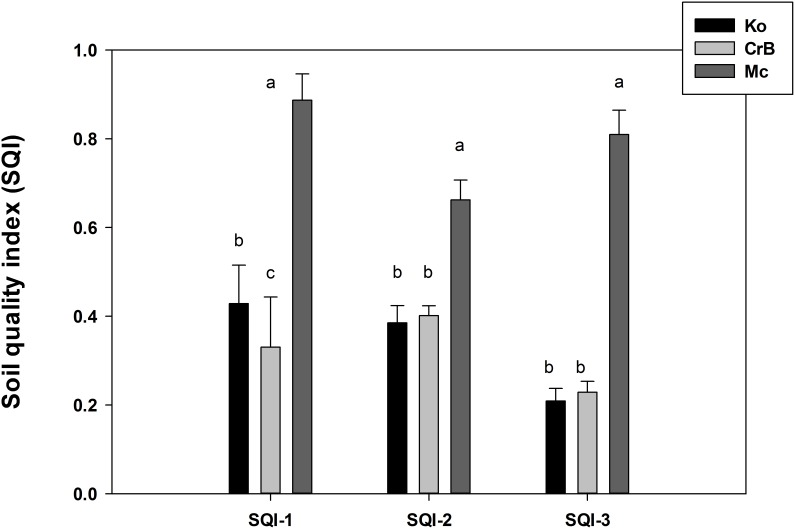
- SQI values varied by treatment and soil type and ranged from 0–0.9 (1 being maximum); the organic muck soil (Mc) had significantly higher soil quality than mineral soils, with SQI-1 ordered Mc > Ko > CrB.
- SQIs did not significantly differ by depth under any method; SQI-3 was most strongly correlated with crop yield (r = 0.74–0.78), and all three SQIs were significantly correlated with each other (r = 0.92–0.97) and with crop yield (r = 0.65–0.79).
- When the dataset was split by crop, correlations were low: r < 0.20 for soybean grain and r < 0.60 for corn grain (data not shown), indicating that crop-specific and key soil parameters are important for estimating SQI.
- SQI-1 and SQI-2 had higher values than SQI-3 in some scenarios (SQI-1 for Ko and Mc; SQI-2 for CrB), but SQI-3 predicted crop yield relatively higher and was regarded as the best and easiest model due to its objective approach and lower number of indicator selection.
Methods
- Soil samples were collected in May 2013 from three on-farm sites in Ohio: organic Mc (Martisco Variant silt loam), mineral CrB (Crosby silt loam), and Ko (Kokomo silty clay loam), at 0–10, 10–20, 20–40, and 40–60 cm depths under no-tillage/conventional tillage or cover crop/no-cover crop treatments.
- Thirteen soil parameters were measured (pH, EC, BD, WSA, GMD, MWD, PR, SOC, N, C-stock, N-stock, AWC, water content); SQI-1 and SQI-2 used nine after omitting redundant MWD, C and N concentrations, and water content, while SQI-3 used PCA to select a minimum data set of four non-redundant parameters (SOC, AWC, WSA, pH).
- SQI-1 used threshold scores from literature/expert opinion; SQI-2 used linear scoring and weighted additive functions (RDC 0.4, WSC 0.2, NSC 0.4); SQI-3 used PCA-based statistical modeling. SQIs were validated against soybean and corn yield via Pearson correlation, with Tukey’s test in SAS and PCA in SPSS.
Limitations
- The paper states there is no standard methodology for correlating crop yield with depthwise or combined-layer SQI, and that low crop-specific correlations (r < 0.20 for soybean grain, r < 0.60 for corn grain) suggest key soil fertility and microbial parameters (e.g., ion exchange capacities, macro/micronutrients, microbial biomass/C/N, respiration) were not monitored.
- The paper states SQI-1 is subjective and relies on researcher viewpoint; SQI-2 requires many soil parameters under different functional systems and may be expensive/time-consuming; SQI-3 needs long-term evaluation within a particular soil/crop system.
- Evident from the text: the study used 72 samples from three on-farm sites in one year (May 2013) and validated against same-year crop yield, with values based on three field or laboratory measurements, so findings may be site- and year-specific.
Model-written summary. Check it against the paper before relying on it.
Integrity signals
Registry
Cites
Statistics
Figures



Verification
Claims the paper makes
1 Valid · 0 Not valid · 15 Not checked · 57 Own results and interpretations
The sources with a verdict support this claim; the rest weren’t checked yet, have no full text we could read, or their verdicts aren’t rated yet.
In the paper
“Most studies indexed soil quality employing only one method, with a few exceptions [8], [15], [16].”
§ Comparison of Soil Quality Index Using Three Methods > Introduction
What the sources say
- Not checked — no full text of the sourcecites [8] Andrews S, Karlen D, Mitchell J (2002) A comparison of soil quality indexing methods for vegetable production systems in Northern California. Agriculture, Ecosystems & Environment 90: 25– 45. source
- Supportedcites [15] Zobeck TM, Halvorson AD, Wienhold B, Acosta-Martinez V, Karlen DL (2008) Comparison of two soil quality indexes to evaluate cropping systems in northern Colorado. Journal of Soil and Water Conservation 63: 329– 338. source
The Abstract describes this study as testing and comparing two soil-quality indexes, SQI and SCI. It therefore supports the citation’s role as an exception to studies using only one method; it does not need to establish how common single-method studies are. (LLM, conf=0.91)
- Not checked — no full text of the sourcecites [16] Zornoza R, Mataix-Solera J, Guerrero C, Arcenegui V, Mataix-Beneyto J, et al (2008) Validating the effectiveness and sensitivity of two soil quality indices based on natural forest soils under Mediterranean conditions. Soil Biology and Biochemistry 40: 2079– 2087. source
plain- Asserted: passes — The authors put it forward as true.
- Checkable: passes — It can be checked against evidence.
- Load-bearing: passes — The paper’s conclusions depend on it.
- Based: passes — The paper gives a reason why it holds.
A result the paper states — it cites no source for it, so there is none to check. The quote shows it is in the paper.
In the paper
“Nevertheless, relatively higher correlation coefficient was observed in the 0–10 cm soil layer than the deeper soil profile (Table 7)”
§ Comparison of Soil Quality Index Using Three Methods > Results and Discussions
plainstates an association- Asserted: passes — The authors put it forward as true.
- Checkable: passes — It can be checked against evidence.
- Load-bearing: unclear — It is unclear whether the paper’s conclusions depend on it.
- Based: passes — The paper gives a reason why it holds.
A result the paper states — it cites no source for it, so there is none to check. The quote shows it is in the paper.
In the paper
“Depth had little influence in any SQIs in the present study”
§ Comparison of Soil Quality Index Using Three Methods > Results and Discussions
plain- Asserted: passes — The authors put it forward as true.
- Checkable: passes — It can be checked against evidence.
- Load-bearing: unclear — It is unclear whether the paper’s conclusions depend on it.
- Based: passes — The paper gives a reason why it holds.
A result the paper reports from its own data — it cites no other source for it, so there is none to check. The quote shows it is in the paper.
In the paper
“The SQI calculated by three different methods indicated that studied muck soil has significantly higher soil quality than that of mineral soils under on-farm conditions.”
§ Comparison of Soil Quality Index Using Three Methods > Conclusions
hedged- Asserted: passes — The authors put it forward as true.
- Checkable: passes — It can be checked against evidence.
- Load-bearing: passes — The paper’s conclusions depend on it.
- Based: passes — The paper gives a reason why it holds.
A result the paper reports from its own data — it cites no other source for it, so there is none to check. The quote shows it is in the paper.
In the paper
“while both Ko and Mc had significantly higher influence of RDC in SQI-2 in the upper layers than the lower depths, the opposite trend was found for the NSC (Fig. S1).”
§ Comparison of Soil Quality Index Using Three Methods > Results and Discussions
plainstates an association- Asserted: passes — The authors put it forward as true.
- Checkable: passes — It can be checked against evidence.
- Load-bearing: unclear — It is unclear whether the paper’s conclusions depend on it.
- Based: passes — The paper gives a reason why it holds.
43 more claims
Create a free account to see all 73 claims and to verify the 1 reference still open.
- It may state two separate claims as one. 18
- Probably not a substantial claim. 7
Citations
Cites
Jolliffe, I. (2005) · Encyclopedia of Statistics in Behavioral Science · doi:10.1002/0470013192.bsa501 · Cited by 14,310
The application of electronic computers to factor analysis
Kaiser, H. F. (1960) · Educational and Psychological Measurement · doi:10.1177/001316446002000116 · Cited by 12,459 · cited 2×
“0 following Kaiser [36], the present study had the third and fourth components with eigenvalues of 0.”
InfluentialGoodall, C. (1988) · Technometrics · doi:10.1080/00401706.1988.10488412 · Cited by 8,675
Dunteman, G. (1989) · Sage eBooks · doi:10.4135/9781412985475 · Cited by 2,658
Defining Soil Quality for a Sustainable Environment
(1994) · SSSA Special Publications · doi:10.2136/sssaspecpub35 · Cited by 2,181
Defining and Assessing Soil Quality
Doran, J. W., & Parkin, T. B. (1994) · SSSA Special Publications · doi:10.2136/sssaspecpub35.c1 · Cited by 2,176 · cited 2×
“Soil quality is defined as the soil’s capacity to function within natural or managed ecosystem boundaries and to sustain plant productivity while reducing soil degradation [1–4].”
BackgroundSoil Quality: A Concept, Definition, and Framework for Evaluation (A Guest Editorial)
Karlen, D. L., Mausbach, M. J., Doran, J. W., Cline, R. G., Harris, R. F., & Schuman, G. E. (1997) · Soil Science Society of America Journal · doi:10.2136/sssaj1997.03615995006100010001x · Cited by 2,028 · cited 1×
“Thus, a mathematical or statistical framework was put forward in early 1990s to estimate soil quality index (SQI) [1,3,4].”
BackgroundA Direct Method of Aggregate Analysis of Soils and a Study of the Physical Nature of Erosion Losses1
Yoder, R. E. (1936) · Agronomy Journal · doi:10.2134/agronj1936.00021962002800050001x · Cited by 1,403 · cited 1×
“Bulk samples were obtained to measure the aggregate size distributions and fraction of water stable aggregates (WSA) using the wet sieving method [24].”
MethodThe Soil Management Assessment Framework: A Quantitative Soil Quality Evaluation Method
Andrews, S. S., Karlen, D. L., & Cambardella, C. A. (2004) · Soil Science Society of America Journal · doi:10.2136/sssaj2004.1945 · Cited by 1,341
Research works printed but not linked: 1
- Dane JH, Hopmans JH (2002) Water retention and storage. In: Dane JH, Topp GC, editors. Methods of soil analysis Part 4, SSSA Book Ser 5. Madison, WI.: SSSA. pp. 671–717.
Cited by
Items 301–379 of 379
Representativeness of determining the soil natural fertility index
Perovych, L., Perovych, L., & Martyniuk, T. (2021) · Modern achievements of geodesic science and industry · doi:10.33841/1819-1339-1-41-164-171 · Cited by 1
Santos, J. L. C., Atencia, J. D. C. M., Guzmán, C. K. F., Pineda, J. F. G., & Vitola, J. L. R. (2021) · Agronomía Costarricense · doi:10.15517/rac.v45i2.47768
Sari, P. T., Indarto, I., Mandala, M., et al. (2021) · Geosfera Indonesia · doi:10.19184/geosi.v6i2.24506
“The significance level of the three variables was determined by the eigen value (Mukherjee & Lal, 2014).”
BackgroundMethodMethodological aspects of organic production and balanced nature management
Stasiv, O., & Nakonechnyi, R. (2022) · Foothill and mountain agriculture and stockbreeding · doi:10.32636/01308521.2022-(71)-1-3
Aruna, L., Surekha, K., & BRAJENDRA, B. (2022) · Springer eBooks · doi:10.1007/978-3-030-95618-9_59 · Cited by 1
Vinay, S., & Bharath, H. A. (2022) · Water science and technology library · doi:10.1007/978-3-031-14096-9_17
Assessing Mine Restoration Success Using Biological Soil Quality Indicators
Pandey, V. C., Ahirwal, J., Roychowdhury, R., & Chaturvedi, R. (2023) · Wiley eBooks · doi:10.1002/9781119872283.ch5 · Cited by 2
UNIVERSAL APPROACH TO TERRITORY ASSESSMENT
Perovych, L., Perovych, I., Ванчура, Р., & Smoliy, K. (2022) · TECHNICAL SCIENCES AND TECHNOLOGIES · doi:10.25140/2411-5363-2022-3(29)-178-185
Fodder Grass Strips: An Affordable Technology for Sustainable Rainfed Agriculture in India
Pushpanjali, P., Samuel, J., Pankaj, P. K., et al. (2023) · Agriculture · doi:10.3390/agriculture13020318
Maurya, A. K., Yadav, V. K., Singh, T. D., Maurya, A., & Singh, V. K. (2023) · International Journal of Environment and Climate Change · doi:10.9734/ijecc/2023/v13i61841
Kumar, T., Adarsh, A., Prasad, J., et al. (2023) · SSRN Electronic Journal · doi:10.2139/ssrn.4537628
Assessing the Quality of Constructed Technosols Enabled Holistic Ecological Restoration MonitoringPreprint
Imbaná, R., Valente, F. D. D. A., Siqueira, R. G., dos Santos, C. M. M., & de Assis, I. R. (2023) · SSRN Electronic Journal · doi:10.2139/ssrn.4626770
Kumar, T., Adarsh, A., Prasad, J., et al. (2023) · SSRN Electronic Journal · doi:10.2139/ssrn.4650996
Lima, L. D. S., Rosman, P. C. C., & Carneiro, J. C. (2024) · IntechOpen eBooks · doi:10.5772/intechopen.1004881
Soil management affects soil C and N stocks but not overall soil health
Cordero-Irizarry, P. M., Lal, R., & Sotomayor-Ramirez, D. R. (2024) · The Journal of Agriculture of the University of Puerto Rico · doi:10.46429/jaupr.v108i1.21410
“Mukherjee and Lal (2014) reported that soil health could be influenced more by soil type than management and sampling depth through the simple additive approach.”
BackgroundSelf-citationCastillo, C., Taguas, E. V., Pérez, R., et al. (2024) · SSRN Electronic Journal · doi:10.2139/ssrn.4843697
Kuntoji, A. (2023) · Annals of Plant and Soil Research · doi:10.47815/apsr.2023.10232
Investigating soil health and resilience in small-scale agroecosystems of Mount-Lebanon
Mayassi, N. E., Thérèse, A., Sukkariyah, B. F., & Zdruli, P. (2024) · Agroecology and Sustainable Food Systems · doi:10.1080/21683565.2024.2364752 · Cited by 2
“The simple additive integration technique was used in this study (Apesteguía et al. 2017; Mukherjee, Lal, and Sainju 2014; Nunes et al. 2020): Where: SQIi = total sum of individual soil property index values SQImin = minimum value of the soil quality index SQImax = maximum value of the soil quality…”
Addressing Soil Quality Data Gaps with Imputation: Evidence from Ethiopia and UgandaPreprint
Dang, H.-A. H., Carletto, C., Gourlay, S., & Abanokova, K. (2024) · SSRN Electronic Journal · doi:10.2139/ssrn.4863781 · Cited by 1
ĐÁNH GIÁ CHẤT LƯỢNG ĐẤT VÙNG TRỒNG CAM HUYỆN TRÀ ÔN, TỈNH VĨNH LONG
Phương, N. V. (2024) · Journal of Science and Technology - IUH · doi:10.46242/jstiuh.v68i02.5086 · Cited by 1
“Do đó, một SQI thích hợp có thể có ba mục tiêu thành phần: chất lượng môi trường, tính bền vững nông học và khả năng kinh tế xã hội [4].”
Pacífico, I. C. (2024) · Digital Library of Theses and Dissertations (Universidade de São Paulo) · doi:10.11606/d.11.2024.tde-01072024-155352
Maulood, P. M. (2024) · Mağallaẗ ʻulūm al-rāfidayn · doi:10.33899/rjs.2024.184533
Dong, H. P., Nguyen, B. T., Le, A. H., & Dinh, G. D. (2024) · Geoderma Regional · doi:10.1016/j.geodrs.2024.e00878 · Cited by 1
Resource Sustainability and its Determinants in the Context of MGNREGA in West Bengal
Ekbal Hossain, J. P. B. (2025) · doi:10.52783/eel.v15i1.2360
Villegas, A. M., Restrepo, J. D., Ravagli, M. A. A., et al. (2024) · Agronomía Colombiana · doi:10.15446/agron.colomb.v42n2.114840
“The Scorecard evaluates the chemical, physical, and biological characteristics of soils (Mukherjee, 2014), making it an important tool for identifying areas in need of improvement and encouraging best management practices by taking the list of regenerative practices to a quantitative level and…”
Santorufo, L., Gargiulo, M., Memoli, V., Maisto, G., Barile, R., & Ruello, G. (2025) · Fire · doi:10.3390/fire8030099 · Cited by 2
The Evolution of Methods and Tools Used to Assess Soil Health Indicators - a Scoping ReviewPreprint
Buthelezi, K., Kibirige, D., & Buthelezi-Dube, N. N. (2025) · SSRN Electronic Journal · doi:10.2139/ssrn.5232105
Figorilli, S., Canfora, L., Manfredini, A., Violino, S., Moscovini, L., Pallottino, F., Antonucci, F., Costa, C., Furmanczyk, E. M., Popińska, W., et al. (2025) · Smart Agricultural Technology · doi:10.1016/j.atech.2025.101106
de Paula, A. L., Schiebelbein, L. M., Becker, R. K., Barbosa, E. A. A., Barbosa, F. T., Galvão, C. W., Etto, R. M., Melo, H. F., da Fonseca, A. F., & Giarola, N. F. B. (2026) · SOIL · doi:10.5194/soil-12-545-2026 · Cited by 2
Evaluation of Soil Health Index Under Short-Term Effects of Fertility Management in KentuckyPreprint
Mukherjee, A., Airee, S., & Bhandari, A. (2025) · SSRN Electronic Journal · doi:10.2139/ssrn.5372915
Self-citationComparisons of soil health properties among three long‐term land‐use systems in Trans Nzoia, Kenya
Omondi, E. C., Mukherjee, A., Norton, J. B., Ashilenje, D. S., Norton, U., Beeby, J. S., & Chiwo, W. O. (2025) · Soil Science Society of America Journal · doi:10.1002/saj2.70167
Self-citationUgwu, D. O., Ogumba, P. O., Dedan, N. K., et al. (2025) · AgroEnvironmental Sustainability · doi:10.59983/s2025030403
Sufardi, S., & Helmi, H. (2025) · Applied and Environmental Soil Science · doi:10.1155/aess/7530709
Rodríguez, C. C., Taguas, E. V., Vallejo, M., Pérez, R., Wells, R. R., Bingner, R. L., & Macpherson, H. G. (2026) · Precision Agriculture · doi:10.1007/s11119-025-10312-7
“…num - ber of soil properties is reduced using statistical procedures to derive a minimum data set (MDS) of significant soil quality indicators, which are assigned normalized weights and scores to calculate a single SQI (Andrews & Carroll, 2001; Mukherjee & Lal, 2014; Ollo - barren et al., 2016 ).”
Jadhav, J., Mujumdar, M., Awale, M., Patil, R., Kuchekar, S. R., Chaudhary, I. J., soni, D., Mane, A., Kamble, P. N., & Shekhar, S. (2026) · Discover Soil. · doi:10.1007/s44378-026-00162-8 · Cited by 1
“To assess soil health across drought-prone and non-drought regions, we developed a novel SQI based on a multi-parameter scoring system that does not rely on crop yield data, which is often influenced by external environmental factors [46, 57].”
Gök, G., Gürbüz, O. Ö., & Gürbüz, O. A. (2026) · Scientific Reports · doi:10.1038/s41598-026-37497-9 · Cited by 1
“To overcome the limitations related to monitoring leachate quality, modeling options have been widely used 18 .”
Jin, H., Yang, T., Huang, Y., Liu, W., Yan, Y., Zhang, L.-H., & Li, J. (2026) · Agriculture Communications · doi:10.1016/j.agrcom.2026.100132 · Cited by 1
Burbano-Figueroa, Ó., Moreno-Moran, M., & Ferrer, J. L. R. (2024) · Revista Colombiana de Ciencias Hortícolas · doi:10.19053/uptc.24223719.18008
“It is also widely used to identify underlying soil parameter structures that define soil quality (Mukherjee and Lal, 2014; Vasu et al ., 2016) and to assess the impact of land-use chang-es on soil health (Cherubin et al ., 2016; Raiesi, 2017).”
Liu, H., Tan, X., Xiao, R., et al. (2026) · Ecological Indicators · doi:10.1016/j.ecolind.2026.114755
Mohanty, S., Saha, S., Saha, B., Ray, M., Dasgupta, S., Chatterjee, S., Mukhopadhyay, S. K., & Poddar, R. (2026) · Journal of soil science and plant nutrition · doi:10.1007/s42729-025-02974-z
Sharma, A., Sahoo, B. P., & Sahoo, S. K. (2026) · Research Square · doi:10.21203/rs.3.rs-8976999/v1
Saha, T., Ghosh, R., Dutta, T. K., Sarkar, P., Saha, R., & Mahata, S. K. (2026) · International Conference on Electronics, Materials Engineering & Nano-Technology (IEMENTech) · doi:10.1109/iementech202669403.2026.11434386
Awwal, Y. A., Young, A. C., & Linus, M. (2026) · Kuwait Journal of Science · doi:10.1016/j.kjs.2026.100577
Thoumazeau, A. (2018) · theses.fr (ABES) · doi:10.70675/61c031f6z2138z4300za80bzcc92b424242c
Joshua, O. L. U., SAMAILA, I. K., YUSUF, H. O., Sangari, D. U., & HAYATU, S. J. (2025) · Environmental Studies Journal · doi:10.36108/esj/5202.40.0130
SQIpro: Comprehensive Soil Quality Index Computation and Visualization
Islam, S., & Kaushal, R. (2026) · doi:10.32614/cran.package.sqipro
Junaidi, E., Alfina, R., Asman, A., et al. (2026) · Water Air & Soil Pollution · doi:10.1007/s11270-026-09525-x
“PCA is effective for statistical dimensionality reduction (Mukherjee & Lal, 2014; Zornoza et al., 2015; Zuza et al., 2023), whereas ANP allows incorporation of relational feedback and expert-informed weighting.”
Fitriana, F., Azhari, A. W., & Sah, S. S. (2026) · IOP Conference Series Earth and Environmental Science · doi:10.1088/1755-1315/1616/1/012100
“More recently, the integration of machine learning (ML) and remote sensing (RS) has expanded the capacity of SQI to predict soil quality across larger spatial scales with greater accuracy [17,23].”
Wang, J., Xiang, K., Xu, X., Wu, L., Luo, J., & Wu, C. (2026) · Journal of Soils and Sediments · doi:10.1007/s11368-026-04400-y
“Expert weighting intro - duces subjectivity, which is suboptimal for evaluating 44 diverse indicators (Mukherjee and Lal 2014).”
Romaniuk, M. I. (2026) · Biolohichni systemy · doi:10.31861/biosystems2025.03.443 · Cited by 1
Dryland soil quality modelling in Najran, Saudi Arabia, using a GIS-based geometric approach
Alqurashi, M., Lawrence, J., Mason, P. J., & Ghail, R. C. (2026) · Frontiers in Sustainable Food Systems · doi:10.3389/fsufs.2026.1847272
Filho, R. N. D. A., Santos, L. D. V., Leite, O. D. C., et al. (2026) · Research Square · doi:10.21203/rs.3.rs-9986795/v1
Evaluation of Land Quality Under Different Land Use Patterns on the Qingshuihe Plain in China
Wang, Y., She, R., Li, Y., Tai, S., Chen, G., Du, Y., Zhang, D., & Yao, Y. (2026) · Soil Use and Management · doi:10.1111/sum.70249
“Land quality assessment (LQA), as a crucial approach for understanding land resource endowments and elucidating their carrying capacities and limiting factors, has garnered extensive global attention (Tang et al. 2025; Bünemann et al. 2018; Mukherjee and Lal 2014).”
Xavier, J. F., da Silva, M. S. R. D. A., Ferreira, C. D. S., et al. (2026) · SSRN Electronic Journal · doi:10.2139/ssrn.7000648
Early Detection of Soil Multifunctionality Loss in Amazonian Mangroves Driven by Land Use Change
Mello, F. A. D. O., Ferreira, T. O., Ruiz, F., Costa, R. F., Queiroz, H. M., Mello, D. E. B. F., Menillo, R. B., Barbosa, L. M., Bernardino, A. F., & Cherubin, M. R. (2026) · Wetlands · doi:10.1007/s13157-026-02085-0
“This approach has been implemented in multiple studies regarding soil health, providing a balanced role for each indicator and resulting in more accurate analysis (Karlen and Stott 1994; Mukherjee and Lal 2014 ; Cherubin et al 2016b, 2017).”
MASQI: An Automated Spatial Framework for Agricultural Soil Quality Assessment in Arid Lands
Al-hashimi, H., Mawla, T. J. A. A., Khan, S., & Niaz, R. (2026) · Earth Systems and Environment · doi:10.1007/s41748-026-01294-1
“To address this limitation, comprehensive Soil Quality Indices (SQIs) were developed to integrate multiple soil indicators into a single, quantifiable score (Andrews et al. 2002 ; Mukherjee and Lal 2014).”
Šarapatka, B., & Bednář, M. (2026) · Journal of Soils and Sediments · doi:10.1007/s11368-026-04411-9 · Cited by 1
“To address these gaps, this study adopts a multi-indi-cator approach and constructs a Soil Quality Index (SQI) integrating physical, chemical, and biological soil properties (Mukherjee and Lal 2014 ).”
InfluentialPordel, N., Hosseinzadeh, J., Heydari, M., et al. (2026) · Soil Science Society of America Journal · doi:10.1002/saj2.70279
Tokgöz, F. K., & Aksu, Y. (2026) · Bitlis Eren Üniversitesi Fen Bilimleri Dergisi · doi:10.17798/bitlisfen.1802648
Sanad, H., Moussadek, R., Mouhir, L., et al. (2026) · Soil Systems · doi:10.3390/soilsystems10070070
“Similar sample ranges (20–40 observations) have been successfully employed in soil quality index studies and localized agroecosystem assessments [82–84], particularly when the objective is site-specific management rather than regional-scale generalization.”
From Indicators to Integration: Soil Health Assessment and the SMAF Framework
Aboukila, E., Hamdy, M., El-Kammah, M., Alharbi, A., Abouelsaad, I. A., & Aggag, A. M. (2026) · Land · doi:10.3390/land15071278
“The percentage of variation explained by each PC assigns data-driven weights, minimizing subjective investigator bias [153,154].”
Feng, J., Liu, J., Wang, Y., Wang, M., Zheng, Z., Zhang, W., Wang, C., Yu, Z., Masoudi, A., & Liu, J. (2026) · Journal of Forestry Research · doi:10.1007/s11676-026-02109-9
“Indices based on the minimum data set (MDS) performed better than those based on the total data set (TDS), consistent with previous work showing that reducing redundancy improves stability and interpretability (Andrews et al. 2004; Mukherjee and Lal 2014; Saleh et al. 2021).”
Luo, X., Shu, Y., Zhang, Y., Zeng, X., Chen, X., Liang, H., Fang, C., Yang, S. M., & Liu, L. (2026) · Soil Science & Plant Nutrition · doi:10.1080/00380768.2026.2704005
Correlation between Land-use History, Soil Conditions, and Tree Vitality in an Urban Park1
Landscape Architecture Major, S. N. U., Park, S.-G., Heo, C.-R., et al. (2026) · Korean Journal of Environment and Ecology · doi:10.13047/kjee.2026.40.3.233
Calixto-Costa, J. C., Barreto, A. V. R., de Melo, R. E., et al. (2026) · Applied Soil Ecology · doi:10.1016/j.apsoil.2026.107343
Wilis, R., & Abdullah, U. H. (2026) · Jurnal Penelitian Pendidikan IPA · doi:10.29303/jppipa.v12i7.15250
Ramzan, S., Akhter, S., Saleem, H., Ashraf, I., Ahmad, P., & Nazir, N. (2026) · Advances in geographical and environmental sciences · doi:10.1007/978-981-92-0835-7_13
Sosulski, T., Smreczak, B., & Szymańska, M. (2026) · Soil Science Society of America Journal · doi:10.1002/saj2.70328
Kroeksakul, P., Singhaboot, P., & Hongthong, P. (2026) · SSRN Electronic Journal · doi:10.2139/ssrn.7346370
Ambrosino, M., & Cicchella, D. (2026) · Journal of Environmental Management · doi:10.1016/j.jenvman.2026.130845
Upreti, G., Celin, S. M., & Haritash, A. K. (2026) · Research Square · doi:10.21203/rs.3.rs-10486463/v1
Ouda, S. A. H., & Zohry, A. E. (2026) · Frontiers in Sustainable Food Systems · doi:10.3389/fsufs.2026.1923296
Lin, Y., han, Y., Li, Z., et al. (2026) · SSRN Electronic Journal · doi:10.2139/ssrn.7442514
Filho, R. N. D. A., Santos, L. D. V., da Silva, E. G., et al. (2026) · SSRN Electronic Journal · doi:10.2139/ssrn.7454946
Selvamurugan, M., Suresh, T., Baskar, M., & Balasubramaniam, P. (2026) · Soil Use and Management · doi:10.1111/sum.70292
“Multivariate approaches such as Principal Component Analysis (PCA) have therefore been widely employed to identify sensitive indicators and develop robust soil quality assessment frameworks (Mukherjee and Lal 2014; Vasu et al. 2016).”
Xavier, J. F., da Silva, M. S. R. D. A. [., Ferreira, C. D. S., Gonçalves, J. V. D. S., da Silva, A. B. G. V., Silva, C. F., Neto, E. C. D. S., Pereira, M. G., & Coelho, I. D. S. (2026) · Applied Soil Ecology · doi:10.1016/j.apsoil.2026.107513
Chu, J., 冯长春, Jiang, H., Yang, X., Jing, Y., Pavinato, P. S., Cherubin, M. R., Zhaohai, Z., Leanne, P., Qian, Y., et al. (2026) · Farming System · doi:10.1016/j.farsys.2026.100283
Maitry, A., Patil, G., & Jhariya, M. K. (2026) · Environmental Monitoring and Assessment · doi:10.1007/s10661-026-15972-0
“Soil quality indices (SQI) offer a method that considers multiple factors through composite measures (Bastida et al., 2008; Mukherjee & Lal, 2014).”
Metadata
- Authors
- Mukherjee, A., & Lal, R.
- Affiliations
- The Ohio State University (US)
- Corresponding author
- Mukherjee, Atanu
- Venue
- PLoS ONE
- Publisher
- Public Library of Science (PLoS)
- Published
- 2014-08-22
- Volume
- 9
- Issue
- 8
- Pages
- e105981
- ISSN
- 1932-6203 (ISSN-L)
- PMC
- PMC4141864
- OpenAlex
- W2011488730
- Cited by
- 379
- References
- 45
- Citations by year
- 2026: 54 · 2025: 42 · 2024: 55 · 2023: 42 · 2022: 40 · 2021: 49 · 2020: 26 · 2019: 18 · 2018: 21 · 2017: 12 · 2016: 14 · 2015: 4 · 2014: 2
- FWCI
- 15.04
- Type
- journal article
- Language
- en
- Open access
- gold
- doi.org
- Locations
- PLoS ONE (publishedVersion, cc-by)
- PubMed Central (publishedVersion, cc-by)
- PubMed (publishedVersion)
- RePEc: Research Papers in Economics (submittedVersion)
- DOAJ (DOAJ: Directory of Open Access Journals) (submittedVersion, cc-by-sa)
- Funders
- U.S. Department of Agriculture (2011-68002-30190)
- National Institute of Food and Agriculture (20116800230190)
- Topics
- Life Sciences › Agricultural and Biological Sciences › Soil Science › Soil Management and Crop Yield
- Life Sciences › Agricultural and Biological Sciences › Soil Science › Soil Science and Environmental Management
- Life Sciences › Agricultural and Biological Sciences › Agronomy and Crop Science › Sustainable Agricultural Systems Analysis
- Keywords
- soil quality index, soil quality assessment, crop yield, principal component analysis, soil depth, organic soils, mineral soils, soil management, Ohio soils
- MeSH terms
- Zea mays, Models, Theoretical, Ohio, Soil, Glycine max, Models, Statistical, Crops, Agricultural, Principal Component Analysis
About these checks
Registry, retraction, Cites and statistics results are computed, not judged, with one exception: a printed reference that no index lists is read once by a model before it counts as a citation error. Claims are extracted by a model and kept only when their quote appears verbatim in the text; each cited source is then checked, with a model’s help, for whether it says what the claim relies on. Those verdicts can be wrong — read the claim’s quote and the cited source before relying on one.
A language model drew the claims from the paper on 2026-10-10, under version 3 of the claim definition (model deepseek-v4.1-flash, prompt extract-v3).
A second model labelled each claim on 2026-10-10 (model jev-1.13-20260917, definition revision gold-guideline-v0.2).
Cited sources are checked with a language model’s help (gpt-6-sol).
Statistics and arithmetic are recomputed, not judged.
Confidence bands are shown only for fields calibrated on our annotated test set. None is calibrated yet, so no band is shown.
What counts as a claim ›How we measure confidence ›How we check this ›
Are you an author, or do you see a problem with this page? Request a review
Data sources
Bibliographic data: Semantic Scholar, OpenAlex, Crossref.
Contains information from the Semantic Scholar Academic Graph Datasets, made available under the ODC Attribution License (ODC-BY 1.0).
Semantic Scholar’s data is described in: Kinney, R., et al. (2023). The Semantic Scholar Open Data Platform. arXiv:2301.10140.
