

Comparison of Soil Quality Index Using Three Methods
Open accessThe DOI matches its Crossref record; 44 of the 45 references it cites were found in a registry or an index; 1 of the 29 sources its claims cite were checked for support.
Abstract
Assessment of management-induced changes in soil quality is important to sustaining high crop yield. Three methods used to estimate SQI were: (i) simple additive SQI, (ii) weighted additive SQI, and (iii) statistically modeled SQI based on principal component analysis (PCA).
Overview
CoChat Summary
TL;DR
The paper compares three soil quality index (SQI) methods—simple additive, weighted additive, and PCA-based—using 72 soil samples from three Ohio on-farm sites. All three SQIs were significantly correlated with each other and with crop yield, but the PCA-based SQI-3 showed the strongest yield correlation and was judged best for long-term use.
Key findings
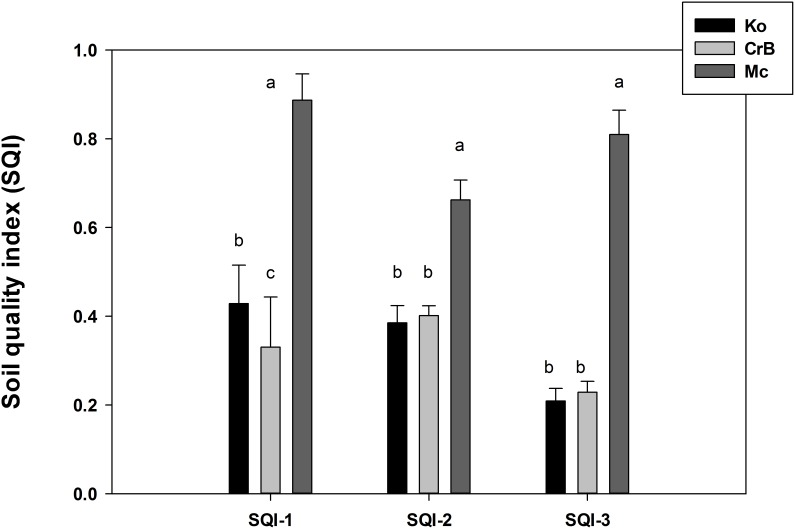
- SQI values varied by treatment and soil type and ranged from 0–0.9 (1 being maximum); the organic muck soil (Mc) had significantly higher soil quality than mineral soils, with SQI-1 ordered Mc > Ko > CrB.
- SQIs did not significantly differ by depth under any method; SQI-3 was most strongly correlated with crop yield (r = 0.74–0.78), and all three SQIs were significantly correlated with each other (r = 0.92–0.97) and with crop yield (r = 0.65–0.79).
- When the dataset was split by crop, correlations were low: r < 0.20 for soybean grain and r < 0.60 for corn grain (data not shown), indicating that crop-specific and key soil parameters are important for estimating SQI.
- SQI-1 and SQI-2 had higher values than SQI-3 in some scenarios (SQI-1 for Ko and Mc; SQI-2 for CrB), but SQI-3 predicted crop yield relatively higher and was regarded as the best and easiest model due to its objective approach and lower number of indicator selection.
Methods
- Soil samples were collected in May 2013 from three on-farm sites in Ohio: organic Mc (Martisco Variant silt loam), mineral CrB (Crosby silt loam), and Ko (Kokomo silty clay loam), at 0–10, 10–20, 20–40, and 40–60 cm depths under no-tillage/conventional tillage or cover crop/no-cover crop treatments.
- Thirteen soil parameters were measured (pH, EC, BD, WSA, GMD, MWD, PR, SOC, N, C-stock, N-stock, AWC, water content); SQI-1 and SQI-2 used nine after omitting redundant MWD, C and N concentrations, and water content, while SQI-3 used PCA to select a minimum data set of four non-redundant parameters (SOC, AWC, WSA, pH).
- SQI-1 used threshold scores from literature/expert opinion; SQI-2 used linear scoring and weighted additive functions (RDC 0.4, WSC 0.2, NSC 0.4); SQI-3 used PCA-based statistical modeling. SQIs were validated against soybean and corn yield via Pearson correlation, with Tukey’s test in SAS and PCA in SPSS.
Limitations
- The paper states there is no standard methodology for correlating crop yield with depthwise or combined-layer SQI, and that low crop-specific correlations (r < 0.20 for soybean grain, r < 0.60 for corn grain) suggest key soil fertility and microbial parameters (e.g., ion exchange capacities, macro/micronutrients, microbial biomass/C/N, respiration) were not monitored.
- The paper states SQI-1 is subjective and relies on researcher viewpoint; SQI-2 requires many soil parameters under different functional systems and may be expensive/time-consuming; SQI-3 needs long-term evaluation within a particular soil/crop system.
- Evident from the text: the study used 72 samples from three on-farm sites in one year (May 2013) and validated against same-year crop yield, with values based on three field or laboratory measurements, so findings may be site- and year-specific.
Model-written summary. Check it against the paper before relying on it.
Integrity signals
Registry
Cites
Statistics
Figures



Verification
Claims the paper makes
1 Valid · 0 Not valid · 15 Not checked · 57 Own results and interpretations
The sources with a verdict support this claim; the rest weren’t checked yet, have no full text we could read, or their verdicts aren’t rated yet.
In the paper
“Most studies indexed soil quality employing only one method, with a few exceptions [8], [15], [16].”
§ Comparison of Soil Quality Index Using Three Methods > Introduction
What the sources say
- Not checked — no full text of the sourcecites [8] Andrews S, Karlen D, Mitchell J (2002) A comparison of soil quality indexing methods for vegetable production systems in Northern California. Agriculture, Ecosystems & Environment 90: 25– 45. source
- Supportedcites [15] Zobeck TM, Halvorson AD, Wienhold B, Acosta-Martinez V, Karlen DL (2008) Comparison of two soil quality indexes to evaluate cropping systems in northern Colorado. Journal of Soil and Water Conservation 63: 329– 338. source
The Abstract describes this study as testing and comparing two soil-quality indexes, SQI and SCI. It therefore supports the citation’s role as an exception to studies using only one method; it does not need to establish how common single-method studies are. (LLM, conf=0.91)
- Not checked — no full text of the sourcecites [16] Zornoza R, Mataix-Solera J, Guerrero C, Arcenegui V, Mataix-Beneyto J, et al (2008) Validating the effectiveness and sensitivity of two soil quality indices based on natural forest soils under Mediterranean conditions. Soil Biology and Biochemistry 40: 2079– 2087. source
plain- Asserted: passes — The authors put it forward as true.
- Checkable: passes — It can be checked against evidence.
- Load-bearing: passes — The paper’s conclusions depend on it.
- Based: passes — The paper gives a reason why it holds.
A result the paper states — it cites no source for it, so there is none to check. The quote shows it is in the paper.
In the paper
“Nevertheless, relatively higher correlation coefficient was observed in the 0–10 cm soil layer than the deeper soil profile (Table 7)”
§ Comparison of Soil Quality Index Using Three Methods > Results and Discussions
plainstates an association- Asserted: passes — The authors put it forward as true.
- Checkable: passes — It can be checked against evidence.
- Load-bearing: unclear — It is unclear whether the paper’s conclusions depend on it.
- Based: passes — The paper gives a reason why it holds.
A result the paper states — it cites no source for it, so there is none to check. The quote shows it is in the paper.
In the paper
“Depth had little influence in any SQIs in the present study”
§ Comparison of Soil Quality Index Using Three Methods > Results and Discussions
plain- Asserted: passes — The authors put it forward as true.
- Checkable: passes — It can be checked against evidence.
- Load-bearing: unclear — It is unclear whether the paper’s conclusions depend on it.
- Based: passes — The paper gives a reason why it holds.
A result the paper reports from its own data — it cites no other source for it, so there is none to check. The quote shows it is in the paper.
In the paper
“The SQI calculated by three different methods indicated that studied muck soil has significantly higher soil quality than that of mineral soils under on-farm conditions.”
§ Comparison of Soil Quality Index Using Three Methods > Conclusions
hedged- Asserted: passes — The authors put it forward as true.
- Checkable: passes — It can be checked against evidence.
- Load-bearing: passes — The paper’s conclusions depend on it.
- Based: passes — The paper gives a reason why it holds.
A result the paper reports from its own data — it cites no other source for it, so there is none to check. The quote shows it is in the paper.
In the paper
“while both Ko and Mc had significantly higher influence of RDC in SQI-2 in the upper layers than the lower depths, the opposite trend was found for the NSC (Fig. S1).”
§ Comparison of Soil Quality Index Using Three Methods > Results and Discussions
plainstates an association- Asserted: passes — The authors put it forward as true.
- Checkable: passes — It can be checked against evidence.
- Load-bearing: unclear — It is unclear whether the paper’s conclusions depend on it.
- Based: passes — The paper gives a reason why it holds.
43 more claims
Create a free account to see all 73 claims and to verify the 1 reference still open.
- It may state two separate claims as one. 18
- Probably not a substantial claim. 7
Citations
Cites
Jolliffe, I. (2005) · Encyclopedia of Statistics in Behavioral Science · doi:10.1002/0470013192.bsa501 · Cited by 14,310
The application of electronic computers to factor analysis
Kaiser, H. F. (1960) · Educational and Psychological Measurement · doi:10.1177/001316446002000116 · Cited by 12,459 · cited 2×
“0 following Kaiser [36], the present study had the third and fourth components with eigenvalues of 0.”
InfluentialGoodall, C. (1988) · Technometrics · doi:10.1080/00401706.1988.10488412 · Cited by 8,675
Dunteman, G. (1989) · Sage eBooks · doi:10.4135/9781412985475 · Cited by 2,658
Defining Soil Quality for a Sustainable Environment
(1994) · SSSA Special Publications · doi:10.2136/sssaspecpub35 · Cited by 2,181
Defining and Assessing Soil Quality
Doran, J. W., & Parkin, T. B. (1994) · SSSA Special Publications · doi:10.2136/sssaspecpub35.c1 · Cited by 2,176 · cited 2×
“Soil quality is defined as the soil’s capacity to function within natural or managed ecosystem boundaries and to sustain plant productivity while reducing soil degradation [1–4].”
BackgroundSoil Quality: A Concept, Definition, and Framework for Evaluation (A Guest Editorial)
Karlen, D. L., Mausbach, M. J., Doran, J. W., Cline, R. G., Harris, R. F., & Schuman, G. E. (1997) · Soil Science Society of America Journal · doi:10.2136/sssaj1997.03615995006100010001x · Cited by 2,028 · cited 1×
“Thus, a mathematical or statistical framework was put forward in early 1990s to estimate soil quality index (SQI) [1,3,4].”
BackgroundA Direct Method of Aggregate Analysis of Soils and a Study of the Physical Nature of Erosion Losses1
Yoder, R. E. (1936) · Agronomy Journal · doi:10.2134/agronj1936.00021962002800050001x · Cited by 1,403 · cited 1×
“Bulk samples were obtained to measure the aggregate size distributions and fraction of water stable aggregates (WSA) using the wet sieving method [24].”
MethodThe Soil Management Assessment Framework: A Quantitative Soil Quality Evaluation Method
Andrews, S. S., Karlen, D. L., & Cambardella, C. A. (2004) · Soil Science Society of America Journal · doi:10.2136/sssaj2004.1945 · Cited by 1,341
Research works printed but not linked: 1
- Dane JH, Hopmans JH (2002) Water retention and storage. In: Dane JH, Topp GC, editors. Methods of soil analysis Part 4, SSSA Book Ser 5. Madison, WI.: SSSA. pp. 671–717.
Cited by
Items 201–300 of 379
Kruczkowska, B., Jończak, J., Kondras, M., Oktaba, L., Pawłowicz, E., Chojnacka, A., Jankiewicz, U., Oktaba, J., Olejniczak, I., Słowińska, S., et al. (2023) · Agriculture Ecosystems & Environment · doi:10.1016/j.agee.2023.108434 · Cited by 6
Karthikeyan, K., Vasu, D., Tiwary, P., Cunliffe, A. M., Chandran, P., Sankar, M., & Singh, S. K. (2018) · Archives of Agronomy and Soil Science · doi:10.1080/03650340.2018.1542131 · Cited by 6
“Among the different MCDA approaches, soil quality index (SQI) method to evaluate land suitability is recently used in many studies due to its quantitative nature (Mukherjee and Lal 2014; Biswas et al. 2017).”
MethodRajput, R. S., Patley, S., Choudhary, B., & Gupta, S. N. (2023) · International Journal of Environment and Climate Change · doi:10.9734/ijecc/2023/v13i123750 · Cited by 8
Belay, A., Assen, M. M., & Abegaz, A. (2025) · Environmental and Sustainability Indicators · doi:10.1016/j.indic.2025.100641 · Cited by 6
Impact of Rubber Cultivation on Soil Quality and Carbon Stocks in Southern Peninsular India
Saha, K., Kumar, A., Nair, K. M., Jessy, M. D., Ghosh, S., Lalitha, M., Karthika, K. S., Jayaramaiah, M., Sujata, K., Parvathy, S., et al. (2025) · Soil Use and Management · doi:10.1111/sum.70110 · Cited by 9
“The initial purpose of PCA is to reduce the dimensionality of the entire data set, which is made up of many intercorrelated variables (Mukherjee and Lal 2014).”
Soil Health and Ecosystem Services in Mangrove Forests: A Global Overview
Mello, F. A. D. O., Ferreira, T. O., Bernardino, A. F., Queiroz, H. M., de Mello, D. C., Menillo, R. B., & Cherubin, M. R. (2024) · Water · doi:10.3390/w16243626 · Cited by 10
Assessment of soil quality indicators under rice ecosystem of Assam, India
Gayan, A., Nath, D. J., Bhattacharyya, B., & Dutta, N. (2020) · Journal of Environmental Biology · doi:10.22438/jeb/41/6/si-246 · Cited by 5
Et-Tayeb, H., Namr, K. I., Mzouri, E. H. E., Bourhrami, B. E., & Moussadek, R. (2022) · Ecological Engineering & Environmental Technology · doi:10.12912/27197050/145962 · Cited by 5
“31) was found under NT compared to CT (14,55).”
MethodManure Application Is the Key to Improving Soil Quality of New Terraces
Shi, X., Song, X. S., Zhao, G., Yang, Q., Abbott, L. K., & Li, F. (2022) · Sustainability · doi:10.3390/su142215166 · Cited by 6
Janaki, P., Poongavanam, L. K. S., Parameswari, E., Monicaa, M., Ramanujam, K., Rangasamy, S., Mariappan, S., & Kavitha, P. S. (2024) · Environmental Monitoring and Assessment · doi:10.1007/s10661-024-12608-z · Cited by 6
“Then, SQI PCA was arrived as below. where, S i is the linear score of each indicator and W i is the weighted factor.”
InfluentialBayram, M., Günal, H., & Özgöz, E. (2015) · Yüzüncü Yıl Üniversitesi Tarım Bilimleri Dergisi · doi:10.29133/yyutbd.236414 · Cited by 7
Soil quality response to land-use change for sugarcane expansion in Brazil
Cherubin, M. R. (2016) · Digital Library of Theses and Dissertations (Universidade de São Paulo) · doi:10.11606/t.11.2016.tde-16062016-160123 · Cited by 6
Pordel, N., Hosseinzadeh, J., Heydari, M., et al. (2025) · Forest Ecology and Management · doi:10.1016/j.foreco.2025.123334 · Cited by 4
Majeed, I., Singh, K., Fidelis, C., Yinil, D., Minasny, B., Das, B. S., & Field, D. J. (2024) · Soil Use and Management · doi:10.1111/sum.13077 · Cited by 4
“Simple and weighted additive or statistical approaches through principal component analysis (PCA) are commonly followed to develop SQIs (Mukherjee & Lal, 2014).”
Comparative Studies on Soil Quality Index Estimation of a Hilly-Zone Sub-Watershed in Karnataka
Yadav, M. B. N., Patil, P. L., & Hebbara, M. (2023) · Sustainability · doi:10.3390/su152416576 · Cited by 7
Soil Carbon Impacts on Functionality and Environmental Sustainability
Lal, R. (2016) · The anthropocene: Politik - economics - society - science · doi:10.1007/978-3-319-45035-3_1 · Cited by 5
Self-citationModel Input Data Uncertainty and Its Potential Impact on Soil Properties
Mannschatz, T., & Dietrich, P. (2016) · Elsevier eBooks · doi:10.1016/b978-0-12-803011-0.00002-1 · Cited by 4
Rajendran, A., & Shanmuganathan, M. (2019) · East African Agricultural and Forestry Journal · doi:10.1080/00128325.2019.1602898 · Cited by 4
“Quality of soil is defined as the capacity of soil to work within an environment and land-use boundaries to uphold biological efficiency, maintain environmental quality, and to promote plant and animal health (Mukherjee and Lal 2014).”
BackgroundEvaluating common soil health tests for dryland wheat systems of inland Pacific Northwest
Singh, S. K., Singh, S., Singh, S., et al. (2023) · Journal of Soils and Sediments · doi:10.1007/s11368-023-03697-3 · Cited by 4
“…Soil Health Institute set forth the North American Project to Evaluate Soil Health Measurements (NAPESHM) to ameliorate the problem that a standardized universal soil health assessment method is currently not available despite global emphasis on soil health (Larkin 2015; Mukherjee and Lal 2014).”
Nano-satellites uphold Boserup’s theory of smallholder agricultural intensificationPreprint
Tong, X., Brandt, M., Rasmussen, L. V., Hiernaux, P., Bruun, T. B., Reiner, F., Abdi, A. M., Herrmann, S., Li, S., & Fensholt, R. (2022) · Research Square · doi:10.21203/rs.3.rs-2041995/v1 · Cited by 5
Quintana-Esteras, S., Martí, C., Ortiz, O., & Villas, D. B. (2025) · Sustainability · doi:10.3390/su17135949 · Cited by 4
Samaniego, T., Sales, B., & Acosta, R. A. S. (2025) · Sustainability · doi:10.3390/su17177610 · Cited by 5
Zhang, J., Yan, X., Chen, L., Xia, X., Chen, Y., Long, C., Wang, B., & Peng, D. (2025) · Scientific Reports · doi:10.1038/s41598-025-22359-7 · Cited by 3
Minimum dataset with integrated scoring and indexing methods for soil quality assessment
Islam, K. R., Rahman, A., Dick, W. A., Shedekar, V. S., Gonzalez, J. M., Watts, D. B., Fausey, N. R., Batte, M. T., VanToai, T. T., Reeder, R. C., et al. (2026) · PLoS ONE · doi:10.1371/journal.pone.0346136 · Cited by 5
“SQI calculated SQI using linear scoring and three indexing methods was strongly correlated with crop yield (r = 0.65 to 0.79) [21].”
InfluentialEstimating Soil Quality Index (SQI) of arid region of south India using machine learning algorithms
Dharumarajan, S., Harikaran, G. K., Lalitha, M., Moharana, P. C., Vasundhara, R., Kalaiselvi, B., Kumari, S., Suputhra, A., Srinivasan, R., Pradeep, C. M., et al. (2024) · Elsevier eBooks · doi:10.1016/b978-0-443-18773-5.00026-0 · Cited by 3
Ennaji, N., Ouakhir, H., Said, H., et al. (2024) · IOP Conference Series Earth and Environmental Science · doi:10.1088/1755-1315/1398/1/012004 · Cited by 3
“Furthermore, the SQI emerges not just as a tool, but as a catalyst for the preservation and enhancement of our precious terrestrial resources[1], researchers have developed an SQI tailored to the unique conditions of the Mediterranean region.”
InfluentialLal, B., Sharma, A., Gupta, A. K., et al. (2024) · Environment Development and Sustainability · doi:10.1007/s10668-024-05729-5 · Cited by 3
“Whereas, PC-2 was mainly contributed for available nutrients and SOC due to highly fertile soil good relation with these parameters was noted (Mukherjee & Lal, 2014).”
InfluentialNatural farming needs manure augmentation to optimize soil quality and crop productivity
Thakur, P., Paliyal, S. S., Kumar, P., Raj, Y., Thakur, P., Dev, P., Thakur, A., Butail, N. P., & Gill, A. (2025) · Soil Use and Management · doi:10.1111/sum.70005 · Cited by 5
“In determining the maize grain equivalent yield (MEY), intercrop yields were converted into main crop yield to allow comparison of the crops cultivated under intercropping.”
InfluentialDivyadarshan, A., Naik, S. K., Dhakar, M. K., et al. (2025) · Land Degradation and Development · doi:10.1002/ldr.5547 · Cited by 3
“The maximum variability in the data set was best explained by the principal components (PCs) with high eigenvalues and variances (Mukherjee and Lal 2014).”
Elaete, S., Ilukor, J., Isoto, R. E., et al. (2025) · Discover Soil. · doi:10.1007/s44378-025-00058-z · Cited by 3
“Following studies by Mukherjee and Lal [22], Nehrani.”
Mellouki, M. E., Boularbah, A., & Kebede, F. (2025) · Frontiers in Soil Science · doi:10.3389/fsoil.2025.1638448 · Cited by 3
Priya, G. V., Malarkodi, M., Karthikeyan, S., & Balachandar, D. (2020) · Madras Agricultural Journal · doi:10.29321/maj.2020.000363 · Cited by 3
“Simple addition or scoring function of soil quality indicators are two approaches widely followed for SQI calculations (Mukherjee and Lal, 2014; MoebiusClune et al., 2016).”
MethodResultOgban, P. I. (2021) · Agro-Science · doi:10.4314/as.v20i3.6 · Cited by 3
“However, compared with 1.33 Mg m–3 lower and 1.48 Mg m–3 upper critical limits for mediumtextured soils (Mukherjee and Lal, 2014; Pulido Moncada et al., 2015), the values in Tables 1 and 2 were fairly high and the soil on both aspects deemed compacted and hence degraded in the 30 cm depth, despite…”
BackgroundInfluentialSuppe, N. J., Baja, S., Neswati, R., & Rukmana, D. (2022) · Sains Tanah - Journal of Soil Science and Agroclimatology · doi:10.20961/stjssa.v19i2.61973 · Cited by 11
“The variance of each component/factor explains the contribution of the component in interpreting data as a whole, and the corresponding load explains the extent of correlation between the indicator and component (Armenise et al., 2013; Mukherjee & Lal, 2014).”
BackgroundMondal, R., & Mistri, B. (2023) · Environmental Monitoring and Assessment · doi:10.1007/s10661-023-12156-y · Cited by 4
“Soil plays a strategic role in achieving food security (Mukherjee & Lal, 2014; Parra-González & Rodriguez-Valenzuela, 2017), but during the last few decades, abrupt changes have been identified associated with the terrestrial surface of the earth, from the natural environment to manmade activities…”
BackgroundFrancos, M., Sánchez-García, C., Sangrador, L. F., Corvacho-Ganahín, Ó., & Nadal‐Romero, E. (2024) · CATENA · doi:10.1016/j.catena.2024.108416 · Cited by 3
Tan, H., Tuo, Y., Chang, X., Liang, J., Yang, Q., & He, X. (2024) · Plant and Soil · doi:10.1007/s11104-024-07068-w · Cited by 4
“…(Vasu et al. 2021), soil indicators are interdependent and interact with each other, a single indicator may be one-sided and unfavorable to soil quality evaluation (Mukherjee and Lal 2014), and while it is difficult to conduct soil quality comprehensive evaluation of with numerous indicators.”
CHARACTERISTICS AND QUALITY Of SOILS UNDER SELECTED FARMING PRACTICES IN SOUTHWESTERN NIGERIA
Eludoyin, A. O., Adelere, Y. M., & Awotoye, O. O. (2018) · GEOGRAPHY ENVIRONMENT SUSTAINABILITY · doi:10.24057/2071-9388-2018-11-3-111-125 · Cited by 3
“The SQI approach has been found relevant to soil assessment in tropical areas (Doran and Parkin 1994; Bremer and Ellert 2004; Bastida et al. 2008; Ezeaku 2011; Awotoye et al. 2011; Armenise et al. 2013; Ibrahim et al. 2014; Mukherjee and Lal 2014).”
BackgroundTowards Fully Automated Decision-Making Systems for Precision Agriculture
Sophocleous, M. (2020) · Advances in environmental engineering and green technologies book series · doi:10.4018/978-1-7998-5000-7.ch004 · Cited by 3
Kaur, J., & Singh, D. (2023) · International Journal of Plant & Soil Science · doi:10.9734/ijpss/2023/v35i72875 · Cited by 3
Simões, V. J. L. P., Leite, M. L. D. M. V., de Souza, E. S., de Lucena, L. R. R., & Izidro, J. L. P. S. (2018) · Agrarian Academy · doi:10.18677/agrarian_academy_2018a26 · Cited by 8
Owoade, F. M., Adiku, S. G. K., Atkinson, C. J., MacCarthy, D. S., Kumahor, S. K., & Kolawole, G. O. (2020) · West African Journal of Applied Ecology · Cited by 3
Roy, P. D., Jena, R. K., Mitran, T., Moharana, P. C., Basak, N., & Saha, B. (2024) · Environmental Earth Sciences · doi:10.1007/s12665-024-11797-7 · Cited by 2
“An earlier study accommodated the SOC, clay content and BD in MDS (de Lima et al. 2008; Mukherjee and Lal 2014; Shukla et al. 2006).”
Maguzu, J., Maliondo, S. M. S., Ilstedt, U., & Katani, J. Z. (2024) · Sustainable Environment · doi:10.1080/27658511.2024.2433330 · Cited by 3
“Only the variables with absolute factor loadings corresponding to each of the principal components (PCs) in each site class were considered to develop a minimum data set (MDS) (Mukherjee et al., 2014).”
InfluentialVishvamitera, S., Sharma, S. K., Sankhyan, N. K., Chauhan, R., Chauhan, N., & Sharma, S. (2025) · Soil Use and Management · doi:10.1111/sum.70093 · Cited by 2
“Following the transformation, a weighted additive method was used to integrate the variables into indices (Mukherjee and Lal 2014).”
Grover, D., Chaudhry, S., & Mishra, A. K. (2025) · Environmental Research Communications · doi:10.1088/2515-7620/adea36 · Cited by 3
Impact of Land Use Change on Soil Quality and Health in Volcanic Soils of Southern Chile
Caurapán, B., Zehetner, F., Martínez, O. A., Dörner, J., Vergara, R., Clunes, J., Zúñiga, F., & Valle, S. R. (2025) · Land Degradation and Development · doi:10.1002/ldr.70115 · Cited by 2
“These three components were then used to calculate the Soil Health Index (SHI) (Andrews et al. 2002; Mukherjee and Lal 2014; Yu et al. 2018).”
Balakrishnan, D., Sathyan, A. R., Jena, A., Funk, C., & Breuer, L. (2025) · Discover Environment · doi:10.1007/s44274-025-00444-y · Cited by 5
Temporal dynamics of hydrochar-soil interaction: evidence from a pot experiment
Santo, T. D., Marzaioli, R., Zaccariello, L., Marfella, L., Morra, L., Battipaglia, G., Mastellone, M. L., & Rutigliano, F. A. (2026) · International Journal of Environmental Science and Technology · doi:10.1007/s13762-026-07192-3 · Cited by 2
Mohamed, R. G. R., Shendi, M. M., Belal, A.-A. A., & Abdelfattah, M. A. (2022) · Fayoum Journal of Agricultural Research and Development /Fayoum Journal of Agricultural Research and Development · doi:10.21608/fjard.2022.240949 · Cited by 2
Effect of Different Factors on the Soil Quality of Typic Ustipsamments of State Kerala, in India
Mini, V., & Raj, A. (2024) · International Journal of Environment and Climate Change · doi:10.9734/ijecc/2024/v14i13886 · Cited by 2
Endale, T., Diels, J., Tsegaye, D., Kasaye, A., Gulie, G., Leta, G., Dassou, O., Belayneh, L., & Verdoodt, A. (2024) · Soil and Tillage Research · doi:10.1016/j.still.2024.106072 · Cited by 4
Bioindicators for Assessing Soil Quality in Ecuador’s Jun Jun Micro-Watershed
Quelal, O. M., Yánez, W. Y., & Carrera, J. R. A. (2024) · Agronomy · doi:10.3390/agronomy14071436 · Cited by 2
Ingle, S. N., Nagaraju, M., Kumar, N., Prasad, J., Tiwary, P., Srivastava, R. K., Sahu, N., Lal, B., Das, S. P., Pradhan, A. K., et al. (2024) · Plant Science Today · doi:10.14719/pst.4607 · Cited by 6
Saha, K., Kumar, A., Nair, K. M., Lalitha, M., Das, P., Maske, S. P., Jacob, P. J., Jessy, M. D., Karthika, K. S., Ramamurthy, V., et al. (2024) · Environmental Monitoring and Assessment · doi:10.1007/s10661-024-13216-7 · Cited by 5
“The initial purpose of PCA is to reduce the dimensionality of the entire data set, which is made up of many intercorrelated variables (Mukherjee & Lal, 2014).”
Basuki, B., Fatmawati, A., & Rohman, F. A. (2025) · Jurnal Teknik Pertanian Lampung (Journal of Agricultural Engineering) · doi:10.23960/jtep-l.v14i1.1-9 · Cited by 2
Kumar, T., Kundu, M. S., Gupta, S. K., & Jha, R. K. (2025) · Environment Development and Sustainability · doi:10.1007/s10668-024-05951-1 · Cited by 2
Chen, Z., Chen, Z., & Gao, H. (2025) · Forests · doi:10.3390/f16060933 · Cited by 3
Exploring the annual seasonal impacts on the ecological restoration of post-mining sites
Imbaná, R., Valente, F. D. D. A., Alves, M. Q., Moreira, S. L. S., Oliveira, F. Z., Anunciação, A. D. A., Silva, R. R., Coelho, F. T. A., & de Assis, I. R. (2025) · Ecological Engineering · doi:10.1016/j.ecoleng.2025.107708 · Cited by 2
Qaswar, M., & Mouazen, A. M. (2025) · Smart Agricultural Technology · doi:10.1016/j.atech.2025.101328 · Cited by 3
Assessment and mapping of soil quality in different forest types of Mizoram, Northeast India
Mukhopadhyay, D., Mishra, G., & Rahaman, S. M. (2025) · Arabian Journal of Geosciences · doi:10.1007/s12517-025-12301-6 · Cited by 4
“…were chosen to address the different groups of factors responsible directly or indirectly in soil quality changes as observed in different previous works (Abuzaid et al. 2020; AbdelRahman et al. 2018; Seybold et al. 2016; Paz ‐ Ferreiro and Fu 2016; Mukherjee and Lal 2014; Schloter et al. 2003).”
Joshua, O. L. U., SAMAILA, I. K., Sangari, D. U., Lawrence, M. O., & Abdulrasak, Y. L. (2025) · doi:10.36108/jast/5202.320.0120 · Cited by 2
Бегей, С. С., & Karasevych, N. (2020) · Foothill and mountain agriculture and stockbreeding · doi:10.32636/01308521.2021-(70)-1-3 · Cited by 2
Preliminary Assessment of Land Quality Index of the Paddy Field Around Jember Regency
Sari, P. T., Mandala, M., & Cahyono, B. E. (2022) · IOP Conference Series Earth and Environmental Science · doi:10.1088/1755-1315/1038/1/012038 · Cited by 2
Makovníková, J., Pálka, B., & Kološta, S. (2022) · Journal of Geoscience and Environment Protection · doi:10.4236/gep.2022.106001 · Cited by 2
“Land use change can be significant factor influencing SHI (Mukherjee & Lal, 2014).”
BackgroundChatterjee, S. (2023) · Environment Development and Sustainability · doi:10.1007/s10668-023-03451-2 · Cited by 2
“Since then, it has been used in many studies (Fernandes et al., 2011; Masto, 2004; Mukherjee & Lal, 2014).”
Mustofa, A., Utami, S. N. H., & Purwanto, B. H. (2024) · Sains Tanah - Journal of Soil Science and Agroclimatology · doi:10.20961/stjssa.v21i1.65454 · Cited by 6
“Thus, an appropriate SQI may have three objective components: environmental quality, agronomic sustainability, and socioeconomic viability (Mukherjee & Lal, 2014).”
BackgroundSatellite mapping reveals complex patterns of agricultural intensification in the SahelPreprint
Tong, X., Brandt, M., Rasmussen, L. V., Hiernaux, P., Herrmann, S., Bruun, T. B., Reiner, F., Abdi, A. M., Li, S., & Fensholt, R. (2024) · Research Square · doi:10.21203/rs.3.rs-4135738/v1 · Cited by 2
Saxena, A., Pandit, M. K., Meena, V. P., et al. (2024) · Environmental Monitoring and Assessment · doi:10.1007/s10661-024-13214-9 · Cited by 1
“Although a single subsurface sample (SH-5/4) has an exceptionally high EC value of 783 µS/cm, it may not have a harmful impact on soil (Mukherjee & Lal, 2014).”
InfluentialGarcía-Montero, L. G., Fragela, M., Alexis, S., et al. (2025) · Agriculture · doi:10.3390/agriculture15131402 · Cited by 1
Habtie, T. T., Teferi, E., & Guta, F. (2025) · Scientific African · doi:10.1016/j.sciaf.2025.e02982 · Cited by 1
Geospatial Analysis of Soil Quality Parameters and Soil Health in the Lower Mahanadi Basin, India
Swain, S. K., Parida, B. R., Mallick, A., Dwivedi, C. S., Kumar, M., Pandey, A. C., & Kumar, N. (2025) · GeoHazards · doi:10.3390/geohazards6040071 · Cited by 2
“A Simple Additive SQI was formulated by assigning threshold values to each parameter, based on expert knowledge and published literature [35].”
InfluentialKılıç, M., Öztürk, M., Günal, H., Zhang, Y., & Budak, M. (2025) · The Journal of Agricultural Science · doi:10.1017/s0021859625100415 · Cited by 1
“This finding was further corroborated by Mukherjee and Lal (2014), who demonstrated that SOC stock was more efficiently preserved in pasture and forest soils compared to croplands due to reduced decomposition rates, a mechanism consistent with the SQI disparities between pasture areas (mean SQI =…”
Gonzalez‐Maldonado, N., Steenwerth, K. L., Nocco, M. A., Yao, E. H., Zaragoza, L. R., Moonilall, N. I., & Lazcano, C. (2026) · European Journal of Soil Science · doi:10.1111/ejss.70265 · Cited by 1
“Despite the differences, WAS in both ideal and challenging soils fit the description of medium physical quality (Mukherjee and Lal 2014).”
Multi‐Depth Soil Attributes Dataset
Zárate-Salazar, J. R., Oliveira, E. V. D. S., Correia, W. D. J., et al. (2026) · Geoscience Data Journal · doi:10.1002/gdj3.70052 · Cited by 1
Soil Fertility Status and Its Implications for Sustainable Cocoa Cultivation in Ghana and Togo
Attiogbé, A. A. C., Nehren, U. M., Agodzo, S. K., Quansah, E., Bessah, E., Salack, S., Parkoo, E. N., & Sogbedji, J. M. (2026) · Land · doi:10.3390/land15010127 · Cited by 4
Bittner, D., Smith, J. U., Leontidis, G., Campbell, G. A., Biegel, J., Smith, P., Kuhnert, M., Skalský, R., Giuliani, L. M., Salik, A. W., et al. (2026) · Environmental Research Letters · doi:10.1088/1748-9326/ae3975 · Cited by 3
“…more sophisticated approach is to assign specific weights to individual indicators, depending on (a) expert judgement, (b) the indicators’ importance in contributing to a specific soil function or service, or (c) based on quantitative techniques used to derive the minimum data set [142, 145, 154].”
Patil, K., Biswas, S., Jadhao, S. D., Purakayastha, T. J., Singh, P., Rahaman, R., & Tripathy, S. (2026) · European Journal of Soil Science · doi:10.1111/ejss.70317 · Cited by 1
“The PCA approach proved effective for computing SQI, as supported by Mukherjee and Lal (2014) and Nabiollahi et al. (2018).”
Gao, S., Burce, K., Smith, L., Espinoza, N., & Melbourne, A. (2026) · Frontiers in Soil Science · doi:10.3389/fsoil.2026.1845450 · Cited by 1
Performance evaluation of soil quality indices in agricultural landscapes
Khan, S. A., Khan, A. R., & Said, S. (2026) · Discover Soil. · doi:10.1007/s44378-026-00267-0 · Cited by 1
“…additive method offers a more nuanced approach to soil quality assessment, acknowledging the unique contributions of individual soil indicators to overall soil function and quality, and thereby providing a more realistic representation of the complex interactions within soil ecosystems [13, 88].”
Status and distribution of soil fertility under different domains of central India
Tagore, G. S., Sharma, Y. M., Sharma, R. C., et al. (2021) · International Journal of Chemical Studies · doi:10.22271/chemi.2021.v9.i2o.11958 · Cited by 1
“The similar results were obtained at another palace by Chandra et al. (2012) [5], Mukherjee and Lal (2014) [17] and Cherubin et al. (2016) [6].”
BackgroundResultSoil health: definitions, history, key concepts and hurdles
Wander, M. M. (2022) · Burleigh Dodds series in agricultural science · doi:10.19103/as.2021.0094.01 · Cited by 3
Soil Quality Assessment: Integrated Study on Standard Scoring Functions and Geospatial Approach
Keshavarzi, A., Fernández, M. P., Zeraatpisheh, M., Tuffour, H. O., Bhunia, G. S., Shit, P. K., & Rodrigo‐Comino, J. (2022) · Environmental science and engineering · doi:10.1007/978-3-031-09270-1_11 · Cited by 1
Hota, S., Mishra, V. N., Mourya, K. K., Saikia, U. S., & Ray, S. K. (2022) · Environment Conservation Journal · doi:10.36953/ecj.10462244 · Cited by 1
“For sustainable agricultural production and environmental health, it is important to measure specific soil properties to monitor soil quality (Karlenet al., 1997; Mukherjee and Lal, 2014; Choudhury and Mandal, 2021).”
BackgroundMultivariate Approach to Characterizing Soil Quality of Gabonese’s Ferralitic Soils
Musadji, N.-Y., Obame, R. G. M., Mounguengui, M. M., Ondo, J. A., Koutika, L., Ravire, E., & Rodier, C. (2024) · Open Journal of Soil Science · doi:10.4236/ojss.2024.144014 · Cited by 1
Shehata, E., & Abdelaty, E. F. (2024) · Soil & Environment · doi:10.25252/se/2024/243153 · Cited by 1
Cuautle, J. D. J. A. F., Duque, N. P. A., Sandoval-Gonzalez, O. O., et al. (2018) · Sugar Tech · doi:10.1007/s12355-018-0682-3 · Cited by 1
Alrawi, N. S., & Alrawi, M. K. I. (2021) · IOP Conference Series Earth and Environmental Science · doi:10.1088/1755-1315/761/1/012023 · Cited by 1
“Garrigues [6], and Garrigues [7],and Rahmanipour [8] agreed to define soil quality as “the capacity of soil to function within the boundaries of an ecosystem and to use land to conserve Biological productivity, preserving environmental quality, and promoting plant and animal health Used methods of quantitative analysi…”
MethodAnker, Y., Mirlas, V., Zilberbrand, M., & Oren, A. (2021) · ASSA, CSSA and SSSA · doi:10.1002/9780891189831.ch6 · Cited by 1
Measuring the Unmeasurable: A Structural Equation Modeling Approach to Assessing Soil HealthPreprint
Maaz, T. M., Heck, R. H., Glazer, C. T., Loo, M. K., Rivera-Zayas, J., Krenz, A. R., Beckstrom, T. B., Crow, S. E., & Deenik, J. L. (2022) · SSRN Electronic Journal · doi:10.2139/ssrn.4140137 · Cited by 1
Mas, A. M. M. (2018) · UPCommons institutional repository (Universitat Politècnica de Catalunya) · doi:10.5821/dissertation-2117-125500 · Cited by 1
Saha, K., Kumar, A., Karthika, K. S., & Das, P. (2023) · SSRN Electronic Journal · doi:10.2139/ssrn.4588600 · Cited by 1
Mayassi, N. E., Atallah, T., Sukkariyah, B. F., & Zdruli, P. (2023) · Preprints.org · doi:10.20944/preprints202310.0490.v1 · Cited by 1
Nthebere, K., Tata, R. P., Bhimireddy, P., et al. (2024) · Research Square · doi:10.21203/rs.3.rs-4622163/v1 · Cited by 1
Chauhan, N., Sankhyan, N. K., Sharma, R. P., Sepehya, S., Sood, P., Mehta, S., Gupta, N., & Vishvamitera, S. (2026) · Soil Use and Management · doi:10.1111/sum.70207 · Cited by 1
“Additionally, the SQI was validated by conducting a correlation analysis with the average grain yield, as described by Mukherjee and Lal (2014).”
Anthropogenic effects on soil physical, chemical, and biological properties in the Missouri Ozarks
Taylor, A. W. (2018) · MOspace Institutional Repository (University of Missouri) · doi:10.32469/10355/67712
To the question of determining the soil quality index in road construction
Perovych, L., Perovych, L., Martyniuk, T., & Peresoliak, R. (2019) · Bulletin of Kharkov National Automobile and Highway University · doi:10.30977/bul.2219-5548.2019.86.2.49 · Cited by 1
Evaluating the Soil Qulaity of Three Sub-Watersheds in Udayapur District, Nepal
Ghimire, M., Mandal, R. A., & Mathema, A. B. (2020) · RePEc: Research Papers in Economics
Mathew, A. M., & Rani, B. (2020) · International Journal of Chemical Studies · doi:10.22271/chemi.2020.v8.i4ag.10069
“(2012) [14] and Mukherjee and Lal (2014) [16] with slight modifications based on the fertility status of Kerala soils.”
Sürdürülebilir Toprak İşleme Yöntemlerinin Belirlenmesinde Toprak Kalitesinin Önemi
Bayram, M., Günal, H., & Özgöz, E. (2015) · Yüzüncü Yıl Üniversitesi Tarım Bilimleri Dergisi
Metadata
- Authors
- Mukherjee, A., & Lal, R.
- Affiliations
- The Ohio State University (US)
- Corresponding author
- Mukherjee, Atanu
- Venue
- PLoS ONE
- Publisher
- Public Library of Science (PLoS)
- Published
- 2014-08-22
- Volume
- 9
- Issue
- 8
- Pages
- e105981
- ISSN
- 1932-6203 (ISSN-L)
- PMC
- PMC4141864
- OpenAlex
- W2011488730
- Cited by
- 379
- References
- 45
- Citations by year
- 2026: 54 · 2025: 42 · 2024: 55 · 2023: 42 · 2022: 40 · 2021: 49 · 2020: 26 · 2019: 18 · 2018: 21 · 2017: 12 · 2016: 14 · 2015: 4 · 2014: 2
- FWCI
- 15.04
- Type
- journal article
- Language
- en
- Open access
- gold
- doi.org
- Locations
- PLoS ONE (publishedVersion, cc-by)
- PubMed Central (publishedVersion, cc-by)
- PubMed (publishedVersion)
- RePEc: Research Papers in Economics (submittedVersion)
- DOAJ (DOAJ: Directory of Open Access Journals) (submittedVersion, cc-by-sa)
- Funders
- U.S. Department of Agriculture (2011-68002-30190)
- National Institute of Food and Agriculture (20116800230190)
- Topics
- Life Sciences › Agricultural and Biological Sciences › Soil Science › Soil Management and Crop Yield
- Life Sciences › Agricultural and Biological Sciences › Soil Science › Soil Science and Environmental Management
- Life Sciences › Agricultural and Biological Sciences › Agronomy and Crop Science › Sustainable Agricultural Systems Analysis
- Keywords
- soil quality index, soil quality assessment, crop yield, principal component analysis, soil depth, organic soils, mineral soils, soil management, Ohio soils
- MeSH terms
- Zea mays, Models, Theoretical, Ohio, Soil, Glycine max, Models, Statistical, Crops, Agricultural, Principal Component Analysis
About these checks
Registry, retraction, Cites and statistics results are computed, not judged, with one exception: a printed reference that no index lists is read once by a model before it counts as a citation error. Claims are extracted by a model and kept only when their quote appears verbatim in the text; each cited source is then checked, with a model’s help, for whether it says what the claim relies on. Those verdicts can be wrong — read the claim’s quote and the cited source before relying on one.
A language model drew the claims from the paper on 2026-10-10, under version 3 of the claim definition (model deepseek-v4.1-flash, prompt extract-v3).
A second model labelled each claim on 2026-10-10 (model jev-1.13-20260917, definition revision gold-guideline-v0.2).
Cited sources are checked with a language model’s help (gpt-6-sol).
Statistics and arithmetic are recomputed, not judged.
Confidence bands are shown only for fields calibrated on our annotated test set. None is calibrated yet, so no band is shown.
What counts as a claim ›How we measure confidence ›How we check this ›
Are you an author, or do you see a problem with this page? Request a review
Data sources
Bibliographic data: Semantic Scholar, OpenAlex, Crossref.
Contains information from the Semantic Scholar Academic Graph Datasets, made available under the ODC Attribution License (ODC-BY 1.0).
Semantic Scholar’s data is described in: Kinney, R., et al. (2023). The Semantic Scholar Open Data Platform. arXiv:2301.10140.
