

Higher Media Multi-Tasking Activity Is Associated with Smaller Gray-Matter Density in the Anterior Cingulate Cortex
Open accessThe DOI matches its Crossref record; 49 of the 49 references it cites were found in a registry or an index.
Abstract
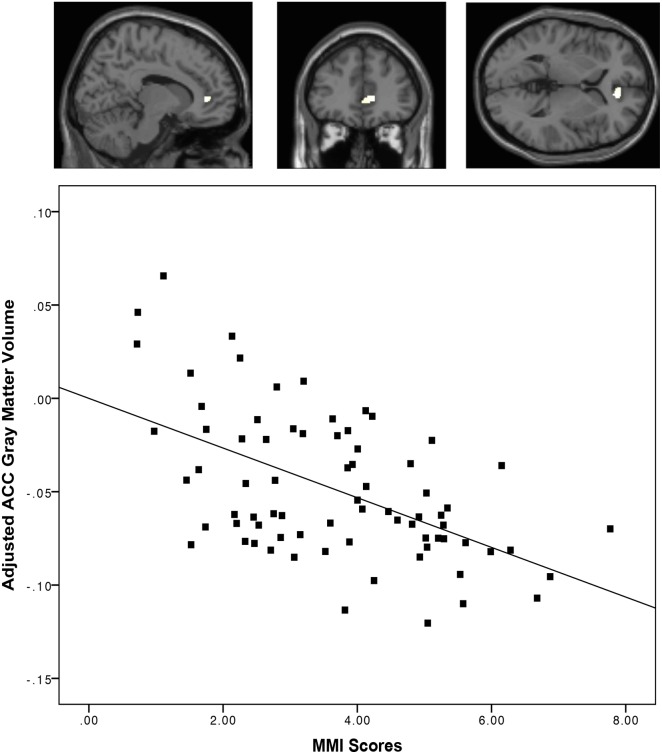
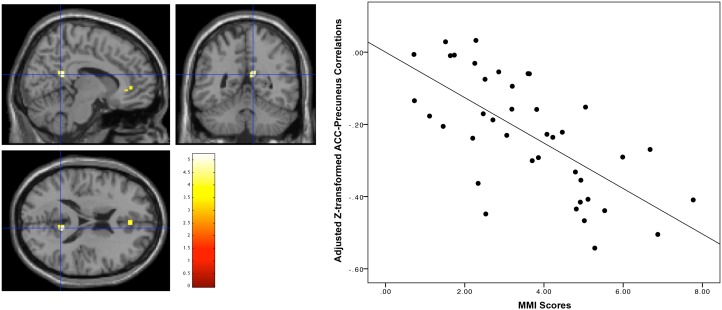
Media multitasking, or the concurrent consumption of multiple media forms, is increasingly prevalent in today's society and has been associated with negative psychosocial and cognitive impacts. Individuals who engage in heavier media-multitasking are found to perform worse on cognitive control tasks and exhibit more socio-emotional difficulties. However, the neural processes associated with media multi-tasking remain unexplored. The present study investigated relationships between media multitasking activity and brain structure. Research has demonstrated that brain structure can be altered upon prolonged exposure to novel environments and experience. Thus, we expected differential engagements in media multitasking to correlate with brain structure variability. This was confirmed via Voxel-Based Morphometry (VBM) analyses: Individuals with higher Media Multitasking Index (MMI) scores had smaller gray matter density in the anterior cingulate cortex (ACC). Functional connectivity between this ACC region and the precuneus was negatively associated with MMI. Our findings suggest a possible structural correlate for the observed decreased cognitive control performance and socio-emotional regulation in heavy media-multitaskers. While the cross-sectional nature of our study does not allow us to specify the direction of causality, our results brought to light novel associations between individual media multitasking behaviors and ACC structure differences.
Overview
The claims and statistics of this paper haven’t been checked yet.
Free: it reads the open-access text and checks the first 5 claims that cite a source we can check. Create a free account to check every claim.
Integrity signals
Registry
Cites
Statistics
Figures
Verification
Claims the paper makes
The claims and statistics of this paper haven’t been checked yet.
Free: it reads the open-access text and checks the first 5 claims that cite a source we can check. Create a free account to check every claim.
Claims other papers make about this one
Each is checked against this paper’s own text: does it say what the citing paper says it does?
The source backs part of the claim, not all of it — or backs it for a different population, condition or comparison.
In the citing paper
“Studies indicate that internet addiction is connected to reduced grey matter density in the frontal cortex of the brain, a region critical for determination and self-control (Loh and Kanai, 2014).”
From SCROLLING AND SUSTAINED ATTENTION: HOW SOCIAL MEDIA INFLUENCE SUSTAINED ATTENTION OF HIGH SCHOOL STUDENTS (2024) · cites this paper as Loh and Kanai, 2014
Experimental — accuracy not yet measuredThe source backs part of the claim, not all of it — or backs it for a different population, condition or comparison.
In the citing paper
“A reduction in grey matter density in the anterior prefrontal cortex, a brain region linked with cognitive and emotional regulation, has been observed, implying potential adverse effects on brain function due to social media usage (Loh and Kanai, 2014).”
From SCROLLING AND SUSTAINED ATTENTION: HOW SOCIAL MEDIA INFLUENCE SUSTAINED ATTENTION OF HIGH SCHOOL STUDENTS (2024) · cites this paper as Loh and Kanai, 2014
Experimental — accuracy not yet measuredThe source backs part of the claim, not all of it — or backs it for a different population, condition or comparison.
In the citing paper
“Individuals who frequently engage in media multitasking (e.g., using multiple digital devices simultaneously) have reduced gray matter density in the anterior cingulate cortex, a brain region associated with cognitive and emotional regulation which suggests that digital media use may have a negative impact on brain structure and function (Loh and Kanai, 2014).”
From The impact of digital technology, social media, and artificial intelligence on cognitive functions: a review (2023) · cites this paper as Loh and Kanai, 2014
Experimental — accuracy not yet measuredThe cited source says what the claim attributes to it.
In the citing paper
“Individuals who frequently engage in media multitasking (e.g., using multiple digital devices simultaneously) have reduced gray matter density in the anterior cingulate cortex, a brain region associated with cognitive and emotional regulation which suggests that digital media use may have a negative impact on brain structure and function (Loh and Kanai, 2014).”
From The impact of digital technology, social media, and artificial intelligence on cognitive functions: a review (2023) · cites this paper as Loh and Kanai, 2014
Self-check
Percentages, sums and reported differences re-computed from the paper’s own numbers.
The self-check needs the paper’s full text.
Citations
Cites
An Integrative Theory of Prefrontal Cortex Function
Miller, E. K., & Cohen, J. D. (2001) · Annual Review of Neuroscience · doi:10.1146/annurev.neuro.24.1.167 · Cited by 12,803 · cited 1×
“Past research has converged on the role of prefrontal cortical regions in cognitive control [12,13,14,15].”
BackgroundA default mode of brain function
Raichle, M. E., MacLeod, A. M., Snyder, A. Z., Powers, W. J., Gusnard, D. A., & Shulman, G. L. (2001) · Proceedings of the National Academy of Sciences · doi:10.1073/pnas.98.2.676 · Cited by 12,190
The Brain's Default Network: Anatomy, Function, and Relevance to Disease
Buckner, R. L., Andrews‐Hanna, J. R., & Schacter, D. L. (2008) · Annals of the New York Academy of Sciences · doi:10.1196/annals.1440.011 · Cited by 9,761
Voxel-Based Morphometry—The Methods
Ashburner, J., & Friston, K. J. (2000) · NeuroImage · doi:10.1006/nimg.2000.0582 · Cited by 8,676 · cited 1×
“Voxel-based morphometry (VBM; [20]) is a commonly used neuroimaging analysis technique that enables voxel-wise statistical analyses of pre-processed MRI images.”
MethodA fast diffeomorphic image registration algorithm
Ashburner, J. (2007) · NeuroImage · doi:10.1016/j.neuroimage.2007.07.007 · Cited by 8,122
(1999) · Cited by 7,995
Conflict monitoring and cognitive control
Botvinick, M. M., Braver, T. S., Barch, D. M., Carter, C. S., & Cohen, J. D. (2001) · Psychological Review · doi:10.1037/0033-295x.108.3.624 · Cited by 7,351
Cognitive and emotional influences in anterior cingulate cortex
Bush, G., Luu, P., & Posner, M. I. (2000) · Trends in Cognitive Sciences · doi:10.1016/s1364-6613(00)01483-2 · Cited by 6,259 · cited 4×
“However, researchers have noted that this delineation is not absolute [23,34,37].”
BackgroundInfluentialHandbook of Personality : Theory and Research
Pervin, L. A. (1992) · Cited by 4,543
Contributions of anterior cingulate cortex to behaviour
Devinsky, O., Morrell, M. J., & Vogt, B. A. (1995) · Brain · doi:10.1093/brain/118.1.279 · Cited by 3,377
Cited by
Lissak, G. (2018) · Environmental Research · doi:10.1016/j.envres.2018.01.015 · Cited by 1,024
The myths of the digital native and the multitasker
Kirschner, P. A., & De Bruyckere, P. (2017) · Teaching and Teacher Education · doi:10.1016/j.tate.2017.06.001 · Cited by 796
“In discussions of educational innovation, especially those discussions relating to either implementing specific information and communication technologies, the need for more effective pedagogies, or experienced problems with motivation, the term digital native (Prensky, 2001, 2006) is inevitably thrown into the arena.…”
BackgroundInfluentialThe “online brain”: How the Internet may be changing our cognition
Firth, J., Torous, J., Stubbs, B., Firth, J. A., Steiner, G. Z., Smith, L., Alvarez‐Jimenez, M., Gleeson, J., Vancampfort, D., Armitage, C. J., et al. (2019) · World Psychiatry · doi:10.1002/wps.20617 · Cited by 694
Sex differences in the developing brain: insights from multimodal neuroimaging
Kaczkurkin, A. N., Raznahan, A., & Satterthwaite, T. D. (2019) · Neuropsychopharmacology · doi:10.1038/s41386-018-0111-z · Cited by 403
Shanmugasundaram, M., & Tamilarasu, A. (2023) · Frontiers in Cognition · doi:10.3389/fcogn.2023.1203077 · Cited by 291
Metadata
- Authors
- Loh, K. K., & Kanai, R.
- Affiliations
- National University of Singapore (SG)
- Corresponding author
- Loh, Kep Kee
- ORCID
- Loh, Kep Kee
- Venue
- PLoS ONE
- Publisher
- Public Library of Science (PLoS)
- Published
- 2014-09-24
- Volume
- 9
- Issue
- 9
- Pages
- e106698
- ISSN
- 1932-6203 (ISSN-L)
- PMC
- PMC4174517
- OpenAlex
- W1981254501
- Semantic Scholar
- f2438046b81a9e37c4f7a296ec5d4f5f37de5769
- Cited by
- 141
- References
- 49
- Citations by year
- 2026: 15 · 2025: 5 · 2024: 9 · 2023: 13 · 2022: 8 · 2021: 10 · 2020: 16 · 2019: 14 · 2018: 18 · 2017: 15 · 2016: 8 · 2015: 9
- FWCI
- 5.95
- Type
- journal article
- Language
- en
- Open access
- gold
- doi.org
- Locations
- PLoS ONE (publishedVersion, cc-by)
- PubMed Central (publishedVersion, cc-by)
- PubMed (publishedVersion)
- Sussex Research Online (University of Sussex) (submittedVersion, cc-by)
- RePEc: Research Papers in Economics (submittedVersion)
- DOAJ (DOAJ: Directory of Open Access Journals) (submittedVersion, cc-by-sa)
- Figshare (submittedVersion, cc-by)
- Funders
- Japan Science and Technology Agency
- Precursory Research for Embryonic Science and Technology
- Topics
- Life Sciences › Neuroscience › Cognitive Neuroscience › Neural and Behavioral Psychology Studies
- Social Sciences › Decision Sciences › Information Systems and Management › Personal Information Management and User Behavior
- Social Sciences › Sociology and Political Science › Impact of Technology on Adolescents
- Keywords
- media multitasking, gray matter density, anterior cingulate cortex, precuneus, functional connectivity, brain structure, cognitive control, neuroplasticity
- MeSH terms
- Adult, Brain, Gyrus Cinguli, Humans, Magnetic Resonance Imaging, Male, Psychomotor Performance, Regression Analysis, Multimedia, Young Adult, Gray Matter
About these checks
Registry, retraction, Cites and statistics results are computed, not judged, with one exception: a printed reference that no index lists is read once by a model before it counts as a citation error. Claims are extracted by a model and kept only when their quote appears verbatim in the text; each cited source is then checked, with a model’s help, for whether it says what the claim relies on. Those verdicts can be wrong — read the claim’s quote and the cited source before relying on one.
Statistics and arithmetic are recomputed, not judged.
Confidence bands are shown only for fields calibrated on our annotated test set. None is calibrated yet, so no band is shown.
What counts as a claim ›How we measure confidence ›How we check this ›
Are you an author, or do you see a problem with this page? Request a review
Data sources
Bibliographic data: Semantic Scholar, OpenAlex, Crossref.
Contains information from the Semantic Scholar Academic Graph Datasets, made available under the ODC Attribution License (ODC-BY 1.0).
Semantic Scholar’s data is described in: Kinney, R., et al. (2023). The Semantic Scholar Open Data Platform. arXiv:2301.10140.
