

From Cognitive Maps to Cognitive Graphs
Open accessThe DOI matches its Crossref record; 40 of the 40 references it cites were found in a registry or an index.
Abstract
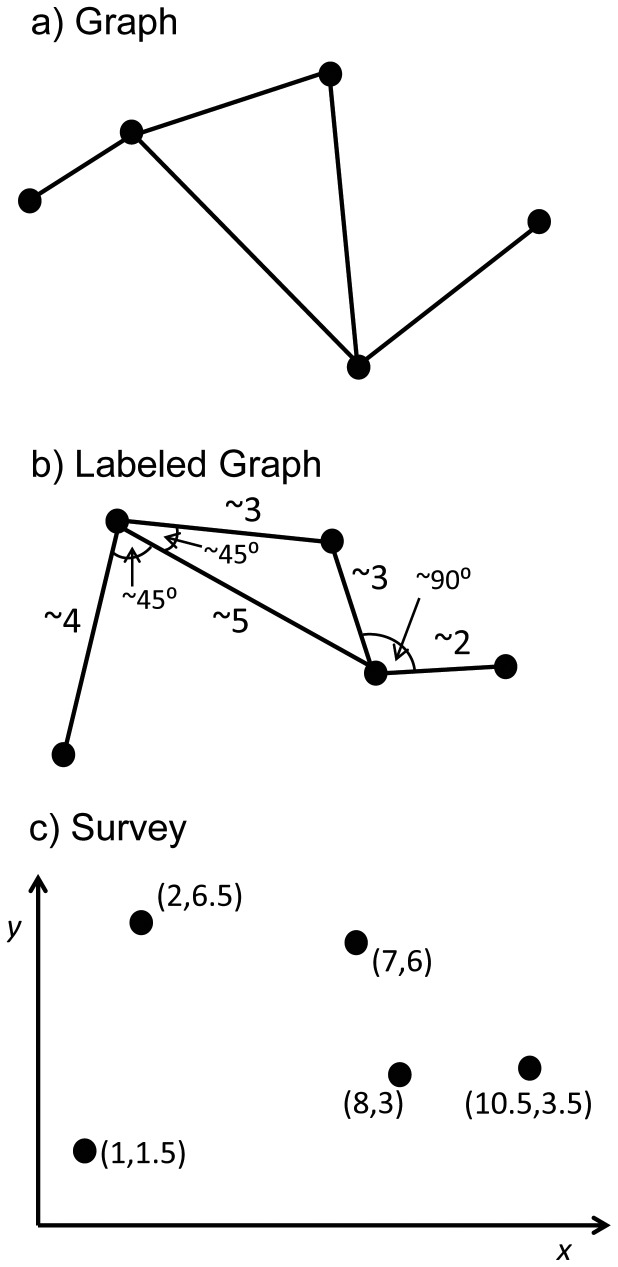
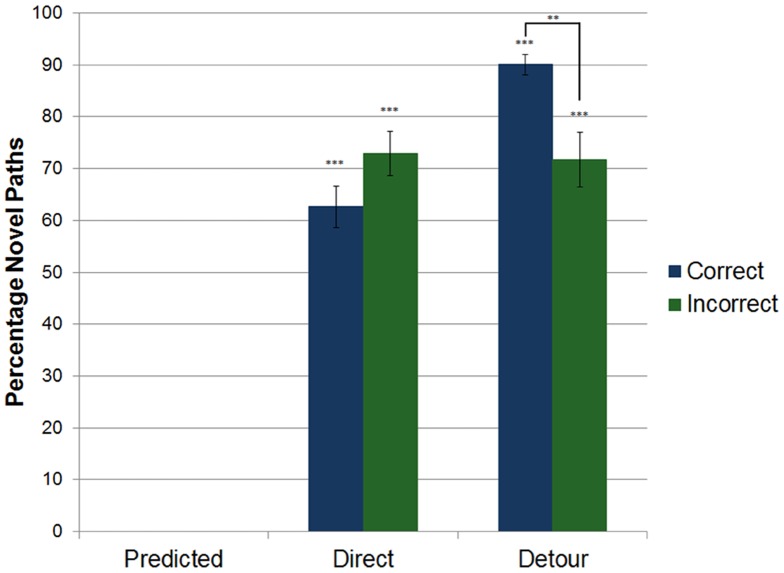
We investigate the structure of spatial knowledge that spontaneously develops during free exploration of a novel environment. We present evidence that this structure is similar to a labeled graph: a network of topological connections between places, labeled with local metric information. In contrast to route knowledge, we find that the most frequent routes and detours to target locations had not been traveled during learning. Contrary to purely topological knowledge, participants typically traveled the shortest metric distance to a target, rather than topologically equivalent but longer paths. The results are consistent with the proposal that people learn a labeled graph of their environment.
Overview
The claims and statistics of this paper haven’t been checked yet.
Free: it reads the open-access text and checks the first 5 claims that cite a source we can check. Create a free account to check every claim.
Integrity signals
Registry
Cites
Statistics
Figures
Verification
Claims the paper makes
The claims and statistics of this paper haven’t been checked yet.
Free: it reads the open-access text and checks the first 5 claims that cite a source we can check. Create a free account to check every claim.
Claims other papers make about this one
Each is checked against this paper’s own text: does it say what the citing paper says it does?
The source backs part of the claim, not all of it — or backs it for a different population, condition or comparison.
In the citing paper
“This suggests that cognitive maps may take on a graph or topographic form across multiple hierarchies (Chrastil & Warren, 2014; Peer et al., 2020).”
From Cognitive Maps for a Non-Euclidean Environment: Path Integration and Spatial Memory on a Sphere (2024) · cites this paper as Chrastil & Warren, 2014
Experimental — accuracy not yet measuredIn the citing paper
“In addition to urban features, vertices can bear characteristics of human behaviour such as pedestrian travel decisions. Relationships between vertices in a graph can vary, from representation of direct connections or distances to route-related choices (Boeing, 2020;Chrastil and Warren, 2014;Franz et al., 2005;Warren et al., 2017;Werner et al., 2000).”
From Urban planning and design with points of interest and visual perception (2024) · cites this paper as Chrastil and Warren, 2014
Self-check
Percentages, sums and reported differences re-computed from the paper’s own numbers.
The self-check needs the paper’s full text.
Citations
Cites
Harary, F. (1969) · Cited by 10,739
Gallistel, C. R. (1990) · Cited by 2,571
Path integration and the neural basis of the 'cognitive map'
McNaughton, B. L., Battaglia, F. P., Jensen, O., Moser, E. I., & Moser, M.-B. (2006) · Nature Reviews Neuroscience · doi:10.1038/nrn1932 · Cited by 2,024 · cited 1×
“Such a Euclidean cognitive map might be built up by path integration during spatial learning [3,4], and it would enable direct shortcuts between known locations.”
BackgroundPackard, M. G., & McGaugh, J. L. (1996) · Neurobiology of Learning and Memory · doi:10.1006/nlme.1996.0007 · Cited by 1,492 · cited 1×
“Neural evidence indicates that brain areas supporting habitual route learning are active at a later stage of learning [e.g. 36,37], consistent with the idea that navigators rely on different forms of spatial knowledge at different stages of learning and for different purposes [38].”
BackgroundDevelopment of a self-report measure of environmental spatial ability
Hegarty, M. (2002) · Intelligence · doi:10.1016/s0160-2896(02)00116-2 · Cited by 1,023 · cited 1×
“First, they completed (a) the Santa Barbara Sense of Direction Scale (SBSOD), in which lower scores indicate better sense of direction [27].”
MethodThe Well-Worn Route and the Path Less Traveled
Hartley, T., Maguire, E. A., Spiers, H. J., & Burgess, N. (2003) · Neuron · doi:10.1016/s0896-6273(03)00095-3 · Cited by 817 · cited 1×
“Neural evidence indicates that brain areas supporting habitual route learning are active at a later stage of learning [e.g. 36,37], consistent with the idea that navigators rely on different forms of spatial knowledge at different stages of learning and for different purposes [38].”
BackgroundWhat determines our navigational abilities?
Wolbers, T., & Hegarty, M. (2010) · Trends in Cognitive Sciences · doi:10.1016/j.tics.2010.01.001 · Cited by 810 · cited 2×
“Finally, individual differences in spatial ability could affect the navigational strategies used in this task [26].”
BackgroundIaria, G., Petrides, M., Dagher, A., Pike, B., & Bohbot, V. D. (2003) · The Journal of Neuroscience · doi:10.1523/jneurosci.23-13-05945.2003 · Cited by 799 · cited 1×
“It is possible that the most successful navigators were those who were able to translate between perspectives [26,35].”
BackgroundEvidence of hierarchies in cognitive maps
Hirtle, S. C., & Jonides, J. (1985) · Memory & Cognition · doi:10.3758/bf03197683 · Cited by 655 · cited 1×
“For example, distance estimates between locations frequently violate Euclidean axioms [15,17–21], and the addition of turns [6,22], intersections [23], or barriers [14] can increase the subjective distance of a route.”
BackgroundDistortions in memory for maps
Tversky, B. (1981) · Cognitive Psychology · doi:10.1016/0010-0285(81)90016-5 · Cited by 639 · cited 1×
“For example, distance estimates between locations frequently violate Euclidean axioms [15,17–21], and the addition of turns [6,22], intersections [23], or barriers [14] can increase the subjective distance of a route.”
Background
Research works printed but not linked: 1
- Zacks JM, Mires J, Tversky B, Hazeltine E (2000) Mental spatial transformations of objects and perspective. Spat Cogn Comput 2: 315– 332. · doi:10.1023/a:1015584100204
Cited by
Items 101–153 of 153
Human path integration and the neural underpinnings
Chrastil, E. R. (2023) · Elsevier eBooks · doi:10.1016/b978-0-12-820480-1.00016-4 · Cited by 4
Self-citationPlan Explanations that Exploit a Cognitive Spatial Model
Korpan, R., & Epstein, S. L. (2021) · doi:10.18653/v1/2021.splurobonlp-1.7 · Cited by 1
“Other recent work suggests that people use a cognitive graph with labeled metric information that captures connectivity and patterns (Chrastil and Warren, 2014; Warren et al., 2017).”
BackgroundChen, W., Li, W., Huang, Y., & Ding, X. (2024) · Journal of Memory and Language · doi:10.1016/j.jml.2024.104587 · Cited by 2
Differential contributions of global and local object landmarks in human wayfinding behavior
Lin, W., & Chang, E. C. (2025) · Memory & Cognition · doi:10.3758/s13421-025-01807-9 · Cited by 1
“In contrast, global landmarks may require extended exposure before they can be effectively incorporated into an allocentric geometric framework that supports survey knowledge (Chrastil & Warren, 2014; Weisberg & Newcombe, 2018).”
InfluentialMuffato, V., Miola, L., Errigo, S., Pazzaglia, F., & Meneghetti, C. (2025) · Cognitive Research Principles and Implications · doi:10.1186/s41235-025-00696-5 · Cited by 1
“In terms of joystick familiarity, we expected an impact on exploration behaviors (Chrastil & Warren, 2014; Puthusseryppady et al., 2024).”
InfluentialNavigating Cognitive Maps: Statistical Analysis of 3D Path Data in Minecraft
Zhang, J., Shuster, A. E., Morehouse, A. B., Mednick, S. C., Yu, Z., Shen, W., & Simon, K. C. N. S. (2026) · Psychometrika · doi:10.1017/psy.2025.10069 · Cited by 1
“Our application of this algorithm to understand movement in Minecraft builds on graph-based models to analyze trajectory data (Chrastil & Warren, 2014; Spaccapietra et al., 2008).”
How Does Aging Impact the Structure and Function of Parallel Navigation Circuits across Mammals?
Barnes, C. A., Srivathsa, S., Hill, P. F., Srokova, S., & Ekstrom, A. D. (2026) · Springer eBooks · doi:10.1007/978-3-032-20563-6_13 · Cited by 1
Cognitive maps as a medium for thought
Yousif, S. R., & Epstein, R. A. (2026) · Trends in Cognitive Sciences · doi:10.1016/j.tics.2026.07.010 · Cited by 2
Yu, Y., Setogawa, T., Matsumoto, J., Nishimaru, H., & Nishijo, H. (2022) · AIMS neuroscience · doi:10.3934/neuroscience.2022021 · Cited by 2
“Recent human behavioral studies suggest that the allocentric spatial knowledge required for navigation in a real environment and drawing routes on a map can be represented as a labeled graph [28,29].”
Enhancing Safety and Efficiency through Explainable Transfer Learning
Guo, Y., & Sycara, K. P. (2024) · Artificial intelligence · doi:10.5772/intechopen.115536 · Cited by 1
Flexible Path Planning Through Vicarious Trial and ErrorPreprint
Krichmar, J. L., Ketz, N., Pilly, P. K., & Soltoggio, A. (2021) · bioRxiv (Cold Spring Harbor Laboratory) · doi:10.1101/2021.09.08.459317 · Cited by 3
“Moreover, they can express spatial knowledge in the form of novel shortcuts over locations not previously explored [Chrastil and Warren, 2014, Boone et al., 2019].”
BackgroundHuffman, D. J., Ekstrom, A. D., & Jaha, N. (2026) · bioRxiv (Cold Spring Harbor Laboratory) · doi:10.64898/2026.02.10.705053 · Cited by 1
Topological structure in human spatial representation revealed through drawingPreprint
Kittur, M., Zhang, A., Bryce, N. V., & Yousif, S. R. (2026) · bioRxiv (Cold Spring Harbor Laboratory) · doi:10.64898/2026.06.12.731853 · Cited by 1
“Indeed, a topological perspective can help to unify disparate ideas in vision science (Chen, 2005), developmental psychology (Piaget & Inhelder, 1948), and spatial navigation (Chrastil & Warren, 2014; Warren et al., 2017).”
InfluentialCobo, A. (2018) · UPM Digital Archive (Technical University of Madrid) · doi:10.20868/upm.thesis.52403 · Cited by 1
A Separate Data Structure for Online Multi-hypothesis Topological Mapping
Gong, C., Chen, G., Dong, W., Sheng, X., & Zhu, X. (2019) · Lecture notes in computer science · doi:10.1007/978-3-030-27538-9_58
Deliberate Exploration Supports Navigation in Unfamiliar WorldsPreprint
Korpan, R., & Epstein, S. L. (2020) · arXiv (Cornell University) · doi:10.48550/arxiv.2007.00798
“ts successful travel in a challenging, realistic space. I. INTRODUCTION A cognitive spatial model is a mental representation that captures connectivity, distances, patterns, and topological structure [1]. Navigators learn such a model based on their perception and their experience [2]. The thesis of our work is that l…”
Akimoto, K., Fukawa, A., & Yairi, I. E. (2021) · Advances in intelligent systems and computing · doi:10.1007/978-3-030-73113-7_21
Cheng, Y., & Chrastil, L. (2021) · PsyArXiv (OSF Preprints) · doi:10.31234/osf.io/7ygk2
Faculty Opinions recommendation of Processing of different spatial scales in the human brain.
Grady, C. L., & Rieck, J. R. (2020) · Faculty Opinions – Post-Publication Peer Review of the Biomedical Literature · doi:10.3410/f.736581491.793570869
Navigational systems in the human brain dynamically code for past, present, and future trajectoriesPreprint
Cheng, Y., Ling, S., Stern, C. E., & Chrastil, E. R. (2023) · bioRxiv (Cold Spring Harbor Laboratory) · doi:10.1101/2023.08.22.554387
Self-citationEffects of brain lesions on human spatial navigation
Li, A., Lei, X., & Rosenbaum, R. S. (2024) · Elsevier eBooks · doi:10.1016/b978-0-12-820480-1.00153-4
Structured Action Preparation during Visuomotor Decision-makingPreprint
Trach, J. E., & McDougle, S. D. (2024) · PsyArXiv (OSF Preprints) · doi:10.31234/osf.io/pkez6
Spatial memory and its role in navigation and episodic memory
Zheng, L. J., & Ekstrom, A. D. (2024) · Elsevier eBooks · doi:10.1016/b978-0-443-15754-7.00021-3
Reynoso-Cruz, J. E., Sánchez‐Solano, K. G., Torres, C. E. R., & Salazar, L. T. H. (2024) · International Journal of Comparative Psychology · doi:10.46867/ijcp.20312
Mental graphs structure the storage and retrieval of visuomotor associationsPreprint
Trach, J. E., & McDougle, S. D. (2024) · PsyArXiv (OSF Preprints) · doi:10.31234/osf.io/pkez6_v1
Glennerster, A. (2025) · Neuropsychologia · doi:10.1016/j.neuropsychologia.2025.109233
Flexible navigation with neuromodulated cognitive maps
Danieli, K., & Lepperød, M. E. (2026) · PLoS Computational Biology · doi:10.1371/journal.pcbi.1013487 · Cited by 1
“However, an approach that can scale poorly [13, 14, 15].”
Graph properties drive navigational selection between equidistant routes
Chi, L., Starrett, M. J., Rao, Y., & Chrastil, E. R. (2025) · Neuropsychologia · doi:10.1016/j.neuropsychologia.2025.109310
“Additionally, this study does not differentiate between specific types of cognitive graph knowledge, such as topological graph, labeled graph, or route-based knowledge (Chrastil and Warren, 2014; Peer et al., 2021; Warren, 2019).”
Self-citationSensori-motricité et espaces de navigation
Lhuillier, S., & Gyselinck, V. (2024) · HAL
Jaeger, A. J., Weisberg, S. M., Nazareth, A., & Newcombe, N. S. (2024) · Figshare · doi:10.6084/m9.figshare.26606590
Muffato, V., Miola, L., Pellegrini, M., Pazzaglia, F., & Meneghetti, C. (2024) · Figshare · doi:10.6084/m9.figshare.26608084
The Impact of Endocrine Aging on Spatial Navigation
Yu, S. (2023) · eScholarship (California Digital Library)
Navigators learn a local graph, not a global mapPreprint
Strickrodt, M., Meilinger, T., Bülthoff, H., & Warren, W. (2026) · bioRxiv (Cold Spring Harbor Laboratory) · doi:10.64898/2026.01.11.698858
“…of places, such as a topological graph in which nodes correspond to places and edges to paths linking them, augmented by local metric information about the rotation and translation between places (e.g., Chrastil & Warren, 2014; Meilinger, 2008; Warren, Rothman, Schnapp, & Ericson, 2017).”
Self-citationSpaces and sequences in the hippocampus: a homological perspective
Babichev, A., Vashin, V., & Dabaghian, Y. A. (2026) · Journal of Computational Neuroscience · doi:10.1007/s10827-026-00923-y
“…as the clique complex associated with the graph of coactivity, G , also known as the cognitive graph (Muller et al., 1996; Trullier & Meyer, 2000; Chrastil & Warren, 2014; Burgess & O’Keefe, 1996; Peer et al., 2021; Ericson & Warren, Physiologically, such a graph may arise, for example, as the…”
Building Goal-Directed Cognitive GraphsPreprint
Gungi, A., Sepúlveda, P., Aitsahalia, I. F., Blanco-Pozo, M., & Iigaya, K. (2026) · bioRxiv (Cold Spring Harbor Laboratory) · doi:10.64898/2026.02.18.706628
Computation and cognitive maps: Symbols and spaces, or paths and graphs?
Farquharson, R. P. (2026) · Mind & Language · doi:10.1111/mila.70028
Newton, C., Barnes, C. A., Flanagin, V. L., Gillespie, A. K., Hornberger, M., Moffat, S. D., Schinazi, V. R., Segen, V., Wiener, J. M., Weisberg, S. M., et al. (2026) · Springer eBooks · doi:10.1007/978-3-032-20563-6_16
Spatial Navigation in Humans and Rodents: Bridging Levels of Analyses
Ólafsdóttir, H. F., Bičanski, A., Creem-Regehr, S. H., Dilks, D. D., Donato, F., Epstein, R. A., Farran, E. K., Jacobs, J., Kunz, L., Wills, T. J., et al. (2026) · Springer eBooks · doi:10.1007/978-3-032-20563-6_9
Knowledge representation and exploitation for interactive and cognitive robots
Sarthou, G. (2021) · theses.fr (ABES) · doi:10.70675/624ce40cz548az4e5fzb844zae88b9e3e8e4 · Cited by 2
Spatial navigation in the monkey : A cross-species journey beyond the hippocampus
Vericel, M. (2023) · theses.fr (ABES) · doi:10.70675/52a4ad4dz3531z4d75zb09cz465a96a3c117
All Eyes on the Hippocampus: The Primate Hippocampus as a Visually-Guided Cognitive Graph
Cognitive Science Society 2025, Bonin, A., Dang, L., Doherty, O., Huffman, D., & Shakya, A. (2025) · eScholarship (California Digital Library) · doi:10.48448/r5q8-yf83
Cognitive Maps: Some People Make Them, Some People StrugglePreprint
Newcombe, N. S., & Weisberg, S. M. (2023) · OSF Preprints (OSF Preprints)
Mental Representations of Impossible Non-Euclidean Environments
McAvan, A. S., & McNamara, T. P. (2026) · Psychological Research · doi:10.1007/s00426-026-02297-3
“or as cognitive graphs (e.g., Chrastil & Warren, 2014).”
Brain-inspired representations of urban space
Manley, E., & McNamee, D. (2026) · International Journal of Geographical Information Science · doi:10.1080/13658816.2026.2660988
“These findings have prompted interest in how non-Euclidean or graph-like models influence spatial navigation (Chrastil and Warren 2014).”
Reward selectively preserves relational structure in memory
Lee, S., & Bakkour, A. (2026) · Cognition · doi:10.1016/j.cognition.2026.106673
The Contribution of Spatially Tuned Brain Cells to Human Navigation Performance
Dickmann, F., Korte, A., ́Meara, D. O., Oster, C., Edler, D., Axmacher, N., & Keil, J. (2026) · KN - Journal of Cartography and Geographic Information · doi:10.1007/s42489-026-00225-4
“A theoretical framework that integrates these different sources of spatial information is the cognitive graph model proposed by Chrastil and Warren (2014).”
Topological structure in human spatial representation revealed through drawingPreprint
Kittur, M., Zhang, A., Bryce, N. V., & Yousif, S. R. (2026) · eLife · doi:10.7554/elife.112077
Topological structure in human spatial representation revealed through drawingPreprint
Kittur, M., Zhang, A., Bryce, N. V., & Yousif, S. R. (2026) · eLife · doi:10.7554/elife.112077.1
When do sex differences manifest? Context-dependent modulation of spatial memory
Fiedler, J. (2025) · SDL
A Simple Framework for Visual Navigation
Johnson, F., Cao, B. B., Jain, S., Ashok, A., & Dana, K. (2026) · doi:10.1109/cvprf71909.2026.00308 · Cited by 1
“In psychology, the concept of cognitive maps and graphs [17, 20, 44, 54] formalizes this intuition, with studies showing that humans encode rel-1 Code is available at https://github.com/visnavdev/feudalnav. ative distances between landmarks as approximate graphs.”
Metadata
- Authors
- Chrastil, E. R., & Warren, W. H.
- Affiliations
- Boston University (US)
- Brown University (US)
- Corresponding author
- Chrastil, Elizabeth R.
- Venue
- PLoS ONE
- Publisher
- Public Library of Science (PLoS)
- Published
- 2014-11-12
- Volume
- 9
- Issue
- 11
- Pages
- e112544
- ISSN
- 1932-6203 (ISSN-L)
- PMC
- PMC4229194
- OpenAlex
- W2048742326
- Semantic Scholar
- e68bdc638f9c795c83a49f1ae1b9ff8a3cadd3a0
- Cited by
- 146
- References
- 40
- Citations by year
- 2026: 23 · 2025: 12 · 2024: 15 · 2023: 18 · 2022: 10 · 2021: 14 · 2020: 13 · 2019: 13 · 2018: 13 · 2017: 7 · 2016: 3 · 2015: 3 · 2014: 2
- FWCI
- 6.12
- Type
- journal article
- Language
- en
- Open access
- gold
- doi.org
- Locations
- PLoS ONE (publishedVersion, cc-by)
- Europe PMC (PubMed Central) (publishedVersion, cc-by)
- PubMed Central (publishedVersion, cc-by)
- PubMed (publishedVersion)
- eScholarship (California Digital Library) (submittedVersion, cc-by)
- RePEc: Research Papers in Economics (submittedVersion)
- DOAJ (DOAJ: Directory of Open Access Journals) (submittedVersion)
- eScholarship (California Digital Library) (submittedVersion)
- Funders
- National Science Foundation (0843940)
- Topics
- Social Sciences › Psychology › Experimental and Cognitive Psychology › Spatial Cognition and Navigation
- Life Sciences › Neuroscience › Cognitive Neuroscience › Memory and Neural Mechanisms
- Social Sciences › Geography, Planning and Development › Geography Education and Pedagogy
- Keywords
- cognitive maps, cognitive graphs, spatial knowledge, route learning, metric distance, free exploration, novel environment, shortest path, detours, graph learning
- MeSH terms
- Adult, Cognition, Female, Humans, Learning, Male, Orientation, Pattern Recognition, Visual, Space Perception, User-Computer Interface, Maze Learning, Knowledge
About these checks
Registry, retraction, Cites and statistics results are computed, not judged, with one exception: a printed reference that no index lists is read once by a model before it counts as a citation error. Claims are extracted by a model and kept only when their quote appears verbatim in the text; each cited source is then checked, with a model’s help, for whether it says what the claim relies on. Those verdicts can be wrong — read the claim’s quote and the cited source before relying on one.
Statistics and arithmetic are recomputed, not judged.
Confidence bands are shown only for fields calibrated on our annotated test set. None is calibrated yet, so no band is shown.
What counts as a claim ›How we measure confidence ›How we check this ›
Are you an author, or do you see a problem with this page? Request a review
Data sources
Bibliographic data: Semantic Scholar, OpenAlex, Crossref.
Contains information from the Semantic Scholar Academic Graph Datasets, made available under the ODC Attribution License (ODC-BY 1.0).
Semantic Scholar’s data is described in: Kinney, R., et al. (2023). The Semantic Scholar Open Data Platform. arXiv:2301.10140.
