

From Cognitive Maps to Cognitive Graphs
Open accessThe DOI matches its Crossref record; 40 of the 40 references it cites were found in a registry or an index.
Abstract
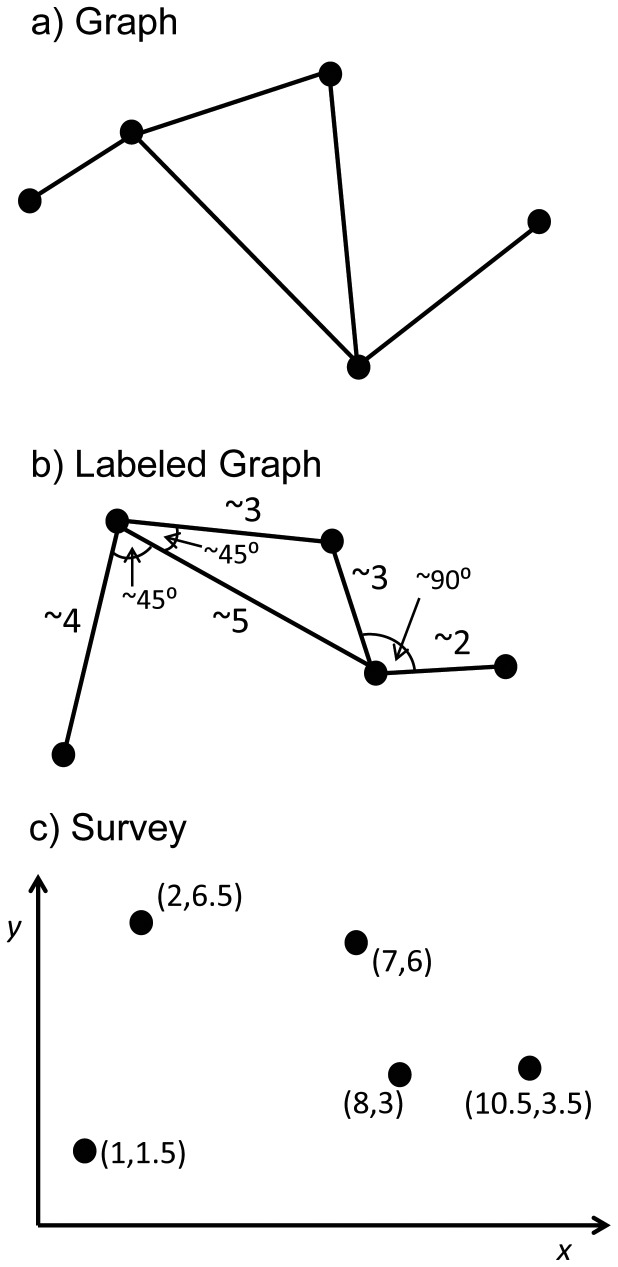
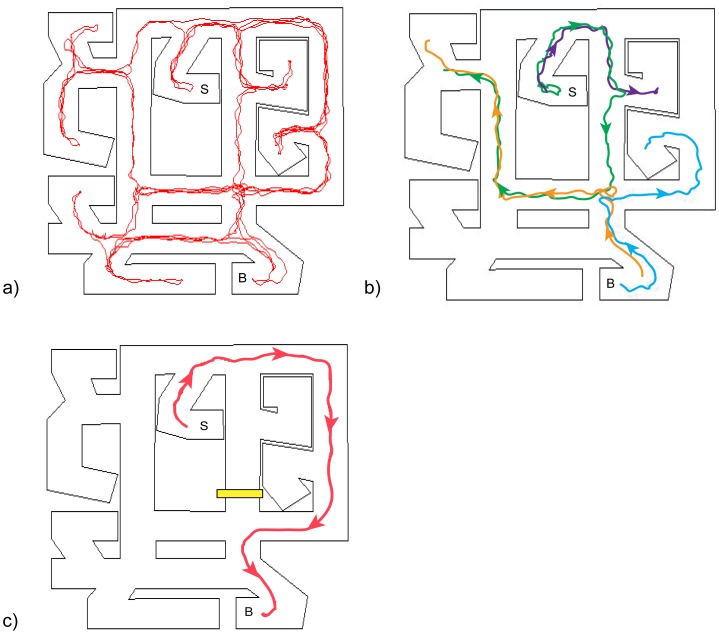
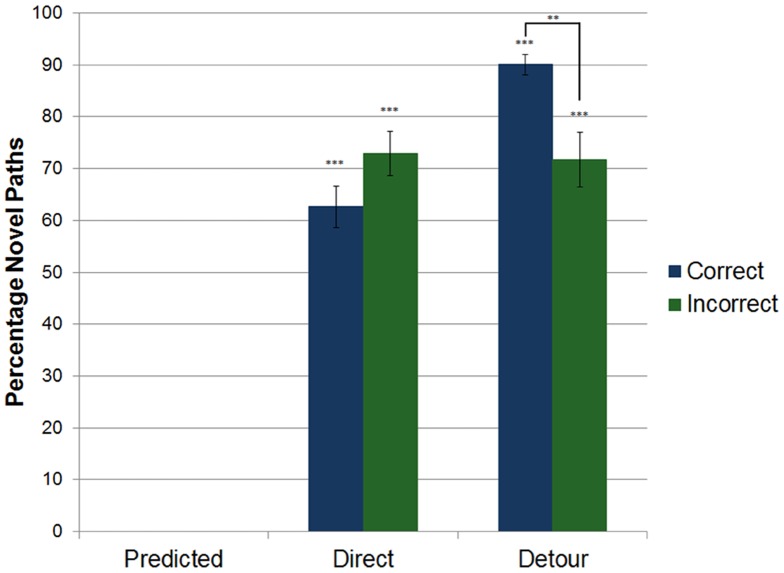
We investigate the structure of spatial knowledge that spontaneously develops during free exploration of a novel environment. We present evidence that this structure is similar to a labeled graph: a network of topological connections between places, labeled with local metric information. In contrast to route knowledge, we find that the most frequent routes and detours to target locations had not been traveled during learning. Contrary to purely topological knowledge, participants typically traveled the shortest metric distance to a target, rather than topologically equivalent but longer paths. The results are consistent with the proposal that people learn a labeled graph of their environment.
Overview
The claims and statistics of this paper haven’t been checked yet.
Free: it reads the open-access text and checks the first 5 claims that cite a source we can check. Create a free account to check every claim.
Integrity signals
Registry
Cites
Statistics
Figures
Verification
Claims the paper makes
The claims and statistics of this paper haven’t been checked yet.
Free: it reads the open-access text and checks the first 5 claims that cite a source we can check. Create a free account to check every claim.
Claims other papers make about this one
Each is checked against this paper’s own text: does it say what the citing paper says it does?
The source backs part of the claim, not all of it — or backs it for a different population, condition or comparison.
In the citing paper
“This suggests that cognitive maps may take on a graph or topographic form across multiple hierarchies (Chrastil & Warren, 2014; Peer et al., 2020).”
From Cognitive Maps for a Non-Euclidean Environment: Path Integration and Spatial Memory on a Sphere (2024) · cites this paper as Chrastil & Warren, 2014
Experimental — accuracy not yet measuredIn the citing paper
“In addition to urban features, vertices can bear characteristics of human behaviour such as pedestrian travel decisions. Relationships between vertices in a graph can vary, from representation of direct connections or distances to route-related choices (Boeing, 2020;Chrastil and Warren, 2014;Franz et al., 2005;Warren et al., 2017;Werner et al., 2000).”
From Urban planning and design with points of interest and visual perception (2024) · cites this paper as Chrastil and Warren, 2014
Self-check
Percentages, sums and reported differences re-computed from the paper’s own numbers.
The self-check needs the paper’s full text.
Citations
Cites
Harary, F. (1969) · Cited by 10,739
Gallistel, C. R. (1990) · Cited by 2,571
Path integration and the neural basis of the 'cognitive map'
McNaughton, B. L., Battaglia, F. P., Jensen, O., Moser, E. I., & Moser, M.-B. (2006) · Nature Reviews Neuroscience · doi:10.1038/nrn1932 · Cited by 2,024 · cited 1×
“Such a Euclidean cognitive map might be built up by path integration during spatial learning [3,4], and it would enable direct shortcuts between known locations.”
BackgroundPackard, M. G., & McGaugh, J. L. (1996) · Neurobiology of Learning and Memory · doi:10.1006/nlme.1996.0007 · Cited by 1,492 · cited 1×
“Neural evidence indicates that brain areas supporting habitual route learning are active at a later stage of learning [e.g. 36,37], consistent with the idea that navigators rely on different forms of spatial knowledge at different stages of learning and for different purposes [38].”
BackgroundDevelopment of a self-report measure of environmental spatial ability
Hegarty, M. (2002) · Intelligence · doi:10.1016/s0160-2896(02)00116-2 · Cited by 1,023 · cited 1×
“First, they completed (a) the Santa Barbara Sense of Direction Scale (SBSOD), in which lower scores indicate better sense of direction [27].”
MethodThe Well-Worn Route and the Path Less Traveled
Hartley, T., Maguire, E. A., Spiers, H. J., & Burgess, N. (2003) · Neuron · doi:10.1016/s0896-6273(03)00095-3 · Cited by 817 · cited 1×
“Neural evidence indicates that brain areas supporting habitual route learning are active at a later stage of learning [e.g. 36,37], consistent with the idea that navigators rely on different forms of spatial knowledge at different stages of learning and for different purposes [38].”
BackgroundWhat determines our navigational abilities?
Wolbers, T., & Hegarty, M. (2010) · Trends in Cognitive Sciences · doi:10.1016/j.tics.2010.01.001 · Cited by 810 · cited 2×
“Finally, individual differences in spatial ability could affect the navigational strategies used in this task [26].”
BackgroundIaria, G., Petrides, M., Dagher, A., Pike, B., & Bohbot, V. D. (2003) · The Journal of Neuroscience · doi:10.1523/jneurosci.23-13-05945.2003 · Cited by 799 · cited 1×
“It is possible that the most successful navigators were those who were able to translate between perspectives [26,35].”
BackgroundEvidence of hierarchies in cognitive maps
Hirtle, S. C., & Jonides, J. (1985) · Memory & Cognition · doi:10.3758/bf03197683 · Cited by 655 · cited 1×
“For example, distance estimates between locations frequently violate Euclidean axioms [15,17–21], and the addition of turns [6,22], intersections [23], or barriers [14] can increase the subjective distance of a route.”
BackgroundDistortions in memory for maps
Tversky, B. (1981) · Cognitive Psychology · doi:10.1016/0010-0285(81)90016-5 · Cited by 639 · cited 1×
“For example, distance estimates between locations frequently violate Euclidean axioms [15,17–21], and the addition of turns [6,22], intersections [23], or barriers [14] can increase the subjective distance of a route.”
BackgroundCognitive maps, cognitive collages, and spatial mental models
Tversky, B. (1993) · Lecture Notes in Computer Science · doi:10.1007/3-540-57207-4_2 · Cited by 635
A dissociation between object manipulation spatial ability and spatial orientation ability
Kozhevnikov, M., & Hegarty, M. (2001) · Memory & Cognition · doi:10.3758/bf03200477 · Cited by 629 · cited 1×
“Finally, participants were given (d) the Perspective-Taking Test (PTSOT) [31], in which they view a 2D array of objects on a page, and indicate their directions from different imagined viewpoints.”
MethodMental representations of spatial relations
McNamara, T. P. (1986) · Cognitive Psychology · doi:10.1016/0010-0285(86)90016-2 · Cited by 572 · cited 1×
“A number of studies have cast doubt on a globally consistent Euclidean cognitive map [6,12–16].”
BackgroundSimultaneous Localization and Mapping
Thrun, S. (2007) · Springer Tracts in Advanced Robotics · doi:10.1007/978-3-540-75388-9_3 · Cited by 530 · cited 1×
“A cognitive map is commonly thought of as globally consistent survey knowledge with a common coordinate system, also known as a global metric embedding [2].”
Systems of Spatial Reference in Human Memory
Shelton, A. L., & McNamara, T. P. (2001) · Cognitive Psychology · doi:10.1006/cogp.2001.0758 · Cited by 490 · cited 1×
“This finding is consistent with studies demonstrating that spatial errors are frequently made when navigators must imagine a change in direction [32].”
ResultFoo, P., Warren, W. H., Duchon, A., & Tarr, M. J. (2005) · Journal of Experimental Psychology: Learning, Memory, and Cognition · doi:10.1037/0278-7393.31.2.195 · Cited by 406
Self-citationBIOLOGICALLY BASED ARTIFICIAL NAVIGATION SYSTEMS: REVIEW AND PROSPECTS
TRULLIER, O., WIENER, S. I., BERTHOZ, A., & MEYER, J.-A. (1997) · Progress in Neurobiology · doi:10.1016/s0301-0082(96)00060-3 · Cited by 363 · cited 1×
“Several possible forms of spatial knowledge may underlie human navigation [1].”
BackgroundCognitive Maps in Children and Men
Kosslyn, S. M., Pick, H. L., & Fariello, G. R. (1974) · Child Development · doi:10.1111/j.1467-8624.1974.tb00655.x · Cited by 260 · cited 1×
“For example, distance estimates between locations frequently violate Euclidean axioms [15,17–21], and the addition of turns [6,22], intersections [23], or barriers [14] can increase the subjective distance of a route.”
BackgroundByrne, R. W. (1979) · Quarterly Journal of Experimental Psychology · doi:10.1080/14640747908400714 · Cited by 258 · cited 3×
“For example, distance estimates between locations frequently violate Euclidean axioms [15,17–21], and the addition of turns [6,22], intersections [23], or barriers [14] can increase the subjective distance of a route.”
BackgroundPrototypes, location, and associative networks (PLAN): Towards a unified theory of cognitive mapping
Chown, E. (1995) · Cognitive Science · doi:10.1016/0364-0213(95)90003-9 · Cited by 220 · cited 1×
“Thus, graph knowledge would express the known connectivity of the environment [6–11], enabling novel detours.”
BackgroundThe Perception of Traversed Distance
Sadalla, E. K., & Magel, S. G. (1980) · Environment and Behavior · doi:10.1177/0013916580121005 · Cited by 212 · cited 1×
“For example, distance estimates between locations frequently violate Euclidean axioms [15,17–21], and the addition of turns [6,22], intersections [23], or barriers [14] can increase the subjective distance of a route.”
BackgroundCognitive Maps in Children and Men
Kosslyn, S. M., Pick, H. L., & Fariello, G. R. (1974) · Child Development · doi:10.2307/1127837 · Cited by 206
Active and passive spatial learning in human navigation: Acquisition of graph knowledge.
Chrastil, E. R., & Warren, W. H. (2015) · Journal of Experimental Psychology: Learning, Memory, and Cognition · doi:10.1037/xlm0000082 · Cited by 175
Self-citationModelling Navigational Knowledge by Route Graphs
Werner, S., Krieg-Brückner, B., & Herrmann, T. (2000) · Lecture notes in computer science · doi:10.1007/3-540-45460-8_22 · Cited by 170 · cited 1×
“Thus, graph knowledge would express the known connectivity of the environment [6–11], enabling novel detours.”
BackgroundActive and passive spatial learning in human navigation: Acquisition of survey knowledge.
Chrastil, E. R., & Warren, W. H. (2013) · Journal of Experimental Psychology: Learning, Memory, and Cognition · doi:10.1037/a0032382 · Cited by 170 · cited 2×
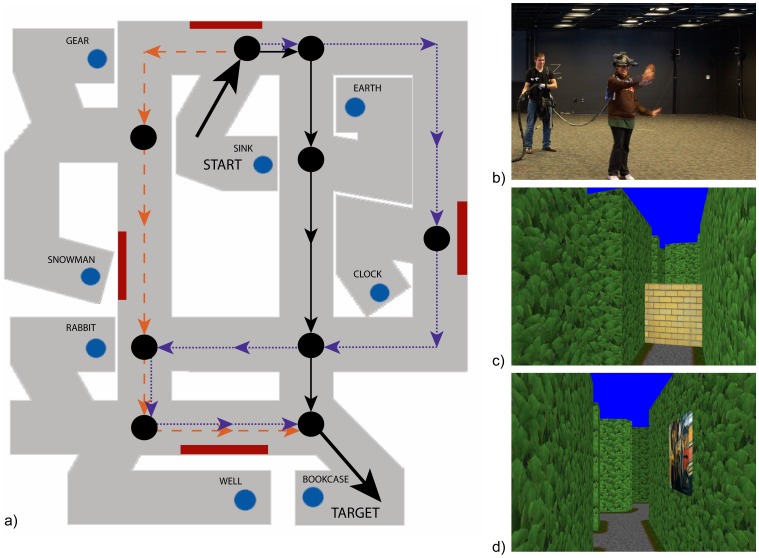
“For comparison with survey knowledge, we previously used this same maze to test survey learning in a separate group of participants [24].”
MethodSelf-citationThe Perception of Traversed Distance: Intersections
Sadalla, E. K., & Staplin, L. J. (1980) · Environment and Behavior · doi:10.1177/0013916580122003 · Cited by 165
The Network of Reference Frames Theory: A Synthesis of Graphs and Cognitive Maps
Meilinger, T. (2008) · Lecture notes in computer science · doi:10.1007/978-3-540-87601-4_25 · Cited by 135 · cited 1×
“Graph knowledge may be intermediate between these two perspectives, and might be used flexibly from either an egocentric or allocentric viewpoint [10].”
BackgroundThe Skeleton In The Cognitive Map: A Computational and Empirical Exploration
Kuipers, B., Tecuci, D. G., & Stankiewicz, B. J. (2003) · Environment and Behavior · doi:10.1177/0013916502238866 · Cited by 134
Interaction With an Immersive Virtual Environment Corrects Users' Distance Estimates
Richardson, A. R., & Waller, D. A. (2007) · Human Factors The Journal of the Human Factors and Ergonomics Society · doi:10.1518/001872007x200139 · Cited by 134 · cited 1×
“Participants were given several minutes in a practice maze with a different layout from the test maze and which contained objects not used during the experiment, sufficient to correct the depth underestimation common in head-mounted displays [25].”
MethodVideo game experience predicts virtual, but not real navigation performance
Richardson, A. E., Powers, M. E., & Bousquet, L. G. (2010) · Computers in Human Behavior · doi:10.1016/j.chb.2010.10.003 · Cited by 127 · cited 1×
“They also filled out (b) a questionnaire including report of current and past video game use, which has been shown to be a factor in virtual navigation [28].”
BackgroundTurner's syndrome: further demonstration of the presence of specific cognitional deficiencies.
Money, J., & Alexander, D. F. (1966) · Journal of Medical Genetics · doi:10.1136/jmg.3.1.47 · Cited by 120 · cited 1×
“They completed (c) the Road Map Test (RMT) [29,30], in which participants report the direction of each turn (left or right) in a route drawn on a city map, modified to have a 20-second time limit.”
MethodSymmetry and Asymmetry of Human Spatial Memory
McNamara, T. P., & Diwadkar, V. A. (1997) · Cognitive Psychology · doi:10.1006/cogp.1997.0669 · Cited by 107 · cited 1×
“For example, distance estimates between locations frequently violate Euclidean axioms [15,17–21], and the addition of turns [6,22], intersections [23], or barriers [14] can increase the subjective distance of a route.”
BackgroundProblems in Cognitive Distance: Implications for Cognitive Mapping
Cadwallader, M. (1979) · Environment and Behavior · doi:10.1177/0013916579114007 · Cited by 103 · cited 1×
“For example, distance estimates between locations frequently violate Euclidean axioms [15,17–21], and the addition of turns [6,22], intersections [23], or barriers [14] can increase the subjective distance of a route.”
BackgroundBaird, J. C., Wagner, M., & Noma, E. (1982) · Geographical Analysis · doi:10.1111/j.1538-4632.1982.tb00069.x · Cited by 81 · cited 1×
“For example, distance estimates between locations frequently violate Euclidean axioms [15,17–21], and the addition of turns [6,22], intersections [23], or barriers [14] can increase the subjective distance of a route.”
BackgroundEmbodied spatial cognition: Biological and artificial systems
Mallot, H. A., & Basten, K. (2008) · Image and Vision Computing · doi:10.1016/j.imavis.2008.09.001 · Cited by 57 · cited 1×
“Thus, graph knowledge would express the known connectivity of the environment [6–11], enabling novel detours.”
BackgroundHumans do not switch between path knowledge and landmarks when learning a new environment
Foo, P., Duchon, A., Warren, W. H., & Tarr, M. J. (2007) · Psychological Research · doi:10.1007/s00426-006-0080-4 · Cited by 57 · cited 1×
“A number of studies have cast doubt on a globally consistent Euclidean cognitive map [6,12–16].”
BackgroundSelf-citationBohbot, V., Jech, R., Růžička, E., Nadel, L., Kalina, M., Štěpánková, K., & Bureš, J. (2002) · Physiological Research · doi:10.33549/physiolres.930000.51.s49 · Cited by 53
Heading‐vector navigation based on head‐direction cells and path integration
Kubie, J. L., & Fenton, A. A. (2009) · Hippocampus · doi:10.1002/hipo.20532 · Cited by 49
Bohbot, V. D., Jech, R., Růžička, E., Nadel, L., Kalina, M., Štěpánková, K., & Bureš, J. (2002) · Cited by 13
Comparing the Psychophysical and Geometric Characteristics of Spatial Perception and Cognitive Maps
Wagner, M. (2008) · Cognitive Studies | Études cognitives · doi:10.11225/jcss.15.6 · Cited by 11 · cited 1×
“For example, distance estimates between locations frequently violate Euclidean axioms [15,17–21], and the addition of turns [6,22], intersections [23], or barriers [14] can increase the subjective distance of a route.”
Background
Research works printed but not linked: 1
- Zacks JM, Mires J, Tversky B, Hazeltine E (2000) Mental spatial transformations of objects and perspective. Spat Cogn Comput 2: 315– 332. · doi:10.1023/a:1015584100204
Cited by
Structuring knowledge with cognitive maps and cognitive graphs
Peer, M., Brunec, I. K., Newcombe, N. S., & Epstein, R. A. (2021) · Trends in Cognitive Sciences · doi:10.1016/j.tics.2020.10.004 · Cited by 283
“Subsequent authors have developed other models of graph-like spatial representations [19,26,36,38,41,45,47,179–182], with additional elements such as a skeleton of major routes on which the graph is constructed [44], labels at nodes and edges indicating directions and distances [8,9,30], and node-specific reference fr…”
BackgroundHow do (some) people make a cognitive map? Routes, places, and working memory.
Weisberg, S. M., & Newcombe, N. S. (2016) · Journal of Experimental Psychology: Learning, Memory, and Cognition · doi:10.1037/xlm0000200 · Cited by 219
Active and passive spatial learning in human navigation: Acquisition of graph knowledge.
Chrastil, E. R., & Warren, W. H. (2015) · Journal of Experimental Psychology: Learning, Memory, and Cognition · doi:10.1037/xlm0000082 · Cited by 175
“Finally, a planned companion article will report on the contribution of active attention to both types of knowledge (Chrastil & Warren, 2014a).”
BackgroundInfluentialSelf-citationRethinking retrosplenial cortex: Perspectives and predictions
Alexander, A. S., Place, R., Starrett, M. J., Chrastil, E. R., & Nitz, D. A. (2022) · Neuron · doi:10.1016/j.neuron.2022.11.006 · Cited by 194
Self-citationWormholes in virtual space: From cognitive maps to cognitive graphs
Warren, W. H., Rothman, D. B., Schnapp, B. H., & Ericson, J. D. (2017) · Cognition · doi:10.1016/j.cognition.2017.05.020 · Cited by 167
“In a similar experiment, however, Chrastil and Warren (2014) found that participants took the metrically shortest route or detour to a target significantly more often than topologically equivalent but longer alternatives.”
Self-citation
Metadata
- Authors
- Chrastil, E. R., & Warren, W. H.
- Affiliations
- Boston University (US)
- Brown University (US)
- Corresponding author
- Chrastil, Elizabeth R.
- Venue
- PLoS ONE
- Publisher
- Public Library of Science (PLoS)
- Published
- 2014-11-12
- Volume
- 9
- Issue
- 11
- Pages
- e112544
- ISSN
- 1932-6203 (ISSN-L)
- PMC
- PMC4229194
- OpenAlex
- W2048742326
- Semantic Scholar
- e68bdc638f9c795c83a49f1ae1b9ff8a3cadd3a0
- Cited by
- 146
- References
- 40
- Citations by year
- 2026: 23 · 2025: 12 · 2024: 15 · 2023: 18 · 2022: 10 · 2021: 14 · 2020: 13 · 2019: 13 · 2018: 13 · 2017: 7 · 2016: 3 · 2015: 3 · 2014: 2
- FWCI
- 6.12
- Type
- journal article
- Language
- en
- Open access
- gold
- doi.org
- Locations
- PLoS ONE (publishedVersion, cc-by)
- Europe PMC (PubMed Central) (publishedVersion, cc-by)
- PubMed Central (publishedVersion, cc-by)
- PubMed (publishedVersion)
- eScholarship (California Digital Library) (submittedVersion, cc-by)
- RePEc: Research Papers in Economics (submittedVersion)
- DOAJ (DOAJ: Directory of Open Access Journals) (submittedVersion)
- eScholarship (California Digital Library) (submittedVersion)
- Funders
- National Science Foundation (0843940)
- Topics
- Social Sciences › Psychology › Experimental and Cognitive Psychology › Spatial Cognition and Navigation
- Life Sciences › Neuroscience › Cognitive Neuroscience › Memory and Neural Mechanisms
- Social Sciences › Geography, Planning and Development › Geography Education and Pedagogy
- Keywords
- cognitive maps, cognitive graphs, spatial knowledge, route learning, metric distance, free exploration, novel environment, shortest path, detours, graph learning
- MeSH terms
- Adult, Cognition, Female, Humans, Learning, Male, Orientation, Pattern Recognition, Visual, Space Perception, User-Computer Interface, Maze Learning, Knowledge
About these checks
Registry, retraction, Cites and statistics results are computed, not judged, with one exception: a printed reference that no index lists is read once by a model before it counts as a citation error. Claims are extracted by a model and kept only when their quote appears verbatim in the text; each cited source is then checked, with a model’s help, for whether it says what the claim relies on. Those verdicts can be wrong — read the claim’s quote and the cited source before relying on one.
Statistics and arithmetic are recomputed, not judged.
Confidence bands are shown only for fields calibrated on our annotated test set. None is calibrated yet, so no band is shown.
What counts as a claim ›How we measure confidence ›How we check this ›
Are you an author, or do you see a problem with this page? Request a review
Data sources
Bibliographic data: Semantic Scholar, OpenAlex, Crossref.
Contains information from the Semantic Scholar Academic Graph Datasets, made available under the ODC Attribution License (ODC-BY 1.0).
Semantic Scholar’s data is described in: Kinney, R., et al. (2023). The Semantic Scholar Open Data Platform. arXiv:2301.10140.
