

Muscle Oxygen Changes following Sprint Interval Cycling Training in Elite Field Hockey Players
Open accessThe DOI matches its Crossref record; 52 of the 53 references it cites were found in a registry or an index.
Abstract
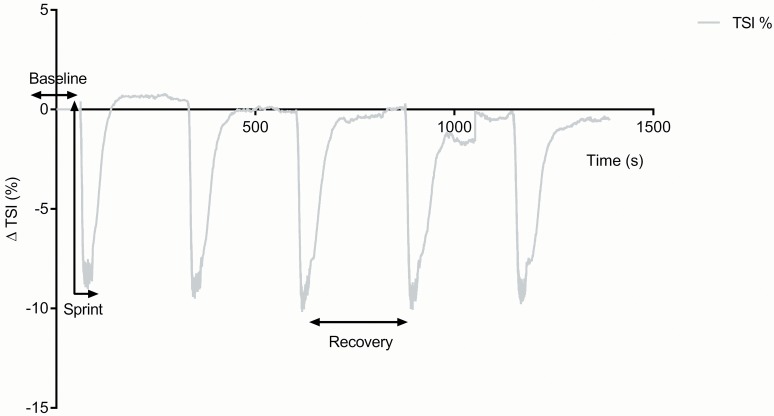
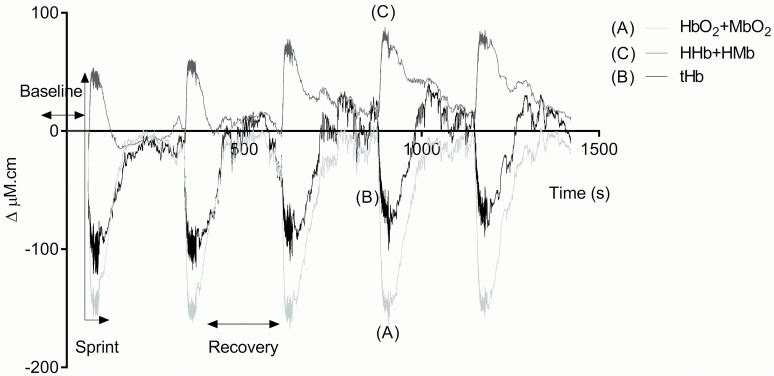
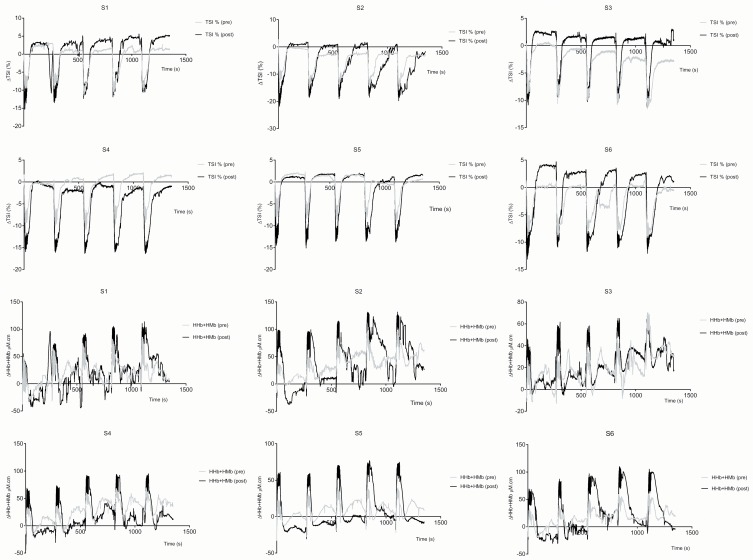
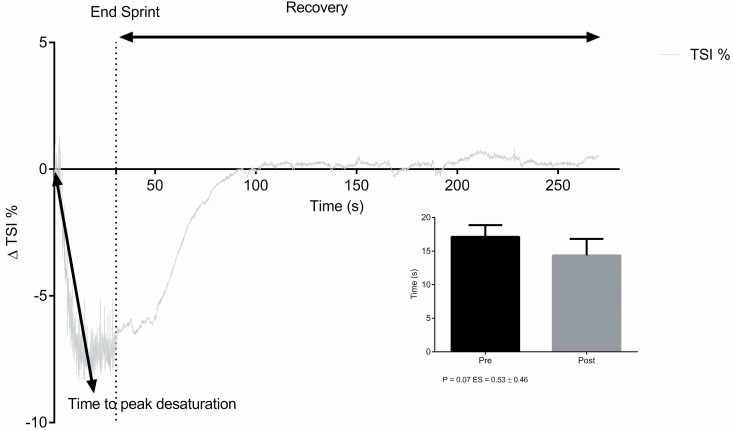
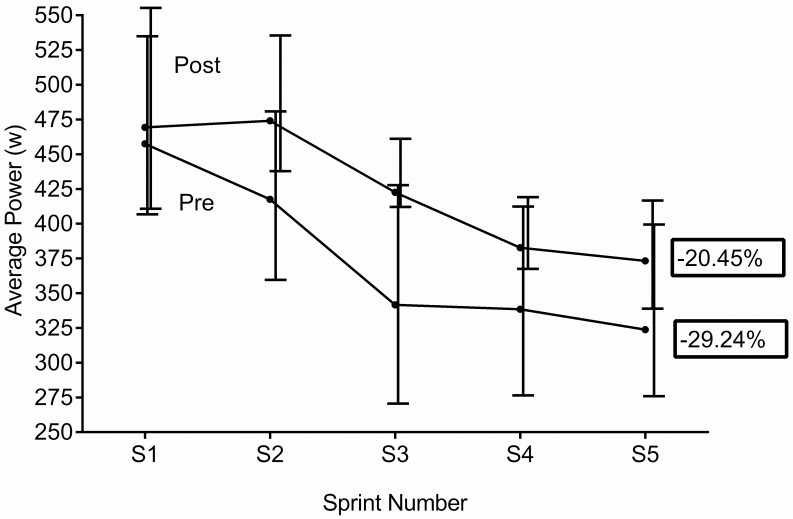
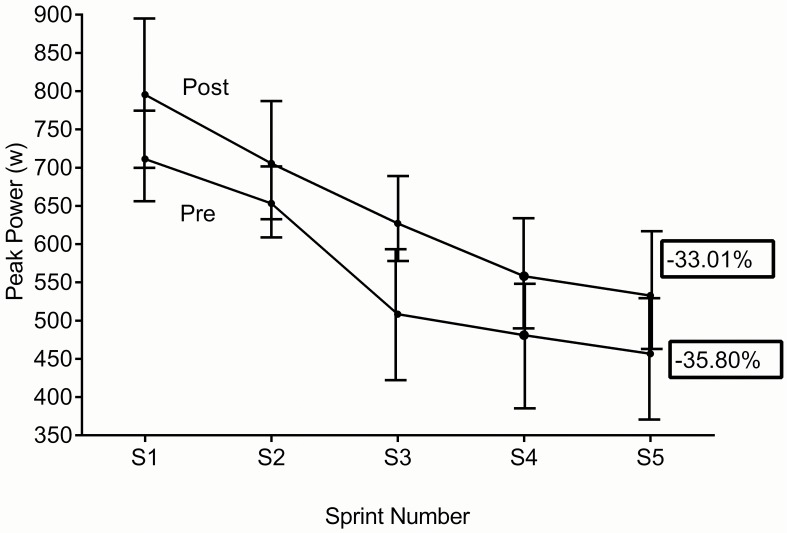
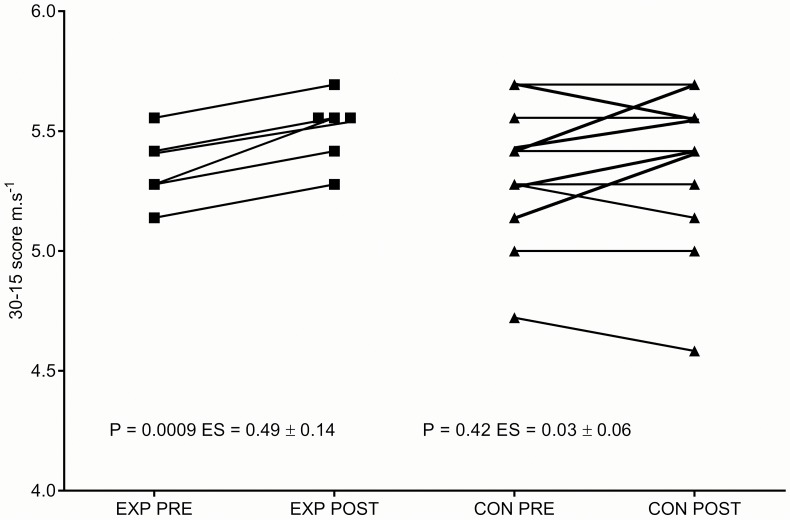
This study examined the effects of Sprint Interval Cycling (SIT) on muscle oxygenation kinetics and performance during the 30-15 intermittent fitness test (IFT). Twenty-five women hockey players of Olympic standard were randomly selected into an experimental group (EXP) and a control group (CON). The EXP group performed six additional SIT sessions over six weeks in addition to their normal training program. To explore the potential training-induced change, EXP subjects additionally completed 5 x 30s maximal intensity cycle testing before and after training. During these tests near-infrared spectroscopy (NIRS) measured parameters; oxyhaemoglobin + oxymyoglobin (HbO2+ MbO2), tissue deoxyhaemoglobin + deoxymyoglobin (HHb+HMb), total tissue haemoglobin (tHb) and tissue oxygenation (TSI %) were taken. In the EXP group (5.34 ± 0.14 to 5.50 ± 0.14 m.s(-1)) but not the CON group (pre = 5.37 ± 0.27 to 5.39 ± 0.30 m.s(-1)) significant changes were seen in the 30-15 IFT performance. EXP group also displayed significant post-training increases during the sprint cycling: ΔTSI (-7.59 ± 0.91 to -12.16 ± 2.70%); ΔHHb+HMb (35.68 ± 6.67 to 69.44 ± 26.48 μM.cm); and ΔHbO2+ MbO2 (-74.29 ± 13.82 to -109.36 ± 22.61 μM.cm). No significant differences were seen in ΔtHb (-45.81 ± 15.23 to -42.93 ± 16.24). NIRS is able to detect positive peripheral muscle oxygenation changes when used during a SIT protocol which has been shown to be an effective training modality within elite athletes.
Overview
The claims and statistics of this paper haven’t been checked yet.
Free: it reads the open-access text and checks the first 5 claims that cite a source we can check. Create a free account to check every claim.
Integrity signals
Registry
Cites
Statistics
Figures
Verification
Claims the paper makes
The claims and statistics of this paper haven’t been checked yet.
Free: it reads the open-access text and checks the first 5 claims that cite a source we can check. Create a free account to check every claim.
Claims other papers make about this one
Each is checked against this paper’s own text: does it say what the citing paper says it does?
The cited source says what the claim attributes to it.
In the citing paper
“In support of this, positive peripheral muscle oxygenation adaptations have been reported as a consequence of cycling sprint interval training, demonstrating that NIRS has the potential to assess the effectiveness of training interventions at the level of the individual athlete. 7”
From Performance comparison of the MOXY and PortaMon near-infrared spectroscopy muscle oximeters at rest and during exercise (2018) · cites this paper as [7]
Self-check
Percentages, sums and reported differences re-computed from the paper’s own numbers.
The self-check needs the paper’s full text.
Citations
Cites
Progressive Statistics for Studies in Sports Medicine and Exercise Science
HOPKINS, W. G., MARSHALL, S. W., BATTERHAM, A. M., & HANIN, J. (2009) · Medicine & Science in Sports & Exercise · doi:10.1249/mss.0b013e31818cb278 · Cited by 9,128 · cited 1×
“Data was also assessed for clinical significance using an approach based on the magnitudes of change with 90% confidence limits (90%CL) [35].”
MethodMeasures of Reliability in Sports Medicine and Science
Hopkins, W. G. (2000) · Sports Medicine · doi:10.2165/00007256-200030010-00001 · Cited by 4,635 · cited 1×
“Device measurement varianceto-training adaptation (signal-to-noise) overlap can make the interpretation of the magnitude and benefit of imposed interventions difficult [41].”
BackgroundAdaptations of skeletal muscle to endurance exercise and their metabolic consequences
Holloszy, J. O., & Coyle, E. F. (1984) · Journal of Applied Physiology · doi:10.1152/jappl.1984.56.4.831 · Cited by 1,985
Burgomaster, K. A., Howarth, K. R., Phillips, S. M., Rakobowchuk, M., MacDonald, M. J., McGee, S. L., & Gibala, M. J. (2008) · The Journal of Physiology · doi:10.1113/jphysiol.2007.142109 · Cited by 1,257 · cited 2×
“Concomitant with training induced performance improvements significant alterations in typical markers of muscle oxidative potential such as cytochrome c oxidase and citrate synthase [24] have been noted in previous studies using muscle biopsy samples [22, 36].”
BackgroundGibala, M. J., Little, J. P., Van Essen, M., Wilkin, G. P., Burgomaster, K. A., Safdar, A., Raha, S., & Tarnopolsky, M. A. (2006) · The Journal of Physiology · doi:10.1113/jphysiol.2006.112094 · Cited by 1,082 · cited 1×
“Concomitant with training induced performance improvements significant alterations in typical markers of muscle oxidative potential such as cytochrome c oxidase and citrate synthase [24] have been noted in previous studies using muscle biopsy samples [22, 36].”
BackgroundRepeated-Sprint Ability – Part I: Factors Contributing to Fatigue
Girard, O., Mendez-Villanueva, A., & Bishop, D. (2011) · Sports Medicine · doi:10.2165/11590550-000000000-00000 · Cited by 916
Brown, R., James, C., Henderson, L. A., & Macefield, V. G. (2012) · Frontiers in Physiology · doi:10.3389/fphys.2012.00394 · Cited by 726
Invited Review: Contractile activity-induced mitochondrial biogenesis in skeletal muscle
Hood, D. A. (2001) · Journal of Applied Physiology · doi:10.1152/jappl.2001.90.3.1137 · Cited by 693
Little, J. P., Safdar, A., Wilkin, G. P., Tarnopolsky, M. A., & Gibala, M. J. (2010) · The Journal of Physiology · doi:10.1113/jphysiol.2009.181743 · Cited by 667
Glaister, M. (2005) · Sports Medicine · doi:10.2165/00007256-200535090-00003 · Cited by 561
Recovery from exercise-induced desaturation in the quadriceps muscles of elite competitive rowers
Chance, B., Dait, M. T., Zhang, C., Hamaoka, T., & Hagerman, F. (1992) · American Journal of Physiology-Cell Physiology · doi:10.1152/ajpcell.1992.262.3.c766 · Cited by 528
Time–motion analysis of elite field hockey, with special reference to repeated-sprint activity
Spencer, M., Lawrence, S., Rechichi, C., Bishop, D., Dawson, B., & Goodman, C. (2004) · Journal of Sports Sciences · doi:10.1080/02640410410001716715 · Cited by 475
Monitoring tissue oxygen availability with near infrared spectroscopy (NIRS) in health and disease
Boushel, R., Langberg, H., Olesen, J., Gonzales‐Alonzo, J., Bülow, J., & Kjær, M. (2001) · Scandinavian Journal of Medicine & Science in Sports · doi:10.1034/j.1600-0838.2001.110404.x · Cited by 469
Buchheit, M. (2008) · Journal of Strength and Conditioning Research · doi:10.1519/jsc.0b013e3181635b2e · Cited by 453
Ferrari, M., Muthalib, M., & Quaresima, V. (2011) · Philosophical Transactions of the Royal Society A: Mathematical, Physical and Engineering Sciences · doi:10.1098/rsta.2011.0230 · Cited by 450
Adipose tissue thickness affects in vivo quantitative near-IR spectroscopy in human skeletal muscle
VAN BEEKVELT, M. C. P., BORGHUIS, M. S., VAN ENGELEN, B. G. M., WEVERS, R. A., & COLIER, W. N. J. M. (2001) · Clinical Science · doi:10.1042/cs1010021 · Cited by 369
Hamaoka, T., McCully, K. K., Quaresima, V., Yamamoto, K., & Chance, B. (2007) · Journal of Biomedical Optics · doi:10.1117/1.2805437 · Cited by 329 · cited 2×
“Detailed reviews of NIRS methodology, medical applications and potential limitations have been published previously [2, 3].”
BackgroundSprint Interval Training Effects on Aerobic Capacity: A Systematic Review and Meta-Analysis
Gist, N. H., Fedewa, M. V., Dishman, R. K., & Cureton, K. J. (2014) · Sports Medicine · doi:10.1007/s40279-013-0115-0 · Cited by 325
Jacobs, R. A., Flück, D., Bonne, T. C., Bürgi, S., Christensen, P. M., Toigo, M., & Lundby, C. (2013) · Journal of Applied Physiology · doi:10.1152/japplphysiol.00445.2013 · Cited by 268
GPS Analysis of Elite Women's Field Hockey Training and Competition
Gabbett, T. J. (2010) · Journal of Strength and Conditioning Research · doi:10.1519/jsc.0b013e3181ceebbb · Cited by 197
Bailey, S. J., Wilkerson, D. P., DiMenna, F. J., & Jones, A. M. (2009) · Journal of Applied Physiology · doi:10.1152/japplphysiol.00144.2009 · Cited by 194
Hamaoka, T., McCully, K. K., Niwayama, M., & Chance, B. (2011) · Philosophical Transactions of the Royal Society A: Mathematical, Physical and Engineering Sciences · doi:10.1098/rsta.2011.0298 · Cited by 186 · cited 1×
“Motion artifact can sometimes produce large ‘spikes’ in the oxygen measurements, usually due to an unsecure device attachment or the forceful muscle contractions [52] experienced during dynamic exercise.”
BackgroundMuscle Deoxygenation and Neural Drive to the Muscle during Repeated Sprint Cycling
RACINAIS, S., BISHOP, D., DENIS, R., LATTIER, G., MENDEZ-VILLANEUVA, A., & PERREY, S. (2007) · Medicine & Science in Sports & Exercise · doi:10.1249/01.mss.0000251775.46460.cb · Cited by 179
Buchheit, M., & Ufland, P. (2010) · European Journal of Applied Physiology · doi:10.1007/s00421-010-1654-9 · Cited by 172
Aerobic Conditioning for Team Sport Athletes
Stone, N. M., & Kilding, A. E. (2009) · Sports Medicine · doi:10.2165/00007256-200939080-00002 · Cited by 164
Van Beekvelt, M. C. P., Van Engelen, B. G. M., Wevers, R. A., & Colier, W. N. J. M. (2002) · Clinical Physiology and Functional Imaging · doi:10.1046/j.1475-097x.2002.00420.x · Cited by 146
The use of near infrared spectroscopy in sports medicine.
Quaresima, V., Lepanto, R., & Ferrari, M. (2003) · PubMed · Cited by 143
Buchheit, M., Abbiss, C. R., Peiffer, J. J., & Laursen, P. B. (2011) · European Journal of Applied Physiology · doi:10.1007/s00421-011-2021-1 · Cited by 135
e, J. E., Bishop, D. J., Hill-Haas, S. V., DAWSON, B. T., & Goodman, C. (2005) · European Journal of Applied Physiology · doi:10.1007/s00421-005-0056-x · Cited by 127
Repeated‐sprint performance and vastus lateralis oxygenation: Effect of limited O 2 availability
Billaut, F., & Buchheit, M. (2013) · Scandinavian Journal of Medicine and Science in Sports · doi:10.1111/sms.12052 · Cited by 123
The use of GPS to evaluate activity profiles of elite women hockey players during match-play
Macutkiewicz, D., & Sunderland, C. (2011) · Journal of Sports Sciences · doi:10.1080/02640414.2011.570774 · Cited by 104
Validity and Reliability of the Wattbike Cycle Ergometer
Hopker, J., Myers, S., Jobson, S. A., Bruce, W., & Passfield, L. (2010) · International Journal of Sports Medicine · doi:10.1055/s-0030-1261968 · Cited by 94
Skeletal Muscle Metabolism in Endurance Athletes with Near-Infrared Spectroscopy
BRIZENDINE, J. T., RYAN, T. E., LARSON, R. D., & McCULLY, K. K. (2013) · Medicine & Science in Sports & Exercise · doi:10.1249/mss.0b013e31827e0eb6 · Cited by 83
Ryan, T. E., Brizendine, J. T., & McCully, K. K. (2013) · Journal of Applied Physiology · doi:10.1152/japplphysiol.01043.2012 · Cited by 77
Muthalib, M., Millet, G. Y., Quaresima, V., & Nosaka, K. (2010) · Journal of Biomedical Optics · doi:10.1117/1.3309746 · Cited by 71
Spencer, M. D., Murias, J. M., Lamb, H., Kowalchuk, J. M., & Paterson, D. H. (2010) · European Journal of Applied Physiology · doi:10.1007/s00421-010-1653-x · Cited by 69
Physiological monitoring of the Olympic athlete
Davison, R. R., van Someren, K. A., & JONES, A. M. (2009) · Journal of Sports Sciences · doi:10.1080/02640410903045337 · Cited by 64
Buchheit, M., Ufland, P., Haydar, B., Laursen, P. B., & Ahmaidi, S. (2011) · Clinical Physiology and Functional Imaging · doi:10.1111/j.1475-097x.2011.01020.x · Cited by 62
Reliability of near-infrared spectroscopy for determining muscle oxygen saturation during exercise
Austin, K. G., Daigle, K. A., Patterson, P., Cowman, J., Chelland, S., & Haymes, E. M. (2005) · Research Quarterly for Exercise and Sport · doi:10.1080/02701367.2005.10599317 · Cited by 58
Haydar, B., Haddad, H. A., Ahmaïdi, S., & Buchheit, M. (2011) · Europe PMC (PubMed Central) · Cited by 57
Effects of short-term endurance training on muscle deoxygenation trends using NIRS
PATRICK NEARY, J., MCKENZIE, D. C., & BHAMBHANI, Y. N. (2002) · Medicine & Science in Sports & Exercise · doi:10.1097/00005768-200211000-00006 · Cited by 55
Age and Activity Status Affect Muscle Reoxygenation Time after Maximal Cycling Exercise
ICHIMURA, S., MURASE, N., OSADA, T., KIME, R., HOMMA, T., UEDA, C., NAGASAWA, T., MOTOBE, M., HAMAOKA, T., & KATSUMURA, T. (2006) · Medicine & Science in Sports & Exercise · doi:10.1249/01.mss.0000227312.08599.f1 · Cited by 47
Tolerance to high-intensity intermittent running exercise: do oxygen uptake kinetics really matter?
Buchheit, M., Hader, K., & Mendez-Villanueva, A. (2012) · Frontiers in Physiology · doi:10.3389/fphys.2012.00406 · Cited by 44
DiMenna, F. J., Wilkerson, D. P., Burnley, M., Bailey, S. J., & JONES, A. M. (2009) · Journal of Applied Physiology · doi:10.1152/japplphysiol.01047.2009 · Cited by 42
Physiological Responses to an Acute Bout of Sprint Interval Cycling
Freese, E. C., Gist, N. H., & Cureton, K. J. (2013) · The Journal of Strength and Conditioning Research · doi:10.1519/jsc.0b013e318281575c · Cited by 39
Prieur, F., & Mucci, P. (2012) · European Journal of Applied Physiology · doi:10.1007/s00421-012-2430-9 · Cited by 38
Metabolic and performance effects of warm‐up intensity on sprint cycling
Wittekind, A., & Beneke, R. (2010) · Scandinavian Journal of Medicine and Science in Sports · doi:10.1111/j.1600-0838.2010.01248.x · Cited by 36
Crenshaw, A. G., Elçadi, G. H., Hellström, F., & Mathiassen, S. E. (2011) · European Journal of Applied Physiology · doi:10.1007/s00421-011-2244-1 · Cited by 33
ROLE OF ENERGY SYSTEMS IN TWO INTERMITTENT FIELD TESTS IN WOMEN FIELD HOCKEY PLAYERS
LEMMINK, K. A. P. M., & Visscher, S. H. (2006) · The Journal of Strength and Conditioning Research · doi:10.1519/00124278-200608000-00033 · Cited by 31
Influence of priming exercise on muscle deoxy[Hb + Mb] during ramp cycle exercise
Boone, J., Bouckaert, J. J., Barstow, T. J., & Bourgois, J. (2011) · European Journal of Applied Physiology · doi:10.1007/s00421-011-2068-z · Cited by 28
Muscle oxygenation monitoring using near-infrared spectroscopy
Hamaoka, T. (2013) · The Journal of Physical Fitness and Sports Medicine · doi:10.7600/jpfsm.2.203 · Cited by 16
Skeletal muscle reoxygenation after high-intensity exercise in mitochondrial myopathy
Bravo, D. M., Gimenes, A. C., Nascimento, R. B., Ferreira, E. V. M., Siqueira, A. C. B., Meda, E. D. S., Neder, J. A., & Nery, L. E. (2011) · European Journal of Applied Physiology · doi:10.1007/s00421-011-2136-4 · Cited by 13
Research works printed but not linked: 1
- Quaresima V, Ferrari M, Ciabattoni M, Canto U, Colonna R. Oxygenation kinetics of different leg muscle groups measured during a 100-m sprint run by a portable near-infrared photometer. Ital J Sport Sci. 1999; 6(1): 20– 3.
Cited by
Muscle Oximetry in Sports Science: A Systematic Review
Perrey, S., & Ferrari, M. (2018) · Sports Medicine · doi:10.1007/s40279-017-0820-1 · Cited by 220
“Twenty three studies included elite or highly trained participants [15–17, 21–23, 27, 33, 35, 36, 38, 39, 41, 42, 44, 60–66, 68], six studies included well-trained participants [28, 29, 37, 46, 67, 71], 12 studies included trained participants [20, 24, 25, 32, 34, 40, 43, 45, 54, 55, 58, 59], and moderately trained pa…”
BackgroundMethodInfluentialMcManus, C. J., Collison, J., & Cooper, C. E. (2018) · Journal of Biomedical Optics · doi:10.1117/1.jbo.23.1.015007 · Cited by 205
“tial to assess the effectiveness of training interventions at the level of the individual athlete.(7) To be effective outside the”
BackgroundMethodSelf-citationHypoxic Repeat Sprint Training Improves Rugby Player's Repeated Sprint but Not Endurance Performance
Hamlin, M. J., Olsen, P., Marshall, H. C., Lizamore, C. A., & Elliot, C. (2017) · Frontiers in Physiology · doi:10.3389/fphys.2017.00024 · Cited by 88
Delextrat, A. A., Gruet, M., & Bieuzen, F. (2018) · The Journal of Strength and Conditioning Research · doi:10.1519/jsc.0000000000002570 · Cited by 84
Wahl, P., Wehmeier, U. F., Jansen, F., Kilian, Y., Bloch, W., Werner, N., Mester, J., & Hilberg, T. (2016) · Frontiers in Physiology · doi:10.3389/fphys.2016.00643 · Cited by 67
Metadata
- Authors
- Jones, B., Hamilton, D. K., & Cooper, C. E.
- Affiliations
- University of Essex (GB)
- Corresponding author
- Jones, Ben
- Venue
- PLOS ONE
- Publisher
- Public Library of Science (PLoS)
- Published
- 2015-03-25
- Volume
- 10
- Issue
- 3
- Pages
- e0120338
- ISSN
- 1932-6203 (ISSN-L)
- PMC
- PMC4373931
- OpenAlex
- W1964978455
- Semantic Scholar
- 016caa946ee6cd846f40958d95fef6d1cc67cbb5
- Cited by
- 68
- References
- 53
- Citations by year
- 2026: 5 · 2025: 6 · 2024: 6 · 2023: 1 · 2022: 4 · 2021: 7 · 2020: 6 · 2019: 8 · 2018: 14 · 2017: 5 · 2016: 5 · 2015: 1
- FWCI
- 8.60
- Type
- journal article
- Language
- en
- Open access
- gold
- doi.org
- Licence
- Locations
- PLoS ONE (publishedVersion, cc-by)
- PubMed Central (publishedVersion, cc-by)
- PubMed (publishedVersion)
- Open Access at Essex (University of Essex) (acceptedVersion)
- DOAJ (DOAJ: Directory of Open Access Journals) (submittedVersion, cc-by-sa)
- Funders
- Engineering and Physical Sciences Research Council (EP/F005733/1)
- Topics
- Health Sciences › Medicine › Orthopedics and Sports Medicine › Sports Performance and Training
- Health Sciences › Medicine › Physiology (medical) › Cardiovascular and exercise physiology
- Health Sciences › Medicine › Physiology (medical) › Exercise and Physiological Responses
- Keywords
- sprint interval training, muscle oxygenation, field hockey, 30-15 Intermittent Fitness Test, near-infrared spectroscopy, tissue oxygen saturation, hemoglobin, deoxyhemoglobin, training-induced changes, elite female athletes, cycling training
- MeSH terms
- Adult, Bicycling, Exercise Test, Female, Hemoglobins, Hockey, Humans, Oxygen, Oxygen Consumption, Oxyhemoglobins, Physical Education and Training, Muscle, Skeletal, Athletic Performance, Young Adult, Athletes
About these checks
Registry, retraction, Cites and statistics results are computed, not judged, with one exception: a printed reference that no index lists is read once by a model before it counts as a citation error. Claims are extracted by a model and kept only when their quote appears verbatim in the text; each cited source is then checked, with a model’s help, for whether it says what the claim relies on. Those verdicts can be wrong — read the claim’s quote and the cited source before relying on one.
Statistics and arithmetic are recomputed, not judged.
Confidence bands are shown only for fields calibrated on our annotated test set. None is calibrated yet, so no band is shown.
What counts as a claim ›How we measure confidence ›How we check this ›
Are you an author, or do you see a problem with this page? Request a review
Data sources
Bibliographic data: Semantic Scholar, OpenAlex, Crossref.
Contains information from the Semantic Scholar Academic Graph Datasets, made available under the ODC Attribution License (ODC-BY 1.0).
Semantic Scholar’s data is described in: Kinney, R., et al. (2023). The Semantic Scholar Open Data Platform. arXiv:2301.10140.
