

Emotion-Motion Interactions in Conversion Disorder: An fMRI Study
Open accessThe DOI matches its Crossref record; 42 of the 44 references it cites were found in a registry or an index.
Abstract
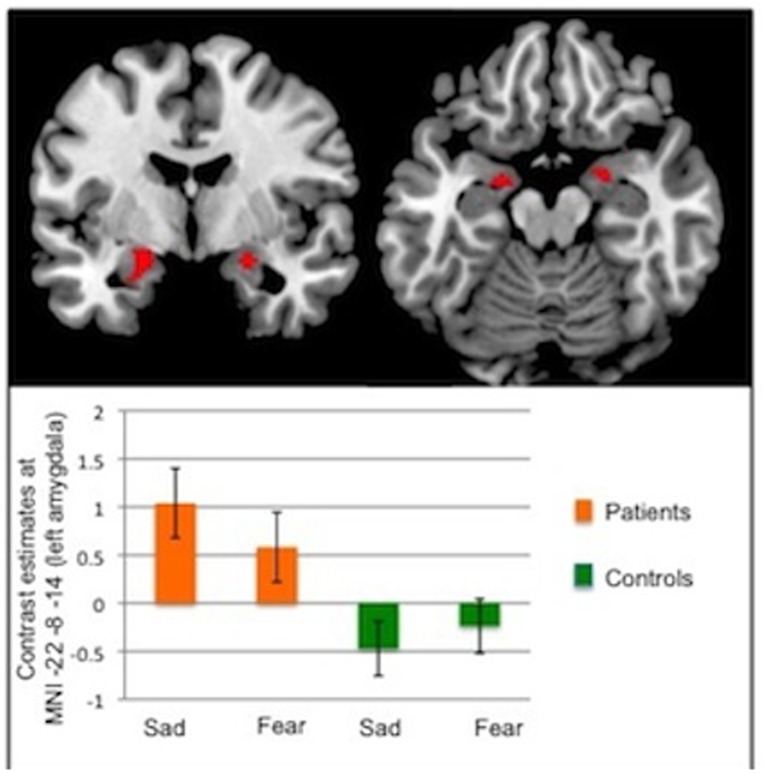
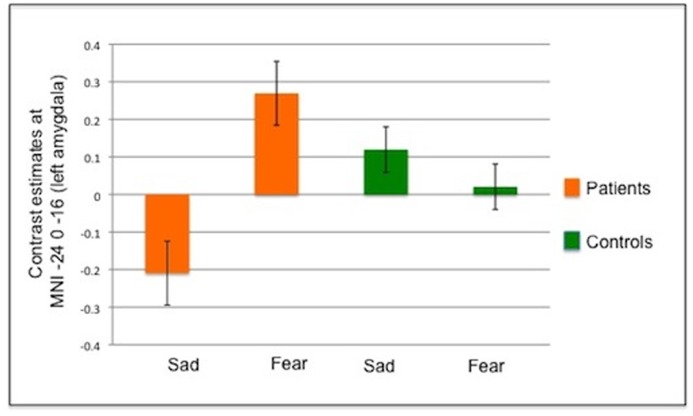
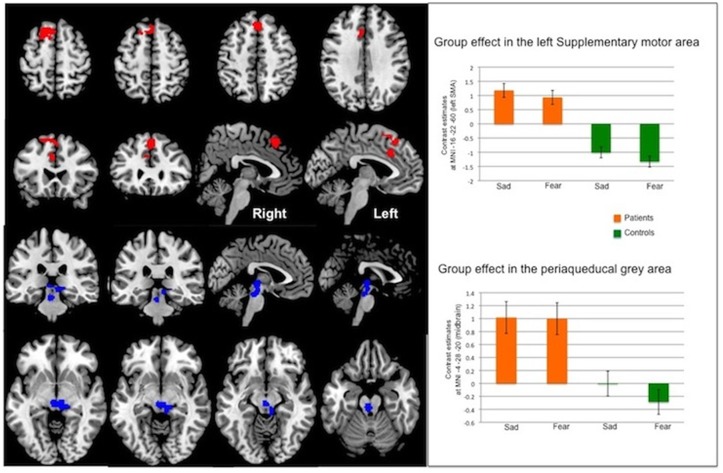
OBJECTIVES: To evaluate the neural correlates of implicit processing of negative emotions in motor conversion disorder (CD) patients. METHODS: An event related fMRI task was completed by 12 motor CD patients and 14 matched healthy controls using standardised stimuli of faces with fearful and sad emotional expressions in comparison to faces with neutral expressions. Temporal changes in the sensitivity to stimuli were also modelled and tested in the two groups. RESULTS: We found increased amygdala activation to negative emotions in CD compared to healthy controls in region of interest analyses, which persisted over time consistent with previous findings using emotional paradigms. Furthermore during whole brain analyses we found significantly increased activation in CD patients in areas involved in the 'freeze response' to fear (periaqueductal grey matter), and areas involved in self-awareness and motor control (cingulate gyrus and supplementary motor area). CONCLUSIONS: In contrast to healthy controls, CD patients exhibited increased response amplitude to fearful stimuli over time, suggesting abnormal emotional regulation (failure of habituation / sensitization). Patients with CD also activated midbrain and frontal structures that could reflect an abnormal behavioral-motor response to negative including threatening stimuli. This suggests a mechanism linking emotions to motor dysfunction in CD.
Overview
The claims and statistics of this paper haven’t been checked yet.
Free: it reads the open-access text and checks the first 5 claims that cite a source we can check. Create a free account to check every claim.
Integrity signals
Registry
Cites
Statistics
Figures
Verification
Claims the paper makes
The claims and statistics of this paper haven’t been checked yet.
Free: it reads the open-access text and checks the first 5 claims that cite a source we can check. Create a free account to check every claim.
Claims other papers make about this one
Each is checked against this paper’s own text: does it say what the citing paper says it does?
The source backs part of the claim, not all of it — or backs it for a different population, condition or comparison.
In the citing paper
“While findings have not been entirely consistent across studies and FND sub-populations, between-group differences in default mode, salience and sensorimotor network areas have been identified in a range FND populations compared to controls.45,207,[209][210][211][212]”
From A new science of emotion: implications for functional neurological disorder (2022) · cites this paper as [45]
Experimental — accuracy not yet measuredThe source backs part of the claim, not all of it — or backs it for a different population, condition or comparison.
In the citing paper
“Additionally, heightened arousal is linked to defensive behaviours driven by the periaqueductal grey, such as tonic immobility and fight or flight responses-behavioural programmes that share overlapping semiological features with functional seizures.45,[171][172][173][174]”
From A new science of emotion: implications for functional neurological disorder (2022) · cites this paper as [45]
Experimental — accuracy not yet measured
Self-check
Percentages, sums and reported differences re-computed from the paper’s own numbers.
The self-check needs the paper’s full text.
Citations
Cites
The Hospital Anxiety and Depression Scale
Zigmond, A. S., & Snaith, R. P. (1983) · Acta Psychiatrica Scandinavica · doi:10.1111/j.1600-0447.1983.tb09716.x · Cited by 47,139
Depression and quality of life in older persons: A review
Sivertsen, H., Bjørkløf, G. H., Engedal, K., Selbæk, G., & Helvik, A.-S. (2015) · Dementia and Geriatric Cognitive Disorders · doi:10.1159/000437299 · Cited by 14,152
Diagnostic and Statistical Manual of Mental Disorders(DSM)
(2008) · Encyclopedia of Counseling · doi:10.4135/9781412963978.n182 · Cited by 10,830
Meeting of minds: the medial frontal cortex and social cognition
Amodio, D. M., & Frith, C. D. (2006) · Nature Reviews Neuroscience · doi:10.1038/nrn1884 · Cited by 3,782
Social Origins of Depression: A Study of Psychiatric Disorder in Women.
Schnitzer, P. K., Brown, G. W., & Harris, T. (1980) · Contemporary Sociology · doi:10.2307/2065631 · Cited by 3,053
Cognitive and emotional control of pain and its disruption in chronic pain
Bushnell, M. C., Čeko, M., & Low, L. A. (2013) · Nature Reviews Neuroscience · doi:10.1038/nrn3516 · Cited by 2,076
Social Origins of Depression: A Study of Psychiatric Disorder in Women
McDaniel, E. (1980) · The Journal of Nervous and Mental Disease · doi:10.1097/00005053-198009000-00013 · Cited by 1,896
LeDoux, J., Iwata, J., Cicchetti, P., & Reis, D. (1988) · The Journal of Neuroscience · doi:10.1523/jneurosci.08-07-02517.1988 · Cited by 1,580
Adolphs, R., Tranel, D., Damasio, H., & Damasio, A. (1995) · The Journal of Neuroscience · doi:10.1523/jneurosci.15-09-05879.1995 · Cited by 1,138
A Bayesian account of ‘hysteria’
Edwards, M. J., Adams, R. A., Brown, H., Parees, I., & Friston, K. J. (2012) · Brain · doi:10.1093/brain/aws129 · Cited by 825
Research works printed but not linked: 2
- Voon V, Brezing C, Gallea C, Ameli R, Roelofs K, et al (2010) Emotional stimuli and motor conversion disorder. Brain 133: 1526– 1536. 10.1093/brain/awq054 20371508 PMC2859149 · DOI · Paper page
- Worsley KJ (2001) Statistical analysis of activation images, in Functional MRI: An Introduction to Methods.; Edited by Jezzard P, Matthews PM, Smith SM., editor. New York: Oxford University Press.
Cited by
Items 101–183 of 183
Mavroudis, I. A., Franekova, K., Petridis, F., Ciobica, A. S., Dăscălescu, G., Anton, E., Ilea, C. G., Papagiannopoulos, S., & Kazis, D. A. (2025) · Brain Sciences · doi:10.3390/brainsci15090907 · Cited by 12
Somatoforme Störungen – somatoforme Belastungsstörung und verwandte Störungen
Kapfhammer, H. (2017) · Springer eBooks · doi:10.1007/978-3-662-49295-6_74 · Cited by 14
Positive clinical signs in neurological diseases – An observational study
Aboud, O., Al-Salaimeh, A., Raina, S. K., Sahaya, K., & Hinduja, A. (2018) · Journal of Clinical Neuroscience · doi:10.1016/j.jocn.2018.10.113 · Cited by 8
Longarzo, M., Cavaliere, C., Mele, G., Tozza, S., Tramontano, L., Alfano, V., Aiello, M., Salvatore, M., & Grossi, D. (2020) · Brain Sciences · doi:10.3390/brainsci10060385 · Cited by 10
Issak, S., Williams, G. P., Kanaan, R., Fini, N. A., & Nielsen, G. (2025) · Brain and Behavior · doi:10.1002/brb3.70208 · Cited by 7
Self-citationOrtega‐Robles, E., Shalash, A., Ramírez‐Bermúdez, J., & Arias-Carrión, Ó. (2025) · Movement Disorders Clinical Practice · doi:10.1002/mdc3.70136 · Cited by 8
Mass hysteria attack rates in children and adolescents: a meta-analysis
Zhao, G., Cheng, Q., Dong, X., & Xie, L. (2021) · Journal of International Medical Research · doi:10.1177/03000605211039812 · Cited by 8
Mann, L. G., Servant, M., Hay, K. R., Song, A. K., Trujillo, P., Yan, B., Kang, H., Zald, D. H., Donahue, M. J., Logan, G. D., et al. (2023) · Journal of Cognitive Neuroscience · doi:10.1162/jocn_a_02048 · Cited by 9
Stephen, C. D., Sharma, N., Callahan, J., Carson, A. J., & Perez, D. L. (2017) · Harvard Review of Psychiatry · doi:10.1097/hrp.0000000000000135 · Cited by 8
Medeiros, F. M., Myskiw, J. D. C., Baptista, P. P. A., Neves, L. T., Martins, L. A., Furini, C. R. G., Izquierdo, I., Xavier, L. L., Hollands, K. L., & Mestriner, R. G. (2017) · Neuroscience Letters · doi:10.1016/j.neulet.2017.12.017 · Cited by 8
Somatic Symptom and Related Disorders
Williams, S. E., Zahka, N. E., & Kullgren, K. A. (2020) · Issues in clinical child psychology · doi:10.1007/978-3-030-35598-2_14 · Cited by 7
Free Will, Emotions and Agency: Pathophysiology of Functional Movement Disorder
Hallett, M. (2022) · Current clinical neurology · doi:10.1007/978-3-030-86495-8_2 · Cited by 8
Étiopathogénie des troubles neurologiques fonctionnels : marqueurs biologiques et modèles théoriques
Conejero, I., Thouvenot, É., Hingray, C., Hubsch, C. A., El‐Hage, W., Carle, G., Rotgé, J., Drapier, S., Drapier, D., & Mouchabac, S. (2023) · L Encéphale · doi:10.1016/j.encep.2023.06.003 · Cited by 9
Pick, S., David, A. S., Edwards, M. J., Goldstein, L. H., Hodsoll, J. P., Millman, L. S. M., Nicholson, T. R., Reinders, A. A. T. S., Stanton, B. R., Winston, J. S., et al. (2024) · PLoS ONE · doi:10.1371/journal.pone.0305015 · Cited by 11
Self-citationFeinstein, A., & Voon, V. (2021) · Journal of Psychiatric Research · doi:10.1016/j.jpsychires.2021.07.013 · Cited by 6
Statistical shape analysis of corpus callosum in functional neurological disorder
Baykara, M., Baykara, S., & Atmaca, M. (2022) · Neuropsychiatria i Neuropsychologia · doi:10.5114/nan.2022.117950 · Cited by 6
Stigma in functional neurological disorder; a longitudinal study
McLoughlin, C., Ramsay, N., Tak, L. M., Carson, A. J., & Stone, J. (2026) · Journal of Psychosomatic Research · doi:10.1016/j.jpsychores.2026.112550 · Cited by 5
Clarici, A., Bulfon, M., Radin, Y., & Panksepp, J. (2024) · Frontiers in Psychology · doi:10.3389/fpsyg.2024.1395247 · Cited by 6
Post-traumatic Stress Disorder Symptom Substitution as a Cause of Functional Neurological Disorder
Burke, M. J., Lizano, P. L., Jacobs, C. S., & Stern, T. A. (2019) · Psychosomatics · doi:10.1016/j.psym.2019.03.003 · Cited by 7
Funktionelle Bewegungsstörungen
Popkirov, S. (2020) · Springer eBooks · doi:10.1007/978-3-662-61272-9_7 · Cited by 5
Recognising and managing functional neurological disorder in the acute healthcare setting
Galenchik-Chan, A., Ren, T., Cohen, D., & Maurer, C. W. (2025) · Emergency Medicine Journal · doi:10.1136/emermed-2024-214459 · Cited by 4
Neuroimaging abnormalities in functional/dissociative seizures: a meta-analysis
Homayoun, M., Lo, A. P.-K., Sinclair, B., Nazem-Zadeh, M.-R., Neal, A. J., Winton‐Brown, T., Kwan, P., & Kanaan, R. (2025) · Neuroscience & Biobehavioral Reviews · doi:10.1016/j.neubiorev.2025.106439 · Cited by 6
Self-citationMechanisms of motor dysfunction in functional neurological disorder: A narrative review
Lo, A. P.-K., Homayoun, M., Jamieson, A. J., Harrison, B. J., & Kanaan, R. (2025) · Neuroscience & Biobehavioral Reviews · doi:10.1016/j.neubiorev.2025.106358 · Cited by 5
Self-citationArousability, Personality, and Decision-Making Ability in Dissociative Disorder
Ghosh, D., Mukhopadhyay, P., Chatterjee, I., & Roy, P. K. (2021) · Indian Journal of Psychological Medicine · doi:10.1177/0253717620981555 · Cited by 4
Magnetic resonance imaging histogram analysis of amygdala in functional neurological disorder
Baykara, M., Baykara, S., & Atmaca, M. (2022) · Psychiatry Research Neuroimaging · doi:10.1016/j.pscychresns.2022.111487 · Cited by 5
From Photography to fMRI: Epistemic Functions of Images in Medical Research on Hysteria
Muhr, P. (2022) · transcript Verlag eBooks · doi:10.14361/9783839461761 · Cited by 13
Neuroscience in pictures: Functional neurological disorder
Westlin, C., Keshavan, M. S., & Perez, D. L. (2025) · Asian Journal of Psychiatry · doi:10.1016/j.ajp.2025.104449 · Cited by 3
Pathophysiology of functional neurological disorder for the general neurologist
Phillips, W. E. (2025) · BMJ Neurology Open · doi:10.1136/bmjno-2025-001309 · Cited by 6
Ultra-high field brain MRI for functional neurological disorder: opportunities and challenges
Myren, S., Jungilligens, J., Diez, I. P., Bøen, E., Elvsåshagen, T., Forstmann, B. U., Ziaei, M., & Doan, T. P. (2026) · NeuroImage Clinical · doi:10.1016/j.nicl.2026.103972 · Cited by 4
GENDER DIFFERENCES: PARANORMAL BELIEFS AND MALADAPTIVE EMOTIONAL SCHEMAS
Roohee, A., & Sunbal, M. (2023) · Journal of Arts & Social Sciences (JASS) · doi:10.46662/jass.v10i1.307 · Cited by 4
Joos, A. A. B., Halmer, R., Leiprecht, N., Schörner, K., Lahmann, C., & Blahak, C. (2019) · Der Nervenarzt · doi:10.1007/s00115-019-00827-6 · Cited by 3
Kılıç, Ö., Eser, H. Y., Necef, I., Altunöz, U., Çakmak, Ö. Ö., & Aktaş, C. (2021) · Nöro Psikiyatri Arşivi · doi:10.29399/npa.27599 · Cited by 5
Interoceptive disruption in functional neurological disorder: a multimodal brain imaging studyPreprint
Sojka, P., Serranová, T., Khalsa, S. S., Perez, D. L., & Diez, I. P. (2024) · medRxiv · doi:10.1101/2024.03.13.24303546 · Cited by 7
Functional Neurological Disorders: A Comprehensive Review
Lalitha, L. P., Acharya, P., Javali, M., Mehta, A., & Rangaiah, P. (2025) · Journal of the Association of Physicians of India · doi:10.59556/japi.73.1051 · Cited by 3
Westlin, C., Rioux, M., Lee, J., Panenka, W. J., Palombo, D. J., Todd, R. M., Silverberg, N. D., & Perez, D. L. (2025) · NeuroImage Clinical · doi:10.1016/j.nicl.2025.103936 · Cited by 4
Bleier, C., Guthrie, A. J., Ranford, J., MacLean, J., Godena, E. J., Maggio, J., Finkelstein, S. A., Diez, I. P., Westlin, C., Quigley, K. S., et al. (2026) · NeuroImage Clinical · doi:10.1016/j.nicl.2026.103996 · Cited by 2
Functional Neurological Disorders
Sinanović, O., Zukić, S., Banović, S., Sinanović, E., & Muftić, M. (2023) · Springer eBooks · doi:10.1007/978-3-031-33013-1_14 · Cited by 3
EMOTION-MOTION INTERACTIONS IN CONVERSION DISORDER: AN FMRI STUDY
Nicholson, T. R., Aybek, S., O’Daly, O., Zelaya, F. O., Kanaan, R., & David, A. S. (2015) · Journal of Neurology Neurosurgery & Psychiatry · doi:10.1136/jnnp-2015-311750.43 · Cited by 2
Self-citationKitten, S., Jani, N. D., & Llano, D. A. (2022) · Cureus · doi:10.7759/cureus.27930 · Cited by 1
Bağcaz, A., & Ceran, S. (2024) · Psikiyatride Guncel Yaklasimlar - Current Approaches in Psychiatry · doi:10.18863/pgy.1300192 · Cited by 1
Le trouble neurologique fonctionnel : Une élaboration de l'atteinte traumatique ?
Misdrahi, S., Louët, E., Gargiulo, M., & Luca, M. D. (2025) · European Journal of Trauma & Dissociation · doi:10.1016/j.ejtd.2025.100518 · Cited by 1
Psychological assessment and support in functional neurological disorder: a longitudinal study
Radin, Y., Bulfon, M., Caruso, P., Barbi, E., Manganotti, P., & Clarici, A. (2025) · Frontiers in Psychology · doi:10.3389/fpsyg.2025.1506069 · Cited by 3
Kdouri, L., Hmamouche, Y., Seghrouchni, A. E. F., & Chaminade, T. (2025) · Multimodal Technologies and Interaction · doi:10.3390/mti9040031 · Cited by 2
Li, J., Zhao, J., Li, Y., Jiao, Y., & Chen, X. (2026) · BMJ Neurology Open · doi:10.1136/bmjno-2025-001390 · Cited by 1
El trastorno neurológico funcional: modelos explicativos y aportes de las psicoterapias
Sarudiansky, M., Pico, M. M. A., Tenreyro, C., & Korman, G. P. (2026) · Acta neurológica colombiana · doi:10.22379/anc.2099 · Cited by 1
Zaheer, R., Rehman, S., & Ghazali, S. R. (2026) · International Journal of Cognitive Behavioral Therapy · doi:10.1007/s41811-026-00287-2 · Cited by 1
Joos, A. A. B. (2020) · Swiss Archives of Neurology Psychiatry and Psychotherapy · doi:10.4414/sanp.2020.03081 · Cited by 2
fMRI Analysis of Dissociative Convulsions: A Case-Controlled Study
Garg, H., Sharan, P., Kumaran, S. S., Bhargava, R., Patra, B. N., & Tripathi, M. (2023) · Neurology India · doi:10.4103/0028-3886.378651 · Cited by 1
Role of the Motor Cortex in Virtual Reality-Based Neurofeedback for Emotional Self-regulation
Arpaïa, P., D’Errico, G., Frosolone, M., Paolis, L. T. D., Grassini, S., Mastrati, G., & Moccaldi, N. (2023) · Lecture notes in computer science · doi:10.1007/978-3-031-43401-3_34 · Cited by 1
Chiu, N., & Strain, J. J. (2017) · Neuropsychiatry · doi:10.4172/neuropsychiatry.1000200 · Cited by 1
Downwards Vertical Attention Bias in Conversion Disorder vs Controls: A Pilot Study
Gazit, S., Elkana, O., Dawidowicz, L., Yeshayahu, L., & Biran, I. (2017) · Psychosomatics · doi:10.1016/j.psym.2017.07.004 · Cited by 1
Hedonicity in functional motor disorders: a chemosensory study assessing taste
Cecchini, M. P., Tamburin, S., Zanini, A., Boschi, F., Demartini, B., Goeta, D., Dallocchio, C., Marotta, A., Fiorio, M., & Tinazzi, M. (2020) · Journal of Neural Transmission · doi:10.1007/s00702-020-02244-5 · Cited by 1
Somatoforme Störungen – somatoforme Belastungsstörung und verwandte Störungen
Kapfhammer, H. (2016) · Springer eBooks · doi:10.1007/978-3-642-45028-0_74-1 · Cited by 2
Emotion and motor function: a clinical and developmental perspective
McSweeney, M. (2019) · White Rose eTheses Online (University of Leeds, The University of Sheffield, University of York)
Functional (psychogenic) movement disorders
Jankovic, J. J., Hallett, M., Okun, M. S., Comella, C., Fahn, S., & Goldman, J. G. (2021) · Elsevier eBooks · doi:10.1016/b978-0-323-31071-0.00027-5
Starčević, A., Marjanovic-Haljilji, M., Milic, L., & Filipović, B. F. (2022) · Srpski arhiv za celokupno lekarstvo · doi:10.2298/sarh221006118s
Kaya, F., Daştan, N. B., & Çiftçi, H. (2023) · Health Sciences Quarterly · doi:10.26900/hsq.1773
Chapter 13. Somatic Symptom and Related Disorders
Agronin, M. (2022) · American Psychiatric Association Publishing eBooks · doi:10.1176/appi.books.9781615375196.ds13
Roohee, A., Sunbal, M., & Ahmad, S. M. (2023) · Pakistan Journal of Social Research · doi:10.52567/pjsr.v5i02.1109
Clinical impact and misdiagnosis of functional ophthalmological symptoms: a case report
Moyano, B. P., Duquenne, C., Favrat, B., Francois-Xavier, B., Kokkinakis, I., & Tzartzas, K. (2023) · Journal of Medical Case Reports · doi:10.1186/s13256-023-04063-0
Aktuelle Forschungsergebnisse zur Neuropsychologie dissoziativer Anfälle
Jungilligens, J., Hoppe, C., & Reuner, G. (2024) · Clinical Epileptology · doi:10.1007/s10309-024-00681-w
Mesolimbic local field potentials are modulated by motor controlPreprint
Mann, L. G., Qian, H., Hughes, N., Zhao, Z., Singh, B., Wang, Z., Johnson, G. W., Fulton, J. N., Yan, B., Kang, H., et al. (2024) · bioRxiv (Cold Spring Harbor Laboratory) · doi:10.1101/2024.07.02.601451
Malingering and functional movement disorder
Михайлович, Е. К., Fedotova, E. Y., & Illarioshkin, S. N. (2024) · Neurology neuropsychiatry Psychosomatics · doi:10.14412/2074-2711-2024-4-90-97
Current research on the neuropsychology of dissociative seizures
Jungilligens, J., Hoppe, C., & Reuner, G. (2024) · Clinical Epileptology · doi:10.1007/s10309-024-00707-3
Funktionelle Bewegungsstörungen
Popkirov, S. (2024) · Springer eBooks · doi:10.1007/978-3-662-69215-8_7
Functional Neurological Symptom Disorder in Children and Adolescents
Chee, P., Williams, S. E., & Zahka, N. E. (2025) · Elsevier eBooks · doi:10.1016/b978-0-443-10944-7.00107-4
Cherian, A., Puthanveedu, D. K., Amod, R., & Sundaram, S. (2025) · Acta Neurologica Belgica · doi:10.1007/s13760-025-02836-6 · Cited by 1
Neurosciences and Child Development: Mirror Neurons, Empathy, and Embodiment
Nemer, P., Maldonado-Durán, J. M., Hull, M., & Teagarden, A. (2025) · Springer eBooks · doi:10.1007/978-3-031-98319-1_3
Gulati, K., & Pandey, S. (2025) · Seminars in Neurology · doi:10.1055/a-2769-7282
The, J. T., & Hermitte, Y. (2026) · L Évolution Psychiatrique · doi:10.1016/j.evopsy.2026.02.002
Distinct Cortical Activation in Adolescents With Social Anxiety Disorder: An fNIRS Study
Liu, H., Zhang, J., Niu, Y., Huang, W., Li, Q., Liu, Z., Leavey, G., & Li, G. (2026) · Brain and Behavior · doi:10.1002/brb3.71357
Psychogenic Nonepileptic Seizures and Comorbid Epilepsy in Youth
Plioplys, S., & Jutla, A. (2026) · Springer eBooks · doi:10.1007/978-3-032-10099-3_26
Functional Neurological Disorder: A Primer for Neuropsychologists
Kavish, N., & Maietta, J. E. (2026) · Springer eBooks · doi:10.1007/978-3-032-07777-6_20
Amlang, C. J., Espay, A. J., & Perez, D. L. (2026) · Current Neurology and Neuroscience Reports · doi:10.1007/s11910-026-01496-0
Jiang, H., He, J., Li, L., Guo, Y., Gan, X., Fan, X., Wang, X. R., Ferraro, S., Vatansever, D., Kendrick, K. M., et al. (2026) · medRxiv · doi:10.64898/2026.05.03.26352312
Mavroudis, I. A., Petridis, F., Ciobîcă, A., Pădurariu, M., Papagiannopoulos, S., & Kazis, D. A. (2026) · Life · doi:10.3390/life16060926 · Cited by 1
Functional movement disorders: diagnosis, pathophysiology, and treatment
Maillard, A., Mhanna, E., Faiz, H., & Garcin, B. (2026) · Current Opinion in Neurology · doi:10.1097/wco.0000000000001504
Mark Hallett and the renaissance of functional neurological disorder
Stone, J. (2026) · Clinical Parkinsonism & Related Disorders · doi:10.1016/j.prdoa.2026.100464
Roadmap for functional neurological disorders: Shared circuitry and future directions
Ertenu, D. D., Papolu, A., Quezada, J., Jadhav, S., Dean, S. L., & Salpekar, J. A. (2026) · International review of neurobiology · doi:10.1016/bs.irn.2026.08.014
Treatment of Functional Neurological Disorders
Park, J. E. (2026) · Journal of Clinical Neurology · doi:10.3988/jcn.2026.0223 · Cited by 1
Putica, A. (2026) · Biological Psychiatry Global Open Science · doi:10.1016/j.bpsgos.2026.100825
Imaging biomarkers in functional neurological disorders
Lozzi, I., Concetti, C., & Aybek, S. (2026) · Philosophical Transactions of the Royal Society B Biological Sciences · doi:10.1098/rstb.2024.0472 · Cited by 2
Self-citationNeurophysiological basis of functional movement disorders: A transcranial magnetic stimulation study
Prakash, S. S., Bhattacharya, A., Kenchaiah, R., Yadav, R., Nagaraju, B. C., Reddy, Y. C. J., Holla, V. V., Mahale, R. R., Pal, P. K., & Kamble, N. L. (2026) · Journal of Psychosomatic Research · doi:10.1016/j.jpsychores.2026.113021
Metadata
- Authors
- Aybek, S., Nicholson, T. R., O’Daly, O., Zelaya, F., Kanaan, R. A., & David, A. S.
- Affiliations
- University of Geneva (CH)
- King's College London (GB)
- The University of Melbourne (AU)
- Corresponding author
- Aybek, Selma
- ORCID
- Venue
- PLOS ONE
- Publisher
- Public Library of Science (PLoS)
- Published
- 2015-04-10
- Volume
- 10
- Issue
- 4
- Pages
- e0123273
- ISSN
- 1932-6203 (ISSN-L)
- PMC
- PMC4393246
- OpenAlex
- W2056387840
- Cited by
- 183
- References
- 44
- Citations by year
- 2026: 20 · 2025: 19 · 2024: 17 · 2023: 13 · 2022: 17 · 2021: 16 · 2020: 20 · 2019: 13 · 2018: 18 · 2017: 18 · 2016: 9 · 2015: 3
- FWCI
- 12.91
- Type
- journal article
- Language
- en
- Open access
- gold
- doi.org
- Licence
- Locations
- PLoS ONE (publishedVersion, cc-by)
- PubMed Central (publishedVersion, cc-by)
- PubMed (publishedVersion)
- Minerva Access (University of Melbourne) (submittedVersion, cc-by)
- Research Portal (King's College London) (submittedVersion, cc-by)
- DOAJ (DOAJ: Directory of Open Access Journals) (submittedVersion, cc-by-sa)
- Funders
- South London and Maudsley NHS Foundation Trust
- National Institute for Health and Care Research (CL-2009-17-006, CS-2014-14-016)
- King's College London
- Université de Genève
- Medical Research Council (MR/J004162/1)
- Topics
- Health Sciences › Medicine › Psychiatry and Mental health › Psychosomatic Disorders and Their Treatments
- Health Sciences › Medicine › Clinical Neurology › Deep Brain Stimulation and Movement Disorders
- Life Sciences › Neuroscience › Cognitive Neuroscience › Neural and Behavioral Psychology Studies
- Keywords
- conversion disorder, amygdala, fear, emotional face processing, freezing response, periaqueductal gray, habituation, emotion regulation, supplementary motor area, cingulate gyrus, self-awareness, neural correlates
- MeSH terms
- Adult, Brain Mapping, Conversion Disorder, Emotions, Female, Humans, Magnetic Resonance Imaging, Male, Middle Aged, Motion, Psychomotor Performance, Models, Statistical, Case-Control Studies, Young Adult
About these checks
Registry, retraction, Cites and statistics results are computed, not judged, with one exception: a printed reference that no index lists is read once by a model before it counts as a citation error. Claims are extracted by a model and kept only when their quote appears verbatim in the text; each cited source is then checked, with a model’s help, for whether it says what the claim relies on. Those verdicts can be wrong — read the claim’s quote and the cited source before relying on one.
Statistics and arithmetic are recomputed, not judged.
Confidence bands are shown only for fields calibrated on our annotated test set. None is calibrated yet, so no band is shown.
What counts as a claim ›How we measure confidence ›How we check this ›
Are you an author, or do you see a problem with this page? Request a review
Data sources
Bibliographic data: Semantic Scholar, OpenAlex, Crossref.
Contains information from the Semantic Scholar Academic Graph Datasets, made available under the ODC Attribution License (ODC-BY 1.0).
Semantic Scholar’s data is described in: Kinney, R., et al. (2023). The Semantic Scholar Open Data Platform. arXiv:2301.10140.
