

Emotion-Motion Interactions in Conversion Disorder: An fMRI Study
Open accessThe DOI matches its Crossref record; 42 of the 44 references it cites were found in a registry or an index.
Abstract
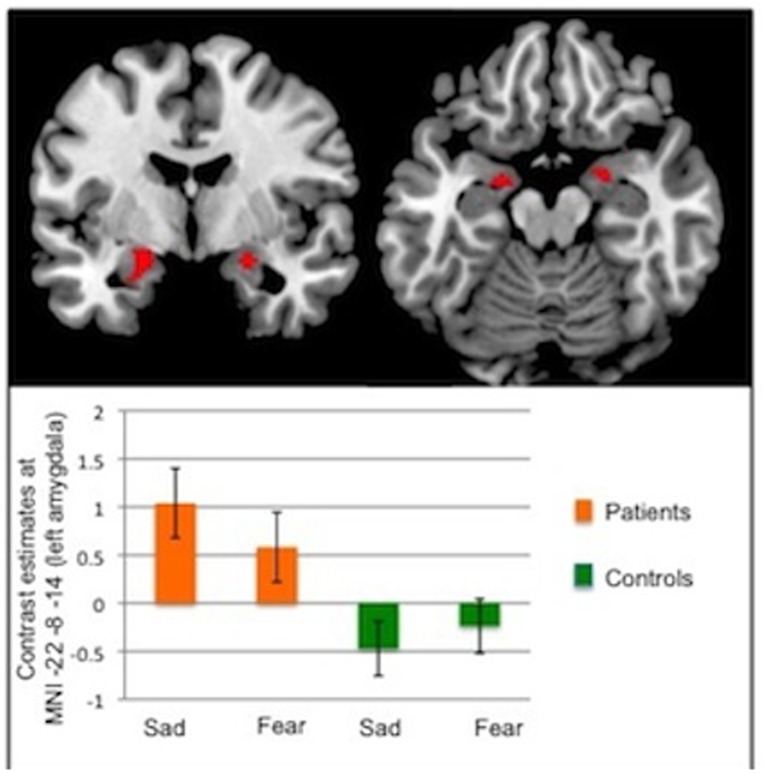
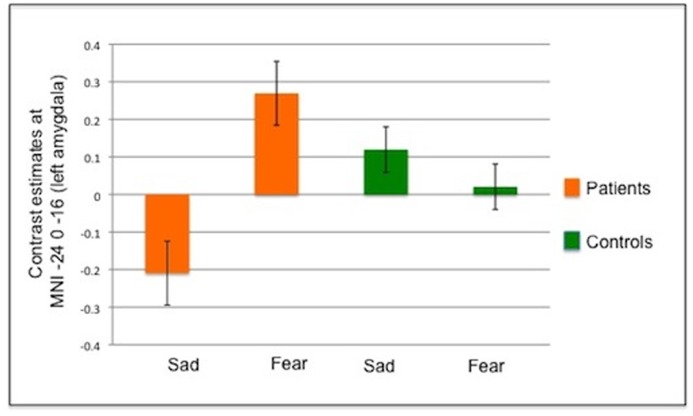
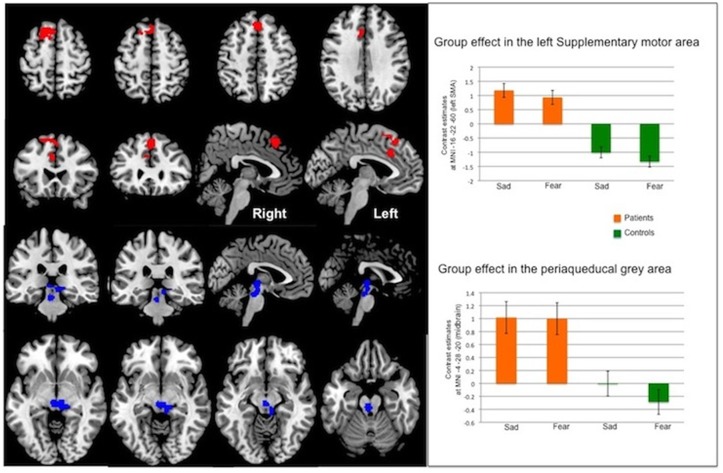
OBJECTIVES: To evaluate the neural correlates of implicit processing of negative emotions in motor conversion disorder (CD) patients. METHODS: An event related fMRI task was completed by 12 motor CD patients and 14 matched healthy controls using standardised stimuli of faces with fearful and sad emotional expressions in comparison to faces with neutral expressions. Temporal changes in the sensitivity to stimuli were also modelled and tested in the two groups. RESULTS: We found increased amygdala activation to negative emotions in CD compared to healthy controls in region of interest analyses, which persisted over time consistent with previous findings using emotional paradigms. Furthermore during whole brain analyses we found significantly increased activation in CD patients in areas involved in the 'freeze response' to fear (periaqueductal grey matter), and areas involved in self-awareness and motor control (cingulate gyrus and supplementary motor area). CONCLUSIONS: In contrast to healthy controls, CD patients exhibited increased response amplitude to fearful stimuli over time, suggesting abnormal emotional regulation (failure of habituation / sensitization). Patients with CD also activated midbrain and frontal structures that could reflect an abnormal behavioral-motor response to negative including threatening stimuli. This suggests a mechanism linking emotions to motor dysfunction in CD.
Overview
The claims and statistics of this paper haven’t been checked yet.
Free: it reads the open-access text and checks the first 5 claims that cite a source we can check. Create a free account to check every claim.
Integrity signals
Registry
Cites
Statistics
Figures
Verification
Claims the paper makes
The claims and statistics of this paper haven’t been checked yet.
Free: it reads the open-access text and checks the first 5 claims that cite a source we can check. Create a free account to check every claim.
Claims other papers make about this one
Each is checked against this paper’s own text: does it say what the citing paper says it does?
The source backs part of the claim, not all of it — or backs it for a different population, condition or comparison.
In the citing paper
“While findings have not been entirely consistent across studies and FND sub-populations, between-group differences in default mode, salience and sensorimotor network areas have been identified in a range FND populations compared to controls.45,207,[209][210][211][212]”
From A new science of emotion: implications for functional neurological disorder (2022) · cites this paper as [45]
Experimental — accuracy not yet measuredThe source backs part of the claim, not all of it — or backs it for a different population, condition or comparison.
In the citing paper
“Additionally, heightened arousal is linked to defensive behaviours driven by the periaqueductal grey, such as tonic immobility and fight or flight responses-behavioural programmes that share overlapping semiological features with functional seizures.45,[171][172][173][174]”
From A new science of emotion: implications for functional neurological disorder (2022) · cites this paper as [45]
Experimental — accuracy not yet measured
Self-check
Percentages, sums and reported differences re-computed from the paper’s own numbers.
The self-check needs the paper’s full text.
Citations
Cites
The Hospital Anxiety and Depression Scale
Zigmond, A. S., & Snaith, R. P. (1983) · Acta Psychiatrica Scandinavica · doi:10.1111/j.1600-0447.1983.tb09716.x · Cited by 47,139
Depression and quality of life in older persons: A review
Sivertsen, H., Bjørkløf, G. H., Engedal, K., Selbæk, G., & Helvik, A.-S. (2015) · Dementia and Geriatric Cognitive Disorders · doi:10.1159/000437299 · Cited by 14,152
Diagnostic and Statistical Manual of Mental Disorders(DSM)
(2008) · Encyclopedia of Counseling · doi:10.4135/9781412963978.n182 · Cited by 10,830
Meeting of minds: the medial frontal cortex and social cognition
Amodio, D. M., & Frith, C. D. (2006) · Nature Reviews Neuroscience · doi:10.1038/nrn1884 · Cited by 3,782
Social Origins of Depression: A Study of Psychiatric Disorder in Women.
Schnitzer, P. K., Brown, G. W., & Harris, T. (1980) · Contemporary Sociology · doi:10.2307/2065631 · Cited by 3,053
Cognitive and emotional control of pain and its disruption in chronic pain
Bushnell, M. C., Čeko, M., & Low, L. A. (2013) · Nature Reviews Neuroscience · doi:10.1038/nrn3516 · Cited by 2,076
Social Origins of Depression: A Study of Psychiatric Disorder in Women
McDaniel, E. (1980) · The Journal of Nervous and Mental Disease · doi:10.1097/00005053-198009000-00013 · Cited by 1,896
LeDoux, J., Iwata, J., Cicchetti, P., & Reis, D. (1988) · The Journal of Neuroscience · doi:10.1523/jneurosci.08-07-02517.1988 · Cited by 1,580
Adolphs, R., Tranel, D., Damasio, H., & Damasio, A. (1995) · The Journal of Neuroscience · doi:10.1523/jneurosci.15-09-05879.1995 · Cited by 1,138
A Bayesian account of ‘hysteria’
Edwards, M. J., Adams, R. A., Brown, H., Parees, I., & Friston, K. J. (2012) · Brain · doi:10.1093/brain/aws129 · Cited by 825
Bzdok, D., Laird, A. R., Zilles, K., Fox, P. T., & Eickhoff, S. B. (2013) · Human Brain Mapping · doi:10.1002/hbm.22138 · Cited by 431
The functional anatomy of a hysterical paralysis
Marshall, J. C., Halligan, P. W., Fink, G. R., Wade, D. T., & Frackowiak, R. S. J. (1997) · Cognition · doi:10.1016/s0010-0277(97)00020-6 · Cited by 371
Emotional stimuli and motor conversion disorder
Voon, V., Brezing, C., Gallea, C., Ameli, R., Roelofs, K., LaFrance, W. C., & Hallett, M. (2010) · Brain · doi:10.1093/brain/awq054 · Cited by 353
The involuntary nature of conversion disorder
Voon, V., Gallea, C., Hattori, N., Bruno, M., Ekanayake, V., & Hallett, M. (2010) · Neurology · doi:10.1212/wnl.0b013e3181ca00e9 · Cited by 335
Detecting and adjusting for artifacts in fMRI time series data
Diedrichsen, J., & Shadmehr, R. (2005) · NeuroImage · doi:10.1016/j.neuroimage.2005.04.039 · Cited by 274
Voon, V., Brezing, C., Gallea, C., & Hallett, M. (2011) · Movement Disorders · doi:10.1002/mds.23890 · Cited by 237
Motor inhibition in hysterical conversion paralysis
Cojan, Y., Waber, L., Carruzzo, A., & Vuilleumier, P. (2009) · NeuroImage · doi:10.1016/j.neuroimage.2009.05.023 · Cited by 232
Functional connectivity of dissociation in patients with psychogenic non-epileptic seizures
van der Kruijs, S. J. M., Bodde, N. M. G., Vaessen, M. J., Lazeron, R. H. C., Vonck, K., Boon, P., Hofman, P. A. M., Backes, W. H., Aldenkamp, A. P., & Jansen, J. F. A. (2012) · Journal of Neurology, Neurosurgery & Psychiatry · doi:10.1136/jnnp-2011-300776 · Cited by 230
Neural Correlates of Recall of Life Events in Conversion Disorder
Aybek, S., Nicholson, T. R., Zelaya, F., O’Daly, O. G., Craig, T. J., David, A. S., & Kanaan, R. A. (2014) · JAMA Psychiatry · doi:10.1001/jamapsychiatry.2013.2842 · Cited by 216
Self-citationAltered central somatosensory processing in chronic pain patients with “hysterical” anesthesia
Mailis-Gagnon, A., Giannoylis, I., Downar, J., Kwan, C. L., Mikulis, D. J., Crawley, A. P., Nicholson, K., & Davis, K. D. (2003) · Neurology · doi:10.1212/wnl.60.9.1501 · Cited by 201
A preferential increase in the extrastriate response to signals of danger
Surguladze, S. A., Brammer, M. J., Young, A. W., Andrew, C., Travis, M. J., Williams, S. C. R., & Phillips, M. L. (2003) · NeuroImage · doi:10.1016/s1053-8119(03)00085-5 · Cited by 198
Fear and stop: A role for the amygdala in motor inhibition by emotional signals
Sagaspe, P., Schwartz, S., & Vuilleumier, P. (2011) · NeuroImage · doi:10.1016/j.neuroimage.2011.01.027 · Cited by 160
Fear bradycardia and activation of the human periaqueductal grey
Hermans, E. J., Henckens, M. J. A. G., Roelofs, K., & Fernández, G. (2013) · NeuroImage · doi:10.1016/j.neuroimage.2012.10.063 · Cited by 151
Beyond Neurovascular: Migraine as a Dysfunctional Neurolimbic Pain Network
Maizels, M., Aurora, S., & Heinricher, M. (2012) · Headache: The Journal of Head and Face Pain · doi:10.1111/j.1526-4610.2012.02209.x · Cited by 143
Basal hypercortisolism and trauma in patients with psychogenic nonepileptic seizures
Bakvis, P., Spinhoven, P., Giltay, E. J., Kuyk, J., Edelbroek, P. M., Zitman, F. G., & Roelofs, K. (2010) · Epilepsia · doi:10.1111/j.1528-1167.2009.02394.x · Cited by 132
Neural responses to facial expressions support the role of the amygdala in processing threat
Mattavelli, G. C., Sormaz, M., Flack, T. R., Asghar, A. U. R., Fan, S., Frey, J. N., Manssuer, L. R., Usten, D., Young, A. W., & Andrews, T. J. (2013) · Social Cognitive and Affective Neuroscience · doi:10.1093/scan/nst162 · Cited by 101
Imaging Repressed Memories in Motor Conversion Disorder
Kanaan, R. A. A., Craig, T. K. J., Wessely, S. C., & David, A. S. (2007) · Psychosomatic Medicine · doi:10.1097/psy.0b013e31802e4297 · Cited by 100
Self-citationWERRING, D. J., WESTON, L., BULLMORE, E. T., PLANT, G. T., & RON, M. A. (2004) · Psychological Medicine · doi:10.1017/s0033291703008985 · Cited by 86
Demenescu, L. R., Renken, R., Kortekaas, R., van Tol, M.-J., Marsman, J. B. C., van Buchem, M. A., van der Wee, N. J. A., Veltman, D. J., den Boer, J. A., & Aleman, A. (2011) · Psychological Medicine · doi:10.1017/s0033291711000596 · Cited by 80
Bakvis, P., Spinhoven, P., & Roelofs, K. (2009) · Epilepsy & Behavior · doi:10.1016/j.yebeh.2009.09.006 · Cited by 73
Abnormal Parietal Function in Conversion Paresis
van Beilen, M., de Jong, B. M., Gieteling, E. W., Renken, R., & Leenders, K. L. (2011) · PLoS ONE · doi:10.1371/journal.pone.0025918 · Cited by 69
The Developmental Origins of Conversion Disorders
Kozlowska, K. (2007) · Clinical Child Psychology and Psychiatry · doi:10.1177/1359104507080977 · Cited by 63
How “psychogenic” are psychogenic movement disorders?
Stone, J., & Edwards, M. J. (2011) · Movement Disorders · doi:10.1002/mds.23882 · Cited by 60
Attention in hysteria: a study of Janet's hypothesis by means of habituation and arousal measures
(1980) · American Journal of Psychiatry · doi:10.1176/ajp.137.2.217 · Cited by 60
The structure of past and future lives in depression.
Dalgleish, T., Hill, E., Golden, A.-M. J., Morant, N., & Dunn, B. D. (2011) · Journal of Abnormal Psychology · doi:10.1037/a0020797 · Cited by 52
Miguel, T. T., & Nunes‐de‐Souza, R. L. (2006) · Brain Research · doi:10.1016/j.brainres.2005.12.095 · Cited by 48
The neural circuitry of conversion disorder and its recovery.
Bryant, R. A., & Das, P. (2011) · Journal of Abnormal Psychology · doi:10.1037/a0025076 · Cited by 37
Kozlowska, K., Brown, K. J., Palmer, D. M., & Williams, L. M. (2013) · Psychosomatic Medicine · doi:10.1097/psy.0b013e318286be43 · Cited by 31
Functional Brain Imaging in a Woman With Spatial Neglect Due to Conversion Disorder
Saj̈, A., Arzy, S., & Vuilleumier, P. (2009) · JAMA · doi:10.1001/jama.2009.1834 · Cited by 21
Life events in conversion disorder: Role of timing and nature of events
Aybek, S., Nicholson, T. R., Jamieson-Craig, T., David, A. S., & Kanaan, R. (2010) · IRIS · Cited by 4
Self-citationDevelopers of the Hepatitis B Vaccine
Braillon, A. (2009) · JAMA · doi:10.1001/jama.2009.1832 · Cited by 3
An, X., Bandler, R., �ng�r, D., & Price, J. L. (1998) · The Journal of Comparative Neurology · doi:10.1002/(sici)1096-9861(19981130)401:4<455::aid-cne3>3.0.co;2-6
Research works printed but not linked: 1
- V Voon, 2010, Emotional stimuli and motor conversion disorder, Brain, 133, 1526, 10.1093/brain/awq054 · DOI · Paper page
Cited by
Current Concepts in Diagnosis and Treatment of Functional Neurological Disorders
Espay, A. J., Aybek, S., Carson, A., Edwards, M. J., Goldstein, L. H., Hallett, M., LaFaver, K., LaFrance, W. C., Lang, A. E., Nicholson, T., et al. (2018) · JAMA Neurology · doi:10.1001/jamaneurol.2018.1264 · Cited by 786
Self-citationPick, S., Goldstein, L. H., Perez, D. L., & Nicholson, T. R. (2019) · Journal of Neurology, Neurosurgery & Psychiatry · doi:10.1136/jnnp-2018-319201 · Cited by 296
Self-citationNeuroimaging in functional neurological disorder: State of the field and research agenda
Perez, D. L., Nicholson, T. R., Asadi-Pooya, A. A., Bègue, I., Butler, M., Carson, A. J., David, A. S., Deeley, Q., Diez, I., Edwards, M. J., et al. (2021) · NeuroImage: Clinical · doi:10.1016/j.nicl.2021.102623 · Cited by 216
Self-citationA framework for understanding the pathophysiology of functional neurological disorder
Drane, D. L., Fani, N., Hallett, M., Khalsa, S. S., Perez, D. L., & Roberts, N. A. (2021) · CNS Spectrums · doi:10.1017/s1092852920001789 · Cited by 189
A new science of emotion: implications for functional neurological disorder
Jungilligens, J., Paredes-Echeverri, S., Popkirov, S., Barrett, L. F., & Perez, D. L. (2022) · Brain · doi:10.1093/brain/awac204 · Cited by 164
Metadata
- Authors
- Aybek, S., Nicholson, T. R., O’Daly, O., Zelaya, F., Kanaan, R. A., & David, A. S.
- Affiliations
- University of Geneva (CH)
- King's College London (GB)
- The University of Melbourne (AU)
- Corresponding author
- Aybek, Selma
- ORCID
- Venue
- PLOS ONE
- Publisher
- Public Library of Science (PLoS)
- Published
- 2015-04-10
- Volume
- 10
- Issue
- 4
- Pages
- e0123273
- ISSN
- 1932-6203 (ISSN-L)
- PMC
- PMC4393246
- OpenAlex
- W2056387840
- Cited by
- 183
- References
- 44
- Citations by year
- 2026: 20 · 2025: 19 · 2024: 17 · 2023: 13 · 2022: 17 · 2021: 16 · 2020: 20 · 2019: 13 · 2018: 18 · 2017: 18 · 2016: 9 · 2015: 3
- FWCI
- 12.91
- Type
- journal article
- Language
- en
- Open access
- gold
- doi.org
- Licence
- Locations
- PLoS ONE (publishedVersion, cc-by)
- PubMed Central (publishedVersion, cc-by)
- PubMed (publishedVersion)
- Minerva Access (University of Melbourne) (submittedVersion, cc-by)
- Research Portal (King's College London) (submittedVersion, cc-by)
- DOAJ (DOAJ: Directory of Open Access Journals) (submittedVersion, cc-by-sa)
- Funders
- South London and Maudsley NHS Foundation Trust
- National Institute for Health and Care Research (CL-2009-17-006, CS-2014-14-016)
- King's College London
- Université de Genève
- Medical Research Council (MR/J004162/1)
- Topics
- Health Sciences › Medicine › Psychiatry and Mental health › Psychosomatic Disorders and Their Treatments
- Health Sciences › Medicine › Clinical Neurology › Deep Brain Stimulation and Movement Disorders
- Life Sciences › Neuroscience › Cognitive Neuroscience › Neural and Behavioral Psychology Studies
- Keywords
- conversion disorder, amygdala, fear, emotional face processing, freezing response, periaqueductal gray, habituation, emotion regulation, supplementary motor area, cingulate gyrus, self-awareness, neural correlates
- MeSH terms
- Adult, Brain Mapping, Conversion Disorder, Emotions, Female, Humans, Magnetic Resonance Imaging, Male, Middle Aged, Motion, Psychomotor Performance, Models, Statistical, Case-Control Studies, Young Adult
About these checks
Registry, retraction, Cites and statistics results are computed, not judged, with one exception: a printed reference that no index lists is read once by a model before it counts as a citation error. Claims are extracted by a model and kept only when their quote appears verbatim in the text; each cited source is then checked, with a model’s help, for whether it says what the claim relies on. Those verdicts can be wrong — read the claim’s quote and the cited source before relying on one.
Statistics and arithmetic are recomputed, not judged.
Confidence bands are shown only for fields calibrated on our annotated test set. None is calibrated yet, so no band is shown.
What counts as a claim ›How we measure confidence ›How we check this ›
Are you an author, or do you see a problem with this page? Request a review
Data sources
Bibliographic data: Semantic Scholar, OpenAlex, Crossref.
Contains information from the Semantic Scholar Academic Graph Datasets, made available under the ODC Attribution License (ODC-BY 1.0).
Semantic Scholar’s data is described in: Kinney, R., et al. (2023). The Semantic Scholar Open Data Platform. arXiv:2301.10140.
