

The DOI matches its Crossref record; 57 of the 57 references it cites were found in a registry or an index.
Transnational Corporations as ‘Keystone Actors’ in Marine Ecosystems
Open accessAbstract
Keystone species have a disproportionate influence on the structure and function of ecosystems. Here we analyze whether a keystone-like pattern can be observed in the relationship between transnational corporations and marine ecosystems globally. We show how thirteen corporations control 11-16% of the global marine catch (9-13 million tons) and 19-40% of the largest and most valuable stocks, including species that play important roles in their respective ecosystem. They dominate all segments of seafood production, operate through an extensive global network of subsidiaries and are profoundly involved in fisheries and aquaculture decision-making. Based on our findings, we define these companies as keystone actors of the Anthropocene. The phenomenon of keystone actors represents an increasingly important feature of the human-dominated world. Sustainable leadership by keystone actors could result in cascading effects throughout the entire seafood industry and enable a critical transition towards improved management of marine living resources and ecosystems.
Overview
The claims and statistics of this paper haven’t been checked yet.
Run the check — free, no account needed. It reads the open-access text and checks the sources it cites.
Integrity signals
Registry
Cites
Statistics
Figures
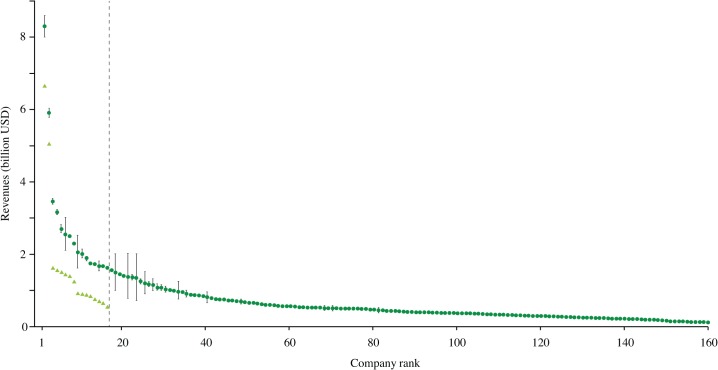
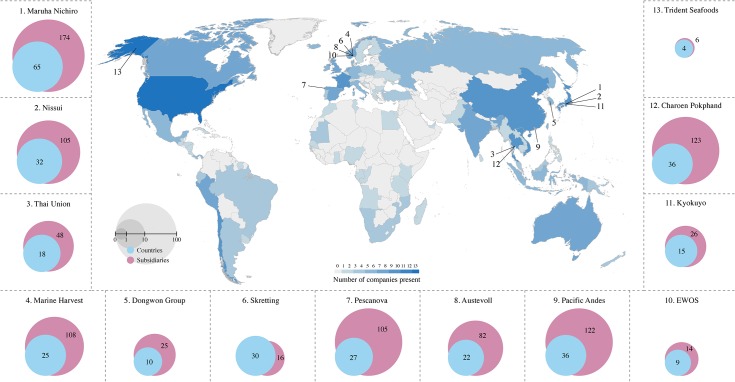
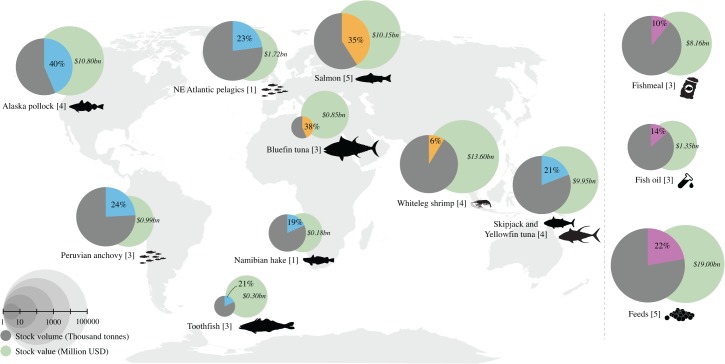
Verification
Claims the paper makes
The claims and statistics of this paper haven’t been checked yet.
Run the check — free, no account needed. It reads the open-access text and checks the sources it cites.
Claims other papers make about this one
Each is checked against this paper’s own text: does it say what the citing paper says it does?
The source backs part of the claim, not all of it — or backs it for a different population, condition or comparison.
In the citing paper
“A handful of transnational corporations control large (>50%) shares of supply chains in agriculture, fishing, logging, and mining ( 71 , 72 )”
From Pervasive human-driven decline of life on Earth points to the need for transformative change (2019) · cites this paper as [71]
Experimental — accuracy not yet measuredThe check wasn’t confident either way, so it gives no verdict — never disputed.
In the citing paper
“whereas funds channeled through tax havens support most illegal, unreported, and unregulated fishing ( 71 , 73 ), creating governance challenges.”
From Pervasive human-driven decline of life on Earth points to the need for transformative change (2019) · cites this paper as [71]
Experimental — accuracy not yet measured
Self-check
Percentages, sums and reported differences re-computed from the paper’s own numbers.
The self-check needs the paper’s full text.
Citations
Cites
Emergence of Scaling in Random Networks
Barabási, A.-L., & Albert, R. (1999) · Science · doi:10.1126/science.286.5439.509 · Cited by 36,135
Catastrophic shifts in ecosystems
Scheffer, M., Carpenter, S., Foley, J. A., Folke, C., & Walker, B. (2001) · Nature · doi:10.1038/35098000 · Cited by 7,510
Self-citationThe interaction of TIGIT with PVR and PVRL2 inhibits human NK cell cytotoxicity
Stanietsky, N., Simic, H., Arapovic, J., Toporik, A., Levy, O., Novik, A., Levine, Z., Beiman, M., Dassa, L., Achdout, H., et al. (2009) · Proceedings of the National Academy of Sciences · doi:10.1073/pnas.0903474106 · Cited by 3,524
The Anthropocene: Are Humans Now Overwhelming the Great Forces of Nature
Steffen, W., Crutzen, P. J., & McNeill, J. R. (2007) · AMBIO: A Journal of the Human Environment · doi:10.1579/0044-7447(2007)36[614:taahno]2.0.co;2 · Cited by 3,487
Effect of aquaculture on world fish supplies.
Naylor, R. L., Goldburg, R. J., Primavera, J. H., Kautsky, N., Beveridge, M. C. M., Clay, J., Folke, C., Lubchenco, J., Mooney, H., & Troell, M. (2000) · Nature · doi:10.1038/35016500 · Cited by 3,063
Self-citationTowards sustainability in world fisheries.
Pauly, D., Christensen, V., Guénette, S., Pitcher, T. J., Sumaila, U. R., Walters, C. J., Watson, R., & Zeller, D. (2002) · Nature · doi:10.1038/nature01017 · Cited by 3,019
The Anthropocene: conceptual and historical perspectives
Steffen, W., Grinevald, J., Crutzen, P., & McNeill, J. (2011) · Philosophical Transactions of the Royal Society A: Mathematical, Physical and Engineering Sciences · doi:10.1098/rsta.2010.0327 · Cited by 2,411
Anticipating Critical Transitions
Scheffer, M., Carpenter, S. R., Lenton, T. M., Bascompte, J., Brock, W., Dakos, V., van de Koppel, J., van de Leemput, I. A., Levin, S. A., van Nes, E. H., et al. (2012) · Science · doi:10.1126/science.1225244 · Cited by 2,208
Challenges in the Quest for Keystones
Power, M. E., Tilman, D., Estes, J. A., Menge, B. A., Bond, W. J., Mills, L. S., Daily, G., Castilla, J. C., Lubchenco, J., & Paine, R. T. (1996) · BioScience · doi:10.2307/1312990 · Cited by 2,018
Feeding aquaculture in an era of finite resources
Naylor, R. L., Hardy, R. W., Bureau, D., Chiu, A., Elliott, M., Farrell, A. P., Forster, I. P., Gatlin, D. M., Goldburg, R. J., Hua, K., et al. (2009) · Proceedings of the National Academy of Sciences · doi:10.1073/pnas.0905235106 · Cited by 1,588
Research works printed but not linked: 1
- Anonymous. <chapter-title>In for the long term—Sustainability Report 2011</chapter-title>. <publisher-loc>Hong Kong</publisher-loc>: <publisher-name>Pacific Andes</publisher-name>, <year>2012</year>.
Cited by
Sorted by citations
Pervasive human-driven decline of life on Earth points to the need for transformative change
Díaz, S., Settele, J., Brondízio, E. S., Ngo, H. T., Agard, J., Arneth, A., Balvanera, P., Brauman, K. A., Butchart, S. H. M., Chan, K. M. A., et al. (2019) · Science · doi:10.1126/science.aax3100 · Cited by 2,926
Social-ecological resilience and biosphere-based sustainability science
Folke, C., Biggs, R., Norström, A. V., Reyers, B., & Rockström, J. (2016) · Ecology and Society · doi:10.5751/es-08748-210341 · Cited by 1,485
Self-citationFolke, C. (2016) · Ecology and Society · doi:10.5751/es-09088-210444 · Cited by 982
Self-citationOur future in the Anthropocene biosphere
Folke, C., Polasky, S., Rockström, J., Galaz, V., Westley, F. R., Lamont, M., Scheffer, M., Österblom, H., Carpenter, S. R., Chapin, F. S., et al. (2021) · AMBIO · doi:10.1007/s13280-021-01544-8 · Cited by 863
Self-citationThe Blue Acceleration: The Trajectory of Human Expansion into the Ocean
Jouffray, J., Blasiak, R., Norström, A. V., Österblom, H., & Nyström, M. (2020) · One Earth · doi:10.1016/j.oneear.2019.12.016 · Cited by 797
Self-citation
Metadata
- Authors
- Österblom, H., Jouffray, J.-B., Folke, C., Crona, B., Troell, M., Merrie, A., & Rockström, J.
- Affiliations
- Stockholm Resilience Centre (SE)
- Royal Swedish Academy of Sciences (SE)
- Corresponding author
- Österblom, Henrik
- Jouffray, Jean-Baptiste
- Folke, Carl
- Crona, Beatrice
- Troell, Max
- Merrie, Andrew
- Rockström, Johan
- ORCID
- Venue
- PLOS ONE
- Publisher
- Public Library of Science (PLoS)
- Published
- 2015-05-27
- Volume
- 10
- Issue
- 5
- Pages
- e0127533
- ISSN
- 1932-6203 (ISSN-L)
- PMC
- PMC4446349
- OpenAlex
- W1560630840
- Cited by
- 276
- References
- 55
- Citations by year
- 2026: 16 · 2025: 25 · 2024: 27 · 2023: 35 · 2022: 27 · 2021: 29 · 2020: 40 · 2019: 20 · 2018: 19 · 2017: 21 · 2016: 15 · 2015: 2
- FWCI
- 15.58
- Type
- journal article
- Language
- en
- Open access
- gold
- doi.org
- Licence
- Locations
- PLoS ONE (publishedVersion, cc-by)
- PubMed Central (publishedVersion, cc-by)
- PubMed (publishedVersion)
- RePEc: Research Papers in Economics (submittedVersion)
- DOAJ (DOAJ: Directory of Open Access Journals) (submittedVersion, cc-by-sa)
- Figshare (submittedVersion, cc-by)
- Topics
- Life Sciences › Agricultural and Biological Sciences › Aquatic Science › Marine and fisheries research
- Physical Sciences › Environmental Science › Management, Monitoring, Policy and Law › Coastal and Marine Management
- Physical Sciences › Environmental Science › Ecology › Coastal Fisheries and Human Impacts
- Keywords
- multinational corporations, marine ecosystems, seafood production, fisheries, aquaculture, subsidiaries, fish stocks, Anthropocene, sustainable leadership, marine resource management
- MeSH terms
- Animals, Fisheries, Industry, Oceans and Seas, Professional Corporations, Ecosystem, Aquaculture, Internationality, Ecological and Environmental Phenomena, Policy
About these checks
Registry, retraction, Cites and statistics results are computed, not judged, with one exception: a printed reference that no index lists is read once by a model before it counts as a citation error. Claims are extracted by a model and kept only when their quote appears verbatim in the text; each cited source is then checked, with a model’s help, for whether it says what the claim relies on. Those verdicts can be wrong — read the claim’s quote and the cited source before relying on one.
Statistics and arithmetic are recomputed, not judged.
Confidence bands are shown only for fields calibrated on our annotated test set. None is calibrated yet, so no band is shown.
What counts as a claim ›How we measure confidence ›How we check this ›
Are you an author, or do you see a problem with this page? Request a review
