

The DOI matches its Crossref record; 59 of the 60 references it cites were found in a registry or an index; none of the 35 sources its claims cite is checked for support yet.
Can DNA-Based Ecosystem Assessments Quantify Species Abundance? Testing Primer Bias and Biomass—Sequence Relationships with an Innovative Metabarcoding Protocol
Open accessAbstract
Metabarcoding is an emerging genetic tool to rapidly assess biodiversity in ecosystems. It involves high-throughput sequencing of a standard gene from an environmental sample and comparison to a reference database. However, no consensus has emerged regarding laboratory pipelines to screen species diversity and infer species abundances from environmental samples. In particular, the effect of primer bias and the detection limit for specimens with a low biomass has not been systematically examined, when processing samples in bulk. We developed and tested a DNA metabarcoding protocol that utilises the standard cytochrome c oxidase subunit I (COI) barcoding fragment to detect freshwater macroinvertebrate taxa. DNA was extracted in bulk, amplified in a single PCR step, and purified, and the libraries were directly sequenced in two independent MiSeq runs (300-bp paired-end reads). Specifically, we assessed the influence of specimen biomass on sequence read abundance by sequencing 31 specimens of a stonefly species with known haplotypes spanning three orders of magnitude in biomass (experiment I). Then, we tested the recovery of 52 different freshwater invertebrate taxa of similar biomass using the same standard barcoding primers (experiment II). Each experiment was replicated ten times to maximise statistical power. The results of both experiments were consistent across replicates. We found a distinct positive correlation between species biomass and resulting numbers of MiSeq reads. Furthermore, we reliably recovered 83% of the 52 taxa used to test primer bias. However, sequence abundance varied by four orders of magnitudes between taxa despite the use of similar amounts of biomass. Our metabarcoding approach yielded reliable results for high-throughput assessments. However, the results indicated that primer efficiency is highly species-specific, which would prevent straightforward assessments of species abundance and biomass in a sample. Thus, PCR-based metabarcoding assessments of biodiversity should rely on presence-absence metrics.
Overview
AI snapshot
Written from the paper’s full text.
TL;DR
This study developed and tested a replicated COI metabarcoding protocol for freshwater macroinvertebrates, using bulk DNA extraction and Illumina MiSeq sequencing. It found a strong biomass–read relationship within a single species, but strong species-specific primer bias across taxa, concluding that PCR-based metabarcoding cannot reliably quantify species abundance or biomass and should be used for presence–absence assessments.
Key findings
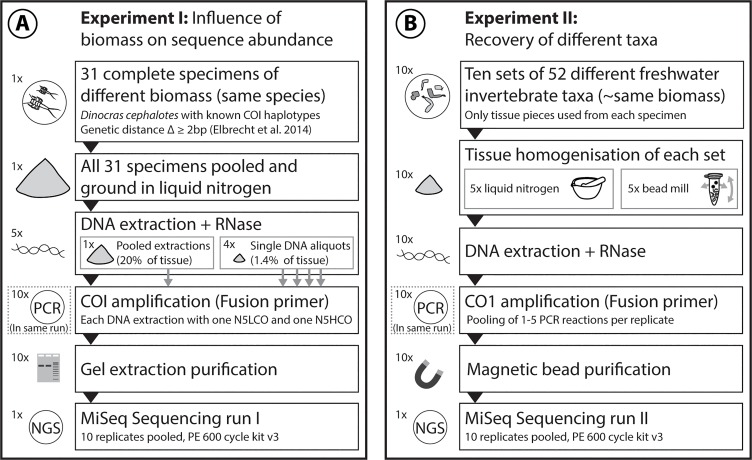
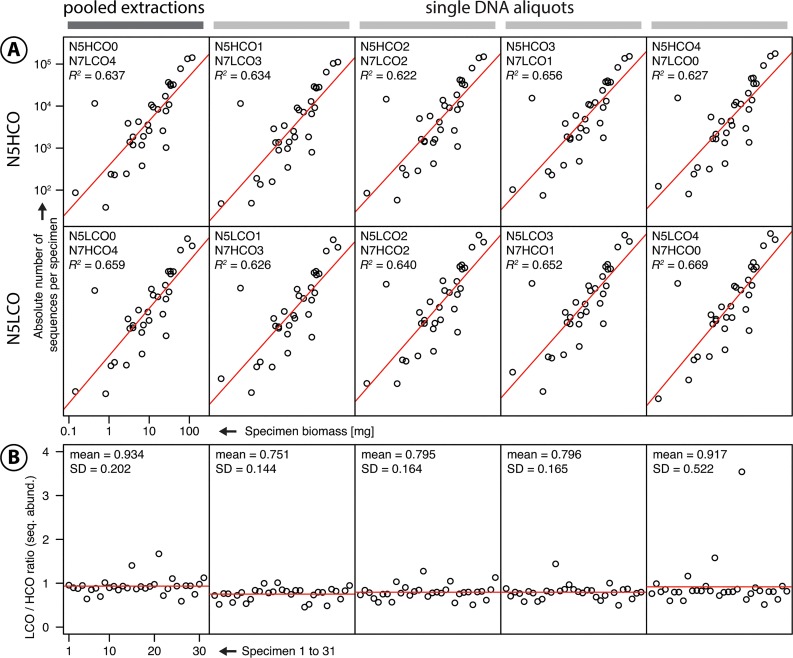
- In experiment I, all 31 *Dinocras cephalotes* specimens were recovered across ten replicates, including the smallest specimen at 0.023% (0.145 mg) of total biomass; specimen biomass and sequence abundance showed a highly significant positive linear correlation in all ten replicates (p<0.001, R² = 0.65).
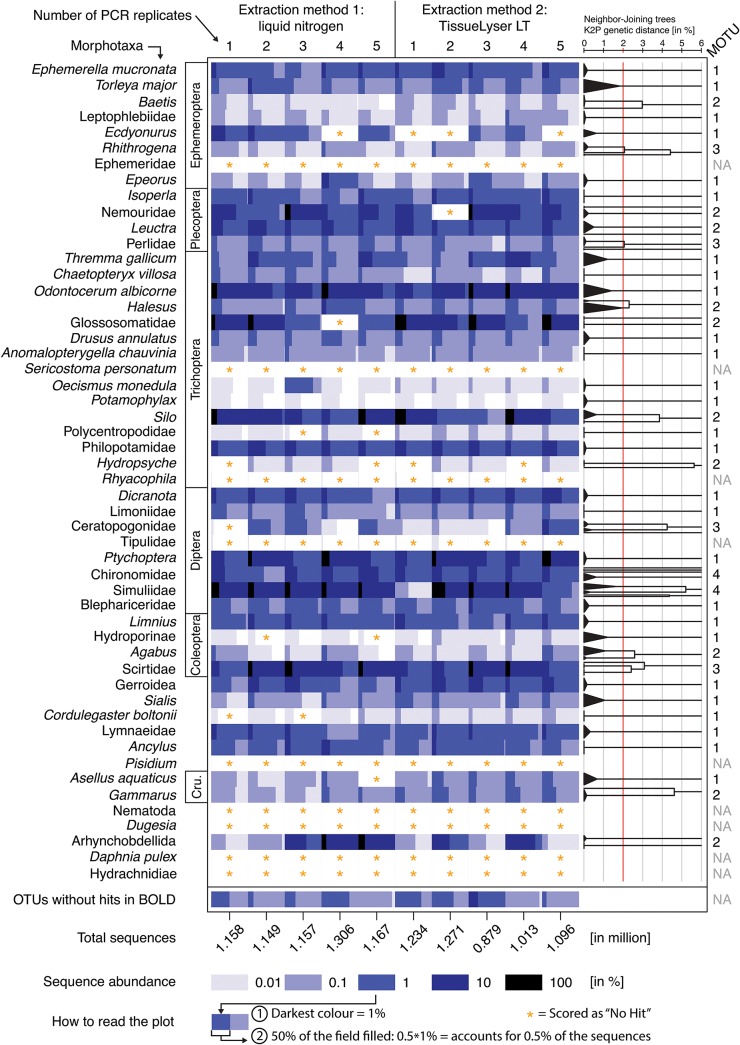
- In experiment II, 83% (43/52) of taxa were reliably recovered; 34 taxa were recovered in all ten replicates. Recovery by group was Ephemeroptera 7/8 (88%), Plecoptera 4/4 (100%), Trichoptera 13/15 (86%), Diptera 7/8 (88%), and Others 12/17 (71%).
- Despite similar biomass, sequence abundance varied by four orders of magnitude among taxa, and there was no correlation between taxon biomass and number of recovered sequences. Primer efficiency was highly species-specific, preventing straightforward abundance or biomass inference.
- LCO and HCO sequencing direction had small effects on final sequence abundance (2.7% and 4.4% differences in experiments I and II), though LCO was 34% more frequent in experiment I (p = 0.006) and no primer bias was detected in experiment II (p = 0.41).
Methods
- Two controlled experiments with ten replicates each were sequenced on two independent MiSeq runs using 300-bp paired-end reads; experiment I used 31 *D. cephalotes* stonefly specimens spanning three orders of magnitude in biomass, and experiment II used 52 freshwater invertebrate taxa with similar tissue biomass.
- DNA was extracted in bulk, amplified in a single PCR step with tagged fusion primers based on standard COI LCO1490/HCO2198, purified, and directly sequenced; experiment I used 1.4% and 20% tissue aliquots, while experiment II pooled roughly equal tissue amounts per taxon.
- Bioinformatic analysis used demultiplexing, cutadapt primer removal, read concatenation, blastn against reference haplotypes for experiment I, and UPARSE OTU clustering at 97% identity with BOLD identification for experiment II; sequence counts were normalised to total sequence abundance and tissue weight.
Limitations
- The paper states that PCR-based metabarcoding cannot accurately estimate species biomass or even abundance in diverse environmental samples because primer efficiency is highly species-specific; it recommends presence–absence metrics and notes that PCR-free approaches are needed for biomass estimates.
- The paper states that only 83% of taxa were recovered with one universal COI primer pair, that barcode reference databases remain incomplete, that DNA-based assessments cannot assign biological traits, and that PCR replication effects were not evaluated due to a small number of replicates.
- Evident from the text: the experiments are limited to freshwater macroinvertebrates from western Germany and a specific MiSeq/COI Folmer protocol; some morphotaxa were identified only to family or order and contained multiple MOTUs, so species-level amplification behaviour may be more variable than the morphotaxon-level summaries suggest.
Model-written summary. Check it against the paper before relying on it.
Integrity signals
Registry
Cites
Statistics
Figures
Verification
Claims the paper makes
44 Own result · 24 Own interpretation · 22 Not checked yet · 8 No basis given · 5 Own method
A result the paper reports from its own data — it cites no other source for it, so there is none to check. The quote shows it is in the paper.
In the paper
“However, sequence abundance varied by four orders of magnitudes between taxa despite the use of similar amounts of biomass.”
§ Can DNA-Based Ecosystem Assessments Quantify Species Abundance? Testing Primer Bias and Biomass—Sequence Relationships with an Innovative Metabarcoding Protocol > Abstract
plain- Asserted: passes — The authors put it forward as true.
- Checkable: passes — It can be checked against evidence.
- Load-bearing: passes — The paper’s conclusions depend on it.
- Based: passes — The paper gives a reason why it holds.
A result the paper reports from its own data — it cites no other source for it, so there is none to check. The quote shows it is in the paper.
In the paper
“we found significant differences between the LCO and HCO primers with respect to the number of reads with no hits in experiment I (t-test, p = 0.01, S3A Fig) and final hits in experiment II (t-test, p = 0.01, S3B Fig).”
§ Can DNA-Based Ecosystem Assessments Quantify Species Abundance? Testing Primer Bias and Biomass—Sequence Relationships with an Innovative Metabarcoding Protocol > Results > Sequencing success and statistics
plain- Asserted: passes — The authors put it forward as true.
- Checkable: passes — It can be checked against evidence.
- Load-bearing: unclear — It is unclear whether the paper’s conclusions depend on it.
- Based: passes — The paper gives a reason why it holds.
A result the paper reports from its own data — it cites no other source for it, so there is none to check. The quote shows it is in the paper.
In the paper
“We detected few outliers and low standard deviations for the ratio of LCO- to HCO-based haplotype read abundance for each of the five DNA extractions (Fig 2B and S8 Fig).”
§ Can DNA-Based Ecosystem Assessments Quantify Species Abundance? Testing Primer Bias and Biomass—Sequence Relationships with an Innovative Metabarcoding Protocol > Results > Experiment I
plain- Asserted: passes — The authors put it forward as true.
- Checkable: passes — It can be checked against evidence.
- Load-bearing: unclear — It is unclear whether the paper’s conclusions depend on it.
- Based: passes — The paper gives a reason why it holds.
A result the paper reports from its own data — it cites no other source for it, so there is none to check. The quote shows it is in the paper.
In the paper
“The sequencing results for the ten replicates were highly reproducible.”
§ Can DNA-Based Ecosystem Assessments Quantify Species Abundance? Testing Primer Bias and Biomass—Sequence Relationships with an Innovative Metabarcoding Protocol > Results > Experiment I
boosted- Asserted: passes — The authors put it forward as true.
- Checkable: passes — It can be checked against evidence.
- Load-bearing: passes — The paper’s conclusions depend on it.
- Based: passes — The paper gives a reason why it holds.
A result the paper reports from its own data — it cites no other source for it, so there is none to check. The quote shows it is in the paper.
In the paper
“We did not observe significant differences in sequence abundance among the replicates using different amounts of extracted tissue as a template.”
§ Can DNA-Based Ecosystem Assessments Quantify Species Abundance? Testing Primer Bias and Biomass—Sequence Relationships with an Innovative Metabarcoding Protocol > Results > Experiment I
plain- Asserted: passes — The authors put it forward as true.
- Checkable: passes — It can be checked against evidence.
- Load-bearing: passes — The paper’s conclusions depend on it.
- Based: passes — The paper gives a reason why it holds.
A result the paper reports from its own data — it cites no other source for it, so there is none to check. The quote shows it is in the paper.
In the paper
“From the DNA extractions performed with the TissueLyser LT, six more specimens (2.31%) were recovered than when DNA was extracted with liquid nitrogen.”
§ Can DNA-Based Ecosystem Assessments Quantify Species Abundance? Testing Primer Bias and Biomass—Sequence Relationships with an Innovative Metabarcoding Protocol > Results > Experiment II
plaindirectn = 6- Asserted: passes — The authors put it forward as true.
- Checkable: passes — It can be checked against evidence.
- Load-bearing: unclear — It is unclear whether the paper’s conclusions depend on it.
- Based: passes — The paper gives a reason why it holds.
A result the paper reports from its own data — it cites no other source for it, so there is none to check. The quote shows it is in the paper.
In the paper
“Sequences starting with the LCO primer for the first read were significantly overrepresented in experiment I (34% more frequent than sequences beginning with the HCO primer, t-test, p = 0.006, S4A Fig).”
§ Can DNA-Based Ecosystem Assessments Quantify Species Abundance? Testing Primer Bias and Biomass—Sequence Relationships with an Innovative Metabarcoding Protocol > Results > Sequencing success and statistics
plaincorrelationaln = 31- Asserted: passes — The authors put it forward as true.
- Checkable: passes — It can be checked against evidence.
- Load-bearing: unclear — It is unclear whether the paper’s conclusions depend on it.
- Based: passes — The paper gives a reason why it holds.
A result the paper reports from its own data — it cites no other source for it, so there is none to check. The quote shows it is in the paper.
In the paper
“A much higher per-site nucleotide diversity was observed using the consensus sequences of the 31 unique Dinocras cephalotes COI haplotypes (see experiment I below) (S2 Fig). Fewer peaks of low diversity (only up to 70% identical bases) were detected using both primers than using one primer at a time (100% identical bases).”
§ Can DNA-Based Ecosystem Assessments Quantify Species Abundance? Testing Primer Bias and Biomass—Sequence Relationships with an Innovative Metabarcoding Protocol > Materials and Methods > Primer design and sequencing strategy
plaindirect- Asserted: passes — The authors put it forward as true.
- Checkable: passes — It can be checked against evidence.
- Load-bearing: passes — The paper’s conclusions depend on it.
- Based: passes — The paper gives a reason why it holds.
A result the paper reports from its own data — it cites no other source for it, so there is none to check. The quote shows it is in the paper.
In the paper
“In experiment II, we did not detect primer bias (t-test, p = 0.41, S4B Fig).”
§ Can DNA-Based Ecosystem Assessments Quantify Species Abundance? Testing Primer Bias and Biomass—Sequence Relationships with an Innovative Metabarcoding Protocol > Results > Sequencing success and statistics
plain- Asserted: passes — The authors put it forward as true.
- Checkable: passes — It can be checked against evidence.
- Load-bearing: unclear — It is unclear whether the paper’s conclusions depend on it.
- Based: passes — The paper gives a reason why it holds.
A result the paper reports from its own data — it cites no other source for it, so there is none to check. The quote shows it is in the paper.
In the paper
“Specimens with a low biomass tend to show relatively high variation in sequence abundance among the ten replicates.”
§ Can DNA-Based Ecosystem Assessments Quantify Species Abundance? Testing Primer Bias and Biomass—Sequence Relationships with an Innovative Metabarcoding Protocol > Results > Experiment I
hedgedcorrelationaln = 31- Asserted: passes — The authors put it forward as true.
- Checkable: passes — It can be checked against evidence.
- Load-bearing: passes — The paper’s conclusions depend on it.
- Based: passes — The paper gives a reason why it holds.
- Probably not a substantial claim. 23
- It may state two separate claims as one. 23
A result the paper reports from its own data — it cites no other source for it, so there is none to check. The quote shows it is in the paper.
In the paper
“The two independent weight measurements differed in mean by 0.1 mg (SD = 0.03).”
§ Can DNA-Based Ecosystem Assessments Quantify Species Abundance? Testing Primer Bias and Biomass—Sequence Relationships with an Innovative Metabarcoding Protocol > Results > Experiment I
plainn = 31- Asserted: passes — The authors put it forward as true.
- Checkable: passes — It can be checked against evidence.
- Load-bearing: fails — The paper’s conclusions may not depend on it.
- Based: passes — The paper gives a reason why it holds.
Probably not a substantial claim. The paper’s conclusions may not depend on it.
A result the paper reports from its own data — it cites no other source for it, so there is none to check. The quote shows it is in the paper.
In the paper
“The MiSeq runs of experiments I and II yielded 9.63 and 14.07 Gb of read data, respectively.”
§ Can DNA-Based Ecosystem Assessments Quantify Species Abundance? Testing Primer Bias and Biomass—Sequence Relationships with an Innovative Metabarcoding Protocol > Results > Sequencing success and statistics
plain- Asserted: passes — The authors put it forward as true.
- Checkable: passes — It can be checked against evidence.
- Load-bearing: fails — The paper’s conclusions may not depend on it.
- Based: passes — The paper gives a reason why it holds.
Probably not a substantial claim. The paper’s conclusions may not depend on it. It may state two separate claims as one.
A result the paper reports from its own data — it cites no other source for it, so there is none to check. The quote shows it is in the paper.
In the paper
“In all 10 replicates, we recovered all 31 D. cephalotes specimens based on their unique haplotypes, including the smallest specimens, which only made up 0.023% (0.145 mg) of the total specimen biomass (Fig 2A).”
§ Can DNA-Based Ecosystem Assessments Quantify Species Abundance? Testing Primer Bias and Biomass—Sequence Relationships with an Innovative Metabarcoding Protocol > Results > Experiment I
plainn = 31- Asserted: passes — The authors put it forward as true.
- Checkable: passes — It can be checked against evidence.
- Load-bearing: passes — The paper’s conclusions depend on it.
- Based: passes — The paper gives a reason why it holds.
It may state two separate claims as one.
A result the paper reports from its own data — it cites no other source for it, so there is none to check. The quote shows it is in the paper.
In the paper
“The mean normalised sequence abundances had low standard deviations and the linear model fit well (p<0.001, R 2 = 0.65, S8 Fig).”
§ Can DNA-Based Ecosystem Assessments Quantify Species Abundance? Testing Primer Bias and Biomass—Sequence Relationships with an Innovative Metabarcoding Protocol > Results > Experiment I
plaincorrelational- Asserted: passes — The authors put it forward as true.
- Checkable: passes — It can be checked against evidence.
- Load-bearing: passes — The paper’s conclusions depend on it.
- Based: passes — The paper gives a reason why it holds.
It may state two separate claims as one.
The paper states this without a source or data behind it here, so there is nothing to check it against. The quote shows it is in the paper.
In the paper
“For two specimens, we recovered sequence artefacts (see S6 Fig); these did not affect further analyses.”
§ Can DNA-Based Ecosystem Assessments Quantify Species Abundance? Testing Primer Bias and Biomass—Sequence Relationships with an Innovative Metabarcoding Protocol > Results > Experiment I
plainn = 2- Asserted: passes — The authors put it forward as true.
- Checkable: passes — It can be checked against evidence.
- Load-bearing: fails — The paper’s conclusions may not depend on it.
- Based: passes — The paper gives a reason why it holds.
Probably not a substantial claim. The paper’s conclusions may not depend on it. It may state two separate claims as one.
A result the paper reports from its own data — it cites no other source for it, so there is none to check. The quote shows it is in the paper.
In the paper
“Both MiSeq runs showed good read quality (sequences with Q30 ≥ 85.3% and 83.3%).”
§ Can DNA-Based Ecosystem Assessments Quantify Species Abundance? Testing Primer Bias and Biomass—Sequence Relationships with an Innovative Metabarcoding Protocol > Results > Sequencing success and statistics
plain- Asserted: passes — The authors put it forward as true.
- Checkable: passes — It can be checked against evidence.
- Load-bearing: fails — The paper’s conclusions may not depend on it.
- Based: passes — The paper gives a reason why it holds.
Probably not a substantial claim. The paper’s conclusions may not depend on it. It may state two separate claims as one.
A result the paper reports from its own data — it cites no other source for it, so there is none to check. The quote shows it is in the paper.
In the paper
“Sequences that did not match the target species were similar to sequences derived from a variety of benthic organisms, but also fungi and plants.”
§ Can DNA-Based Ecosystem Assessments Quantify Species Abundance? Testing Primer Bias and Biomass—Sequence Relationships with an Innovative Metabarcoding Protocol > Results > Experiment II
plain- Asserted: passes — The authors put it forward as true.
- Checkable: passes — It can be checked against evidence.
- Load-bearing: unclear — It is unclear whether the paper’s conclusions depend on it.
- Based: passes — The paper gives a reason why it holds.
It may state two separate claims as one.
The paper states this without a source or data behind it here, so there is nothing to check it against. The quote shows it is in the paper.
In the paper
“Using our protocol, it is possible to assess community compositions within a week, from sampling to species identification.”
§ Can DNA-Based Ecosystem Assessments Quantify Species Abundance? Testing Primer Bias and Biomass—Sequence Relationships with an Innovative Metabarcoding Protocol > Discussion > Implications for large-scale monitoring and future challenges
hedgeddirect- Asserted: passes — The authors put it forward as true.
- Checkable: passes — It can be checked against evidence.
- Load-bearing: fails — The paper’s conclusions may not depend on it.
- Based: fails — The paper may give no reason why it holds.
Probably not a substantial claim. The paper’s conclusions may not depend on it. The paper may give no reason why it holds.
In the paper
“Furthermore, we used a universal COI primer with a broad target range [41], and only 17% of taxa went undetected.”
§ Can DNA-Based Ecosystem Assessments Quantify Species Abundance? Testing Primer Bias and Biomass—Sequence Relationships with an Innovative Metabarcoding Protocol > Discussion > Implications for large-scale monitoring and future challenges
What the sources say
- Not checked yetcites [41] O Folmer, 1994, DNA primers for amplification of mitochondrial cytochrome c oxidase subunit I from diverse metazoan invertebrates, Mol Marine Biol Biotechnol
plain- Asserted: passes — The authors put it forward as true.
- Checkable: passes — It can be checked against evidence.
- Load-bearing: unclear — It is unclear whether the paper’s conclusions depend on it.
- Based: passes — The paper gives a reason why it holds.
It may state two separate claims as one.
A result the paper reports from its own data — it cites no other source for it, so there is none to check. The quote shows it is in the paper.
In the paper
“Of all recovered 213 OTUs, 31 could not be identified using the BOLD database (S9B Fig).”
§ Can DNA-Based Ecosystem Assessments Quantify Species Abundance? Testing Primer Bias and Biomass—Sequence Relationships with an Innovative Metabarcoding Protocol > Results > Experiment II
plain- Asserted: passes — The authors put it forward as true.
- Checkable: passes — It can be checked against evidence.
- Load-bearing: fails — The paper’s conclusions may not depend on it.
- Based: passes — The paper gives a reason why it holds.
Probably not a substantial claim. The paper’s conclusions may not depend on it.
A result the paper reports from its own data — it cites no other source for it, so there is none to check. The quote shows it is in the paper.
In the paper
“We detected a slightly different sequencing efficiency between forward and reverse primers, but this only affected total sequence abundance and did not systematically alter the inferences from the data.”
§ Can DNA-Based Ecosystem Assessments Quantify Species Abundance? Testing Primer Bias and Biomass—Sequence Relationships with an Innovative Metabarcoding Protocol > Discussion > Experiment I: Relationship between specimen biomass and sequence abundance
plaindirect- Asserted: passes — The authors put it forward as true.
- Checkable: passes — It can be checked against evidence.
- Load-bearing: unclear — It is unclear whether the paper’s conclusions depend on it.
- Based: passes — The paper gives a reason why it holds.
It may state two separate claims as one.
The paper states this without a source or data behind it here, so there is nothing to check it against. The quote shows it is in the paper.
In the paper
“Our parallel sequencing strategy leads to an increase in per-site sequence diversity and read quality.”
§ Can DNA-Based Ecosystem Assessments Quantify Species Abundance? Testing Primer Bias and Biomass—Sequence Relationships with an Innovative Metabarcoding Protocol > Discussion > Implications for large-scale monitoring and future challenges
plaindirect- Asserted: passes — The authors put it forward as true.
- Checkable: passes — It can be checked against evidence.
- Load-bearing: fails — The paper’s conclusions may not depend on it.
- Based: fails — The paper may give no reason why it holds.
Probably not a substantial claim. The paper’s conclusions may not depend on it. The paper may give no reason why it holds. It may state two separate claims as one.
None of the sources cited for this claim have been checked yet.
In the paper
“different species within a genus or subfamily can have different ecological preferences and stress tolerances and belong to different functional feeding groups [11,12] see [13] for review.”
§ Can DNA-Based Ecosystem Assessments Quantify Species Abundance? Testing Primer Bias and Biomass—Sequence Relationships with an Innovative Metabarcoding Protocol > Introduction
What the sources say
- Not checked yetcites [11] Merritt RW, Berg MB, Cummins KW. An Introduction to the Aquatic Insects of North America. 2009.
- Not checked yetcites [12] SU Pauls, 2008, Grazers, shredders and filtering carnivores—The evolution of feeding ecology in Drusinae (Trichoptera: Limnephilidae): Insights from a molecular phylogeny, Mol Phylogenet Evol source
- Not checked yetcites [13] FC Jones, 2008, Taxonomic sufficiency: The influence of taxonomic resolution on freshwater bioassessments using benthic macroinvertebrates, Environ Rev source
plaincorrelational- Asserted: passes — The authors put it forward as true.
- Checkable: passes — It can be checked against evidence.
- Load-bearing: passes — The paper’s conclusions depend on it.
- Based: passes — The paper gives a reason why it holds.
It may state two separate claims as one.
What the paper did — it cites no source for this, so there is none to check. The quote shows it is in the paper.
In the paper
“The same PCR master mix was used for all reactions to ensure identical PCR conditions for all replicates.”
§ Can DNA-Based Ecosystem Assessments Quantify Species Abundance? Testing Primer Bias and Biomass—Sequence Relationships with an Innovative Metabarcoding Protocol > Materials and Methods > Experiment I: Relationship between specimen biomass and sequence abundance
plain- Asserted: passes — The authors put it forward as true.
- Checkable: passes — It can be checked against evidence.
- Load-bearing: fails — The paper’s conclusions may not depend on it.
- Based: passes — The paper gives a reason why it holds.
Probably not a substantial claim. The paper’s conclusions may not depend on it.
In the paper
“many benthic invertebrate larvae are difficult to identify at the species level, and thus the most practical taxonomic level for the identification of these organisms is often only the genus or family [10].”
§ Can DNA-Based Ecosystem Assessments Quantify Species Abundance? Testing Primer Bias and Biomass—Sequence Relationships with an Innovative Metabarcoding Protocol > Introduction
What the sources say
- Not checked yetcites [10] P Haase, 2010, First audit of macroinvertebrate samples from an EU Water Framework Directive monitoring program: human error greatly lowers precision of assessment results, J North Am Benthol Soc source
plaindirect- Asserted: passes — The authors put it forward as true.
- Checkable: passes — It can be checked against evidence.
- Load-bearing: passes — The paper’s conclusions depend on it.
- Based: passes — The paper gives a reason why it holds.
It may state two separate claims as one.
What the paper did — it cites no source for this, so there is none to check. The quote shows it is in the paper.
In the paper
“To ensure reliable hits, only sequences that had a maximum of five mismatches and gaps were included in the analysis.”
§ Can DNA-Based Ecosystem Assessments Quantify Species Abundance? Testing Primer Bias and Biomass—Sequence Relationships with an Innovative Metabarcoding Protocol > Materials and Methods > Experiment I: Relationship between specimen biomass and sequence abundance
plain- Asserted: passes — The authors put it forward as true.
- Checkable: passes — It can be checked against evidence.
- Load-bearing: passes — The paper’s conclusions depend on it.
- Based: passes — The paper gives a reason why it holds.
Probably not a substantial claim.
A conclusion the paper draws from its own results — it cites no other source for it, so there is none to check. The quote shows it is in the paper.
In the paper
“The parallel sequencing approach thus substantially reduced regions of low per-site diversity, improving read quality.”
§ Can DNA-Based Ecosystem Assessments Quantify Species Abundance? Testing Primer Bias and Biomass—Sequence Relationships with an Innovative Metabarcoding Protocol > Materials and Methods > Primer design and sequencing strategy
plaindirect- Asserted: passes — The authors put it forward as true.
- Checkable: passes — It can be checked against evidence.
- Load-bearing: unclear — It is unclear whether the paper’s conclusions depend on it.
- Based: passes — The paper gives a reason why it holds.
It may state two separate claims as one.
None of the sources cited for this claim have been checked yet.
In the paper
“DNA barcoding allows for standardized and accurate species identification [15–18].”
§ Can DNA-Based Ecosystem Assessments Quantify Species Abundance? Testing Primer Bias and Biomass—Sequence Relationships with an Innovative Metabarcoding Protocol > Introduction
What the sources say
- Not checked yetcites [15] PDN Hebert, 2003, Barcoding animal life: cytochrome c oxidase subunit 1 divergences among closely related species, Proc R Soc Lond B Biol Sci source
- Not checked yetcites [16] X Zhou, 2009, Towards a comprehensive barcode library for arctic life—Ephemeroptera, Plecoptera, and Trichoptera of Churchill, Manitoba, Canada, Front Zool source
- Not checked yetcites [17] X Zhou, 2010, Ephemeroptera, Plecoptera, and Trichoptera fauna of Churchill (Manitoba, Canada): insights into biodiversity patterns from DNA barcoding, J North Am Benthol Soc source
- Not checked yetcites [18] BW Sweeney, 2011, Can DNA barcodes of stream macroinvertebrates improve descriptions of community structure and water quality?, J North Am Benthol Soc source
plaindirect- Asserted: passes — The authors put it forward as true.
- Checkable: passes — It can be checked against evidence.
- Load-bearing: fails — The paper’s conclusions may not depend on it.
- Based: passes — The paper gives a reason why it holds.
Probably not a substantial claim. The paper’s conclusions may not depend on it. It may state two separate claims as one.
In the paper
“frequent identification errors occur and many specimens are not detected in samples [10]”
§ Can DNA-Based Ecosystem Assessments Quantify Species Abundance? Testing Primer Bias and Biomass—Sequence Relationships with an Innovative Metabarcoding Protocol > Introduction
What the sources say
- Not checked yetcites [10] P Haase, 2010, First audit of macroinvertebrate samples from an EU Water Framework Directive monitoring program: human error greatly lowers precision of assessment results, J North Am Benthol Soc source
plain- Asserted: passes — The authors put it forward as true.
- Checkable: passes — It can be checked against evidence.
- Load-bearing: passes — The paper’s conclusions depend on it.
- Based: passes — The paper gives a reason why it holds.
It may state two separate claims as one.
What the paper did — it cites no source for this, so there is none to check. The quote shows it is in the paper.
In the paper
“All analyses were performed with ten replicates to improve statistical robustness.”
- Also stated in: § Abstract · plain
“Each experiment was replicated ten times to maximise statistical power.”
§ Can DNA-Based Ecosystem Assessments Quantify Species Abundance? Testing Primer Bias and Biomass—Sequence Relationships with an Innovative Metabarcoding Protocol > Introduction
plaindirect- Asserted: passes — The authors put it forward as true.
- Checkable: passes — It can be checked against evidence.
- Load-bearing: fails — The paper’s conclusions may not depend on it.
- Based: passes — The paper gives a reason why it holds.
Probably not a substantial claim. The paper’s conclusions may not depend on it.
- Also stated in: § Abstract · plain
In the paper
“Stein and co-authors showed that ten of 16 assessment metrics had higher statistical power using DNA barcoding than morphological assessment [14].”
§ Can DNA-Based Ecosystem Assessments Quantify Species Abundance? Testing Primer Bias and Biomass—Sequence Relationships with an Innovative Metabarcoding Protocol > Introduction
What the sources say
- Not checked yetcites [14] ED Stein, 2014, Is DNA Barcoding Actually Cheaper and Faster than Traditional Morphological Methods: Results from a Survey of Freshwater Bioassessment Efforts in the United States?, PLoS ONE source
plaincorrelational- Asserted: passes — The authors put it forward as true.
- Checkable: passes — It can be checked against evidence.
- Load-bearing: fails — The paper’s conclusions may not depend on it.
- Based: passes — The paper gives a reason why it holds.
Probably not a substantial claim. The paper’s conclusions may not depend on it.
In the paper
“For animals, a 658-bp standardized fragment of the mitochondrial gene COI (cytochrome c oxidase subunit 1) is typically used [19].”
§ Can DNA-Based Ecosystem Assessments Quantify Species Abundance? Testing Primer Bias and Biomass—Sequence Relationships with an Innovative Metabarcoding Protocol > Introduction
What the sources say
- Not checked yetcites [19] PDN Hebert, 2003, Biological identifications through DNA barcodes, Proc R Soc Lond B Biol Sci source
plain- Asserted: passes — The authors put it forward as true.
- Checkable: passes — It can be checked against evidence.
- Load-bearing: fails — The paper’s conclusions may not depend on it.
- Based: passes — The paper gives a reason why it holds.
Probably not a substantial claim. The paper’s conclusions may not depend on it.
A conclusion the paper draws from its own results — it cites no other source for it, so there is none to check. The quote shows it is in the paper.
In the paper
“Presumably, these morphotaxa contained several taxonomically distant species, which are unequally well amplified with the Folmer primers.”
§ Can DNA-Based Ecosystem Assessments Quantify Species Abundance? Testing Primer Bias and Biomass—Sequence Relationships with an Innovative Metabarcoding Protocol > Discussion > Experiment II: Primer amplification bias between species
hedgedcorrelational- Asserted: passes — The authors put it forward as true.
- Checkable: passes — It can be checked against evidence.
- Load-bearing: fails — The paper’s conclusions may not depend on it.
- Based: passes — The paper gives a reason why it holds.
Probably not a substantial claim. The paper’s conclusions may not depend on it. It may state two separate claims as one.
What the paper did — it cites no source for this, so there is none to check. The quote shows it is in the paper.
In the paper
“We used a highly replicated and standardised approach for species detection using DNA metabarcoding”
§ Can DNA-Based Ecosystem Assessments Quantify Species Abundance? Testing Primer Bias and Biomass—Sequence Relationships with an Innovative Metabarcoding Protocol > Discussion > Implications for large-scale monitoring and future challenges
plain- Asserted: passes — The authors put it forward as true.
- Checkable: passes — It can be checked against evidence.
- Load-bearing: fails — The paper’s conclusions may not depend on it.
- Based: passes — The paper gives a reason why it holds.
Probably not a substantial claim. The paper’s conclusions may not depend on it.
A conclusion the paper draws from its own results — it cites no other source for it, so there is none to check. The quote shows it is in the paper.
In the paper
“show that several technical and logistic problems have to be overcome before this protocol can be used for large-scale monitoring.”
§ Can DNA-Based Ecosystem Assessments Quantify Species Abundance? Testing Primer Bias and Biomass—Sequence Relationships with an Innovative Metabarcoding Protocol > Discussion > Implications for large-scale monitoring and future challenges
plain- Asserted: passes — The authors put it forward as true.
- Checkable: passes — It can be checked against evidence.
- Load-bearing: passes — The paper’s conclusions depend on it.
- Based: passes — The paper gives a reason why it holds.
Probably not a substantial claim.
A conclusion the paper draws from its own results — it cites no other source for it, so there is none to check. The quote shows it is in the paper.
In the paper
“However, our results indicate that the amount of tissue used in the DNA extraction was sufficient and did not lead to the systematic exclusion of small specimens as long as tissues are well ground and specimens have similar amplification efficiencies.”
§ Can DNA-Based Ecosystem Assessments Quantify Species Abundance? Testing Primer Bias and Biomass—Sequence Relationships with an Innovative Metabarcoding Protocol > Discussion > Experiment I: Relationship between specimen biomass and sequence abundance
hedgedn = 31- Asserted: passes — The authors put it forward as true.
- Checkable: passes — It can be checked against evidence.
- Load-bearing: passes — The paper’s conclusions depend on it.
- Based: passes — The paper gives a reason why it holds.
It may state two separate claims as one.
A conclusion the paper draws from its own results — it cites no other source for it, so there is none to check. The quote shows it is in the paper.
In the paper
“However degraded DNA and contamination as in eDNA studies with amplicons is not a concern for organisms collected directly from streams.”
§ Can DNA-Based Ecosystem Assessments Quantify Species Abundance? Testing Primer Bias and Biomass—Sequence Relationships with an Innovative Metabarcoding Protocol > Discussion > Implications for large-scale monitoring and future challenges
plain- Asserted: passes — The authors put it forward as true.
- Checkable: passes — It can be checked against evidence.
- Load-bearing: fails — The paper’s conclusions may not depend on it.
- Based: fails — The paper may give no reason why it holds.
Probably not a substantial claim. The paper’s conclusions may not depend on it. The paper may give no reason why it holds.
None of the sources cited for this claim have been checked yet.
In the paper
“Several studies show that DNA-based assessments are superior to morphological assessments in freshwater ecosystems (e.g., [14,25,33])”
§ Can DNA-Based Ecosystem Assessments Quantify Species Abundance? Testing Primer Bias and Biomass—Sequence Relationships with an Innovative Metabarcoding Protocol > Discussion
What the sources say
- Not checked yetcites [14] ED Stein, 2014, Is DNA Barcoding Actually Cheaper and Faster than Traditional Morphological Methods: Results from a Survey of Freshwater Bioassessment Efforts in the United States?, PLoS ONE source
- Not checked yetcites [25] JK Jackson, 2014, Cryptic biodiversity in streams: a comparison of macroinvertebrate communities based on morphological and DNA barcode identifications, Freshw Sci source
- Not checked yetcites [33] Zimmermann J, Glöckner G, Jahn R, Enke N, Gemeinholzer B. Metabarcoding vs. morphological identification to assess diatom diversity in environmental studies. Mol Ecol Resour. 2014; 1–17. <comment>doi: 10.1111/1755-0998.12336</comment> source
plaincorrelational- Asserted: passes — The authors put it forward as true.
- Checkable: passes — It can be checked against evidence.
- Load-bearing: fails — The paper’s conclusions may not depend on it.
- Based: passes — The paper gives a reason why it holds.
Probably not a substantial claim. The paper’s conclusions may not depend on it.
A conclusion the paper draws from its own results — it cites no other source for it, so there is none to check. The quote shows it is in the paper.
In the paper
“but not its abundance because many small organisms generate the same number of sequence reads as a few large organisms.”
§ Can DNA-Based Ecosystem Assessments Quantify Species Abundance? Testing Primer Bias and Biomass—Sequence Relationships with an Innovative Metabarcoding Protocol > Discussion > Implications for large-scale monitoring and future challenges
plain- Asserted: passes — The authors put it forward as true.
- Checkable: passes — It can be checked against evidence.
- Load-bearing: passes — The paper’s conclusions depend on it.
- Based: passes — The paper gives a reason why it holds.
It may state two separate claims as one.
A conclusion the paper draws from its own results — it cites no other source for it, so there is none to check. The quote shows it is in the paper.
In the paper
“Thus, it is not possible to accurately estimate species biomass or even abundance in diverse environmental samples using amplification-based sequencing protocols.”
§ Can DNA-Based Ecosystem Assessments Quantify Species Abundance? Testing Primer Bias and Biomass—Sequence Relationships with an Innovative Metabarcoding Protocol > Discussion > Implications for large-scale monitoring and future challenges
plain- Asserted: passes — The authors put it forward as true.
- Checkable: passes — It can be checked against evidence.
- Load-bearing: passes — The paper’s conclusions depend on it.
- Based: passes — The paper gives a reason why it holds.
It may state two separate claims as one.
In the paper
“The efforts of large national and international barcoding consortia (BOLD, iBOL, and GBOL) have contributed to a substantial increase in both the size and quality of reference databases [56]”
§ Can DNA-Based Ecosystem Assessments Quantify Species Abundance? Testing Primer Bias and Biomass—Sequence Relationships with an Innovative Metabarcoding Protocol > Discussion > Implications for large-scale monitoring and future challenges
What the sources say
- Not checked yetcites [56] P Taberlet, 2012, Towards next-generation biodiversity assessment using DNA metabarcoding, Mol Ecol source
plaindirect- Asserted: passes — The authors put it forward as true.
- Checkable: passes — It can be checked against evidence.
- Load-bearing: fails — The paper’s conclusions may not depend on it.
- Based: passes — The paper gives a reason why it holds.
Probably not a substantial claim. The paper’s conclusions may not depend on it.
None of the sources cited for this claim have been checked yet.
In the paper
“we are confident that metabarcoding will widely replace present biomonitoring methods over time because 1) it has a higher taxonomic resolution [14], 2) it is cost efficient and fast and, most importantly, 3) it reduces human bias enabling comparisons among studies [57].”
§ Can DNA-Based Ecosystem Assessments Quantify Species Abundance? Testing Primer Bias and Biomass—Sequence Relationships with an Innovative Metabarcoding Protocol > Discussion > Implications for large-scale monitoring and future challenges
What the sources say
- Not checked yetcites [14] ED Stein, 2014, Is DNA Barcoding Actually Cheaper and Faster than Traditional Morphological Methods: Results from a Survey of Freshwater Bioassessment Efforts in the United States?, PLoS ONE source
- Not checked yetcites [57] Y Ji, 2013, Reliable, verifiable and efficient monitoring of biodiversity via metabarcoding, Ecol Lett source
boosteddirect- Asserted: passes — The authors put it forward as true.
- Checkable: fails — It may be too vague to check against evidence.
- Load-bearing: fails — The paper’s conclusions may not depend on it.
- Based: passes — The paper gives a reason why it holds.
Probably not a substantial claim. It may be too vague to check against evidence. The paper’s conclusions may not depend on it. It may state two separate claims as one.
A conclusion the paper draws from its own results — it cites no other source for it, so there is none to check. The quote shows it is in the paper.
In the paper
“We provide a highly reproducible laboratory protocol for processing macroinvertebrate samples in bulk and identified species using metabarcoding with the standard COI region.”
§ Can DNA-Based Ecosystem Assessments Quantify Species Abundance? Testing Primer Bias and Biomass—Sequence Relationships with an Innovative Metabarcoding Protocol > Conclusions
boosted- Asserted: passes — The authors put it forward as true.
- Checkable: passes — It can be checked against evidence.
- Load-bearing: passes — The paper’s conclusions depend on it.
- Based: passes — The paper gives a reason why it holds.
It may state two separate claims as one.
In the paper
“Piñol et al. [39] proposed a relationship between biomass and sequence reads, but did not systematically examine this hypothesis.”
§ Can DNA-Based Ecosystem Assessments Quantify Species Abundance? Testing Primer Bias and Biomass—Sequence Relationships with an Innovative Metabarcoding Protocol > Discussion > Experiment I: Relationship between specimen biomass and sequence abundance
What the sources say
- Not checked yetcites [39] Piñol J, Mir G, Gomez-Polo P, Agustí N. Universal and blocking primer mismatches limit the use of high-throughput DNA sequencing for the quantitative metabarcoding of arthropods. Mol Ecol Resour. 2014; 1–12. <comment>doi: 10.1111/1755-0998.12355</comment> source
plaincorrelational- Asserted: passes — The authors put it forward as true.
- Checkable: passes — It can be checked against evidence.
- Load-bearing: fails — The paper’s conclusions may not depend on it.
- Based: passes — The paper gives a reason why it holds.
Probably not a substantial claim. The paper’s conclusions may not depend on it. It may state two separate claims as one.
A conclusion the paper draws from its own results — it cites no other source for it, so there is none to check. The quote shows it is in the paper.
In the paper
“This is consistent with the primer bias which we already observed between morphotaxa and support the overall findings of strong taxon-specific amplification bias.”
§ Can DNA-Based Ecosystem Assessments Quantify Species Abundance? Testing Primer Bias and Biomass—Sequence Relationships with an Innovative Metabarcoding Protocol > Discussion > Experiment II: Primer amplification bias between species
boostedcorrelational- Asserted: passes — The authors put it forward as true.
- Checkable: passes — It can be checked against evidence.
- Load-bearing: passes — The paper’s conclusions depend on it.
- Based: passes — The paper gives a reason why it holds.
It may state two separate claims as one.
A conclusion the paper draws from its own results — it cites no other source for it, so there is none to check. The quote shows it is in the paper.
In the paper
“The methods developed in this study can easily be adapted to assess the communities of other ecosystems.”
§ Can DNA-Based Ecosystem Assessments Quantify Species Abundance? Testing Primer Bias and Biomass—Sequence Relationships with an Innovative Metabarcoding Protocol > Discussion > Implications for large-scale monitoring and future challenges
plain- Asserted: passes — The authors put it forward as true.
- Checkable: fails — It may be too vague to check against evidence.
- Load-bearing: fails — The paper’s conclusions may not depend on it.
- Based: fails — The paper may give no reason why it holds.
Probably not a substantial claim. It may be too vague to check against evidence. The paper’s conclusions may not depend on it. The paper may give no reason why it holds.
In the paper
“However, while this approach could have comparable taxonomic resolution as the COI barcode, it is currently limited by the lack of reference databases [55].”
§ Can DNA-Based Ecosystem Assessments Quantify Species Abundance? Testing Primer Bias and Biomass—Sequence Relationships with an Innovative Metabarcoding Protocol > Discussion > Implications for large-scale monitoring and future challenges
What the sources say
- Not checked yetcites [55] LJ Clarke, 2014, Environmental metabarcodes for insects: in silicoPCR reveals potential for taxonomic bias, Mol Ecol Resour source
hedgeddirect- Asserted: passes — The authors put it forward as true.
- Checkable: passes — It can be checked against evidence.
- Load-bearing: unclear — It is unclear whether the paper’s conclusions depend on it.
- Based: passes — The paper gives a reason why it holds.
It may state two separate claims as one.
A conclusion the paper draws from its own results — it cites no other source for it, so there is none to check. The quote shows it is in the paper.
In the paper
“A combination of both data types, i.e., DNA species barcodes and ecological traits, will maximise the power of metabarcoding for the reliable assessment of ecosystem responses under stress and for biomonitoring.”
§ Can DNA-Based Ecosystem Assessments Quantify Species Abundance? Testing Primer Bias and Biomass—Sequence Relationships with an Innovative Metabarcoding Protocol > Discussion > Implications for large-scale monitoring and future challenges
plaindirect- Asserted: passes — The authors put it forward as true.
- Checkable: fails — It may be too vague to check against evidence.
- Load-bearing: passes — The paper’s conclusions depend on it.
- Based: passes — The paper gives a reason why it holds.
Probably not a substantial claim. It may be too vague to check against evidence.
- Rests on an assumption: DNA-based assessments cannot assign biological traits to species.
The paper relies on this without support.
Precise estimates of biomass with respect to specimen recovery and primer bias have not been performed.
“Precise estimates of biomass with respect to specimen recovery and primer bias have not been performed.”
The paper relies on this without support.
COI amplicons are typically similar in base composition.
“COI amplicons are typically similar in base composition; therefore, three strategies were used to increase sequence diversity.”
The paper relies on this without support.
Sanger sequencing requires that each specimen is processed individually in the laboratory, which is costly and extremely time-consuming for routine community assessments involving hundreds or thousands of specimens per sample.
“However, Sanger sequencing requires that each specimen is processed individually in the laboratory, which is costly and extremely time-consuming for routine community assessments involving hundreds or thousands of specimens per sample.”
The paper relies on this without support.
Benthic indicator organisms vary in biomass, and this variation depends on taxonomic group and life stage.
“Benthic indicator organisms vary in biomass, and this variation depends on taxonomic group and life stage.”
The paper relies on this without support.
Morphotaxa could often only be identified at family or order level, and several species per morphotaxon may occur in the sampled aquatic habitats even at the same habitat patch.
“This was expected, as morphotaxa could often only be identified at family or order level, and several species per morphotaxon may occur in the sampled aquatic habitats even at the same habitat patch.”
The paper relies on this without support.
Stochastic effects increase with reduced specimen biomass.
“This result is expected because stochastic effects increase with reduced specimen biomass.”
The paper relies on this without support.
Currently, the monitoring of freshwater ecosystems is based on abundance metrics, which cannot be generated using the metabarcoding solutions currently available.
“Currently, the monitoring of freshwater ecosystems is based on abundance metrics, which cannot be generated using the metabarcoding solutions currently available.”
The paper relies on this without support.
All assessment protocols rely on reference catalogues against which inventory data of a species from an ecosystem are compared.
“All assessment protocols rely on reference catalogues against which inventory data of a species from an ecosystem are compared.”
The paper relies on this without support.
Changes in species traits in a community (e.g. functional feeding groups, tolerance against pollution) are used as indicator values to evaluate the biological significance of inferred community changes.
“In particular, changes in species traits in a community (e.g. functional feeding groups, tolerance against pollution) are used as indicator values to evaluate the biological significance of inferred community changes.”
The paper relies on this without support.
DNA-based assessments cannot assign biological traits to species.
“However, DNA-based assessments cannot assign biological traits to species.”
Claims other papers make about this one
Each is checked against this paper’s own text: does it say what the citing paper says it does?
In the citing paper
“This was done to increase the likelihood of detecting small-bodied and rare species in samples, as individuals with a larger biomass provide disproportionate amounts of DNA and can therefore be over-represented when metabarcoding bulk samples65.”
From Soundscapes and deep learning enable tracking biodiversity recovery in tropical forests (2023) · cites this paper as [65]
Self-check
Percentages, sums and reported differences re-computed from the paper’s own numbers.
Each contradiction between two passages listed here was confirmed by an independent check.
Rated minor: it would not touch a result — a value no result rests on, a p-value that stays on the same side of the significance level, or a conflict that is clerical, resolved elsewhere in the paper, or outside its own findings.
In the paper
§ Can DNA-Based Ecosystem Assessments Quantify Species Abundance? Testing Primer Bias and Biomass—Sequence Relationships with an Innovative Metabarcoding Protocol > Results > Experiment II
“We were able to reliably assign OTUs to all 52 taxa included in the extraction.”
§ Can DNA-Based Ecosystem Assessments Quantify Species Abundance? Testing Primer Bias and Biomass—Sequence Relationships with an Innovative Metabarcoding Protocol > Discussion > Implications for large-scale monitoring and future challenges
“Furthermore, we used a universal COI primer with a broad target range [41], and only 17% of taxa went undetected.”
Citations
Cites
R: A Language and Environment for Statistical Computing
R Core Team (2000) · doi:10.32614/r.manuals · Cited by 355,893
QIIME allows analysis of high-throughput community sequencing data
Caporaso, J. G., Kuczynski, J., Stombaugh, J., Bittinger, K., Bushman, F. D., Costello, E. K., Fierer, N., Peña, A. G., Goodrich, J. K., Gordon, J. I., et al. (2010) · Nature Methods · doi:10.1038/nmeth.f.303 · Cited by 34,887
Cutadapt removes adapter sequences from high-throughput sequencing reads
Martin, M. (2011) · EMBnet.journal · doi:10.14806/ej.17.1.200 · Cited by 33,889
BLAST+: architecture and applications
Camacho, C., Coulouris, G., Avagyan, V., Ma, N., Papadopoulos, J., Bealer, K., & Madden, T. L. (2009) · BMC Bioinformatics · doi:10.1186/1471-2105-10-421 · Cited by 22,074
UPARSE: highly accurate OTU sequences from microbial amplicon reads
Edgar, R. C. (2013) · Nature Methods · doi:10.1038/nmeth.2604 · Cited by 16,770
Folmer, O., Black, M., Hoeh, W., Lutz, R., & Vrijenhoek, R. (1994) · PubMed · doi:10.5281/zenodo.15145663 · Cited by 15,546
Biological identifications through DNA barcodes
Hebert, P. D. N., Cywinska, A., Ball, S. L., & deWaard, J. R. (2003) · Proceedings of the Royal Society of London. Series B: Biological Sciences · doi:10.1098/rspb.2002.2218 · Cited by 13,376
A safe operating space for humanity
Rockström, J., Steffen, W., Noone, K., Persson, Å., Chapin, F. S., Lambin, E. F., Lenton, T. M., Scheffer, M., Folke, C., Schellnhuber, H. J., et al. (2009) · Nature · doi:10.1038/461472a · Cited by 13,333
Ecosystems and Human Well-being: Synthesis
Assessment, M. E. (2005) · Island Press · doi:10.5281/zenodo.18167309 · Cited by 10,665
Freshwater biodiversity: importance, threats, status and conservation challenges
Dudgeon, D., Arthington, A. H., Gessner, M. O., Kawabata, Z., Knowler, D. J., Lévêque, C., Naiman, R. J., Prieur‐Richard, A., Soto, D., Stiassny, M. L. J., et al. (2006) · Biological Reviews · doi:10.1017/s1464793105006950 · Cited by 8,489
Cited by
Sorted by citations
Items 101–200 of 765
Zizka, V. M. A., Leese, F., Peinert, B., & Geiger, M. F. (2018) · Genome · doi:10.1139/gen-2018-0048 · Cited by 95
Self-citationBoivin‐Delisle, D., Laporte, M., Burton, F., Dion, R., Normandeau, É., & Bernatchez, L. (2020) · Environmental DNA · doi:10.1002/edn3.135 · Cited by 90
“Many studies previously showed that the occurrence of amplification bias is imputable to a differential affinity with primer binding sites (Andruszkiewicz, Sassoubre, et al., 2017; Andruszkiewicz, Starks, et al., 2017; Elbrecht & Leese, 2015; Piñol et al., 2018).”
BackgroundSoundscapes and deep learning enable tracking biodiversity recovery in tropical forests
Müller, J., Mitesser, O., Schaefer, H. M., Seibold, S., Busse, A., Kriegel, P., Rabl, D., Gelis, R., Arteaga, A., Freile, J., et al. (2023) · Nature Communications · doi:10.1038/s41467-023-41693-w · Cited by 89
“This was done to increase the likelihood of detecting small-bodied and rare species in samples, as individuals with a larger biomass provide disproportionate amounts of DNA and can therefore be over-represented when metabarcoding bulk samples 65 .”
Kitson, J. J. N., Hahn, C., Sands, R. J. N., Straw, N. A., Evans, D. M., & Lunt, D. H. (2018) · Molecular Ecology · doi:10.1111/mec.14518 · Cited by 96
Derocles, S. A. P., Bohan, D. A., Dumbrell, A. J., Kitson, J. J. N., Massol, F., Pauvert, C., Plantegenest, M., Vacher, C., & Evans, D. M. (2018) · Advances in ecological research/Advances in Ecological Research · doi:10.1016/bs.aecr.2017.12.001 · Cited by 96
Toward a standardized quantitative and qualitative insect monitoring scheme
Hausmann, A., Segerer, A. H., Greifenstein, T., Knubben, J., Morinière, J., Bozicevic, V., Doczkal, D., Günter, A., Ulrich, W., & Habel, J. C. (2020) · Ecology and Evolution · doi:10.1002/ece3.6166 · Cited by 81
“…752 1,199 68.2 74.7 1,395 1,156 1,035 710 74.2 61.4 data on the number of species and the amount of biomass provide little information on the status of an ecosystem or of entire landscapes, and information on the abundance of species and species compositions is crucial (Elbrecht & Leese, 2015).”
BackgroundInfluentialDNA metabarcoding reveals the complex and hidden responses of chironomids to multiple stressors
Beermann, A. J., Zizka, V. M. A., Elbrecht, V., BARANOV, V. A., & Leese, F. (2018) · Environmental Sciences Europe · doi:10.1186/s12302-018-0157-x · Cited by 83
Self-citationCan non-destructive DNA extraction of bulk invertebrate samples be used for metabarcoding?
Carew, M. E., Coleman, R. A., & Hoffmann, A. A. (2018) · PeerJ · doi:10.7717/peerj.4980 · Cited by 84
“2014; Elbrecht & Leese 2015; Carew et al. 2016; Elbrecht, Peinert & Leese 2017; Elbrecht et 425 al.”
BackgroundSerrana, J. M., Miyake, Y., Gamboa, M., & Watanabe, K. (2019) · Ecological Indicators · doi:10.1016/j.ecolind.2019.02.008 · Cited by 85
Ershova, E. A., Wangensteen, O. S., Descôteaux, R., Barth-Jensen, C., & Præbel, K. (2021) · ICES Journal of Marine Science · doi:10.1093/icesjms/fsab171 · Cited by 84
Yates, M. C., Cristescu, M. E., & Derry, A. M. (2021) · Molecular Ecology · doi:10.1111/mec.16202 · Cited by 82
““Universal” primers vary in their binding affinity to different taxonomic groups; as a result, amplification efficiency can vary significantly among taxa (Elbrecht & Leese, 2015; Piñol et al., 2015).”
BackgroundPollen metabarcoding as a tool for tracking long‐distance insect migrations
Suchan, T., Talavera, G., Sáez, L., Ronikier, M., & Vila, R. (2018) · Molecular Ecology Resources · doi:10.1111/1755-0998.12948 · Cited by 86
Yang, J., Zhang, X., Xie, Y., Song, C., Zhang, Y., Yu, H., & Burton, G. A. (2017) · Scientific Reports · doi:10.1038/s41598-017-01808-y · Cited by 86
Bailet, B., Bouchez, A., Franc, A., Frigerio, J.-M., Keck, F., Karjalainen, S. M., Rimet, F., Schneider, S. C., & Kahlert, M. (2019) · Metabarcoding and Metagenomics · doi:10.3897/mbmg.3.34002 · Cited by 80
“However, in our study, a significant number of taxa were not detected at all with metabarcoding assessment: the DNA extraction and amplification may have been hampered because of primer specificity (Elbrecht and Leese 2015).”
BackgroundCahill, A., Pearman, J. K., Borja, Á., Carugati, L., Carvalho, S., Danovaro, R., Dashfield, S., David, R., Féral, J., Olenin, S., et al. (2018) · Ecology and Evolution · doi:10.1002/ece3.4283 · Cited by 80
Weigand, A. M., & Macher, J.-N. (2018) · Metabarcoding and Metagenomics · doi:10.3897/mbmg.2.26869 · Cited by 78
Cannon, M. V., Hester, J., Shalkhauser, A., Chan, E. R., Logue, K., Small, S. T., & Serre, D. (2016) · Scientific Reports · doi:10.1038/srep22908 · Cited by 75
Metabarcoding of freshwater invertebrates to detect the effects of a pesticide spill
Andújar, C., Arribas, P., Gray, C., Bruce, C., Woodward, G., Yu, D. W., & Vogler, A. P. (2017) · Molecular Ecology · doi:10.1111/mec.14410 · Cited by 80
“…obtained from environmental samples, such as soil and leaf litter (Yang et al. 2014; Arribas et al. 2016; Zinger et al. 2016), the deep sea (Esling et al. 2015; Guardiola et al. 2015; Leray & Knowlton 2015; Lanzén et al. 2016), and freshwater sediments and the water column (Elbrecht &…”
BackgroundDNA metabarcoding uncovers fungal diversity of mixed airborne samples in Italy
Banchi, E., Ametrano, C. G., Stanković, D., Verardo, P., Moretti, O., Gabrielli, F., Lazzarin, S., Borney, M. F., Tassan, F., Tretiach, M., et al. (2018) · PLoS ONE · doi:10.1371/journal.pone.0194489 · Cited by 74
Xing, R., Wang, N., Hu, R.-R., Zhang, J.-K., Han, J., & Chen, Y. (2019) · Food Control · doi:10.1016/j.foodcont.2019.02.034 · Cited by 76
Leasi, F., Sevigny, J. L., Laflamme, E. M., Artois, T., Curini-Galletti, M. C., Navarrete, A. D. J., Domênico, M. D., Goetz, F., Hall, J. A., Hochberg, R., et al. (2018) · Communications Biology · doi:10.1038/s42003-018-0119-2 · Cited by 73
Duarte, S., Leite, B. R., Feio, M. J., Costa, F. O., & Filipe, A. F. (2021) · Water · doi:10.3390/w13030331 · Cited by 73
“PCR inhibition controls may also be applied to ensure that extracted DNA is free of inhibitors [35,60,115].”
BackgroundMethodInfluentialBlackman, R. C., Mächler, E., Altermatt, F., Arnold, A., Beja, P. R., Boets, P., Egeter, B., Elbrecht, V., Filipe, A. F., Jones, J. I., et al. (2019) · Metabarcoding and Metagenomics · doi:10.3897/mbmg.3.34735 · Cited by 76
“…the most obvious technical challenges with bulk sample analysis are processing speed (i.e. the removal of specimens from the organic material they are collected with, for example with a kick-net sample) and both biomass and primer biases (Piñol et al. 2014, 2018; Elbrecht and Leese 2015, 2017).”
BackgroundSelf-citationExtracting abundance information from DNA ‐based data
Luo, M., Ji, Y., Warton, D. I., & Yu, D. W. (2022) · Molecular Ecology Resources · doi:10.1111/1755-0998.13703 · Cited by 75
“For instance, Malaise traps preferentially capture Diptera (deWaard et al. 2019), and different fish species, body sizes, and physiological conditions vary in their eDNA shedding rates (Thalinger et al. 2021; Yates et al. 2021b).”
BackgroundInfluentialMüller, J. C., Brandl, R., Brändle, M., Förster, B., de Araújo, B. C., Goßner, M. M., Ladas, A., Wagner, M., Maraun, M., Schall, P., et al. (2017) · Oikos · doi:10.1111/oik.04972 · Cited by 79
Watts, C., Dopheide, A., Holdaway, R. J., Davis, C., Wood, J. R., Thornburrow, D., & Dickie, I. A. (2019) · Austral Entomology · doi:10.1111/aen.12384 · Cited by 71
“…binding and amplification efficiency and variable gene copy numbers between species tend to obscure the link between organism abundance/biomass and DNA sequence read abundance, making PCR-based abundance estimations problematic (Polz & Cavanaugh 1998; Porazinska et al. 2009; Elbrecht & Leese 2015).”
BackgroundDNA Metabarcoding Methods for the Study of Marine Benthic Meiofauna: A Review
Gielings, R., Fais, M., Fontaneto, D., Creer, S., Costa, F. O., Renema, W., & Macher, J. (2021) · Frontiers in Marine Science · doi:10.3389/fmars.2021.730063 · Cited by 70
Marine invasions enter the genomic era: three lessons from the past, and the way forward
Viard, F., David, P., & Darling, J. A. (2016) · Current Zoology · doi:10.1093/cz/zow053 · Cited by 70
“Recent studies suggest that at least rough abundance estimates can already be generated with metabarcoding data (Kelly et al. 2014; Elbrecht and Leese 2015).”
Capture enrichment of aquatic environmental DNA: A first proof of concept
Wilcox, T. M., Zarn, K. E., Piggott, M. P., Young, M. K., McKelvey, K. S., & Schwartz, M. K. (2018) · Molecular Ecology Resources · doi:10.1111/1755-0998.12928 · Cited by 70
“These primer biases result in skewed relative sequence abundances and failure to detect some taxa known to be present, particularly those that are rare (e.g., Elbrecht & Leese, 2015; Evans et al., 2016; Kelly, Port, Yamahara, & Crowder, 2014).”
BackgroundRichardson, R. T., Curtis, H. R., Matcham, E. G., Lin, C., Suresh, S., Sponsler, D. B., Hearon, L. E., & Johnson, R. M. (2018) · Molecular Ecology · doi:10.1111/mec.14975 · Cited by 66
Toward accurate species‐level metabarcoding of arthropod communities from the tropical forest canopy
Creedy, T. J., Ng, W. S., & Vogler, A. P. (2019) · Ecology and Evolution · doi:10.1002/ece3.4839 · Cited by 64
“…studies have attempted validation of metabarcoding for arthropods, frequently by constructing mock communities to test the effects of primer choice (Elbrecht & Leese, 2015; Krehenwinkel et al., 2017), taxonomic composition (Krehenwinkel et al., 2018; Morinière et al., 2016), and amount of input…”
BackgroundInfluentialRapid assessment of coral cover from environmental DNA in Hawai'i
Nichols, P. K., & Marko, P. B. (2019) · Environmental DNA · doi:10.1002/edn3.8 · Cited by 69
DNA metabarcoding marker choice skews perception of marine eukaryotic biodiversity
Casey, J. M., Ransome, E. J., Collins, A. G., Mahardini, A., KURNIASIH, E. M., Sembiring, A., Schiettekatte, N. M. D., Cahyani, N. K. D., Anggoro, A. W., Moore, M., et al. (2021) · Environmental DNA · doi:10.1002/edn3.245 · Cited by 81
Brantschen, J., Blackman, R. C., Walser, J., & Altermatt, F. (2021) · PLoS ONE · doi:10.1371/journal.pone.0257510 · Cited by 68
“However, reads from a metabarcoding approach cannot be translated into species counts [32,33], and thus we could not directly calculate the IBCH index based on specimen counts for eDNA reads.”
BackgroundMethodKennedy, S. R., Prost, S., Overcast, I., Rominger, A. J., Gillespie, R. G., & Krehenwinkel, H. (2020) · Development Genes and Evolution · doi:10.1007/s00427-020-00652-x · Cited by 73
“This is because varying PCR efficiencies between different taxa inevitably lead to biased recovery of species abundances, sometimes by several orders of magnitude (Elbrecht and Leese 2015).”
BackgroundA quantitative protocol for DNA metabarcoding of springtails (Collembola)
Saitoh, S., Aoyama, H., Fujii, S., Sunagawa, H., Nagahama, H., Akutsu, M., Shinzato, N., Kaneko, N., & Nakamori, T. (2016) · Genome · doi:10.1139/gen-2015-0228 · Cited by 74
“Hirai et al. (2015) also employed small numbers of PCR cycles (22), whereas Diaz-Real et al. (2015) and Elbrecht and Leese (2015) used 40 (with touching down) and 30 cycles, respectively, but all of these authors reported good results.”
BackgroundResultInfluentialBatovska, J., Piper, A. M., Valenzuela, I., Cunningham, J. P., & Blacket, M. J. (2021) · Scientific Reports · doi:10.1038/s41598-021-85855-6 · Cited by 67
Capabilities and limitations of using DNA metabarcoding to study plant–pollinator interactions
Arstingstall, K. A., DeBano, S. J., Li, X., Wooster, D. E., Rowland, M. M., Burrows, S. J., & Frost, K. E. (2021) · Molecular Ecology · doi:10.1111/mec.16112 · Cited by 68
“It is well known that different loci and primer pairs have their own taxonomic biases with respect to detection and using two different loci allows us to resolve different taxonomic groups (Cowart et al., 2015; Deagle et al., 2014; Elbrecht & Leese, 2015; Leray & Knowlton, 2017; Piñol et al., 2015).”
BackgroundCorse, E., Meglécz, E., Archambaud‐Suard, G., Ardisson, M., Martin, J., Tougard, C., Chappaz, R., & Dubut, V. (2017) · Molecular Ecology Resources · doi:10.1111/1755-0998.12703 · Cited by 73
“Due to PCR biases, the number of reads is a very poor estimator of abundance in metabarcoding studies (Elbrecht & Leese, 2015), and only presence/absence of MOTUs can be obtained with clusteringbased approaches, since different alleles coming from the same taxon are confounded in the same MOTU.”
BackgroundEstimating the genetic diversity of Pacific salmon and trout using multigene eDNA metabarcoding
Weitemier, K., Penaluna, B. E., Hauck, L., Longway, L. J., Garcia, T. S., & Cronn, R. (2021) · Molecular Ecology · doi:10.1111/mec.15811 · Cited by 66
“…remains a challenge for the field, with multiple mechanisms decoupling the correlation between biomass and sequence count, such as variable eDNA shedding rates and PCR bias (Elbrecht & Leese, 2015); although some studies have had success in this area (Levi et al., 2019; Thomsen et al., 2016).”
BackgroundMadden, A. A., Barberán, A., Bertone, M. A., Menninger, H., Dunn, R. R., & Fierer, N. (2016) · Molecular Ecology · doi:10.1111/mec.13900 · Cited by 66
“Given that arthropods can vary dramatically in size and DNA can be shed through frass (faeces), sequence abundances are not directly proportional to biomass and all data were therefore analysed using presence/absence metrics alone (Elbrecht & Leese 2015; Barnes & Turner 2016).”
BackgroundMethodDrinkwater, R., Jucker, T., Potter, J. H. T., Swinfield, T., Coomes, D. A., Slade, E. M., Gilbert, M. T. P., Lewis, O. T., Bernard, H., Struebig, M. J., et al. (2020) · Molecular Ecology · doi:10.1111/mec.15724 · Cited by 71
“…leech pool, multiple assignments to the same taxon were collapsed, resulting in occurrence data or presence-only, a common practice given the uncertainty of the link between sequence count and species abundance in the context of metabarcoding studies (Deagle et al., 2018; Elbrecht & Leese, 2015).”
BackgroundLewe, N., Hermans, S. M., Lear, G., Kelly, L. T., Thomson‐Laing, G., Weisbrod, B., Wood, S. A., Keyzers, R. A., & Deslippe, J. R. (2021) · Journal of Microbiological Methods · doi:10.1016/j.mimet.2021.106271 · Cited by 75
“…chain reaction (PCR), parameters like the condition of the DNA template, GC-content of the template (Nichols et al., 2018), the choice of primers (Elbrecht and Leese, 2015; Parada et al., 2016) and polymerases, and the PCR conditions can induce amplification biases (Dopheide et al., 2019;…”
BackgroundBylemans, J., Gleeson, D. M., Lintermans, M., Hardy, C. M., Beitzel, M., Gilligan, D. M., & Furlan, E. M. (2018) · Metabarcoding and Metagenomics · doi:10.3897/mbmg.2.30457 · Cited by 64
“…surveys will be affected by the species richness, the relative abundance of species, species-specific seasonal variation in eDNA concentrations and primer specific amplification biases (Elbrecht and Leese 2015, Pinol et al. 2015, Buxton et al. 2017, Bylemans et al. 2017, Takahashi et al. 2017).”
BackgroundBruno, A., Sandionigi, A., Agostinetto, G., Bernabovi, L., Frigerio, J., Casiraghi, M., & Labra, M. (2019) · Genes · doi:10.3390/genes10030248 · Cited by 65
“Nevertheless, DNA metabarcoding still has some limitations: (i) DNA fragmentation [14,15]; (ii) DNA amplification biases [16,17]; (iii) the real ‘primer universality’ [18]; (iv) the presence of DNA amplification inhibitors [19]; (v) the occurrence of (food) materials in trace and low DNA yield [17]; (vi) the accidenta…”
BackgroundStream water quality assessment by metabarcoding of invertebrates
Kuntke, F., de Jonge, N., Hesselsøe, M., & Nielsen, J. L. (2019) · Ecological Indicators · doi:10.1016/j.ecolind.2019.105982 · Cited by 64
“Furthermore, different sizes of specimens, and even life stages, may result in different read abundance of sequences e.g. one large organism might result in the same read abundance as many small organisms of the same species (Elbrecht and Leese, 2015).”
BackgroundInfluentialRubbmark, O. R., Sint, D., Horngacher, N., & Traugott, M. (2018) · Ecology and Evolution · doi:10.1002/ece3.4520 · Cited by 63
“In fact, it has been shown that most tested COI primers that claim to be universal are only marginally so and often fail to amplify many taxa (Clarke, Soubrier, Weyrich, & Cooper, 2014; Deagle et al., 2014; Elbrecht & Leese, 2015; Leray et al., 2013).”
BackgroundUchida, N. A., Kubota, K., Aita, S., & Kazama, S. (2020) · PeerJ · doi:10.7717/peerj.9176 · Cited by 67
Shu, L., Ludwig, A., & Peng, Z. (2021) · Ecology and Evolution · doi:10.1002/ece3.7658 · Cited by 63
Using environmental (e)DNA sequencing for aquatic biodiversity surveys: a beginner’s guide
Shaw, J. L. A., Weyrich, L. S., & Cooper, A. (2016) · Marine and Freshwater Research · doi:10.1071/mf15361 · Cited by 67
“…have found that read counts are semiquantitative, where differences in the proportional abundance of sequences for a given species across samples reflects the actual proportional abundance of that species in the environment (Porazinska et al. 2009; Kelly et al. 2014; Elbrecht and Leese 2015).”
BackgroundGeerts, A. N., Boets, P., den Heede, S. V., Goethals, P. L. M., & der heyden, C. V. (2017) · Ecological Indicators · doi:10.1016/j.ecolind.2017.08.068 · Cited by 62
Increased performance of DNA metabarcoding of macroinvertebrates by taxonomic sorting
Beentjes, K. K., Speksnijder, A. G. C. L., Schilthuizen, M., Hoogeveen, M., Pastoor, R., & van der Hoorn, B. (2019) · PLoS ONE · doi:10.1371/journal.pone.0226527 · Cited by 60
“Interactions between taxa from various organism groups, of varying sizes and in varying biomass ratios remain understudied, and implications can be severe, limiting the possibility to relate metabarcoding read data to actual taxon abundances [28], even though these actual abundances might not be as important for simpl…”
BackgroundMächler, E., Walser, J., & Altermatt, F. (2020) · Molecular Ecology · doi:10.1111/mec.15725 · Cited by 62
“The fourth strategy was based on relative abundance cut-off values (Elbrecht & Leese, 2015; Macher et al., 2018; Tabe rlet et al., 2018; Yamamoto et al., 2017).”
BackgroundMetabarcoding of fungal communities associated with bark beetles
Miller, K. E., Hopkins, K., Inward, D. J. G., & Vogler, A. P. (2016) · Ecology and Evolution · doi:10.1002/ece3.1925 · Cited by 61
“Standard ITS primers have been shown to exhibit taxonomic preferences (Tedersoo et al. 2014; Elbrecht and Leese 2015).”
BackgroundMacKeigan, P. W., Garner, R. E., Monchamp, M., Walsh, D. A., Onana, V. E., Kraemer, S. A., Pick, F. R., Beisner, B. E., Agbeti, M. D., da Costa, N. B., et al. (2022) · Harmful Algae · doi:10.1016/j.hal.2022.102187 · Cited by 71
Yu, Z., Ito, S., Wong, M. K., Yoshizawa, S., Inoue, J. G., Itoh, S., Yukami, R., Ishikawa, K., Guo, C., Ijichi, M., et al. (2022) · PLoS ONE · doi:10.1371/journal.pone.0273670 · Cited by 60
Tsuji, S., Inui, R., Nakao, R., Miyazono, S., Saito, M., Kono, T., & AKAMATSU, Y. (2022) · Scientific Reports · doi:10.1038/s41598-022-25274-3 · Cited by 65
“Primer bias is recognised as one of the main causes of the distortion of the relative abundance of amplified DNA in a sample in DNA metabarcoding data 34,61–63 .”
Hidden diversity: parasites of stream arthropods
Grabner, D. S. (2016) · Freshwater Biology · doi:10.1111/fwb.12848 · Cited by 60
Time-series metabarcoding analysis of zooplankton diversity of the NW Atlantic continental shelf
Bucklin, A., Yeh, H. D., Questel, J. M., Richardson, D. E., Reese, B., Copley, N. J., & Wiebe, P. H. (2019) · ICES Journal of Marine Science · doi:10.1093/icesjms/fsz021 · Cited by 59
Choice of DNA extraction method affects DNA metabarcoding of unsorted invertebrate bulk samples
Majaneva, M., Diserud, O. H., Eagle, S. H. C., Hajibabaei, M., & Ekrem, T. (2018) · Metabarcoding and Metagenomics · doi:10.3897/mbmg.2.26664 · Cited by 58
“Although some methodological limitations, such as estimation of biomass (Elbrecht and Leese 2015), detection of rare species (Leray and Knowlton 2017) and incomplete reference libraries (Hajibabaei et al. 2016; Hering et al. 2018) still exist, DNA metabarcoding based monitoring of freshwater…”
Martins, F. M. S., Porto, M., Feio, M. J., Egeter, B., Bonin, A., Serra, S. R. Q., Taberlet, P., & Beja, P. R. (2020) · Molecular Ecology · doi:10.1111/mec.15620 · Cited by 59
“Similar problems have also been described in tissue-based metabarcoding protocols (Elbrecht & Leese, 2015; Hajibabaei et al., 2012).”
BackgroundMethodInfluentialMeyer, A., Boyer, F., Valentini, A., Bonin, A., Ficetola, G. F., Beisel, J., Bouquerel, J., Wagner, P., Gaboriaud, C., Leese, F., et al. (2020) · Molecular Ecology · doi:10.1111/mec.15723 · Cited by 61
“If individual markers can exhibit some bias in the detection of taxa in a given sample (Elbrecht & Leese, 2015, 2017; Piñol et al., 2015), using multiple markers which efficiently amplify different taxonomic groups can limit the global bias of detection.”
BackgroundSelf-citationMessage in a Bottle—Metabarcoding enables biodiversity comparisons across ecoregions
Steinke, D., deWaard, S. L., Sones, J. E., Ivanova, N. V., Prosser, S. W. J., Perez, K., Braukmann, T., MILTON, M. A., Zakharov, E., deWaard, J. R., et al. (2022) · GigaScience · doi:10.1093/gigascience/giac040 · Cited by 56
“However, they have been used to provide relative abundance [50, 51] or relative biomass [52, 53].”
Macher, T., Beermann, A. J., & Leese, F. (2021) · Molecular Ecology Resources · doi:10.1111/1755-0998.13358 · Cited by 59
“…primer binding efficiency and sequencing bias, there is often only a weak correlation between read abundances and specimen counts or biomass (Elbrecht & Leese, 2015; Elbrecht et al., 2017, Bista et al., 2018), although for several cases with improved primer settings exceptions exist (e.g.…”
BackgroundSelf-citationTowards reproducible metabarcoding data: Lessons from an international cross‐laboratory experiment
Zaiko, A., Greenfield, P. A., Abbott, C. L., von Ammon, U., Bilewitch, J., Bunce, M., Cristescu, M. E., Chariton, A. A., Dowle, E., Geller, J. B., et al. (2021) · Molecular Ecology Resources · doi:10.1111/1755-0998.13485 · Cited by 64
Pereira, C. L., Gilbert, M. T. P., Araújo, M. B., & Matias, M. G. (2021) · Methods in Ecology and Evolution · doi:10.1111/2041-210x.13718 · Cited by 59
“…and fungi) while others are still under debate (e.g. microeukaryotes), because these regions often span across a large phylogenetic branch and do not always perform equally well for all involved taxonomic groups (Altermatt et al., 2020), and there is often primer bias (Elbrecht & Leese, 2015).”
BackgroundErdozain, M., Thompson, D. G., Porter, T. M., Kidd, K. A., Kreutzweiser, D. P., Sibley, P. K., Swystun, T., Chartrand, D. T., & Hajibabaei, M. (2019) · Ecological Indicators · doi:10.1016/j.ecolind.2019.01.014 · Cited by 63
Application of next-generation sequencing for the identification of herbal products
Lo, Y. T., & Shaw, P. C. (2019) · Biotechnology Advances · doi:10.1016/j.biotechadv.2019.107450 · Cited by 57
Verkuil, Y. I., Nicolaus, M., Ubels, R., Dietz, M. W., Samplonius, J. M., Galema, A., Kiekebos, K., de Knijff, P., & Both, C. (2022) · Ecology and Evolution · doi:10.1002/ece3.8881 · Cited by 64
“Many studies assess the presence/absence of taxa and not the read abundance, because PCR- based methods may not sufficiently approximate the relative abundance of each prey taxa (Elbrecht & Leese, 2015; Piñol et al., 2015; Jusino et al., 2019, but see Deagle et al., 2019; Thomas et al., 2016).”
BackgroundMethodResultInfluentialTapolczai, K., Vasselon, V., Bouchez, A., Stenger‐Kovács, C., Padisák, J., & Rimet, F. (2018) · Ecology and Evolution · doi:10.1002/ece3.4701 · Cited by 55
“While SST values can reach up to 99% (Apothéloz‐Perret‐Gentil et al., 2017), most range between 95% and 97% (Edgar, 2013; Elbrecht & Leese, 2015; Kelly et al., 2018; Patin et al., 2013), which is thought to effectively maximize genetic diversity while also minimizing the frequency of sequencing…”
BackgroundFrom DNA barcoding to personalized nutrition: the evolution of food traceability
Galimberti, A., Casiraghi, M., Bruni, I., Guzzetti, L., Cortis, P., Berterame, N. M., & Labra, M. (2019) · Current Opinion in Food Science · doi:10.1016/j.cofs.2019.07.008 · Cited by 57
van der Heyde, M., Bunce, M., & Nevill, P. (2022) · The Science of The Total Environment · doi:10.1016/j.scitotenv.2022.157617 · Cited by 56
Schenk, J., Kleinbölting, N., & Traunspurger, W. (2020) · Ecology and Evolution · doi:10.1002/ece3.6104 · Cited by 59
“& Lehtiniemi, 2016; Elbrecht & Leese, 2015; Vivien, Lejzerowicz, & Pawlowski, 2016).”
Assessing the influence of sample tagging and library preparation on DNA metabarcoding
Zizka, V. M. A., Elbrecht, V., Macher, J., & Leese, F. (2019) · Molecular Ecology Resources · doi:10.1111/1755-0998.13018 · Cited by 60
“As an alternative labelling approach, so‐called “fusion”—PCR primers have been developed (Elbrecht & Leese, 2015, 2017a; Lundberg et al., 2013).”
BackgroundMethodResultInfluentialSelf-citationMora, D., Abarca, N., Proft, S., Grau, J. H., Enke, N., Carmona, J., Skibbe, O., Jahn, R., & Zimmermann, J. (2019) · Freshwater Science · doi:10.1086/704827 · Cited by 54
“…in abundance estimates based on valve counts and sequence reads are widely debated by the metabarcoding community, particularly in terms of the use of the number of sequence reads to infer taxa abundances and its application to biomonitoring (Elbrecht and Leese 2015, Vasselon et al. 2018).”
BackgroundHardulak, L. A., Morinière, J., Hausmann, A., Hendrich, L., Schmidt, S., Doczkal, D., Müller, J. C., Hebert, P. D. N., & Haszprunar, G. (2020) · Molecular Ecology Resources · doi:10.1111/1755-0998.13212 · Cited by 56
“Additionally, an issue impacting the ability of metabarcoding to recover sequences representing the total biodiversity of a holistically homogenized sample is the bias in primer competition due to unequal specimen size (Elbrecht & Leese, 2015; Elbrecht et al., 2017; Leray & Knowlton, 2015).”
BackgroundEnvironmental DNA Metabarcoding: A Novel Contrivance for Documenting Terrestrial Biodiversity
Hassan, S., Sabreena, Poczai, P., Ganai, B. A., Almalki, W. H., Gafur, A., & Sayyed, R. Z. (2022) · Biology · doi:10.3390/biology11091297 · Cited by 54
Miyata, K., Inoue, Y., Amano, Y., Nishioka, T., Nagaike, T., Kawaguchi, T., Morita, O., Yamane, M., & Honda, H. (2022) · Scientific Reports · doi:10.1038/s41598-022-23888-1 · Cited by 54
Advances in metabarcoding techniques bring us closer to reliable monitoring of the marine benthos
Steyaert, M., Priestley, V., Osborne, O. G., Herraiz, A., Arnold, R. S., & Savolainen, V. (2020) · Journal of Applied Ecology · doi:10.1111/1365-2664.13729 · Cited by 54
Vitecek, S., Johnson, R. K., & Poikāne, S. (2021) · Water · doi:10.3390/w13030346 · Cited by 54
“This is because DNA metabarcoding and other molecular techniques cannot deliver the exact same data on BQE communities as is currently used for assessment [67,68].”
Using hierarchical models to compare the sensitivity of metabarcoding and qPCR for eDNA detection
McColl‐Gausden, E. F., Weeks, A. R., Coleman, R. A., Song, S. V., & Tingley, R. (2023) · Ecological Informatics · doi:10.1016/j.ecoinf.2023.102072 · Cited by 56
Pollen metabarcoding reveals broad and species-specific resource use by urban bees
Potter, C., de Vere, N., Jones, L. E., Ford, C. R., Hegarty, M., Hodder, K. H., Díaz, A., & Franklin, E. L. (2019) · PeerJ · doi:10.7717/peerj.5999 · Cited by 52
DNA metabarcoding—a new approach to fauna monitoring in mine site restoration
Fernandes, K., van der Heyde, M., Bunce, M., Dixon, K. W., Harris, R. J., Wardell‐Johnson, G., & Nevill, P. (2018) · Restoration Ecology · doi:10.1111/rec.12868 · Cited by 51
Gillet, B., Cottet, M., Destanque, T., Kue, K., Descloux, S., Chanudet, V., & Hughes, S. (2018) · PLoS ONE · doi:10.1371/journal.pone.0208592 · Cited by 55
“If the biomass can be inferred in a quite reliable manner for single species by qPCR for example [55], the primer efficiency is highly species-specific using metabarcoding approach which would prevent accurate assessments of biomass in a sample [56].”
BackgroundYarimizu, K., Sildever, S., Hamamoto, Y., Tazawa, S., Oikawa, H., Yamaguchi, H., Basti, L., Mardones, J. I., Paredes-Mella, J., & Nagai, S. (2021) · Harmful Algae · doi:10.1016/j.hal.2021.102008 · Cited by 52
Fungal exposome, human health, and unmet needs: A 2022 update with special focus on allergy
Vitte, J., Michel, M., Malinovschi, A., Caminati, M., Odebode, A. J., Annesi‐Maesano, I., Caimmi, D. P., Cassagne, C., Demoly, P. M., Heffler, E. M., et al. (2022) · Allergy · doi:10.1111/all.15483 · Cited by 53
High-throughput environmental DNA analysis informs a biological assessment of an urban stream
Bagley, M. J., Pilgrim, E. M., Knapp, M., Yoder, C. O., Domingo, J. W. S., & Banerji, A. (2019) · Ecological Indicators · doi:10.1016/j.ecolind.2019.04.088 · Cited by 52
“competition in the PCR, causing some species to be absent from the measured species pool (false negatives) and estimates of relative abundances of others to be biased relative to biomass (Elbrecht and Leese, 2015).”
BackgroundSeagrass (Halophila stipulacea) invasion enhances carbon sequestration in the Mediterranean Sea
Wesselmann, M., Geraldi, N. R., Duarte, C. M., García-Orellana, J., Díaz‐Rúa, R., Arias‐Ortiz, A., Hendriks, I. E., Apostolaki, E. T., & Marbà, N. (2021) · Global Change Biology · doi:10.1111/gcb.15589 · Cited by 48
“The use of eDNA to quantify organisms has some limitations, including PCR bias, which can result in enhanced, reduced or even no amplification of specific taxa (Deagle et al., 2014; Elbrecht & Leese, 2015; Krehenwinkel et al., 2017).”
BackgroundObservation Bias in Metabarcoding
Shaffer, M., Allan, E. A., Cise, A. M. V., Parsons, K. M., Shelton, A. O., & Kelly, R. P. (2025) · Molecular Ecology Resources · doi:10.1111/1755-0998.14119 · Cited by 51
“…to such uncertainty, many current studies have concluded that our limited understanding of metabarcoding requires further research before we can confidently use these data quantitatively, and that metabarcoding data should maybe only be used for presence/absence metrics (Elbrecht and Leese 2015).”
Gogarten, J. F., Calvignac‐Spencer, S., Nunn, C. L., Ulrich, M., Saiepour, N., Nielsen, H. V., Deschner, T., Fichtel, C., Kappeler, P. M., Knauf, S., et al. (2019) · Molecular Ecology Resources · doi:10.1111/1755-0998.13101 · Cited by 48
Takahashi, M., DiBattista, J. D., Jarman, S., Newman, S. J., Wakefield, C. B., Harvey, E. S., & Bunce, M. (2020) · Scientific Reports · doi:10.1038/s41598-020-60779-9 · Cited by 47
Nielsen, M., Gilbert, M. T. P., Pape, T., & Bohmann, K. (2019) · Environmental DNA · doi:10.1002/edn3.16 · Cited by 46
“Metabarcoding also relies on PCR amplification which might introduce primer bias (Elbrecht & Leese, 2015; Piñol, Mir, Gomez-Polo, & Agustí, 2015).”
BackgroundPearman, J. K., Chust, G., Aylagas, E., Villarino, E., Watson, J. R., Chenuil, A., Borja, Á., Cahill, A., Carugati, L., Danovaro, R., et al. (2020) · Molecular Ecology · doi:10.1111/mec.15692 · Cited by 47
“This can be due to differences in the production of eDNA (Klymus et al., 2015), the production of copurifying contaminants (e.g. mucopolysaccharides) by taxa (Pereira et al., 2011), and also through primer biases that skew these estimates (Elbrecht & Leese, 2015).”
BackgroundMariac, C., Vigouroux, Y., Duponchelle, F., GARCÍA-DÁVILA, C. R., Nunez, J., Desmarais, É., & Renno, J. (2018) · PLoS ONE · doi:10.1371/journal.pone.0202976 · Cited by 46
“This bias leads to an underestimation of the specific diversity and makes it more difficult to obtain reliable quantitative data [13].”
BackgroundKim, D., Park, K., Joo, G., & Kwak, I. (2019) · Applied Sciences · doi:10.3390/app9163272 · Cited by 46
George, P. B. L., Creer, S., Griffiths, R. I., Emmett, B. A., Robinson, D. A., & Jones, D. L. (2019) · Frontiers in Environmental Science · doi:10.3389/fenvs.2019.00173 · Cited by 47
“To check for contamination in sieves, 3 negative control DNA extractions were completed as well as 2 negative control kit extractions using the same technique Frontiers in Environmental Science | www.frontiersin.org 3 November 2019 | Volume 7 | Article 173 T A B L E 1 | M e a n va lu e s (± S E ) o f so il p h ys ic a…”
BackgroundInfluentialYeh, H. D., Questel, J. M., Maas, K. R., & Bucklin, A. (2020) · Deep Sea Research Part II Topical Studies in Oceanography · doi:10.1016/j.dsr2.2020.104738 · Cited by 51
“The use of highly conserved primers, which can detect most members of large groups such as eukaryotes and prokaryotes, has allowed researchers to determine gut contents semi-quantitatively (Amaral-Zettler et al., 2009; Elbrecht and Leese, 2015).”
BackgroundFernández, S., Rodriguez-Martinez, S., Martínez, J. L., García‐Vázquez, E., & Ardura, A. (2019) · Environmental DNA · doi:10.1002/edn3.40 · Cited by 49
“…presence/absence of data seems to be sufficient for a precise assessment in many cur‐ rent indices (Aylagas et al., 2014; Eichmiller et al., 2016; Elbrecht & Leese, 2015; Lejzerowicz et al., 2015; Pawlowski et al., 2018); thus, the approach here employed has potential for application in the…”
BackgroundPorter, T. M., Morris, D., Basiliko, N., Hajibabaei, M., Doucet, D. S., Bowman, S., Emilson, E. J. S., Emilson, C. E., Chartrand, D. T., Wainio-Keizer, K. L., et al. (2019) · Scientific Reports · doi:10.1038/s41598-019-54532-0 · Cited by 45
Counting with DNA in metabarcoding studies: how should we convert sequence reads to dietary data?Preprint
Deagle, B. E., Thomas, A. C., McInnes, J. C., Clarket, L. J., Vesterinen, E. J., Clare, E. L., Kartzinel, T. R., & Eveson, J. P. (2018) · bioRxiv (Cold Spring Harbor Laboratory) · doi:10.1101/303461 · Cited by 45
Metadata
- Authors
- Elbrecht, V., & Leese, F.
- Affiliations
- Ruhr University Bochum (DE)
- Corresponding author
- Leese, Florian
- Venue
- PLOS ONE
- Publisher
- Public Library of Science (PLoS)
- Published
- 2015-07-08
- Volume
- 10
- Issue
- 7
- Pages
- e0130324
- ISSN
- 1932-6203 (ISSN-L)
- PMC
- PMC4496048
- OpenAlex
- W1551951435
- Semantic Scholar
- 5b5925709b20821df1f956c4c737e5fadb1e8b43
- Cited by
- 765
- References
- 60
- Citations by year
- 2026: 75 · 2025: 73 · 2024: 49 · 2023: 69 · 2022: 71 · 2021: 91 · 2020: 75 · 2019: 73 · 2018: 108 · 2017: 51 · 2016: 26 · 2015: 3
- FWCI
- 56.82
- Type
- journal article
- Language
- en
- Open access
- gold
- doi.org
- Licence
- Locations
- PLoS ONE (publishedVersion, cc-by)
- PubMed Central (publishedVersion, cc-by)
- PubMed (publishedVersion)
- DOAJ (DOAJ: Directory of Open Access Journals) (submittedVersion, cc-by-sa)
- Figshare (submittedVersion, cc-by)
- Topics
- Physical Sciences › Environmental Science › Ecology › Environmental DNA in Biodiversity Studies
- Life Sciences › Agricultural and Biological Sciences › Ecology, Evolution, Behavior and Systematics › Invertebrate Taxonomy and Ecology
- Physical Sciences › Environmental Science › Ecology › Microbial Community Ecology and Physiology
- Keywords
- DNA metabarcoding, primer bias, species abundance estimation, COI barcoding, freshwater macroinvertebrates, Plecoptera, MiSeq sequencing, biodiversity assessment
- MeSH terms
- Animals, Electron Transport Complex IV, Diptera, DNA, Fresh Water, Haplotypes, Species Specificity, Reproducibility of Results, Polymerase Chain Reaction, Ecosystem, DNA Primers, Biomass, Biodiversity, DNA Barcoding, Taxonomic, High-Throughput Nucleotide Sequencing, Odonata
About these checks
Registry, retraction, Cites and statistics results are computed, not judged, with one exception: a printed reference that no index lists is read once by a model before it counts as a citation error. Claims are extracted by a model and kept only when their quote appears verbatim in the text; each cited source is then checked, with a model’s help, for whether it says what the claim relies on. Those verdicts can be wrong — read the claim’s quote and the cited source before relying on one.
A language model drew the claims from the paper on 2026-10-06, under version 3 of the claim definition (model deepseek-v4.1-flash, prompt extract-v3).
A second model labelled each claim on 2026-10-06 (model jev-1.13-20260917, definition revision gold-guideline-v0.2).
Statistics and arithmetic are recomputed, not judged.
Confidence bands are shown only for fields calibrated on our annotated test set. None is calibrated yet, so no band is shown.
What counts as a claim ›How we measure confidence ›How we check this ›
Are you an author, or do you see a problem with this page? Request a review
