

The DOI matches its Crossref record; 128 of the 129 references it cites were found in a registry or an index.
The “Reading the Mind in the Eyes” Test: Complete Absence of Typical Sex Difference in ~400 Men and Women with Autism
Open accessAbstract
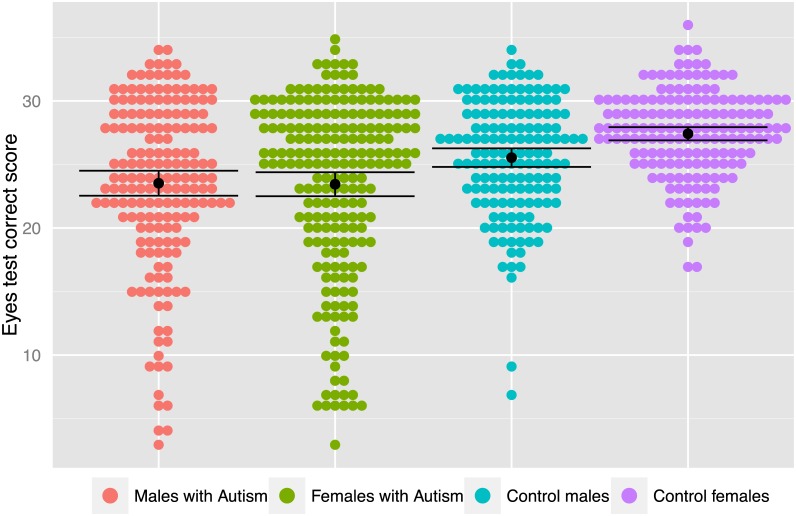
The "Reading the Mind in the Eyes" test (Eyes test) is an advanced test of theory of mind. Typical sex difference has been reported (i.e., female advantage). Individuals with autism show more difficulty than do typically developing individuals, yet it remains unclear how this is modulated by sex, as females with autism have been under-represented. Here in a large, non-male-biased sample we test for the effects of sex, diagnosis, and their interaction. The Eyes test (revised version) was administered online to 395 adults with autism (178 males, 217 females) and 320 control adults (152 males, 168 females). Two-way ANOVA showed a significant sex-by-diagnosis interaction in total correct score (F(1,711) = 5.090, p = 0.024, ηp2 = 0.007) arising from a significant sex difference between control males and females (p < 0.001, Cohen's d = 0.47), and an absence of a sex difference between males and females with autism (p = 0.907, d = 0.01); significant case-control differences were observed across sexes, with effect sizes of d = 0.35 in males and d = 0.69 in females. Group-difference patterns fit with the extreme-male-brain (EMB) theory predictions. Eyes test-Empathy Quotient and Eyes test-Autism Spectrum Quotient correlations were significant only in females with autism (r = 0.35, r = -0.32, respectively), but not in the other 3 groups. Support vector machine (SVM) classification based on response pattern across all 36 items classified autism diagnosis with a relatively higher accuracy for females (72.2%) than males (65.8%). Nevertheless, an SVM model trained within one sex generalized equally well when applied to the other sex. Performance on the Eyes test is a sex-independent phenotypic characteristic of adults with autism, reflecting sex-common social difficulties, and provides support for the EMB theory predictions for both males and females. Performance of females with autism differed from same-sex controls more than did that of males with autism. Females with autism also showed stronger coherence between self-reported dispositional traits and Eyes test performance than all other groups.
Overview
The claims and statistics of this paper haven’t been checked yet.
Run the check — free, no account needed. It reads the open-access text and checks the sources it cites.
Integrity signals
Registry
Cites
Statistics
Figures
Verification
Claims the paper makes
The claims and statistics of this paper haven’t been checked yet.
Run the check — free, no account needed. It reads the open-access text and checks the sources it cites.
Claims other papers make about this one
Each is checked against this paper’s own text: does it say what the citing paper says it does?
The cited source says what the claim attributes to it.
In the citing paper
“Likewise, scores in the RMET are similar to those seen in other publications with autistic participants [41, 71].”
From A 'choice', an 'addiction', a way 'out of the lost': Exploring self-injury in autistic people without intellectual disability (2019) · cites this paper as [71]
Self-check
Percentages, sums and reported differences re-computed from the paper’s own numbers.
The self-check needs the paper’s full text.
Citations
Cites
A Tutorial on Support Vector Machines for Pattern Recognition
Burges, C. J. C. (1998) · Data Mining and Knowledge Discovery · doi:10.1023/a:1009715923555 · Cited by 16,616
Schölkopf, B., & Smola, A. J. (2001) · The MIT Press eBooks · doi:10.7551/mitpress/4175.001.0001 · Cited by 11,934
Does the autistic child have a “theory of mind” ?
Baron-Cohen, S., Leslie, A. M., & Frith, U. (1985) · Cognition · doi:10.1016/0010-0277(85)90022-8 · Cited by 8,599
Self-citationBaron-Cohen, S., Wheelwright, S., Skinner, R., Martin, J., & Clubley, E. (2001) · Journal of Autism and Developmental Disorders · doi:10.1023/a:1005653411471 · Cited by 6,450 · cited 2×
“In previous studies conducted in the general population and not sex-stratified, Eyes test scores show an inverse correlation with AQ scores [58, 78], and a positive correlation with EQ scores Absence of Typical Sex Difference on the Eyes Test in Autism”
BackgroundSelf-citationData mining and knowledge discovery: making sense out of data
Feyyad, U. M. (1996) · IEEE Expert · doi:10.1109/64.539013 · Cited by 4,644
Baron‐Cohen, S., Wheelwright, S., Hill, J., Raste, Y., & Plumb, I. (2001) · Journal of Child Psychology and Psychiatry · doi:10.1111/1469-7610.00715 · Cited by 4,555 · cited 6×
“The Eyes test (revised and online version) consists of 36 grey-scale photos of people taken from magazines [14, 31].”
BackgroundMethodResultInfluentialSelf-citationBaron‐Cohen, S., Wheelwright, S. J., Hill, J., Raste, Y., & Plumb, I. (2001) · PubMed · Cited by 4,313
Self-citationBaron-Cohen, S., & Wheelwright, S. (2004) · Journal of Autism and Developmental Disorders · doi:10.1023/b:jadd.0000022607.19833.00 · Cited by 4,093
Self-citationMindblindness: An Essay on Autism and Theory of Mind
(1995) · Choice Reviews Online · doi:10.5860/choice.33-2412 · Cited by 3,670
Frith, C., & Frith, U. (2005) · Current Biology · doi:10.1016/j.cub.2005.08.041 · Cited by 3,553
Cited by
Sorted by citations
Items 201–239 of 239
Što ustvari ispituje Test očiju? Neke metodološke teškoće ispitivanja teorije uma Testom očiju
Dom za djecu “Maestral”, S., Barać, B., Vulić‐Prtorić, A., & Odjel za psihologiju, S. U. Z. (2016) · Klinička psihologija · doi:10.21465/2016-kp-2-0002 · Cited by 3
Wills-Jackson, C. (2018) · Journal of International Crisis and Risk Communication Research · Cited by 2
Digital Communication and Swift TrustPreprint
Babutsidze, Z., Hanaki, N., & Zylbersztejn, A. (2019) · SSRN Electronic Journal · doi:10.2139/ssrn.3343329 · Cited by 2
Nonverbal Content and Swift Trust: An Experiment on Digital CommunicationPreprint
Babutsidze, Z., Hanaki, N., & Zylbersztejn, A. (2020) · SSRN Electronic Journal · doi:10.2139/ssrn.3540258 · Cited by 2
Jia, R., Riemenschneider, C. K., & Jia, H. H. (2025) · MIS Quarterly · doi:10.25300/misq/2025/19395 · Cited by 1
The power of many small sex differences in cognition, personality, and interests
Herlitz, A., Frostegård, J. K. E., Asperholm, M., Bränström, R., Guest, E., Martinsen, J., Sonnegård, H., Sorjonen, K., Thorell, L. B., & Persson, B. N. (2026) · Scientific Reports · doi:10.1038/s41598-026-53824-6 · Cited by 1
Zheltyakova, M., Korotkov, A. D., Bursov, K., Knyazeva, I., Myznikov, A., Masharipov, R. S., Moroshkina, N. V., Cherednichenko, D. V., & Kireev, M. V. (2025) · Herald of the Russian Academy of Sciences · doi:10.1134/s1019331626601416 · Cited by 1
Milosevic, M. M., Koropanovski, N., Vuković, M., Mudrić, M. R., Kukić, F., Ristić, I., Stamatis, A., & Dopsaj, M. (2026) · Journal of Functional Morphology and Kinesiology · doi:10.3390/jfmk11010032 · Cited by 1
Kouklari, E.-C. (2017) · Greenwich Academic Literature Archive (University of Greenwich) · Cited by 1
Empathy-relevant processing in psychopathic offenders
Efferson, L. M. (2019) · Cited by 1
“Reading the Mind in the Eyes” Test (RMET), The
Warrier, V., Bethlehem, R. A. I., & Baron‐Cohen, S. (2020) · Springer eBooks · doi:10.1007/978-3-319-24612-3_549 · Cited by 1
Self-citationPerformance contests and merit pay with empathic employees
Fabel, O., Mauser, S. F., & Zhang, Y. (2023) · Managerial and Decision Economics · doi:10.1002/mde.4003 · Cited by 1
Floris, D. L., Saccaro, L. F., Delavari, F., Strzelczyk, D., Vieira, B. H., Elleaume, C., Pretzsch, C. M., Ecker, C., Banaschewski, T., Holt, R., et al. (2026) · Research Square · doi:10.21203/rs.3.rs-10317780/v1 · Cited by 1
Self-citationCorrelatos estructurales de las alteraciones cognitivas en niños con TEA
García, F. C. (2017) · Tesis Doctorals en Xarxa (Consorci de Serveis Universitaris de Catalunya) · doi:10.6035/14023.2017.146230
Saure, E. (2018)
Walker, D. (2017) · Coventry University Open Collections (Coventry university)
Characteristics of emotion discrimination from biological motion in trait-anxiety
Kim, J. (2019) · 한국심리학회지: 일반 · doi:10.22257/kjp.2019.12.38.4.579
Itskovich, G. (2021) · Autism and Developmental Disorders · doi:10.17759/autdd.2021190302
Brandão, L. C. D. M., Moreira, V. C. D. M., da Silva, J. L. N., da Silva, F. F., Costa, E. D., & de Almeida, M. I. (2022) · Amplla Editora eBooks · doi:10.51859/amplla.tsr648.1122-8
Baron‐Cohen, S. (2020) · The Cognitive Psychology Bulletin · doi:10.53841/bpscog.2020.1.5.8
Self-citationBaron‐Cohen, S. (2020) · Developmental Psychology Forum · doi:10.53841/bpsdev.2020.1.91.5
Self-citationTheory of mind in relation to other cognitive abilities
(2023) · Frontiers research topics · doi:10.3389/978-2-83251-531-0
Lacroix, A. (2023) · UGA Éditions eBooks · doi:10.4000/books.ugaeditions.29935
Fourneret, P., Mottolese, R., Gauld, C., Clément, A., Dubreucq, M., Savelon, S. V., & Dubreucq, J. (2023) · Périnatalité · doi:10.3166/rmp-2022-0192
Toward A Multiscale Account of TrustPreprint
Christov‐Moore, L., Jinich‐Diamant, A., Bolis, D., Lehmann, K., Kanske, P., Durinski, T., Lynch, C., Iacoboni, M., Kaplan, J., Hesp, C., et al. (2024) · PsyArXiv (OSF Preprints) · doi:10.31234/osf.io/p2gwa
Executive Functioning Processes in Simple and Complex Theory of Mind Tasks
Shamji, J. F. (2022) · University of North Texas Digital Library (University of North Texas) · doi:10.12794/metadc1985747
Toward A Multiscale Account of TrustPreprint
Christov‐Moore, L., Jinich‐Diamant, A., Bolis, D., Lehmann, K., Kanske, P., Durinski, T., Lynch, C., Iacoboni, M., Kaplan, J., Hesp, C., et al. (2024) · PsyArXiv (OSF Preprints) · doi:10.31234/osf.io/p2gwa_v1
Justus, S. A., Hutson, E., Summe, J., & Duarte, A. (2025) · Autism Research · doi:10.1002/aur.70083
Iwabuchi, T., Hirai, T., Umeda, N., Yogo, H., Nishimiya, Y., Nishigaki, Y., Watanabe, M., Yamasue, H., Tsujii, M., Tsuchiya, K. J., et al. (2025) · Autism Research · doi:10.1002/aur.70134
Altschuler, M. R., Krueger, R. F., Mohr, A. H., & Faja, S. (2026) · Development and Psychopathology · doi:10.1017/s0954579425101077
Çifteci, K., Kurtulmuş, A., & Karatepe, H. T. (2026) · Behavioral Medicine · doi:10.1080/08964289.2026.2627891 · Cited by 1
A Qualitative Investigation of Adolescents’ Perceptions of Sharing Guilt Memories with Their Parents
Zaneti, S., & Boyacıoğlu, İ. (2026) · Human Arenas · doi:10.1007/s42087-026-00612-3
Gender powers perception of “dancing circles in love”
Naamnih, L., Sokolov, A. N., Fallgatter, A. J., & Pavlova, M. A. (2026) · Cerebral Cortex · doi:10.1093/cercor/bhag092
Kostov, K., Alonso-Esteban, Y., & Marín, F. A. (2026) · Children · doi:10.3390/children13070932
Morales, J.-P., Rojas‐Thomas, F., Paul, M., Moreno, M., Huepe-Artigas, D., O'Byrne, D. F., García, R., Migeot, J., Solano-Durán, P., & Huepe, D. (2026) · Research Square · doi:10.21203/rs.3.rs-8274314/v1
Sex differences in social cognition: Insights from a sample enriched for social dysfunction
Kemp, K. C., Blain, S. D., Zehra, S., DeStefani, S., Locarno, L. R., Mathis, K., Lasagna, C. A., Colombi, C., Burton, C. Z., Moe, A. M., et al. (2026) · PLoS ONE · doi:10.1371/journal.pone.0354796
Misailidi, P., & Chaliassos, E. (2026) · The Journal of Early Adolescence · doi:10.1177/02724316261485874
Metadata
- Authors
- Baron-Cohen, S., Bowen, D. C., Holt, R. J., Allison, C., Auyeung, B., Lombardo, M. V., Smith, P., & Lai, M.-C.
- Affiliations
- University of Cambridge (GB)
- Centre for Addiction and Mental Health (CA)
- Corresponding author
- Lai, Meng-Chuan
- Venue
- PLOS ONE
- Publisher
- Public Library of Science (PLoS)
- Published
- 2015-08-27
- Volume
- 10
- Issue
- 8
- Pages
- e0136521
- ISSN
- 1932-6203 (ISSN-L)
- PMC
- PMC4552377
- OpenAlex
- W1943649909
- Cited by
- 238
- References
- 129
- Citations by year
- 2026: 12 · 2025: 10 · 2024: 19 · 2023: 18 · 2022: 29 · 2021: 29 · 2020: 28 · 2019: 28 · 2018: 24 · 2017: 27 · 2016: 14
- FWCI
- 13.02
- Type
- journal article
- Language
- en
- Open access
- gold
- doi.org
- Licence
- Locations
- PLoS ONE (publishedVersion, cc-by)
- PubMed Central (publishedVersion, cc-by)
- PubMed (publishedVersion)
- CentAUR (University of Reading) (acceptedVersion, other-oa)
- DOAJ (DOAJ: Directory of Open Access Journals) (submittedVersion, cc-by-sa)
- Edinburgh Research Explorer (University of Edinburgh) (submittedVersion, cc-by)
- Apollo (University of Cambridge) (submittedVersion, cc-by)
- Funders
- Wellcome Trust (091774, 091774/Z/10/Z)
- National Institute for Health and Care Research
- Medical Research Council (G0600977)
- Topics
- Life Sciences › Neuroscience › Cognitive Neuroscience › Autism Spectrum Disorder Research
- Social Sciences › Psychology › Developmental and Educational Psychology › Child and Animal Learning Development
- Life Sciences › Neuroscience › Cognitive Neuroscience › Face Recognition and Perception
- Keywords
- autism spectrum disorder, theory of mind, Reading the Mind in the Eyes Test, sex differences, extreme male brain theory, empathy, Autism Spectrum Quotient, social cognition, autistic adults
- MeSH terms
- Autism Spectrum Disorder, Adult, Female, Humans, Male, Reading, Sex Characteristics, Support Vector Machine
About these checks
Registry, retraction, Cites and statistics results are computed, not judged, with one exception: a printed reference that no index lists is read once by a model before it counts as a citation error. Claims are extracted by a model and kept only when their quote appears verbatim in the text; each cited source is then checked, with a model’s help, for whether it says what the claim relies on. Those verdicts can be wrong — read the claim’s quote and the cited source before relying on one.
Statistics and arithmetic are recomputed, not judged.
Confidence bands are shown only for fields calibrated on our annotated test set. None is calibrated yet, so no band is shown.
What counts as a claim ›How we measure confidence ›How we check this ›
Are you an author, or do you see a problem with this page? Request a review
