

Emotional Dynamics in the Age of Misinformation
Open accessThe DOI matches its Crossref record; 51 of the 53 references it cites were found in a registry or an index.
Abstract
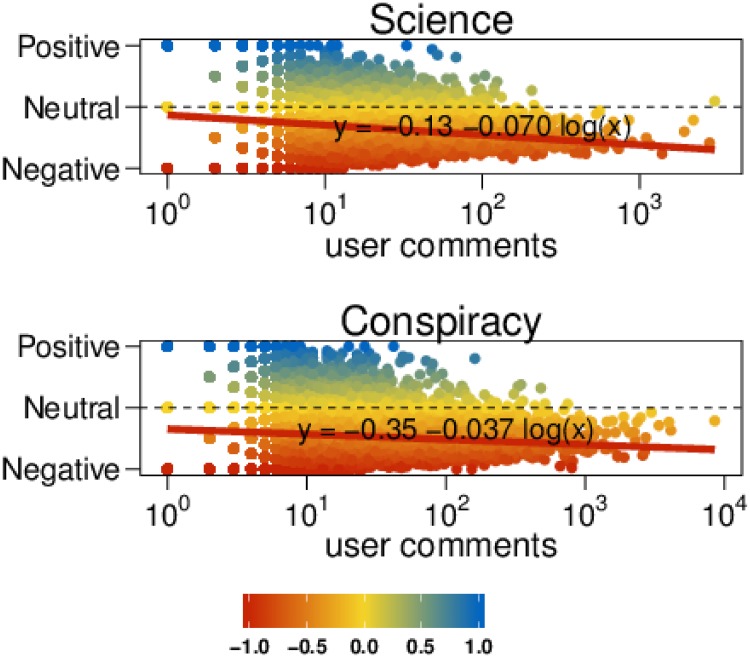
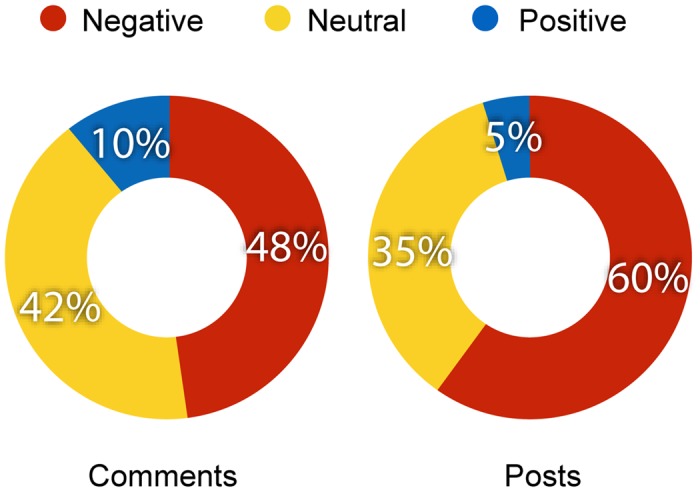
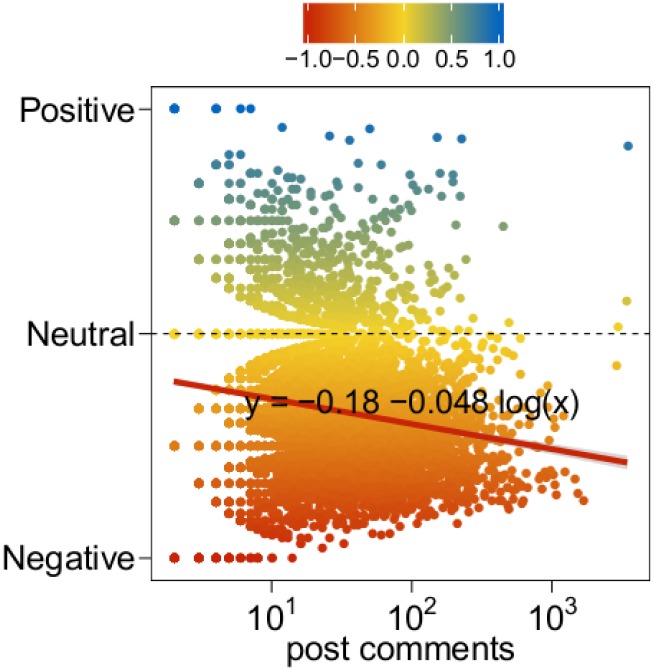
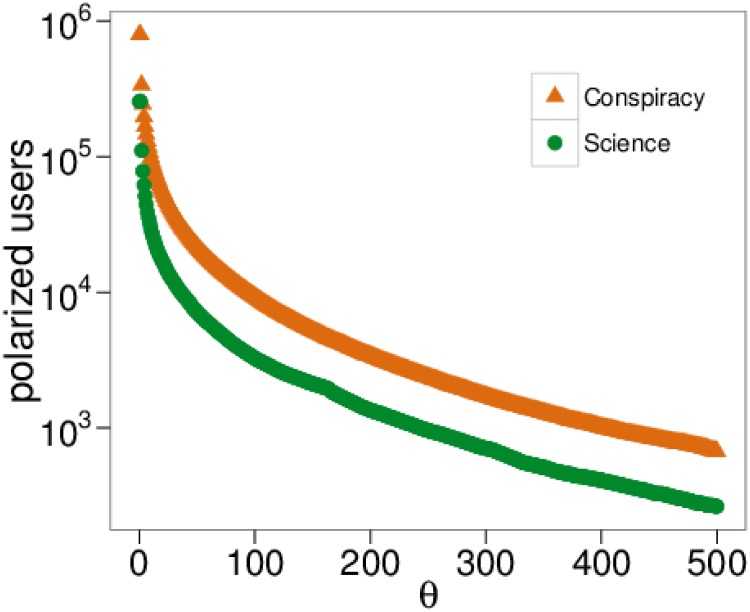
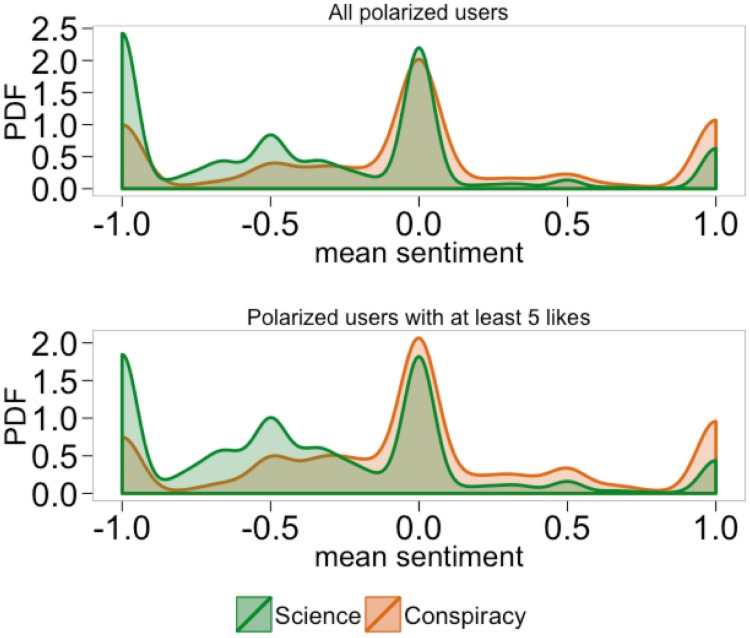
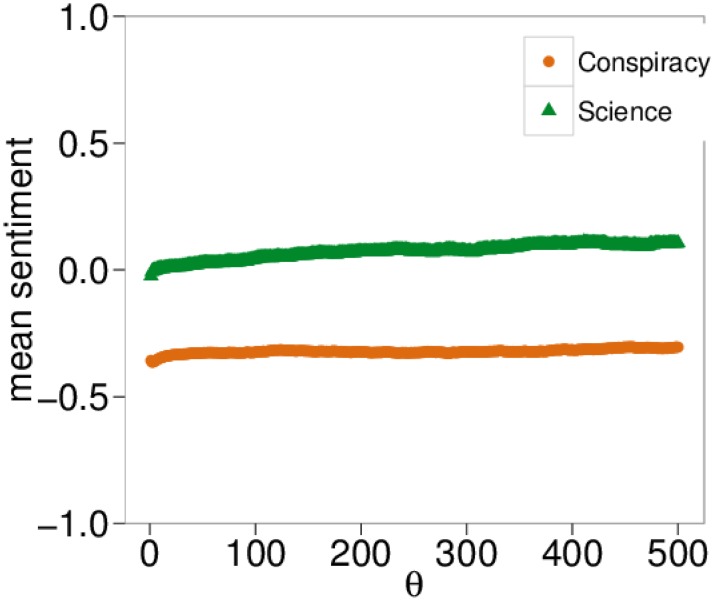
According to the World Economic Forum, the diffusion of unsubstantiated rumors on online social media is one of the main threats for our society. The disintermediated paradigm of content production and consumption on online social media might foster the formation of homogeneous communities (echo-chambers) around specific worldviews. Such a scenario has been shown to be a vivid environment for the diffusion of false claim. Not rarely, viral phenomena trigger naive (and funny) social responses-e.g., the recent case of Jade Helm 15 where a simple military exercise turned out to be perceived as the beginning of the civil war in the US. In this work, we address the emotional dynamics of collective debates around distinct kinds of information-i.e., science and conspiracy news-and inside and across their respective polarized communities. We find that for both kinds of content the longer the discussion the more the negativity of the sentiment. We show that comments on conspiracy posts tend to be more negative than on science posts. However, the more the engagement of users, the more they tend to negative commenting (both on science and conspiracy). Finally, zooming in at the interaction among polarized communities, we find a general negative pattern. As the number of comments increases-i.e., the discussion becomes longer-the sentiment of the post is more and more negative.
Overview
The claims and statistics of this paper haven’t been checked yet.
Free: it reads the open-access text and checks the first 5 claims that cite a source we can check. Create a free account to check every claim.
Integrity signals
Registry
Cites
Statistics
Figures
Verification
Claims the paper makes
The claims and statistics of this paper haven’t been checked yet.
Free: it reads the open-access text and checks the first 5 claims that cite a source we can check. Create a free account to check every claim.
Claims other papers make about this one
Each is checked against this paper’s own text: does it say what the citing paper says it does?
The source backs part of the claim, not all of it — or backs it for a different population, condition or comparison.
In the citing paper
“Further, online stories from social media perceived as negative garner more reactions (for example, likes, Facebook reactions)42,43.”
From Negativity drives online news consumption (2023) · cites this paper as [42]
Experimental — accuracy not yet measuredThe cited source says what the claim attributes to it.
In the citing paper
“cuanto más larga es la conversación (más número de comentarios), mayor es la carga de negatividad del sentimiento o la emoción del caso (Zollo et al., 2015)”
From Emociones y polarización de las comunidades digitales en América Latina: elecciones presidenciales 2018-2019 (2023) · cites this paper as Zollo et al., 2015
In the citing paper
“The majority of studies on online behaviour are correlational34–36,38–42, while laboratory studies take subjects out of their natural environment.”
From Negativity drives online news consumption (2023) · cites this paper as [42]
Self-check
Percentages, sums and reported differences re-computed from the paper’s own numbers.
The self-check needs the paper’s full text.
Citations
Cites
A Coefficient of Agreement for Nominal Scales
Cohen, J. (1960) · Educational and Psychological Measurement · doi:10.1177/001316446002000104 · Cited by 42,398 · cited 1×
“On the other hand, Cohen’s kappa [49] is a standard measure of interrater agreement, but rarely used to evaluate classification models.”
MethodThe Nature of Statistical Learning Theory
Vapnik, V. N. (1995) · doi:10.1007/978-1-4757-2440-0 · Cited by 39,138
Ellison, N. B., Steinfield, C., & Lampe, C. (2007) · Journal of Computer-Mediated Communication · doi:10.1111/j.1083-6101.2007.00367.x · Cited by 9,939 · cited 1×
“Notice that each of these actions has a particular meaning [39–41].”
BackgroundWeighted kappa: nominal scale agreement provision for scaled disagreement or partial credit
Cohen, J. (1968) · Psychological Bulletin · doi:10.1037/h0026256 · Cited by 8,736 · cited 1×
“We use Cohen’s weighted kappa [50] to compare the inter-annotator agreement and self-agreement.”
MethodA systematic analysis of performance measures for classification tasks
Sokolova, M., & Lapalme, G. (2009) · Information Processing & Management · doi:10.1016/j.ipm.2009.03.002 · Cited by 7,515 · cited 1×
“F1 is the harmonic mean of Precision and Recall for each class [48]:”
BackgroundThumbs up?: sentiment classification using machine learning techniques
Pang, B., Lee, L., & Vaithyanathan, S. (2002) · Proceedings of the ACL-02 conference on Empirical methods in natural language processing - EMNLP '02 · doi:10.3115/1118693.1118704 · Cited by 7,024 · cited 1×
“Even with this rough approximation, and disagreements on single cases, it turns out that on a large scale, when one deals with thousands of sentiment assignments, the aggregated sentiment converges to stable values [37].”
BackgroundOpinion Mining and Sentiment Analysis
Pang, B., & Lee, L. (2008) · now publishers, Inc. eBooks · doi:10.1561/9781601981516 · Cited by 6,720
Opinion mining and sentiment analysis
Pang, B., & Lee, L. (2008) · Foundations and Trends® in Information Retrieval · doi:10.1561/1500000011 · Cited by 6,372
Twitter as a Corpus for Sentiment Analysis and Opinion Mining
Pak, A., & Paroubek, P. (2010) · Language Resources and Evaluation Conference (LREC) · doi:10.63317/47akcj8foo4d · Cited by 2,704 · cited 1×
“Although other studies apply sentiment analysis to social media [32–35], our work is the first linking the interplay between communities emerging around shared narratives and specifically addressing the emotional dynamics with respect to misinformation spreading.”
BackgroundPredicting Elections with Twitter: What 140 Characters Reveal about Political Sentiment
Tumasjan, A., Sprenger, T., Sandner, P., & Welpe, I. (2010) · Proceedings of the International AAAI Conference on Web and Social Media · doi:10.1609/icwsm.v4i1.14009 · Cited by 2,649
Research works printed but not linked: 2
- Del Vicario M, Bessi A, Zollo F, Petroni F, Scala A, Caldarelli G, et al. Echo chambers in the age of misinformation. arXiv preprint arXiv:150900189. 2015;.
- Go A, Bhayani R, Huang L. Twitter sentiment classification using distant supervision. CS224N Project Report, Stanford. 2009;p. 1– 12.
Cited by
Items 201–290 of 290
Hass-Postings als Form der Cyber-Kriminalität – eine interdisziplinäre Verortung
Biron, B., Pospisil, B., Huber, E., Backfried, G., & Quirchmayr, G. (2022) · Springer eBooks · doi:10.1007/978-3-658-35450-3_30-1 · Cited by 2
García-Marín, D. (2023) · Estudios sobre el Mensaje Periodístico · doi:10.5209/esmp.85070 · Cited by 2
An Analysis of Relationship Between Social Bots and Echo Chambers on X in Modern Japan
Ippa, S., Okubo, T., & Hashimoto, M. (2024) · International Symposium on Computing and Networking · doi:10.1109/candar64496.2024.00014 · Cited by 2
“Also, the longer the discussion goes on, the more negative feelings increase [64].”
Meng, X., Wang, X., & Zhao, X. (2025) · Internet Research · doi:10.1108/intr-07-2024-1123 · Cited by 3
Politricks: Teaching political tricks and discernment through active and passive tools
Hopkins, S.-A. M., Rayburn-Reeves, R. M., Lindemans, J. W., O’Gorrman, K. C., Vandewalker, I., Luebeck, C., & Sherlock, J. (2025) · PNAS Nexus · doi:10.1093/pnasnexus/pgaf245 · Cited by 2
Bridging cognition and emotion: Empathy-driven multimodal misinformation detection
Yuan, L., Wang, Z., Zhang, Z., & Shi, L. (2026) · Information Fusion · doi:10.1016/j.inffus.2026.104210 · Cited by 2
Toward a Better Understanding of Emotional Dynamics on Facebook
Zollo, F., Sluban, B., Mozetič, I., & Quattrociocchi, W. (2017) · Studies in computational intelligence · doi:10.1007/978-3-319-72150-7_30 · Cited by 2
Self-citationMisinformation Dissemination on the Web
Almeida, J. M. (2019) · The Web Conference · doi:10.1145/3308560.3316450 · Cited by 2
Rodríguez, M., & Giri, L. (2021) · CONICET Digital (CONICET) · Cited by 2
Negative Sentiment Shift on a Chinese Movie-Rating Website
Mao, H. (2023) · Journal of Social Computing · doi:10.23919/jsc.2023.0014 · Cited by 2
Towards the Modeling of Behavioral Trajectories of Users in Online Social MediaPreprint
Bessi, A. (2016) · arXiv (Cornell University) · doi:10.48550/arxiv.1611.05778 · Cited by 3
“We conclude discussing merits and limitations of our approach as well as future and promising research directions.”
BackgroundSelf-citationMP Twitter Abuse in the Age of COVID-19: White PaperPreprint
Gorrell, G., Farrell, T., & Bontcheva, K. (2020) · arXiv (Cornell University) · doi:10.48550/arxiv.2006.08363 · Cited by 4
“Polarisation and echo chambers make it harder for the right information to reach people, and for them to trust it when it does [3], and the damage can be counted in lives.”
BackgroundThe Effects of Positive and Negative Emotions on Knowledge RevisionPreprint
Trevors, G., & Kendeou, P. (2018) · SSRN Electronic Journal · doi:10.2139/ssrn.3274111 · Cited by 3
Demata, M. (2025) · Oxford University Press eBooks · doi:10.1093/9780198945222.003.0059 · Cited by 2
Sabra, I., & Elkadi, M. (2022) · Journal of Law and Emerging Technologies · doi:10.54873/jolets.v2i1.70 · Cited by 2
ART ACTIVITIES AS A MEDIUM FOR CRITICAL THINKING IN THE "LET'S SHARE THE ART" PROGRAM
Umam, A. N. (2022) · Biopsikososial Jurnal Ilmiah Psikologi Fakultas Psikologi Universitas Mercubuana Jakarta · doi:10.22441/biopsikososial.v6i2.17286 · Cited by 1
Vanin, A. V., Владимировна, Г. О., & Лебедев, А. Н. (2025) · Journal of Modern Foreign Psychology · doi:10.17759/jmfp.2025140109 · Cited by 3
“И наоборот, недостоверная информация играет ключевую роль в соз-дании поляризованных сообществ [13].”
Harley, J. M., Ahn, B. “., Lau, C. H.-H., & Moreno, M. V. (2025) · European Journal of Psychology of Education · doi:10.1007/s10212-025-00969-z · Cited by 1
“Fake news is often framed using negative, emotional language (Zollo et al., 2015), to elicit a biased response to the original content, thereby eliciting negative emotions to be associated with the topic.”
Bhih, A. E., Igbida, J., Meskaoui, J. E., Hassouni, H., Elharrar, N., Berrai, I. E., Balatif, O., & Rachik, M. (2025) · International Journal of Dynamics and Control · doi:10.1007/s40435-025-01920-2 · Cited by 1
Digital-Age Dilemmas for Democracy: Disinformation and Polarization in the 21st Century
Haq, R., Ullah, I., Khan, Z., & Shaukat, S. S. (2025) · ACADEMIA International Journal for Social Sciences · doi:10.63056/acad.004.04.1185 · Cited by 1
Gualda, E., Estebanez, P. P., & Faroldi, L. G. (2026) · Redes Revista hispana para el análisis de redes sociales · doi:10.5565/rev/redes.1129 · Cited by 1
Peace, truth and the digital public sphere: A Wesleyan postcolonial theology
Reyes, C. (2026) · HTS Teologiese Studies / Theological Studies · doi:10.4102/hts.v82i1.11321 · Cited by 1
Corbett, B., Grew, E., McShane, C., Wood, L., Scholz, C., Flynn, E., Corriveau, K. H., Kornbluh, M., Neal, J. W., Xu, J., et al. (2026) · Child Development · doi:10.1093/chidev/aacag124 · Cited by 1
Welzenbach-Vogel, I. C. (2021) · Springer eBooks · doi:10.1007/978-3-662-63641-1_8 · Cited by 1
Information, social networks and emotions: fear and anger towards Pedro Sánchez 2019–2021
Rivera, J. M. P., Lagares, N., Gulías, E. J., & Pereira, M. T. (2025) · Frontiers in Political Science · doi:10.3389/fpos.2024.1456412 · Cited by 4
Vogel, M., & Buder, J. (2025) · Computers in Human Behavior Reports · doi:10.1016/j.chbr.2025.100876 · Cited by 1
Algorithmen in digitalen Medien und ihr Einfluss auf die Meinungsbildung. Endbericht zum TA-Projekt
Oertel, B., Dametto, D., Kluge, J., & Todt, J. (2022) · Repository KITopen (Karlsruhe Institute of Technology) · doi:10.5445/ir/1000154065 · Cited by 5
On the fallibility of human memory for future actions
Pluviano, S. (2019) · ERA · Cited by 1
Sciannamea, R., Mura, G., & Diamantini, D. (2019) · doi:10.31124/advance.8120639.v1 · Cited by 1
Sciannamea, R., Mura, G., & Diamantini, D. (2019) · doi:10.31124/advance.8120639 · Cited by 1
A Re-Conceptualization of Online Misinformation DiffusionPreprint
Bourbon, B., & Murimi, R. M. (2022) · arXiv (Cornell University) · doi:10.48550/arxiv.2208.06468 · Cited by 1
“In Zollo et al (2015), the authors studied the emotional responses evoked by misinformation.”
BackgroundFischer, K. (2025) · PsyArXiv (OSF Preprints) · doi:10.31234/osf.io/jvxen_v1 · Cited by 1
Recognizing, explaining and countering norm transgressive behaviour on social media
Padje, E. D. H. (2016) · TNO Repository
Television News and Public Opinion: Commentary on Toal & O’Loughlin and Hale, Shevel, & Onuch
Gaufman, E. (2018) · Geopolitics · doi:10.1080/14650045.2018.1465048
“Social networks in this regard provide an excellent illustration that also show how they are conducive to the psychological phenomenon of confirmation bias (Del Vicario et al. 2015; Zollo et al. 2015).”
BackgroundUnderstanding misinformation on Twitter in the context of controversial issues
Addawood, A. (2019) · Illinois Digital Environment for Access to Learning and Scholarship (University of Illinois at Urbana-Champaign) · Cited by 2
El desacuerdo en modelos de formación de opiniones: resultados de estática comparativa
Melguizo, I. (2020) · Revista de Economía del Rosario · doi:10.12804/revistas.urosario.edu.co/economia/a.9112
Cullinan, C. (2021) · Research Repository (Delft University of Technology)
Wischnewski, M., & Krämer, N. (2020) · Technology Mind and Behavior · doi:10.1037/tmb0000029.supp
The New World Order on Twitter: Evaluative language in English and Spanish tweets
Mora-López, N. (2022) · Discourse approaches to politics, society and culture · doi:10.1075/dapsac.98.13mor · Cited by 2
Pant, I., Broniatowski, D. A., Long, M. W., Duwal, S., Polackal, J., Chandarana, S., & Turner, M. M. (2023) · doi:10.2196/preprints.45686
Personalized Rumor Refutation Through Graph Regular Pattern
Li, B., Liu, X., Dong, B., Wang, W., & Zhang, B. (2023) · IEEE International Conference on Big Data Analytics (ICBDA) · doi:10.1109/icbda57405.2023.10104992
“Unfortunately, rumors usually cause serious financial and reputation damage and even bring about negative emotions in the populace [13].”
BackgroundCano, J. M. M., & Espinosa, M. C. (2023) · Dilemas contemporáneos Educación Política y Valores · doi:10.46377/dilemas.v10i3.3637
How Does a Twitter Hashtag Hype a COVID-19 Conspiracy Theory?
Xiong, J., Wang, Y., Zhao, L., & Li, J. (2023) · Lecture Notes in Education Psychology and Public Media · doi:10.54254/2753-7048/4/20220129
Introduction to Influence Operations in Cyberspace
Pijpers, P. B. M. J. (2023) · Edward Elgar Publishing eBooks · doi:10.4337/9781035307296.00007
Hass-Postings als Form der Cyber-Kriminalität – eine interdisziplinäre Verortung
Biron, B., Pospisil, B., Huber, E., Backfried, G., & Quirchmayr, G. (2023) · Cyberkriminologie - Theorien, Methoden, Erscheinungsformen · doi:10.1007/978-3-658-35442-8_30 · Cited by 1
(2023) · Journal of Trial and Error · doi:10.36850/i3.1
Grigorieva, M. V. (2024) · Izvestiya of the Samara Science Centre of the Russian Academy of Sciences Social Humanitarian Medicobiological Sciences · doi:10.37313/2413-9645-2024-26-94-61-70 · Cited by 1
El ocaso de 'koinonia'. La distopía en la literatura norteamericana
Mascarell, A. B., & López, M. M. (2024) · Universitat de València eBooks · doi:10.7203/puv-oa-340-6
Coercion and Trust: A Multi-Disciplinary Dialogue
Chatterjee, S., & Jameson, J. (2024) · Routledge eBooks · doi:10.4324/9781003398233
“‘Massive digital misinformation’ has been characterised by the World Economic Forum as ‘one of the main threats to our society’ (using the term ‘misinformation’ as a broad category for all forms of false information) (Romeo, 2022; Zollo et al., 2015).”
Jameson, J. (2024) · Routledge eBooks · doi:10.4324/9781003398233-7
Nayak, B. S., & Walton, N. (2024) · Springer eBooks · doi:10.1007/978-3-031-62308-0_7
Morosoli, S. (2024) · OSF Preprints (OSF Preprints) · doi:10.31219/osf.io/rmtf7
The Relationship Between Emotional and Other Factors in Information Diffusion
Ippa, S., Okubo, T., & Hashimoto, M. (2025) · IEEE Access · doi:10.1109/access.2025.3535547
“We believe that this adds a new perspective to previous research [16], [50], [51], [52] that states that negative emotions are expressed in echo chambers.”
Tremblay, N., Lavoie, K., Bacon, S., & Bélanger‐Gravel, A. (2025) · Public Health · doi:10.1016/j.puhe.2025.02.001 · Cited by 1
Algorithmic Influence on Conflict and Cooperation in Digital Communities
Russo, A., & Caliandro, A. (2025) · PLOS complex systems. · doi:10.1007/978-3-031-82431-9_36
Bonetti, A., & Maiorano, M. (2026) · Humanities and Social Sciences Communications · doi:10.1057/s41599-026-07095-1
“This pattern re fl ects echo chamber dynamics, consistent with prior research (Bessi et al., 2015; Del Vicario et al., (2016b); Zollo et al., 2015).”
Emotion Cum False Information Detection Based on Sentiment, Structural and Semantic Frameworks
Naskar, D., Das, S., & Rodríguez, S. (2025) · IEEE International Conference on Semantic Computing (ICSC) · doi:10.1109/icsc64641.2025.00013
“In this regard, several studies [2]–[4] show different observations of political contents, conspiracy news, and public health-related misin-formation that significantly affect people’s day-to-day social activities, lifestyles, and so on.”
Affective Polarization, Wholeheartedness, and Fanaticism
Tanesini, A. (2025) · Oxford University Press eBooks · doi:10.1093/9780197760222.003.0020
Interbrain Synchrony Mitigates Extremism Within Echo Chambers
Sobeh, A., Vakrat, T. M., & Shamay‐Tsoory, S. (2025) · Annals of the New York Academy of Sciences · doi:10.1111/nyas.70083
“Thispotential confoundcouldinflatethesupposedprevalenceofechochambers [54].”
ФУНДАМЕНТАЛЬНАЯ И ПРИКЛАДНАЯ НАУКА: СОСТОЯНИЕ И ТЕНДЕНЦИИ РАЗВИТИЯ
университет», Ф. В. «. П. Г., Лихачев, М. О., Анастасиевич, Д. В., университет», Ф. В. «. Г. Э., Валерьевич, Д. Л., университет», Ф. В. «. Г. Э., Igumnov, O. A., университет», Ф. В. «. П. Г., Николаевна, Л. Е., Федерации», Д. И. У. –. Ф. В. «. А. Н. Х. И. Г. С. П. П. Р., et al. (2025) · ICSP «NEW SCIENCE» eBooks · doi:10.46916/01122025-1-978-5-00215-470-8
THE NEOMYTHOLOGIZATION OF WORLDVIEW AS A SOCIO-CULTURAL BASIS OF INFORMATION SOCIETY
МФЮА, К. Ф. М. Ф. –. Ю. У., & Komarova, I. I. (2025) · ICSP «NEW SCIENCE» eBooks · doi:10.46916/01122025-2-978-5-00215-470-8
Additional file 1 of Flow of online misinformation during the peak of the COVID-19 pandemic in Italy
Caldarelli, G., De Nicola, R., Petrocchi, M., Pratelli, M., & Saracco, F. (2021) · Figshare · doi:10.6084/m9.figshare.14920988
Self-citationMedia literacy education against fake news
Scheibenzuber, C. (2023) · doi:10.5282/edoc.32407 · Cited by 1
Additional file 1 of Reliance on emotion promotes belief in fake news
Martel, C., Pennycook, G., & Rand, D. G. (2020) · Figshare · doi:10.6084/m9.figshare.13065598
Additional file 1 of Emotions in online rumor diffusion
Pröllochs, N., Bär, D., & Feuerriegel, S. (2021) · Figshare · doi:10.6084/m9.figshare.16829927
Leone, M. (2015) · Institutional Research Information System University of Turin (University of Turin)
Flores Bautista, P. M. (2024) · eScholarship (California Digital Library) · Cited by 1
(Extended abstract): A decolonial feminist approach to gendered disinformation
Gehrke, M. (2023) · University of Groningen research database (University of Groningen / Centre for Information Technology) · Cited by 1
Schrader, T. (2023) · Staffordshire Online Repository (Staffordshire University)
Schleier, V. I. (2024) · UCL Discovery (University College London)
Health Misinformation: Examining Its Presence and Impact across Communication Contexts
(2025) · Frontiers research topics · doi:10.3389/978-2-8325-7272-6
Welzenbach-Vogel, I. C. (2026) · Bürgerbewusstsein · doi:10.1007/978-3-658-50019-1_10
Emotional drivers of misinformation consumption and toxicity on YouTube
Santoro, A., Ciringione, L., Stella, M., & Zollo, F. (2026) · PeerJ Computer Science · doi:10.7717/peerj-cs.3398
Self-citationINFORMATION AND PSYCHOLOGICAL IMPACT AS A FACTOR IN DIRECTING CIVIL SERVANTS TOWARD PUBLIC SERVICE
Степанович, М. А., & Selezneva, E. V. (2026) · Public Administration Issues · doi:10.17323/1999-5431-2026-0-1-58-85
Pérez, B. L. (2026) · Ciencia policial: revista del Instituto de Estudios de Policía · doi:10.14201/cp.32367
Pogrebna, G., & Hills, T. T. (2026) · Cambridge University Press eBooks · doi:10.1017/9781108939010.035
Understanding Collective Behaviour Using Online Data and Mobile Phones
Botta, F., Preis, T., & Moat, H. S. (2026) · Cambridge University Press eBooks · doi:10.1017/9781108939010.044
Bribena, K. (2026) · SIAR-Global Journal of Medicine & Pharmaceutical Review · doi:10.66694/siar.gjmpr2026005
de Carvalho, C. P., Ramos, J. P., Simas, C., Barbosa, P., Carthy, S., & Pinto, M. (2026) · Campbell Systematic Reviews · doi:10.1177/18911803261459099
“…amongst disenfranchised, white men (Johnson, 2018), one which relied heavily on reframed or out-of-context interpretations of history (Strick, 2022) and false or misleading evidence (Juh ´ asz & Szicherle, 2017) to elicit strong emotions (Zollo et al., 2015), and, too often, prompting violence.”
Quarisa, C. M., & Thomas, E. F. (2026) · Frontiers in Social Psychology · doi:10.3389/frsps.2026.1768090
Lomasto, L., Lettieri, N., Malandrino, D., Mosca, V., & Zaccagnino, R. (2026) · Lecture notes in computer science · doi:10.1007/978-3-032-29532-3_8
Unmasking the Backfire Effect: An Exploration of Resistance to Fact-Checking in the Digital Age
Li, J., & Chang, X. (2026) · Information Systems Frontiers · doi:10.1007/s10796-026-10780-w
“Polarizing topics such as abortion and guns are particularly prone to eliciting strong responses, as they align with users’ ideological affiliations and trigger defensive behaviors (Zollo et al., 2015 ).”
A Human-Centered Approach to Understanding Citizens’ Responses to Public Communication Challenges
Balčytienė, A., Bunevičienė, I., Krakovsky, C., & Lindmeyer, M. S. (2026) · Communications · doi:10.1515/commun-2026-0012
“The prevalence of toxic content and manipulations that directly affect sensitive issues, especially on social media platforms, undermines group cohesion, their sense of togetherness, solidarity, security, and overall well-being (Zollo et al., 2015; Pradel, 2024).”
PEMBELAJARAN DIGITAL STORYTELLING DALAM KONTEN MEDIA SOSIAL UNTUK GENERASI MUDA
Irena, L., Febyola, E., Augustine, M., & Carolina, A. (2025) · Jurnal Bakti Masyarakat Indonesia · doi:10.24912/jbmi.v8i3.35954
Sufi, F. K., & Zohra, F. (2026) · Information · doi:10.3390/info17070700
“Moral Foundations Theory (MFT) further explains how distinct communities invoke divergent moral vocabularies—such as care, fairness, loyalty, and authority—to frame contentious issues [8–11].”
Setyaningsih, R., Santoso, D. H., & Shovmayanti, N. A. (2026) · MUHARRIK Jurnal Dakwah dan Sosial · doi:10.37680/muharrik.v9i1.9370 · Cited by 2
“The tone of online discussions tends to grow increasingly negative, particularly within polarized communities (Zollo et al., 2015).”
Xiang, T., Fu, H., & Yunze, Z. (2026) · Information Processing & Management · doi:10.1016/j.ipm.2026.105171
Communicative Roles and Structural Fragmentation in LPDP Scholarship Discourse on Platform X
Azizah, F., Tristina, N., Elisabeth Satya Wacana Patricia, S., Nuraeni, R., & Cahyani, A. I. (2026) · Language, Technology, and Social Media. · doi:10.70211/ltsm.3026-7196.531
“Homophily can shape social ties [39], [40], and emotion or identity can affect diffusion [41], yet none of these mechanisms was measured here.”
Rodríguez, M., & Giri, L. (2021) · Revista iberoamericana de ciencia tecnología y sociedad
Corelly, A., Sitinjak, F., Tumanggor, M. R., Arvi, S., Nasution, H., & Nasution, A. S. (2025) · Digital Repository Universitas Negeri Medan (Universitas Negeri Medan)
Metadata
- Authors
- Zollo, F., Novak, P. K., Del Vicario, M., Bessi, A., Mozetič, I., Scala, A., Caldarelli, G., & Quattrociocchi, W.
- Affiliations
- IMT School for Advanced Studies Lucca (IT)
- Jožef Stefan Institute (SI)
- Corresponding author
- Quattrociocchi, Walter
- ORCID
- Venue
- PLOS ONE
- Publisher
- Public Library of Science (PLoS)
- Published
- 2015-09-30
- Volume
- 10
- Issue
- 9
- Pages
- e0138740
- ISSN
- 1932-6203 (ISSN-L)
- PMC
- PMC4589395
- OpenAlex
- W2133664726
- Cited by
- 273
- References
- 53
- Citations by year
- 2026: 23 · 2025: 29 · 2024: 24 · 2023: 32 · 2022: 35 · 2021: 36 · 2020: 23 · 2019: 26 · 2018: 15 · 2017: 13 · 2016: 13 · 2015: 4
- FWCI
- 49.63
- Type
- journal article
- Language
- en
- Open access
- gold
- doi.org
- Licence
- Locations
- PLoS ONE (publishedVersion, cc-by)
- Europe PMC (PubMed Central) (publishedVersion, cc-by)
- PubMed Central (publishedVersion, cc-by)
- PubMed (publishedVersion)
- DiRROS repository (University of Maribor) (publishedVersion, other-oa)
- IMT Institutional Repository (IMT School for Advanced Studies Lucca) (acceptedVersion)
- arXiv (Cornell University) (submittedVersion)
- RePEc: Research Papers in Economics (submittedVersion)
- DOAJ (DOAJ: Directory of Open Access Journals) (submittedVersion, cc-by-sa)
- IRIS Research product catalog (Sapienza University of Rome) (submittedVersion)
- ARCA (Università Ca' Foscari Venezia) (submittedVersion)
- arXiv (Cornell University)
- Topics
- Social Sciences › Sociology and Political Science › Misinformation and Its Impacts
- Physical Sciences › Computer Science › Artificial Intelligence › Sentiment Analysis and Opinion Mining
- Social Sciences › Communication › Social Media and Politics
- Keywords
- misinformation, conspiracy theories, social media, echo chambers, polarization, sentiment analysis, user engagement, emotional dynamics, viral content
- MeSH terms
- Communication, Emotions, Female, Humans, Male
About these checks
Registry, retraction, Cites and statistics results are computed, not judged, with one exception: a printed reference that no index lists is read once by a model before it counts as a citation error. Claims are extracted by a model and kept only when their quote appears verbatim in the text; each cited source is then checked, with a model’s help, for whether it says what the claim relies on. Those verdicts can be wrong — read the claim’s quote and the cited source before relying on one.
Statistics and arithmetic are recomputed, not judged.
Confidence bands are shown only for fields calibrated on our annotated test set. None is calibrated yet, so no band is shown.
What counts as a claim ›How we measure confidence ›How we check this ›
Are you an author, or do you see a problem with this page? Request a review
Data sources
Bibliographic data: Semantic Scholar, OpenAlex, Crossref.
Contains information from the Semantic Scholar Academic Graph Datasets, made available under the ODC Attribution License (ODC-BY 1.0).
Semantic Scholar’s data is described in: Kinney, R., et al. (2023). The Semantic Scholar Open Data Platform. arXiv:2301.10140.
