

Emotional Dynamics in the Age of Misinformation
Open accessThe DOI matches its Crossref record; 51 of the 53 references it cites were found in a registry or an index.
Abstract
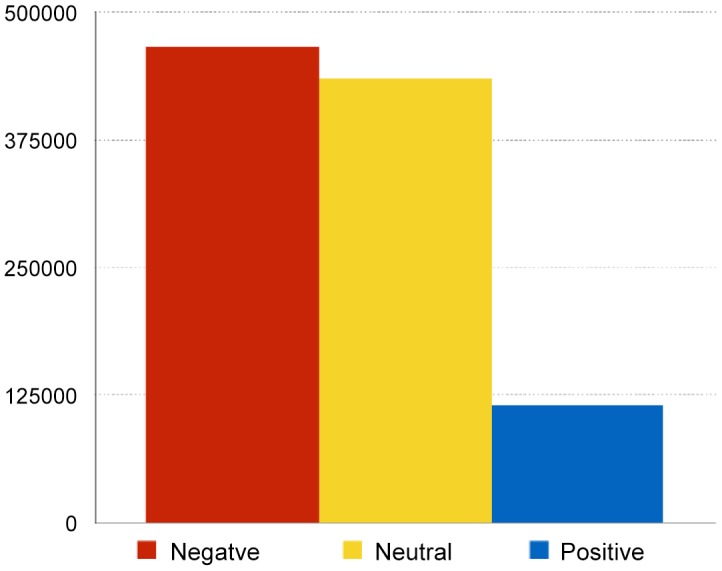
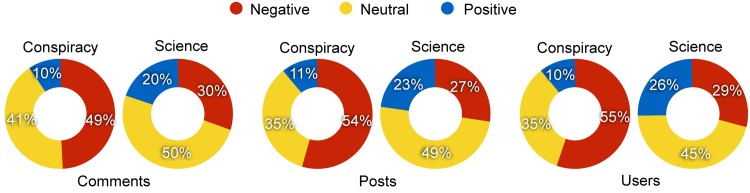
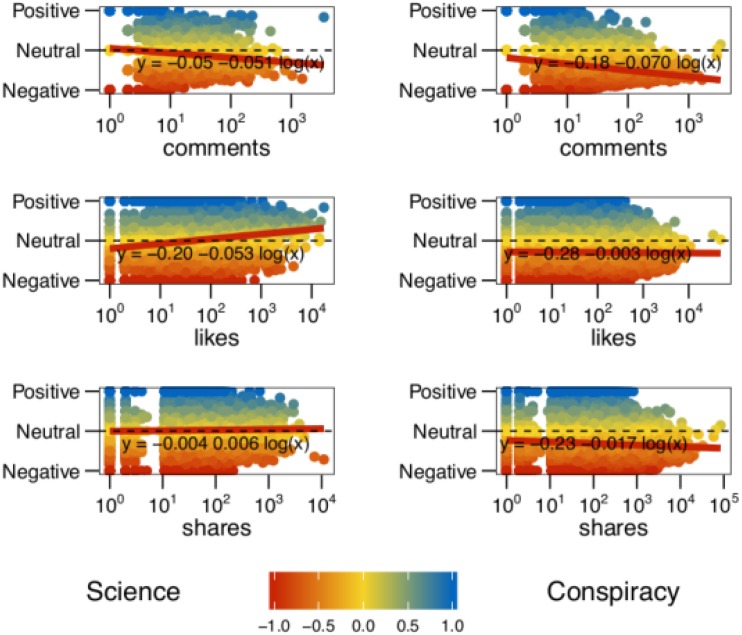
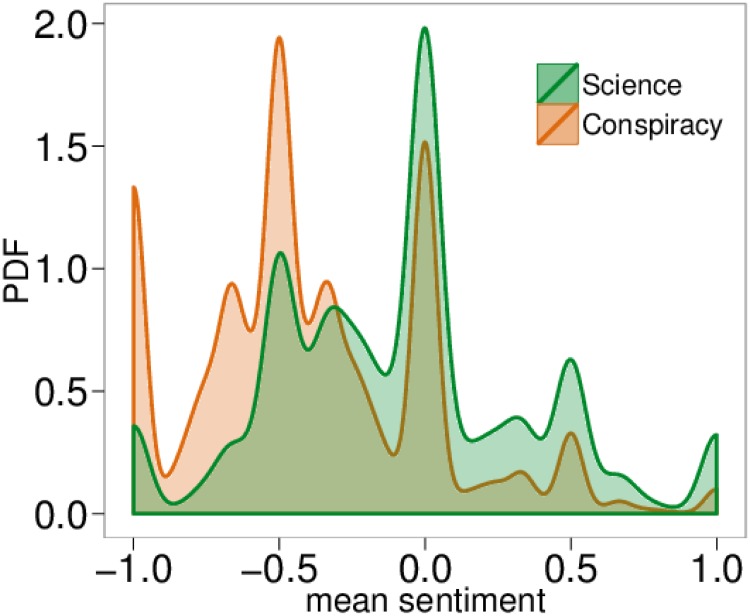
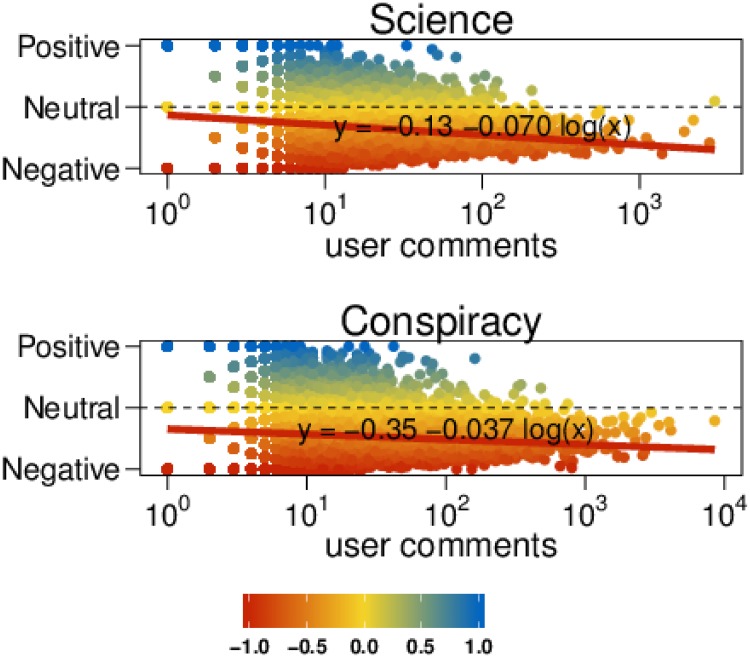
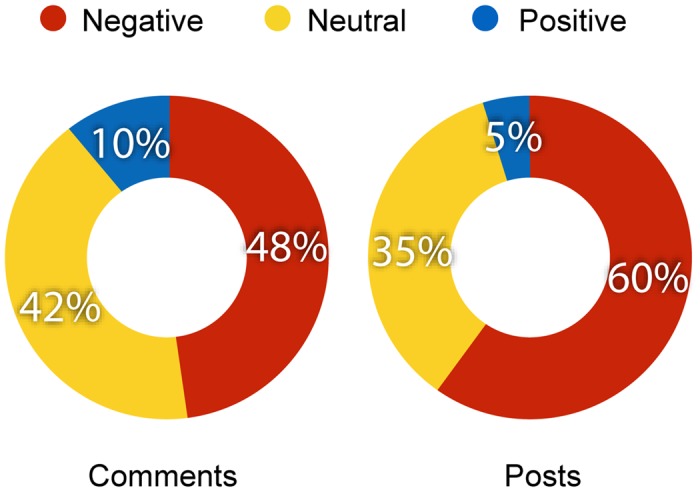
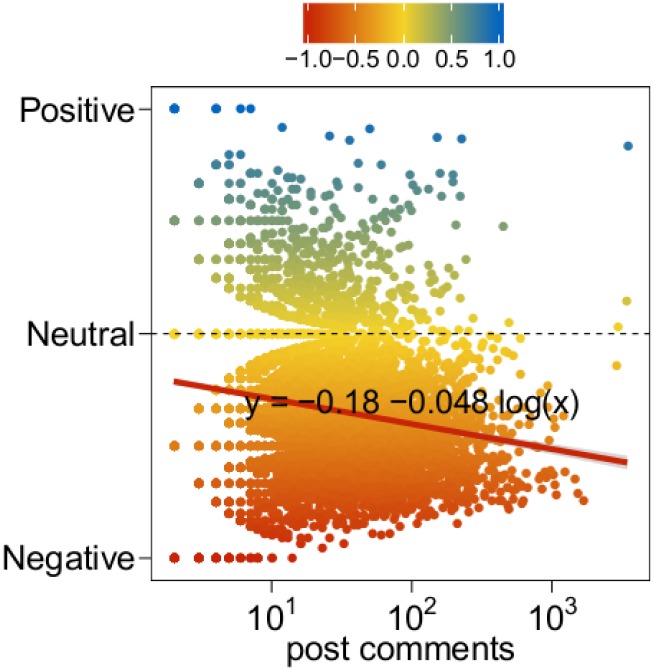
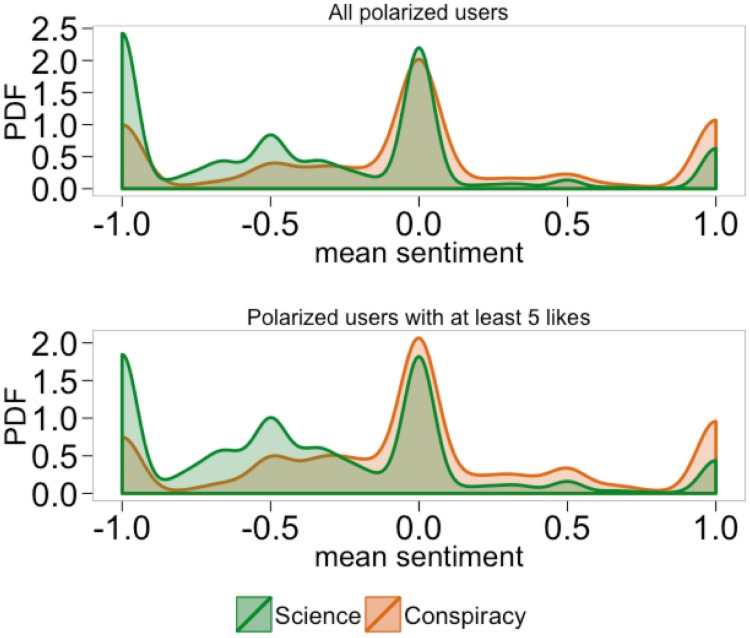
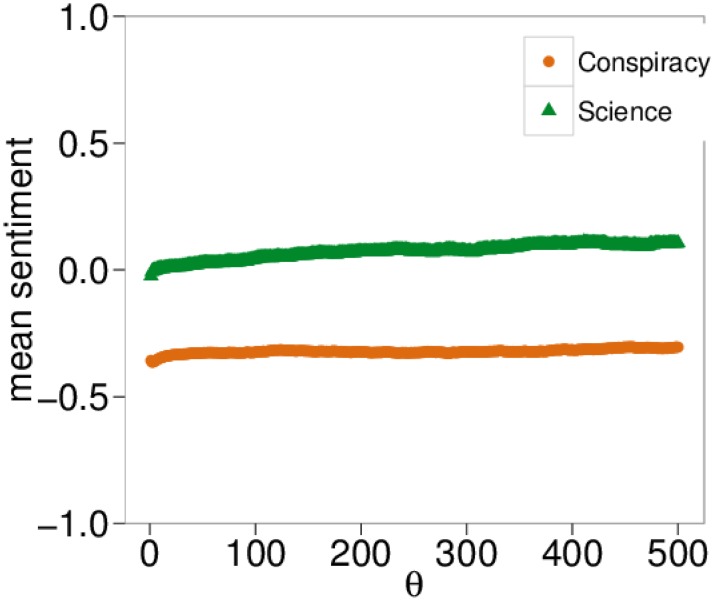
According to the World Economic Forum, the diffusion of unsubstantiated rumors on online social media is one of the main threats for our society. The disintermediated paradigm of content production and consumption on online social media might foster the formation of homogeneous communities (echo-chambers) around specific worldviews. Such a scenario has been shown to be a vivid environment for the diffusion of false claim. Not rarely, viral phenomena trigger naive (and funny) social responses-e.g., the recent case of Jade Helm 15 where a simple military exercise turned out to be perceived as the beginning of the civil war in the US. In this work, we address the emotional dynamics of collective debates around distinct kinds of information-i.e., science and conspiracy news-and inside and across their respective polarized communities. We find that for both kinds of content the longer the discussion the more the negativity of the sentiment. We show that comments on conspiracy posts tend to be more negative than on science posts. However, the more the engagement of users, the more they tend to negative commenting (both on science and conspiracy). Finally, zooming in at the interaction among polarized communities, we find a general negative pattern. As the number of comments increases-i.e., the discussion becomes longer-the sentiment of the post is more and more negative.
Overview
The claims and statistics of this paper haven’t been checked yet.
Free: it reads the open-access text and checks the first 5 claims that cite a source we can check. Create a free account to check every claim.
Integrity signals
Registry
Cites
Statistics
Figures
Verification
Claims the paper makes
The claims and statistics of this paper haven’t been checked yet.
Free: it reads the open-access text and checks the first 5 claims that cite a source we can check. Create a free account to check every claim.
Claims other papers make about this one
Each is checked against this paper’s own text: does it say what the citing paper says it does?
The source backs part of the claim, not all of it — or backs it for a different population, condition or comparison.
In the citing paper
“Further, online stories from social media perceived as negative garner more reactions (for example, likes, Facebook reactions)42,43.”
From Negativity drives online news consumption (2023) · cites this paper as [42]
Experimental — accuracy not yet measuredThe cited source says what the claim attributes to it.
In the citing paper
“cuanto más larga es la conversación (más número de comentarios), mayor es la carga de negatividad del sentimiento o la emoción del caso (Zollo et al., 2015)”
From Emociones y polarización de las comunidades digitales en América Latina: elecciones presidenciales 2018-2019 (2023) · cites this paper as Zollo et al., 2015
In the citing paper
“The majority of studies on online behaviour are correlational34–36,38–42, while laboratory studies take subjects out of their natural environment.”
From Negativity drives online news consumption (2023) · cites this paper as [42]
Self-check
Percentages, sums and reported differences re-computed from the paper’s own numbers.
The self-check needs the paper’s full text.
Citations
Cites
A Coefficient of Agreement for Nominal Scales
Cohen, J. (1960) · Educational and Psychological Measurement · doi:10.1177/001316446002000104 · Cited by 42,398 · cited 1×
“On the other hand, Cohen’s kappa [49] is a standard measure of interrater agreement, but rarely used to evaluate classification models.”
MethodThe Nature of Statistical Learning Theory
Vapnik, V. N. (1995) · doi:10.1007/978-1-4757-2440-0 · Cited by 39,138
Ellison, N. B., Steinfield, C., & Lampe, C. (2007) · Journal of Computer-Mediated Communication · doi:10.1111/j.1083-6101.2007.00367.x · Cited by 9,939 · cited 1×
“Notice that each of these actions has a particular meaning [39–41].”
BackgroundWeighted kappa: nominal scale agreement provision for scaled disagreement or partial credit
Cohen, J. (1968) · Psychological Bulletin · doi:10.1037/h0026256 · Cited by 8,736 · cited 1×
“We use Cohen’s weighted kappa [50] to compare the inter-annotator agreement and self-agreement.”
MethodA systematic analysis of performance measures for classification tasks
Sokolova, M., & Lapalme, G. (2009) · Information Processing & Management · doi:10.1016/j.ipm.2009.03.002 · Cited by 7,515 · cited 1×
“F1 is the harmonic mean of Precision and Recall for each class [48]:”
BackgroundThumbs up?: sentiment classification using machine learning techniques
Pang, B., Lee, L., & Vaithyanathan, S. (2002) · Proceedings of the ACL-02 conference on Empirical methods in natural language processing - EMNLP '02 · doi:10.3115/1118693.1118704 · Cited by 7,024 · cited 1×
“Even with this rough approximation, and disagreements on single cases, it turns out that on a large scale, when one deals with thousands of sentiment assignments, the aggregated sentiment converges to stable values [37].”
BackgroundOpinion Mining and Sentiment Analysis
Pang, B., & Lee, L. (2008) · now publishers, Inc. eBooks · doi:10.1561/9781601981516 · Cited by 6,720
Opinion mining and sentiment analysis
Pang, B., & Lee, L. (2008) · Foundations and Trends® in Information Retrieval · doi:10.1561/1500000011 · Cited by 6,372
Twitter as a Corpus for Sentiment Analysis and Opinion Mining
Pak, A., & Paroubek, P. (2010) · Language Resources and Evaluation Conference (LREC) · doi:10.63317/47akcj8foo4d · Cited by 2,704 · cited 1×
“Although other studies apply sentiment analysis to social media [32–35], our work is the first linking the interplay between communities emerging around shared narratives and specifically addressing the emotional dynamics with respect to misinformation spreading.”
BackgroundPredicting Elections with Twitter: What 140 Characters Reveal about Political Sentiment
Tumasjan, A., Sprenger, T., Sandner, P., & Welpe, I. (2010) · Proceedings of the International AAAI Conference on Web and Social Media · doi:10.1609/icwsm.v4i1.14009 · Cited by 2,649
The political blogosphere and the 2004 U.S. election: divided they blog
Adamic, L. A., & Glance, N. (2005) · Proceedings of the 3rd international workshop on Link discovery · doi:10.1145/1134271.1134277 · Cited by 2,619
On the evolution of user interaction in facebook
Viswanath, B., Mislove, A., Cha, M., & Gummadi, K. P. (2009) · Proceedings of the 2nd ACM workshop on Online social networks · doi:10.1145/1592665.1592675 · Cited by 1,461 · cited 1×
“Notice that each of these actions has a particular meaning [39–41].”
BackgroundLooking at, looking up or keeping up with people?: motives and use of facebook
Joinson, A. N. (2008) · Proceedings of the SIGCHI Conference on Human Factors in Computing Systems · doi:10.1145/1357054.1357213 · Cited by 1,393
Misinformation and the Currency of Democratic Citizenship
Kuklinski, J. H., Quirk, P. J., Jerit, J., Schwieder, D., & Rich, R. F. (2000) · The Journal of Politics · doi:10.1111/0022-3816.00033 · Cited by 1,167 · cited 1×
“Individuals may be uninformed or misinformed, and the debunking campaigns against unsubstantiated rumors do not seem to be effective [26].”
BackgroundColleoni, E., Rozza, A., & Arvidsson, A. (2014) · Journal of Communication · doi:10.1111/jcom.12084 · Cited by 1,151
Online and Uncivil? Patterns and Determinants of Incivility in Newspaper Website Comments
Coe, K., Kenski, K., & Rains, S. A. (2014) · Journal of Communication · doi:10.1111/jcom.12104 · Cited by 964
Sentiment Analysis of Short Informal Texts
Kiritchenko, S., Zhu, X., & Mohammad, S. M. (2014) · Journal of Artificial Intelligence Research · doi:10.1613/jair.4272 · Cited by 880 · cited 2×
“F1ðþ; Þ is the macro-averaged F-score of the positive and negative classes, a standard evaluation measure [41] used also in the SemEval competition (http://alt.”
BackgroundMethodAnderson, A. A., Brossard, D., Scheufele, D. A., Xenos, M. A., & Ladwig, P. (2014) · Journal of Computer-Mediated Communication · doi:10.1111/jcc4.12009 · Cited by 786
The wisdom of crowds : why the many are smarter than the few
Surowiecki, J. (2005) · Cited by 760
Science vs Conspiracy: Collective Narratives in the Age of Misinformation
Bessi, A., Coletto, M., Davidescu, G. A., Scala, A., Caldarelli, G., & Quattrociocchi, W. (2015) · PLOS ONE · doi:10.1371/journal.pone.0118093 · Cited by 645 · cited 4×
“The resulting dataset –downloaded over a timespan of four years (2010 to 2014)– is composed of 73 public Italian Facebook pages and it is the same used in [19] and [20].”
BackgroundInfluentialSelf-citationDecisions 2.0: the power of collective intelligence
Bonabeau, E. W. (2009) · Dialnet (Universidad de la Rioja) · Cited by 633
Dynamic debates: an analysis of group polarization over time on Twitter
Yardi, S., & Boyd, D. (2010) · Bulletin of Science, Technology & Society · doi:10.1177/0270467610380011 · Cited by 625
A Simple Approach to Ordinal Classification
Frank, E., & Hall, M. (2001) · Lecture Notes in Computer Science · doi:10.1007/3-540-44795-4_13 · Cited by 606 · cited 1×
“We apply the wrapper approach, described in [51], with two linear-kernel Support Vector Machine (SVM) [34] classifiers.”
MethodThe networked young citizen: social media, political participation and civic engagement
Loader, B. D., Vromen, A., & Xenos, M. A. (2014) · Information, Communication & Society · doi:10.1080/1369118x.2013.871571 · Cited by 436
Is There an Elite Hold? Traditional Media to Social Media Agenda Setting Influence in Blog Networks
Meraz, S. (2009) · Journal of Computer-Mediated Communication · doi:10.1111/j.1083-6101.2009.01458.x · Cited by 431
Friggeri, A., Adamic, L., Eckles, D., & Cheng, J. (2014) · Proceedings of the International AAAI Conference on Web and Social Media · doi:10.1609/icwsm.v8i1.14559 · Cited by 382 · cited 1×
“Indeed, microblogging platforms such as Facebook and Twitter allow for the direct and disintermediated production and consumption of contents [4–7].”
BackgroundEntanglements in Practice: Performing Anonymity Through Social Media1
Scott, S. V., & Orlikowski, W. J. (2014) · MIS Quarterly · doi:10.25300/misq/2014/38.3.11 · Cited by 337
A Review of Social Media Use in E-Government
Magro, M. J. (2012) · Administrative Sciences · doi:10.3390/admsci2020148 · Cited by 277
Jungherr, A., Jürgens, P., & Schoen, H. (2012) · Social Science Computer Review · doi:10.1177/0894439311404119 · Cited by 267
Byford, J. (2011) · Palgrave Macmillan UK eBooks · doi:10.1057/9780230349216 · Cited by 259
Collective attention in the age of (mis)information
Mocanu, D., Rossi, L., Zhang, Q., Karsai, M., & Quattrociocchi, W. (2015) · Computers in Human Behavior · doi:10.1016/j.chb.2015.01.024 · Cited by 242 · cited 1×
“In [16, 17, 19] it has been pointed out that the more users are exposed to unsubstantiated rumors, the more they are likely to jump the credulity barrier.”
BackgroundSelf-citationFranks, B., Bangerter, A., & Bauer, M. W. (2013) · Frontiers in Psychology · doi:10.3389/fpsyg.2013.00424 · Cited by 222 · cited 1×
“This latter point opens to interesting question about the quasi-religious mentality of conspiracists [45] and the way in which such an echo-chamber digests and debate news and events.”
BackgroundOpinion dynamics on interacting networks: media competition and social influence
Quattrociocchi, W., Caldarelli, G., & Scala, A. (2014) · Scientific Reports · doi:10.1038/srep04938 · Cited by 221
Self-citationCurrent Issues and Advances in Misinformation Research
Frenda, S. J., Nichols, R. M., & Loftus, E. F. (2011) · Current Directions in Psychological Science · doi:10.1177/0963721410396620 · Cited by 214
Conspiracy Theories: A Critical Introduction
Byford, J. T. (2011) · Open Research Online - ORO (The Open University) · Cited by 185
Evaluation Methods for Ordinal Classification
Gaudette, L., & Japkowicz, N. (2009) · Lecture notes in computer science · doi:10.1007/978-3-642-01818-3_25 · Cited by 142 · cited 1×
“Accuracy within n [47] allows for a wider range of predictions to be considered correct.”
BackgroundTrend of Narratives in the Age of Misinformation
Bessi, A., Zollo, F., Del Vicario, M., Scala, A., Caldarelli, G., & Quattrociocchi, W. (2015) · PLOS ONE · doi:10.1371/journal.pone.0134641 · Cited by 123
Self-citationViral Misinformation: The Role of Homophily and Polarization
Bessi, A., Petroni, F., Del Vicario, M., Zollo, F., Anagnostopoulos, A., Scala, A., Caldarelli, G., & Quattrociocchi, W. (2015) · Proceedings of the 24th International Conference on World Wide Web · doi:10.1145/2740908.2745939 · Cited by 97
Self-citationZhu, B., Chen, C., Loftus, E. F., Lin, C., He, Q., Chen, C., Li, H., Moyzis, R. K., Lessard, J., & Dong, Q. (2010) · Personality and Individual Differences · doi:10.1016/j.paid.2010.02.016 · Cited by 96 · cited 1×
“…claim (whether substantiated or not) may be altered by normative social influence or by the coherence with the system of beliefs of the individual [26–30], making the preferential driver of contents the confirmation bias – i.e., the tendency to select and interpret information coherently with…”
BackgroundThe economy of attention in the age of (mis)information
Bessi, A., Scala, A., Rossi, L., Zhang, Q., & Quattrociocchi, W. (2014) · Journal of Trust Management · doi:10.1186/s40493-014-0012-y · Cited by 61 · cited 3×
“In [16, 17, 19] it has been pointed out that the more users are exposed to unsubstantiated rumors, the more they are likely to jump the credulity barrier.”
BackgroundSelf-citationOPINIONS MANIPULATION: MEDIA, POWER AND GOSSIP
QUATTROCIOCCHI, W., CONTE, R., & LODI, E. (2011) · Advances in Complex Systems · doi:10.1142/s0219525911003165 · Cited by 57
Self-citationSocial Determinants of Content Selection in the Age of (Mis)Information
Bessi, A., Caldarelli, G., Del Vicario, M., Scala, A., & Quattrociocchi, W. (2014) · Lecture Notes in Computer Science · doi:10.1007/978-3-319-13734-6_18 · Cited by 45
Self-citationLongitude: A Privacy-Preserving Location Sharing Protocol for Mobile Applications
Dong, C., & Dulay, N. (2011) · IFIP International Federation for Information Processing/IFIP · doi:10.1007/978-3-642-22200-9_12 · Cited by 37
Public opinions of light rail service in Los Angeles, an analysis using Twitter data
Luong, T. T. B., & Houston, D. (2015) · Illinois Digital Environment for Access to Learning and Scholarship (University of Illinois at Urbana-Champaign) · Cited by 35
Extremism and the psychology of uncertainty.
Hogg, M. A., & Blaylock, D. (2012) · Cited by 34
Advances in Artificial Intelligence
Bergler, S. (2008) · Lecture notes in computer science · doi:10.1007/978-3-540-68825-9 · Cited by 28
Collective attention in the age of (mis)informationPreprint
Mocanu, D., Rossi, L., Zhang, Q. F., Karsai, M., & Quattrociocchi, W. (2014) · arXiv (Cornell University) · doi:10.48550/arxiv.1403.3344 · Cited by 27 · cited 1×
“In [16, 17, 19] it has been pointed out that the more users are exposed to unsubstantiated rumors, the more they are likely to jump the credulity barrier.”
BackgroundSelf-citationJøsang, A., Quattrociocchi, W., & Karabeg, D. (2011) · IFIP International Federation for Information Processing/IFIP · doi:10.1007/978-3-642-22200-9_25 · Cited by 22
Self-citationLanglois, J. L. (2009) · Versión. Estudios de Comunicación y Política · Cited by 19
Malone, T. W. (2007) · International Conference on Collaboration Technologies and Systems (CTS) · doi:10.1109/cts.2007.4621716 · Cited by 18
Brabazon, T. (2014) · Springer briefs in geography · doi:10.1007/978-981-287-269-2 · Cited by 16
Research works printed but not linked: 2
- Del Vicario M, Bessi A, Zollo F, Petroni F, Scala A, Caldarelli G, et al. Echo chambers in the age of misinformation. arXiv preprint arXiv:150900189. 2015;.
- Go A, Bhayani R, Huang L. Twitter sentiment classification using distant supervision. CS224N Project Report, Stanford. 2009;p. 1– 12.
Cited by
The spreading of misinformation online
Del Vicario, M., Bessi, A., Zollo, F., Petroni, F., Scala, A., Caldarelli, G., Stanley, H. E., & Quattrociocchi, W. (2016) · Proceedings of the National Academy of Sciences · doi:10.1073/pnas.1517441113 · Cited by 2,407
“Such a phenomenon is particularly evident on the WWW where users, embedded in homogeneous clusters (14–16), process information through a shared system of meaning (10, 11, 17, 18) and trigger collective framing of narratives that are often biased toward self-confirmation.”
BackgroundSelf-citationUnderstanding Conspiracy Theories
Douglas, K. M., Uscinski, J. E., Sutton, R. M., Cichocka, A., Nefes, T., Ang, C. S., & Deravi, F. (2019) · Political Psychology · doi:10.1111/pops.12568 · Cited by 1,511
Kralj Novak, P., Smailović, J., Sluban, B., & Mozetič, I. (2015) · PLOS ONE · doi:10.1371/journal.pone.0144296 · Cited by 805
Self-citationHorne, B., & Adali, S. (2017) · Proceedings of the International AAAI Conference on Web and Social Media · doi:10.1609/icwsm.v11i1.14976 · Cited by 688
Fake news game confers psychological resistance against online misinformation
Roozenbeek, J., & van der Linden, S. (2019) · Palgrave Communications · doi:10.1057/s41599-019-0279-9 · Cited by 708
Metadata
- Authors
- Zollo, F., Novak, P. K., Del Vicario, M., Bessi, A., Mozetič, I., Scala, A., Caldarelli, G., & Quattrociocchi, W.
- Affiliations
- IMT School for Advanced Studies Lucca (IT)
- Jožef Stefan Institute (SI)
- Corresponding author
- Quattrociocchi, Walter
- ORCID
- Venue
- PLOS ONE
- Publisher
- Public Library of Science (PLoS)
- Published
- 2015-09-30
- Volume
- 10
- Issue
- 9
- Pages
- e0138740
- ISSN
- 1932-6203 (ISSN-L)
- PMC
- PMC4589395
- OpenAlex
- W2133664726
- Cited by
- 273
- References
- 53
- Citations by year
- 2026: 23 · 2025: 29 · 2024: 24 · 2023: 32 · 2022: 35 · 2021: 36 · 2020: 23 · 2019: 26 · 2018: 15 · 2017: 13 · 2016: 13 · 2015: 4
- FWCI
- 49.63
- Type
- journal article
- Language
- en
- Open access
- gold
- doi.org
- Licence
- Locations
- PLoS ONE (publishedVersion, cc-by)
- Europe PMC (PubMed Central) (publishedVersion, cc-by)
- PubMed Central (publishedVersion, cc-by)
- PubMed (publishedVersion)
- DiRROS repository (University of Maribor) (publishedVersion, other-oa)
- IMT Institutional Repository (IMT School for Advanced Studies Lucca) (acceptedVersion)
- arXiv (Cornell University) (submittedVersion)
- RePEc: Research Papers in Economics (submittedVersion)
- DOAJ (DOAJ: Directory of Open Access Journals) (submittedVersion, cc-by-sa)
- IRIS Research product catalog (Sapienza University of Rome) (submittedVersion)
- ARCA (Università Ca' Foscari Venezia) (submittedVersion)
- arXiv (Cornell University)
- Topics
- Social Sciences › Sociology and Political Science › Misinformation and Its Impacts
- Physical Sciences › Computer Science › Artificial Intelligence › Sentiment Analysis and Opinion Mining
- Social Sciences › Communication › Social Media and Politics
- Keywords
- misinformation, conspiracy theories, social media, echo chambers, polarization, sentiment analysis, user engagement, emotional dynamics, viral content
- MeSH terms
- Communication, Emotions, Female, Humans, Male
About these checks
Registry, retraction, Cites and statistics results are computed, not judged, with one exception: a printed reference that no index lists is read once by a model before it counts as a citation error. Claims are extracted by a model and kept only when their quote appears verbatim in the text; each cited source is then checked, with a model’s help, for whether it says what the claim relies on. Those verdicts can be wrong — read the claim’s quote and the cited source before relying on one.
Statistics and arithmetic are recomputed, not judged.
Confidence bands are shown only for fields calibrated on our annotated test set. None is calibrated yet, so no band is shown.
What counts as a claim ›How we measure confidence ›How we check this ›
Are you an author, or do you see a problem with this page? Request a review
Data sources
Bibliographic data: Semantic Scholar, OpenAlex, Crossref.
Contains information from the Semantic Scholar Academic Graph Datasets, made available under the ODC Attribution License (ODC-BY 1.0).
Semantic Scholar’s data is described in: Kinney, R., et al. (2023). The Semantic Scholar Open Data Platform. arXiv:2301.10140.
