

The DOI matches its Crossref record; 43 of the 44 references it cites were found in a registry or an index.
The Role of Compassion in Altruistic Helping and Punishment Behavior
Open accessAbstract
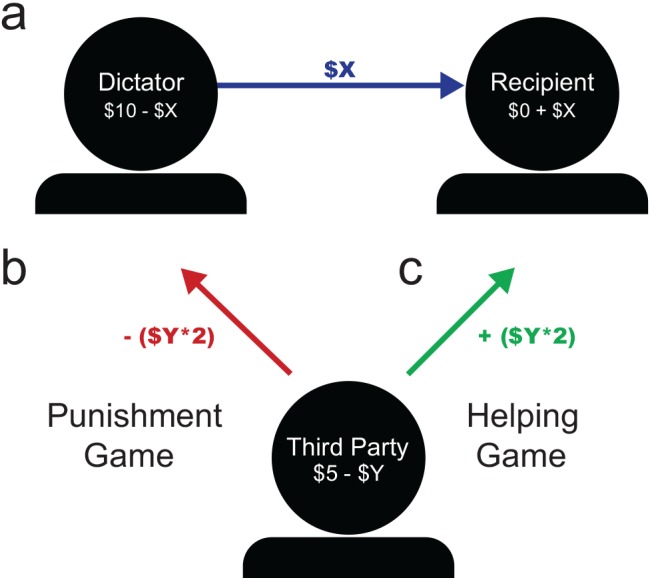
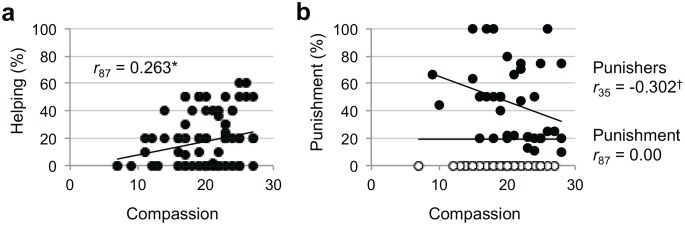
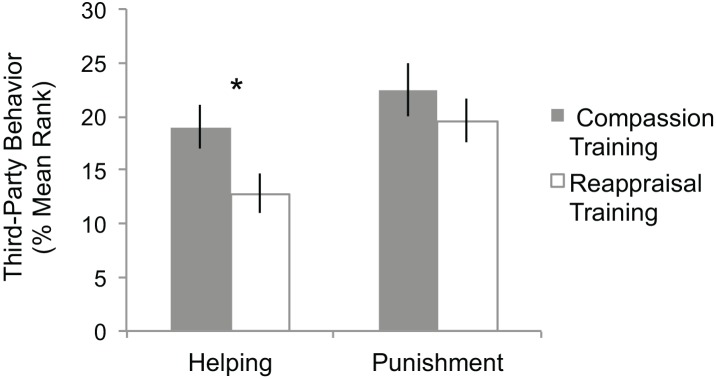
Compassion, the emotional response of caring for another who is suffering and that results in motivation to relieve suffering, is thought to be an emotional antecedent to altruistic behavior. However, it remains unclear whether compassion enhances altruistic behavior in a uniform way or is specific to sub-types of behavior such as altruistic helping of a victim or altruistic punishment of a transgressor. We investigated the relationship between compassion and subtypes of altruistic behavior using third-party paradigms where participants (1) witnessed an unfair economic exchange between a transgressor and a victim, and (2) had the opportunity to either spend personal funds to either economically (a) help the victim or (b) punish the transgressor. In Study 1, we examined whether individual differences in self-reported empathic concern (the emotional component of compassion) was associated with greater altruistic helping or punishment behavior in two independent samples. For participants who witnessed an unfair transaction, trait empathic concern was associated with greater helping of a victim and had no relationship to punishment. However, in those who decided to punish the transgressor, participants who reported greater empathic concern decided to punish less. In Study 2, we directly enhanced compassion using short-term online compassion meditation training to examine whether altruistic helping and punishment were increased after two weeks of training. Compared to an active reappraisal training control group, the compassion training group gave more to help the victim and did not differ in punishment of the transgressor. Together, these two studies suggest that compassion is related to greater altruistic helping of victims and is not associated with or may mitigate altruistic punishment of transgressors.
Overview
The claims and statistics of this paper haven’t been checked yet.
Run the check — free, no account needed. It reads the open-access text and checks the sources it cites.
Integrity signals
Registry
Cites
Statistics
Figures
Verification
Claims the paper makes
The claims and statistics of this paper haven’t been checked yet.
Run the check — free, no account needed. It reads the open-access text and checks the sources it cites.
Claims other papers make about this one
Each is checked against this paper’s own text: does it say what the citing paper says it does?
The check wasn’t confident either way, so it gives no verdict — never disputed.
In the citing paper
“Weng et al. (2015) found that greater pro-social behavior (charitable donations) were correlated with changes in the inferior parietal cortex and dorsolateral prefrontal cortex.”
From A Systematic Review and Meta-analysis of the Effects of Meditation on Empathy, Compassion, and Prosocial Behaviors (2018) · cites this paper as Weng et al., 2015
Experimental — accuracy not yet measured
Self-check
Percentages, sums and reported differences re-computed from the paper’s own numbers.
The self-check needs the paper’s full text.
Citations
Cites
Development and validation of brief measures of positive and negative affect: The PANAS scales.
Watson, D., Clark, L. A., & Tellegen, A. (1988) · Journal of Personality and Social Psychology · doi:10.1037/0022-3514.54.6.1063 · Cited by 32,433
Cognitive Therapy for Depression
(2012) · PsycEXTRA Dataset · doi:10.1037/e675542012-001 · Cited by 9,678
A new scale of social desirability independent of psychopathology.
Crowne, D. P., & Marlowe, D. (1960) · Journal of Consulting Psychology · doi:10.1037/h0047358 · Cited by 8,686
Social Relationships and Health
House, J. S., Landis, K. R., & Umberson, D. (1988) · Science · doi:10.1126/science.3399889 · Cited by 7,073
Altruistic punishment in humans
Fehr, E., & Gächter, S. (2002) · Nature · doi:10.1038/415137a · Cited by 5,616
An experimental analysis of ultimatum bargaining
Güth, W., Schmittberger, R., & Schwarze, B. (1982) · Journal of Economic Behavior & Organization · doi:10.1016/0167-2681(82)90011-7 · Cited by 4,868
Social Relationships and Health.
Cohen, S. (2004) · American Psychologist · doi:10.1037/0003-066x.59.8.676 · Cited by 4,852
(1980) · Medical Entomology and Zoology · Cited by 4,712
Behavioral Game Theory: Experiments in Strategic Interaction
Camerer, C. F. (2003) · Cited by 3,722
Kawachi, I. I. (2001) · Journal of Heredity · doi:10.1093/jurban/78.3.458 · Cited by 3,565
Cited by
Sorted by citations
Does gratitude enhance prosociality?: A meta-analytic review.
Lawrence, K., Tunney, R. J., & Ferguson, E. (2017) · Psychological Bulletin · doi:10.1037/bul0000103 · Cited by 458
On the interaction of social affect and cognition: empathy, compassion and theory of mind
Preckel, K., Kanske, P., & Singer, T. (2018) · Current Opinion in Behavioral Sciences · doi:10.1016/j.cobeha.2017.07.010 · Cited by 348
Luberto, C. M., Shinday, N., Song, R., Philpotts, L. L., Park, E. R., Fricchione, G. L., & Yeh, G. Y. (2018) · Mindfulness · doi:10.1007/s12671-017-0841-8 · Cited by 346
The plasticity of well-being: A training-based framework for the cultivation of human flourishing
Dahl, C. J., Wilson‐Mendenhall, C. D., & Davidson, R. J. (2020) · Proceedings of the National Academy of Sciences · doi:10.1073/pnas.2014859117 · Cited by 295
Self-citationDifferential benefits of mental training types for attention, compassion, and theory of mind
Trautwein, F.-M., Kanske, P., Böckler, A., & Singer, T. (2020) · Cognition · doi:10.1016/j.cognition.2019.104039 · Cited by 139
The Cambridge Handbook of Personality Psychology
(2020) · Cambridge University Press eBooks · doi:10.1017/9781108264822 · Cited by 148
The neuroscience of social feelings: mechanisms of adaptive social functioning
Eslinger, P. J., Anders, S., Ballarini, T., Boutros, S., Krach, S., Mayer, A. V., Moll, J., Newton, T. L., Schroeter, M. L., de Oliveira-Souza, R., et al. (2021) · Neuroscience & Biobehavioral Reviews · doi:10.1016/j.neubiorev.2021.05.028 · Cited by 130
Mascaro, J. S., Florian, M. P., Ash, M. J., Palmer, P. K., Frazier, T., Condon, P., & Raison, C. (2020) · Frontiers in Psychology · doi:10.3389/fpsyg.2020.547241 · Cited by 118
Temperament and brain networks of attention
Posner, M. I., & Rothbart, M. K. (2018) · Philosophical Transactions of the Royal Society B Biological Sciences · doi:10.1098/rstb.2017.0254 · Cited by 95
Meditation in context: factors that facilitate prosocial behavior
Condon, P. (2018) · Current Opinion in Psychology · doi:10.1016/j.copsyc.2018.09.011 · Cited by 76
Mindfulness training increases cooperative decision making in economic exchanges: Evidence from fMRI
Kirk, U., Gu, X., Sharp, C., Hula, A., Fonagy, P., & Montague, P. R. (2016) · NeuroImage · doi:10.1016/j.neuroimage.2016.05.075 · Cited by 71
Weng, H. Y., Lapate, R. C., Stodola, D. E., Rogers, G. M., & Davidson, R. J. (2018) · Frontiers in Psychology · doi:10.3389/fpsyg.2018.00771 · Cited by 82
Self-citationZhao, K., Ferguson, E., & Smillie, L. D. (2017) · Scientific Reports · doi:10.1038/s41598-017-02952-1 · Cited by 69
Multiple-Brain Connectivity During Third Party Punishment: an EEG Hyperscanning Study
Ciaramidaro, A., Toppi, J., Casper, C., Freitag, C. M., Siniatchkin, M., & Astolfi, L. (2018) · Scientific Reports · doi:10.1038/s41598-018-24416-w · Cited by 71
Cohen, N., & Ochsner, K. N. (2018) · Current Opinion in Behavioral Sciences · doi:10.1016/j.cobeha.2018.08.007 · Cited by 76
Compassion for self versus other: A critical review of compassion training research
Quaglia, J. T., Soisson, A., & Simmer‐Brown, J. (2020) · The Journal of Positive Psychology · doi:10.1080/17439760.2020.1805502 · Cited by 62
Urbanska, K., McKeown, S., & Taylor, L. K. (2019) · Journal of Experimental Social Psychology · doi:10.1016/j.jesp.2019.01.010 · Cited by 51
Moral Motivation and the Basal Forebrain
Zahn, R., de Oliveira‐Souza, R., & Moll, J. (2019) · Neuroscience & Biobehavioral Reviews · doi:10.1016/j.neubiorev.2019.10.022 · Cited by 45
Hino, H. (2022) · International Business Review · doi:10.1016/j.ibusrev.2022.102034 · Cited by 47
Moisuc, A., Bräuer, M., Fonseca, A., Chaurand, N., & Greitemeyer, T. (2018) · British Journal of Social Psychology · doi:10.1111/bjso.12246 · Cited by 40
Fear leads to suffering: Fears of compassion predict restriction of the moral boundary
Crimston, C. R., Blessing, S., Gilbert, P., & Kirby, J. N. (2021) · British Journal of Social Psychology · doi:10.1111/bjso.12483 · Cited by 40
Alonso-Ferres, M., Navarro‐Carrillo, G., Garrido‐Macías, M., Moreno‐Bella, E., & Valor‐Segura, I. (2020) · PLoS ONE · doi:10.1371/journal.pone.0232608 · Cited by 35
Ben‐Eliyahu, A., & Zeidner, M. (2020) · Cambridge University Press eBooks · doi:10.1017/9781108264822.041 · Cited by 33
Effects of compassion training on brain responses to suffering others
Ashar, Y. K., Andrews‐Hanna, J. R., Halifax, J. S., Dimidjian, S., & Wager, T. D. (2021) · Social Cognitive and Affective Neuroscience · doi:10.1093/scan/nsab052 · Cited by 37
Karim, A., Fathurohman, O., Muhammadun, M., Saripudin, W., Rahmat, D., & Mansir, F. (2023) · Cogent Social Sciences · doi:10.1080/23311886.2023.2238968 · Cited by 79
Empathy and helping: the role of affect in response to others’ suffering
Kang, Y., Mesquiti, S., Baik, E. S., & Falk, E. B. (2025) · Scientific Reports · doi:10.1038/s41598-025-87221-2 · Cited by 33
Lu, T., & McKeown, S. (2018) · Journal of Applied Social Psychology · doi:10.1111/jasp.12558 · Cited by 30
DeYoung, C. G., & Blain, S. D. (2020) · Cambridge University Press eBooks · doi:10.1017/9781108264822.026 · Cited by 34
The pattern theory of compassion
Gallagher, S., Raffone, A., & Aglioti, S. M. (2024) · Trends in Cognitive Sciences · doi:10.1016/j.tics.2024.04.005 · Cited by 37
Perspectives on Character Virtue Development
Clement, S., & Bollinger, R. A. (2016) · Research in Human Development · doi:10.1080/15427609.2016.1172445 · Cited by 23
Reisenzein, R., Hildebrandt, A., & Weber, H. (2020) · Cambridge University Press eBooks · doi:10.1017/9781108264822.009 · Cited by 26
Rashkova, Y., Moi, L., & Cabiddu, F. (2023) · Journal of Business Ethics · doi:10.1007/s10551-023-05357-5 · Cited by 29
Must Heads Roll? A Critique of and Alternative Approaches to Swift Blame
Skarlicki, D. P., Kay, A. A., Aquino, K. F., & Fushtey, D. S. (2017) · Academy of Management Perspectives · doi:10.5465/amp.2015.0118 · Cited by 21
Dixson, D. D., Anderson, C. L., & Keltner, D. J. (2018) · Journal of Well-Being Assessment · doi:10.1007/s41543-019-00015-y · Cited by 21
Weng, H. Y., Ikeda, M. P., Lewis‐Peacock, J. A., Chao, M. T., Fullwiley, D., Goldman, V., Skinner, S. N., Duncan, L. G., Gazzaley, A. H., & Hecht, F. M. (2020) · Frontiers in Psychology · doi:10.3389/fpsyg.2020.573134 · Cited by 23
Self-citationMassey, S. H., Decety, J., Wisner, K. L., & Wakschlag, L. S. (2017) · Frontiers in Public Health · doi:10.3389/fpubh.2017.00239 · Cited by 19
Steinvik, H. R., Duffy, A. L., & Zimmer‐Gembeck, M. J. (2023) · International Journal of Bullying Prevention · doi:10.1007/s42380-023-00164-y · Cited by 16
One Compassion, Many Means: A Big Two Analysis of Compassionate Behavior
Quaglia, J. T. (2022) · Mindfulness · doi:10.1007/s12671-022-01895-7 · Cited by 18
Robinson, M. D., & Sedikides, C. (2020) · Cambridge University Press eBooks · doi:10.1017/9781108264822.031 · Cited by 18
The Five-Factor Model of Personality: Consensus and Controversy
McCrae, R. R. (2020) · Cambridge University Press eBooks · doi:10.1017/9781108264822.013 · Cited by 20
Feruglio, S., Panasiti, M. S., Crescentini, C., Aglioti, S. M., & Ponsi, G. (2022) · Frontiers in Integrative Neuroscience · doi:10.3389/fnint.2022.963422 · Cited by 15
Mindfulness: reflexão sobre limites e potencialidades para a assistência de enfermagem
Gherardi‐Donato, E. C. D. S., Fernandes, M. N. D. F., Scorsolini‐Comin, F., & Zanetti, A. C. G. (2019) · Revista de Enfermagem da UFSM · doi:10.5902/2179769233058 · Cited by 12
Compassion protects against vital exhaustion and negative emotionality
Saarinen, A. I. L., Keltikangas‐Järvinen, L., Viding, E. M., Dobewall, H., Kaseva, K., Lehtimäki, T. J., Raitakari, O. T., & Hintsanen, M. (2021) · Motivation and Emotion · doi:10.1007/s11031-021-09878-2 · Cited by 16
Prosocial Behaviors: Their Motivations and Impacts on Organizational Culture
Vieweg, J. (2018) · Journal of Values-Based Leadership · doi:10.22543/0733.62.1224 · Cited by 12
Appreciative Joy Meditation Enhances Acceptance of Unfair Offer in Ultimatum Game
Ng, G. T. T., Lai, D. C. K., Zeng, X., & Oei, T. P. S. (2019) · Mindfulness · doi:10.1007/s12671-019-01139-1 · Cited by 13
The effect of empathy with nature and humans on conservation behaviour
Raymond, C. M., Eriksson, M., Korpilo, S., & Carruthers‐Jones, J. (2025) · Journal of Environmental Psychology · doi:10.1016/j.jenvp.2025.102710 · Cited by 12
KRAUSE, N. M. (2021) · doi:10.1093/oso/9780197587652.001.0001 · Cited by 11
Evolutionary Personality Psychology
Lewis, D. M. G., Al-Shawaf, L., & Buss, D. M. (2020) · Cambridge University Press eBooks · doi:10.1017/9781108264822.022 · Cited by 11
A novel approach to measure brain-to-brain spatial and temporal alignment during positive empathy
Toppi, J., Siniatchkin, M., Vogel, P., Freitag, C. M., Laura Astolfi, A., & Ciaramidaro, A. (2022) · Scientific Reports · doi:10.1038/s41598-022-18911-4 · Cited by 10
Ferguson, E., Quigley, E., Powell, G., Stewart, L., Harrison, F., & Tallentire, H. (2019) · Royal Society Open Science · doi:10.1098/rsos.181441 · Cited by 10
Development of Personality across the Life Span
Atherton, O. E., Donnellan, M. B., & Robins, R. W. (2020) · Cambridge University Press eBooks · doi:10.1017/9781108264822.017 · Cited by 15
Promoting prosocial behavior in an unequal world
Kirkland, K., Jetten, J., Wilks, M., & Kirby, J. N. (2023) · Frontiers in Psychology · doi:10.3389/fpsyg.2022.1021093 · Cited by 12
The moral mosaic: A factor structure for predictors of moral behavior
Bell, K., & Showers, C. J. (2020) · Personality and Individual Differences · doi:10.1016/j.paid.2020.110340 · Cited by 9
Approach–Avoidance Theories of Personality
Corr, P. J., & Krupıć, D. (2020) · Cambridge University Press eBooks · doi:10.1017/9781108264822.025 · Cited by 12
Lu, H. (2020) · Health Communication · doi:10.1080/10410236.2019.1582313 · Cited by 5
Dorrough, A. R., Olsson, M. I. T., Froehlich, L., Glöckner, A., & Martiny, S. E. (2020) · Journal of Behavioral Decision Making · doi:10.1002/bdm.2208 · Cited by 8
Caprara, G. V., & Vecchione, M. (2020) · Cambridge University Press eBooks · doi:10.1017/9781108264822.038 · Cited by 9
Conceptual and Historical Perspectives
Cloninger, S. C. (2020) · Cambridge University Press eBooks · doi:10.1017/9781108264822.004 · Cited by 8
Compassion and moral inclusion as cornerstones for conservation education and coexistence
Yanco, E. G., Batavia, C., & Ramp, D. (2021) · Biological Conservation · doi:10.1016/j.biocon.2021.109253 · Cited by 10
Dream content and procedural learning in Vipassana meditators and controls.
Solomonova, E., Dubé, S., Samson-Richer, A., Blanchette‐Carrière, C., Paquette, T., & Nielsen, T. (2018) · Dreaming · doi:10.1037/drm0000081 · Cited by 8
Experiments in political psychology
Fischer, K., Atkinson, Q. D., & Chaudhuri, A. (2021) · Edward Elgar Publishing eBooks · doi:10.4337/9781789909852.00015 · Cited by 5
Personality, Preferences and Socioeconomic Behavior
Ferguson, E., Zhao, K., & Smillie, L. D. (2020) · Cambridge University Press eBooks · doi:10.1017/9781108264822.044 · Cited by 6
Temperament and Brain Networks of Attention
Rothbart, M. K., Posner, M. I., & Sheese, B. E. (2020) · Cambridge University Press eBooks · doi:10.1017/9781108264822.016 · Cited by 8
Biesanz, J. C., & Wallace, J. D. (2020) · Cambridge University Press eBooks · doi:10.1017/9781108264822.006 · Cited by 7
Steinvik, H. R., Duffy, A. L., & Zimmer‐Gembeck, M. J. (2024) · International Journal of Bullying Prevention · doi:10.1007/s42380-024-00254-5 · Cited by 8
Steinvik, H. R., Duffy, A. L., & Zimmer‐Gembeck, M. J. (2025) · Journal of Adolescence · doi:10.1002/jad.12513 · Cited by 9
Nexus Between Emotional Intelligence and Altruism as a Matter of Compassion for Others
Enwereuzor, I. K., & Ugwu, M. C. (2021) · Psychological Studies · doi:10.1007/s12646-020-00592-6 · Cited by 5
Masters-Waage, T. C., Reb, J. M., Tov, W., & Bandara, U. (2021) · Mindfulness · doi:10.1007/s12671-021-01781-8 · Cited by 5
The emergence of team compassion: Theoretical implications and practical interventions
Bui, L. T. T., Park, G., & Wang, L. (2024) · Australian Journal of Management · doi:10.1177/03128962241286180 · Cited by 6
Liao, C.-H. (2025) · Scientific Reports · doi:10.1038/s41598-024-84339-7 · Cited by 7
Personality in Clinical Psychology
Widiger, T. A., & McCabe, G. A. (2020) · Cambridge University Press eBooks · doi:10.1017/9781108264822.042 · Cited by 5
States and Situations, Traits and Environments
Asendorpf, J. B., & Rauthmann, J. F. (2020) · Cambridge University Press eBooks · doi:10.1017/9781108264822.007 · Cited by 10
Differential Benefits of Mental Training Types for Attention, Compassion, and Theory of MindPreprint
Trautwein, F., Kanske, P., Böckler, A., & Singer, T. (2017) · PsyArXiv (OSF Preprints) · doi:10.31234/osf.io/k5dqb · Cited by 6
Dispositional compassion shifts social preferences in systematic ways
Ocampo, J. M. A., & Keltner, D. J. (2023) · Journal of Personality · doi:10.1111/jopy.12896 · Cited by 4
Situational assessment of empathy and compassion: Predicting prosociality using a video-based task
Górska, G., Berkovich‐Ohana, A., Klimecki, O., & Trautwein, F. (2023) · PLoS ONE · doi:10.1371/journal.pone.0289465 · Cited by 6
Wesarg, C., Gallistl, M., Niconchuk, M., & Engert, V. (2024) · Comprehensive Psychoneuroendocrinology · doi:10.1016/j.cpnec.2024.100253 · Cited by 4
Personality Traits and Mental Disorders
Hakulinen, C. A., Jokela, M. M., Mika Kivimaki, B., & Elovainio, M. J. (2020) · Cambridge University Press eBooks · doi:10.1017/9781108264822.018 · Cited by 4
Anxiety, Depression and Cognitive Dysfunction
Eysenck, M. W., & Holmes, A. (2020) · Cambridge University Press eBooks · doi:10.1017/9781108264822.033 · Cited by 3
Salgado, J. F., Anderson, N. R., & Moscoso, S. (2020) · Cambridge University Press eBooks · doi:10.1017/9781108264822.040 · Cited by 4
Models of Personality Structure
Raad, B. D., & Barelds, D. P. H. (2020) · Cambridge University Press eBooks · doi:10.1017/9781108264822.012 · Cited by 4
Cognitive Processes and Models
Matthews, G. (2020) · Cambridge University Press eBooks · doi:10.1017/9781108264822.028 · Cited by 5
Kim, J. K., & Park, B. (2019) · International Journal of Business and Management · doi:10.5539/ijbm.v14n11p18 · Cited by 3
Guomin, J. I. N., & Li, D. (2020) · Advances in Psychological Science · doi:10.3724/sp.j.1042.2020.00978 · Cited by 4
Basic Needs, Goals and Motivation
Szalma, J. L. (2020) · Cambridge University Press eBooks · doi:10.1017/9781108264822.030 · Cited by 3
Personality in Cross-Cultural Perspective
Dragūns, J. G., & Tanaka‐Matsumi, J. (2020) · Cambridge University Press eBooks · doi:10.1017/9781108264822.037 · Cited by 4
Intentions versus outcomes: Determinants of costly third-party interventions in fairness maintenance
Chen, M., Zhang, R., Li, Y., Liu, J., & Li, X. (2025) · Journal of Experimental Social Psychology · doi:10.1016/j.jesp.2025.104838 · Cited by 2
Overcorrection as a Strategy for Virtue Development
Little, S. B. (2026) · British Journal of Educational Studies · doi:10.1080/00071005.2025.2608794 · Cited by 2
Narrative Identity in the Social World
McLean, K. C., Syed, M., Haraldsson, K. G., & Lowe, L. (2020) · Cambridge University Press eBooks · doi:10.1017/9781108264822.035 · Cited by 2
Lynam, D. R., Vize, C. E., & Miller, J. D. (2020) · Cambridge University Press eBooks · doi:10.1017/9781108264822.043 · Cited by 2
Jayawickreme, E., & Zachry, C. E. (2020) · Cambridge University Press eBooks · doi:10.1017/9781108264822.032 · Cited by 2
Mikulincer, M., & Shaver, P. R. (2020) · Cambridge University Press eBooks · doi:10.1017/9781108264822.020 · Cited by 4
The “African Time” Syndrome: Understanding Lateness among Nigerian Public Service Workers
Onyishi, I. E., Ugwu, F. O., Ujoatuonu, I. V. N., Ugwu, L. E., & Okeja, U. B. (2022) · Journal of Social Service Research · doi:10.1080/01488376.2022.2139041 · Cited by 2
Models of Physical Health and Personality
Heilmayr, D., & Friedman, H. S. (2020) · Cambridge University Press eBooks · doi:10.1017/9781108264822.019 · Cited by 2
Urbanska, K., McKeown, S., & Taylor, L. K. (2019) · doi:10.31234/osf.io/yh9dx · Cited by 2
Religious and Spiritual Identities
KRAUSE, N. M. (2021) · Oxford University Press eBooks · doi:10.1093/oso/9780197587652.003.0003 · Cited by 2
Sallis, H., Smith, G. D., & Munafo, M. R. (2020) · Cambridge University Press eBooks · doi:10.1017/9781108264822.024 · Cited by 1
Self-Regulation and Control in Personality Functioning
Carver, C. S., & Scheier, M. F. (2020) · Cambridge University Press eBooks · doi:10.1017/9781108264822.029 · Cited by 1
Chagas-Bastos, F. H. (2023) · Personality and Social Psychology Bulletin · doi:10.1177/01461672231213899 · Cited by 3
Teaching for sustainability and altruism through project-based learning: A framework and case study
Blaisdell, M., Haslip, M. J., Meehan, S., & Harrington, N. (2024) · Journal of Moral Education · doi:10.1080/03057240.2024.2416680 · Cited by 1
Puspasari, K. D., & Nabila, Z. S. (2019) · ASEAN Conference on Psychology, Counselling, and Humanities (ACPCH) · doi:10.2991/acpch-18.2019.39 · Cited by 1
Metadata
- Authors
- Weng, H. Y., Fox, A. S., Hessenthaler, H. C., Stodola, D. E., & Davidson, R. J.
- Affiliations
- University of Wisconsin–Madison (US)
- Corresponding author
- Weng, Helen Y.
- Davidson, Richard J.
- Venue
- PLOS ONE
- Publisher
- Public Library of Science (PLoS)
- Published
- 2015-12-10
- Volume
- 10
- Issue
- 12
- Pages
- e0143794
- ISSN
- 1932-6203 (ISSN-L)
- PMC
- PMC4675554
- OpenAlex
- W2191876901
- Cited by
- 132
- References
- 44
- Citations by year
- 2026: 4 · 2025: 5 · 2024: 7 · 2023: 8 · 2022: 8 · 2021: 21 · 2020: 49 · 2019: 10 · 2018: 11 · 2017: 7 · 2016: 2
- FWCI
- 19.39
- Type
- journal article
- Language
- en
- Open access
- gold
- doi.org
- Licence
- Locations
- PLoS ONE (publishedVersion, cc-by)
- PubMed Central (publishedVersion, cc-by)
- PubMed (publishedVersion)
- eScholarship (California Digital Library) (submittedVersion)
- RePEc: Research Papers in Economics (submittedVersion)
- DOAJ (DOAJ: Directory of Open Access Journals) (submittedVersion)
- Figshare (submittedVersion, cc-by)
- Funders
- Fetzer Institute
- University of Wisconsin-Madison (T32-MH018931)
- Mind and Life Institute
- Osher Center for Integrative Medicine
- Curtin University of Technology
- National Institutes of Health (AT003997)
- University of California, San Francisco
- National Institute of Mental Health (T32MH018931)
- National Center for Complementary and Integrative Health (T32AT006956, P01AT004952, T32AT003997)
- Topics
- Social Sciences › Economics, Econometrics and Finance › Economics and Econometrics › Experimental Behavioral Economics Studies
- Social Sciences › Psychology › Social Psychology › Emotions and Moral Behavior
- Life Sciences › Neuroscience › Cognitive Neuroscience › Psychology of Moral and Emotional Judgment
- Keywords
- compassion, altruistic punishment, empathic concern, trait empathy
- MeSH terms
- Adult, Altruism, Empathy, Female, Games, Experimental, Humans, Male, Punishment, Young Adult
About these checks
Registry, retraction, Cites and statistics results are computed, not judged, with one exception: a printed reference that no index lists is read once by a model before it counts as a citation error. Claims are extracted by a model and kept only when their quote appears verbatim in the text; each cited source is then checked, with a model’s help, for whether it says what the claim relies on. Those verdicts can be wrong — read the claim’s quote and the cited source before relying on one.
Statistics and arithmetic are recomputed, not judged.
Confidence bands are shown only for fields calibrated on our annotated test set. None is calibrated yet, so no band is shown.
What counts as a claim ›How we measure confidence ›How we check this ›
Are you an author, or do you see a problem with this page? Request a review
