

The DOI matches its Crossref record; 43 of the 44 references it cites were found in a registry or an index.
The Role of Compassion in Altruistic Helping and Punishment Behavior
Open accessAbstract
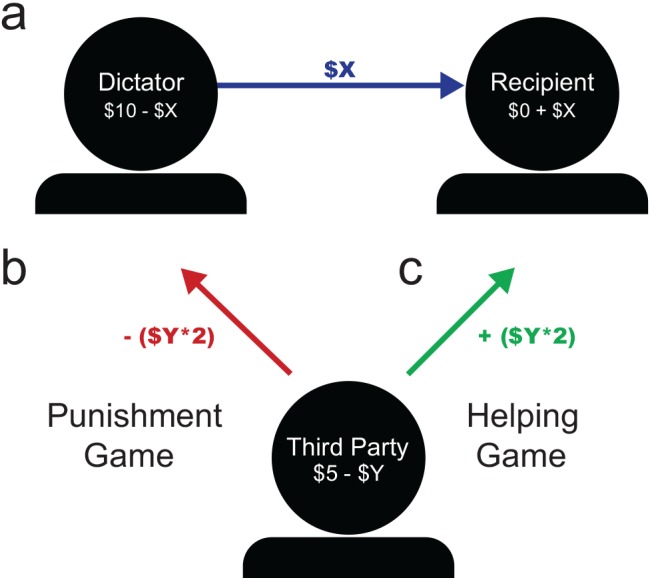
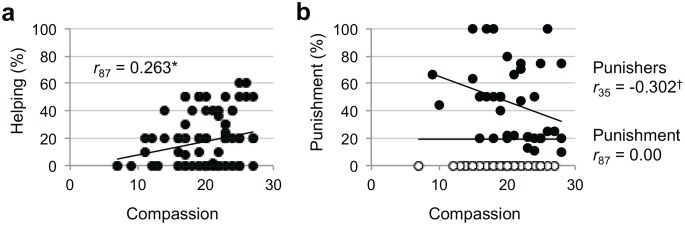
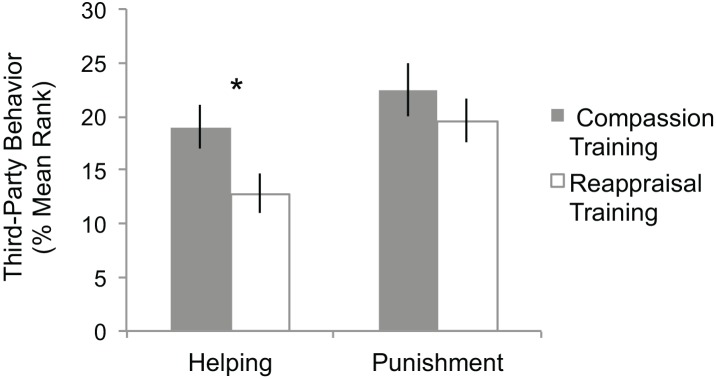
Compassion, the emotional response of caring for another who is suffering and that results in motivation to relieve suffering, is thought to be an emotional antecedent to altruistic behavior. However, it remains unclear whether compassion enhances altruistic behavior in a uniform way or is specific to sub-types of behavior such as altruistic helping of a victim or altruistic punishment of a transgressor. We investigated the relationship between compassion and subtypes of altruistic behavior using third-party paradigms where participants (1) witnessed an unfair economic exchange between a transgressor and a victim, and (2) had the opportunity to either spend personal funds to either economically (a) help the victim or (b) punish the transgressor. In Study 1, we examined whether individual differences in self-reported empathic concern (the emotional component of compassion) was associated with greater altruistic helping or punishment behavior in two independent samples. For participants who witnessed an unfair transaction, trait empathic concern was associated with greater helping of a victim and had no relationship to punishment. However, in those who decided to punish the transgressor, participants who reported greater empathic concern decided to punish less. In Study 2, we directly enhanced compassion using short-term online compassion meditation training to examine whether altruistic helping and punishment were increased after two weeks of training. Compared to an active reappraisal training control group, the compassion training group gave more to help the victim and did not differ in punishment of the transgressor. Together, these two studies suggest that compassion is related to greater altruistic helping of victims and is not associated with or may mitigate altruistic punishment of transgressors.
Overview
The claims and statistics of this paper haven’t been checked yet.
Run the check — free, no account needed. It reads the open-access text and checks the sources it cites.
Integrity signals
Registry
Cites
Statistics
Figures
Verification
Claims the paper makes
The claims and statistics of this paper haven’t been checked yet.
Run the check — free, no account needed. It reads the open-access text and checks the sources it cites.
Claims other papers make about this one
Each is checked against this paper’s own text: does it say what the citing paper says it does?
The check wasn’t confident either way, so it gives no verdict — never disputed.
In the citing paper
“Weng et al. (2015) found that greater pro-social behavior (charitable donations) were correlated with changes in the inferior parietal cortex and dorsolateral prefrontal cortex.”
From A Systematic Review and Meta-analysis of the Effects of Meditation on Empathy, Compassion, and Prosocial Behaviors (2018) · cites this paper as Weng et al., 2015
Experimental — accuracy not yet measured
Self-check
Percentages, sums and reported differences re-computed from the paper’s own numbers.
The self-check needs the paper’s full text.
Citations
Cites
Development and validation of brief measures of positive and negative affect: The PANAS scales.
Watson, D., Clark, L. A., & Tellegen, A. (1988) · Journal of Personality and Social Psychology · doi:10.1037/0022-3514.54.6.1063 · Cited by 32,433
Cognitive Therapy for Depression
(2012) · PsycEXTRA Dataset · doi:10.1037/e675542012-001 · Cited by 9,678
A new scale of social desirability independent of psychopathology.
Crowne, D. P., & Marlowe, D. (1960) · Journal of Consulting Psychology · doi:10.1037/h0047358 · Cited by 8,686
Social Relationships and Health
House, J. S., Landis, K. R., & Umberson, D. (1988) · Science · doi:10.1126/science.3399889 · Cited by 7,073
Altruistic punishment in humans
Fehr, E., & Gächter, S. (2002) · Nature · doi:10.1038/415137a · Cited by 5,616
An experimental analysis of ultimatum bargaining
Güth, W., Schmittberger, R., & Schwarze, B. (1982) · Journal of Economic Behavior & Organization · doi:10.1016/0167-2681(82)90011-7 · Cited by 4,868
Social Relationships and Health.
Cohen, S. (2004) · American Psychologist · doi:10.1037/0003-066x.59.8.676 · Cited by 4,852
(1980) · Medical Entomology and Zoology · Cited by 4,712
Behavioral Game Theory: Experiments in Strategic Interaction
Camerer, C. F. (2003) · Cited by 3,722
Kawachi, I. I. (2001) · Journal of Heredity · doi:10.1093/jurban/78.3.458 · Cited by 3,565
Cited by
Sorted by citations
Does gratitude enhance prosociality?: A meta-analytic review.
Lawrence, K., Tunney, R. J., & Ferguson, E. (2017) · Psychological Bulletin · doi:10.1037/bul0000103 · Cited by 458
On the interaction of social affect and cognition: empathy, compassion and theory of mind
Preckel, K., Kanske, P., & Singer, T. (2018) · Current Opinion in Behavioral Sciences · doi:10.1016/j.cobeha.2017.07.010 · Cited by 348
Luberto, C. M., Shinday, N., Song, R., Philpotts, L. L., Park, E. R., Fricchione, G. L., & Yeh, G. Y. (2018) · Mindfulness · doi:10.1007/s12671-017-0841-8 · Cited by 346
The plasticity of well-being: A training-based framework for the cultivation of human flourishing
Dahl, C. J., Wilson‐Mendenhall, C. D., & Davidson, R. J. (2020) · Proceedings of the National Academy of Sciences · doi:10.1073/pnas.2014859117 · Cited by 295
Self-citationDifferential benefits of mental training types for attention, compassion, and theory of mind
Trautwein, F.-M., Kanske, P., Böckler, A., & Singer, T. (2020) · Cognition · doi:10.1016/j.cognition.2019.104039 · Cited by 139
Metadata
- Authors
- Weng, H. Y., Fox, A. S., Hessenthaler, H. C., Stodola, D. E., & Davidson, R. J.
- Affiliations
- University of Wisconsin–Madison (US)
- Corresponding author
- Weng, Helen Y.
- Davidson, Richard J.
- Venue
- PLOS ONE
- Publisher
- Public Library of Science (PLoS)
- Published
- 2015-12-10
- Volume
- 10
- Issue
- 12
- Pages
- e0143794
- ISSN
- 1932-6203 (ISSN-L)
- PMC
- PMC4675554
- OpenAlex
- W2191876901
- Cited by
- 132
- References
- 44
- Citations by year
- 2026: 4 · 2025: 5 · 2024: 7 · 2023: 8 · 2022: 8 · 2021: 21 · 2020: 49 · 2019: 10 · 2018: 11 · 2017: 7 · 2016: 2
- FWCI
- 19.39
- Type
- journal article
- Language
- en
- Open access
- gold
- doi.org
- Licence
- Locations
- PLoS ONE (publishedVersion, cc-by)
- PubMed Central (publishedVersion, cc-by)
- PubMed (publishedVersion)
- eScholarship (California Digital Library) (submittedVersion)
- RePEc: Research Papers in Economics (submittedVersion)
- DOAJ (DOAJ: Directory of Open Access Journals) (submittedVersion)
- Figshare (submittedVersion, cc-by)
- Funders
- Fetzer Institute
- University of Wisconsin-Madison (T32-MH018931)
- Mind and Life Institute
- Osher Center for Integrative Medicine
- Curtin University of Technology
- National Institutes of Health (AT003997)
- University of California, San Francisco
- National Institute of Mental Health (T32MH018931)
- National Center for Complementary and Integrative Health (T32AT006956, P01AT004952, T32AT003997)
- Topics
- Social Sciences › Economics, Econometrics and Finance › Economics and Econometrics › Experimental Behavioral Economics Studies
- Social Sciences › Psychology › Social Psychology › Emotions and Moral Behavior
- Life Sciences › Neuroscience › Cognitive Neuroscience › Psychology of Moral and Emotional Judgment
- Keywords
- compassion, altruistic punishment, empathic concern, trait empathy
- MeSH terms
- Adult, Altruism, Empathy, Female, Games, Experimental, Humans, Male, Punishment, Young Adult
About these checks
Registry, retraction, Cites and statistics results are computed, not judged, with one exception: a printed reference that no index lists is read once by a model before it counts as a citation error. Claims are extracted by a model and kept only when their quote appears verbatim in the text; each cited source is then checked, with a model’s help, for whether it says what the claim relies on. Those verdicts can be wrong — read the claim’s quote and the cited source before relying on one.
Statistics and arithmetic are recomputed, not judged.
Confidence bands are shown only for fields calibrated on our annotated test set. None is calibrated yet, so no band is shown.
What counts as a claim ›How we measure confidence ›How we check this ›
Are you an author, or do you see a problem with this page? Request a review
