

The DOI matches its Crossref record; 74 of the 74 references it cites were found in a registry or an index.
The Relationship between Health Literacy and Health Disparities: A Systematic Review
Open accessAbstract
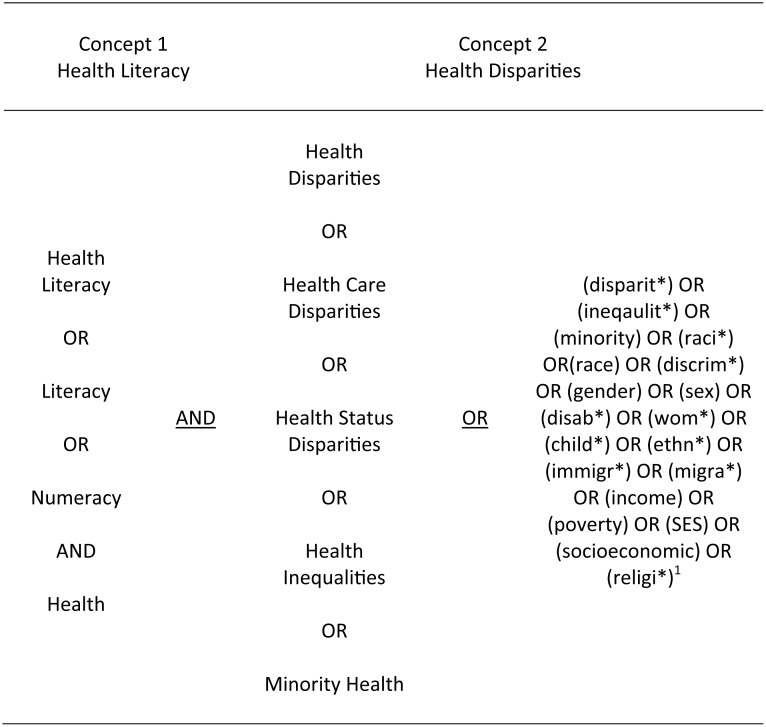
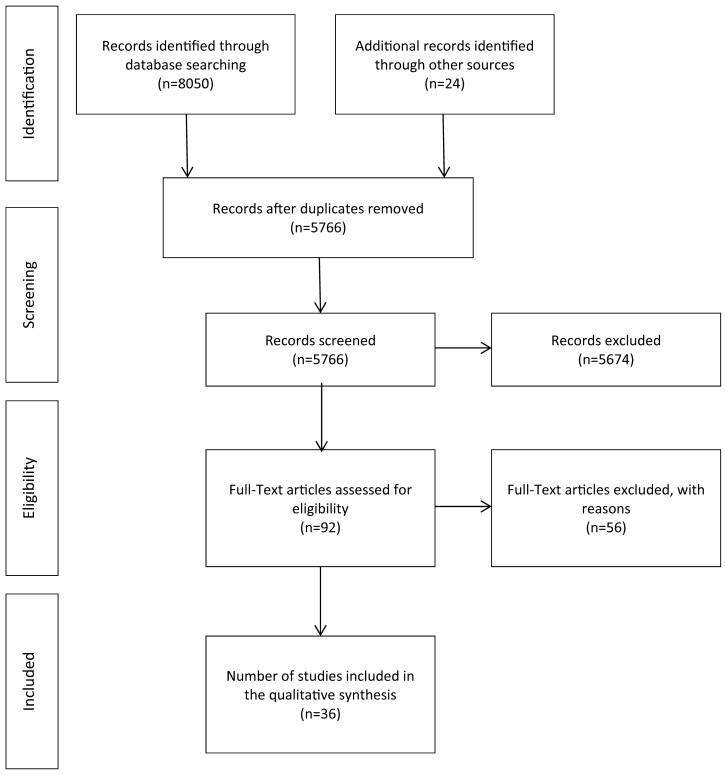
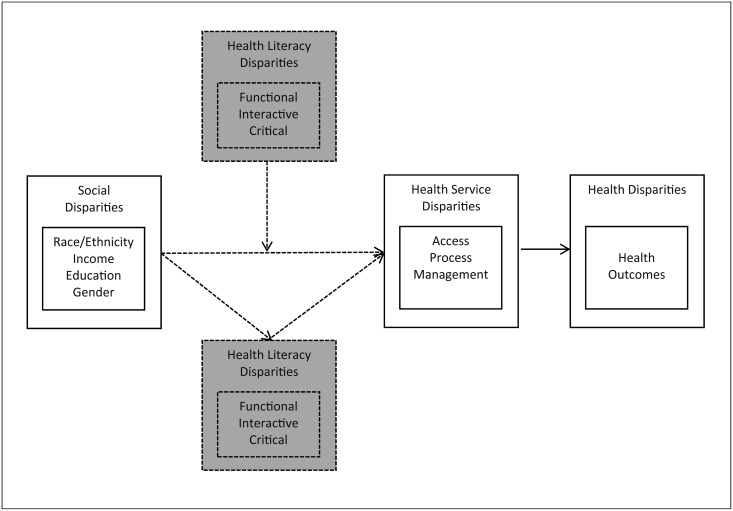
OBJECTIVES: Health literacy is commonly associated with many of the antecedents of health disparities. Yet the precise nature of the relationship between health literacy and disparities remains unclear. A systematic review was conducted to better understand in how far the relationship between health literacy and health disparities has been systematically studied and which potential relationships and pathways have been identified. METHODS: Five databases, including PubMed/MEDLINE and CINAHL, were searched for peer-reviewed studies. Publications were included in the review when they (1) included a valid measure of health literacy, (2) explicitly conceived a health disparity as related to a social disparity, such as race/ethnicity or education and (3) when results were presented by comparing two or more groups afflicted by a social disparity investigating the effect of health literacy on health outcomes. Two reviewers evaluated each study for inclusion and abstracted relevant information. Findings were ordered according to the disparities identified and the role of health literacy in explaining them. RESULTS: 36 studies were included in the final synthesis. Most of the studies investigated racial/ethnic disparities, followed by some few studies that systematically investigated educational disparities. Some evidence was found on the mediating function of health literacy on self-rated health status across racial/ethnic and educational disparities, as well as on the potential effect of health literacy and numeracy on reducing racial/ethnic disparities in medication adherence and understanding of medication intake. CONCLUSION: Overall the evidence on the relationship between health literacy and disparities is still mixed and fairly limited. Studies largely varied with regard to health(-related) outcomes under investigation and the health literacy assessments used. Further, many studies lacked a specific description of the nature of the disparity that was explored and a clear account of possible pathways tested.
Overview
The claims and statistics of this paper haven’t been checked yet.
Run the check — free, no account needed. It reads the open-access text and checks the sources it cites.
Integrity signals
Registry
Cites
Statistics
Figures
Verification
Claims the paper makes
The claims and statistics of this paper haven’t been checked yet.
Run the check — free, no account needed. It reads the open-access text and checks the sources it cites.
Claims other papers make about this one
Each is checked against this paper’s own text: does it say what the citing paper says it does?
The cited source says what the claim attributes to it.
In the citing paper
“Language barriers are not the only issue that contributes to health inequities, and much has been written about these factors that are collectively known as social determinants of health [59-62]”
From Technology enabled clinical care (TECC): Protocol for a prospective longitudinal cohort study of smartphone-augmented mental health treatment (2021) · cites this paper as [61]
Self-check
Percentages, sums and reported differences re-computed from the paper’s own numbers.
The self-check needs the paper’s full text.
Citations
Cites
Preferred Reporting Items for Systematic Reviews and Meta-Analyses: the PRISMA statement
Moher, D., Liberati, A., Tetzlaff, J., Altman, D. G., & for the PRISMA Group (2009) · BMJ · doi:10.1136/bmj.b2535 · Cited by 83,823
Preferred reporting items for systematic reviews and meta-analyses: the PRISMA Statement.
(2009) · PubMed Central · Cited by 44,859
Preferred reporting items for systematic reviews and meta-analyses: The PRISMA statement
Moher, D., Liberati, A., Tetzlaff, J., Altman, D. G., & the PRISMA Group* (2009) · Annals of Internal Medicine · doi:10.7326/0003-4819-151-4-200908180-00135 · Cited by 37,554
Low Health Literacy and Health Outcomes: An Updated Systematic Review
Berkman, N. D., Sheridan, S. L., Donahue, K. E., Halpern, D. J., & Crotty, K. (2011) · Annals of Internal Medicine · doi:10.7326/0003-4819-155-2-201107190-00005 · Cited by 5,505
Health Literacy: A Prescription to End Confusion
Committee on Health Literacy, Board on Neuroscience and Behavioral Health, & Institute of Medicine (2004) · doi:10.17226/10883 · Cited by 3,444
Quick Assessment of Literacy in Primary Care: The Newest Vital Sign
Weiss, B. (2005) · The Annals of Family Medicine · doi:10.1370/afm.405 · Cited by 2,222
Rapid estimate of adult literacy in medicine: a shortened screening instrument.
Davis, T. C., Long, S. W., Jackson, R. H., Mayeaux, E. J., George, R. B., Murphy, P. W., & Crouch, M. A. (1993) · PubMed · Cited by 1,597
Health disparities and health equity: Concepts and measurement
Braveman, P. (2006) · Annual Review of Public Health · doi:10.1146/annurev.publhealth.27.021405.102103 · Cited by 1,570
Socioeconomic Disparities in Health in the United States: What the Patterns Tell Us
Braveman, P. A., Cubbin, C., Egerter, S., Williams, D. R., & Pamuk, E. (2010) · American Journal of Public Health · doi:10.2105/ajph.2009.166082 · Cited by 1,548
Kutner, M. A., Greenburg, E., Jin, Y., & Paulsen, C. A. (2006) · National Center for Education Statistics · Cited by 1,545
Cited by
Sorted by citations
Understanding and Responding to Health Literacy as a Social Determinant of Health
Nutbeam, D., & Lloyd, J. E. (2021) · Annual Review of Public Health · doi:10.1146/annurev-publhealth-090419-102529 · Cited by 1,178
Stormacq, C., Van den Broucke, S., & Wosinski, J. (2019) · Health Promotion International · doi:10.1093/heapro/day062 · Cited by 928
Wolf, M. S., Serper, M., Opsasnick, L. A., O’Conor, R. M., Curtis, L. M., Benavente, J. Y., Wismer, G. A., Batio, S., Eifler, M. R., Zheng, P., et al. (2020) · Annals of Internal Medicine · doi:10.7326/m20-1239 · Cited by 563
Akalu, Y., Ayelign, B., & Molla, M. D. (2020) · Infection and Drug Resistance · doi:10.2147/idr.s258736 · Cited by 353
McCaffery, K. J., Dodd, R. H., Cvejic, E., Ayre, J., Batcup, C., Isautier, J., Copp, T., Bonner, C., Pickles, K. M., Nickel, B., et al. (2020) · Public Health Research & Practice · doi:10.17061/phrp30342012 · Cited by 293
Metadata
- Authors
- Mantwill, S., Monestel-Umaña, S., & Schulz, P. J.
- Affiliations
- Università della Svizzera italiana (CH)
- Corresponding author
- Mantwill, Sarah
- Venue
- PLOS ONE
- Publisher
- Public Library of Science (PLoS)
- Published
- 2015-12-23
- Volume
- 10
- Issue
- 12
- Pages
- e0145455
- ISSN
- 1932-6203 (ISSN-L)
- PMC
- PMC4689381
- OpenAlex
- W2199607157
- Cited by
- 395
- References
- 73
- Citations by year
- 2026: 36 · 2025: 45 · 2024: 44 · 2023: 35 · 2022: 41 · 2021: 54 · 2020: 72 · 2019: 30 · 2018: 19 · 2017: 15 · 2016: 3
- FWCI
- 2.21
- Type
- journal article
- Language
- en
- Open access
- gold
- doi.org
- Licence
- Locations
- PLoS ONE (publishedVersion, cc-by)
- PubMed Central (publishedVersion, cc-by)
- PubMed (publishedVersion)
- RePEc: Research Papers in Economics (acceptedVersion)
- DOAJ (DOAJ: Directory of Open Access Journals) (submittedVersion, cc-by-sa)
- Figshare (submittedVersion, cc-by)
- Topics
- Health Sciences › Health Professions › General Health Professions › Health Literacy and Information Accessibility
- Social Sciences › Health › Health disparities and outcomes
- Health Sciences › Medicine › Public Health, Environmental and Occupational Health › Cultural Competency in Health Care
- Keywords
- health literacy, health disparities, racial and ethnic disparities, educational inequality, self-rated health, medication adherence, numeracy, social determinants of health, mediation pathways
- MeSH terms
- Ethnicity, Humans, Health Knowledge, Attitudes, Practice, Health Status Disparities, Health Literacy
About these checks
Registry, retraction, Cites and statistics results are computed, not judged, with one exception: a printed reference that no index lists is read once by a model before it counts as a citation error. Claims are extracted by a model and kept only when their quote appears verbatim in the text; each cited source is then checked, with a model’s help, for whether it says what the claim relies on. Those verdicts can be wrong — read the claim’s quote and the cited source before relying on one.
Statistics and arithmetic are recomputed, not judged.
Confidence bands are shown only for fields calibrated on our annotated test set. None is calibrated yet, so no band is shown.
What counts as a claim ›How we measure confidence ›How we check this ›
Are you an author, or do you see a problem with this page? Request a review
