

Languages Support Efficient Communication about the Environment: Words for Snow Revisited
Open accessThe DOI matches its Crossref record; 47 of the 48 references it cites were found in a registry or an index.
Abstract
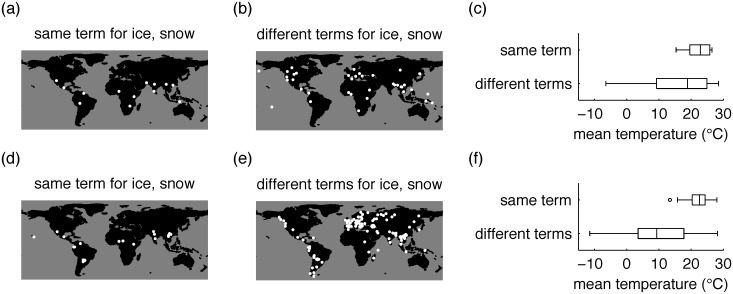
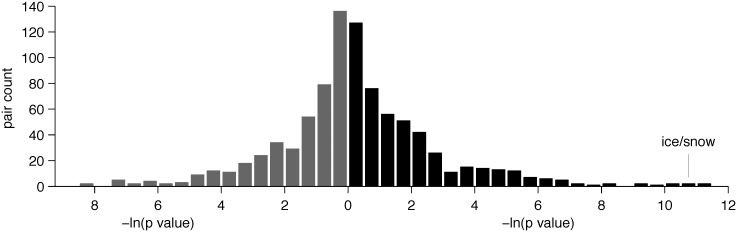
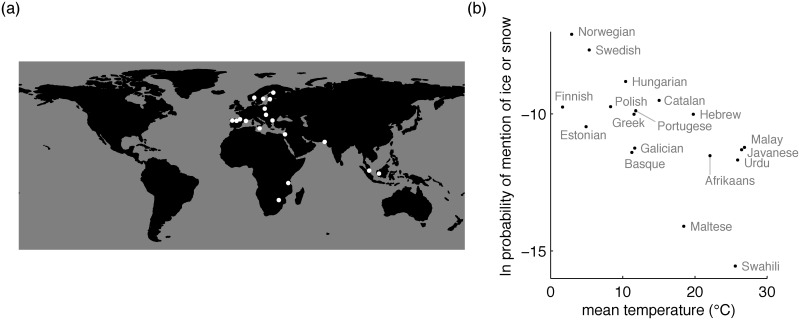
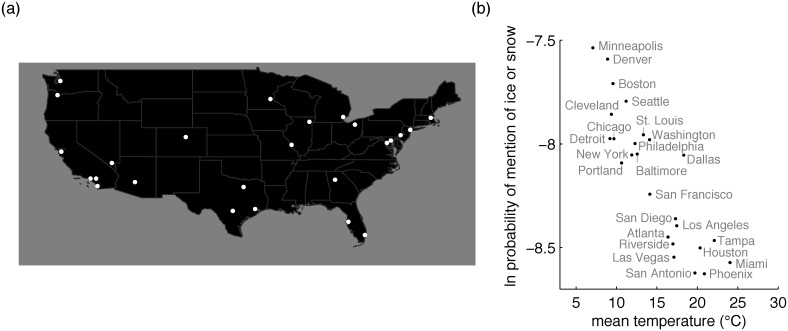
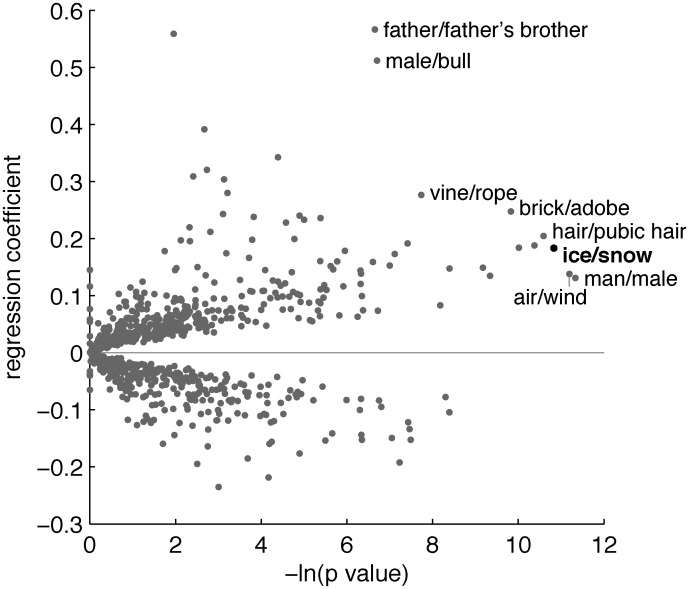
The claim that Eskimo languages have words for different types of snow is well-known among the public, but has been greatly exaggerated through popularization and is therefore viewed with skepticism by many scholars of language. Despite the prominence of this claim, to our knowledge the line of reasoning behind it has not been tested broadly across languages. Here, we note that this reasoning is a special case of the more general view that language is shaped by the need for efficient communication, and we empirically test a variant of it against multiple sources of data, including library reference works, Twitter, and large digital collections of linguistic and meteorological data. Consistent with the hypothesis of efficient communication, we find that languages that use the same linguistic form for snow and ice tend to be spoken in warmer climates, and that this association appears to be mediated by lower communicative need to talk about snow and ice. Our results confirm that variation in semantic categories across languages may be traceable in part to local communicative needs. They suggest moreover that despite its awkward history, the topic of "words for snow" may play a useful role as an accessible instance of the principle that language supports efficient communication.
Overview
The claims and statistics of this paper haven’t been checked yet.
Free: it reads the open-access text and checks the first 5 claims that cite a source we can check. Create a free account to check every claim.
Integrity signals
Registry
Cites
Statistics
Figures

Verification
Claims the paper makes
The claims and statistics of this paper haven’t been checked yet.
Free: it reads the open-access text and checks the first 5 claims that cite a source we can check. Create a free account to check every claim.
Claims other papers make about this one
Each is checked against this paper’s own text: does it say what the citing paper says it does?
The source backs part of the claim, not all of it — or backs it for a different population, condition or comparison.
In the citing paper
“If there is a communicative need to talk about subcategories in an environment, then the category system will be more fine-grained than if there is no such need [6].”
From The role of pragmatic mechanisms in referential communication and categorization: An emergent communication model (2026) · cites this paper as [6]
Experimental — accuracy not yet measuredThe cited source says what the claim attributes to it.
In the citing paper
“The authors found that languages that use the same linguistic form for both snow and ice tend to be spoken in warmer countries.”
From The role of pragmatic mechanisms in referential communication and categorization: An emergent communication model (2026) · cites this paper as [6]
The cited source says what the claim attributes to it.
In the citing paper
“It has been proposed that, due to cognitive constraints, both languages and category systems tend to find an optimal tradeoff between simplicity and informativeness [6,8,16–20].”
From The role of pragmatic mechanisms in referential communication and categorization: An emergent communication model (2026) · cites this paper as [6]
The cited source says what the claim attributes to it.
In the citing paper
“This is in line with the efficient communication hypothesis which predicts that human languages are optimized for efficient communication”
From The role of pragmatic mechanisms in referential communication and categorization: An emergent communication model (2026) · cites this paper as [6]
Experimental — accuracy not yet measured
Self-check
Percentages, sums and reported differences re-computed from the paper’s own numbers.
The self-check needs the paper’s full text.
Citations
Cites
Controlling the False Discovery Rate: A Practical and Powerful Approach to Multiple Testing
Benjamini, Y., & Hochberg, Y. (1995) · Journal of the Royal Statistical Society Series B: Statistical Methodology · doi:10.1111/j.2517-6161.1995.tb02031.x · Cited by 109,482
The evolution of grammar: tense, aspect, and modality in the languages of the world
(1995) · Choice Reviews Online · doi:10.5860/choice.32-4321 · Cited by 3,820
Language, Thought, and Reality: Selected Writings of Benjamin Lee Whorf
Miller, G. A., & Carroll, J. B. (1957) · The American Journal of Psychology · doi:10.2307/1419256 · Cited by 2,743
Expectation-based syntactic comprehension
Levy, R. (2008) · Cognition · doi:10.1016/j.cognition.2007.05.006 · Cited by 2,202
Efficiency and Complexity in Grammars
Hawkins, J. A. (2004) · doi:10.1093/acprof:oso/9780199252695.001.0001 · Cited by 1,743 · cited 1×
“Many aspects of language yield evidence consistent with this hypothesis, including word frequency distributions [11, 12], word length [13], syllable duration [14], compositional structure [15], syntactic structures and processing [16–18], the learning of case marking [19], and—of direct relevance to Boas’ snow example…”
BackgroundHuman behavior and the principle of least effort.
indicated, N. A. (1949) · Journal of Consulting Psychology · doi:10.1037/h0052803 · Cited by 1,565
Aylett, M., & Turk, A. (2004) · Language and Speech · doi:10.1177/00238309040470010201 · Cited by 781
Language Universals: With Special Reference to Feature Hierarchies
Greenberg, J. H. (1966) · Cited by 759
Redundancy and reduction: Speakers manage syntactic information density
Florian Jaeger, T. (2010) · Cognitive Psychology · doi:10.1016/j.cogpsych.2010.02.002 · Cited by 733
Word lengths are optimized for efficient communication
Piantadosi, S. T., Tily, H., & Gibson, E. (2011) · Proceedings of the National Academy of Sciences · doi:10.1073/pnas.1012551108 · Cited by 695 · cited 1×
“Many aspects of language yield evidence consistent with this hypothesis, including word frequency distributions [11, 12], word length [13], syllable duration [14], compositional structure [15], syntactic structures and processing [16–18], the learning of case marking [19], and—of direct relevance to Boas’ snow example…”
Background
Research works printed but not linked: 1
- Saxton D, Saxton L. Dictionary: Papago & Pima to English, English to Papago & Pima. University of Arizona Press; 1969.
Cited by
Differential coding of perception in the world’s languages
Majid, A., Roberts, S. G., Cilissen, L., Emmorey, K., Nicodemus, B., O’Grady, L., Woll, B., LeLan, B., de Sousa, H., Cansler, B. L., et al. (2018) · Proceedings of the National Academy of Sciences · doi:10.1073/pnas.1720419115 · Cited by 342
Semantic typology and efficient communication
Kemp, C., Xu, Y., & Regier, T. (2018) · Annual Review of Linguistics · doi:10.1146/annurev-linguistics-011817-045406 · Cited by 180
“Regier et al. (2016) tested a variant of the same principle more broadly across languages.”
BackgroundSelf-citationVision dominates in perceptual language: English sensory vocabulary is optimized for usage
Winter, B., Perlman, M., & Majid, A. (2018) · Cognition · doi:10.1016/j.cognition.2018.05.008 · Cited by 184
Sensory Linguistics: Language, perception, and metaphor
Winter, B. (2019) · Converging Evidence in Language and Communication Research · doi:10.1075/celcr.20 · Cited by 161
Why Are There Different Languages? The Role of Adaptation in Linguistic Diversity
Lupyan, G., & Dale, R. A. C. (2016) · Trends in Cognitive Sciences · doi:10.1016/j.tics.2016.07.005 · Cited by 193
Krause, M. A., Bard, K. A., & Leavens, D. A. (2016) · Cambridge University Press eBooks · doi:10.1017/9781009445696.003 · Cited by 146
Cultural influences on word meanings revealed through large-scale semantic alignment
Thompson, B., Roberts, S. G., & Lupyan, G. (2020) · Nature Human Behaviour · doi:10.1038/s41562-020-0924-8 · Cited by 201
Universal meaning extensions of perception verbs are grounded in interaction
Roque, L. S., Kendrick, K. H., Norcliffe, E., & Majid, A. (2018) · Cognitive Linguistics · doi:10.1515/cog-2017-0034 · Cited by 120
Conceptual Relations Predict Colexification across Languages
Xu, Y., Duong, K., Malt, B. C., Jiang, S., & Srinivasan, M. (2020) · Cognition · doi:10.1016/j.cognition.2020.104280 · Cited by 121
Languages in Drier Climates Use Fewer Vowels
Everett, C. (2017) · Frontiers in Psychology · doi:10.3389/fpsyg.2017.01285 · Cited by 90
Nölle, J., Staib, M., Fusaroli, R., & Tylén, K. (2018) · Cognition · doi:10.1016/j.cognition.2018.08.014 · Cited by 96
Communicative need in colour naming
Zaslavsky, N., Kemp, C., Tishby, N., & Regier, T. (2020) · Cognitive Neuropsychology · doi:10.1080/02643294.2019.1604502 · Cited by 70
Self-citationFloyd, S., Roque, L. S., & Majid, A. (2018) · Journal of Linguistic Anthropology · doi:10.1111/jola.12190 · Cited by 69
Altitude and the distributional typology of language structure: Ejectives and beyond
Urban, M., & Moran, S. (2021) · PLoS ONE · doi:10.1371/journal.pone.0245522 · Cited by 61
Environmental Change and Sustainability of Indigenous Languages in Northern Alaska
Reo, N. J., Topkok, M. S., Kanayurak, N., Stanford, J. N., Peterson, D. A., & Whaley, L. J. (2019) · ARCTIC · doi:10.14430/arctic68655 · Cited by 51
Robust, Causal, and Incremental Approaches to Investigating Linguistic Adaptation
Roberts, S. G. (2018) · Frontiers in Psychology · doi:10.3389/fpsyg.2018.00166 · Cited by 54
Sensory Linguistics: Language, perception and metaphor
Winter, B. (2019) · Cited by 71
Adult Learning and Language Simplification
Atkinson, M., Smith, K., & Kirby, S. (2018) · Cognitive Science · doi:10.1111/cogs.12686 · Cited by 56
Language as shaped by the environment: linguistic construal in a collaborative spatial task
Nölle, J., Fusaroli, R., Mills, G. J., & Tylén, K. (2020) · Humanities and Social Sciences Communications · doi:10.1057/s41599-020-0404-9 · Cited by 54
Hahn, M., & Xu, Y. (2022) · Proceedings of the National Academy of Sciences · doi:10.1073/pnas.2122604119 · Cited by 56
Rissman, L., Horton, L., Flaherty, M., Senghas, A., Coppola, M., Brentari, D., & Goldin-Meadow, S. (2020) · Cognition · doi:10.1016/j.cognition.2020.104332 · Cited by 39
Winter, B., & Srinivasan, M. (2022) · Metaphor and Symbol · doi:10.1080/10926488.2021.1945419 · Cited by 43
Language evolution research in the year 2020: A survey of new directions
Nölle, J., Hartmann, S., & Tinits, P. (2020) · Language Dynamics and Change · doi:10.1163/22105832-bja10005 · Cited by 40
Urban, M. (2020) · Language and Linguistics Compass · doi:10.1111/lnc3.12393 · Cited by 34
Does optimal partitioning of color space account for universal color categorization?
Jraissati, Y., & Douven, I. (2017) · PLoS ONE · doi:10.1371/journal.pone.0178083 · Cited by 24
Local similarity and global variability characterize the semantic space of human languages
Lewis, M. L., Cahill, A., Madnani, N., & Evans, J. A. (2023) · Proceedings of the National Academy of Sciences · doi:10.1073/pnas.2300986120 · Cited by 44
Kilarski, M. (2021) · Amsterdam studies in the theory and history of linguistic science. Series 3, Studies in the history of linguistics · doi:10.1075/sihols.129.c6 · Cited by 17
From language to meteorology: kinesis in weather events and weather verbs across Sinitic languages
Huang, C., Dong, S., Yang, Y., & Ren, H. (2021) · Humanities and Social Sciences Communications · doi:10.1057/s41599-020-00682-w · Cited by 15
The fundamental importance of method to theory
Dale, R. A. C., Warlaumont, A. S., & Johnson, K. L. (2022) · Nature Reviews Psychology · doi:10.1038/s44159-022-00120-5 · Cited by 24
Investigating environmental effects on phonology using diachronic models
Hartmann, F., Roberts, S. G., Valdes, P. J., & Grollemund, R. (2024) · Evolutionary Human Sciences · doi:10.1017/ehs.2023.33 · Cited by 13
Haspelmath, M. (2023) · Frontiers in Psychology · doi:10.3389/fpsyg.2023.1236853 · Cited by 13
More is Better: English Language Statistics are Biased Toward Addition
Winter, B., Fischer, M. H., Scheepers, C., & Myachykov, A. (2023) · Cognitive Science · doi:10.1111/cogs.13254 · Cited by 15
Languages are efficient, but for whom?
Trott, S., & Bergen, B. K. (2022) · Cognition · doi:10.1016/j.cognition.2022.105094 · Cited by 20
The languages of North America: An overview
Kilarski, M. (2021) · Amsterdam studies in the theory and history of linguistic science. Series 3, Studies in the history of linguistics · doi:10.1075/sihols.129.c2 · Cited by 11
Multimodality matters in numerical communication
Winter, B., & Marghetis, T. (2023) · Frontiers in Psychology · doi:10.3389/fpsyg.2023.1130777 · Cited by 9
Group Coordination Catalyzes Individual and Cultural Intelligence
Wu, C. M., Dale, R. A. C., & Hawkins, R. D. (2024) · Open Mind · doi:10.1162/opmi_a_00155 · Cited by 21
Rethinking the relationship between pronoun-drop and individualism with Bayesian multilevel models
Lee, S. (2017) · Journal of Language Evolution · doi:10.1093/jole/lzx003 · Cited by 8
Why Don't Languages Adapt to Their Environment?
Giró, J. L. M. (2018) · Frontiers in Communication · doi:10.3389/fcomm.2018.00024 · Cited by 8
(2019) · Converging evidence in language and communication research · doi:10.1075/celcr.20.c18 · Cited by 6
From the field into the lab: causal approaches to the evolution of spatial language
Nölle, J., & Spranger, M. (2022) · Linguistics Vanguard · doi:10.1515/lingvan-2020-0007 · Cited by 9
Talking About Temperature and Social Thermoregulation in the Languages of the World
Koptjevskaja‐Tamm, M., & Nikolaev, D. (2021) · International Review of Social Psychology · doi:10.5334/irsp.410 · Cited by 7
Language as shaped by the environment: linguistic construal in a collaborative spatial taskPreprint
Nölle, J., Fusaroli, R., Mills, G. J., & Tylén, K. (2019) · PsyArXiv (OSF Preprints) · doi:10.31234/osf.io/pk4xs · Cited by 5
Cognitive-Cultural Looping Mechanism of Urban Space Conceptualization
Alinam, Z., Tylén, K., Pirbabaei, M. T., & Gharehbaglou, M. (2021) · Integrative Psychological and Behavioral Science · doi:10.1007/s12124-021-09642-8 · Cited by 6
Wu, J., & Chentsova-Dutton, Y. E. (2025) · Journal of Cross-Cultural Psychology · doi:10.1177/00220221251362805 · Cited by 12
A History of the Study of the Indigenous Languages of North America
Kilarski, M. (2021) · Amsterdam studies in the theory and history of linguistic science. Series 3, Studies in the history of linguistics · doi:10.1075/sihols.129 · Cited by 8
Elevation and fog-cloud similarity in Tibeto-Burman languages
Ding, H., & Dong, S. (2023) · Humanities and Social Sciences Communications · doi:10.1057/s41599-023-01877-7 · Cited by 7
Viva, M. M. D., Castellotti, S., & Paramei, G. V. (2023) · Humanities and Social Sciences Communications · doi:10.1057/s41599-023-02393-4 · Cited by 8
Colexification of “thunder” and “dragon” in Sino-Tibetan languages
Ding, H., & Dong, S. (2024) · Asia Pacific Translation and Intercultural Studies · doi:10.1080/23306343.2024.2383513 · Cited by 6
The geo domain: a review on the conceptualization of geographical and geopolitical entities
Falcinelli, I., Fini, C., Mazzuca, C., & Borghi, A. M. (2024) · Frontiers in Psychology · doi:10.3389/fpsyg.2024.1389581 · Cited by 7
Foggy connections, cloudy frontiers: On the (non-)adaptation of lexical structures
Urban, M. (2023) · Frontiers in Psychology · doi:10.3389/fpsyg.2023.1115832 · Cited by 4
Optimal Interval DivisionPreprint
Tian, J. (2015) · SSRN Electronic Journal · doi:10.2139/ssrn.2697430 · Cited by 6
Translation and Cognition: Cases of Asymmetry. An Editorial
Deckert, M. (2017) · Research in Language · doi:10.1515/rela-2017-0008 · Cited by 4
Jraissati, Y. (2019) · Review of Philosophy and Psychology · doi:10.1007/s13164-019-00439-8 · Cited by 4
Language and society: How social pressures shape grammatical structure
Raviv, L. (2020) · MPG.PuRe (Max Planck Society) · Cited by 8
Color Categorization: Patterns and Mechanisms of Evolution
Paramei, G. V. (2020) · Springer eBooks · doi:10.1007/978-3-642-27851-8_397-1 · Cited by 4
Griber, Y. A., Ivleva, A. I., Solovyev, V. Y., & Paramei, G. V. (2026) · Humanities and Social Sciences Communications · doi:10.1057/s41599-026-07021-5 · Cited by 4
Kallens, P. C., Dale, R. A. C., & Christiansen, M. H. (2018) · Physics of Life Reviews · doi:10.1016/j.plrev.2018.07.003 · Cited by 3
Universals and variation in language and thought: Concepts, communication, and semantic structure
Carstensen, A. (2016) · eScholarship (California Digital Library) · Cited by 3
Self-citationNumbers in Context: Cardinals, Ordinals, and Nominals in American English
Woodin, G., & Winter, B. (2024) · Cognitive Science · doi:10.1111/cogs.13471 · Cited by 2
A computational analysis of lexical elaboration across languages
Khishigsuren, T., Regier, T., Vylomova, E., & Kemp, C. (2025) · Proceedings of the National Academy of Sciences · doi:10.1073/pnas.2417304122 · Cited by 3
Self-citationTian, J. (2021) · The Economic Journal · doi:10.1093/ej/ueab055 · Cited by 2
Josserand, M., Pellegrino, F., Grosseck, O., Dediu, D., & Raviv, L. (2024) · Cognitive Science · doi:10.1111/cogs.70011 · Cited by 4
Communicative need modulates competition in language changePreprint
Karjus, A., Blythe, R. A., Kirby, S., & Smith, K. (2020) · arXiv (Cornell University) · doi:10.48550/arxiv.2006.09277 · Cited by 14
Local similarity and global variability characterize the semantic space of human languagesPreprint
Lewis, M. L., Cahill, A., Madnani, N., & Evans, J. A. (2020) · doi:10.31234/osf.io/f5bvp · Cited by 2
Nölle, J., Staib, M., Fusaroli, R., & Tylén, K. (2018) · PsyArXiv (OSF Preprints) · doi:10.31234/osf.io/j7k6q · Cited by 5
A simple threshold captures the social learning of conventions
Guilbeault, D., Caplan, S., & Yang, C. D. (2026) · Proceedings of the National Academy of Sciences · doi:10.1073/pnas.2508061123 · Cited by 2
Approximate round number use depends on magnitude
Woodin, G., Lorson, A., & Winter, B. (2026) · Language and Cognition · doi:10.1017/langcog.2026.10090 · Cited by 1
Extending research on language foundations and evolution
Gong, T., Shuai, L., & Wu, Y. (2018) · Physics of Life Reviews · doi:10.1016/j.plrev.2018.09.001 · Cited by 1
Kuzmina, A. A. (2022) · Sovremennye issledovaniya sotsialnykh problem · doi:10.12731/2077-1770-2022-14-2-295-322 · Cited by 1
Sensory linguistics: Introduction to the book
Winter, B. (2019) · Converging evidence in language and communication research · doi:10.1075/celcr.20.c1 · Cited by 1
Conceptual Similarity and Communicative Need Shape Colexification: An Experimental Study
Karjus, A., Blythe, R. A., Kirby, S., Wang, T., & Smith, K. (2021) · Cognitive Science · doi:10.1111/cogs.13035 · Cited by 50
Facial expressions alter the fundamental sound properties of speech
Tessaro, L. W. E., & Whissell, C. (2021) · ELS Journal on Interdisciplinary Studies in Humanities · doi:10.34050/elsjish.v4i1.12786 · Cited by 1
Color Categorization: Patterns and Mechanisms of Evolution
Paramei, G. V. (2023) · Springer eBooks · doi:10.1007/978-3-030-89862-5_397 · Cited by 2
Kobrock, K., Ohmer, X., Bruni, E., & Gotzner, N. (2026) · PLOS Computational Biology · doi:10.1371/journal.pcbi.1014326
“They relate this finding to the lower communicative need to talk about snow and ice in these regions [6].”
InfluentialKilarski, M. (2021) · Amsterdam studies in the theory and history of linguistic science. Series 3, Studies in the history of linguistics · doi:10.1075/sihols.129.ni
Identifying linguistic selection and innovation while controlling for cultural drift
Karjus, A., Blythe, R. A., Kirby, S., & Smith, K. (2018) · International Conference on the Evolution of Language (EvoLang) · doi:10.12775/3991-1.046
Where We Come From and Are We Aware of Where We Are Going To?
Vanaclocha, V., Sáiz‐Sapena, N., Ortiz-Criado, J. M., & Vanaclocha, L. (2021) · IntechOpen eBooks · doi:10.5772/intechopen.84700
La adaptación de las lenguas al entorno: una aproximación crítica
Giró, J. L. M. (2019) · Glosema Revista Asturiana de Llingüística · doi:10.17811/glosema.1.2019.139-175
Language evolution research in the year 2020: A survey of new directionsPreprint
Nölle, J., Hartmann, S., & Tinits, P. (2020) · PsyArXiv (OSF Preprints) · doi:10.31234/osf.io/qb987 · Cited by 1
Pragmatic effects on semantic learnability: Insights from evidentiality
Saratsli, D., & Anna Papafragou, A. (2023) · Journal of Memory and Language · doi:10.1016/j.jml.2023.104426 · Cited by 1
Izhbaeva, G. R., Мырзагалиева, А. С., & Temeresheva, L. N. (2023) · Sovremennye issledovaniya sotsialnykh problem · doi:10.12731/2077-1770-2023-15-3-235-248
The adaptive value of languages: Non–linguistic causes of language diversity, Volume IIPreprint
Benítez‐Burraco, A., & Moran, S. (2024) · doi:10.31234/osf.io/h2bsy
Editorial: The adaptive value of languages: non-linguistic causes of language diversity, volume II
Benítez‐Burraco, A., & Moran, S. (2024) · Frontiers in Psychology · doi:10.3389/fpsyg.2024.1387290
Winter, B. (2019) · Converging evidence in language and communication research · doi:10.1075/celcr.20.c10
Winter, B. (2019) · Converging evidence in language and communication research · doi:10.1075/celcr.20.ack
Winter, B. (2019) · Converging evidence in language and communication research · doi:10.1075/celcr.20.c16
Explaining the hierarchy of the senses
Winter, B. (2019) · Converging evidence in language and communication research · doi:10.1075/celcr.20.c9
Winter, B. (2019) · Converging evidence in language and communication research · doi:10.1075/celcr.20.c13
Semantic preferences of sensory words
(2019) · Converging evidence in language and communication research · doi:10.1075/celcr.20.c14
Winter, B. (2019) · Converging evidence in language and communication research · doi:10.1075/celcr.20.index
Winter, B. (2019) · Converging evidence in language and communication research · doi:10.1075/celcr.20.c2
Winter, B. (2019) · Converging evidence in language and communication research · doi:10.1075/celcr.20.ref
Synesthetic metaphors are not metaphorical
Winter, B. (2019) · Converging evidence in language and communication research · doi:10.1075/celcr.20.c7
The Embodied Lexicon Hypothesis
Winter, B. (2019) · Converging evidence in language and communication research · doi:10.1075/celcr.20.c5
Winter, B. (2019) · Converging evidence in language and communication research · doi:10.1075/celcr.20.c11
Re-evaluating the hierarchy of the senses
(2019) · Converging evidence in language and communication research · doi:10.1075/celcr.20.c17
(2019) · Converging evidence in language and communication research · doi:10.1075/celcr.20.c6
Winter, B. (2019) · Converging evidence in language and communication research · doi:10.1075/celcr.20.c4
Winter, B. (2019) · Converging evidence in language and communication research · doi:10.1075/celcr.20.c8
Frequency, semantic complexity, and iconicity
Winter, B. (2019) · Converging evidence in language and communication research · doi:10.1075/celcr.20.c15
Metadata
- Authors
- Regier, T., Carstensen, A., & Kemp, C.
- Affiliations
- University of California, Berkeley (US)
- Carnegie Mellon University (US)
- Corresponding author
- Regier, Terry
- Carstensen, Alexandra
- Kemp, Charles
- Venue
- PLOS ONE
- Publisher
- Public Library of Science (PLoS)
- Published
- 2016-04-13
- Volume
- 11
- Issue
- 4
- Pages
- e0151138
- ISSN
- 1932-6203 (ISSN-L)
- PMC
- PMC4830456
- OpenAlex
- W2339609277
- Cited by
- 136
- References
- 48
- Citations by year
- 2026: 17 · 2025: 6 · 2024: 8 · 2023: 10 · 2022: 6 · 2021: 25 · 2020: 11 · 2019: 32 · 2018: 13 · 2017: 4 · 2016: 3
- FWCI
- 24.67
- Type
- journal article
- Language
- en
- Open access
- gold
- doi.org
- Licence
- Locations
- PLoS ONE (publishedVersion, cc-by)
- Europe PMC (PubMed Central) (publishedVersion, cc-by)
- PubMed Central (publishedVersion, cc-by)
- PubMed (publishedVersion)
- KiltHub Repository (submittedVersion, cc-by)
- DOAJ (DOAJ: Directory of Open Access Journals) (submittedVersion, cc-by-sa)
- eScholarship (California Digital Library) (submittedVersion)
- Figshare (submittedVersion, cc-by)
- Minerva Access (University of Melbourne) (submittedVersion, cc-by)
- KiltHub Repository (cc-by)
- Funders
- National Science Foundation (1106400, 1041707)
- University of California Berkeley (DGE-1106400)
- Topics
- Social Sciences › Psychology › Experimental and Cognitive Psychology › Categorization, perception, and language
- Social Sciences › Cultural Studies › Language and cultural evolution
- Social Sciences › Linguistics and Language › Language and Culture
- Keywords
- semantic categories, language and environment, communication efficiency, communication needs, Eskimo languages, language change
- MeSH terms
- Inuit, Female, Humans, Male, Semantics, Snow
About these checks
Registry, retraction, Cites and statistics results are computed, not judged, with one exception: a printed reference that no index lists is read once by a model before it counts as a citation error. Claims are extracted by a model and kept only when their quote appears verbatim in the text; each cited source is then checked, with a model’s help, for whether it says what the claim relies on. Those verdicts can be wrong — read the claim’s quote and the cited source before relying on one.
Statistics and arithmetic are recomputed, not judged.
Confidence bands are shown only for fields calibrated on our annotated test set. None is calibrated yet, so no band is shown.
What counts as a claim ›How we measure confidence ›How we check this ›
Are you an author, or do you see a problem with this page? Request a review
Data sources
Bibliographic data: Semantic Scholar, OpenAlex, Crossref.
Contains information from the Semantic Scholar Academic Graph Datasets, made available under the ODC Attribution License (ODC-BY 1.0).
Semantic Scholar’s data is described in: Kinney, R., et al. (2023). The Semantic Scholar Open Data Platform. arXiv:2301.10140.
