

Languages Support Efficient Communication about the Environment: Words for Snow Revisited
Open accessThe DOI matches its Crossref record; 47 of the 48 references it cites were found in a registry or an index.
Abstract
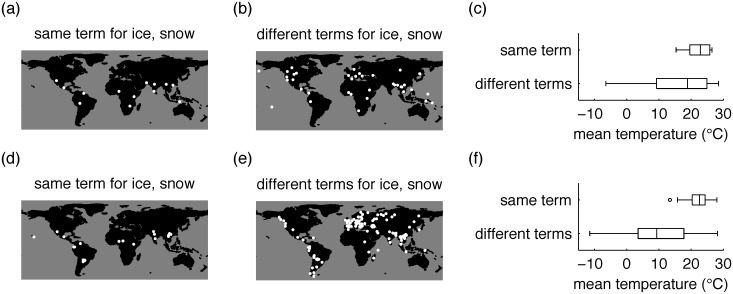
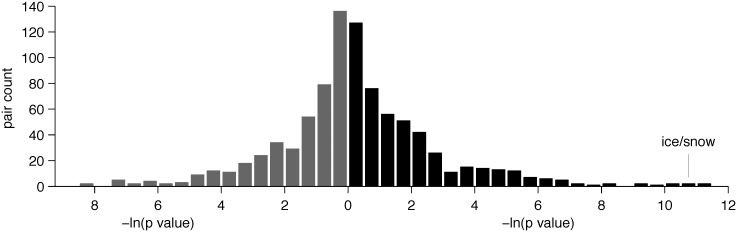
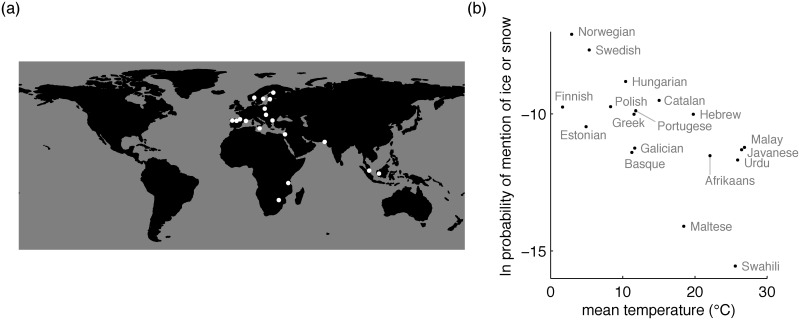
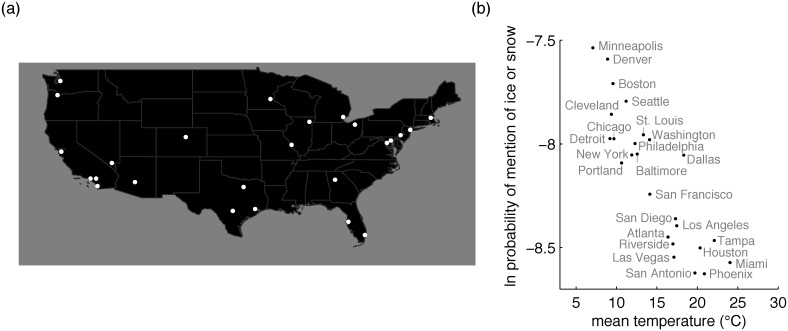
The claim that Eskimo languages have words for different types of snow is well-known among the public, but has been greatly exaggerated through popularization and is therefore viewed with skepticism by many scholars of language. Despite the prominence of this claim, to our knowledge the line of reasoning behind it has not been tested broadly across languages. Here, we note that this reasoning is a special case of the more general view that language is shaped by the need for efficient communication, and we empirically test a variant of it against multiple sources of data, including library reference works, Twitter, and large digital collections of linguistic and meteorological data. Consistent with the hypothesis of efficient communication, we find that languages that use the same linguistic form for snow and ice tend to be spoken in warmer climates, and that this association appears to be mediated by lower communicative need to talk about snow and ice. Our results confirm that variation in semantic categories across languages may be traceable in part to local communicative needs. They suggest moreover that despite its awkward history, the topic of "words for snow" may play a useful role as an accessible instance of the principle that language supports efficient communication.
Overview
The claims and statistics of this paper haven’t been checked yet.
Free: it reads the open-access text and checks the first 5 claims that cite a source we can check. Create a free account to check every claim.
Integrity signals
Registry
Cites
Statistics
Figures

Verification
Claims the paper makes
The claims and statistics of this paper haven’t been checked yet.
Free: it reads the open-access text and checks the first 5 claims that cite a source we can check. Create a free account to check every claim.
Claims other papers make about this one
Each is checked against this paper’s own text: does it say what the citing paper says it does?
The source backs part of the claim, not all of it — or backs it for a different population, condition or comparison.
In the citing paper
“If there is a communicative need to talk about subcategories in an environment, then the category system will be more fine-grained than if there is no such need [6].”
From The role of pragmatic mechanisms in referential communication and categorization: An emergent communication model (2026) · cites this paper as [6]
Experimental — accuracy not yet measuredThe cited source says what the claim attributes to it.
In the citing paper
“The authors found that languages that use the same linguistic form for both snow and ice tend to be spoken in warmer countries.”
From The role of pragmatic mechanisms in referential communication and categorization: An emergent communication model (2026) · cites this paper as [6]
The cited source says what the claim attributes to it.
In the citing paper
“It has been proposed that, due to cognitive constraints, both languages and category systems tend to find an optimal tradeoff between simplicity and informativeness [6,8,16–20].”
From The role of pragmatic mechanisms in referential communication and categorization: An emergent communication model (2026) · cites this paper as [6]
The cited source says what the claim attributes to it.
In the citing paper
“This is in line with the efficient communication hypothesis which predicts that human languages are optimized for efficient communication”
From The role of pragmatic mechanisms in referential communication and categorization: An emergent communication model (2026) · cites this paper as [6]
Experimental — accuracy not yet measured
Self-check
Percentages, sums and reported differences re-computed from the paper’s own numbers.
The self-check needs the paper’s full text.
Citations
Cites
Controlling the False Discovery Rate: A Practical and Powerful Approach to Multiple Testing
Benjamini, Y., & Hochberg, Y. (1995) · Journal of the Royal Statistical Society Series B: Statistical Methodology · doi:10.1111/j.2517-6161.1995.tb02031.x · Cited by 109,482
The evolution of grammar: tense, aspect, and modality in the languages of the world
(1995) · Choice Reviews Online · doi:10.5860/choice.32-4321 · Cited by 3,820
Language, Thought, and Reality: Selected Writings of Benjamin Lee Whorf
Miller, G. A., & Carroll, J. B. (1957) · The American Journal of Psychology · doi:10.2307/1419256 · Cited by 2,743
Expectation-based syntactic comprehension
Levy, R. (2008) · Cognition · doi:10.1016/j.cognition.2007.05.006 · Cited by 2,202
Efficiency and Complexity in Grammars
Hawkins, J. A. (2004) · doi:10.1093/acprof:oso/9780199252695.001.0001 · Cited by 1,743 · cited 1×
“Many aspects of language yield evidence consistent with this hypothesis, including word frequency distributions [11, 12], word length [13], syllable duration [14], compositional structure [15], syntactic structures and processing [16–18], the learning of case marking [19], and—of direct relevance to Boas’ snow example…”
BackgroundHuman behavior and the principle of least effort.
indicated, N. A. (1949) · Journal of Consulting Psychology · doi:10.1037/h0052803 · Cited by 1,565
Aylett, M., & Turk, A. (2004) · Language and Speech · doi:10.1177/00238309040470010201 · Cited by 781
Language Universals: With Special Reference to Feature Hierarchies
Greenberg, J. H. (1966) · Cited by 759
Redundancy and reduction: Speakers manage syntactic information density
Florian Jaeger, T. (2010) · Cognitive Psychology · doi:10.1016/j.cogpsych.2010.02.002 · Cited by 733
Word lengths are optimized for efficient communication
Piantadosi, S. T., Tily, H., & Gibson, E. (2011) · Proceedings of the National Academy of Sciences · doi:10.1073/pnas.1012551108 · Cited by 695 · cited 1×
“Many aspects of language yield evidence consistent with this hypothesis, including word frequency distributions [11, 12], word length [13], syllable duration [14], compositional structure [15], syntactic structures and processing [16–18], the learning of case marking [19], and—of direct relevance to Boas’ snow example…”
Background
Research works printed but not linked: 1
- Saxton D, Saxton L. Dictionary: Papago & Pima to English, English to Papago & Pima. University of Arizona Press; 1969.
Cited by
Items 101–137 of 137
Winter, B. (2019) · Converging evidence in language and communication research · doi:10.1075/celcr.20.prelim
Winter, B. (2019) · Converging evidence in language and communication research · doi:10.1075/celcr.20.c3
Dominance relations and specialization of sensory words
Winter, B. (2019) · Converging evidence in language and communication research · doi:10.1075/celcr.20.c12
Winter, B. (2019) · Converging evidence in language and communication research · doi:10.1075/celcr.20.toc
Kilarski, M. (2021) · Amsterdam studies in the theory and history of linguistic science. Series 3, Studies in the history of linguistics · doi:10.1075/sihols.129.prelim
Kilarski, M. (2021) · Amsterdam studies in the theory and history of linguistic science. Series 3, Studies in the history of linguistics · doi:10.1075/sihols.129.toc
Kilarski, M. (2021) · Amsterdam studies in the theory and history of linguistic science. Series 3, Studies in the history of linguistics · doi:10.1075/sihols.129.si
Index of Languages, Dialects and Language Families
Kilarski, M. (2021) · Amsterdam studies in the theory and history of linguistic science. Series 3, Studies in the history of linguistics · doi:10.1075/sihols.129.li
Kilarski, M. (2021) · Amsterdam studies in the theory and history of linguistic science. Series 3, Studies in the history of linguistics · doi:10.1075/sihols.129.c8
Sound systems in Iroquoian languages
Kilarski, M. (2021) · Amsterdam studies in the theory and history of linguistic science. Series 3, Studies in the history of linguistics · doi:10.1075/sihols.129.c4
Kilarski, M. (2021) · Amsterdam studies in the theory and history of linguistic science. Series 3, Studies in the history of linguistics · doi:10.1075/sihols.129.refs
Gender in Algonquian languages
Kilarski, M. (2021) · Amsterdam studies in the theory and history of linguistic science. Series 3, Studies in the history of linguistics · doi:10.1075/sihols.129.c5
Kilarski, M. (2021) · Amsterdam studies in the theory and history of linguistic science. Series 3, Studies in the history of linguistics · doi:10.1075/sihols.129.loa
Kilarski, M. (2021) · Amsterdam studies in the theory and history of linguistic science. Series 3, Studies in the history of linguistics · doi:10.1075/sihols.129.c1
Kilarski, M. (2021) · Amsterdam studies in the theory and history of linguistic science. Series 3, Studies in the history of linguistics · doi:10.1075/sihols.129.pre
Kilarski, M. (2021) · Amsterdam studies in the theory and history of linguistic science. Series 3, Studies in the history of linguistics · doi:10.1075/sihols.129.lof
Studies of the languages of North America
Kilarski, M. (2021) · Amsterdam studies in the theory and history of linguistic science. Series 3, Studies in the history of linguistics · doi:10.1075/sihols.129.c3
Kilarski, M. (2021) · Amsterdam studies in the theory and history of linguistic science. Series 3, Studies in the history of linguistics · doi:10.1075/sihols.129.c7
Efficient Communication, the Lexicon, and Grammar
Jia, Y., & Wu, Y. (2025) · Nature anthropology · doi:10.70322/natanthropol.2025.10008
The End of Radical Concept NativismPreprint
Rule, J., & Piantadosi, S. T. (2025) · PsyArXiv (OSF Preprints) · doi:10.31234/osf.io/zs9f6_v1
Everett, C. (2025) · Oxford University Press eBooks · doi:10.1093/oxfordhb/9780192886491.013.8
Everett, C. (2025) · Elsevier eBooks · doi:10.1016/b978-0-323-95504-1.00659-1
Adult learning of a novel quantifier tracks semantic universals
Ramotowska, S., van Maanen, L., & Szymanik, J. (2026) · Cognition · doi:10.1016/j.cognition.2026.106523 · Cited by 2
Mechanisms of Change in Lexical Semantics
Franco, K. (2026) · doi:10.1002/9781119898023.wbcdl141
Sanches, M. C. P. (2019) · theses.fr (ABES) · doi:10.70675/23d3688fza2a5z4b5czace8z77e89e074aaf
The mighty moon: colexification and change in north-west Amazonia
Aikhenvald, A. Y., & Dixon, R. M. W. (2026) · Journal of Linguistics · doi:10.1017/s0022226726101224
Development of Pointing in Toddlers: Cultural and Epistemological Perspectives
Cochet, H. (2026) · Cambridge University Press eBooks · doi:10.1017/9781009445696.006
Souls on Ice: Matthew Henson's Arctic Modernities
James, J. C. (2026) · Duke University Press eBooks · doi:10.1215/9781478062547-005
James, J. C. (2026) · Duke University Press eBooks · doi:10.1215/9781478062547-007
James, J. C. (2026) · Duke University Press eBooks · doi:10.1215/9781478062547-009
James, J. C. (2026) · Duke University Press eBooks · doi:10.1215/9781478062547-008
Ecomelancholia: Life, Land, and Unrenewable Loss
James, J. C. (2026) · Duke University Press eBooks · doi:10.1215/9781478062547-002
James, J. C. (2026) · Duke University Press eBooks · doi:10.1215/9781478062547-001
A Theory of the Bottom: Black Ecofeminism as Politics
James, J. C. (2026) · Duke University Press eBooks · doi:10.1215/9781478062547-006
“Buried in Guano”: Race, Labor, and Sustainability
James, J. C. (2026) · Duke University Press eBooks · doi:10.1215/9781478062547-003
Dyspossession: Abolitionist Ecology and the Black Commons
James, J. C. (2026) · Duke University Press eBooks · doi:10.1215/9781478062547-004
The colexification of eating, drinking and smoking in Sinitic languages
Lu, W., & Ding, H. (2026) · Open Linguistics · doi:10.1515/opli-2025-0083
Metadata
- Authors
- Regier, T., Carstensen, A., & Kemp, C.
- Affiliations
- University of California, Berkeley (US)
- Carnegie Mellon University (US)
- Corresponding author
- Regier, Terry
- Carstensen, Alexandra
- Kemp, Charles
- Venue
- PLOS ONE
- Publisher
- Public Library of Science (PLoS)
- Published
- 2016-04-13
- Volume
- 11
- Issue
- 4
- Pages
- e0151138
- ISSN
- 1932-6203 (ISSN-L)
- PMC
- PMC4830456
- OpenAlex
- W2339609277
- Cited by
- 136
- References
- 48
- Citations by year
- 2026: 17 · 2025: 6 · 2024: 8 · 2023: 10 · 2022: 6 · 2021: 25 · 2020: 11 · 2019: 32 · 2018: 13 · 2017: 4 · 2016: 3
- FWCI
- 24.67
- Type
- journal article
- Language
- en
- Open access
- gold
- doi.org
- Licence
- Locations
- PLoS ONE (publishedVersion, cc-by)
- Europe PMC (PubMed Central) (publishedVersion, cc-by)
- PubMed Central (publishedVersion, cc-by)
- PubMed (publishedVersion)
- KiltHub Repository (submittedVersion, cc-by)
- DOAJ (DOAJ: Directory of Open Access Journals) (submittedVersion, cc-by-sa)
- eScholarship (California Digital Library) (submittedVersion)
- Figshare (submittedVersion, cc-by)
- Minerva Access (University of Melbourne) (submittedVersion, cc-by)
- KiltHub Repository (cc-by)
- Funders
- National Science Foundation (1106400, 1041707)
- University of California Berkeley (DGE-1106400)
- Topics
- Social Sciences › Psychology › Experimental and Cognitive Psychology › Categorization, perception, and language
- Social Sciences › Cultural Studies › Language and cultural evolution
- Social Sciences › Linguistics and Language › Language and Culture
- Keywords
- semantic categories, language and environment, communication efficiency, communication needs, Eskimo languages, language change
- MeSH terms
- Inuit, Female, Humans, Male, Semantics, Snow
About these checks
Registry, retraction, Cites and statistics results are computed, not judged, with one exception: a printed reference that no index lists is read once by a model before it counts as a citation error. Claims are extracted by a model and kept only when their quote appears verbatim in the text; each cited source is then checked, with a model’s help, for whether it says what the claim relies on. Those verdicts can be wrong — read the claim’s quote and the cited source before relying on one.
Statistics and arithmetic are recomputed, not judged.
Confidence bands are shown only for fields calibrated on our annotated test set. None is calibrated yet, so no band is shown.
What counts as a claim ›How we measure confidence ›How we check this ›
Are you an author, or do you see a problem with this page? Request a review
Data sources
Bibliographic data: Semantic Scholar, OpenAlex, Crossref.
Contains information from the Semantic Scholar Academic Graph Datasets, made available under the ODC Attribution License (ODC-BY 1.0).
Semantic Scholar’s data is described in: Kinney, R., et al. (2023). The Semantic Scholar Open Data Platform. arXiv:2301.10140.
