

Nonlinear Network Reconstruction from Gene Expression Data Using Marginal Dependencies Measured by DCOL
Open accessThe DOI matches its Crossref record; 50 of the 50 references it cites were found in a registry or an index.
Abstract
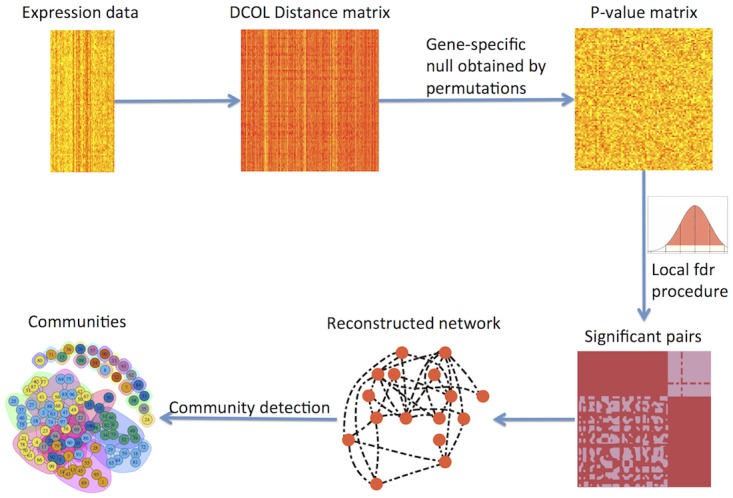
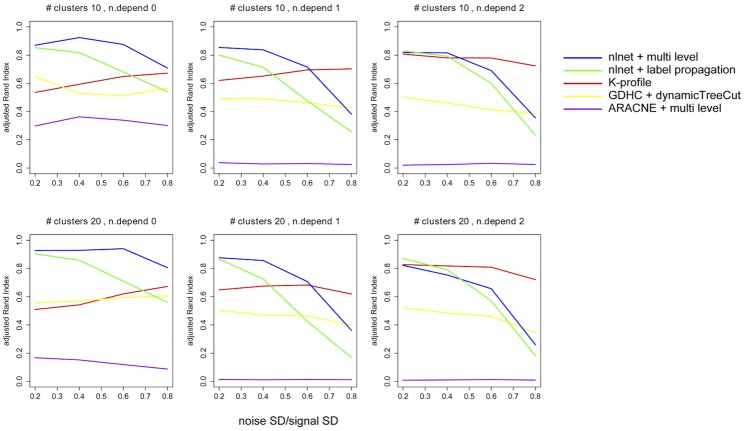
Reconstruction of networks from high-throughput expression data is an important tool to identify new regulatory relations. Given that nonlinear and complex relations exist between biological units, methods that can utilize nonlinear dependencies may yield insights that are not provided by methods using linear associations alone. We have previously developed a distance to measure predictive nonlinear relations, the Distance based on Conditional Ordered List (DCOL), which is sensitive and computationally efficient on large matrices. In this study, we explore the utility of DCOL in the reconstruction of networks, by combining it with local false discovery rate (lfdr)-based inference. We demonstrate in simulations that the new method named nlnet is effective in recovering hidden nonlinear modules. We also demonstrate its utility using a single cell RNA seq dataset. The method is available as an R package at https://cran.r-project.org/web/packages/nlnet.
Overview
The claims and statistics of this paper haven’t been checked yet.
Free: it reads the open-access text and checks the first 5 claims that cite a source we can check. Create a free account to check every claim.
Integrity signals
Registry
Cites
Statistics
Figures
Verification
Claims the paper makes
The claims and statistics of this paper haven’t been checked yet.
Free: it reads the open-access text and checks the first 5 claims that cite a source we can check. Create a free account to check every claim.
Claims other papers make about this one
Each is checked against this paper’s own text: does it say what the citing paper says it does?
In the citing paper
“WGCNA is a correlation-based GRN inference algorithm, which is typically used to generate a non-directional network53; DCOL is a ranking-based non-linear network modelling method54; and GENIE3 uses an ensemble of tree-based regression models, and aims to detect directional network edges.”
From Dissecting cell identity via network inference and in silico gene perturbation (2023) · cites this paper as [54]
Self-check
Percentages, sums and reported differences re-computed from the paper’s own numbers.
The self-check needs the paper’s full text.
Citations
Cites
WGCNA: an R package for weighted correlation network analysis
Langfelder, P., & Horvath, S. (2008) · BMC Bioinformatics · doi:10.1186/1471-2105-9-559 · Cited by 27,252
Fast unfolding of communities in large networks
Blondel, V. D., Guillaume, J.-L., Lambiotte, R., & Lefebvre, E. (2008) · Journal of Statistical Mechanics: Theory and Experiment · doi:10.1088/1742-5468/2008/10/p10008 · Cited by 21,424 · cited 1×
“In this study, we apply two common community finding methods: multi-level optimization of modularity, and label propagation [31, 32].”
MethodHubert, L., & Arabie, P. (1985) · Journal of Classification · doi:10.1007/bf01908075 · Cited by 8,219
A General Framework for Weighted Gene Co-Expression Network Analysis
Zhang, B., & Horvath, S. (2005) · Statistical Applications in Genetics and Molecular Biology · doi:10.2202/1544-6115.1128 · Cited by 5,684 · cited 1×
“A number of methods with different objectives have been proposed, including network reconstruction based on marginal correlation [7, 8], Gaussian graphical models [9, 10], Bayesian network [11, 12], mutual information-based network inference”
MethodNear linear time algorithm to detect community structures in large-scale networks
Raghavan, U. N., Albert, R., & Kumara, S. (2007) · Physical Review E · doi:10.1103/physreve.76.036106 · Cited by 3,502
Metabolomics: the apogee of the omics trilogy
Patti, G. J., Yanes, O., & Siuzdak, G. (2012) · Nature Reviews Molecular Cell Biology · doi:10.1038/nrm3314 · Cited by 2,571 · cited 1×
“High-throughput expression techniques such as microarray, deep sequencing, and liquid chromatography-mass spectrometry (LC-MS) are able to generate measurements of tens of thousands of biological units simultaneously [1, 2].”
BackgroundMargolin, A. A., Nemenman, I., Basso, K., Wiggins, C., Stolovitzky, G., Favera, R. D., & Califano, A. (2006) · BMC Bioinformatics · doi:10.1186/1471-2105-7-s1-s7 · Cited by 2,420 · cited 1×
“One is the mutual information-based network inference methodology ARACNE, and its R package name is parmigene [14].”
BackgroundMargolin, A. A., Nemenman, I. M., Basso, K., Wiggins, C. H., Stolovitzky, G. A., Favera, R. D., & Califano, A. (2006) · BMC Bioinformatics · doi:10.7916/d8g15zbp · Cited by 2,246
Using GOstats to test gene lists for GO term association
Falcon, S., & Gentleman, R. (2007) · Bioinformatics · doi:10.1093/bioinformatics/btl567 · Cited by 2,015
K-Profiles: A Nonlinear Clustering Method for Pattern Detection in High Dimensional Data
Wang, K., Zhao, Q., Lu, J., & Yu, T. (2015) · BioMed Research International · doi:10.1155/2015/918954 · Cited by 989 · cited 1×
“Two other methods are nonlinear clustering methods: General Dependency Hierarchical Clustering (GDHC) [26] and the K-profile method [33].”
MethodSelf-citation
Cited by
Dissecting cell identity via network inference and in silico gene perturbation
Kamimoto, K., Stringa, B., Hoffmann, C. M., Jindal, K., Solnica-Krezel, L., & Morris, S. A. (2023) · Nature · doi:10.1038/s41586-022-05688-9 · Cited by 677
Mapping gene regulatory networks from single-cell omics data
Fiers, M. W. E. J., Minnoye, L., Aibar, S., Bravo González-Blas, C., Kalender Atak, Z., & Aerts, S. (2018) · Briefings in Functional Genomics · doi:10.1093/bfgp/elx046 · Cited by 235
A comprehensive survey of regulatory network inference methods using single cell RNA sequencing data
Nguyen, H., Tran, D., Tran, B., Pehlivan, B., & Nguyen, T. (2021) · Briefings in Bioinformatics · doi:10.1093/bib/bbaa190 · Cited by 177
Gene regulatory network inference resources: A practical overview
Mercatelli, D., Scalambra, L., Triboli, L., Ray, F., & Giorgi, F. M. (2020) · Biochimica et Biophysica Acta (BBA) - Gene Regulatory Mechanisms · doi:10.1016/j.bbagrm.2019.194430 · Cited by 161
Computational Methods for Single-Cell RNA Sequencing
Hie, B., Peters, J., Nyquist, S. K., Shalek, A. K., Berger, B., & Bryson, B. D. (2020) · Annual Review of Biomedical Data Science · doi:10.1146/annurev-biodatasci-012220-100601 · Cited by 89
Inference of gene regulatory networks using pseudo-time series data
Zhang, Y., Chang, X., & Liu, X. (2021) · Bioinformatics · doi:10.1093/bioinformatics/btab099 · Cited by 37
Gene Co-Expression Network Tools and Databases for Crop Improvement
Zainal‐Abidin, R., Harun, S., Vengatharajuloo, V., Tamizi, A. A., & Samsulrizal, N. H. (2022) · Plants · doi:10.3390/plants11131625 · Cited by 28
“Although non-linear relationships are essential for complex interactions, they can be diverse, and the statistical power for detecting such relations is lower than linear-based correlation [73].”
BackgroundEstimating Linear and Nonlinear Gene Coexpression Networks by Semiparametric Neighborhood Selection
Kontio, J., Rinta-aho, M., & Sillanpää, M. J. (2020) · Genetics · doi:10.1534/genetics.120.303186 · Cited by 14
“This is due to the simple fact that the statistical power of detecting such nonlinear dependencies is lower compared to linear dependencies between genes (Liu et al. 2016).”
BackgroundMethodInfluentialUthamacumaran, A. (2024) · Interdisciplinary Sciences Computational Life Sciences · doi:10.1007/s12539-024-00657-4 · Cited by 17
“Cohen’s d = − 1.18 and statistical power of 0.91 between the number of patients and total cell population size suggest a large effect size to detect significant effects multi-nestedness (recursiveness) and community structures (modularity) within gene expression networks [43].”
InfluentialChen, L., Dautle, M., Gao, R., Zhang, S., & Chen, Y. (2025) · Briefings in Bioinformatics · doi:10.1093/bib/bbaf089 · Cited by 18
“Most early methods focused on static scRNA-seq data,including GENIE3 [8],GRNBoost2 [9],SCENIC [10],NLNET [11],PIDC [12],PPCOR [13],and SINCERA [14].”
Studying temporal dynamics of single cells: expression, lineage and regulatory networks
Pan, X., & Zhang, X. (2023) · Biophysical Reviews · doi:10.1007/s12551-023-01090-5 · Cited by 14
“…methods or time-series data, to characterize the causal relationships between genes; Correlation-based methods (Aibar et al. 2017; Chan et al. 2018; Liu et al. 2016) that calculates pairwise correlation metrics for the genes and build edges based on the rankings of each pair; and correlation…”
Approaches for Benchmarking Single-Cell Gene Regulatory Network Methods
Karamveer, K., & Uzun, Y. (2024) · Bioinformatics and Biology Insights · doi:10.1177/11779322241287120 · Cited by 12
“Inference 163 ), differential equation (inference snapshot, 32 SCODE, 31 and SCOUP 34 ), expression correlation (empirical Bayes, information measures, 164 SINCERA, 165 NLNET, 40 and SCENIC 28 ), correlation based on pseudotime ordering (SCINGE, 119 SCIMITAR, 36 SINCERETIES, 35 and LEAP 38 ).”
Liu, W., Teng, Z., Li, Z., & Chen, J. (2024) · Interdisciplinary Sciences Computational Life Sciences · doi:10.1007/s12539-024-00633-y · Cited by 8
“NLNET [10] proposes a conditional ordered list for distance estimation.”
Das, S., Pradhan, U. K., & Rai, S. N. (2022) · Current Bioinformatics · doi:10.2174/1574893617666220823114108 · Cited by 5
Differential Network Analysis Reveals Regulatory Patterns in Neural Stem Cell Fate Decision
Xie, J., Yin, Y., Yang, F., Sun, J., & Wang, J. (2021) · Interdisciplinary Sciences Computational Life Sciences · doi:10.1007/s12539-020-00415-2 · Cited by 7
Han, M., Chen, X., Li, X., Ma, J., Chen, T., Yang, C., Wang, J., Li, Y., Guo, W., & Zhu, Y. (2025) · Briefings in Bioinformatics · doi:10.1093/bib/bbaf081 · Cited by 2
“…methods designed for bulk RNA-seq analysis (ICA [21], WGCNA [22], FLAME [23], spectral clustering [24], Dclust [25], spectral biclustering [26], MERLIN [27], and GENIE3 [3]) and six methods tailored for scRNA-seq analysis (SCENIC [6],SCIMITAR [28],NLNET [29],SCODE [30],PIDC [31],and LEAP [32]).”
nlnet: Nonlinear Network, Clustering, and Variable Selection Based on DCOL
Tianwei Yu, H. L. (2015) · doi:10.32614/cran.package.nlnet
foodingraph: Food Network Inference and Visualization
Gasque, V., Hejblum, B. P., & Samieri, C. (2019) · doi:10.32614/cran.package.foodingraph
Logic programs to infer computational models of human embryonic development
Bolteau, M. (2024) · theses.fr (ABES) · doi:10.70675/258d6c4ez1135z4e52z96bez7da60569409f
Metadata
- Authors
- Liu, H., Li, P., Zhu, M., Wang, X., Lu, J., & Yu, T.
- Affiliations
- Tongji University (CN)
- Shandong University of Science and Technology (CN)
- Emory University (US)
- Corresponding author
- Lu, Jianwei
- Yu, Tianwei
- Venue
- PLOS ONE
- Publisher
- Public Library of Science (PLoS)
- Published
- 2016-07-05
- Volume
- 11
- Issue
- 7
- Pages
- e0158247
- ISSN
- 1932-6203 (ISSN-L)
- PMC
- PMC4933395
- OpenAlex
- W2460641621
- Cited by
- 17
- References
- 50
- Citations by year
- 2025: 2 · 2024: 4 · 2023: 2 · 2022: 2 · 2021: 2 · 2020: 3 · 2019: 1 · 2017: 1
- FWCI
- 0.52
- Type
- journal article
- Language
- en
- Open access
- gold
- doi.org
- Licence
- Locations
- PLoS ONE (publishedVersion, cc-by)
- Europe PMC (PubMed Central) (publishedVersion, cc-by)
- PubMed Central (publishedVersion, cc-by)
- PubMed (publishedVersion)
- RePEc: Research Papers in Economics (submittedVersion)
- DOAJ (DOAJ: Directory of Open Access Journals) (submittedVersion)
- Funders
- National Natural Science Foundation of China (CN) (41476120, 61572362, 81571347, 21477087)
- National Institutes of Health (P30AI50409)
- Ministry of Science and Technology of the People's Republic of China (2013CB967101)
- Topics
- Life Sciences › Biochemistry, Genetics and Molecular Biology › Molecular Biology › Gene Regulatory Network Analysis
- Life Sciences › Biochemistry, Genetics and Molecular Biology › Molecular Biology › Bioinformatics and Genomic Networks
- Life Sciences › Biochemistry, Genetics and Molecular Biology › Molecular Biology › Gene expression and cancer classification
- Keywords
- gene regulatory networks, nonlinear dependencies, local false discovery rate, single-cell RNA sequencing, gene expression data, network inference
- MeSH terms
- Algorithms, Computer Simulation, Humans, Models, Genetic, Reproducibility of Results, Gene Expression, Computational Biology, Internet, Gene Expression Profiling, Gene Regulatory Networks, High-Throughput Nucleotide Sequencing, Gene Ontology
About these checks
Registry, retraction, Cites and statistics results are computed, not judged, with one exception: a printed reference that no index lists is read once by a model before it counts as a citation error. Claims are extracted by a model and kept only when their quote appears verbatim in the text; each cited source is then checked, with a model’s help, for whether it says what the claim relies on. Those verdicts can be wrong — read the claim’s quote and the cited source before relying on one.
Statistics and arithmetic are recomputed, not judged.
Confidence bands are shown only for fields calibrated on our annotated test set. None is calibrated yet, so no band is shown.
What counts as a claim ›How we measure confidence ›How we check this ›
Are you an author, or do you see a problem with this page? Request a review
Data sources
Bibliographic data: Semantic Scholar, OpenAlex, Crossref.
Contains information from the Semantic Scholar Academic Graph Datasets, made available under the ODC Attribution License (ODC-BY 1.0).
Semantic Scholar’s data is described in: Kinney, R., et al. (2023). The Semantic Scholar Open Data Platform. arXiv:2301.10140.
