

The DOI matches its Crossref record; 37 of the 37 references it cites were found in a registry or an index.
Gender Differences in Emotional Response: Inconsistency between Experience and Expressivity
Open accessAbstract
The present study investigated gender differences in both emotional experience and expressivity. Heart rate (HR) was recorded as an indicator of emotional experience while the participants watched 16 video clips that induced eight types of emotion (sadness, anger, horror, disgust, neutrality, amusement, surprise, and pleasure). We also asked the participants to report valence, arousal, and motivation as indicators of emotional expressivity. Overall, the results revealed gender differences in emotional experience and emotional expressivity. When watching videos that induced anger, amusement, and pleasure, men showed larger decreases in HR, whereas women reported higher levels of arousal. There was no gender difference in HR when the participants watched videos that induced horror and disgust, but women reported lower valence, higher arousal, and stronger avoidance motivation than did men. Finally, no gender difference was observed in sadness or surprise, although there was one exception-women reported higher arousal when watching videos that induced sadness. The findings suggest that, when watching videos that induce an emotional response, men often have more intense emotional experiences, whereas women have higher emotional expressivity, particularly for negative emotions. In addition, gender differences depend on the specific emotion type but not the valence.
Overview
The claims and statistics of this paper haven’t been checked yet.
Run the check — free, no account needed. It reads the open-access text and checks the sources it cites.
Integrity signals
Registry
Cites
Statistics
Figures
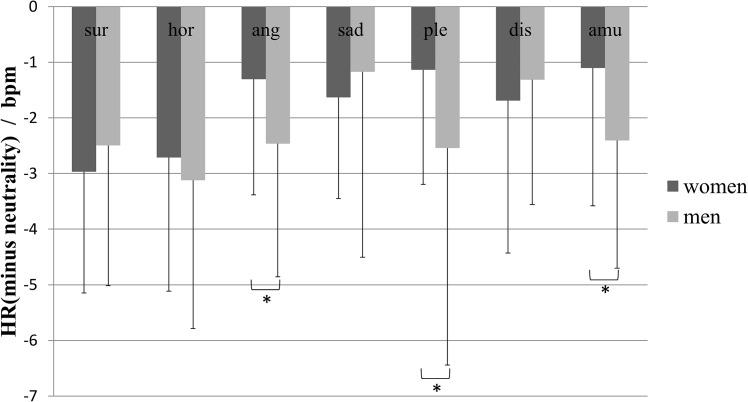
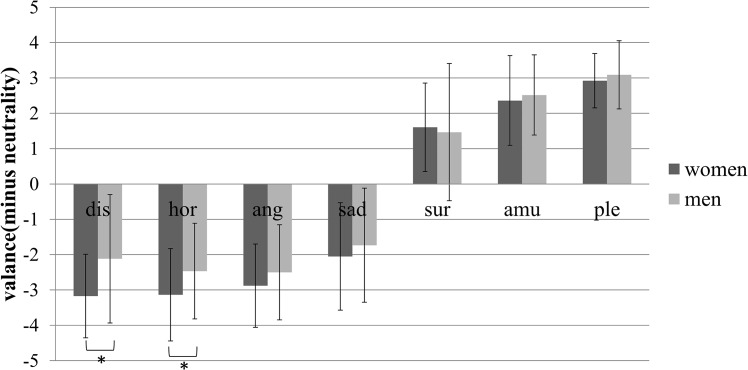
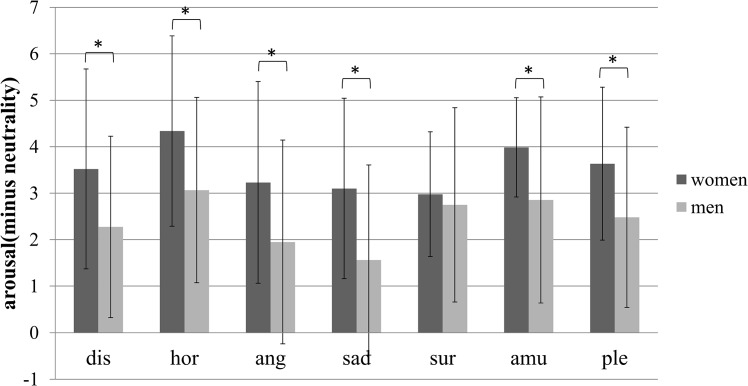
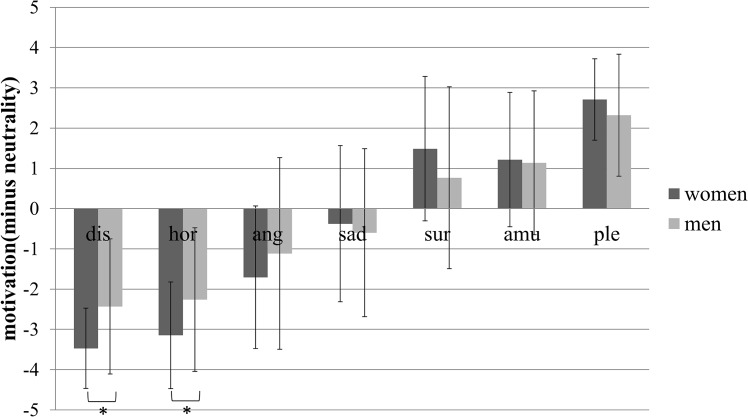
Verification
Claims the paper makes
The claims and statistics of this paper haven’t been checked yet.
Run the check — free, no account needed. It reads the open-access text and checks the sources it cites.
Claims other papers make about this one
Each is checked against this paper’s own text: does it say what the citing paper says it does?
The source backs part of the claim, not all of it — or backs it for a different population, condition or comparison.
In the citing paper
“Research has consistently shown that men and women exhibit different patterns of media consumption and varying emotional responses to distressing (media) content [196,197].”
From Impact of Media-Induced Uncertainty on Mental Health: Narrative-Based Perspective. (2025) · cites this paper as [196]
Experimental — accuracy not yet measured
Self-check
Percentages, sums and reported differences re-computed from the paper’s own numbers.
The self-check needs the paper’s full text.
Citations
Cites
Heart rate variability: origins, methods, and interpretive caveats
BERNTSON, G. G., THOMAS BIGGER, J., ECKBERG, D. L., GROSSMAN, P., KAUFMANN, P. G., MALIK, M., NAGARAJA, H. N., PORGES, S. W., SAUL, J. P., STONE, P. H., et al. (1997) · Psychophysiology · doi:10.1111/j.1469-8986.1997.tb02140.x · Cited by 3,962
Biobehavioral responses to stress in females: Tend-and-befriend, not fight-or-flight.
Taylor, S. E., Klein, L. C., Lewis, B. P., Gruenewald, T. L., Gurung, R. A. R., & Updegraff, J. A. (2000) · Psychological Review · doi:10.1037/0033-295x.107.3.411 · Cited by 3,308
Emotion elicitation using films
Gross, J. J., & Levenson, R. W. (1995) · Cognition & Emotion · doi:10.1080/02699939508408966 · Cited by 2,179
Mauss, I. B., & Robinson, M. D. (2009) · Cognition and Emotion · doi:10.1080/02699930802204677 · Cited by 2,078
The Handbook of emotion elicitation and assessment
(2008) · Choice Reviews Online · doi:10.5860/choice.46-1769 · Cited by 1,128
Emotion and motivation II: Sex differences in picture processing.
Bradley, M. M., Codispoti, M., Sabatinelli, D., & Lang, P. J. (2001) · Emotion · doi:10.1037/1528-3542.1.3.300 · Cited by 943
Emotion Elicitation Using Films
Rottenberg, J. A., Ray, R. D., & Gross, J. J. (2007) · Oxford University Press eBooks · doi:10.1093/oso/9780195169157.003.0002 · Cited by 862
A review on sex differences in processing emotional signals
Kret, M. E., & De Gelder, B. (2012) · Neuropsychologia · doi:10.1016/j.neuropsychologia.2011.12.022 · Cited by 584
Areas of brain activation in males and females during viewing of erotic film excerpts
Karama, S., Lecours, A. R., Leroux, J., Bourgouin, P., Beaudoin, G., Joubert, S., & Beauregard, M. (2002) · Human Brain Mapping · doi:10.1002/hbm.10014 · Cited by 522
Gender and Culture Differences in Emotion.
Fischer, A. H., Rodriguez Mosquera, P. M., van Vianen, A. E. M., & Manstead, A. S. R. (2004) · Emotion · doi:10.1037/1528-3542.4.1.87 · Cited by 521
Research works printed but not linked: 3
- MG Gard, 2007, Sex differences in the time course of emotion, Emotion, 7, 429, 10.1037/1528-3542.7.2.429 · DOI · Paper page
- Z Zhang, 2001, Behavioral medicine scale manual, Chinese J Behav Med Sci, 10, 19
- J Yi, 2003, The Chinese version of the TAS-20: reliability and validity, Chinese Mental Health J, 17, 763
Cited by
Sorted by citations
Shi, P., Yang, A., Zhao, Q., Chen, Z., Ren, X., & Dai, Q. (2021) · Frontiers in Psychiatry · doi:10.3389/fpsyt.2021.589687 · Cited by 292
“Indeed, males reported less depression, even they experienced more intense emotions (92), indicating that they need greater symptom severity to ask for help.”
BackgroundRomero, D. E., Muzy, J., Damacena, G. N., de Souza, N. A., de Almeida, W. D. S., Szwarcwald, C. L., Malta, D. C., Barros, M. B. D. A., Júnior, P. R. B. D. S., Azevedo, L. O., et al. (2021) · Cadernos de Saúde Pública · doi:10.1590/0102-311x00216620 · Cited by 160
The neuroscience of sadness: A multidisciplinary synthesis and collaborative review
Arias-López, J. A., Williams, C., Raghvani, R., Aghajani, M., Báez, S., Belzung, C., Booij, L., Busatto, G. F., Chiarella, J., Fu, C. H. Y., et al. (2020) · Neuroscience & Biobehavioral Reviews · doi:10.1016/j.neubiorev.2020.01.006 · Cited by 138
“However, a more recent investigation (Deng et al., 2016) exploring gender differences in both emotional experience (measured by HR) and expressivity (valence, arousal, motivation), found that gender differences appear to depend on emotional valence.”
Comstock, E. M., Pierre, R. G. S., & Mackiernan, Y. D. (1981) · PubMed · Cited by 116
Facial mimicry, empathy, and emotion recognition: a meta-analysis of correlations
Holland, A. C., O’Connell, G., & Dziobek, I. (2021) · Cognition and Emotion · doi:10.1080/02699931.2020.1815655 · Cited by 114
“On a related topic, *Deng et al. (2016) urged claims about claims in gender differences in emotion processing to separate emotional expressivity (e.g. facial mimicry), where gender differences are consistently observed, from emotional experience, where the evidence for gender differences is less…”
Background
Metadata
- Authors
- Deng, Y., Chang, L., Yang, M., Huo, M., & Zhou, R.
- Affiliations
- Beijing Normal University (CN)
- University of Macau (MO)
- The University of Texas at Austin (US)
- Corresponding author
- Zhou, Renlai
- Venue
- PLOS ONE
- Publisher
- Public Library of Science (PLoS)
- Published
- 2016-06-30
- Volume
- 11
- Issue
- 6
- Pages
- e0158666
- ISSN
- 1932-6203 (ISSN-L)
- PMC
- PMC4928818
- OpenAlex
- W2466307579
- Cited by
- 382
- References
- 37
- Citations by year
- 2026: 21 · 2025: 44 · 2024: 35 · 2023: 59 · 2022: 43 · 2021: 53 · 2020: 74 · 2019: 24 · 2018: 16 · 2017: 10 · 2016: 1
- FWCI
- 26.73
- Type
- journal article
- Language
- en
- Open access
- gold
- doi.org
- Licence
- Locations
- PLoS ONE (publishedVersion, cc-by)
- Europe PMC (PubMed Central) (publishedVersion, cc-by)
- PubMed Central (publishedVersion, cc-by)
- PubMed (publishedVersion)
- RePEc: Research Papers in Economics (submittedVersion)
- DOAJ (DOAJ: Directory of Open Access Journals) (submittedVersion, cc-by-sa)
- eScholarship (California Digital Library) (submittedVersion, cc-by)
- Funders
- National Basic Research Program of China (2011CB505101)
- Shangshan funding
- Topics
- Social Sciences › Psychology › Social Psychology › Emotions and Moral Behavior
- Physical Sciences › Computer Science › Artificial Intelligence › Emotion and Mood Recognition
- Social Sciences › Psychology › Experimental and Cognitive Psychology › Evolutionary Psychology and Human Behavior
- Keywords
- gender differences, emotional experience, emotional expressivity, heart rate, emotion induction, valence, arousal, avoidance motivation, sadness, anger, disgust, horror, amusements, pleasure, surprise
- MeSH terms
- Arousal, Emotions, Facial Expression, Female, Heart Rate, Humans, Male, Photic Stimulation, Sex Characteristics, Young Adult
About these checks
Registry, retraction, Cites and statistics results are computed, not judged, with one exception: a printed reference that no index lists is read once by a model before it counts as a citation error. Claims are extracted by a model and kept only when their quote appears verbatim in the text; each cited source is then checked, with a model’s help, for whether it says what the claim relies on. Those verdicts can be wrong — read the claim’s quote and the cited source before relying on one.
Statistics and arithmetic are recomputed, not judged.
Confidence bands are shown only for fields calibrated on our annotated test set. None is calibrated yet, so no band is shown.
What counts as a claim ›How we measure confidence ›How we check this ›
Are you an author, or do you see a problem with this page? Request a review
