

Predicting Outcome in Internet-Based Cognitive Behaviour Therapy for Major Depression: A Large Cohort Study of Adult Patients in Routine Psychiatric Care
Open accessThe DOI matches its Crossref record; 55 of the 56 references it cites were found in a registry or an index.
Abstract
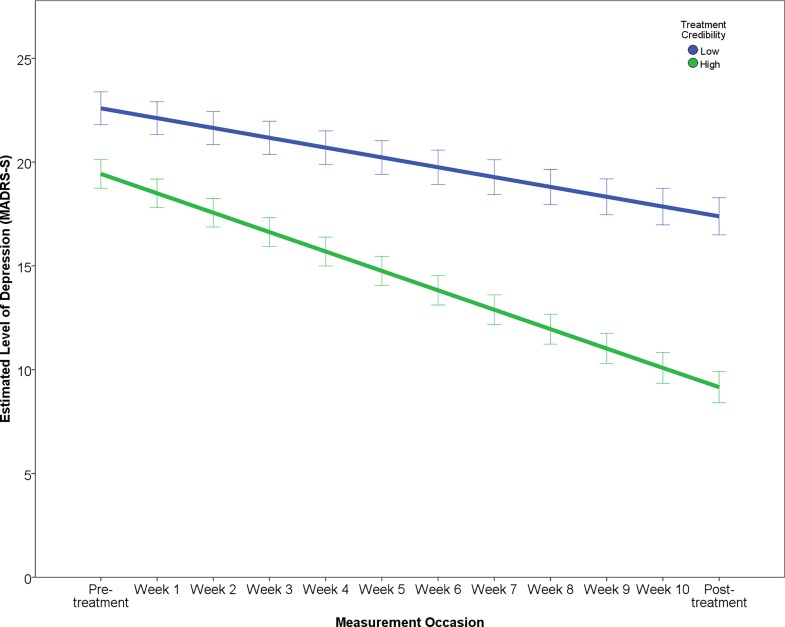
BACKGROUND: Although the effectiveness of therapist-guided internet-based cognitive behaviour therapy (ICBT) for treating depression has been well documented, knowledge of outcome predictors and risk factors associated with lower treatment response is limited, especially when the treatment has been conducted within a naturalistic clinical setting. Identification of such factors is important for clinicians when making treatment recommendations. METHODS: Data from a large cohort (N = 1738) of adult outpatients having been treated with ICBT for depression at an outpatient psychiatric clinic were analysed. A multilevel modelling approach was used to identify patient and treatment variables associated with the speed of recovery during treatment using weekly measurements of the Montgomery Åsberg Depression Rating Scale Self-Rated (MADRS-S). OUTCOMES: Adhering to the treatment, perceiving it as credible and working full-time emerged as predictors of a faster pace of recovery and were also associated with a lower level of depression at the end of treatment. Higher pre-treatment depression and sleep problems were associated with a greater improvement rate, but predicted higher depression after treatment. Having a history of psychotropic medication was associated with both slower improvement and higher post-treatment depression. CONCLUSION: Perceived credibility of ICBT is a strong predictor of treatment response. Assessing patient beliefs and expectations may be a useful aid for clinicians when identifying those who are more or less likely to benefit from ICBT. Helping patients improve expectations prior to treatment may be an important goal for clinicians during the initial assessment phase.
Overview
The claims and statistics of this paper haven’t been checked yet.
Free: it reads the open-access text and checks the first 5 claims that cite a source we can check. Create a free account to check every claim.
Integrity signals
Registry
Cites
Statistics
Figures



Verification
Claims the paper makes
The claims and statistics of this paper haven’t been checked yet.
Free: it reads the open-access text and checks the first 5 claims that cite a source we can check. Create a free account to check every claim.
Claims other papers make about this one
Each is checked against this paper’s own text: does it say what the citing paper says it does?
In the citing paper
“Associations with adherence have been demonstrated for a range of outcomes, including depression [105,106] and anxiety [107,108].”
From The therapeutic alliance in digital mental health interventions for serious mental illnesses: narrative review (2020) · cites this paper as [106]
Self-check
Percentages, sums and reported differences re-computed from the paper’s own numbers.
The self-check needs the paper’s full text.
Citations
Cites
Kessler, R. C., Berglund, P., Demler, O., Jin, R., Merikangas, K. R., & Walters, E. E. (2005) · Archives of General Psychiatry · doi:10.1001/archpsyc.62.6.593 · Cited by 20,391
(1998) · The Journal of Clinical Psychiatry · Cited by 19,139
(1998) · PubMed · Cited by 10,216
Validation of the Insomnia Severity Index as an outcome measure for insomnia research
Bastien, C. (2001) · Sleep Medicine · doi:10.1016/s1389-9457(00)00065-4 · Cited by 8,067 · cited 1×
“The clinical characteristics domain included the Clinical Global Impression–Severity Scale [37] (CGI-S) which was rated on a 7-point scale; the AUDIT [38] and the DUDIT [39] which were used to screen for alcohol problems or drugmisuse; sleep problems measured with the insomnia severity index [40, 41], duration of illn…”
MethodThe empirical status of cognitive-behavioral therapy: A review of meta-analyses
Butler, A. C., Chapman, J. E., Forman, E. M., & Beck, A. T. (2006) · Clinical Psychology Review · doi:10.1016/j.cpr.2005.07.003 · Cited by 3,215 · cited 1×
“Cognitive behavioural therapy (CBT) is an effective treatment for depression [4].”
BackgroundInternet-based cognitive behaviour therapy for symptoms of depression and anxiety: A meta-analysis
SPEK, V., CUIJPERS, P., NYKLÍČEK, I., RIPER, H., KEYZER, J., & POP, V. (2007) · Psychological Medicine · doi:10.1017/s0033291706008944 · Cited by 1,586 · cited 1×
“On the other hand, one study found no relation between initial level of depression and outcome [16] and in other studies it has been linked to better response [17, 18].”
BackgroundCredibility of analogue therapy rationales
Borkovec, T. D., & Nau, S. D. (1972) · Journal of Behavior Therapy and Experimental Psychiatry · doi:10.1016/0005-7916(72)90045-6 · Cited by 1,553
Andrews, G., Cuijpers, P., Craske, M. G., McEvoy, P., & Titov, N. (2010) · PLoS ONE · doi:10.1371/journal.pone.0013196 · Cited by 1,311 · cited 1×
“To increase accessibility of CBT, onlinemethods of treatment delivery such as therapist-guided internet-basedCBT (ICBT) has been recognised as a promising administration format yielding effect sizes at par with conventional face-to-face CBT [5, 6].”
BackgroundBerman, A. H., Bergman, H., Palmstierna, T., & Schlyter, F. (2005) · European Addiction Research · doi:10.1159/000081413 · Cited by 977 · cited 1×
“The clinical characteristics domain included the Clinical Global Impression–Severity Scale [37] (CGI-S) which was rated on a 7-point scale; the AUDIT [38] and the DUDIT [39] which were used to screen for alcohol problems or drugmisuse; sleep problems measured with the insomnia severity index [40, 41], duration of illn…”
MethodSvanborg, P., & Åsberg, M. (1994) · Acta Psychiatrica Scandinavica · doi:10.1111/j.1600-0447.1994.tb01480.x · Cited by 693 · cited 9×
“PrimaryOutcomeMeasure The primary outcome measure was the Montgomery Åsberg Depression Rating Scale SelfRated (MADRS-S) [36].”
BackgroundMethodInfluential
Cited by
Tremain, H., McEnery, C., Fletcher, K., & Murray, G. (2020) · JMIR Mental Health · doi:10.2196/17204 · Cited by 193
Hornstein, S., Zantvoort, K., Lueken, U., Funk, B., & Hilbert, K. (2023) · Frontiers in Digital Health · doi:10.3389/fdgth.2023.1170002 · Cited by 134
Folker, A. P., Mathiasen, K., Lauridsen, S. M., Stenderup, E., Dozeman, E., & Folker, M. P. (2018) · Internet Interventions · doi:10.1016/j.invent.2018.02.001 · Cited by 116
“Regarding patients' attitudes it has been found that patients worry about the clinical effectiveness of iCBT (Topooco et al., 2017) which has been shown to correlate with poorer treatment outcome (El Alaoui et al., 2016).”
BackgroundA systematic review of digital and face-to-face cognitive behavioral therapy for depression
Kambeitz-Ilankovic, L., Rzayeva, U., Völkel, L., Wenzel, J., Weiske, J., Jessen, F., Reininghaus, U., Uhlhaas, P. J., Alvarez-Jimenez, M., & Kambeitz, J. (2022) · npj Digital Medicine · doi:10.1038/s41746-022-00677-8 · Cited by 103
Edmonds, M., Hadjistavropoulos, H. D., Schneider, L. H., Dear, B. F., & Titov, N. (2018) · Journal of Anxiety Disorders · doi:10.1016/j.janxdis.2018.01.003 · Cited by 75
Rayner, C., Coleman, J. R. I., Purves, K. L., Hodsoll, J. P., Goldsmith, K., Alpers, G. W., Andersson, E., Arolt, V., Boberg, J., Bögels, S. M., et al. (2019) · Translational Psychiatry · doi:10.1038/s41398-019-0481-y · Cited by 59
Self-citationHadjistavropoulos, H. D., Peynenburg, V. A., Thiessen, D., Nugent, M., Karin, E., Dear, B. F., & Titov, N. (2022) · Internet Interventions · doi:10.1016/j.invent.2022.100499 · Cited by 47
Mathiasen, K., Riper, H., Andersen, T. E., & Roessler, K. K. (2018) · Journal of Medical Internet Research · doi:10.2196/10927 · Cited by 45
Haller, K., Becker, P., Niemeyer, H., & Boettcher, J. (2023) · Internet Interventions · doi:10.1016/j.invent.2023.100635 · Cited by 56
Schröder, J., Berger, T., Meyer, B., Lutz, W., Späth, C., Michel, P., Rose, M., Hautzinger, M., Hohagen, F., Klein, J. P., et al. (2018) · Depression and Anxiety · doi:10.1002/da.22727 · Cited by 43
“Only few of these studies investigated the positive impactof credibility andexpectancy (cognitive factors thatdirectly refer to the program being examined) on treatment outcome (Alaoui et al., 2016; Ebert et al., 2013).”
BackgroundChan, C. S., Wong, C. Y.-F., Yu, B. Y., Hui, V. K., Ho, F. Y., & Cuijpers, P. J. (2021) · Psychological Medicine · doi:10.1017/s0033291721003421 · Cited by 45
Working alliance with an avatar: How far can we go with internet interventions?
Heim, E., Rötger, A., Lorenz, N., & Maercker, A. (2018) · Internet Interventions · doi:10.1016/j.invent.2018.01.005 · Cited by 41
Catarino, A., Bateup, S., Tablan, V., Innes, K., Freer, S., Richards, A., Stott, R., Hollon, S. D., Chamberlain, S. R., Hayes, A., et al. (2018) · BJPsych Open · doi:10.1192/bjo.2018.57 · Cited by 40
Andersson, E., Crowley, J. J., Lindefors, N., Ljótsson, B., Hedman‐Lagerlöf, E., Boberg, J., Alaoui, S. E., Karlsson, R., Lu, Y., Mattheisen, M., et al. (2018) · Molecular Psychiatry · doi:10.1038/s41380-018-0289-9 · Cited by 40
Self-citationMathiasen, K., Andersen, T. E., Lichtenstein, M. B., Ehlers, L. H., Riper, H., Kleiboer, A., & Roessler, K. K. (2022) · Journal of Medical Internet Research · doi:10.2196/36577 · Cited by 34
Forsell, E., Isacsson, N. H., Blom, K., Jernelöv, S., Abdesslem, F. B., Lindefors, N., Boman, M., & Kaldo, V. (2020) · Journal of Consulting and Clinical Psychology · doi:10.1037/ccp0000462 · Cited by 36
Self-citationPontén, M., Jonsjö, M. A., Vadenmark, V., Moberg, E., Grannas, D., Andersson, G., Boersma, K., Hedman‐Lagerlöf, E., Kleinstäuber, M., Weise, C., et al. (2023) · Psychological Medicine · doi:10.1017/s0033291723003033 · Cited by 42
“This has also been suggested for online treatments (El Alaoui et al., 2015; El Alaoui et al., 2016).”
BackgroundSelf-citationSchaeuffele, C., Bär, J., Buengener, I., Grafiadeli, R., Heuthaler, E., Strieder, J., Ziehn, P., Knaevelsrud, C., Renneberg, B., & Boettcher, J. (2022) · Cognitive Therapy and Research · doi:10.1007/s10608-021-10272-y · Cited by 24
Lüdtke, T., Westermann, S., Pult, L. K., Schneider, B. C., Pfuhl, G., & Moritz, S. (2018) · Internet Interventions · doi:10.1016/j.invent.2018.06.004 · Cited by 18
Wiberg, A.-C., Ghaderi, A., Danielsson, H. B., Safarzadeh, K., Parling, T., Carlbring, P., Jansson, M., & Welch, E. (2022) · Internet Interventions · doi:10.1016/j.invent.2022.100570 · Cited by 23
Sundström, C., Kraepelien, M., Eék, N., Fahlke, C., Kaldo, V., & Berman, A. H. (2017) · BMC Psychiatry · doi:10.1186/s12888-017-1355-6 · Cited by 25
“The program was adapted to the more comprehensive and demanding ICBT interventions typically used at the Internet Psychiatry Clinic, Stockholm [58] with consultative input from three other authors (MK, NE and VK).”
MethodSelf-citationMarinova, N., Rogers, T., & MacBeth, A. M. (2022) · Journal of Affective Disorders · doi:10.1016/j.jad.2022.05.058 · Cited by 20
Bur, O. T., Bielinski, L. L., Krauss, S., Häfliger, A., Guggisberg, J., Krieger, T., & Berger, T. (2022) · Internet Interventions · doi:10.1016/j.invent.2022.100593 · Cited by 16
“On the other hand, several studies found an association between adherence and treatment outcome (Donkin et al., 2011; El Alaoui et al., 2016; Fuhr et al., 2018; Karyotaki et al., 2017; Newby et al., 2014).”
BackgroundJernelöv, S., Forsell, E., Westman, H., Dufva, Y. E., Lindefors, N., Kaldo, V., & Kraepelien, M. (2022) · Journal of Sleep Research · doi:10.1111/jsr.13759 · Cited by 17
“The rated credibility of the intervention was in line with previous studies (El Alaoui et al., 2016), and indicates a predominantly favourable view of the treatment.”
ResultSelf-citationBeintner, I., Görlich, D., Berger, T., Ebert, D. D., Zeiler, M., Herrero Camarano, R., Waldherr, K., & Jacobi, C. (2019) · Internet Interventions · doi:10.1016/j.invent.2018.05.001 · Cited by 14
Zagorscak, P., Heinrich, M., Schulze, J., Böttcher, J., & Knaevelsrud, C. (2020) · Psychotherapy · doi:10.1037/pst0000276 · Cited by 14
Myklebost, S. B., Gjestad, R., İnal, Y., Hammar, Å., & Nordgreen, T. (2022) · Frontiers in Psychiatry · doi:10.3389/fpsyt.2022.795698 · Cited by 12
Cumpanasoiu, D. C., Enrique, Á., Palacios, J. E., Duffy, D. J., McNamara, S., & Richards, D. (2023) · JMIR mhealth and uhealth · doi:10.2196/41815 · Cited by 13
Hentati, A., Forsell, E., Ljótsson, B., Lindefors, N., & Kraepelien, M. (2022) · BJPsych Open · doi:10.1192/bjo.2022.14 · Cited by 8
Self-citationEdmonds, M., McCall, H. C., Dear, B. F., Titov, N., & Hadjistavropoulos, H. D. (2019) · Internet Interventions · doi:10.1016/j.invent.2019.100302 · Cited by 8
Nolte, S., Busija, L., Berger, T., Meyer, B., Moritz, S., Rose, M., Schröder, J., Späth, C., & Klein, J. P. (2021) · BMJ Open · doi:10.1136/bmjopen-2020-041389 · Cited by 8
Thielecke, J., Kuper, P., Ebert, D. D., Cuijpers, P. J., Smit, F., Riper, H. M., Lehr, D., & Buntrock, C. (2023) · Health Expectations · doi:10.1111/hex.13951 · Cited by 7
Cientanni, F., Power, K., Wright, C., Sani, F., Reilly, D., Blake, M.-L., Hustings, K., Morgan, D., & Clark, S. A. (2019) · Internet Interventions · doi:10.1016/j.invent.2019.100248 · Cited by 6
“In contrast, those with a history of psychotropic medication use have been found to have slower improvement rates and higher post-treatment self-reported depression scores in those completing cCBT (El Alaoui et al., 2016).”
BackgroundMethodResultInfluentialApolinário-Hagen, J., Fritsche, L., Albers, L., & Salewski, C. (2018) · Springer eBooks · doi:10.1007/978-981-10-4358-1_21 · Cited by 4
Jensen, E. S., Ladegaard, N., Mellentin, A. I., Ebert, D. D., Titzler, I., Araya, R., Pashoja, A. C., Hazo, J., Holtzmann, J., Cieślak, R., et al. (2021) · Journal of Medical Internet Research · doi:10.2196/30231 · Cited by 7
Bjurner, P., Isacsson, N. H., Abdesslem, F. B., Boman, M., Forsell, E., & Kaldo, V. (2025) · Internet Interventions · doi:10.1016/j.invent.2025.100816 · Cited by 5
Self-citationKravchenko, O., Bäckman, J., Mataix‐Cols, D., Crowley, J. J., Halvorsen, M., Sullivan, P. F., Wallert, J., & Rück, C. (2025) · BMC Psychiatry · doi:10.1186/s12888-025-07012-x · Cited by 7
Rayner, C., Coleman, J. R. I., Skelton, M., Armour, C., Bradley, J. R., Buckman, J. E. J., Davies, M. R., Hirsch, C. R., Hotopf, M. H., Hübel, C., et al. (2022) · BMC Psychiatry · doi:10.1186/s12888-022-04275-6 · Cited by 2
Mathiasen, K., Andersen, T. E., Lichtenstein, M. B., Riper, H., Kleiboer, A., & Roessler, K. K. (2022) · doi:10.2196/preprints.36577 · Cited by 2
Bjarke, J., Gjestad, R., & Nordgreen, T. (2026) · Internet Interventions · doi:10.1016/j.invent.2026.100907 · Cited by 1
Addressing the challenge of treatment adherence in major depressive disorder in different settings
Serafini, G. (2026) · International Clinical Psychopharmacology · doi:10.1097/yic.0000000000000605 · Cited by 1
Karlsson-Good, M., Holländare, F., Hesser, H., Östlund, B., Odén, I., Tallström, F., Stenelius, J., Kaldo, V., Forsell, E., Ljótsson, B., et al. (2026) · Cognitive Behaviour Therapy · doi:10.1080/16506073.2026.2632368 · Cited by 1
Self-citationDiel, A., Hölsken, S., Christoph, J., Lalgi, T. J., Lena, H., Martin, T. C., & Bäuerle, A. (2026) · Mental Health & Prevention · doi:10.1016/j.mhp.2026.200503 · Cited by 1
Liu, X., Zheng, W. Y., Hoon, L., Gupta, S., Venkatesh, S., Christensen, H. M., Newby, J. M., Whitton, A. E., Whitton, A. E., Agarwal, A., et al. (2026) · npj Mental Health Research · doi:10.1038/s44184-026-00208-3 · Cited by 1
Bur, O. T., & Berger, T. (2024) · JMIR Formative Research · doi:10.2196/46860 · Cited by 1
Schaeuffele, C., Bär, J., Buengener, I., Grafiadeli, R., Heuthaler, E., Strieder, J., Ziehn, P., Knaevelsrud, C., Renneberg, B., & Boettcher, J. (2021) · PsyArXiv (OSF Preprints) · doi:10.31234/osf.io/fs4x8 · Cited by 1
Kravchenko, O., Boberg, J., Mataix‐Cols, D., Crowley, J. J., Halvorsen, M., Sullivan, P. F., Wallert, J., & Rück, C. (2024) · Research Square · doi:10.21203/rs.3.rs-4075444/v1
Auyeung, L., Tsang, E. Z., & Mak, W. W. S. (2025) · Computers in Human Behavior Reports · doi:10.1016/j.chbr.2025.100695 · Cited by 6
Rayner, C., Coleman, J. R. I., Skelton, M., Armour, C., Bradley, J. R., Buckman, J. E. J., Davies, M. R., Hirsch, C. R., Hotopf, M. H., Hübel, C., et al. (2022) · Figshare · doi:10.6084/m9.figshare.21602068
Kravchenko, O., Halvorsen, M., Boberg, J., Kaldo, V., Crowley, J. J., Kuja‐Halkola, R., Rück, C., & Wallert, J. (2026) · Journal of Medical Internet Research · doi:10.2196/100162
Self-citation
Metadata
- Authors
- El Alaoui, S., Ljótsson, B., Hedman, E., Svanborg, C., Kaldo, V., & Lindefors, N.
- Affiliations
- Karolinska Institutet (SE)
- Venue
- PLOS ONE
- Publisher
- Public Library of Science (PLoS)
- Published
- 2016-09-12
- Volume
- 11
- Issue
- 9
- Pages
- e0161191
- ISSN
- 1932-6203 (ISSN-L)
- PMC
- PMC5019371
- OpenAlex
- W2519669391
- Cited by
- 51
- References
- 56
- Citations by year
- 2026: 6 · 2025: 4 · 2024: 2 · 2023: 4 · 2022: 13 · 2021: 5 · 2020: 2 · 2019: 4 · 2018: 10 · 2017: 1
- FWCI
- 7.71
- Type
- journal article
- Language
- en
- Open access
- gold
- doi.org
- Licence
- Locations
- PLoS ONE (publishedVersion, cc-by)
- Europe PMC (PubMed Central) (publishedVersion, cc-by)
- PubMed Central (publishedVersion, cc-by)
- PubMed (publishedVersion)
- DOAJ (DOAJ: Directory of Open Access Journals) (submittedVersion)
- Funders
- Stockholms Läns Landsting (ALF 20130413)
- Topics
- Social Sciences › Psychology › Applied Psychology › Digital Mental Health Interventions
- Social Sciences › Psychology › Experimental and Cognitive Psychology › Anxiety, Depression, Psychometrics, Treatment, Cognitive Processes
- Social Sciences › Psychology › Clinical Psychology › Psychotherapy Techniques and Applications
- Keywords
- internet-based cognitive behavioral therapy, major depressive disorder, treatment outcome prediction, treatment response, medication adherence, full-time employment, sleep disorders, outpatient psychiatric care, patient expectations
- MeSH terms
- Adult, Depressive Disorder, Major, Major Depressive Disorder, Female, Humans, Male, Middle Aged, Outpatients, Cohort Studies, Cognitive Behavioral Therapy, Treatment Outcome, Internet
About these checks
Registry, retraction, Cites and statistics results are computed, not judged, with one exception: a printed reference that no index lists is read once by a model before it counts as a citation error. Claims are extracted by a model and kept only when their quote appears verbatim in the text; each cited source is then checked, with a model’s help, for whether it says what the claim relies on. Those verdicts can be wrong — read the claim’s quote and the cited source before relying on one.
Statistics and arithmetic are recomputed, not judged.
Confidence bands are shown only for fields calibrated on our annotated test set. None is calibrated yet, so no band is shown.
What counts as a claim ›How we measure confidence ›How we check this ›
Are you an author, or do you see a problem with this page? Request a review
Data sources
Bibliographic data: Semantic Scholar, OpenAlex, Crossref.
Contains information from the Semantic Scholar Academic Graph Datasets, made available under the ODC Attribution License (ODC-BY 1.0).
Semantic Scholar’s data is described in: Kinney, R., et al. (2023). The Semantic Scholar Open Data Platform. arXiv:2301.10140.
